Introduction
Interest in the Arctic region has swelled in recent years, evidenced by an increasing desire for membership in the Arctic Council. This forum was established in 1996 and focuses on environmental protection and sustainable development in the region (Arctic Council, 1996). The Arctic Council is under increased pressure to admit new observers. The forum currently comprises a number of different actors, including eight Arctic states (Canada, Kingdom of Denmark, Finland, Iceland, Norway, Sweden, Russia and United States), six Permanent Participants representing indigenous peoples of the region (Aleut International Association (AIA), Arctic Athabaskan Council (AAC), Gwich’in Council International (GCI), Inuit Circumpolar Council (ICC), Russian Association of Indigenous Peoples of the North (RAIPON), Saami Council (SC)), and a variety of observers (Arctic Council, 2015a, b; Arctic Council, 22 March 2017c). Observers in the Arctic Council are classified into three sub-categories: (1) non-Arctic states, (2) intergovernmental (IGO) and interparliamentary organisations (hereafter IGOs), and (3) non-governmental organisations (NGOs) (Arctic Council, 2018). We use the title ‘Kingdom of Denmark’ as it captures the three entities that comprise the Kingdom; Greenland and the Faeroe Islands are semi-autonomous, and the official position of the Kingdom is agreed upon by representatives of all three of these actors.
The literature on NGO observers in the Arctic Council is underdeveloped. NGO observers can play a significant role in the council, specifically through contributions to scientific studies by various working groups, and through outreach to the public. This is evidenced, for example, by the significant contributions by the World Wide Fund for Nature – Global Arctic Program (WWF). As a note, this organisation rebranded from the World Wildlife Fund to the World Wide Fund for Nature, however its original name is still used in some places and its acronym remains unchanged. In the Arctic Council, the Global Arctic Programme of the WWF comprises members from WWF branches from seven of the eight Arctic states, the Netherlands and the UK.
Observer membership in the Arctic Council is dependent upon consensus by the Arctic states, and remains conditional once granted. This presents potential observers with the delicate task of maintaining their legitimacy with their conventional support base and audience, balanced with the expectations of the Arctic states and Permanent Participants.
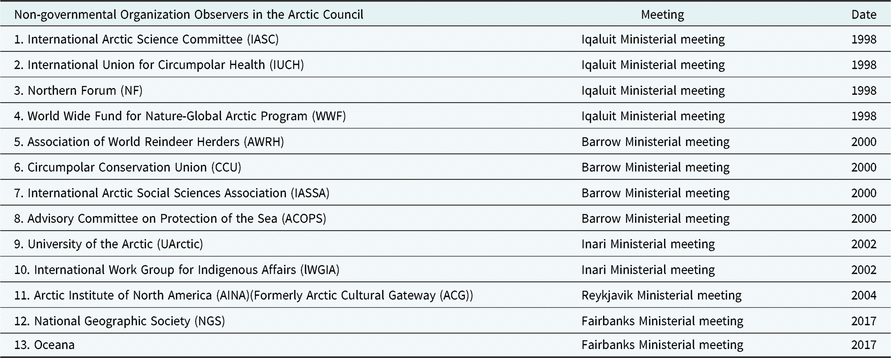
The Arctic Council currently comprises 13 NGO observers (see Table 1), and has been slow to process new applications. In the 2017 Fairbanks Ministerial Meeting, the Arctic states approved the applications for observer status of Oceana and the National Geographic Society (see Arctic Council, 10 July 2017a, b). This was the first time that new NGO observers had been accepted since 2004 (Arctic Council, 2018). The fact that few observers have been accepted is not because of a lack of applications. The Arctic Council has explicit formal criteria for the assessment of new observer applications (Arctic Council, 2013a, b, 2015c). Many applicants can present a sound argument that they meet these criteria. However, the Arctic Council member states are not obliged to accept any new observers. In this manner, the Arctic states maintain near absolute control over access to their forum, and applicants who may appear to meet all of the formal criteria can still have their applications rejected. Meeting the formal criteria for observer status is a necessary requirement for obtaining observer status, but this is seemingly not sufficient on its own. The inference is that the Arctic states are filtering their assessments through informal criteria, and that their perceptions play a role in the evaluation process of NGO applicants.
NGO observers in the Arctic Council

This paper addresses the question of how the NGO observer application process to the Arctic Council is influenced by perceptions of legitimacy of the applicant. We argue that Arctic states have informal criteria for evaluating NGO observer applications, and that the evaluation of these criteria are coloured by individual Arctic states and the Permanent Participants’ perceptions of the legitimacy of the NGO applicant. We develop a framework detailing four key components upon which the perceptions of an NGO are generally formed. These four interrelated components are 1) the repertoire of strategy and tactics it employs; 2) its motivating philosophy; 3) its organisational structure and capacity; and 4) the historical legacy of the organisation in the region. This framework is then incorporated into a broader model of the overall application process for NGO observer status at the Arctic Council. This demonstrates the importance of perceptions of legitimacy, and the role that they play in the overall application process.
NGO observer applications have been chosen as the focus given the paucity of the literature on this subject. While the model herein developed may be partly applicable with respect to applications by states and IGOs, these actors have not been included given notable differences between them and NGOs. Specifically, a greater number of exogenous factors come into play in the evaluation of state and IGO applications; for example, pre-existing bilateral and multilateral relations between Arctic Council member states and applicant states (and IGOs to a lesser extent) complicate the process. Matters of economics and geopolitics become more significant with respect to states (Interviews with Arctic state official 1, 24 September 2018; Arctic state official 2, 24 September 2018; Arctic state official 3, 28 September 2018; Arctic state official 4, 4 October 2018; and Arctic state official 5, 10 October 2018. See Methods and data section below for more information about interviews).
This was substantiated through interviews, with one Arctic state official noting that “we actually try to group the applicants into the categories that the Arctic Council uses.” They elaborated, noting that they considered states first “because it is a political decision to invite a state or not to invite a state. IGOs and NGOs come after that. It doesn’t mean that they are less important for the work of the Arctic Council, but politically, they are less” (Interview with Arctic state official 1, 24 September 2018). Interviewees also noted a difference in capacity between states and NGO applicants, which they take into account when assessing applications. One interviewee explained that,
a state must be willing and able to participate in all the working groups and all the work of the Arctic Council and they must show that they are able and willing. But with an IGO and NGO, you must accept that they are narrower in a way and that you cannot expect that an NGO to participate in all parts of the work as you can sort of demand from a state. (Interview with Arctic state official 2, 24 September 2018)
Arctic Council states often played an active role in the establishment of relevant IGOs, and in some cases, IGO observers are comprised entirely of Arctic States. As a result, the relationship between IGOs and Arctic Council members, and the process by which IGO applications are assessed, are necessarily different from those of an NGO. For example, the observer NEFCO (the Nordic Environment Finance Corporation) was established by and owned by the Nordic states (see Nordic Environment Finance Corporation, n.d.), and the observer NAMMCO (North Atlantic Marine Mammal Commission) is a regional fisheries management organisation comprised of the Faroe Islands, Greenland, Iceland and Norway (North Atlantic Marine Mammal Commission, 2016; and see Arctic Council, 2018).
Methods and data
This paper begins by exploring the literature on legitimacy, reviewing existing literature on Arctic diplomacy, legitimacy and institutions, as well as the role of non-state actors, their influence, and legitimacy in international affairs. The authors drew upon this literature in order to develop a model to explain the assessment process for NGO observer status in the Arctic Council. The model was then triangulated through interviews with people involved in Arctic issues. These interviews were conducted as part of two larger research projects: the first investigating Arctic Council cooperation and diplomacy (conducted in 2016 and 2017), and the second exploring the role of NGO observers in Arctic politics (conducted in 2018). Interviews were selected through the snowballing method (see Tansey, Reference Tansey2007; Robinson Reference Robinson2014). This paper draws upon 90 semi-structured interviews with past and current representatives to the Arctic Council, representatives of the Arctic Council Secretariat, civil servants from the Arctic states who work on Arctic matters, Permanent Participant representatives, as well as academics, think-tank researchers, and NGO representatives working on Arctic issues.
The Arctic community is tightly knit, and in order to maximise disclosure, respondents were given the option of being anonymised to varying degrees. Where required, when citing respondents, descriptors are added in order to provide context and positionality for the quote, while protecting the respondent’s identity. It should be further noted that all five of the ‘Arctic state officials’ interviewed in 2018 come from different Arctic states, and that each spoke from the perspective of their respective state.
Legitimacy and NGO observer membership
With respect to an institution, legitimacy can be seen as “the normative belief by an actor that a rule or institution ought to be obeyed” (Hurd, Reference Hurd1999, p. 381). As Hurd elaborates, legitimacy “is a subjective quality, relational between actor and institution, and defined by the actor’s perception of the institution. The actor’s perception may come from the substance of the rule or from the procedure or source by which it was constituted” (ibid., p. 381). Herein ‘perception’ is the key. Legitimacy is a significant, but intangible state of being, one which actors in international politics strive to achieve. However, it is neither static, nor universal once obtained. Legitimacy is subjective and dependent on perception. The perception of diverse audiences is essential to consider when evaluating the legitimacy of any actor or rule, in order to understand how legitimacy, or the lack thereof, influences practices and decision-making in international politics (Hurd Reference Hurd1999; and see Clark Reference Clark2003).
International fora have increasingly begun to involve a multiplicity of actors, and are becoming multi-level, multi-actor, multi-stakeholder processes (see Auer, Reference Auer2000; Betsill & Bulkeley, Reference Betsill and Bulkeley2004). Given the rise in prominence of non-state actors in the international arena, a considerable literature concerning NGO legitimacy has emerged. NGOs are often seen as key stakeholders with considerable legitimacy, derived from their perceived impartiality/independence, veracity, reliability, representativeness, accountability and transparency (Sikkink, Reference Sikkink, Khagram, Riker and Sikkink2002). On the other hand, NGOs are criticised as not being democratic, accountable, representative or transparent, and in that they may “subvert legitimate avenues of politics,” and “reflect global disparities of influence, particularly a North−South divide” (Sikkink, Reference Sikkink, Khagram, Riker and Sikkink2002 cited by Price, Reference Price2003, p. 590). What is clear is that perceptions of an NGO’s legitimacy vary from actor to actor, and that these perceptions shift and change depending on the venue and over time.
Legitimacy also plays a central role in deliberations surrounding membership into any forum or institution − not just the legitimacy of the prospective member, but also of the venue itself. Legitimacy is mutually reinforcing for members and fora: members can gain legitimacy by joining a forum, and the forum can gain legitimacy from the active participation of prominent actors. Ultimately, legitimacy cannot be assumed, but it is a status that must be conferred by others (Burke, Reference Burkein press).
With regards to the Arctic Council, the presence of observers serves a legitimating function for the Council; equally so, participation in the forum legitimates observers. The legitimacy of the Arctic Council, and by extension the Arctic state members, is increased by the very fact that other actors desire membership in the forum. Here we can invoke the broader literature on status. Like legitimacy, “[s]tatus cannot be attained unilaterally; it must be recognized by others. Status is manifested in voluntary deference directed toward the higher-status actor” (Welsh Larson, Paul, & Wohlforth, Reference Welsh Larson, Paul, Wohlforth, Paul, Welch Larson and Wohlforth2014, p. 10). Therefore, the status of the Arctic Council is elevated as a result of the desire of other actors to join it, and furthermore by the willingness of these other actors to adhere to its strictures on admission and membership (Burke, in press). Observers also add their expertise, insights and perspectives to the workings of the Arctic Council. The Council is therefore likely to be better informed and able to address issues in the region. Increased functionality helps foster legitimacy in the eyes of other actors as well.
From the perspective of NGOs, participation in a high-status international forum helps foster their legitimacy and further increase their status with respect to their peers. For an NGO operating in the Arctic and on Arctic issues, a means of bolstering their legitimacy is through membership and participation in the preeminent forum of the region. Such participation also has the effect of increasing the capacity of that NGO, providing it with access to resources, partners and networks that would otherwise be unattainable. This in turn expands the scope and range of an NGO’s influence, which further legitimates it in the eyes of regional actors and elevates its status with respect to other NGOs working on Arctic issues. In this way, the participation of observer NGOs in the Arctic Council is mutually beneficial.
As a forum rises in prominence, its status attracts the attention of other actors desirous of participation. This is a double-edged sword; on the one hand increased membership reflects the growing status of the forum and its increased legitimacy, but on the other hand swelling membership risks encumbering the functionality of the forum, which by extension could impact its legitimacy and status. As a result, a forum wishing to maintain its status and legitimacy in the face of increased attention must develop a more formalised process of determining membership for new participants. The process of membership application needs to be seen as reasonable to warrant the effort of application. This process must be sufficiently stringent so as to filter high-status and legitimate applicants, and yet not so elaborate as to appear insurmountable.
Shortly after the Arctic Council was formed, it subsumed the Arctic Environmental Protection Strategy (AEPS). As a result, most of the earliest non-state observers, such as the WWF-Global Arctic Program, gained membership without having to go through a formal process the way that recently admitted members, like the National Geographic Society, were required to complete. However, as noted, membership acceptance to a forum can be dynamic; membership requirements can vary over time, reflecting the growing status of the forum and increased desire by outsiders to join. This was the case with the Arctic Council, which adopted formal rules for observer membership 2013 (Arctic Council, 2013a), as explored in the following section.
Formal observer membership process
The Arctic Council was formed in 1996 by the eight Arctic states, and three (later expanded to six) Indigenous Peoples organisations (Arctic Council, 1996, 2015a, b). Pan-Arctic cooperation only became possible with the end of the Cold War and of the Soviet Union, resulting in reduced tension between the Western Arctic states (all NATO members or allies) and Russia (Arnaudo, Reference Arnaudo, Berkman and Vylegzhanin2013). The Arctic Environmental Protection Strategy (AEPS) was the first large-scale pan-Arctic cooperation effort and the predecessor to the Arctic Council (Young, Reference Young2016). The AEPS was established in 1991 with Finland taking a led in its creation, and was followed by the Arctic Council after subsequent negotiations to create an Arctic forum, led by Canada in the early and mid-1990s (Rothwell, Reference Rothwell1995). With the formation of the Arctic Council it was agreed that the AEPS would be absorbed by the new forum after a brief transition period (Young, Reference Young2016). The mandate of the Arctic Council was intended to build on the framework of the AEPS to include sustainable development with “a ‘separate but equal’ theme alongside environmental protection” [Quotes in original text] (Young, Reference Young2016, p. 109).
The formal structure of the Arctic Council comprises three layers of membership: Arctic states, Permanent Participants, and observer members. Of these, the only members of the Arctic Council who have permanent places in the forum are the Arctic states and Permanent Participants. The Permanent Participants negotiated their involvement, and the rules for their integration into the forum, during the initial formation negotiations for the forum. As a result, they are not subject to the same formal and informal criteria for membership as NGO observers.
Burke argues that the Arctic Council is a club, and as such, the admission of new members has been informed by club structures and practices. The core members have arranged their places in the forum in order to ensure their continued status (Burke, Reference Burkein press). Other club members, the observers, are limited members; they are restricted in what they can do and what they can access, and their continued membership is conditional on the ongoing approval of the Arctic states (Arctic Council, 2013b).
Observer membership status in the Arctic Council is set up so that the formal participation of all observers, whether they are states, IGO or NGOs, is equal. Under the forums rules and procedures for participation, no group has greater formalised status or greater opportunities within the forum (Steinberg & Dodds, Reference Steinberg and Dodds2013). Observer membership applications of the three sub-groups are subjected to the same rules, review and assessment process. The same formal application criteria are used as a benchmark by Arctic states and Permanent Participants to evaluate the performance of accepted observers in order to verify ongoing compliance with the rules of forum participation (Arctic Council, 2013a, b).
The formal process by which observers are accepted into the Arctic Council has changed over time, concomitant with increased interest in the region and the higher status of the council. According to one Arctic state official, prior to 2009 all those who applied for observer membership were accepted (Interview with Arctic state official 4, 4 October 2018). The forum needed to adopt increased strictures in order to adapt to an increase in interest and applications during 2007 and 2008, as a result of a number of incidents signalling the changing environment in the region. These incidents included the Russian flag planting at the North Pole (U.S. Geological Survey, 2008), and the development of economic opportunities in the Arctic, such as the 2008 US Geological Survey outlining current and anticipated oil and gas reserves in the region (Burke & Rahbek-Clemmensen, Reference Burke and Rahbek-Clemmensen2017; Faulconbridge, Reference Faulconbridge2007). As a result formal criteria were developed.
The formal criteria upon which observer applications are assessed, also referred to as the ‘Nuuk Criteria,’ were agreed upon in 2011, and are outlined in “Annex 2: To Arctic Council Rules of Procedure” of the 2013 “Arctic Council Rules of Procedure”. The criteria require that a prospective observer:
A. Accepts and supports the objectives of the Arctic Council defined in the Ottawa declaration;
B. Recognizes Arctic States’ sovereignty, sovereign rights and jurisdiction in the Arctic;
C. Recognizes that an extensive legal framework applies to the Arctic Ocean including, notably, the Law of the Sea, and that this framework provides a solid foundation for responsible management of this ocean;
D. Respects the values, interests, culture and traditions of Arctic Indigenous Peoples and other Arctic inhabitants;
E. Has demonstrated a political willingness as well as financial ability to contribute to the work of the Permanent Participants and other Arctic Indigenous Peoples;
F. Has demonstrated their Arctic interests and expertise relevant to the work of the Arctic Council;
G. Has demonstrated a concrete interest and ability to support the work of the Arctic Council, including through partnerships with member states and Permanent Participants bringing Arctic concerns to global decision-making bodies (Arctic Council, 2013a, p.14).
The assessment process occurs at the national level, with states reaching a decision through individual deliberative processes, which vary on a state-by-state basis. This process often draws upon input from representatives on that state’s delegation to the Arctic Council, Indigenous Peoples’ organisations (Permanent Participants from that state, where applicable), various government departments (such as Foreign Affairs/State Department, Natural Resources, Aboriginal Affairs, etc.), and at the executive level (such as the appropriate minister and members of the national leadership). The Arctic Council, as a whole, considers acceptance of new observers at biennial ministerial meetings, where consensus on the part of all eight Arctic states is required.
The Arctic Council has a limited number of formal rules for observers, once they are accepted. The majority of these are structural and procedural, limiting observers’ capacities to operate without the knowledge and approval of the Arctic states, and restricting such things as the degree to which observers can fund projects, and the times that they can speak at meetings (Arctic Council 2013a). The majority of observers’ contributions to the Arctic Council are achieved through their participation in working groups and task forces.
Once membership is granted, a key formal rule is that observers cannot transfer their status to another group (Arctic Council 2013b). Another rule stipulates that observer status “continues for such time as consensus exists amongst Ministers” (Arctic Council, 2013b, p.5). Grounds for the withdrawal of membership exist such that “[a]ny observer that engages in activities which are at odds with the Ottawa Declaration or with the Rules of Procedure will have its status as an observer suspended” (Arctic Council, 2013b, p.5). So far, no observer has had its status revoked, so there is no case to use to evaluate how this formal rule is interpreted in practice. However, the standard by which activities are interpreted to be ‘at odds’ with the mandate and formal rules of the Arctic Council is no doubt a subject of interpretation.
Informal criteria
According to interviews, there are various implicit factors considered by Arctic state representatives when they assess observer applications. Interviewees involved in their respective state review processes noted that from their perspective there have been applicants who met all the formal criteria, but were still not accepted. As such, there must be other factors at play. One respondent noted when asked about the application of the Nuuk Criteria,
you always want to give very rational answers, but …[when] you look at the applicants name and it invokes certain feelings, good or bad. Then you can think, well, and this is just my personal opinion, you cannot really say that you cannot admit this observer because you have a bad feeling about them. Instead you have to have more of a legal or rule-based argument supporting your instinct (Interview with Arctic state official 3, 28 September 2018).
The respondent elaborated, noting that
there are some actors that we have a very good general impression about and there are some that we have the opposite impression about so that sort of feeling or attitude toward the applicant creates a frame or a context for considering the application in a negative or positive way, depending on the impression. The Nuuk Criteria are very useful, and we had them on the desk, and we used them very actively. But for some applicants, if you have a very negative view about them, it doesn’t really matter what criteria you have, and that’s just my personal reflection [on the assessment process]. That’s just how it is. (Interview with Arctic state official 3, 28 September 2018)
In this way, we can see how subjective informal criteria can influence the evaluation process, and how a justification that uses the formal criteria may be developed after a decision has been made based on informal criteria.
The example of Greenpeace is illustrative. Some interviewees, when expounding on the ability of the Arctic states and peoples to collaborate with different states and organisations, compared WWF (an observer) with Greenpeace (an applicant). Many were sceptical as to whether they could work with the latter, noting misgivings as to whether Greenpeace was genuinely open to productively working with them. As one interviewee bluntly stated, “Greenpeace will never get in” (Interview with former senior Arctic Council state representative, 11 May 2016). Another interviewee reflected that “Greenpeace will probably not be a member for the next 25 years” (Interview with Arctic Council state representative, 21 February 2017).
Greenpeace appears to meet all the formal criteria, however as one respondent noted:
the opposition to Greenpeace has nothing to do with their ability or their status or their ability to contribute to the work of the Arctic Council. I think rather that the opposition has to with their sort of work within some of the member states and how they have been fighting with some of the member states’ policies. I think it has to do with that sort of thing. It’s a domestic politics issue. (Interview with Arctic state official 2, 24 September 2018).
Another state representative commented that Greenpeace “has an Arctic profile. That’s true… first you need an Arctic profile and then you have to look at the candidates with the profile” (Interview with Arctic Council state representative, 8 September 2017).
A state official observed, “I don’t think that the member countries have gone through the applications and have come to conclusion that Greenpeace does not meet the [formal] criteria as such” (Interview with Arctic state official 2, 24 September, 2018). However, this has occurred. A different state official noted that in their application Greenpeace had stressed their strong relationships with northerners and respect for their cultures and traditions. However the consultation process within this state, which includes input from stakeholders representing northern peoples, encountered voices which disagreed with Greenpeace’s claims, arguing that it failed to meet criteria D [see above] (Interview with Arctic state official 4, 4 October 2018). In this way, Greenpeace seems to have met many, if not all, of the formal criteria from the perception of some state officials but not others and as one state representative elaborated, there is more than the evaluation of the formal criteria at play: “For us we have no problem to have them [Greenpeace] on board. We think it’s good that they see what we are actually doing…but for others it might be a problem for different reasons” (Interview with Arctic Council state representative, 7 September 2016).
The assessment of the informal criteria can be reduced to a key question: Does the applicant belong in the Arctic Council? As with all the informal criteria, its subjectivity makes this perhaps the most interpretative of the questions, and the one most susceptible to the inherent cultural and political lenses of the Arctic states. Ultimately, all of these factors speak to the perceptions of the legitimacy of the individual applicants on the part of the assessors – does the applicant legitimately belong in the Arctic Council?
Interviews revealed that a host of informal criteria are applied to NGO applicants, that can be distilled down to a basic question: What is the value added by including the member (Interviews with senior Arctic Council state representative, 12 May 2016; and senior Arctic Council state representative, 21 June 2016)? This is a difficult question to answer, as responses are highly subjective. Understanding the existence of this informal criteria can help explain why some Arctic states can support observer applications which arguably fulfil all the formal criteria for observer membership (e.g. the European Union, Greenpeace), while other Arctic states do not.
Other questions were raised in the interviews that alluded to the subjective informal criteria that are used in the consideration of observer applicants. These questions included:
Can we work effectively with the applicant? (Interviews with retired diplomat from an Arctic state, 11 May 2016; former senior Arctic Council state representative, 11 May 2016; Permanent Participant representative, 24 May 2016; and former senior Arctic Council state representative, 29 August 2016).
How has the applicant acted toward us in the past? (From interviews with Senior Arctic Council state representative, 8 September 2017; Permanent Participant representative, 24 May 2016; and Permanent Participant representative, 25 May 2016).
Can we trust the applicant in our forum? (Interviews with Senior Arctic Council state representative, 8 September 2017; former senior Arctic Council state representative, 11 May 2016; Permanent Participant representative, 24 May 2016; and Permanent Participant representative, 25 May 2016).
How actively will the applicant participate in, and support, our work? (Interviews with Senior Arctic Council state representative, 8 September 2017; former senior Arctic Council state representative, 11 May 2016; Permanent Participant representative, 24 May 2016; and senior Arctic Council state representative, 21 June 2016).
Does the applicant belong here? (Interviews with former senior Arctic Council state representative, 11 May 2016; and Permanent Participant representative, 24 May 2016).
These questions emerged in general discussion concerning observers, with the occasional specific reference to the participation of various observers, including by ENGOs.
A large part of the scepticism voiced about Greenpeace stemmed from the second informal criteria: how has the applicant acted toward us in the past? Greenpeace’s campaigning history has included numerous confrontations with one or more of the Arctic states (Interview with Arctic Council state representative, 8 September 2017). Furthermore, from the point of view of many of those interviewed, Greenpeace’s approach toward its campaigns is often seen as problematic to future cooperation (Interviews with Arctic Council state representative, 8 September 2017; Permanent Participant representative, 25 May 2016; and Permanent Participant representative, 5 September 2016). It stands to reason therefore that the answer to the question “can we trust them if we let them into our forum?” with respect to Greenpeace, may very well be “no.” The past experiences of Arctic states with a given applicant matter.
Herein, we begin to see the application of informal criteria influencing the process. This then raises the questions of what are these informal criteria and how do they colour the evaluation process? As previously noted, Arctic states are desirous of determining what value a new observer brings to the Council. Value added is not simply material or mechanistic. True, questions such as ‘how actively will the applicant participate in, and support, our work,’ and ‘can we work effectively with the applicant’ speak to the capacity of an applicant, but the other questions asked speak to the legitimacy of the applicant. For example, the answer to the question ‘can an applicant be trusted in the forum’ is one which necessarily requires a subjective evaluation of the ‘character’ of the applicant – one which touches upon its history with the reviewer, as well as a host of other subjective factors. Questions touching upon whether an applicant ‘belongs in the forum’ necessarily ask whether the applicant is a legitimate actor, worthy of inclusion in the forum, and once granted entry, whether the applicant will acquit themselves in accord with the norms of the forum.
Unpacking NGO legitimacy
A large number of factors contribute to perceptions of legitimacy of any actor, and a number of key factors have been distilled here from the literature: strategy and tactics; motivation and philosophy; structure and capacity; and legacy. There is considerable overlap and interplay between all four of these categories. For example, the strategy and tactics employed by an organisation represents the manifestation of its philosophy, the application of its structure, and a component and continuation of its legacy. The philosophy of an organisation may constrain its use of certain tactics, or influence how it organises itself. Similarly, the structures of many organisations, and the repertoires of action they employ, are often shaped by their histories. Understanding the importance of these four components provides explanatory power as to why some organisations are granted observer status, while others may not.
Strategy, tactics, and legitimacy
What an NGO seeks to achieve, and the methods by which it seeks these ends play a significant role in how it is perceived. Actions put a practitioner into contact, and sometimes conflict, with other actors, thereby influencing how those other actors perceive the practitioner. In this way, the strategy and tactics employed by an NGO influence its perceived legitimacy.
When considering NGO strategies, the literature on NGOs in international relations categorises them in relation to how they interact with institutions (see inter alia Sikkink, Reference Sikkink, della Porta and Tarrow2005; Tarrow & della Porta, Reference Tarrow, della Porta, della Porta and Tarrow2005). Insider strategies are employed within institutions (IGOs, fora, etc.), and often entail NGOs engaging in “highly institutionalized service and advocacy activities” (Tarrow, Reference Tarrow2005, p. 45) they use information and expertise to lobby policymakers (Betsill & Corell, Reference Betsill and Corell2001).
Outsider strategies, by contrast, challenge these institutions, confronting them with protests and boycotts (Tarrow, Reference Tarrow2005). Outsider strategies may also seek to raise awareness of an issue among the public, monitor compliance with agreements, or engage in direct action (Betsill & Corell, Reference Betsill and Corell2001; Eilstrup-Sangiovanni & Phelps Bondaroff, Reference Eilstrup-Sangiovanni and Phelps Bondaroff2014). For an NGO, the decision to adopt an insider or outsider approach will be influenced by the ease of access to an institution, as well as the NGOs perceived efficacy of these strategies, their history, their philosophy, and their structure, all to varying degrees.
In the case of the Arctic Council, the ongoing and consistent application by NGOs for observer status suggests that a large number desire to employ an insider approach. The Arctic Council is a club, whose membership is controlled by the Arctic states, and Permanent Participants (see Burke, in press). The politics within the Arctic Council are necessarily insider politics. This is reinforced by the formal rules governing the behaviour of observers within the forum, and further reinforced by informal rules. For example, when discussing prospective and current observers, interview subjects constantly referred to the WWF, and its participation in the Arctic Council as the ‘gold standard’ of observer participation (Interviews with former high ranking state representative, 11 May 2016; Interview with high ranking state representative, 21 June 2016). When we look at the strategic repertoire of the WWF in the Arctic Council, we see a consummate insider (see Arctic Council, 2016; Hasanat, Reference Hasanat2013, p. 229; Knetch, Reference Knetch, Keil and Knetch2017; interviews with former high ranking state representative, 11 May 2016; former high ranking state representative, 21 June 2016; and former high ranking state representative, 8 September 2017).
The level of contention inherent in the repertoire of an organisation also influences how it is perceived by other actors. As Fassin notes, “the strategies that NGOs and activist groups employ can essentially be seen as somewhere along a continuum with an engagement strategy, with dialogue and persuasion, at one end and a confrontational strategy, with threats and adversary actions, at the other end” (Fassin, Reference Fassin2009, p.511). The perceived legitimacy of an action will vary based on audience. If the target of an engagement strategy perceives this approach as constructive and helpful, they will be more likely to see the strategy and its practitioner as legitimate. On the other hand, a confrontational action may negatively impact the legitimacy of the NGO in the eyes of authorities and decision-makers, despite elevating that same organisation’s legitimacy in the eyes of other audiences (the public or supporters).
Returning to the informal criteria for observer membership of Arctic states, we see an overall preference for NGO observers who employ conventional insider repertoires. When a representative of an Arctic state asks whether they can effectively work with the applicant, or whether or not the applicant belongs in the Arctic Council, they are implicitly inquiring as to whether the prospective NGO observer is likely and able to engage in insider politics, and whether their brand of insider politics is consistent with the political culture of the Arctic Council. The question of how actively an applicant will participate in the work of the forum also speaks to perceptions of the quality and quantity of an NGOs work. When an Arctic state asks whether or not an NGO applicant for observer status can be trusted in the forum, they are in essence asking to what extent they can trust the NGO to adhere to conventional repertoires of action.
Philosophy and motivation
The underlying philosophy or motivations of an organisation directly impact the strategies it employs, the levels of aggression with which it is willing to pursue these strategies, as well as the messaging it adopts, the partnerships it is willing to make, and the structure it forms. The philosophies and motivations of an NGO undergird the history of that organisation, and these can evolve over time. These factors contribute to perceptions of an NGO’s image and legitimacy.
The driving philosophy of an NGO influences the way it interacts with other actors; the level of confrontation inherent to how it executes its strategy, the types of tactics it selects, and ultimately the level to which it is willing to compromise. Some philosophical motivations are more accommodating of compromise than others. In an evaluation of NGO efforts around seal hunting in Eastern Canada, Phelps Bondaroff and Burke (Reference Phelps Bondaroff and Burke2014) elaborated on the impact of the foundational philosophies of various NGOs involved in the campaign against seal hunting, and the extent to which these impacted their involvement in the campaign. Phelps Bondaroff and Burke explored how ENGOs coming from the conservationist tradition were more willing to accept sustainable quotas, left the campaign once the sustainability of seal populations was assured, and generally employed less confrontational approaches (Phelps Bondaroff & Burke, Reference Phelps Bondaroff and Burke2014). ENGOs motivated by preservationism or deep ecology tended to adopt a more abolitionist stance towards seal hunting, persisted in efforts opposing the hunt, and employed more confrontational approaches (Phelps Bondaroff & Burke, Reference Phelps Bondaroff and Burke2014; see also Zelko, Reference Zelko2013). Organisations whose foundational philosophies, such as deep ecology or animal liberationism, lead them to take more inflexible positions are much less able, due to their initial positions, to accommodate compromise. If the life of every seal, or every component of an ecosystem matters equally, then only absolute victory is acceptable (Zelko, Reference Zelko2013). In these cases, not only is compromise unthinkable, but more confrontational strategies and tactics are licensed.
Perceptions of the intransigence of values of an NGO observer are important to Arctic Council states and Permanent Participants. Negotiation and compromise are a hallmark of insider politics. When an Arctic Council member considers whether they can effectively work with an NGO applicant, whether they can trust the applicant in the forum, and ultimately whether the applicant belongs in the forum, they are in part inquiring into the extent to which the philosophy of the NGO allows that NGO to engage in the day-to-day operations of the forum. NGOs that are incapable of compromising, or prone to confrontational repertoires, are less likely to gain observer status in the Arctic Council as compared with more accommodating applicants.
Structure and capacity
The way that an NGO structures itself is essentially a product of the strategy that it wants to execute, the philosophy that motivates it, and its history. There is considerable structural diversity, even between NGOs that employ similar strategies and tactics, and campaign on similar issues. Structure influences how a group is perceived by audiences, the ability of that group to mobilise resources, its capacity to participate in various fora, and ultimately its ability to achieve its desired ends. While this is not the place to engage in a detailed survey of the relationship amongst all of these factors and an organisation’s structure, it is valuable to highlight a number of factors which seem directly relevant to the way in which NGOs are perceived by members of the Arctic Council.
The size of an NGO can be defined by several factors; size can refer to an organisation’s financial resources, the number of staff it employs, its dispersion across various geographic locations, or in the case of mass membership NGOs, the number of members/supporters of the organisation and their distribution. Morss elaborated that a non-state actor is considered a ‘relevant global player’ when “1) its size is considerable, 2) its constituency is substantial and covers several countries, 3) governments and IGOs have granted it (in)formal access to political arenas and 4) it has shown that it is consequential to international politics” (Morss, Reference Morss1991; see also Arts, Reference Arts2003−2004, p. 5). Larger NGOs may appear to have greater international legitimacy as the amount of money they can fundraise, the number of supporters on their rolls, and their geographic scope, all speak to their ability to mobilise resources. Simply put, large organisations appear to be able to achieve more, which puts them in a position to be more successful than smaller organisations (see for example Arts Reference Arts2003−2004).
The ability to achieve outcomes is an important component of NGO legitimacy, what Logister describes as ‘effective legitimacy.’ This is “legitimacy derived from an organisation’s effectiveness and expertise as demonstrated by the quality of its work or ability to achieve the intended results” (Logister, Reference Logister2007, p. 172). When Arctic states inquire as to what value the inclusion of a new observer brings to the Arctic Council, and as to how actively that observer will participate in, and support the work of, the Council, they are in part inquiring as to the overall efficacy of that applicant. Arctic states are looking for observer NGOs that will help them achieve outcomes.
Professional staff and well-managed organisational structures are a consequence and a requirement of an NGO operating at the transnational level and participating in international fora (Jasanoff, Reference Jasanoff1997). Perceptions of professionalism are audience specific. Qualified diplomats and other international officials have high expectations of professionalism of those participating in international fora. Within the Arctic Council, professional and well-organised NGOs have the potential to add value to meetings, actively participate in forum work, and in short, work effectively within the forum. Professional diplomats and civil servants who serve as representatives at the Arctic Council are more likely to be comfortable working with NGO representatives who are perceived as professional. Those trained to participate in international fora have at least some shared experience upon which to build trust and good working relationships. Professionals working for well-organised NGOs, and the NGOs themselves, are less likely to engage in actions that might jeopardise these types of relationships and trust. It is of little surprise, therefore, that international diplomats and functionaries who staff Arctic Council delegations should feel as though the observer NGOs that most belong in the forum are those who resemble themselves.
Legacy
The factors that contribute to perceptions of NGO legitimacy must not only be considered in the present, but also in a historic context. The impact that the history of an NGO has on its perceived legitimacy speaks to the concept of ‘reputational capital.’ Reputational capital is “the potential of using one’s ‘brand name’ or ‘logo’ to acquire resources and/or political influence” (Candler & Dumon, Reference Candler and Dumon2010, p. 266). It is the “public image and credibility” of an actor, which is established through the gradual accretion over the course of an organisation’s history (Kearns, Reference Kearns1994). The power of NGO branding allows an NGO to “apply that reputational capital to yielding streams of income,” and to achieving other objectives (Candler & Dumon, Reference Candler and Dumon2010). While reputational capital can be increased with positive accomplishments, it can also be reduced as a result of scandal (Gibelman & Gelman, Reference Gibelman and Gelman2001). Reputational capital is audience-dependent, and this again speaks to the importance of history and change. An NGO that successfully embarrasses a government through clever image events can accumulate significant reputational capital in the eyes of one audience (supporters for example), while simultaneously lowering its reputational capital in the eyes of that state. This can become significant if the NGO decides to change its approach and audience in the future.
In evaluating the collaborative potential between NGOs involved in the campaigns against seal and whale hunting and various other actors in the Arctic, the present researchers detailed how the legacy of an NGO is significant (Phelps Bondaroff & Burke, Reference Phelps Bondaroff and Burke2014). It was found that NGOs who employed confrontational repertoires, had intractable positions, and who remained active in the campaign past the point where the sustainability of seal populations was assured, continued to earn the animus of actors in the Arctic and sub-Arctic. As noted in the same article, “one lesson learned from the anti-sealing movement is that NGOs…should consider the implications that one form of campaign messaging can have on other, non-targeted, audiences,” and that “some campaign tactics which make significant gains in achieving results in a single campaign can have implications for future collaboration and potential alliances, ultimately shaping the political opportunity structure which activists will encounter in future campaigns” (Phelps Bondaroff & Burke, Reference Phelps Bondaroff and Burke2014, p. 165−166). Overall, we concluded that NGOs “must also be mindful of the legacies of previous campaigns” (Phelps Bondaroff & Burke, Reference Phelps Bondaroff and Burke2014, p. 165−166).
Important pieces of informal evaluation criteria used by Arctic states are considerations of whether or not the NGO observer applicant can be trusted, and how the applicant has behaved towards the forum and its members in the past. The role of legacy in how an NGO is perceived speaks to both of these criteria. The past experience of Arctic states with a given applicant matters. Representatives and states use past experience to inform their perception of an applicant and as a predictor of future behaviour in the forum. Consistency is important in establishing trust. The legacy of an NGO in the region provides a history from which predictors can be derived.
Process of NGO observer membership
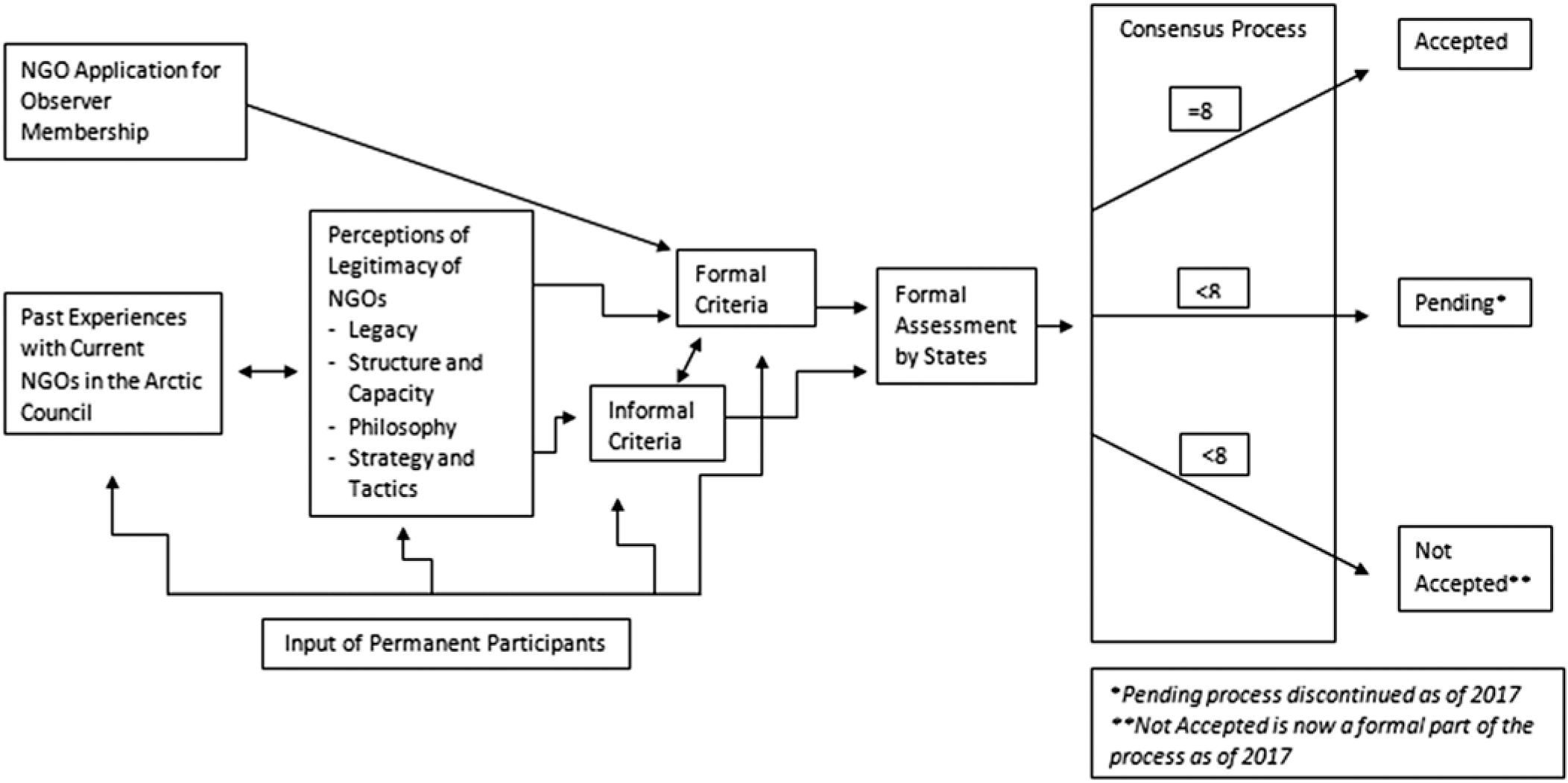
As noted, there are formal and informal criteria by which an NGO observer application is assessed. The perceived legitimacy of an NGO observer applicant is also a key factor in the assessment process of applications. Furthermore, audience matters; there are different audiences even within the Arctic Council – the perceptions of Permanent Participants also heavily influence this process (Interviews with Arctic state official 4, 4 October 2018; and Arctic state official 5, 10 October 2018). This paper seeks to bring clarity to this process, through the development of a model. The model (Fig. 1) seeks to illustrate the various inputs and processes that influence the evaluation of an NGO application:
Straight arrows represent overt impact – where the decision-making process is publicly visible and formally articulated. For example, a statement from the Arctic Council announcing the admission of a new observer.
Uneven arrows indicate influence, reflecting more subtle and varied influences. For example, different Arctic states seeking and incorporating the input of Permanent Participants in their decision-making.
Bi-directional arrows represent cyclical and self-reinforcing processes; perceptions of legitimacy impact how past experiences are considered and which past experiences are elevated to prominence, and vice versa. Positive elements from an organisation’s past are more likely to be highlighted if they are perceived as legitimate, thereby reinforcing that legitimacy.
Model of process of NGO observer membership assessment by an Arctic State.

The process begins with an NGO applying to be an observer, and ends with a number of outcomes. The Arctic Council operates on a consensus basis, all eight Arctic states must agree to new observers. This is reflected in the model by the straight arrows flowing from the initial application, through the formal criteria, leading to the formal assessment process conducted by each individual state. A successful applicant receiving consensus from all Arctic states will be ‘accepted.’ Prior to 2017, applications could be classified as ‘pending’, which applied to those that had not yet received consensus, or those that the Arctic states had not yet evaluated. Because the admission of new state observers is ‘political’ their applications have often been prioritised. Applications that were not considered during a meeting were deferred to future meetings, and could remain in limbo for indeterminate amounts of time. During the Finnish chairmanship in 2017, the ‘pending’ classification was discontinued and the practice of classifying applications as ‘not accepted,’ was adopted. As part of this process, applicants who are not accepted are contacted and informed of the outcome, and informed that if they wish to be considered in the future, they must submit a new application (Interviews with Arctic state official 1, 24 September 2018; Arctic state official 2, 24 September 2018; Arctic state official 3, 28 September 2018; Arctic state official 4, 4 October 2018; and Arctic state official 5, 10 October 2018).
There are a number of factors that influence the formal application review process. While the Arctic states are the only group within the Arctic Council with formal decision-making power, the Permanent Participants also influence decision-making at all stages of the process. As a result, the status of Arctic peoples and their ability to influence Arctic governance is strengthened and imbues the entire process. Permanent Participants help to legitimise the status and work of the Arctic Council (Interviews with Arctic state official 4, 4 October 2018; and Arctic state official 5, 10 October 2018). It is also important to note that while Permanent Participants have influence on the process, their capacity to influence it is limited by both the formal rules of consensus decision-making and by the degree to which they have influence within Arctic member states. For example, the ICC in Canada has more relative influence as compared to RAIPON in Russia (see Josefsen, Reference Josefsen2010; Shadian, Reference Shadian2010; Wallace, Reference Wallace2013).
There is considerable interplay between the formal and informal criteria, which is captured in the model; informal rules serve as a lens through which the formal rules are applied, and inform the creation of the formal rules themselves. The formal rules create a structure through which informal rules are articulated. In other words, it may not be politic to cite informal criteria as the basis for a decision, so the position of an Arctic state is reframed within the structure of the formal criteria (Interview with Arctic state official 3, 28 September 2018). Given the interplay between the two, such a practice is relatively straightforward. It must also be noted that both the formal and informal criteria are influenced by the agendas and interests of the various Permanent Participants.
While the formal and informal criteria exert influence on one another, this does not explain the initial source of either. Moving from this stage of the model, we posit that the origins of both criteria are influenced by the overall perceptions of NGO legitimacy. With all observers, perceptions of the legitimacy matter, but it matters disproportionately more in the evaluation of NGO applications. The four components of legitimacy explored above are therefore incorporated into the model.
Finally, perceptions of legitimacy of individual NGO applicants, on the part of Arctic member states and Permanent Participants, are filtered through past experience with current NGOs observers. These extant working relationships impact how the Arctic members conceptualise the role of an NGO observer in the Arctic Council. Interviews found that many state representatives have an archetype, notably the WWF, and their perceptions of this organisation, its legitimacy and overall approach to participating in the Arctic Council are often seen as the gold standard against which other NGO observers and NGO observer applicants are compared (Interviews with former high ranking state representative, 11 May 2016; and high ranking state representative, 21 June 2016). In the opinion of one former high-ranking state representative:
I think the WWF, for instance, is very engaged in the working groups, at that level, they actively participate in the meetings. They bring scientific [evidence and expertise] to bear on issues to effect policy actions and isn’t that more effective than going out and demonstrating? But they are not always happy with decisions of the Arctic Council and they make that more known through publications and op-eds; they don’t go out and chain themselves to a fence. The people I’ve seen in action are very good. They are PhD level scientists (Interview with retired high-ranking Arctic official, 11 May 2016).
Past experiences with current NGO observers clearly impact the way in which Arctic Council representatives perceive the legitimacy of NGO applicants.
As our model illustrates, the NGO observer application process is complex. Much like an iceberg, the greater part of the process is unseen. NGO applicants are only confronted by the implicit and subjective elements of the evaluation process once their application has already been tendered. As such, their capacity to adapt to meet these criteria is extremely limited, as many perceptions concerning their legitimacy have already been formed. In this way, the Arctic states are able to employ a flexible and subjective process that allows them to maintain the exclusivity of their club, and ensure that participants are willing to adhere to its organisational norms. While this process does not mean only admitting observers who agree with them, the states’ approach has the added benefit of ensuring a smoother operation of the forum and its work, which ultimately helps maintain the legitimacy of the Council itself.
Conclusion
As demonstrated, there are a series of formal and informal criteria, which NGO applicants must meet in order to gain observer status within the Arctic Council. As our model illustrates, these criteria are heavily influenced by a number of other factors, most notably, perceptions of the legitimacy of the individual applicants, as well as past experience with current NGO observers in the forum and input from Permanent Participants. This is significant as it helps foster our understanding as to the kinds of observers who are likely to be accepted through this process. This suggests further research whereby the model can be tested through the analysis of current and prospective NGO observers. This model can help inform prospective members as to the tacit factors which influence the evaluation of their applications, and as such can assist them in making the necessary adjustment to their approach to operating in the region, in order to maximise the likelihood of their application being successful.
In addition, the framework of perceptions of legitimacy of individual NGO observer applicants illuminates how the Arctic states and Permanent Participants develop their perceptions of NGO observers. It also assists NGOs in understanding how their legitimacy may be perceived by diverse audiences, and how these perceptions may impact potential for collaboration. A broader lesson to be learned is the importance of considering the impact that actions will have on multiple audiences, even those not directly targeted in any specific campaign. NGOs wishing to have agency in how their image is perceived by various audiences should be aware of the importance of strategy and tactics, philosophy and motivation, structure and capacity, and legacy on their perceived legitimacy.
The Arctic Council offers a unique opportunity to study how the legitimacy of various actors is perceived. As we have seen, the Arctic Council has the same formal criteria for all three categories of observers (states, IGOs and NGOs), and it also appears as though the informal criteria employed are the same for these observers as well. This, then, suggests that the principal difference between how these actors are evaluated is down to different conceptualisations of legitimacy. This, therefore, offers a ripe area for further research, with the promise of such investigations shedding light on the concept of legitimacy in international relations more broadly.
Acknowledgements
This project has received funding from the European Union’s Horizon 2020 research and innovation programme under the Marie Skłodowska-Curie grant agreement No 746312 held by Danita Catherine Burke (March 2018-2020) and from the Carlsberg Foundation as part the Distinguished Postdoctoral Research Fellowship (Project Number: CF15-0434) held by Danita Catherine Burke (February 2016−2018). Additionally, thanks go to the interviewees who inspired this paper; to Danita Catherine Burke’s host institution, the Centre for War Studies at the University of Southern Denmark; to the support of The Idea Tree Consulting; to the School of Political Science at the University of Ottawa and the Department of Political and Economic Studies at the University of Helsinki who hosted Danita Catherine Burke as a visiting scholar during the research of this piece in 2016; to the School of Politics, Philosophy, International Relations and Environment at Keele University for hosting both authors as visiting scholars during the research and writing of this article in 2018. Finally thanks are due to Brian Doherty, David Scrivener and Vincent Keating for their assistance in the completion of this article.