Paediatric heart failure represents an important cause of morbidity and mortality in childhood. Aetiology and pathogenesis are different between adults and children. In children, heart failure is commonly due to structural heart disease and reversible conditions, thus lending it amenable to definitive therapy. Despite differences with regard to the aetiology of paediatric and adult heart failure with systolic dysfunction, there is overlap in the pathophysiology and clinical management of the two diseases. Although the epidemiology and management of adult heart failure have been extensively studied, the prevalence and management of paediatric heart failure are not well characterised. This article offers an overview on the aetiology and pathophysiology of paediatric heart failure with a specific focus on management of ambulatory paediatric heart failure patients who remain symptomatic despite standard of care and the role of the combined therapy with angiotensin receptor antagonist Valsartan and neprilysin inhibitor Sacubitril.
Definition of paediatric heart failure
Heart failure describes the inability of the heart to meet the haemodynamic needs of the body. Paediatric heart failure can represent a wide range of abnormalities in cardiac structure and function, both congenital and acquired, and can present as systolic/diastolic dysfunction or both. The International Society for Heart and Lung Transplantation defines paediatric heart failure as a clinical and pathologic syndrome that results from ventricular dysfunction, volume, or pressure overload, alone or in combination. In children, it leads to characteristic signs and symptoms, such as poor growth, feeding difficulties, respiratory distress, exercise intolerance, and fatigue, and is associated with circulatory, neurohormonal, and molecular abnormalities.Reference Kirk, Dipchand and Rosenthal 1
Aetiology and prevalence of paediatric heart failure
The clinical course, outcome, and aetiology of paediatric heart failure is more heterogeneous than in the adult population. The greatest percentage of children with heart failure comes from those born with CHD; depending upon age, 25–75% of paediatric heart failure patients have underlying CHD.Reference Rosenthal, Chrisant and Edens 2 The other main cause of paediatric heart failure is cardiomyopathy, with an estimated annual incidence of 1/100,000 children in the United States, Australia, United Kingdom, and Ireland.Reference Lipshultz, Sleeper and Towbin 3 – Reference Andrew, Fenton, Ridout and Burch 5 Of the patients listed for heart transplantation, according to the International Society of Heart and Lung Transplant paediatric registry report, idiopathic dilated cardiomyopathy is the most common cardiomyopathic diagnosis in children (66%).Reference Dipchand, Kirk and Edwards 6 In the current era, however, we must consider more granular diagnoses as genetic testing has become both more prevalent and specific. Systolic dysfunction, as in dilated cardiomyopathy, is associated with muscular dystrophies such as Duchenne’s muscular dystrophy, myotonic dystrophy, and multiple other neuromuscular diseases. Chemotherapy (e.g. anthracycline)-induced cardiac disease often presents as acute systolic dysfunction and may progress to true chronic dilated cardiomyopathy. In developing countries, rheumatic heart disease, nutritional deficiencies, and other tropical diseases, such as Chagas disease, provide the aetiology of paediatric heart failure and cardiomyopathy .Reference Rossano and Shaddy 7
Pathophysiology of paediatric heart failure and potential role of Sacubitril/Valsartan
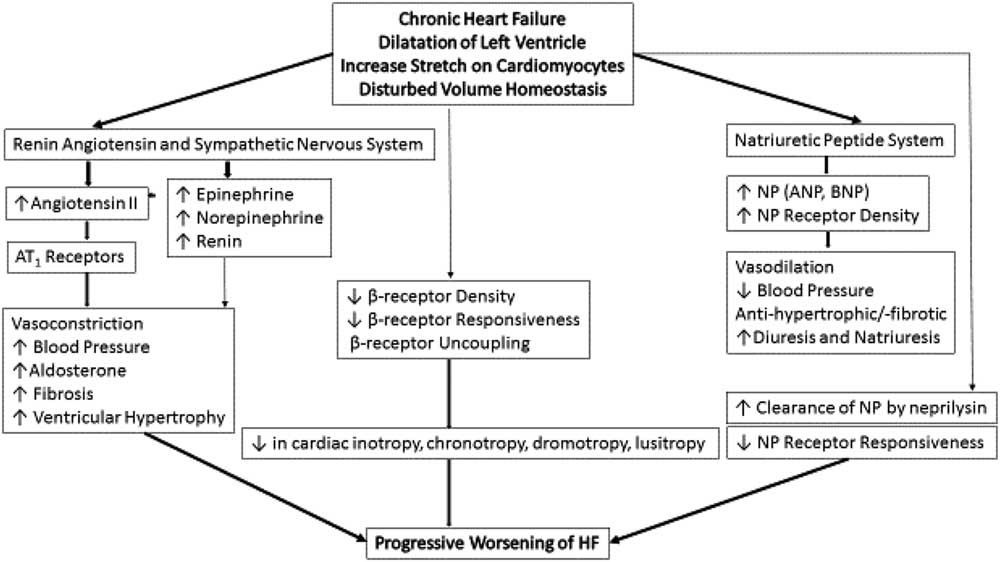
In heart failure, low cardiac output leads to reduced baroreceptor stimulation, resulting in the activation of the sympathetic nervous system, which increases heart rate, cardiac contractility, and vasoconstriction to restore the blood pressure towards normal. The activation of the sympathetic nervous system also includes the release of renin, leading to production of angiotensin II, which in turn causes vasoconstriction of renal afferent arterioles, as well as release of aldosterone, which causes an increase in sodium reabsorption. When the renin–angiotensin–aldosterone system activation is undeterred, vasoconstriction (increased afterload) leads to a substantial increase in cardiac work and myocardial oxygen consumption. At the cellular level, the compensatory gain in cardiac excitation–contraction coupling mediated by sympathetic stimulation ultimately becomes unsuccessful, as the sustained leak of calcium from the sarcoplasmic reticulum leads to depletion of intracellular calcium and ultimately impaired contractility.Reference Sipido and Eisner 8 , Reference Scoote, Poole-Wilson and Williams 9 Unfortunately, the deleterious effects predominate over the long term, leading to pathologic myocardial remodelling, and more rapid progression of myocardial dysfunction (Fig 1).
Pathophysiology of progression of heart failure. ANP=atrial natriuretic peptide; BNP=B-type natriuretic peptide; NP=natriuretic peptide.

The ability of angiotensin-converting enzyme inhibitor/angiotensin receptor antagonist, aldosterone antagonists, and β-blockers to improve survival and slow the progression of heart failure is compatible with this hypothesis.Reference Kantor, Lougheed and Dancea 10 However, despite the use of the above chronic heart failure medications, patients remain at risk of worsening heart failure.Reference Krum, Shi and Pitt 11 Progression of abnormal cardiac remodelling with continued elevation of angiotensin II, aldosterone, anti-diuretic hormone, and sympathetic nervous system activation all impair the function of endogenous neuropeptides such as natriuretic peptides, bradykinin, and adrenomedullin. Natriuretic peptides are coupled to, and activate, guanyl cyclase A, which increases the intracellular concentrations of the second messenger, cyclic guanosine monophosphate. The latter, in turn, activates protein kinase G, leading to vasorelaxation, natriuresis, and diuresis. Atrial natriuretic peptide and B-type natriuretic peptide also inhibit renin secretion and aldosterone production and attenuate cardiac and vascular remodelling, apoptosis, ventricular hypertrophy, and fibrosis.Reference Das and Solinger 12 Adrenomedullin has been shown to reduce myocyte hypertrophy, fibroblast proliferation, collagen synthesis, and aldosterone secretion.Reference Nagaya, Satoh and Nishikimi 13
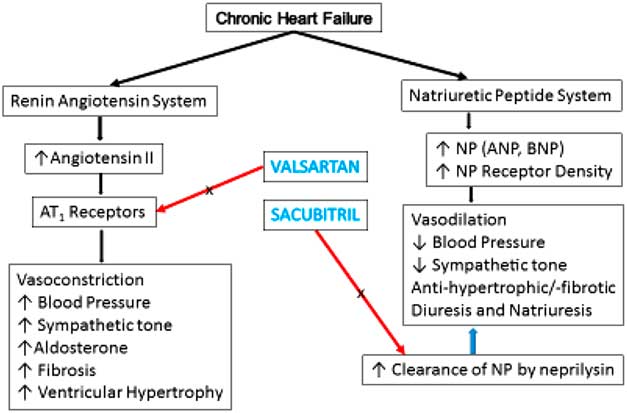
Neprilysin is the key enzyme responsible for the breakdown of neuropeptides. The neprilysin level is increased in chronic heart failure, and thus the clearance of these neuropeptides is accelerated.Reference Knecht, Pagel and Langenickel 14 Inhibition of neprilysin enhances the effects of endogenous natriuretic peptides – atrial natriuretic peptide, bradykinin, and adrenomedullin – which exerts vasodilation, anti-hypertrophic/anti-fibrotic action mitigating the detrimental effects of angiotensin, endothelin, and aldosterone (Fig 2).
Mode of action of Sacubitril and Valsartan. ANP=atrial natriuretic peptide; BNP=B-type natriuretic peptide; NP=natriuretic peptide.

The effect of inhibition of neprilysin on the level of B-type natriuretic peptide is minimal as B-type natriuretic peptide is cleared from the circulation mainly by neuropeptide receptors,Reference Braunwald 15 making this a useful biomarker to measure and track, as a decrease in B-type natriuretic peptide may then be attributable to improved heart failure and not a drug effect. Concomitant inhibition of angiotensin synthesis or action is particularly important, because neprilysin inhibition alone is accompanied by activation of the renin–angiotensin–aldosterone system, possibly because angiotensin itself may be a substrate for neprilysin.Reference Goldsmith 16 Although the actions of angiotensin may be attenuated by angiotensin-converting enzyme inhibitor, simultaneous blockade of angiotensin-converting enzyme and neprilysin can lead to serious angioedema. This has been shown by Omapatrilat versus Enalapril Randomized Trial of Utility in Reducing Events trial.Reference Packer, Califf and Konstam 17 Omapatrilat is a drug that inhibits angiotensin-converting enzyme, neprilysin, and aminopeptidase P and causes significant angioedema. The preferred approach may be to parallel modulation of the neuroendocrine system by the combined use of a neprilysin inhibitor while simultaneously blocking effects of angiotensin action by an angiotensin receptor blocker.
The major pharmacodynamics action of angiotensin-converting enzyme inhibitor is mediated by reversible binding to plasma angiotensin-converting enzyme, resulting in competitive inhibition of the conversion of angiotensin I to angiotensin II. Angiotensin-converting enzyme inhibitor also blunts sympathetic stimulation and activates the parasympathetic system. The net haemodynamic effect of angiotensin-converting enzyme inhibitor is reduction in total peripheral resistance and blood pressure, without change in heart rate or fluid retention. The effect of angiotensin receptor antagonist in heart failure is similar to that of angiotensin-converting enzyme inhibitor. Valsartan, an angiotensin receptor blocker, which is a component of Sacubitril/Valsartan, has been shown to improve outcomes in adults hospitalised for heart failure.Reference Cohn and Tognoni 18 Typically, when blockade of the renin–angiotensin–aldosterone system is desired, it is a common clinical practice in adult heart failure patients to begin with angiotensin-converting enzyme inhibitor and switch to an angiotensin receptor blocker in patients who are intolerant. Because angiotensin receptor blockers do not block the degradation of kinins, angioedema and persistent cough are uncommon. The combination of Valsartan and Sacubitril may be more effective than angiotensin-converting enzyme inhibitor or angiotensin receptor blocker alone because of incremental benefits of neprilysin inhibition in heart failure.Reference McMurray, Packer and Desai 19
The augmentation of endogenous neuropeptides could help to broaden the benefits of renin–angiotensin system inhibitors for patients with heart failure.Reference Desai, McMurray and Milton 20 It is possible that neprilysin inhibition may have additional benefits including improved haemodynamics, reduced ventricular wall stress, myocardial fibrosis, ventricular hypertrophy, and attenuation of progressive ventricular remodelling.Reference Desai, McMurray and Milton 20 Further, neprilysin inhibition of sympathetic drive or potentiation of vagotropic effects and the benefits of enhanced vagal tone in heart failure are well documented, although just coming to prominence as an effective line of therapy.
Management of paediatric heart failure
The goal of acute heart failure management in children is to improve haemodynamics and prevent progression. Current management includes stabilisation with intravenous inotropes/vasopressors, mechanical ventilation, treatment of arrhythmia, and progression to mechanical support if needed. Should some recovery occur, the child is often left with chronic heart failure and the lingering diagnosis of dilated cardiomyopathy, with or without a genetic-based or syndrome/systemic disease-based diagnosis. The goal of clinical management of the chronic paediatric heart failure is to maintain stability, prevent progression, and provide a reasonable milieu to allow somatic growth and optimal development. Despite the lack of sufficient randomised prospective studies, current treatment typically includes some combination of angiotensin-converting enzyme inhibitors, β-blockers, diuretics, aldosterone-blocking agents, and anti-coagulants; digoxin is no longer typically used, and angiotensin receptor blockers enjoy only a small audience in paediatric heart failure management.
When deciding on a maintenance regimen for the treatment of paediatric heart failure, the two most often relied upon factors include efficacy shown in adult heart failure trials, and paediatric consensus statements and guidelines.Reference Kirk, Dipchand and Rosenthal 1 Although the management of paediatric heart failure has been extrapolated from adult trials, there are significant barriers in applying adult data to children because of developmental factors, age variation from birth to adolescence, differences in aetiology and disease progression, and differences in genetic expression profileReference Patel, Mohan and Schneider 21 and β-adrenergic signalling.Reference Miyamoto, Stauffer and Nakuno 22 Specifically, downregulation of β1- and β2-adrenergic receptors is identified in children, whereas β2-adrenergic receptor expression is maintained in adults.Reference Miyamoto, Stauffer and Nakuno 22 There are also differences in phosphorylation status of phospholambanReference Miyamoto, Stauffer and Nakuno 22 and expression of phosphodiesterase isoformsReference Nakano, Sucharov and van Dusen 23 in children versus adults.Reference Nakano, Sucharov and van Dusen 23
The landmark carvedilol study, a randomised controlled trial in paediatric heart failure published in 2007, did not meet its composite primary end-point measure of heart failure outcomes. This study, however, was underpowered (n=161), and included the full range of children – from infancy to 18 years of age – with CHD, including single-ventricle patients with failing systemic right ventricle, as well as patients with normal cardiac anatomy and systolic left ventricular failure.Reference Shaddy, Boucek and Hsu 24 The complexity of designing an effective paediatric heart failure drug trial, as well as interpreting the results, is evident in this valiant effort.
Many children with severe heart failure, progressive disease, and unremitting symptoms are listed for heart transplant, if available; however, cardiac transplantation is a last resort, given the limited availability of donor organs, complicated management, and associated morbidity or mortality.Reference Almond, Thiagrajan and Piercey 25 Although wait-list mortality is less than the transplantation rate (17 versus 63%), and the number of children receiving heart transplant for all diagnoses is about 600 patients yearly world-wide, 26 we do not know how many children, who are not listed for transplant and have no access to these services, die of heart failure each year. Regardless of the number, it is too many. Ultimately what is needed is a readily available, affordable, easily administered, and safe therapy that will stall the progression of heart failure indefinitely, concomitantly allowing reasonably normal growth and development. It is possible that the combination of Sacubitril and Valsartan may meet at some of these criteria.
The efficacy of Sacubitril/Valsartan, over the standard of care angiotensin-converting enzyme inhibitor (Enalapril) for reducing mortality and morbidity in adult heart failure with reduced left ventricle ejection fraction, provides strong rationale that may have clinically meaningful benefits for paediatric heart failure patients.Reference McMurray, Packer and Desai 19
Lessons learned from adult heart failure trials
The Prospective comparison of angiotensin receptor antagonist (Valsartan) and neprilysin inhibitor (Sacubitril) with angiotensin converting enzyme inhibitor (Enalapril) to determine impact on Global Mortality and Morbidity in Heart Failure (PARADIGM-HF) trial was conducted in adult patients with heart failure from 2009 through 2014 and included 8399 patients in 47 countries. The results of the trial have shown that the Sacubitril/Valsartan is superior to enalapril in reducing the risks of both sudden cardiac death and death from worsening heart failure; it is also shown to reduce the risk of hospitalisation and progression of heart failure.Reference McMurray, Packer and Desai 19 , Reference Desai, McMurray and Milton 20 , Reference Packer, McMurray and Desai 27 The PARADIGM-HF trial has also demonstrated that when patients with an estimated glomerular filtration rate <30 ml/min were excluded, fewer patients on Sacubitril/Valsartan developed a serum creatinine level≥2.5 mg/dl (n=139, 3.3%) than did patients on Enalapril (n=188, 4.5%; p=0.007).Reference McMurray, Packer and Desai 19 This suggests that Sacubitril/Valsartan may be superior to angiotensin-converting enzyme inhibitor or angiotensin receptor blocker on renal function. Furthermore, because heart failure is a common, serious complication in patients with end-stage renal disease, Sacubitril/Valsartan might delay the progression of both conditions.
The remarkable success of PARADIGM-HF trial led to a recent ongoing clinical trial, Prospective Comparison of Sacubitril/Valsartan with angiotensin receptor blocker Global Outcome in heart failure with Preserved Ejection Fraction trial, which has begun to enroll 4300 adult heart failure patients with left ventricle ejection fraction >45% to study the superiority of Sacubitril/Valsartan over Valsartan.Reference Solomon, Rizkala and Gong 28 This trial may provide a major breakthrough for the treatment of adults with heart failure with preserved ejection fraction, and subsequent trial in paediatrics may be warranted in future. In a previous study, Ruilope et alReference Ruilope, Dukat and Bohm 29 have demonstrated the superiority of Sacubitril/Valsartan as once-daily doses in adults with hypertension over enalapril.
The adult target dose for Sacubitril/Valsartan was 200 mg twice daily, which is equivalent to 3.1 mg/kg twice daily for children. The adult study demonstrated that Sacubitril/Valsartan was well tolerated; although patients receiving Sacubitril/Valsartan had more episodes of symptomatic hypotension compared with Enalapril, there was no increased rate of discontinuation of therapy. In addition, the incidence of renal failure was less common than for Enalapril during the duration of treatment (median follow-up of 27 months), and there was no increase in the incidence of angioedema. Overall, adverse events were common in the Enalapril group compared with Sacubitril/Valsartan.
On the basis of these favourable data and outcomes obtained in the PARADIGM-HF trial, the Food and Drug Administration fast-tracked the Sacubitril/Valsartan for approval in 2015, and it became the class I recommendation for use in adult heart failure patients in 2016 by both United States and European union heart failure guidelines – less than a year after regulatory approval. In the European Union, the 2016 ESC Guidelines for the diagnosis and Treatment of Acute and Chronic Heart Failure, Sacubitril/Valsartan got a recommendation I B, which signifies class I “strong” (is recommended) and level of evidence B “moderate quality”; these data were derived from one single trial.Reference Ponikowski, Voors and Anker 30 In the 2017 ACC/AHA Focused Update on New Pharmacological Therapy for Heart Failure: An Update of the 2013 AHA Guidelines for the Management of Heart Failure, Sacubitril/Valsartan also received a class I B recommendation.Reference Yancy, Jessup and Bozkurt 31 Therefore, Sacubitril/Valsartan is recommended as an angiotensin-converting enzyme inhibitor replacement to further reduce the risk of heart failure hospitalisation and death in ambulatory patients with heart failure and reduced left ventricle systolic function who remain symptomatic despite optimal treatment with angiotensin-converting enzyme inhibitor, a β-blocker, and aldosterone antagonist.
The combination therapy of neurohormonal modulation and angiotensin inhibition may well represent a new era of hope for children with heart failure. The current paediatric multicentre trial (PANORAMA-HF study, NCT00382525) will similarly examine whether Sacubitril/Valsartan is superior to Enalapril for the treatment of heart failure in children with reduced systemic left ventricle systolic function. The details of the design of the trial has been recently published, and notably the study population is quite homogeneous, including only patients with reduced left ventricle systolic function.Reference Shaddy, Canter and Halnon 32 The target N is 180 patients in each treatment group – Enalapril versus Sacubitril/Valsartan – and, although far from the vast populations studied in adult heart failure trials, is expected to provide adequate power to detect a meaningful difference in an event-driven end point (primary global rank end point). The results from this study may change the clinical practice of our current chronic heart failure treatment in children.
Conclusion
A judicious balance between extrapolation from adult heart failure guidelines and the development of child-specific data on treatment represents a wise approach to optimise management of paediatric heart failure. The successful completion of the PANAROMA-HF study will inform and facilitate paediatric access to Sacubitril/Valsartan, a novel treatment and hope for children with heart failure.
Acknowledgements
We are thankful to Candice Sareli, MD, Office of Human Research, Memorial Healthcare System for her critical review of the manuscript.
Financial Support
This research received no specific grant from any funding agency or from commercial or not-for-profit sectors.
Conflicts of Interest
The authors have no conflicts of interest to disclose.