By contrast to the wealth of theoretical literature on terrorism and violent extremism (e.g., Helmus, York, & Chalk, Reference Helmus, York and Chalk2013), there is a dearth of primary research on this topic. As Victoroff (Reference Victoroff2005) explains, conducting research in this domain can be resource-intensive (e.g., involving fieldwork), potentially dangerous, ethically problematic, and may involve language barriers. In addition, officials may act as gatekeepers for gaining access to incarcerated samples, while active or inactive offenders may have little motivation to be involved in academic research. Thus, policy-makers have had to design and implement counter-terrorism strategies lacking in a sufficient and relevant evidence-base (Dhami, Reference Dhami, Cole and Pantucci2014). It is no surprise that consecutive governments, internationally, have found it difficult to effectively prevent violent extremism and intervene as necessary (Lum, Kennedy, & Shirley, Reference Lum, Kennedy and Shirley2006). The terrorist threat remains real and high.
In the present paper we suggest that understanding how people perceive the pros and cons of violent extremism represents a first step in developing theoretically-guided research that aims to explain and predict peoples’ intentions and decisions to support and (dis)engage in violent extremism. The research reported in the present paper takes this first step by providing a qualitative, exploratory analysis of male youth’s perceptions of the benefits and drawbacks of specific behaviors associated with violent extremism. Before describing our approach, we briefly outline the theoretical perspective that our exploratory work can contribute to, and review relevant past research. We also discuss the methodological challenges that we (and other researchers) have faced.
Towards a rational choice perspective on violent extremism
An array of psycho-social theories have been proposed to explain violent extremism, including psychopathology (Cooper, Reference Cooper1978), paranoia (Post, Reference Post and Reich1998), frustration-aggression (Davies, Reference Davies and Knutson1973), and strain (Agnew, Reference Agnew2010). Footnote 1 However, as Victoroff (Reference Victoroff2005, p. 33) concludes, “virtually none of them has been tested in a systematic way.” This is partly because they are not always amenable to testing due to a lack of precision or specification. In addition, not all theories have clear implications for counter-terrorism policy. The present study was not designed to test a specific theory. Rather, it was designed to provide exploratory data that might lead to future tests of a rational choice approach to violent extremism.
Rational choice theories employed in psychological and criminological research draw in an approximate manner on the expected utility model in Economics (e.g., Gruber, Reference Gruber2001); extending its focus on subjective expected utility. According to this theory, a rational decision-maker (in this case a violent extremist) would decide whether or not to engage in violent extremism by assessing the subjective importance of the possible benefits and drawbacks of engaging in the behavior, in addition to assessing the subjective probabilities of these possible outcomes. The expected utility of the behavior would be determined by the probability-weighted difference between the benefits and drawbacks. The more that the weighted difference favors the benefits, the more likely the decision-maker is to engage in the relevant behavior. Footnote 2
Thus, rational choice theory can help researchers to understand the cognitive process by which an individual makes the above risk assessments and then acts on them. In fact, researchers can test more or less ‘rational’ models (e.g., Dhami & Mandel, Reference Dhami and Mandel2012a, Reference Dhami and Mandel2012b) and examine the moderating or mediating effects of non-cognitive factors, such as emotions, on the cognitive process. Importantly, both the variables that an individual might consider when thinking about (dis)engaging in violent extremism, and those hypothesized by a researcher as important/relevant, can offer some insights into non-cognitive and even non-psychological components of violent extremism (e.g., social, political or economic factors). In addition, rational choice theory has the attraction of potentially providing clear policy interventions, by, for instance, increasing the costs and reducing the rewards so as to de-motivate offenders (Cornish & Clarke, Reference Cornish and Clarke1986).
The potential applicability of rational choice theory to violent extremism has been previously noted (Clarke & Newman, Reference Clarke, Newman, Stritzike, Lewandowsky, Denemark, Clare and Morgan2009). It is clear that violent extremism involves potential positive and negative outcomes (for the individuals involved), whose probability of occurrence is less than certain. Although there has been little research directly asking violent extremists or those ‘at risk’ of such behavior about what they perceive to be the pros and cons of (dis)engagement in violent extremism, there is some indirect evidence. This comes from research on involvement, engagement or radicalization processes, as well as on disengagement, desistance or deradicalization processes. Much of the research is based on secondary sources such as published (media) reports and criminal justice records of individuals, although some has come from interviews with incarcerated individuals.
The small body of evidence suggests that although violent extremism may also involve significant self-sacrifice from losing connection with family, through experiencing formal sanctions, to death, there are also potential benefits to the individual. For instance, individuals may join terrorist groups because of a need to gain or retain affiliations or social ties (Hegghammer, Reference Hegghammer2006), or a need for identity and belonging (Borum, Reference Borum and Silke2011). They may also join in order to readdress perceived injustices or grievances that are either personal to them or directed at a more general level (Borum, Reference Borum and Silke2011; Hegghammer, Reference Hegghammer2006); to fight for a specific cause (Hegghammer, Reference Hegghammer2006); or for some political or religious motive (Hegghammer, Reference Hegghammer2006). Individuals may remain engaged in a group due to increased taking on of the group’s beliefs and values, and for group solidarity (McCauley & Moskalenko, Reference McCauley and Moskalenko2008).
Finally, individuals may disengage because they no longer agree with the group’s ideology or they are dissatisfied with the group’s organization. They may also disengage because their personal life circumstances lead them to alter their preferences and priorities (Garfinkel, Reference Garfinkel2007), or because they are physically separated from the negative peer influences and are faced with more positive influences (Garfinkel, Reference Garfinkel2007). Individuals may disengage because they become disillusioned because their initial motivations are not realized (Bjorgo, Reference Bjørgo2011).
In order to conduct tests of rational choice theory that involve asking individuals to assess the subjective importance of potential positive and negative outcomes of violent extremism and their probabilities of occurrence, it is first necessary to identify what the positive and negative outcomes would be. Here, less precise tests might involve simply asking individuals to think of the positive and negatives that come to mind and then assess those (e.g., Dhami & Mandel, Reference Dhami and Mandel2012b; Hampson, Severson, Burns, Slovic, & Fisher, Reference Hampson, Severson, Burns, Slovic and Fisher2001). However, in such a study, researchers cannot control for the factors that different individuals might assess, and so cannot easily draw conclusions about the predictive utility of any specific factor, which consequently can make it difficult to draw policy implications.
Alternatively, researchers could simply present individuals with an a priori (researcher-drawn) list of positive and negative outcomes (e.g., Beyth-Marom, Austin, Fishhoff, Palmgren, & Jacobs-Quadrel, Reference Beyth-Marom, Austin, Fischhoff, Palmgren and Jacobs-Quadrel1993). However, this may overlook outcomes that are noticeable to participants or it may prompt participants to respond to outcomes that would not otherwise have been apparent to them. It is thus recommended that researchers elicit participants’ perceptions of the outcomes of risky behaviors in order to better understand those mentally available factors that may motivate risk taking in naturalistic settings (e.g., Beyth-Marom et al., Reference Beyth-Marom, Austin, Fischhoff, Palmgren and Jacobs-Quadrel1993; Dhami & Garcia-Retamero, Reference Dhami and Garcia-Retamero2012). Therefore, the main aim of the present study was to identify what individuals themselves perceive to be the benefits and drawbacks of (dis)engaging in violent extremism. These findings can then be used in future research to test rational choice theory.
The present study
The present study explored male youths’ perceptions of the number and nature of the benefits and drawbacks of (a) accessing a violent extremist website, (b) joining a violent extremist group, and (c) leaving such a group. Footnote 3
Our focus on male youth was informed by research indicating that males are more likely to engage in violent extremism than females, and that those engaged in violent extremism are more likely to be younger than older (Bakker, Reference Bakker2006; see also Monahan, Reference Monahan2012). In addition, we sampled these youth from universities because the ‘homegrown’ nature of violent extremism has become a particular concern, and evidence suggests that violent extremists may be better educated on average than the population from which they came (Merari, Reference Merari2010). In fact, the UK Government views universities as a potential ‘hotbed’ for radicalization (Glees & Pope, Reference Glees and Pope2005; Hannah, Clutterbuck, & Ruben, Reference Hannah, Clutterbuck and Ruben2008; HM Government, 2011).
Our focus on (a) accessing a violent extremist website, (b) joining a violent extremist group, and (c) leaving such a group, was guided by the importance of studying different stages of criminal (dis)engagement in order to more precisely test rational choice theory and make more meaningful contributions to policy interventions (Cornish & Clarke, Reference Cornish and Clarke1986). Indeed, Horgan (Reference Horgan2008) notes that there are different stages of engagement in violent extremism, ranging from initial involvement, through committing a violent extremist act, to desistance. The level and/or nature of engagement at each stage can vary. Initial involvement may be as simple as accessing a website or joining an online forum (and this can contribute to the radicalization process). Committing a violent extremist act can range from supporting violent extremism in various ways (e.g., joining an extremist group, providing finances, intelligence, shelter, weapons, recruitment, and training) to committing a violent attack. Desistance can range from reducing engagement with a violent extremist network through to leaving the network altogether, and no longer holding violent extremist views. We have included exemplary behaviors at each stage of engagement mentioned by Horgan (Reference Horgan2008). In addition, our selected behaviors and stages are considered by policy-makers to be important for prevention and intervention (HM Government, 2011).
Method
Participants
Fifty-seven male youth were recruited from universities within the UK via university student web-pages (e.g., university social networking pages) and by directly appealing to students on University grounds. All but three of the sample provided some demographic information. Of those who did, the average age was 22 years (SD = 2.9). Seventy-one percent described themselves as White-British, and 90.4% said they were British citizens. While 63.5% of the sample said the highest level of education they had achieved to-date was university, half of the sample were still in university education. Forty-two percent said they were in some form of employment. Twenty-nine percent said they supported the Labour Party and 25.5% supported the Scottish National Party. Finally, only 35.3 % said they did not hold any specific religious belief.
Materials
Participants were instructed to “Close your eyes and vividly imagine that you have [accessed a violent extremist website/joined a violent extremist group/left a violent extremist group]. On each line below, list the potential [benefits/drawbacks] of [accessing a violent extremist website/joining a violent extremist group/leaving a violent extremist group].” Participants were allowed to list up to seven benefits/drawbacks for each behavior. The decision to limit responses to seven was based on previous research showing that the average number of benefits and drawbacks is between four and seven (i.e., Beyth-Marom et al., Reference Beyth-Marom, Austin, Fischhoff, Palmgren and Jacobs-Quadrel1993; Dhami & Garcia-Retamero, Reference Dhami and Garcia-Retamero2012). Only four participants reached the maximum number. Participants were not explicitly instructed to think of any specific violent extremist group. This was primarily because we wanted to avoid social desirability response bias, and avoid limiting responses to a narrow definition of extremism i.e., one specific group.
A demographics questionnaire was used to collect data on participant age, ethnicity, citizenship, education level, employment status, political party affiliation, and religious beliefs.
Procedure
The survey was self-administered online. The politically-charged and serious criminal nature of violent extremism can threaten the reliability of responses obtained on the topic, especially from those who have engaged in it or who are being asked about their intentions to engage in it. Past researchers have suggested that collecting data online and anonymously increases the sense of ‘distance’ between the participants and researchers, and so can reduce social desirability response bias (Bishop, Cooper, & Hillygus, Reference Bishop, Cooper and Hillygus2009). Footnote 4
A link to the study was advertised around university campuses using posters and on university or student-specific web-pages (e.g., Facebook groups). Participants were also approached on campuses by the researchers and provided with a paper copy of the link to type into a browser if they wanted to participate. Upon accessing the study website, participants were provided with an introduction to the study, and were asked to complete a consent form. Participants then responded to the qualitative part of the study asking about their perceptions of the potential benefits and drawbacks of accessing a violent extremist website, joining a violent extremist group, and leaving a violent extremist group. Each question was presented on a new page to enhance clarity and to create a ‘mental break’ between the questions. The order of the items asking about costs and benefits for each behavior (i.e., accessing, joining, and leaving) were counter-balanced across participants. Participants then completed the demographics questionnaire. Finally, participants were presented with debriefing information. The study was completed when the participant closed their internet browser. There was no opportunity for participants to return to previously completed questions. The data were collected securely and collated in an encrypted MS Excel spreadsheet.
Results
Below, we present a quantitative analysis of the number of perceived benefits and drawbacks that participants provided for each of the three behaviors, followed by a qualitative analysis of the nature of these benefits and drawbacks.
Number of perceived benefits and drawbacks
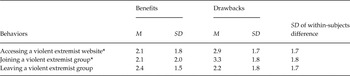
Table 1 presents the average number of benefits and drawbacks that participants provided for each of the three violent extremist behaviors. Paired samples t-tests revealed that participants perceived on average significantly more drawbacks than benefits of accessing a violent extremist website, t(52) = 3.52, p = .001, d = .46, and joining a violent extremist group, t(48) = 4.71, p < .001, d = .62; see Table 1. By contrast, there was no significant difference in the average number of perceived benefits and drawbacks of leaving a violent extremist group, t(54) = .98, p = .332, d = .13; see Table 1.
Average Number of Benefits and Drawbacks of Violent Extremism Provided by Male Youth

Note: *p ≤ .001.
Nature of perceived benefits and drawbacks
First qualitative responses were thematically analyzed. The first author read through all of the responses and created meaningful categories that were apparent for the benefits and drawbacks of each of the three violent extremist behaviors. Categories with less than 3% of responses across any of the three behaviors were coded as ‘other.’ Both authors then independently coded participants’ responses into these categories. Initial inter-coder agreement was high (i.e., from 87% to 98%). The few disagreements were discussed and agreed upon. Following this, an external coder was consulted who had no involvement in the study. Agreement between the authors’ agreed codes and the external coder was high (i.e., from 85% to 100%). The few disagreements were discussed and agreed upon.
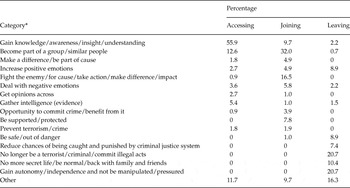
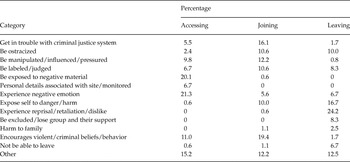
Excluding the ‘other’ categories, a total of 17 different categories of benefits emerged. Ten of these applied to accessing a violent extremist website, 11 to joining a violent extremist group, and nine to leaving a violent extremist group (see Table 2). A total of 13 different categories of drawbacks emerged, with 10 for accessing, and 11 each for joining and leaving (see Table 3). Tables 2 and 3 present the proportion of responses that fell into each category of benefit and drawback, respectively, for the three violent extremist behaviors. The findings are summarized below by the three stages of (dis)engagement.
Percentage of Perceived Benefits of Violent Extremism

Note: Columns may not sum to 100% due to rounding off.
* The category “gain knowledge/awareness/insight/understanding” refers to participants wanting to gain general information. For instance, when referring to the benefit of accessing an extremist website one participant said “get more of a picture about what people who are terrorists think”. The category “gain intelligence/evidence” refers to participants wanting to obtain information pertaining to a specific terrorist plan of action. For example, when referring to the benefits of accessing an extremist website one participant said “knowing if and where a terrorist attack will be”.
Percentage of Perceived Drawbacks of Violent Extremism

Note: Columns may not sum to 100% due to rounding off.
Initial involvement
The most common perceived benefit of accessing a violent extremist website, representing 55.9% of responses, was that it would enable participants to ‘gain knowledge, awareness, insight or understanding’ of the topic. With regard to the perceived potential drawbacks of accessing a violent extremist website, the two most common categories, representing 20.1% and 21.3% of responses respectively, were being ‘exposed to negative material’ and ‘experiencing negative emotions.’
Engagement
Being part of a group or with similar people’ was the most common perceived benefit of joining a violent extremist group, representing 32.0% of responses. The second most common benefit was that this enabled one to ‘fight the enemy, fight for a cause, take action, or make a difference or impact’, which represented 16.5% of responses. The two most common perceived drawbacks of joining a violent extremist group were that it ‘encourages violence, criminal beliefs or behaviors’ and that participants might ‘get in trouble with the criminal justice system’, representing 19.4% and 16.1% of responses, respectively.
Disengagement
Finally, the two most common perceived benefits of leaving a violent extremist group referred to ‘no longer being a terrorist or criminal, or no longer committing illegal acts’ and ‘regaining autonomy or independence, or no longer being manipulated or pressured’, which represented 20.7% and 20.7% of responses, respectively. The two most common perceived drawbacks of leaving a violent extremist group referred to ‘experiencing reprisal or retaliation and being disliked’ and ‘exposing oneself to danger or harm’, representing 24.2% and 16.7% of responses, respectively.
Discussion
The fact that violent extremism is currently considered to be one of the greatest threats to national and international security means that it deserves research attention. However, there is a surprising lack of primary data on violent extremism, and that which exists has often been criticized on methodological grounds (Dhami, Reference Dhami, Cole and Pantucci2014; Victoroff, Reference Victoroff2005). This has severely limited the ability of policy-makers to develop and implement effective prevention and intervention strategies (Lum et al., Reference Lum, Kennedy and Shirley2006).
The present study represents a first step in designing systematic scientific research that can be used to test the utility of rational choice theory in describing and explaining violent extremism. According to some criminologists, this has potential value for reducing terrorism (Clarke & Newman, Reference Clarke, Newman, Stritzike, Lewandowsky, Denemark, Clare and Morgan2009). Precise tests of the theory first require specification of the pros and cons that individuals perceive may potentially arise from this risky behavior. Thus, in the present study we provide a glimpse of how male youth perceive the benefits and drawbacks of accessing a violent extremist website, joining a violent extremist group, and leaving such a group. Our study explores the stages and levels of engagement that have been of interest to policy-makers (e.g., HM Government, 2011).
Compatible with studies of youth risk perceptions and risk taking in the crime and other domains (Beyth-Marom et al., Reference Beyth-Marom, Austin, Fischhoff, Palmgren and Jacobs-Quadrel1993; Dhami & Garcia-Retamero, Reference Dhami and Garcia-Retamero2012), participants in the present study thought of more drawbacks than benefits of accessing a violent extremist website and joining a violent extremist group. Although these perceptions do not necessarily have a deterrent impact (as demonstrated in past research where participants nevertheless had high levels of past and intended risk taking), it does indicate that male youth are aware of the negative consequences of engagement in violent extremism. Follow-up research is needed to establish whether this provides evidence of the effectiveness of current Government awareness raising campaigns or whether this suggests that such campaigns are unnecessary because youth perceptions may have been informed by other sources (e.g., parents, media).
Overall, we found that the nature of the perceived benefits was more varied than were the drawbacks. Across the three risky behaviors, there were 16 meaningful categories of perceived benefits compared to 13 categories of perceived drawbacks. This suggests that prevention and intervention strategies based on deterrence via increasing costs may have to be more restricted in their scope than those based on reducing rewards.
The most commonly perceived benefit of accessing a violent extremist website was that it would help participants ‘gain knowledge/awareness/insight/understanding’ of the violent extremist group and their motivations. Indeed, access to, and use of, extremist websites may act as one factor contributing to initial involvement in violent extremism (Hegghammer, Reference Hegghammer2006; Helmus et al., Reference Helmus, York and Chalk2013). These websites present ideological arguments that culminate in support for violence (Gerstenfeld, Grant, & Chiang, Reference Gerstenfeld, Grant and Chiang2003), and individual’s espousing such beliefs are considered to be at greater risk of engaging in violent extremism (Monahan, Reference Monahan2012; Pressman, Reference Pressman2009). For those individuals who are not already socially connected, exposure to new ideas such as these is a potential factor putting them at risk of radicalization (McCauley & Moskalenko, 2011).
In terms of perceived drawbacks of accessing a violent extremist website, participants noted that they could ‘be exposed to negative material’ and ‘experience negative emotions’ such as annoyance, anger, worry, upset, fear and disgust. The idea that negative emotions may act as a deterrent runs contrary to the current view that these emotions are potential motivational ‘risk’ factors (Horgan, Reference Horgan2008; Monahan, Reference Monahan2012). Future research ought to tease apart the causal relation between negative emotions and (dis)engagement in violent extremism.
The most commonly perceived benefits of joining a violent extremist group were that the individual would ‘become part of a group/be amongst similar people,’ and that he could ‘fight the enemy/for a cause/take action/make a difference/impact’. Personal affiliations have been found to be associated with joining a violent extremist group (Hegghammer, Reference Hegghammer2006). In addition, Pressman (Reference Pressman2009) notes that contextual factors such as contact with violent extremists and a community that is supportive of political or ideologically motivated violence may encourage engagement in violent extremist activities (see also Ginges, Atran, Sachdeva, & Medin, Reference Ginges, Atran, Sachdeva and Medin2011; Horgan, Reference Horgan2008; Monahan, Reference Monahan2012). Similarly, the belief that one must right a wrong or has a grievance has also been identified as a factor potentially increasing the likelihood that an individual may engage in violent extremism (McCauley & Moskalenko, 2011; Monahan, Reference Monahan2012; Pressman, Reference Pressman2009).
The most commonly cited drawbacks of joining a violent extremist group were that it ‘encourages violent/criminal beliefs/behavior’ and that individuals would ‘get in trouble with the criminal justice system’ (i.e., be arrested, convicted, sentenced). The latter supports research showing that youth may perceive negative social reactions involving official sanctions as drawbacks of committing crime (e.g., Beyth-Marom et al., Reference Beyth-Marom, Austin, Fischhoff, Palmgren and Jacobs-Quadrel1993; Dhami & Mandel, Reference Dhami and Mandel2012a).
In sum, the present study has provided preliminary data from which a rational choice model may be constructed and tested. It does not directly examine choice or the relations between risk perceptions and risk taking or choice. Future research can build on our findings by asking individuals to state how much importance (value) they attach to the specific benefits and drawbacks that we have identified, and to state what their subjective likelihood is of occurring. This data can then be used to test the validity of a rational choice model (i.e., weighting and integration of the pros and cons) in predicting variables such as support for, and attitudes towards, violent extremism, as well as intentions to (dis)engage in violent extremism. Studies using known violent extremists could also aim to predict their past level of engagement.
If future research demonstrates that perceived benefits and drawbacks are predictive of accessing a violent extremist website and joining a violent extremist group, our findings suggest that prevention and intervention strategies could be two-pronged: reducing the perceived sense of reward or providing specific rewards (e.g., need for belonging and group affiliation) in legal ways, as well as demonstrating the swiftness, severity and certainty of formal punishment. Furthermore, these strategies ought to be behavior-specific (e.g., accessing a violent extremist website v. joining a violent extremist group).
With regard to leaving a violent extremist group, there was no significant difference in the number of the perceived benefits and drawbacks. We found that the most commonly cited benefits of leaving a violent extremist group were that individuals would ‘no longer be a terrorist/criminal or commit illegal acts’ and they could ‘gain autonomy/independence and not be manipulated/pressured’. Indeed, individuals in extremist groups can experience immense peer pressure (Hegghammer, Reference Hegghammer2006).
The most commonly perceived drawbacks of leaving a violent extremist group were that individuals might ‘experience reprisal/retaliation/dislike’ from the group and they might ‘expose themselves to danger/harm.’ The threat from within the group is not unrealistic as there are many documented examples of in-fighting and competition in such groups (McCauley & Moskalenko, Reference McCauley and Moskalenko2008).
Disengagement from violent extremism may occur due to a change in function within the violent extremist group; a sense of de-radicalization where the individual socially and psychologically reduces his/her commitment to the group; a loss of social ties within the group; and disillusionment between the fantasy and reality of engagement (Bjorgo, Reference Bjørgo2011; Garfinkel, 2011; Horgan, Reference Horgan2008). Our findings suggest that although individuals see benefits to disengagement, they also see the potential for violence being directed at them. This underscores the need for preventive action, since individuals who join a violent extremist group may find it difficult to leave for these reasons. Again, if future research demonstrates that the above perceived benefits and drawbacks of leaving a violent extremist group predictive (dis)engagement in violent extremism, intervention strategies could be designed to help individuals perceive greater benefits of leaving, and they can aid disengagement via providing safety and security (Garfinkel, Reference Garfinkel2007).
Some critics may argue that our sample of male youth was unrepresentative of violent extremists because they were predominately non-Muslim, white and British. We did not specifically target non-British, Muslim minorities because to do so would be viewed as invoking racial stereotyping. Such stereotypes run contrary to the official police statistics which show that, in 2010, individuals of white origin were approximately four times more likely to be stopped and searched under the Terrorism Act 2000 than those of an Asian or Asian British origin (Home Office, 2012). A report by the Security Service confirms that violent extremists in the UK cannot be profiled in terms of race, nationality or religion, and that it is important to adopt a broad analysis in this domain. Most British Muslims are not extremists and that they do not support extremism. In addition, the fact that participants in the present study were not explicitly instructed to think of any specific violent extremist group also meant that responses were applicable to a wider range of participants (including British, non-Muslims). We therefore believe it is important for research on violent extremism (particularly when it is of an exploratory nature) not to confound the concept with other variables such as race, religion and nationality (e.g., HM Government, 2011), and to adopt a broad definition of extremism.
Nevertheless, in hindsight it may have been useful to have asked our participants which violent extremist groups they had in mind. This would have enabled us to compare responses across different types of violent extremist groups. Future research should overcome this limitation. In addition, future research could also involve participants who might be at greatest risk of radicalization and engagement in violent extremism, although this might be challenging given the lack of an effective risk assessment tool in this domain (Monahan, Reference Monahan2012). However, there are some factors such as ideology, affiliations, grievances, and moral emotions (Monahan, Reference Monahan2012) that may be used to ‘screen and select’ participants. Future research can also focus on those who have known to be (dis)engaged in violent extremism, although this may prove difficult as gatekeepers may prevent access to incarcerated populations (although such samples may be criticized for being unrepresentative of offending populations) and sampling from ‘sleeper cells’ is associated with safety, legal and ethical concerns.
As stated at the outset, our research was inspired by a desire to provide a basis for testing a rational choice model of violent extremism. We acknowledge that there are other potentially useful theoretical approaches, and researchers could explore the value of applying those. For instance, recent research suggests that (de)radicalization may be understood in terms of an individual’s motivation to achieve personal significance, combined with an ideology stating violence is appropriate for pursuing this goal, and in the context of social networks reinforcing and enabling this (Kruglanski et al., Reference Kruglanski, Gelfand, Belanger, Sheveland, Hetiarachici and Gunaratna2014).
In a direct test of rational choice theory, other research suggests that the rational choice model may not be valid in predicting youths’ intentions to engage in criminal or other risky activities (e.g., Dhami & Mandel, Reference Dhami and Mandel2012a; Reference Dhami and Mandel2012b). Rather than carefully weighing up the pros and cons of risky behaviors, youth may be solely motivated by the importance they attach to the perceived benefits, irrespective of their probabilities of occurrence and despite the perceived drawbacks. In fact, the impact of perceived drawbacks tends to be weaker than is implied by prevention strategies that focus on informing young people about the costs of risk taking (D’Amico & Fromme, Reference D’Amico and Fromme2002).
While there is evidence to suggest that decisions in other domains are either not based on rational analyses of costs and benefits (e.g., Mazar & Ariely, Reference Mazar and Ariely2006), or that they are not based on conscious insights into a person’s own decision-making (e.g., Burroughs et al., Reference Burroughs, Chaplin, Pandelaere, Norton, Ordabayeva, Gunz and Dinauer2013), the number and richness of the insights provided by the present study’s participants indicates that empirical research investigating a model of rational choice for the decision to access, join and leave a violent extremist group may be warranted. The fact that the interpretation of costs and benefits might be affected by ideological contexts (e.g., death may be a reward under a Jihadi ideology but a drawback under another ideology) means that the value of rational choice approach may, however, be limited. To improve our understanding of violent extremism, developing and empirically testing models from both existing and new paradigms is essential.
Models can also be extended to incorporate the findings of research suggesting that risk perceptions and risk taking may be influenced by non-cognitive factors. In the domain of violent extremism, these may include emotions such as anger or disgust (McCauley & Moskalenko, 2011; Pressman, Reference Pressman2009). It would be useful to identify the non-cognitive factors, such as emotions, that may impact individuals’ risk perceptions (i.e., importance and likelihood of the pros and cons). Hsee (Reference Hsee1999) demonstrated that people make decisions about the future based on rational arguments but used emotions to make decisions about the present. Thus, future research could also examine the effect of temporal context on individuals’ perceptions of the benefits and drawbacks of violent extremism. Finally, ‘sacred values’ or ‘moral rules’ may also affect or even override careful cost-benefit calculations (Ginges et al., Reference Ginges, Atran, Sachdeva and Medin2011). Thus, future psychological research can ask: ‘How rational are violent extremists?’ and ‘What influences their rationality?’ These questions are not only of theoretical interest, but also of practical value since deterrence-based prevention strategies hinge on rational choice models of the offender (Clarke & Newman, Reference Clarke, Newman, Stritzike, Lewandowsky, Denemark, Clare and Morgan2009).
In conclusion, current UK-based strategies for dealing with violent extremism include challenging ideology (HM Government, 2011), and identifying potentially vulnerable youth (such as those at University) and supporting them via counselling, faith guidance, civic engagement, working with their support networks, and providing education, employment, health and housing services (HM Government, 2010). These have been criticized for lacking an empirical or scientific evidence-base (Dhami, Reference Dhami, Cole and Pantucci2014). As Victoroff (Reference Victoroff2005) argues, even when policy-makers rely on the published research on the “mind of the terrorist”, “policies intended to reduce the risk of terrorism may be based on invalid premises” (p. 34). This is because past research has not been sufficiently hypothesis-based. The present study provides an insight into how male youth think about the pros and cons of (dis)engagement in violent extremism, and so can contribute to the sort of systematic theory testing research necessary for developing scientific evidence-based prevention and intervention strategies.
we would like to thank Ms Kirstie McClatchey, Edinburgh Napier University, for her assistance in acting as an external coder, blind to the aims of the study.