


1 Introduction
The ‘Extended IPA Symbols’ for transcribing disordered speech (extIPA) were introduced just over twenty-five years ago (Duckworth et al. Reference Duckworth, Allen, Hardcastle and Ball1990). Since then, a few minor changes have been made (see e.g. Bernhardt & Ball Reference Bernhardt and Ball1993), but no major revision has been made. At the Oslo conference of the International Clinical Phonetics and Linguistics Association (ICPLA) in 2010, a special panel on the transcription of disordered speech reviewed the extIPA symbols and the chart that displays them, with input also from the audience at the panel presentation (Ball et al. Reference Ball, Harding-Bell, Howard, Heselwood, Lohmander, Sell and Trost-Cardamone2010). The results of this review, together with informal consultations with colleagues, led to a set of suggested changes. These were presented in a poster in June 2016 at the ICPLA conference in Halifax, Nova Scotia (Ball et al. Reference Ball, Howard, Elsing and Craig Dickson2016), and approved by the membership. This paper presents a brief overview of the most recent extIPA chart and introduces the changes made.
As with the construction of the original version of the extIPA chart, the symbols all denote either articulatory configurations rarely found in natural language (normally where the IPA has no symbol or diacritic to denote them), or articulations that have only been reported in disordered speech, sometimes because the sound or sounds concerned cannot be produced with a typical human speech-production mechanism.
It should be stressed, too, that the motivation behind the original 1990 version of the extIPA symbols, and subsequent revisions to them, has been to supply transcriptional resources to those needing to describe disordered speech of all types. Symbols have been chosen following requests from speech-language pathologists and clinical phoneticians.
2 The 2008 extIPA chart
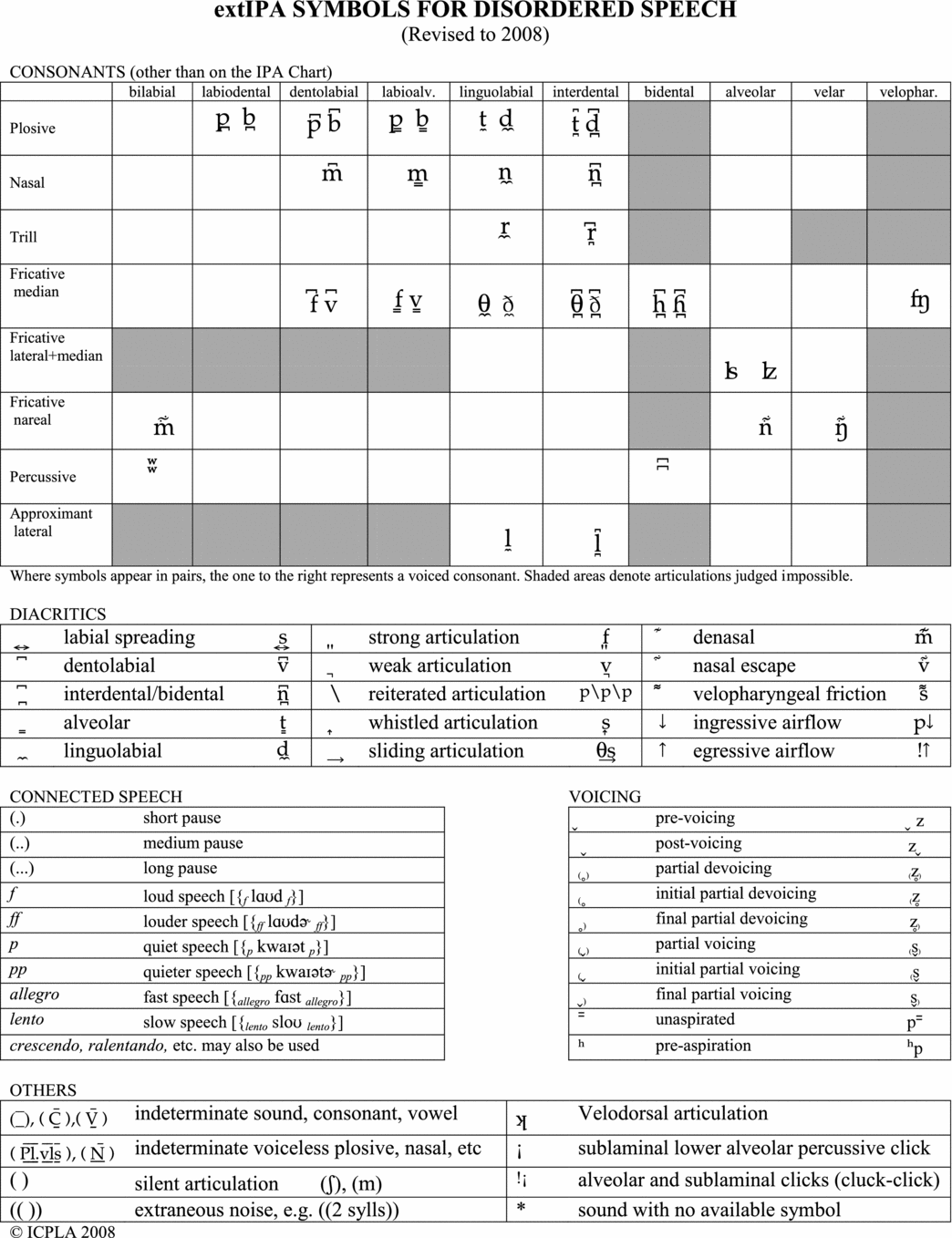
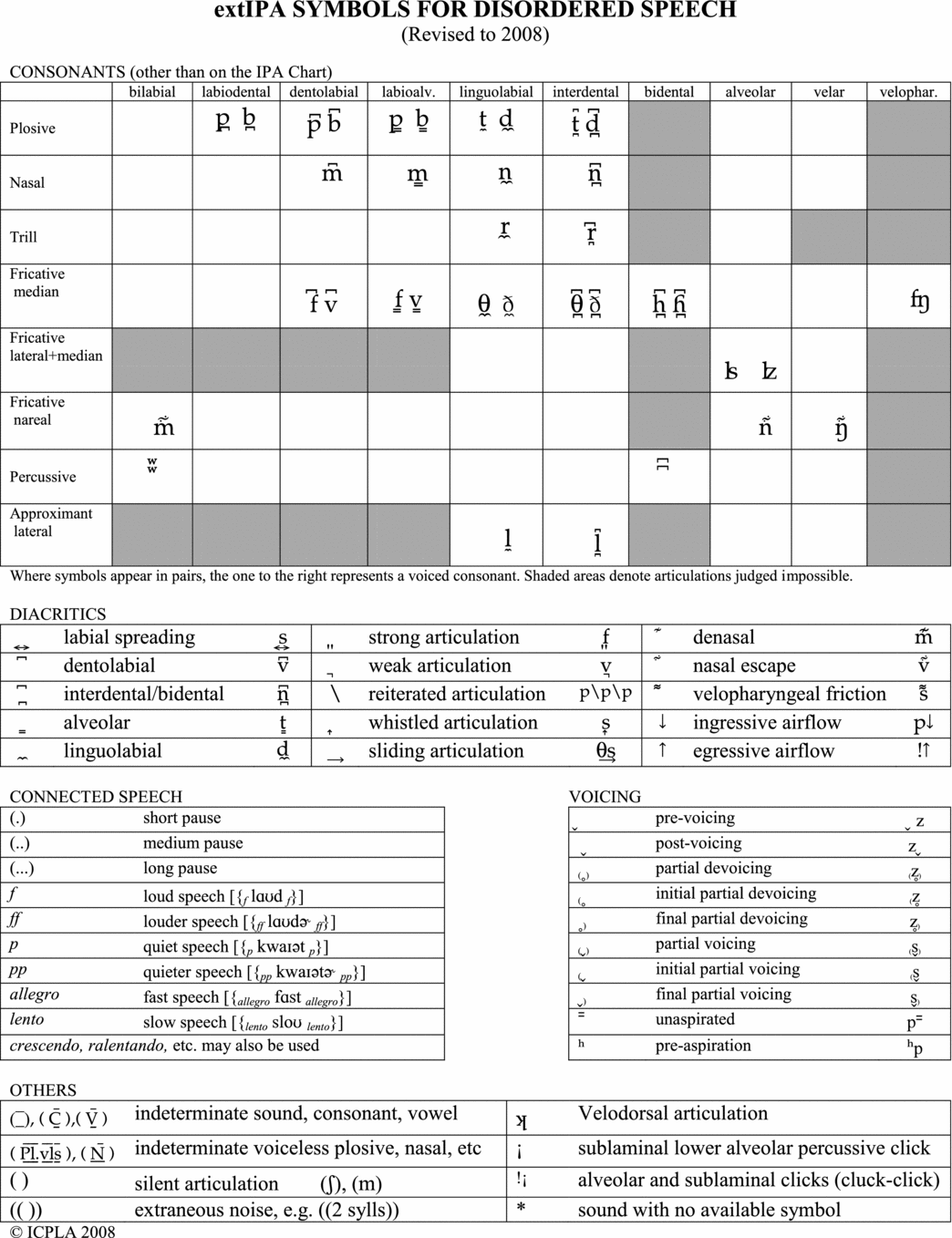
The most recent version of the extIPA chart before the current revision is the 2008 chart (see Figure 1). As with all versions of the chart, this version only displays symbols that are not on the IPA chart (with one exception discussed below). Blank spaces on the main part of the chart, therefore, are to be interpreted as either showing that there is an IPA symbol for the sound or sounds concerned, or that there is no extIPA or IPA symbol. As with the IPA chart, shaded boxes on the chart denote sounds that it is deemed are not possible to produce.
The 2008 extIPA chart.
2.1 Consonant section
The main consonant section of this chart, as with the IPA chart, is at the top of the page, and consists of intersecting columns of places of articulation and rows of manner of articulation, with voicing shown by the placement of the symbols within the boxes (voiceless to the left, voiced to the right). The manners of articulation include several familiar from the IPA chart (plosive, nasal, trill, median fricative, lateral approximant), and three manners needed for disordered speech: median+lateral fricative, nareal fricative, and percussive. The first of these is needed for fricative articulations where there is both a central and a separate lateral gap for air to escape with friction.Footnote 1 These have only been reported at the alveolar place of articulation. ‘Nareal fricatives’ was the term used in this version of the chart for stops produced with audible friction through the nasal cavity, and are characteristics of speakers with various types of velopharyngeal insufficiency. Percussives are sounds produced by the striking together of two rigid articulators. Examples found in disordered speech are restricted to the upper and lower teeth, and the upper and lower lips (made semi-rigid by muscular effort). These latter sounds may well be made on an airstream produced by the movement of the articulators themselves, with glottal closure in place. However, there is currently no instrumental evidence on their production.
Places of articulation also contain a mix of familiar and novel categories. The chart contains the familiar bilabial, labiodental, alveolar, and velar, but also dentolabial, labioalveolar, linguolabial, interdental, bidental, and velopharyngeal. Dentolabial articulations involve the upper lip against the upper edge of the lower teeth (the term ‘reverse labiodental’ is also found, see PRDS 1980), and are denoted with the dental diacritic placed above the relevant symbol. Labioalveolar articulations are only possible in speakers with Class 2 occlusion. ExtIPA uses a diacritic for alveolar place (see also under diacritics below) together with the relevant labial symbol. Linguolabial articulations involve the tongue tip placed at the centre of the upper lip, and extIPA uses the IPA diacritic to denote these. The precursor to the extIPA system (PRDS symbols, PRDS 1983, see also Heselwood Reference Heselwood2013 for a general historical background to the development of symbols for clinical transcription) introduced this place of articulation as it had been relatively frequently reported in child speech disorders. Thus, although the IPA later introduced its own diacritic, as these articulations are encountered in a few languages, the extIPA charts have continued to include them. Interdental articulations are understood here to denote those where the tongue tip protrudes visibly between the upper and lower teeth, and are transcribed using the dental diacritic both above and below the symbol. For speakers with Class 3 occlusion, where the tongue tip protrudes past the top teeth but not necessarily past the bottom teeth, we suggest using a single dental diacritic above the relevant symbol. This will not be confused with dentolabial sounds, which are based on labial symbols.
Bidental articulations involve either the percussive striking of the upper and lower teeth (transcribed by two dental diacritics one above the other operating as a single symbol), or friction through clenched teeth (glottal fricative symbols with the dental diacritic above and below). Finally, a velopharyngeal place of articulation is needed to denote the segment sometimes referred to as a velopharyngeal or nasal snort or a velopharyngeal fricative, whereby turbulent air is forced through a restricted velopharyngeal port into the nasal cavity. The symbol for this sound combines an ‘f’ and an ‘ŋ’ to suggest its fricative and nasal nature.
2.2 Diacritic section
There are 15 diacritics listed in the section immediately under the consonant chart. These cover both atypical articulations and typical ones for which the IPA has no diacritic. The atypical ones are dentolabial, interdental/bidental (these already discussed as they also appear on the main consonant chart), sliding articulation (movement from one place of articulation to a neighbouring one within the timing slot of a single sound), weak and strong articulation (that is, weaker or stronger than typical), denasal, nasal escape, and velopharyngeal frication (this last diacritic for use on a variety of target sounds produced with additional velopharyngeal friction). The typical ones include linguolabial articulations (described earlier), alveolar (as the IPA lacks an explicit alveolar diacritic, and clinical phoneticians often need to mark whether an alveolar target is, in fact, alveolar, for example), and lip-spread articulation (the IPA has a lip-rounded diacritic, but clinical phoneticians may need to transcribe whether a sound is, in fact, lip-spread, as opposed to neutral).
There are also some diacritics that do not fall into either category. Thus, whistled sibilants may be pathological or simply idiosyncratic; reiterations may be part of natural disfluency or an aspect of stuttering; and the arrows for ingressive and egressive airflow can be used to mark typical or disordered speech.
2.3 Connected speech section
The connected speech section was instituted in the original extIPA chart following requests from clinical transcribers for guidance on how to denote features such as pausing, tempo, and loudness. None of the transcriptions suggested are novel, but including them on the extIPA chart gave explicit recognition to previous practice. To mark pauses, extIPA recommends the use of dots (full stops, or periods); one, two and three dots representing short, medium and longer pauses. These should be placed within round brackets to ensure they are not mistaken for the IPA symbol for a syllable boundary.
For loudness and tempo musical notation is sanctioned: f, ff, p, pp (for forte, fortissimo, piano, pianissimo, respectively) are to be used for loudness or softness; and allegro and lento for fast and slow. The chart illustrates how these can be integrated into a linear transcription through the use of labelled curly braces (see also this usage with the transcription system for voice quality, VoQS, as described in Ball, Esling & Dickson Reference Ball, Esling and Craig Dickson1995, Reference Ball, Esling, Craig Dickson, Kent and Ball2000, published online 13 April 2017). Naturally, as noted in this part of the chart, other musical terms such as crescendo or ralentando can be employed as wished.
2.4 Voicing section
For clinical transcribers needing a detailed record of patterns of voicing and devoicing, the current IPA diacritics are deficient in that they do not make explicit whether a sound is (for example) partly or wholly devoiced and, if the former, whether the partial devoicing is at the initial or final part of the segment. The diacritics listed here can be used to clarify this both for the devoicing of a voiced target or the voicing of a voiceless target. Other features covered include pre- and post-voicing, pre-aspiration, and lack of aspiration. The symbols for all except the last of these are adapted from current IPA diacritics. The no-aspiration diacritic has been used in clinical phonetics (at least) for a considerable time, but was not overtly recognized until included in the original extIPA chart.
2.5 ‘Others’ section
This section contains a means for marked differing degrees of certainty at the segmental level, and also symbols for sounds that did not fall within the previous parts of the chart. The marking of degrees of certainty was inherited from the PRDS symbols (PRDS 1983), and the version included on the 2008 extIPA chart was supposed to imitate the use of hand-drawn circles or ovals around the relevant terms in a hand-written transcription. Below the indeterminancy examples are included the use of single and double round brackets to mark silent articulations and extraneous noises, respectively.
The remaining symbols include one for a velodorsal articulation (as recorded in Ball, Manuel & Müller Reference Ball, Manuel and Müller2004), where the velum is the active articulator against a passive raised tongue dorsum. Following this are symbols for a sublaminal lower alveolar percussive clickFootnote 2 (where the underside of the tongue blade strikes the lower alveolar ridge, sometime termed a ‘cluck’), and the combination of an alveolar click followed by the ‘cluck’, often encountered in child speech.Footnote 3 Finally, the existing IPA use of the asterisk to denote sounds with no symbol is recognized, where a description of the sound can be appended at the foot of the transcription.
3 Changes in the 2015 extIPA chart
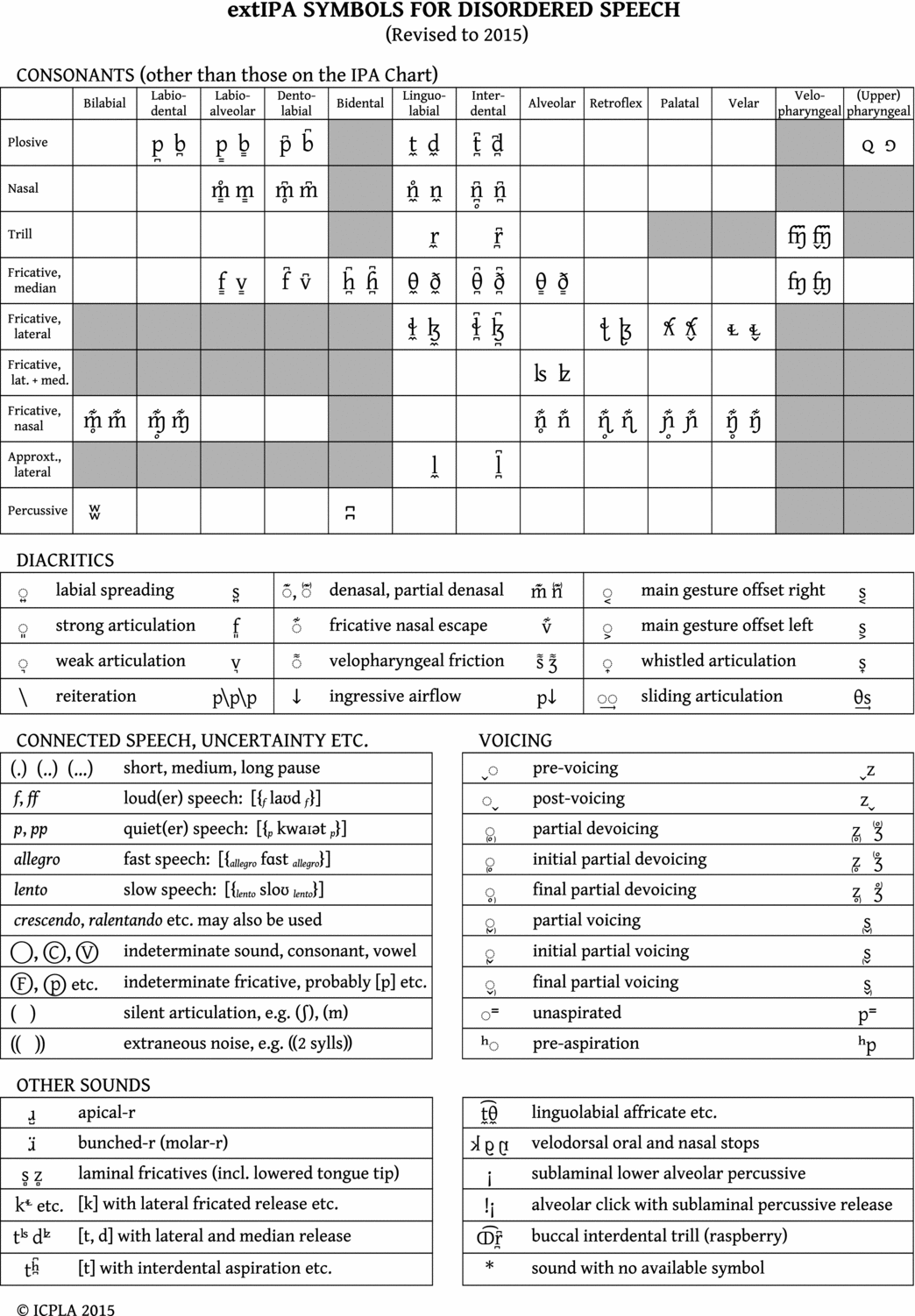
There are four types of changes between the 2008 and the 2015 versions of the extIPA chart: categories and/or symbols removed from the chart, categories renamed between the two charts, symbols changed between the two charts, and categories and/or symbols added to the 2015 chart. These last constitute the great majority of the changes made. These additions to the chart will be looked at in separate subsections that cover parts of the chart. As no changes were made to the voicing part of the chart, this is omitted from discussion. The 2015 chart is shown in Figure 2.
The 2015 extIPA chart.

3.1 Symbols and categories removed or changed
Only one symbol and its associated category was removed from the chart: the upwards arrow to denote egressive airflow. This was envisaged to represent reverse clicks, but these are rarely encountered and it was felt no longer necessary to include this symbol. One category was renamed in the 2015 extIPA chart: the term nareal fricative was altered to nasal fricative. This was undertaken to reflect the usage of clinical phoneticians and speech-language pathologists working with cleft-palate speech.
One symbol was changed, that of the velodorsal stop. In a previous minor revision of the chart, a symbol for this articulation was introduced (see Ball et al. Reference Ball, Manuel and Müller2004). The symbol was a turned-k ([ʞ]). This symbol had featured in older versions of the IPA chart (e.g. that of 1949) to denote a velar click, however the 1979 version of the IPA chart withdrew the symbol as it was deemed that velar clicks were not possible. Thus, it was felt to be a suitable symbol to be repurposed for the velodorsal stop on the extIPA chart. However, recently it has been found that speakers of some languages do produce a click where the rear (velar) closure is released before the anterior closure and which could best be denoted by the turned-k symbol (see e.g. Grenoble Reference Grenoble, Plungian, Daniel, Fedorova, Lyutikova and Tatevoso2014 and Lionnet Reference Lionnet2017). As turned-k is now in use again to represent these velar-released clicks (albeit not yet with IPA sanction), it was decided that a new strategy was needed for the velodorsal stop, and that both voiced and voiceless oral stops and the nasal stop in this configuration should be covered. The solution was to approve reversed IPA velar symbols, thus: [ ].
3.2 Symbols and categories added to the consonant section of the extIPA chart
In the main consonant part of the chart one extra row has been added: lateral fricative. This is to allow for lateral fricatives at the retroflex, palatal, and velar places of articulation to be symbolized (as well as at the linguolabial and interdental places). Unofficial symbols for retroflex, palatal and velar lateral fricatives existed and, as clinical transcribers encounter such lateral fricatives, it was decided to adopt these in the extIPA chart revision. The main consonant chart also has three more places of articulation in the 2015 revision. Added are: retroflex, palatal, and upper pharyngeal. The first two are needed to show the extra lateral fricatives already referred to (and are also used to illustrate additional nasal fricatives). Upper pharyngeal is used to cover requests for symbols for pharyngeal stops produced between the tongue root and the rear wall of the upper pharynx (with no epiglottal involvement) noted in some types of disordered speech. The symbols for these are small-capital q and turned small-capital g: [ ]. The opportunity was taken to re-order the bidental column to follow dentolabial rather than interdental.
Finally on the main consonant chart, the voicing distinction was added to by providing both voiceless and voiced pairs of symbols for many manners of articulation (i.e. nasal, nasal fricative, and the new lateral fricatives). In most cases this is achieved by adding either the IPA voiceless or voicing diacritic to the relevant symbol.
One new symbol not yet described is the velopharyngeal trill. The velopharyngeal fricative described in Section 2.1 above is often accompanied by uvular trilling, but the previous extIPA charts did not distinguish between a trilled and non-trilled version. The addition of a short wavy line to the top of the symbol is an iconic representation of trilling, and by adding the voicing diacritic four velopharyngeal symbols are now available.
3.3 Diacritics
The 2008 chart had 15 diacritics; the 2015 version has only 12. The chart no longer shows diacritics that are also used in the main consonant section, thus removing dentolabial, interdental, alveolar, and linguolabial. One potential drawback of this is that it is no longer obvious that the alveolar diacritic can be used independently of the labio-alveolar articulation type. To address this, the alveolar diacritic is added to [θ] and [ð] in the fricative row to illustrate alveolar nonsibilant, slit fricatives. As noted earlier, the egressive airflow diacritic was also removed. Also added is a means of marking that the main articulatory gesture is noticeably offset to the right or to the left. These diacritics are adapted from the VoQS symbols and, although not overtly specified, are assumed to refer to the transcriber's view of left and right rather than the speaker's. The diacritic-modifier in the voicing section that indicates partial degree is also illustrated here with the denasal diacritic over [n].
3.4 Connected speech
In this section of the chart, space has been saved by placing all three pause lengths on one line, also by placing f and ff, and p and pp on single lines. The four lines saved by doing this are now used for features that on the previous versions of the chart were placed within the ‘Others’ section. These are two lines to illustrate uncertainty in transcription (now using proper circles), and the single and double brackets for silent articulations and extraneous noise. The whole section is renamed as ‘Connected speech, uncertainty, etc’.
3.5 Other sounds
In the section ‘Other sounds’, the examples now all refer to specific sounds. The first of these are in response to the need of clinical transcribers to be able to denote alternative articulatory realization of common sound units, in particular apical versus molar (or ‘bunched’) /r/ in English, and ‘tongue-tip down’ versions of the sibilant fricatives. For the former distinction, the new version of the extIPA chart recommends using the IPA apical diacritic versus the centralizing one. For the latter it is recommended that the IPA tongue-blade diacritic should be used, with the lowered tongue tip not overtly marked. Indeed, transcribers of typical speech may well find these conventions useful and it is arguable that the standard IPA chart should incorporate them.
The next four lines illustrate how existing extIPA symbols can be used to transcribe a range of unusual plosive release types: lateral fricated release, lateral and median release, interdental aspiration, and linguolabial affricates. The velodorsal stops referred to in Section 3.1 above are found next in this section, followed by the ‘cluck-click’ symbols described in Section 2.5. Finally, a symbol to transcribe the ‘raspberry’ is provided. This commonly occurs in child speech and has frequently been requested in informal discussions with clinical transcribers. Using the conventions of the VoQS symbol system (Ball et al. Reference Ball, Esling, Craig Dickson, Kent and Ball2000, Ball, Rahilly & Lowry Reference Ball, Rahilly and Lowry2017), the symbol combines [ↀ], which denotes a buccal airstream, with [ ] for an interdental trill. As this is a somewhat complex symbol, transcribers will be advised that the buccal airstream symbol could be used by itself as a shorthand if the speaker uses these sounds often. The final entry is the asterisk for marking sounds for which there is no symbol.
4 Possible changes not made
In this section several possible changes are outlined. These are divided into sounds with unofficial pre-existing symbols, and those for which there are no existing symbols in use.
4.1 Unofficial symbols
There are several symbols that do not have IPA recognition that might be useful in clinical transcriptions (indeed, some of these, such as the lateral fricatives, have already been added to the extIPA set). Among these are symbols for alveolo-palatal sounds other than fricatives ([ȶ ȡ ȵ ȴ]). These were not considered for inclusion on the revised extIPA chart as, were it needed to transcribe such sounds, other means such as using the palatalization diacritic would suffice. Other unofficial symbols are [ ] for a retroflex lateral flap, [я] for an epiglottal trill, and [
 ] for a glottal without noticeable frication. While these are potentially useful for clinical transcribers and can be kept under consideration for future revisions, no published reports of their use in clinical populations have been found, thus there is no need for their inclusion at the moment.
The labiodental place of articulation has dedicated IPA symbols for the fricatives, the nasal, and the approximant manners of articulation. There are, however, no IPA symbols for labiodental plosives (reflecting their comparative rarity in natural language). As these sounds are not so unusual in typical and disordered phonological development, extIPA (following PRDS before) has provided symbols in the form of [p] and [b] with dental diacritics below. However, the unofficial symbols [ȹ ȸ] have been used for these in Bantu linguistics (see Ladefoged & Maddieson Reference Ladefoged and Maddieson1996). While these symbols are arguably more elegant than the current extIPA sanctioned usage, it was felt best not to recommend change at this stage, but to await any action by the IPA itself in this regard.
4.2 Transcribing the approximant versions of voiced fricatives
This is an area where clinical and other transcribers have met problems. For example, a commonly occurring variant of target English approximant /r/ is a voiced bilabial approximant (indeed, this is possibly becoming a new norm in British English, e.g. Foulkes & Docherty Reference Foulkes and Docherty2000), which currently has to be transcribed as [β] with a lowering diacritic beneath it (the descender on the symbol making it very difficult to discern the diacritic). In dysarthric speech, target voiced fricatives are often realized as voiced approximants – again with the need to use multiple lowering diacritics in a transcribed passage. A final concern is that the IPA symbol [ɰ] appears to be used for both a high back unrounded semi-vowel (i.e. the semivowel equivalent of [ɯ]) and for the approximant version of [ɣ], which are arguably noticeably different sounds; and the same concern has been raised for [j] (see the discussion on Spanish palatal and velar approximants in Martínez-Celdrán Reference Martínez-Celdrán2004). Laver (Reference Laver1994) also notes that [j] and [ɰ] as semivowels would be assumed to have the same spread-lip shape as the vowels to which they are linked ([i] and [ɯ]); however, frictionless continuant versions of voiced fricatives would not be restricted to particular lip shapes.
These problems were addressed in Ball & Rahilly (Reference Ball and Rahilly2011), and a potential set of symbols was put forward. This set, modified to use reversed or turned symbols throughout, is also included in Ball, Rahilly & Lowry (Reference Ball, Rahilly and Lowry2017). These latter symbols are [ ], for bilabial, dental, alveolar, postalveolar, palatal, velar, uvular, and pharyngeal approximants, respectively, with [j] and [ɰ] restricted to denoting the semivowels.
While such a set of symbols might prove most useful for clinical and other transcribers, it was felt that such a major change should perhaps await action by the IPA itself and could, of course, always be revisited for the extIPA in the future if need be.
5 Conclusion
The extIPA chart contains a continually evolving set of symbols in the same way as does the standard IPA chart. Developments in IPA symbols are driven by the need to transcribe natural language, developments in the extIPA symbols are driven by the need to transcribe atypical speech. Sometimes these needs intersect, and new IPA symbols (such as the linguolabial diacritic) are of particular use to clinical phoneticians, and new extIPA symbols (such as the alveolar diacritic) can be of use to those transcribing natural language. We wait to see if issues raised here (such as the need to distinguish voiced fricatives from approximants) get taken further either in the IPA or extIPA symbol sets.
Acknowledgements
The authors would like to thank members of the ICPLA Cleft Palate group at the Oslo conference and Sharynne McLeod for their helpful suggestions, and the anonymous reviewers for their comments.
From August 2017, Martin Ball's affiliation is Bangor University, Wales.