Introduction
Wild rodents such as the wood mouse Apodemus sylvaticus harbour a range of nematodes, cestodes and trematodes and numerous publications have listed these in various parts of the world. Some studies have also investigated seasonal variation in infection parameters within the UK (Lewis, Reference Lewis1968; Lewis & Twigg, Reference Lewis and Twigg1972; Montgomery & Montgomery, Reference Montgomery and Montgomery1988, Reference Montgomery and Montgomery1989, Reference Montgomery and Montgomery1990a; Behnke et al., Reference Behnke, Lewis, Zain and Gilbert1999; Abu-Madi et al., Reference Abu-Madi, Behnke, Lewis and Gilbert2000). The most frequently occurring trematode species was found to be Corrigia vitta (20–100% prevalence) in the pancreas and Brachylaemus recurvum, (8–70% prevalence) in the small intestine. Another intestinal trematode, Plagiorchis muris (Tenabe, Reference Tenabe1922) has been found in wild rodents from several countries including Korea (Seo et al., Reference Seo, Rim and Lee1964, Reference Seo, Cho, Hong, Hong and Lee1981), Japan (Ito & Itagaki, Reference Ito and Itagaki2003), eastern Europe (Grikieniene, Reference Grikieniene2005) and Spain (Feliu et al., Reference Feliu, Renaud, Catzeflis, Hugot, Durand and Morand1997; Fuentes et al., Reference Fuentes, Saez, Trelis, Galan-Puchades and Esteban2004) but to date, this parasite has not been reported in A. sylvaticus within the UK. Two reports in Ireland (Langley & Fairley, Reference Langley and Fairley1982; O'Sullivan et al., Reference O'Sullivan, Smal and Fairley1984) have recorded a prevalence of less than 1% in A. sylvaticus but with generally a single fluke present in each host. The occurrence of P. muris in rodents is unusual because transmission to the definitive hosts is generally via ingestion of insects or their aquatic larvae. The trematode is also of interest as it is infective to humans (Hong et al., Reference Hong, Woo and Chai1996; Chai & Lee, Reference Chai and Lee2002). As part of an annual field course run by the University of Salford at Malham Tarn, Yorkshire, UK, P. muris has been recorded in A. sylvaticus every year for a 13-year period. The aim of this study is to describe the prevalence and intensity of infection of these adult trematodes over this period since this is the first record of this parasite in A. sylvaticus within the UK.
Materials and methods
The study was carried out at Malham Tarn, Yorkshire (grid reference SD 895673) which lies at an altitude of 376 m and is the only upland marl lake in Britain. Trapping was carried out using Longworth traps for 2 days in September each year over a 13-year period from 1993 to 2005. The trapping site was an area of deciduous woodland approximately 50–200 m from the shore of the tarn. Trapped mice were killed by over-exposure to chloroform. Mouse age was estimated by nose to anus length for all mice. However for 106 mice, in the more recent years of the study, weight was also taken. Age cohorts used in previous studies (Lewis, Reference Lewis1968; Behnke et al., Reference Behnke, Lewis, Zain and Gilbert1999; Abu-Madi et al., Reference Abu-Madi, Behnke, Lewis and Gilbert2000), i.e. juveniles ( < 13 g), young adults ( < 20 g) and adults ( ≥ 20 g) were translated to length cohorts of < 7.5 cm, < 9.5 cm and ≥ 9.5 cm, respectively. Mice were sexed on dissection before removal of the alimentary canal for further investigation. The intestine was opened under physiological saline and the presence and intensity of any helminth infections noted. Parasites were removed from the intestine, photographed and identified and fixed in 10% neutral buffered formalin or 70% ethanol.
Monthly rainfall data for the 13-year period was provided by Malham Tarn Field Study Centre from their own weather station.
Results
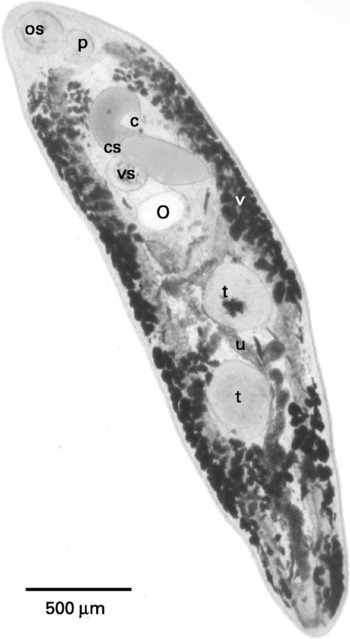
A total of 248 mice (152 male; 96 female) were examined over the 13-year period. Plagiorchis muris was found in the small intestine and was identified following microscopical examination of unstained specimens in comparison with previous descriptions (McMullen, Reference McMullen1937a; Hong et al., Reference Hong, Woo and Chai1996, Reference Hong, Ahn and Woo1998), and with specimens deposited at The Natural History Museum, London. Adult worms (fig. 1) are approximately 2–3 mm in length; the ovary is anterior to the testes which are aligned obliquely; the oral sucker (approximately 350 μm in diameter) is sub-terminal and slightly larger than the ventral sucker (approximately 280 μm in diameter) with the genital pore lying anterior to the ventral sucker.
Morphological features of adult Plagiorchis muris from the small intestine of Apodemus sylvaticus (unstained). c, cirrus; cs, cirrus sac; o, ovary; os, oral sucker; p, pharynx; t, testes; u, uterus; v, vitellaria; vs, ventral sucker.

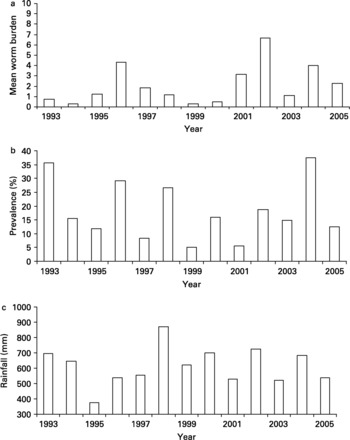
Adult trematodes were found in a total of 42 mice of the 248 mice examined (16.9% prevalence), the prevalence in males and females being 17.8% and 15.6%, respectively. These differences were not statistically significant (χ2 = 0.191, P = 0.662). The prevalence of the other intestinal helminths was 75% for the trichostrongylid nematode Heligmosomoides polygyrus; 6.8% for the oxyuroid nematode Syphacea stroma; 3.6% for the capillaroid nematode Capillaria murissylvatici and 0.8% for the trematode Brachylaemus recurvum. Worm burdens of P. muris, which ranged from 0 to 100, with a mean of 2.03 worms per mouse, were typically overdispersed in their distribution (variance/mean ratio = 41.28; k = 0.046) (Pal & Lewis, Reference Pal and Lewis2004). In total, 83% mice were uninfected whilst a further 10% of mice harboured 1–5 worms. On an annual basis, mean worm burdens varied from 0.3 to 6.6 worms per mouse (fig. 2a). Numbers of P. muris showed little correlation with worm burdens of the other dominant helminth, H. polygyrus (Pearson correlation coefficient = 0.162).
Variation in the mean worm burden (a) and mean prevalence (b) of Plagiorchis muris between years of sampling from 1993 to 2005 in North Yorkshine, UK, in relation to spring/summer rainfall data (c).

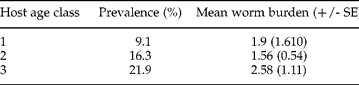
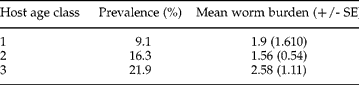
Although mouse length is a crude indicator of age, three length cohorts used indicated that the prevalence of P. muris infections was significantly different between cohorts (χ2 = 5.1, P < 0.05) with an increase in infection in mature adults compared with juveniles (table 1). Worm burden data (table 1) for the three groups was largest for the adult group but differences were not significant, largely due to a juvenile mouse harbouring a worm burden of 53 (χ2 = 0.27, P>0.5).
Mean prevalences and worm burdens for each of the different age classes of Apodemus sylvaticus over the period from 1993 to 2005, in North Yorkshine, UK.
Annual prevalences of P. muris (fig. 2b) ranged from 5% to 35.7% (mean annual prevalence 18.4%) and for most of the study period prevalences appeared to show a cyclical alternation of high and lower values every two years. Superimposition of data for total spring/summer rainfall showed a similar pattern of variation with high and low alternating rainfall values on a 2-year cycle (fig. 2b). A Spearman's rank correlation on this data gave an r value of 0.571 (0.025>P>0.01). Additionally, if data are grouped into years with a high prevalence (above the median of 15.5%) and years with a high spring/summer rainfall (above the median of 623 mm) then a χ2 analysis gives a highly significant value of 9.55 (P = 0.01) indicating that a high spring/summer rainfall is positively correlated with higher P. muris infections in September. However, data relating to mean worm burdens over the entire period (fig. 2a) showed only a very weak correlation with rainfall (Spearman's rank r = 0.093, P>0.1).
Discussion
The occurrence of Plagiorchis muris in the Malham Tarn area appears to be the first record of this trematode within Apodemus sylvaticus, or any other rodent, in the UK although there have been two records, with very low worm burdens, in the Republic of Ireland. The trematode, however, does occur in south-east Asia, central Europe and Spain (Seo et al., Reference Seo, Rim and Lee1964, Reference Seo, Cho, Hong, Hong and Lee1981; Feliu et al., Reference Feliu, Renaud, Catzeflis, Hugot, Durand and Morand1997; Fuentes et al., Reference Fuentes, Saez, Trelis, Galan-Puchades and Esteban2004; Grikieniene, Reference Grikieniene2005). The reasons for its occurrence in north Yorkshire in the UK are unclear. Malham Tarn is one of only eight upland, alkaline lakes in Europe. It is around 0.6 k m2 with an average depth of 3 m (Fryer, Reference Fryer1991). The region is a Site of Special Scientific Interest (SSSI) made up of a complex range of habitats including limestone pavement, moors, grasslands, wetlands and woodlands. This has resulted in a wide diversity of plant and animal species including over 1000 species of dipteran flies. This insect life may be significant in the complex life cycle of P. muris. Adult trematodes have been found in various rodents such as several Apodemus species, Rattus norvegicus and R. rattus (Seo et al., Reference Seo, Cho, Hong, Hong and Lee1981; Hong et al., Reference Hong, Woo and Chai1996). However it has also been recorded in humans, birds and cats (McMullen, Reference McMullen1937a, Reference McMullenb; Hong et al., Reference Hong, Woo and Chai1996; Chai & Lee, Reference Chai and Lee2002; Sohn & Chai, Reference Sohn and Chai2005). There is also some debate (Krasnolobova, Reference Krasnolobova1977; Langley & Fairley, Reference Langley and Fairley1982) as to whether this species is synonymous with P. elegans which occurs largely in birds but which has also been recorded in rodents (Shimalov, Reference Shimalov2002; de Bellocq et al., Reference de Bellocq, Sara, Casanova, Feliu and Morand2003; Fuentes et al., Reference Fuentes, Saez, Trelis, Galan-Puchades and Esteban2004). Both P. elegans and P. muris also show a high molecular similarity using ribosomal DNA sequences (Lee et al., Reference Lee, Huh and Sohn2004). Aquatic snails act as the first intermediate host for Plagiorchis species and up to 25 species of freshwater snails have been recorded from the Malham Tarn area (Norris, Reference Norris2003). The most likely host is Lymnaea stagnalis (McMullen, Reference McMullen1937a, Reference McMullenb; Bock, Reference Bock1984; Janssen & Bock, Reference Janssen and Bock1990) although L. truncatula and L. peregra are also intermediate hosts for P. elegans (Manga-Gonzalez et al., Reference Manga-Gonzalez, Gonzalez-Lanza and Kanev1994; McCarthy, Reference McCarthy1999). The trematode produces sporocysts and xiphidiocercariae within the molluscan host and when these emerge from the mollusc, they penetrate and develop to metacercariae in second intermediate hosts. The latter include a range of aquatic insect larvae including those of dragonflies, mosquitoes and chironomids. (McMullen, Reference McMullen1937a; Janssen & Bock, Reference Janssen and Bock1990; Hong et al., Reference Hong, Woo, Lee and Huh1999). Fish have also been reported to harbour metacercariae and this may be a route of human infection (Hong et al., Reference Hong, Woo and Chai1996). The link between an aquatic intermediate host and a rodent is not obvious but the diet of A. sylvaticus has been shown to include various arthropod adults and larvae particularly during the spring and early summer when seeds are scarce (Smal & Fairley, Reference Smal and Fairley1980; Montgomery & Montgomery, Reference Montgomery and Montgomery1990b). Plagiorchis muris has also been shown to exhibit precocious development of metacercariae within sporocysts, indicating that ingestion of snails may also be the route of infection to the definitive host (McMullen, Reference McMullen1937a).
Worm burdens of P. muris within A. sylvaticus in this study show a typically overdispersed pattern, with only a few hosts harbouring high worm numbers. This distribution is typical of many parasite populations in wild hosts and can result from factors which are intrinsic, e.g. sex, age, variation in susceptibility, exposure to infection, resistance to infection, or extrinsic, e.g. variation in the ecosystem, seasonal differences, year of sampling, density of intermediate hosts (Behnke et al., Reference Behnke, Lewis, Zain and Gilbert1999). In the present study, host sex did not appear to influence either worm burden or prevalence of infection. Neither was there a correlation between the number of P. muris and the dominant nematode species, H. polygyrus. A lack of association between different helminths has also been reported in other studies in the UK (Behnke et al., Reference Behnke, Gilbert, Abu-Madi and Lewis2005). There was, however, a significant increase in the prevalence of infection with host age, likely to be due to an increased exposure to infective stages through the greater foraging behaviour of older mice (Lewis, Reference Lewis1968; Lewis & Twigg, Reference Lewis and Twigg1972; Montgomery & Montgomery, Reference Montgomery and Montgomery1990b).
The present results showed that P. muris is the dominant trematode in this location at this time of year and it is surprising that Brachylaemus recurvum has only a sporadic low prevalence and that Corrigia vitta has not been detected at all. Both of these trematodes have been recorded in other studies with prevalences often greater than 20% (Lewis, Reference Lewis1968; Lewis & Twigg, Reference Lewis and Twigg1972; Montgomery & Montgomery, Reference Montgomery and Montgomery1990a) although significant regional variation including the absence of these species has been reported (Abu-Madi et al., Reference Abu-Madi, Behnke, Lewis and Gilbert2000). Seasonal variation may also be a factor since, in some studies, the prevalence of these trematodes has been shown to be highest in June and July and lowest in August and September (Langley & Fairley, Reference Langley and Fairley1982).
In relation to the 13-year study period, there was a significant variation in the total prevalence of P. muris between sampling years. Similar variation between years has been found for other helminths (Montgomery & Montgomery, Reference Montgomery and Montgomery1989, Reference Montgomery and Montgomery1990a; Behnke et al., Reference Behnke, Lewis, Zain and Gilbert1999) and may be a result of a large number of effects such as host density and age structure but may also may be affected by climate. Helminths of A. sylvaticus are known to exhibit seasonal variation in infection (Lewis & Twigg, Reference Lewis and Twigg1972; Langley & Fairley, Reference Langley and Fairley1982; Montgomery & Montgomery, Reference Montgomery and Montgomery1988, Reference Montgomery and Montgomery1989; Abu-Madi et al., Reference Abu-Madi, Behnke, Lewis and Gilbert2000) but in the present study, trapping was undertaken at the same time each year. The association with spring and summer rainfall data, however, indicates that climate could play a significant role since a higher prevalence of P. muris in September was more associated with wetter spring/summer periods. This is of interest as it infers that exposure of mice to infected insect larvae appears not to occur via direct contact with Malham Tarn itself but rather through exposure to more surface water which, although temporary in nature, may be suitable for the development of insect larvae. This idea is supported by the fact that a narrow shingle beach and earth ridge separate the tarn from the trapping site and this is not likely to be a terrain that A. sylvaticus would cross. The occurrence of P. muris in house rats (Seo et al., Reference Seo, Cho, Hong, Hong and Lee1981) also infers that open bodies of water are not a requirement for transmission. The tarn, and associated wetlands, however, may be important as a general breeding site for insects with aquatic larvae providing a large population of adults which may also deposit eggs on more temporary bodies of water. Studies in other countries have also observed P. muris infections close to lakes or rivers (Grikieniene, Reference Grikieniene2005), and this may be one reason why the parasite has not been found more frequently in UK, if trapping sites have not been located in areas where there are high levels of aquatic insect larvae.
Acknowledgements
The authors would like to thank the Field Studies Council at Malham Tarn for use of their facilities, Dr R.A. Bray at The Natural History Museum, London, for confirmation of the identification of Plagiorchis muris, and the students in Level 3 Bioscience programmes at the University of Salford, between 1993 and 2005, for their diligent work.