Introduction
One of the challenges in sociolinguistic research is to address how our ‘ways of speaking’ may vary across life stages. While mainstream linguistic variation research places its main focus on describing language change, little is known about language and identity at individuals’ various life stages. Nevertheless, there is a growing body of research that examines language of the same cohort of participants a number of times over a long period of time (e.g. Rickford & McNair-Knox Reference Rickford, McNair-Knox, Biber and Finnegan1994; Sankoff Reference Sankoff2004; Meyerhoff & Walker Reference Meyerhoff and Walker2007; Tagliamonte Reference Tagliamonte2012; Rickford & Price Reference Rickford and Price2013). The objective of research across an individual's lifespan is generally framed within a larger aim of discovering patterns of change occurring over time at a community scale or across communities (Tagliamonte Reference Tagliamonte2012; Sankoff Reference Sankoff2018).
Previous research on individual speakers’ language change over time has its own significance, offering valuable insights into language, identity, and life trajectories. Baugh (Reference Baugh, Guy, Feagin, Schiffrin and Baugh1996), for example, analysed negative concord in the language of four US men during adolescence and after eleven years, and found that variation in non-standard variable use aligned with their life trajectories. Rickford & Price (Reference Rickford and Price2013) traced two women's use of African American Vernacular English (AAVE) features from their mid-teens to their mid-thirties. At the age of thirty-five, married with children, and with a positive outlook towards the future for themselves and their children, their use of the target AAVE features was significantly lower than twenty years earlier. Sankoff's (Reference Sankoff2004) analysis of phonological change in the language of two participants from the BBC's ‘Seven up’ series suggests that the individuals’ life trajectories, particularly geographical and social mobility, have an impact on their accents.
A close look at individual speakers’ stylistic practice at different life stages, as exemplified by Rickford & Price (Reference Rickford and Price2013) and Rickford & McNair-Knox (Reference Rickford, McNair-Knox, Biber and Finnegan1994), enables us to interpret how certain features are used as resources to project varying personae and stances in interaction. In SturtzSreetharan's (Reference SturtzSreetharan2004, Reference SturtzSreetharan2009) work on the stylistic practice of men from the Kansai region across three generation groups, for example, the results of the quantitative analysis showed some differences emerging across life stages, but the author also demonstrates how the Kansai men used stylistic features as a way of creating certain types of persona and for negotiating relationships. Thus, the primary concern for language and identity in different life stages calls for what Eckert (Reference Eckert2012) terms the ‘third wave of variation study’, where the stylistic practice of individual speakers is analysed taking account of specific contexts of language use, how linguistic resources are used, and what social meanings are exchanged in interaction. While first-wave studies were concerned with linguistic features as indices of sociological categories such as class, gender, and region, the third wave puts individual speakers and their stylistic practice at the centre of the analysis. Under this approach, the indices at the core of the first wave variation studies are relevant in the sense that the ‘indexical field’ is relied upon as a resource to produce and interpret a range of meanings in interaction (Eckert Reference Eckert2012). And, the ethnographic approach to variation in second-wave studies is also relevant to the extent that it highlights the importance of how linguistic features are used at a more local level, rather than associating them with broader sociological categories adopted in the first-wave approach. But, as Eckert points out, the second wave focused on static identity categories that were attributed to speakers by relying on linguistic features as indices of social affiliation (Eckert Reference Eckert2012).
Our study examines diachronic language variation in a specific small group of speakers who share a similar educational, regional, and socioeconomic background. It analyses the discourse of five Japanese women at two points in their lives: in 1989, at age eighteen, and in 2000, at twenty-nine. They resided in the Kansai region, in western Japan, and came from a low socio-economic background. All graduated from the same technical high school, where a majority of students do not proceed to tertiary education. These women were interviewed by Kaori Okano (one of the authors), with whom they have shared their life stories for nearly thirty years at two-to-five-year intervals, originally for Okano's social anthropology project involving twenty-one Japanese women (Okano Reference Okano2009). In this article, we compare the five women's stylistic practice in late adolescence and adulthood. This time frame was chosen because the transition from adolescence to adulthood is considered ‘crucial in altering linguistic patterns’ (Sankoff Reference Sankoff2018:309), especially in relation to a shift from vernacular to standard variation (Chambers Reference Chambers2003; Rickford & Price Reference Rickford and Price2013). Also, from their own accounts, we found that these women had been through significant changes in their lives related to education, career, family, and geographical moves, which may have had an impact on their identity and stylistic practice.
Locating our inquiry in the third wave of variation research, our main aim is to identify what changes and variation exist in women's stylistic practice in their interaction with Okano, and if chronological trends in stylistic practice took similar trajectories across participants. We then attempt to interpret variability and similarity in the five women's stylistic practice in light of sociological data about these women's life stories.
Background: Kansai dialect, mobility, and discourse
Regional variation was a key aspect of stylistic practice among our participants, especially in relation to their geographical mobility. The participants had Kobe dialect as one of the varieties of Japanese in their repertoire. Kobe dialect is a subdialect of a group identified as Kansai dialect, spoken in the Kansai region. Kansai dialect broadly covers Osaka, Kyoto, Nara, and Hyogo prefectures. The dialect is well recognised across Japan for its pitch accent, morphology, and lexis, especially due to its use by popular entertainers from Osaka in the mainstream media. Osaka dialect, which is often used synonymously with Kansai dialect, has been associated with ‘informality and intimacy’, as well as humour and fun (SturtzSreetharan Reference SturtzSreetharan2017b:555). A large majority of adult dialect speakers in Japan, including the women in our study, use their local variants and the standard Japanese variants as stylistic resources in negotiating discursive context (Takagi Reference Takagi2006; Okamoto & Shibamoto-Smith Reference Okamoto and Shibamoto-Smith2016). Standard Japanese, usually equated with Tokyo variety, is often seen as the variety used in formal contexts and with outsiders from a different region (Takagi Reference Takagi2006), and ‘enregistered’ as ‘aloof, distancing and rational’ (SturtzSreetharan Reference SturtzSreetharan2017b:556). Barke's (Reference Barke, Cook and Shibamoto Smith2018) study of workplace meetings in Osaka revealed employees’ style shifting between Osaka dialect and standard Japanese as well as between desu/masu and plain forms in negotiating various stances. He suggests that Osaka dialect and plain forms were used for ‘off-stage’ and ‘personalized’ discourse as well as for intensifying expression of emotion, while the combination of standard Japanese and desu/masu forms indexed ‘on-stage’ and ‘depersonalized’ stance (Reference Barke, Cook and Shibamoto Smith2018:144).
Style shifting is relevant to our study particularly since Okano spoke mainly in standard Japanese with some features of Kansai dialect, often those shared with her own native dialect. Indeed, within variationist research, there is a need for a deeper understanding of how speakers from different dialect backgrounds interact. In the most recent survey conducted by the National Institute for Japanese Language and Linguistics, nearly 60% of Kansai dialect speakers responded that they are most likely to use the dialect when interacting with friends from other dialect backgrounds. This goes against the general trend found across the country where respondents said they are more likely to avoid using their local dialect with speakers from different dialect backgrounds (Tanaka, Hayashi, Maeda, & Aizawa Reference Tanaka, Naoki, Maeda and Aizawa2016:131). This raises the question of how the participants in our study go about their identity work over repeated encounters with a dialect ‘outsider’ with whom life stories are shared over a long period of time.
One of the key questions of our study is how geographic mobility intersects with the use of regional variants. One of our participants had moved away from the Kobe urban area by 2000, two remained there, one moved away but had returned to Kobe, and one was working in Osaka, fifty kilometres away from her home in the western part of Kobe. The participants’ use of regional variants may interact with the strength of their ties with Kobe. Would those who remained in Kobe use Kobe variants more extensively? Meyerhoff & Walker (Reference Meyerhoff and Walker2007:359), based on their findings of variation in individual grammars of ‘urban sojourners’ and long-term residents in Bequia, suggest that ‘lifespan change is most likely in individuals only in those cases where a variable is associated with strong social indices and/or high levels of social awareness’. Their study highlights the importance of further exploring the impact of social networks on individuals’ lifespan language change.
The issue of geographical mobility and regional variety relates to social networks (Milroy & Gordon Reference Milroy and Gordon2003). Two women in our study moved to a different area for family reasons, and their work environment also changed. The local dialect, density of social network, and the role the women had in the new environment may have all affected the way they spoke about their life experiences. Furthermore, politeness/formality marking at a lexicogrammatical level is a salient aspect of language acquisition, and age-grading in Japanese (Inoue Reference Inoue2014). During the middle-school years, students familiarise themselves with ‘polite’ clause-final forms (desu/masu) in expressing addressee-oriented politeness and formality. Referent-oriented honorifics are mostly acquired as people participate in the workforce in contemporary Japan, but their use decreases when the referent is not present in the interaction (Inoue Reference Inoue2014). Thus, referent honorifics were not used often in our data. In the present study, all of the women entered the workforce straight after their graduation from high school, but their professional and educational paths took different trajectories from there on. Thus, we decided to focus on the clause-final forms that are addressee-oriented stylistic features as one of the key aspects of stylistic practice in our study. Social mobility is also an important aspect of our discussion in this article. The five women would be placed into the social category of ‘working class’ in traditional, or first wave sociolinguistic research (cf. Eckert Reference Eckert2012). However, some of them with upwardly mobile orientation pursued further studies, or moved up in their organisations, while others sacrificed their careers for family. Sankoff's (Reference Sankoff2004) analysis of two men who experienced ‘upward’ and ‘downward’ mobility in their lives revealed a mixed picture of the impact of their social mobility on their accents. The present study explores the possible impact of social mobility on the participants’ discourse.
The study
Data
This study examines a total of ten ethnographic interviews of five women from Kobe conducted in the years 1989 and 2000 by Kaori Okano. In methodological terms, the fact that the participants’ interlocutor was the same person allowed for a controlled data collection environment. Noting that the longitudinal data cannot be analysed without taking into account the evolving relationship and rapport between the participants and Okano (cf. Nakane Reference Nakane, Okano and Maree2018a), we take the position that the study is about stylistic practice in interactively constructed discourse of the participants’ life stories. Okano was born in the Hiroshima prefecture, about 250 kilometres west of Kobe, where she grew up speaking Bingo dialect. Bingo speakers are likely to be identified as ‘outsiders’ by Kansai dialect speakers in Kobe due to differences between the two dialects. Our study does not employ the elicitation method of classic sociolinguistic interviews (cf. Trudgill Reference Trudgill1986; Bell & Johnson Reference Bell and Johnson1997) but seeks to analyse how these Kobe women negotiate their identity in interactions with Okano, interactions originally elicited for social anthropology research.
The 1989 interviews, the first in the longitudinal project, were conducted when the participants were eighteen years old. The main focus of the interviews was how the women chose and secured their first employment in their final year of school and how they envisaged their future. Okano has continued to meet the participants every few years until the present. In 1989, she was conducting PhD fieldwork as a young scholar. By 2000, when the participants were twenty-nine years of age, she was a mother of two with substantial career experience. Below, a brief description of the relevant information about each participant is given. Pseudonyms are used for names of people and employers.
Kanako
Kanako is the oldest of six female siblings. She grew up in council housing. After three months of employment at a factory, she got married. For most of her married life, she lived in a fishing town west of Kobe with her fisherman husband. At the time of the 2000 interview, she was supporting her father-in-law and husband on their boat, while looking after three young daughters at a unit purchased through the 1995 earthquake victim loan support scheme.
Miyuki
Miyuki has always lived with her parents. In 2000, she was employed by a large-scale retail company, where she had worked since high school graduation. At the time of the interview, she had just been promoted, but had also been enrolled in a distance education course at a Tokyo junior college for over two years to pursue her interest in arts. She was not in a relationship.
Natsumi
Natsumi lived with her parents at the time of the 1989 and 2000 interviews. After one year at a company in the sports industry, she quit her job. She then completed a two-year course in industrial design at a post-secondary college and obtained a second grade architect qualification. However, she had had difficulty in finding a permanent job and kept moving from one job to another. In 2000, she was in a long-term relationship.
Satoko
Satoko grew up in a single-parent household with her grandmother. In secondary school, she was in more frequent contact with OkanoFootnote 1 (during Okano's fieldwork) than the other participants of this study. In 2000, she commuted long hours to her office from home, where she had family responsibilities involving her two sons and husband. She was working for a large electronics corporation, and her office locations changed over the years within Kansai.
Yayoi
Yayoi's parents are both middle-school educated. Yayoi married at age nineteen and moved into a rental flat in a town 140 kilometres from Kobe, where her husband's family and relatives lived. After two and half years of marriage, she returned to Kobe, eventually securing a divorce. She had no children, and during her marriage she worked for various employers in the hospitality industry. In 2000 she was in a stable full-time job in Kobe, living in a flat purchased through the earthquake victim loan support scheme.
The interview in 1989 took place in a classroom at the participants’ school. Participants were interviewed individually, but in Yayoi's interview, Miyuki and Natsumi were present. They mostly listened to the interview but responded when Okano or Yayoi addressed them. The 2000 interviews, except for Kanako's, took place at eateries in Kobe. Kanako was interviewed at home, where her youngest child was present. Miyuki was joined by Natsumi in 2000, but Natsumi did not make a substantial contribution to the interview so Okano focused on Miyuki. Natsumi was then interviewed on her own. Participants were also interviewed twice in 1992 and 1996 or 1997, except for Satoko (see Table 1).
Duration of recordings (minutes) analysed.

Analytical method
In exploring the stylistic practice of our participants, three features were chosen as the foci of analysis, and their occurrences were coded. A generalised linear mixed model was utilised for statistical analysis of the token frequencies of these features to make targeted comparisons between the 1989 and 2000 interviews and across participants. R 4.0.0 (R Core Team 2020) and its package lmw4 (Bates, Maechler, Bolker, & Walker Reference Bates, Maechler, Bolker and Walker2015) were used for these purposes. The variation in interview duration was factored into the analysis and occurrences of the target features in reported speech were not coded. The present study did not focus on pitch accent or other phonological features in the analysis as it was beyond the scope of our project. However, as Okamoto & Shibamoto-Smith (Reference Okamoto and Shibamoto-Smith2016) demonstrate with their analysis of the talk-show discourse of the Kansai background comedian Akashiya Sanma, the participants generally maintained their Kansai pitch accent even when using standard variants.
The first two target features analysed below are dialect-specific forms. Negative inflection was chosen as one of the features, because it is well recognised throughout Japan as a salient feature of Kansai dialect. An example is given in Table 2 for the verb wakaru ‘understand’ with its non-past negative forms.
Kansai and standard Japanese negative variants.

* wakara-n is also the negative form commonly used in the researcher's native dialect.
Some verbs also take the negative form of -hin in Kansai, which was also included in the coding.
Aspect markers were another feature analysed, where Kobe-specific morphology is distinct from other Kansai dialects. An example is given in Table 3 for the verb hanasu ‘speak’.
Kobe, Osaka, and standard Japanese aspect variants.

* -teiru ending is used in formal register.
As we can see, Kobe and Osaka dialects share -toru, and Osaka dialect and standard Japanese share -teru. And -too is a feature that distinguishes Kobe from Osaka and from the standard varieties. Since the Kobe-specific -too feature only occurs in an infinitive form, only infinitive forms of aspect markers were included in the analysis.
The third and final feature analysed in this article is the clause-final form where politeness and formality are morphologically marked in Japanese. Clause-final forms were coded into ‘desu/masu’ and ‘plain’ categories, following Barke (Reference Barke, Cook and Shibamoto Smith2018). The desu/masu category in this study included copula -desu, adjective -desu endings, and verb -masu endings and their conjugated forms. The ‘plain’ category included copula -da and its Kansai variety -ya, adjective plain form endings, verb plain form endings, and ‘zero’ forms where a copula is omitted in a noun/noun phrase + copula predicate. Desu/masu forms are addressee-oriented honorifics, and are the same for Kansai dialect and standard Japanese, although Kansai dialect has been more persistent in sustaining dialect-specific referent honorifics. Referent honorifics were not coded in our study, but their use is mentioned where relevant. It should be noted that heightened awareness of formality in the interview situation may motivate desu/masu form use, while perceptions of an interpersonal relationship with the addressee may also affect the choice of desu/masu forms. Thus, clause-final forms can index formality or politeness. We also take into account that functions of desu/masu and plain forms are context dependent and not adequately described as indexing deference or formality. As Cook (Reference Cook2008:46–47) claims, desu/masu can be better described as indexing ‘self-presentational stance’, where one's ‘positive social role’ is projected.
The quantitative analysis is complemented by qualitative discourse analysis, wherein the features chosen for the quantitative analysis are examined in the immediate context of interaction with specific attention to the topic, action, stance, affective involvement, Okano's question type and her choice of variety. This enables a nuanced understanding of the overall trends and the role of rapport between Okano and the participants in the co-construction of identity, given that these were ethnographic interviews in a longitudinal study.
Comparison of stylistic practice in 1989 and 2000
Negative morphology
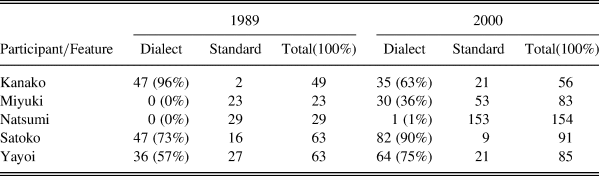
Table 4 below shows occurrences of negative morphology features in 1989 and 2000. Miyuki and Natsumi's discourse did not contain Kansai negative morphology at all in 1989, while Kanako, Satoko, and Yayoi used it for more than 50% of the time in both 1989 and 2000. Natsumi's use of Kansai negative morphology, along with other Kansai dialect features, is almost non-existent in both years, although she occasionally uses Kansai pitch accent. Miyuki and Natsumi both had upwardly mobile orientation, pursuing post-secondary education, which may have been a factor in their inclination to use standard Japanese in their interaction with Okano, an educated interlocutor.
Occurrences of negative morphology features.

Miyuki uses Kansai negative morphology thirty times in her 2000 interview, but never in the 1989 interview.Footnote 2 As mentioned earlier, Natsumi was present at Miyuki's interview in 2000, which may have affected Miyuki's use of Kansai dialect. However, Natsumi's participation was limited, and Miyuki's utterances directed to Natsumi were excluded from coding. Miyuki's use of Kansai negative morphology in 2000 could be due partly to her increased familiarity with Okano and the context of the interaction. But her general stylistic trend indicates low-dialect and high-desu/masu use, which is associated with a ‘self-presentational’ ‘on-stage’ stance (Cook Reference Cook2008:46). As she had progressed in her career within the same company, and was completing tertiary studies by distance, discussing work and professionalism with a passion may have called for frequent use of standard and desu/masu forms, invoking a ‘self-presentational’ stance. When she got emotionally involved, or talked jokingly, however, Kansai variety occasionally appeared. Below, she talks about her new role as an ‘artist’, a positive professional change from her former sales position. In lines 9–10, Kansai negative -hen is used, along with the Kansai copula -ya, although the first instance of negative (line 1) and aspect (line 6) markers are in standard Japanese (Kaori Okano is referred to as ‘KO’ in the examples throughout the article; for transcription conventions, see Appendix B).
(1) [Miyuki 2000]


In the next example, this same ‘balancing act’ is seen following Okano's suggestion that a former teacher may be able to help her find a boyfriend. Miyuki uses the Kansai negative plain form (shinyoo dekihen ‘cannot trust’) twice, and desu/masu form of the same verb (shinyoo dekimasen ‘cannot trust’). When a desu/masu form is chosen, there is no difference between Kansai and standard (-mahen is a possible alternative but it is no longer commonly used in these participants’ generation), and in this case a desu/masu form may serve as the effect of an official announcement (cf. Yoshida & Sakurai Reference Yoshida, Sakurai, Lakoff and Ide2005) to end the discussion of her relationship, or to emphatically reject Okano's suggestion.
(2) [Miyuki 2000]

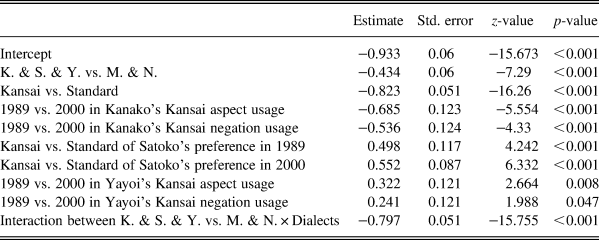
Yayoi's use of Kansai negative morphology in 2000 shows a significant increase from 1989 (β = 0.241, p = 0.047) (For a summary of statistical results regarding Kansai dialect and standard Japanese, see Table 9 in Appendix A). This may be partly due to the formal tone of Okano at the beginning of the 1989 interview, which Yayoi reciprocates. Example (3) below is the last part of this relatively formal stretch of talk. Okano uses a referent honorific -rareru in line 5. Miyuki and Natsumi are present in the room, and the formality may be intended to provide a frame for the communicative purpose of this stretch of talk, which was meant to elicit necessary information from Yayoi without her getting distracted by her friends. In line 7, Yayoi responds with a desu/masu ending erabimashita ‘chose’, but this occurs with a rising intonation and laugh. There is a sense of embarrassment over the formality and the presence of friends. Accordingly, Miyuki and Natsumi do not say anything in the first half of the interview, until they are asked their opinions later (note that Yayoi's utterances directed at them are excluded from coding).
(3) [Yayoi 1989]

While Yayoi still uses Kansai negative morphology far more than Miyuki and Natsumi (see Table 4 above), in the example below, Yayoi uses the standard Japanese negative form -anai as in kawar-anai ‘not change’.
(4) [Yayoi 1989]

But later on, as Okano begins to use more plain forms (see line 2 below in (5) yuwareta ‘was told’ in plain form) and non-standard forms, Yayoi's Kansai dialect features increase. She uses Kansai negative morphology more frequently, an example of which is found below (line 3 yuwahenkatta ‘didn't say’), along with a plain Kansai ending requesting confirmation yan ka (with the standard equivalent of ja nai? ‘didn't I?’). Nevertheless, yan ka is preceded by the standard variant itta ‘said’ instead of the Kansai variant yuuta, which is used in line 4. As in Miyuki's case above, Yayoi draws on both Kansai and standard variants of the same verb within a single turn, which is not uncommon in the data set.
(5) [Yayoi 1989]

Satoko's stylistic practice showed dominant use of Kansai dialect and plain forms. Her use of the Kansai variants is significantly more frequent than standard Japanese ones both in 1989 (β = 0.498, p ≈ 0) and in 2000 (β = 0.552, p ≈ 0).
In (6) below, Satoko is asked about her job interview and uses Kansai negative -hen followed by an interactional particle -nen (line 4). This turn also contains donai, a Kansai dialect form of doo ‘how’, and the verb iu ‘say’ in its Kansai dialect euphonic change (past) form yuuta. Both Okano and Satoko use plain forms, although interestingly, Satoko does not reciprocate the former's standard form for the verb itta but uses yuuta three times in her response. The diversion goes further from Doo yuuta (line 2) to Donai yuuta (line 4) as donai, a Kansai variant of doo ‘what/how’, is used in the latter.
(6) [Satoko 1989]

In contrast with Yayoi's 1989 interview, Satoko's 1989 interview starts in a more informal tone, with a reciprocal use of dialectal features used by Okano.
(7) [Satoko 1989]

Okano's question (line 1) does not contain dialectal features and ends with a noun without the copula desu. Satoko's response in line 3 contains the negative copula in standard Japanese -ja nai, which is now common among Kansai dialect speakers in her generation (instead of Kansai dialect ya nai; Takagi Reference Takagi2006), but in line 4 Okano uses an aspect marker -yoru, which is shared between Kobe and her own native Bingo dialects. Satoko reciprocates, with the conjecture auxiliary in Kansai dialect -yaro and laughter.
The interactive nature of stylistic choice is also found below in a conversation about employee pensions, where the negative form of the verb kangaeru ‘think’ occurs a number of times in both standard and Kansai/Bingo dialect.
(8) [Satoko 1989]

The first two occurrences of the verb kangaeru ‘think’, kangaenakatta ‘didn't think’, produced by Okano (line 1), and kangaenai ‘don't think’, produced by Satoko (line 6), are in a standard form. But Satoko's insertion question in line 3 has a Kansai clause final chau ‘isn't it’, and when pressed with the question in a Kansai/Bingo shared negative form kangaen, Satoko says kangaetehen, using a Kansai negative with a Kansai interactional particle -na in line 8. In the same response turn, Satoko turns to the shared variant kangaenkatta (line 9). This is followed by Okano's repeat of kangaenkatta (line 10), to which Satoko responds with exactly the same form. Like Trudgill's (Reference Trudgill1986) discussion of his own speech accommodation in his sociolinguistic interviews, the choice of regional variation in the above examples suggests that accommodation plays a significant role in Kansai-standard usage in our data set. While Okano's use of standard variants seems to trigger standard use among the participants, there is variation in the degree to which the participants’ use of dialect and standard variants are affected by Okano's variant choice in the preceding turn. Satoko, for example, tends to move away quickly from temporary accommodation to the standard in both the 1989 and 2000 interviews, but Kanako does not always reciprocate when Okano uses Kansai dialectal features (see Nakane Reference Nakane, Okano and Maree2018a). Nevertheless, reciprocity is also observed in that Okano rarely used Kansai/Bingo features with Miyuki and Natsumi who were consistently standard oriented.
The only participant whose use of Kansai negative morphology decreased from 1989 to 2000 was Kanako, and the decrease was significant (β = −0.536, p ≈ 0). This is unexpected given that she had married a local man soon after graduation and started a family, then moved to a close-knit fishing community where a branch of Kansai dialect is spoken (with the same negative morphology). The decrease could be explained partly by age-grading, particularly in this case: a diglossic situation where dialect speakers encounter more contexts where use of the standard variety is expected (Takagi Reference Takagi2006; Tanaka et al. Reference Tanaka, Naoki, Maeda and Aizawa2016). Since her final year of high school in 1989, Kanako has been exposed to a wider range of communicative contexts, while during her school years her time outside school was mostly dedicated to looking after her five much younger siblings. The decrease may also be an instance of a ‘neo-dialect’ that has been reported to emerge among younger speakers in Kansai (e.g. Sanada Reference Sanada1999; Takagi Reference Takagi2006) at a discourse level.
In example (9), where Kanako tells Okano about an unsuccessful outcome of a job application, a Kansai negative -te + hen ‘has not + past participle’ is used in line 2: kitehen ‘hasn't come’. The first verb in line 4, although within a quotation, also has Kansai negative morphology (and note Okano's standard variant of the same verb konakatta), and yuutotta ‘were saying’ is in Kansai progressive form. Furthermore, the stem of this verb shows a euphonic change u, a Kansai dialect feature.
(9) [Kanako 1989]

However, by 2000, -te + hen negative morphology has mostly been replaced by the standard -te + nai (kanri shitenai ‘don't manage’), as we can see below.
(10) [Kanako 2000]

Kanako, however, uses -te + hen in an utterance directed to her young daughter, suggesting that audience design is relevant in her regional variation choice (cf. Rickford & Price Reference Rickford and Price2013). The standard construction in line 2 also could have been triggered by Okano's use of the standard affirmative variant kanri shiteru instead of Kansai/Bingo kanri shitoru. But there are two Kansai dialect features (the verb oru and interactional particle nen) in this turn. Similar to Satoko in example (8), in example (10) Kanako responds using a standard variant of the verb that Okano uses in her question, but then Kansai features emerge as they expand on their responses. Nevertheless, Kanako's 2000 interview shows more extensive use of a wide range of stylistic resources exemplified in the above example. This does not necessarily mean her language has changed. The Kansai -te + hen construction is also used more than once in the talk after her husband comes home (this part is excluded from coding). The shift from -te + hen to the standard -te + nai has been reported as a recent trend among Kansai dialect speakers as a consequence of the increased influence of standard Japanese (Takagi Reference Takagi2006). However, the simple -hen negative construction is still prominent among Kansai youths (Takagi Reference Takagi2006), which is in line with the trend found in Satoko, Yayoi, and Miyuki.
Aspect markers
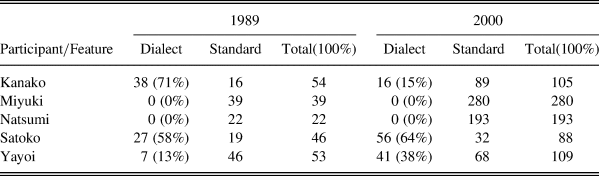
Miyuki and Natsumi did not use Kansai aspect morphology at all in both 1989 and 2000, as shown in Table 5. Kanako and Satoko were frequent users of Kansai (including Kobe) aspect morphology in 1989, but a pattern similar to that seen with Kansai negative morphology is also found whereby Kanako's use of Kansai aspect overall decreased significantly (β = −0.685, p ≈ 0) and Yayoi's increased significantly (β = 0.322, p = 0.008).
Occurrences of aspect morphology features.

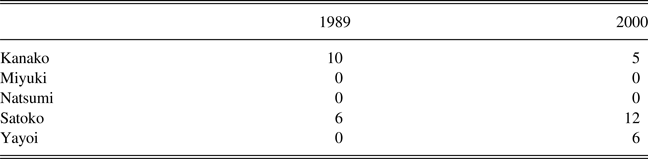
As shown in Table 6, Miyuki and Natsumi do not use Kobe aspect morphology -too at all, while Kanako and Satoko use it occasionally. Yayoi did not use -too at all in 1989, but did in 2000. This could be due to the different physical contexts of the talk, but her rapport with Okano was also likely to have increased, after sharing the emotional turmoil she had experienced in her marriage and divorce in an earlier interview. Below is an example where Yayoi uses -too (omottoo ‘thinking’) as she talks about the possibility of marrying again. Other Kansai features such as shiteshimoota ‘have done’ (line 1) and the copula ya (line 6) are found in Yayoi's turns, but Okano also uses a dialectal form dekin ‘can't do’ (standard dekinai), creating a good rapport between the two women.
(11) [Yayoi 2000]

In 2000, Yayoi uses a combination of aspect markers -teru (Osaka, Standard), -toru (farther west of Kobe) and -too (Kobe). In the example below, Yayoi uses -teru when talking about her career development, with which she plans to become more independent.
(12) [Yayoi 2000]

Occurrences of Kobe aspect morphology -too.

Talking about her career seems to create a context for standard variant use. Yayoi's Kansai dialect use in 2000 evokes family and private matters, which often involves recounting experiences where Kansai dialect was used. The increase in her use of Kansai morphology in 2000 could be explained by the more formal interactional and institutional contexts of the 1989 interview discussed earlier. What also sets Yayoi apart from Satoko and Kanako in 1989 is that Satoko had been in closer contact with Okano, and that Kanako's interview focused more on family and relationship, which may be associated with the two participants’ more frequent use of Kansai variants.
Clause-final forms
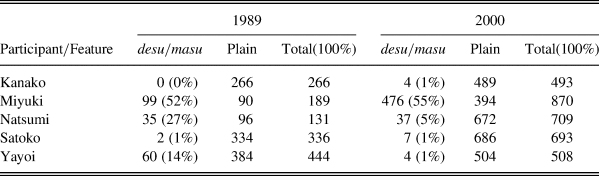
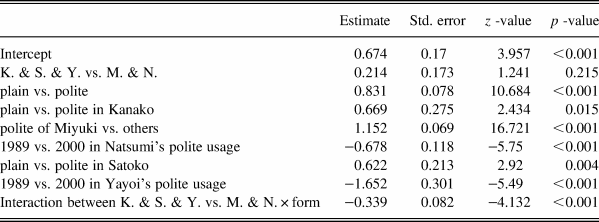
As Table 7 shows, a strong overall tendency to use ‘plain’ clause-final forms was found in Kanako (β = 0.669, p = 0.015) and Satoko (β = 0.622, p = 0.004). (For a summary of statistical results regarding plain and desu/masu forms, see Table 10 in Appendix A.) Yayoi was not as strongly oriented towards plain forms in 1989, but a significant decrease was found in her use of desu/masu forms between 1989 and 2000 (β = –1.652, p ≈ 0). Between the two interviews, Yayoi had shared with Okano intensely emotional experiences related to her marriage breakdown and relationships after the Kobe earthquake disaster. Her increased use of Kansai dialect features and plain forms suggests a shift towards an in-group, informal, and personal stance in 2000.
Occurrences of desu/masu and plain close-final forms.

In contrast, Miyuki more consistently used desu/masu forms than the others, with a significant overall difference from other participants’ frequency (β = 1.152, p ≈ 0). Most of her talk concerns her career, professionalism, and further education. In this regard, Miyuki's overall inclination towards polite forms is aligned with their indexical meanings of ‘professional’ and ‘knowledgeable’ party (Cook Reference Cook2008:47) stance. However, plain forms and Kansai features are sometimes used together in expressing humour or emotional intensity, drawing on the ‘off-stage’ and personalised stance (Barke Reference Barke, Cook and Shibamoto Smith2018:140) associated with the combination. Below, Miyuki jokes about having no time for a relationship.
(13) [Miyuki 2000]

Her joke contains three Kansai features -ya (standard plain copula -da), chuu (standard teiu), and particle nen (standard no da). Drawing on Kansai dialect's indexical associations with humour (SturzSreetharan Reference SturtzSreetharan2017a,Reference SturtzSreetharanb), Miyuki deals with the shift from a professional to personal topic.
The frequency of the desu/masu ending in Natsumi's speech significantly decreased in 2000 (β = −0.678, p ≈ 0). She often combined plain clause-final forms with a stereotypically feminine particle combination -no ne (Okamoto Reference Okamoto, Hall and Bucholtz1995) that seeks agreement, which did not occur in 1989. Natsumi's 2000 discourse is also characterised by a frequent use of high rising terminal (HRT). HRT in Japanese is claimed to attract the addressee's attention efficiently and allows the speaker to continue talking without imposing on the addressee (Inoue Reference Inoue1998), which makes its pragmatic functions similar to those of ‘uptalk’ in English (Warren Reference Warren2015). Japanese HRT spread from the Tokyo metropolitan area since the 1970s, and is associated with ‘youth, sweetness, cuteness, superficiality’ (Kibe, Takeda, Tanaka, Hidaka, & Mitsui Reference Kibe, Takeda, Tanaka, Hidaka and Mitsui2013:41, authors’ translation).
(14) [Natsumi 2000]

In example (14) above, Natsumi's HRT and no ne in lines 1–2 is accompanied by short pauses, but Okano does not provide response tokens or any feedback. Her utterance in line 3 does not indicate clear understanding, thus prompting Natsumi's offer of a paraphrase. They continue with plain forms, co-constructing a conversation on Nastumi's recent career history.
The decrease in desu/masu forms points to a more informal context and reduced social distance from Okano. Her frequent HRT and interactional particle -no ne use allows her to engage in narrative construction in a non-assertive and collaborative way. Natsumi's dominant use of standard Japanese morphology can also be interpreted as accommodating to Okano's stylistic practice, but combined with HRT and -no ne, her stylistic practice also contributes to ‘cosmopolitan’ and ‘educated’ personae vis-à-vis Okano's institutional identity within the context of interaction.
Turning to Kanako, although her discourse is consistently plain-form dominant, it is worth examining her limited desu / masu form use in 2000. Below, she uses desu as she explains different types of shellfish. This indexes a ‘knowledgeable’ party (Cook Reference Cook2008:47) and her ‘official’ capacity (Barke Reference Barke, Cook and Shibamoto Smith2018:129) as a member of her local fishery community.
(15) [Kanako 2000]

Kanako demonstrates more stylistic resources to navigate her mature and multifaceted identity in 2000 in her interaction with an older, well-educated and non-Kansai background interlocutor. There is also better rapport with Okano, as she now shares experiences of motherhood, marriage, and relationships with in-laws.
Discussion
Divergent stylistic practice across participants and time
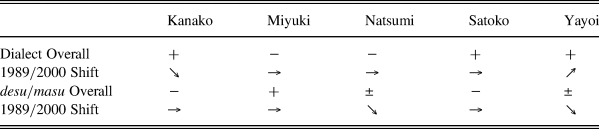
In order to capture an overall picture of inter- and intra-participant variation, the participants’ orientations to the key features are summarised in Table 8 below.
An overview of dialect/standard and desu/masu/plain form orientation.

The participants in this study shared their life stories with the same researcher in ethnographic interviews. Although they share a similar background, different orientations to ethnographic interviews were found in 1989 and 2000 in relation to the use of Kansai dialect, Kobe dialect, and standard Japanese, and clause-final forms. As per Table 8, overall, we see that Kanako and Satoko are strongly oriented towards Kansai dialect and plain forms, while Miyuki is inclined towards standard Japanese and desu/masu form usage.
An important finding is that the participants showed varying stylistic orientations in their first recorded interaction with Okano at school in 1989, even as they moved through the same set of topics. That is, they took varying stances through their stylistic practices and projected different personae vis-à-vis the researcher-interviewer Okano. For example, Satoko's stylistic practice, in reciprocating Okano's use of plain form and occasional use of Kansai/Bingo dialect features, created a generally informal conversational context with a well-developed rapport (as mentioned earlier, Satoko was in more frequent contact with Okano during the 1989 fieldwork). By contrast, Miyuki's greater inclination towards standard Japanese and desu/masu forms in comparison with other participants contributed to the prominence of her ‘professional’ ‘on-stage’ stance (cf. Cook Reference Cook2008:47). Her stylistic patterns point to the institutional nature of the speech event as an interview. This contrast is consistent with the association of dialect and plain form use with personal, private, and ‘off-stage’ indexical values, and of standard and desu/masu form use with impersonal, official, and ‘on-stage’ indices as seen in Barke's (Reference Barke, Cook and Shibamoto Smith2018) study of style shifting among employees at a company in Osaka.
Regarding the question of shifts across time, some notable variation emerged: a decrease in Kanako's Kansai morphology frequency, an increase in Yayoi's frequency of Kansai morphology, and a decrease in desu/masu frequency in Natsumi and Yayoi. Natsumi and Yayoi's similar shift in clause-final form frequency can be attributed to their enhanced rapport with Okano, given the increase in shared knowledge about each other's personal lives from 1998 to 2000. In addition, the institutional setting of the 1989 interview is likely to have affected the formality of interaction. The relatively formal setting of the 1989 interview, and Okano's initial formal approach also provided a context for an ‘on-stage’ discursive stance with more standard Japanese features in Yayoi's interview. Regarding the contrasting decrease in Kanako's Kansai feature use in 2000, considering its private home setting and rapport between the interlocutors, we postulate that life stages and experiences play a role. Eckert (Reference Eckert and Coulmas1997:167) argues that it is important for variation studies to focus on life stages and associated experiences ‘that give age meaning’, rather than on biological age. Between the two interviews, Kanako's school- and family-focused social network expanded through life events such as employment, marriage, childbirth, relocations, and purchase of a property. By 2000, she had also settled in her adopted fishing community with various social roles as a mature adult. Kanako's convergence towards Okano's standard-dominant discourse style in 2000 might indicate an expansion of her stylistic repertoire due to her widening social network. In our separate study of Kanako's discourse over a twenty-seven-year span, her stylistic practice shows variability over the years and within each interview (Nakane Reference Nakane2018b; Takagi, Okano, Iwasaki, Tanaka, Nakane, & Maree Reference Takagi, Okano, Iwasaki, Tanaka, Nakane and Maree2019). The shifts in her stylistic practice could also point to her being a ‘stylistic chameleon’ who is skillful at altering style ‘depending on addressee, topic, and projected persona’ (Rickford & Price Reference Rickford and Price2013:143).
Stylistic practice and social meanings in ethnographic interviews
The study has revealed a range of social meanings associated with Kansai dialect, standard Japanese, and plain and desu/masu forms in the ethnographic interviews. We contend that standard Japanese indexes a formal stance invoking an ‘interview’ context, where the participants’ interactional role to answer Okano's questions is foregrounded. This institutional aspect of the interaction, characterised by the researcher's initiation of topics and questions, invokes an ‘official’ stance associated with standard Japanese. The indexical values of ‘professional’ and ‘cosmopolitan’ personae are also associated with this ‘official’ and ‘institutional’ stance, as seen in Miyuki and Natsumi's consistently low use of Kansai dialect features. However, as question-answer sequences expand into co-constructed narratives, Kansai variants may emerge if the participants (re)orient themselves to a solidarity-oriented or informal stance, or if the ‘interview’ framing of the interaction shifts to a more friendly ‘conversational’ framing as personal matters such as family and relationships are introduced. Related to this ‘off-stage’ stance is emotional intensity and humour indexed by the use of Kansai dialect (cf. SturtzSreetharan Reference SturtzSreetharan2017a,Reference SturtzSreetharanb; Barke Reference Barke, Cook and Shibamoto Smith2018), as shown in Miyuki's example in (13).
The analysis also provides support for the idea that the desu/masu forms not only index a formal ‘interview’ stance but a range of social meanings such as ‘professional’ identity, ‘knowledgeable’ party, and ‘official’ capacity of the speaker. By contrast, plain form usage pointed towards solidarity oriented, personal, and ‘off-stage’ stances. It thus seems that Kansai dialect and plain form on the one hand, and standard Japanese and desu/masu forms on the other, each share similar indexical fields. However, our examples also demonstrated that a close relationship between interlocutors and cosmopolitan personae could be indexed together by the combination of plain form and standard Japanese, as well as a professional identity strongly embedded in a local community.
The stylistic practice in this study also showed reciprocity, thus highlighting the role of Okano's use of discursive resources in the participants’ turn-by-turn stance taking. Furthermore, the fact that Okano is the sole interviewer in the recurrent interviews ensures control of the participants’ addressee, but it also means that rapport and shifting relationships between her and the participants emerged as an important variable in analysing variation.
Finally, the analysis should also be put in the context of societal/community level language shifts and shifting language regard—beliefs about and attitudes towards language varieties, their distribution, and speakers (Preston Reference Preston2010). Since the 1990s, Japan has gone through hoogen buumu ‘dialect boom’, where dialects have come to be treated almost as commodities and appreciated for their ‘cute’ image (Shibamoto Smith & Occhi Reference Shibamoto Smith and Occhi2009). As a part of this ‘boom’, Kansai dialect regained its positive value, and was the most-liked dialect for Tokyo dialect speakers (Jinnouchi Reference Jinnouchi2007). This may also have played a role in the increased or sustained use of Kansai features by some participants, such as Yayoi and Satoko.
Conclusion
This study has revealed the complexity of the way in which stylistic practice varies and shifts when speakers from different dialect backgrounds interact in regular intervals over a long period of time. Although the five women from Kobe shared similar backgrounds from the perspective of a traditional sociolinguistic framework, their stylistic practice showed three types of variability: (i) within individual participants’ talk, even within the same interview; (ii) across participants; and (iii) for a given participant, across the two occasions eleven years apart. This highlights the complexity of the relationship between language, identity, and mobility, but at the same time foregrounds the importance of exploring encounters between people from conventionally different social ‘categories’ in sociolinguistics such as those between the interviewees and the interviewer in this study. Such encounters occur regularly with increased mobility in our society. We hope that this study has shed light on mobility, language, and identity and offered insights into language across the lifespan.
Appendix A: Results of statistical analysis
Coefficients of the generalised linear mixed effect model fitted to the Kansai vs. standard frequency data.

Coefficients of the generalised linear mixed effect model fitted to the plain vs. desu/masu frequency data.

Appendix B: Transcription conventions
- ,
continuing intonation
- ?
rising intonation
- .
completed intonation
- (.)
micropause of less than 0.2 seconds
- (1.5)
pause in seconds
- bold
item discussed in the text
- hh
hearable aspiration
- .hh
hearable inbreath
- (( ))
comment by author
- :
lengthening
- −
truncated word
- =
contiguous utterances (no break or gap)
- [
onset of overlap
- ]
end of overlap