

The purpose of this article is to present a philosophical analysis of virtuous and non-virtuous leaders using Plato’s conceptualization of five leadership types. Plato’s philosophical analysis in the Republic delves into the psychology, virtues, and vices that make up a leader’s character. The philosophers who resurrected the virtue ethics tradition have increased our understanding of virtue and the good life (Audi, Reference Audi2012; Hursthouse, Reference Hursthouse1999; Sison, Hartman, & Fontrodona, Reference Sison, Hartman and Fontrodona2012; Swanton, Reference Swanton2005). Plato’s model offers a slightly different perspective from Aristotelian virtue ethics because he specifically addresses the virtues of leaders. While Plato focuses on political leaders, his analysis can address the duties and responsibilities of today’s corporate leaders as well.Footnote 1 Newton explains that, “The achievement of the excellent corporation is the same as that of Plato’s fully realized state: it allows the human beings within it, with all their faults, to fulfill their potential and become all they can be” (1986: 254).
In this article I explain Plato’s leadership model as presented through the voice of Socrates. I first describe the foundations of Plato’s account which include the connection between virtue and knowledge, and also his view of persuasive rhetoric. I then review each part of Plato’s leadership model. He details the desires that drive leaders, the virtue and lack of virtue that dominate their lives, and how leaders can become wise philosopher-leaders or degenerate into vicious tyrants. I relate each leader type to a modern business example and outline how managers and investors can use the leadership model today.
Note that I refer to Plato’s and not Socrates’ leadership account because I believe it best represents the final voice given to these ideas. Socrates never wrote any books, but his student Plato wrote dialogues that more or less represent Socrates’ ideas. The early Socratic dialogues (e.g. Laches, Charmides, Euthyphro) are believed to represent Socrates’ actual dialogues about defining virtues. According to Vlastos, these earlier dialogues present Socrates using his “elenctic” method by which he uses questions to make his interlocutor reexamine personal beliefs about a virtue such as courage or piety (1991: 46). Aristotle confirms that some of these ideas were not Plato’s (Irwin, Reference Irwin1995: 5). The transitional, middle, and later dialogues are considered to present more of Plato’s systematic ideas even though they are often presented through Socrates.
The dialogue that outlines Plato’s leadership model is the Republic. In the Republic Plato uses Socrates to argue that being just is better than being unjust, even if one benefited from being unjust. The Republic is composed of ten books and Vlastos considers book I to be an early Socratic dialogue (1991: 47). The other nine books represent Plato’s systematic development of various ideas on education, politics, and leadership. For the purposes of this article I attribute arguments in the Republic and other dialogues to Plato; however, the reader should note that these ideas may reflect Socrates’ views to some extent. I follow Vlastos when he contends that Plato is writing about a great philosopher. He states, “Even so, the writer’s overriding concern is always the philosophy—the truths affirmed by Socrates, defended by his arguments, realized in his life, propositions which if true for Socrates are true for every human being” (Vlastos, Reference Vlastos1991: 51). For a similar argument that Socrates’ ideas are represented in the Republic see Christopher Rowe (Reference Rowe and Ferrari2007: 27-54).
THE FOUNDATIONS OF PLATO’S LEADERSHIP ACCOUNT
Plato’s leadership account rests on two conceptual pillars. The first is that virtue focuses on an agent’s character and knowledge more than principles. The second pillar is that the worst leaders are those who lack knowledge and use persuasive speech for unjust ends.
Ethics, Virtue, and Knowledge
The word ethics comes from the Greek ethos which means character or custom. The Greek ethos focus is agent-centric because it explains how to become a virtuous person. Parry explains that ancient philosophers “are concerned about the state of mind and character, the set of values, the attitudes to oneself and to others, and the conception of one’s own place in the common life of a community that belong to just persons simply insofar as they are just” (2014). Unlike principle-centric ethics, a virtue ethic does not seek guiding principles. In the Nichomachean Ethics, Aristotle states that he can only formulate principles that “indicate the truth roughly and in outline” because the premises and arguments “hold good usually” (1094e).Footnote 2 Just as physicians must use experience, practice, and principles when exercising their craft, a leader must develop experience and character in addition to understanding principles. Virtue ethics literature has connected this ancient study to our modern analysis of ethical leadership (Bauman, Reference Bauman, Sison, Beabout and Ferrero2017; Sison et al., Reference Sison, Hartman and Fontrodona2012).
One may ask if an ethical leader is the same as a virtuous leader. To bridge between modern principle-centric ethics and Plato’s view, I assume that a virtuous leader would be regarded as an ethical leader. A virtuous leader would consistently act in accordance with ethical standards because of his/her moral psychology and virtuous dispositions. For example, telling the truth and not harming innocent people emerges from a virtuous character. On this abstract account, a virtuous leader behaves ethically and a vicious or non-virtuous leader behaves unethically.
Another aspect of Plato’s virtue account is his claim that the virtues are somehow part of a whole. Plato discusses the unity of the virtues in the Laches, Charmides, and Protagoras. In the Laches, Socrates allows his interlocutor to hold that knowledge of what is good and evil is necessary, though not sufficient, to be courageous (Irwin, Reference Irwin1995: 40). He also explains that a courageous person would have the knowledge of “all goods and evils put together” and that this person would also not lack “temperance or justice and holiness” (Laches, 199d-199e ).Footnote 3 Socrates then implies that “virtue entire” requires a complete knowledge of good and evil, though he leaves open the possibility that each virtue has its own specific knowledge of good and evil. In the Protagoras, Socrates also appears to equate virtue with knowledge. Protagoras reflects that Socrates believes that justice, temperance, and courage are knowledge, and that virtue itself is knowledge (Protagoras, 361b). Socrates argues his point by noting that wisdom about what is to be feared and not feared is courage, and ignorance of this is cowardice (Protagoras, 360d).
Scholars have analyzed Plato’s unity of the virtues account at length, and resolving this puzzle is beyond this article’s scope (Clark, Reference Clark2015; Irwin, Reference Irwin1995; Santas, Reference Santas and Vlastos1971). However, the connection between virtue and knowledge reveal two important claims about virtue. First, a virtuous person must acquire knowledge of good and its opposite. For example, a just person must know what justice requires and this requires knowledge of justice and its opposite. Though Socrates did not claim to know the essence of each virtue, he did spend his life seeking them by questioning others. Plato also explains that true philosophers naturally love learning and “struggle toward what is… he neither loses nor lessens his erotic love until he grasps the being of each nature itself with the part of his soul that is fitted to grasp it” (Republic, 490b). A person cannot be virtuous without knowing the essence of each virtue.
Second, a virtuous person will also understand that he or she does not know everything about virtue (Philippoussis, Reference Philippoussis1999). In the Apology, Socrates explains that he examines those who society considers wise because he wants to become wise. His questioning method also reveals that his targets do not know what virtue is. Socrates questioned politicians and writers because they appeared to be the wisest citizens. He explains, “I found that those who had the highest reputation were nearly the most deficient, while those who were thought to be most inferior were more knowledgeable” (Apology, 21 e). He discovered that success in one area of life often inflated the egos of leaders and closed them to a further search for truth. He wanted his interviewees to acknowledge their lack of knowledge so that they would turn toward true wisdom which he equated with a good and fine life.Footnote 4 The virtuous person, therefore, realizes that he or she lacks knowledge and turns to seek what is real and true.
Leadership and Rhetoric
Knowledge also plays a critical part in how leaders persuade people. Plato distinguishes between those citizens without knowledge who persuade crowds and those with knowledge of virtue who inspire others. In ancient Greece, they labeled the first group orators and they would use rhetoric to persuade others to believe anything they wanted. Rhetoric could be beneficial if the orator convinced citizens to avoid real danger or injustice, but it could also be harmful if an orator used persuasion for unjust ends. In the Gorgias, Socrates challenges the famous orator Gorgias to explain what rhetoric is actually about. Socrates states, “Oratory doesn’t need to have any knowledge of the state of their subject matter; it only needs to have discovered some device to produce persuasion in order to make itself appear to those who don’t have knowledge that it knows more than those who actually do have it” (Gorgias, 459c). An orator could use rhetoric without knowing what is “just and unjust, what’s shameful and admirable, what’s good and bad” (459d). Plato is concerned that orators with no knowledge of good and evil will harm the audience and lead them astray (Irwin, Reference Irwin1995: 96).
Because virtue requires knowledge, any leader or teacher who uses rhetoric without knowledge could do great harm, especially to those potential leaders who naturally love learning. Plato explains that sophists or private teachers can also mislead and corrupt the best students when they replace knowledge with popular opinion. He explains that these teachers use assemblies to loudly praise, blame or object with “clapping and shouting” to guide the crowds to accept their views or to reinforce the crowd’s views (Republic, 492c). Talented young people are carried away with the crowd’s voice and no knowledgeable sophist will be able to privately undo the damage done (Republic, 492d). According to Plato, the main knack the sophists and orators have is recognizing the “moods and pleasures” of the crowd and then teaching students how to manage them. They do not teach what is actually “fine and shameful, good or bad, and just or unjust” (Republic, 493b).
In contrast to those who lead by mere flattery and persuasion, a person who is a lover of knowledge (i.e., a philosopher) seeks to know the truth of what is fine and good, and just and unjust. Above I explained that a virtuous person has the knowledge required for virtue and also knows what is fine and good. This person also understands that he/she does not know everything. A potential leader develops these characteristics through proper teaching about what is true through math, science, and dialogue. The result is a person who Philippoussis describes as humble, noble, honest, sincere, “a truly gentle person with dignity and integrity” (1999: 117). He explains that this person does not seek to lead others, but he “would be elected or selected (drafted or compelled, if need be) by the people themselves to be their leader” (1999: 117). Why? Because the virtuous person knows what is good and evil and lives according to this knowledge. Plato explains that the ideal city will be governed, not by “people who fight over shadows and struggle against one another in order to rule—as if that [ruling] were a great good—but by people who are awake rather than dreaming” (Republic, 520d).
Plato does approve of a virtuous and knowledgeable person using rhetoric and persuasion to lead others to the truth (see Phaedrus), but only in this instance (Sison, Reference Sison2003: 40). Aristotle, who considered rhetoric to be morally neutral, also identifies virtue as a critical part of persuading others. A leader will need to persuade others through arguments (logos), but also through character (ethos). Aristotle also explains that an aspiring leader requires personal qualities such as virtue, practical wisdom, and good will (Rhetoric, 1378a). Combining the skill of persuasion and the personal qualities that Plato endorses, Sison describes how a virtuous leader persuades others. He states, “A person who displays the characteristics—constitutive not only of trustworthiness or credibility but also of moral capital—necessarily becomes persuasive to his listeners. Because of this, most likely, he’ll also be successful and effective as a leader” (2003: 41).
Plato uses the pillars of virtue-as-knowledge and persuasion-with-character as foundations for his leadership model in the Republic. In the next section I describe Plato’s moral psychology and the virtues that describe the five types of leaders.
DEVELOPING A JUST LEADER IN A JUST CITY
The Republic’s story line starts with Socrates’ interlocutors asking him to defend the benefits of living a just life. His associates argue that justice may be beneficial to others, but is not beneficial to oneself in all cases. Some unjust actions seem beneficial especially if one is a tyrant or can avoid punishment.
Plato uses the analogy of a hypothetical city to investigate the virtue of justice. Socrates divides the people in the city into three classes: producers (craftsmen, money-makers, farmers), guardians (trained soldiers), and rulers (highly trained guardians and wise leaders). His argument in the Republic rests on his comparison of city classes with a person’s moral psychology. For Plato, just as a city has classes, the soul has parts. Just as the classes in the city have certain virtues, the parts of a person’s soul tend to express themselves in virtues. I review Plato’s arguments for the tripartite partition of the soul, the objects of pleasure for each part of the soul, and the virtue that characterizes each part.
The Tripartite Soul
If you have ever felt pulled in different directions regarding a decision, you have felt how one person can feel divided. Experiments in decision making reveal how various brain “systems” interact and may create feelings of conflict. The brain’s automatic or intuitive system often acts quickly while the more deliberative system requires attention to detail and mental effort (Kahneman, Reference Kahneman2011: 21). For example a CEO may be automatically optimistic about an opportunity, but may also doubt its value after further consideration. If the CEO allows his/her optimism to rule over the facts, the CEO will often overpay for an acquisition and destroy value (Kahneman, Reference Kahneman2011: 258).
In his own sophisticated way, Plato describes these conflicts by positing three parts of a soul. Philosophers have questioned the helpfulness of this tripartite explanation, but for Plato’s purposes the explanation identifies internal forces that today we could relate to different areas of the brain.
One part of the soul is the appetitive part. This part of the soul is animal-like. It “lusts, hungers, thirsts, and gets excited by other appetites” (439d).Footnote 5 Plato’s examples include hunger, thirst, sex, and other things that bring pleasure. According to Cooper, they originate from the agent’s own enjoyable experience and can be controlled (1984: 12). For example, a thirsty person will not drink poison. The appetitive part seeks pleasure and the fulfillment of desires—some good for the person (e.g. hunger for food) and some not (e.g. desiring another man’s wife).
A second part of the soul is the spirited part which is known for anger. The spirited part is separate from the appetitive part because a person may become angry at his or her appetites. For example, a person may desire not to exercise and then becomes angry because she wants to have a desire to exercise. Another example of the spirited part is when someone reacts angrily when treated unjustly (Irwin, Reference Irwin1995: 213). Cooper observes that the spirited part expresses competitiveness and a desire for esteem by others (1984: 15). The person’s spirited part will “endure hunger, cold, and the like and keep on till it is victorious, not ceasing from noble actions until it either wins, dies or calms down, called to heel by the reason within him” (440d). The spirited part does have some beliefs. Irwin notes that the spirited part has evaluative attitudes about the “goodness or badness of its object, apart from the fact that it is simply an object of desire” (1995: 212).
The third part of the soul is the rational part. It is different from the other two parts because it calculates what is better or worse for the entire soul. The rational part ideally governs the appetitive part when the appetites want to fulfill desires that do not lead to a good life. Also, the spirited part rarely conflicts with the rational part nor will it become an ally of appetites against reason (440b-e). To clarify this point, Plato explains how Odysseus was furious that his servant girls were sleeping with suitors in his home. Odysseus resists acting on his anger because the rational part knows that the timing for punishment is not right. “For here Homer clearly represents the part that has calculated about better and worse as different from the part that is angry without calculation” (441b).
The appetitive and spirited parts appear to be missing the ability to determine what is better and worse for a person, “all things considered, for myself as a whole” (Irwin, Reference Irwin1995: 215). Irwin explains, “In claiming that the rational part is the source of optimizing desires, Plato implies that it is guided by a conception of the agent’s overall happiness or welfare (eudaimonia) and that the other parts are not guided by it” (Irwin, Reference Irwin1995: 215). The appetitive and spirited parts have their own evaluative abilities when it comes to satisfying an appetite or determining what is causing anger. The rational part is unique because it seeks what is good for the whole soul, desires to know the truth, and also desires to rule the soul (Cooper, Reference Cooper1984: 6).
Plato’s moral psychology also links each part of the soul with a corresponding pleasure and object to which it is attracted. The appetitive part is the largest and strongest part because of its intensity of desire for food, drink, and anything associated with pleasure. Plato calls this part the money or profit-loving part “because such appetites are almost always satisfied by means of money” (581a). The spirited part is attracted to victory, honor, and a good reputation. Plato says that the spirited part should be called the honor-loving part because these are the objects to which it is most attracted. The rational part of the soul seeks the truth, or the true nature of things, and loves to learn. It is different from the other two parts because it desires truth over money and reputation. The rational part is labeled the learning-loving or philosophical part. We identified the importance of this part in the discussion of virtuous people and their natural hunger for knowledge.
Plato is doing more than making interesting distinctions by describing these three objects of attraction. He argues that they represent three types of people: profit-loving, honor-loving, and philosophic. Each type of person loves and is attracted to specific objects of value and ignores the others. The profit-lover may see no use in honor or learning unless they produce more money. Similarly, the philosophical person may value seeking the truth more than seeking money. The three types of people agree that a good life is about being happy (eudaimonia), but they disagree on which type of life produces happiness: the life of wisdom, honor, or wealth. These three attractions become the motivations for Plato’s five types of leaders.
The City and the Four Cardinal Virtues
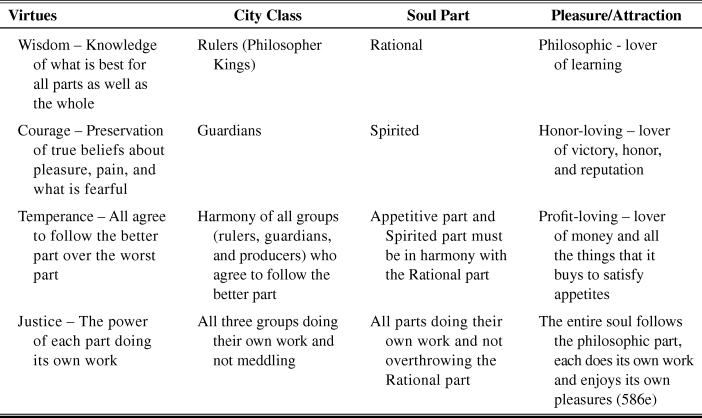
Plato’s partitioning of the city (and the soul) provides a framework for discussing the virtue found in each part (see Table 1). He uses the city model to describe the four cardinal virtues: wisdom, courage, temperance, and justice (427e).
Plato’s Moral Psychology Framework

The first virtue Socrates finds in the ideal city is wisdom or phronesis. Phronesis means prudence and practical knowledge of what to do at the right time, in the right place, and in the right way. Wisdom in the ideal city is found in those highly educated and trained guardians who become rulers. The virtue of wisdom pertains to “the city as a whole and the maintenance of good relations, both internally and with other cities” (428c). Wise leaders harmonize the classes, resolve conflicts among competing parties, and successfully manage relationships with other cities. Plato notes that this group is small and relatively weak compared to the other groups in the city (428e).
The virtue of courage is found in the guardians or soldiers who are trained to fight for the city. In line with the virtue-as-knowledge thesis, Plato explains that a courageous person maintains beliefs about what is to be feared and what is not to be feared. The guardians demonstrate courage when they preserve their unalterable belief that defending the city is pleasure and fleeing the battle is pain. Plato argues that the virtue of civic courage is based on knowledge because no animal could demonstrate this type of courage. The city must be defended through any circumstance, regardless of desires, pleasures, pains, or fears (429d).
The third virtue in the city is temperance or moderation. The Greek term sophrosune can mean self-control, common sense, or being reasonable. It refers to a person who is calm under pressure. Plato expands the virtue in the context of self-control. He argues that a person has self-control when the “better part” of one’s soul is controlling the worst part. Plato concludes that the few in the city who have the better desires and wisdom must control the inferior desires of the masses: “Therefore, if any city is said to be in control of itself and of its pleasures and desires, it is this one” (431d). The control comes when leaders and followers share the same knowledge about who should rule. The virtue of temperance is an agreement between the “naturally worse and the naturally better as to which of the two is to rule both in the city and in each other” (432a). Temperance then is found across all groups and is a type of emergent harmony, while wisdom and courage are found in specific groups.
It is worth noting that Plato, like Aristotle, believes that different people have different natures that make them superior or inferior for positions. For example Plato states that diverse desires and pleasures are mostly found in “children, women, household slaves, and in those of the inferior majority who are called free” (431c). Our modern sentiments may find these distinctions degrading because conventional values hold that every human is equally valuable. But note that Plato supports gender equality in governing. He explains that a farmer’s boy or girl could be recognized as having the nature of a guardian, and therefore women are not excluded from the highest positions in the city. In Republic book V, Plato argues that women should be trained as guardians. He concludes, “Therefore, men and women are by nature the same with respect to guarding the city, except to the extent that one is weaker and the other stronger” (456a). Therefore, Plato’s leadership model applies to both male and female leaders.
The fourth and possibly most important virtue is still hiding in the city. Where is justice? Plato claims that justice is built on the foundation of citizens doing what they are naturally best suited to do whether it is business or ruling. Justice in the city is “doing one’s work and not meddling with what isn’t one’s own” (433b). He explains that when wisdom (i.e., rulers who harmonize relationships), courage (i.e., preserving beliefs about what is truly pleasurable and fearful), and temperance (i.e., the harmony of all groups agreeing on what is best) exist in the city, justice “is the power that makes it possible for them to grow in the city and that preserves them” (433c). Justice emerges when citizens do their own work and it contributes more to the virtuous city than the other three virtues.
Plato provides two examples of justice. The first example is of judges who deliver judgments that “no citizen should have what belongs to another or deprive of what is his own” (433e). This fits with justice in regards to pay, property, and fulfilling our obligations to each other. The second example is of citizens working beyond their natural abilities. Plato claims that each person is gifted by nature and can be trained easily to do some work and not other work. Reeve argues that Plato is not putting people in the three citizen groups by natural aptitude, but is instead recognizing that a person’s “ruling desires set an upper limit to his cognitive development” (1988: 174). In other words, not everyone has a desire to make bread in the producer class, so this person could become a carpenter if it fits his or her limit of cognitive development. Also, the city is not harmed by this exchange. What is vital for justice is that “each person in the Kallipolis (city) must practice the one craft, whether producing, guardianship, or ruling, that demands of him the highest level of cognitive development of which he is capable: money-lovers must be producers of some kind; honour-lovers must be guardians; philosophers must be kings” (Republic 434a-b) (Reeve, Reference Reeve1988: 174).
Plato claims that people seeking roles that are beyond their cognitive development produce injustice or a lack of order. A citizen who is naturally a producer (i.e., craftsman or money-maker) may become proud because of wealth or personal strength, and then try to become a soldier while lacking the natural abilities and training. Or a soldier who is untrained in wisdom and truth may attempt to become a guardian and leader of the city. Or someone tries to do all of the jobs in the city because of an arrogant belief that success in one part of the city transfers to all parts of the city.
Plato argues that different classes exchanging tools and continually meddling produce the greatest harm that could happen to the city (434b-c). The purpose of a good life is happiness and fulfillment and these ends cannot be achieved in a city unless wise, highly trained leaders harmonize different groups. Constant rebellions, civil wars, and class battles destroy happiness for everyone. If justice is the power that emerges when all virtues are present, then the city’s greatest guarantee of happiness is each group doing what they are best suited to do. The greatest threat is arrogant citizens who bully their way into power without the training, wisdom, and natural abilities to harmonize the groups. They are leading to satisfy their own desires for wealth, power, or reputation. Therefore, injustice is the greatest threat to the city’s flourishing.
The parts of the city can now be connected to the parts of the soul and also to the four virtues. The rational part (i.e., rulers) should lead because it is wise and looks out for the health of the whole soul. The spirited part (i.e., guardians) is an ally of the rational part and obeys it. These two parts are harmonious because they are continually learning and reflecting on stories that encourage true beliefs about pleasure, pain, and fear. The appetitive part (i.e., producers and money-lovers) is the largest part of the city and the soul. The rational and spirited parts must govern the appetitive part and ensure that it does not overpower them and enslave them for its own purposes of pursing “so-called pleasures of the body” (442b).
In terms of virtues, the soul is called courageous when the spirited part preserves the rational part’s beliefs about what is to be feared and what is not to be feared, even when confronted with pains and pleasures that tempt it to forget. The rational part is what makes a soul wise because it has knowledge of what is best for each part of the soul as well as the whole soul. A soul is temperate when the three parts believe that the rational part should rule (i.e., the better part) and the appetites avoid warring against rationality (442a-e).
Finally justice is the virtue that guides a person to do what is fine and good and avoid what is shameful and bad. In the negative sense, he does not steal money, betray friends, disrespect parents, commit adultery, nor neglect the city’s gods. The reason why he doesn’t do these things is because, “every part within him does its own work whether it is ruling or being ruled” (443b). Plato elaborates on this point because it leads to the conclusion that justice is beneficial.
One who is just does not allow any part of himself to do the work of another part or allow the various classes within him to meddle with each other. He regulates well what is really his own and rules himself. He puts himself in order, is his own friend, and harmonizes the three parts of himself like three limiting notes in a musical scale—high, low and middle.…And when he does anything, whether acquiring wealth, taking care of his body, engaging in politics, or in private contracts—in all these, he believes that the action is just and fine that preserves his inner harmony and helps achieve it, and calls it so, and regards it as wisdom the knowledge that oversees such actions. And he believes that the action that destroys this harmony is unjust, and calls it so, and regards that belief that oversees it as ignorance (443d-e).
Injustice in a person occurs when the rational, spirited, and appetitive parts stray out of their natural roles and beyond their abilities. Courage becomes cowardice, temperance becomes lawlessness, and wisdom becomes ignorance (444b). A person who lacks the proper knowledge for each virtue becomes vicious.
The soul’s actions can also feed or neglect the virtues. By their reinforcing nature, actions either establish proper leadership in the soul or exalt unruly desires. “Fine ways of living lead one to the possession of virtue, shameful ones to vice” (444e). The interaction between actions and the three parts of the soul cannot be separated. It is not only that the virtues produce fine actions, but that virtuous actions improve the soul’s health as each part fulfills its unique purpose. In recent discussions of moral action and cognition we would say that the actions “tune-up” the moral modules within a person (Sadler-Smith, Reference Sadler-Smith2012).
Plato’s framework offers a dynamic perspective on how virtue arises in a city, and by analogy a corporation and a leader. For example, consider how a business leader may be tempted to commit accounting fraud if an increase in profit results in a larger bonus. By nurturing the money-loving part, she allows the appetitive part to act in a way that the rational part would consider harmful for the whole. In the next section I describe Plato’s five leader types using this framework.
PLATO’S FIVE LEADER TYPES
Plato continues his discussion of cities and character by describing a virtuous leader and four progressively less-virtuous leaders. The five leaders are: the philosopher-king (aristocratic), the timocratic (honor-loving), the oligarchic (money-loving), the democratic (minimally appetite-loving), and the tyrant (uncontrolled appetite-loving). Plato first describes the constitutions of cities and then applies his observations to the souls of leaders (see Table 2).
Plato’s Leadership Model

Note that Plato clearly connects the constitution of a city with the leader’s character which is an important consideration when analyzing leadership and corporate culture. Plato asks, “Or do you think that constitutions are born ‘from oak or rock’ and not from the characters of the people who live in the cities governed by them, which tip the scales, so to speak, and drag the rest along with them?” (544d). Business leaders should recognize that their characters pull their organization with them, for better or worse.
As part of my analysis, I describe an actual business leader who appears to match each leader type. While I cannot truly know the character of another person, I use the documented statements and actions of these leaders to infer their leader type. In some cases, these leaders may change from one leader type to another as they learn more about what virtue requires or decide to pursue money over wisdom. These examples illustrate leadership types at a specific point in time and are not a final evaluation of each leader’s character.
Philosopher-King
A philosopher-king or philosopher-leader is someone who is trained and educated to lead. Plato argues that this leader is the most virtuous and just leader. Business leaders may chuckle at such a notion because philosophers today are characterized as academics who study stereotypically impractical subjects. Why would any business allow a philosopher to run its operations? Citizens listening to Plato said the same thing, and some even called philosophers “useless” and vicious (487e). Plato responded that a philosopher-leader is not a person who studies philosophy, but a person who loves wisdom (philia + sophia = lover of wisdom, skill, intelligence). The philosopher-leader has also completed decades of training in a variety of subjects to prepare for not only managing the state of his/her soul, but also competing groups in an organization.
The philosopher-leader primarily loves wisdom and seeks the truth about the world (475c). Truth is an account of the essence of ideal “forms” such as the good, justice, and beauty. Plato believes that essences such as beauty exist in the world and that we recognize its essence in a painting or in music without seeing or hearing beauty itself. In ethical terms, the philosopher-leader seeks to know the truth of the good itself. In contrast to an ignorant leader who relies on rhetoric and popular opinion, the philosopher-leader relies on wisdom and knowledge of the truth to persuade followers.
Aristotle criticizes Plato’s theory of the forms because it is difficult to prove, but Plato’s observations about leaders seeking the true essence of virtue are still relevant. For example, if a CFO argues that hiding debt in offshore entities is justified because it serves the “greater good” of shareholders, a philosopher-leader could ask, “What is the true good as opposed the CFO’s opinion of what is good?” Seeking the true nature of “good” is what philosopher-leaders do. In another case, philosopher-leaders would not deceive customers to increase revenues because they would understand what temperance is (i.e., letting wisdom decide) and what it requires.
Plato explains that a person with a philosophic nature loves wisdom and hates falsehoods. The love of wisdom subordinates other appetites in the philosopher-leader. The result is a disassociation from those pleasures or fears that would allow vices to develop. The leader “isn’t money-loving, slavish, a boaster, or a coward,” unreliable or unjust (486b). In addition, the philosopher-leader is “good at remembering, quick to learn, high-minded, graceful and a friend and relative of truth, justice, courage, and moderation” (487a). Philippoussis claims that this is someone that followers would seek to be their leader (1999). I would add that shareholders and employees may also seek this person to lead a company.
Wisdom is clearly necessary for a philosopher-leader, but it is not sufficient. The philosopher-leader is not inferior in experience or lacking in other virtues (484e). In addition to their natural love of wisdom, potential leaders must complete years of training. This includes physical training, studying math and science for ten years, five years of argumentation and analysis, and then the best students enter a fifteen year apprenticeship program in different management positions. Plato advocates practical work experience that tests the stability of their beliefs. He states, “But in these [positions], too, they must be tested to see whether they’ll remain steadfast when they’re pulled this way and that or shift their ground” (540a). At age fifty they will be compelled to use their vision of the good to rule the city. These men and women will organize the city, train others to take their place, and the city will be just.
When we analyze the philosopher-leader using Plato’s moral psychology, we see a person who knows how to lead and harmonize the parts of the soul. The love of wisdom and the good takes precedence and the spirited and appetitive parts submit to what is good rather than seeking what they love—honor and profit. The spirited part expresses courage by becoming angry about the right things and addressing injustice quickly. The philosopher-leader is temperate because the better part (wisdom) always dominates the worst part (appetitive desires). Finally, the philosopher-leader is just because the rational, spirited, and appetitive parts are fulfilling their appropriate roles and no internal civil war exists.
Two parallels between a philosopher-leader of a city and a virtuous corporate leader are worth highlighting. First, like a philosopher-leader, a virtuous business leader pursues the reality of what is good and true over seeking honor. Warren Buffett, the CEO of investment giant Berkshire Hathaway, Inc., consistently expresses his expectation that employees seek an ethical good beyond mere opinion or money. In a 2010 memo to managers, he wrote:
Sometimes your associates will say “Everybody else is doing it.” This rationale is almost always a bad one if it is the main justification for a business action. It is totally unacceptable when evaluating a moral decision. Whenever somebody offers that phrase as a rationale, in effect they are saying that they can’t come up with a good reason (Buffett, Reference Buffett2011).
Buffett also seeks the “truth” of the business world in order to pursue the good for his company. In her interactions with Buffett, Schroeder writes that he spends the morning reading publications that include “American Banker, Editor and Publisher, Broadcasting, Beverage Digest, Furniture Today, A.M. Best’ Property-Casualty Review, The New Yorker, Columbia Journalism Review the New York Observer, and newsletters from writers he admired on the stock and bond market” (2009: 27). He then reviews endless reports from the businesses his company owns. It appears that Buffett wants to know what is true and not just opinions.
Buffett also prides himself on not trying to impress the crowd. He is not afraid to disagree with popular opinion if he knows that his facts are correct. He explains his perspective as having a great Inner Scorecard for himself rather than a great Outer Scorecard to please others. In a Socratic moment he asks, “If the world couldn’t see your results, would you rather be thought of as the world’s greatest investor but in reality have the world’s worst record? Or be thought of as the world’s worst investor when you are actually the best?” (Schroeder, Reference Schroeder2009: 32). His portfolio reflects his avoidance of “hot stocks” and instead invests in strong companies with experienced managers.
A second parallel is how Buffett creates “justice” in his company by allowing each subsidiary to run its business without his meddling. Like a philosopher-leader, he manages what is his and expects the other leaders (i.e., citizens) to fulfill their roles. Critics complain that Buffett could produce more profit if he ran a tighter ship. At the 2014 shareholder meeting, Buffett told his critics that they do not consider the great positive benefits that have come from his “over-trusting” approach which includes high ethical expectations and respect for other leaders (Wieczner, Reference Wieczner2014). At the end of 2015, Berkshire Hathaway employed 361,270 people and its market value had a compounded annual gain of 20.8% since 1965 (Buffett, Reference Buffett2016).
Unfortunately, only a few leaders appear to have the extensive preparation to be philosopher-leaders—note that Buffett is 86-years old in 2017. While other positive leadership characters are possible on Plato’s continuum, the leader’s soul degrades when wisdom is abandoned. Abandoning wisdom could lead to the loss of other virtues, or each virtue which has its own knowledge (e.g. courage) could exist as wisdom diminishes. Boone argues that the loss of wisdom causes the loss of the other virtues since all require wisdom (2011). He contends that when a leader abandons wisdom, the soul no longer knows the reality of the good. The other virtues then follow their own attractions (2011).
Timocratic Leader
A timocracy is a constitution based on seeking honor and victory. At the city level, the philosopher-kings may lose power as each generation proceeds and less educated groups rise in their place. Wealth becomes important to the citizens and a civil war over wealth may break out. While the city does not completely swing over to money-loving desires, it does lean in that direction. The philosopher-kings created stability by influencing the classes to do their own thing, but the honor-loving class of guardians increase warfare in the pursuit of victory. Plato partially blames improper education in poetry, music, and physical training for the mixed nature of these timocratic-leaders.
The timocratic-leader, like the city, loves competing and gaining honor. Because the rational part is not fully in control, the profit-loving part of the soul has more discretion and is not always governed by what is objectively good. Without wisdom and rationality to preserve virtue, the stability that characterizes temperance and justice is weakened (549b). The timocratic-leader seeks honor by meddling in the work of others. Competing to receive praise defines this leader’s organizational culture. The timocratic-leader, however, still holds to the tradition of rational guidance. The tension is between the desire for honor and satisfying appetites on one side and the desire for harmony through wisdom on the other. Plato explains, “Because he isn’t a bad man by nature but keeps bad company, when he’s pulled in these two ways [rational and appetitive], he settles in the middle and surrenders the rule over himself to the middle part – the victory-loving and spirited part—and becomes a proud and honor-loving man” (550b).
The virtuous aspects of the timocratic-leader are courage and a willingness to seek justice and avoid shame. Boone explains that these become corrupted since wisdom does not provide them with their true beliefs (2011). The “courageous” leader no longer knows what to fear, what not to fear, and when to act and not act for the good of the whole. Problems also arise when competition creates winners and losers and the timocratic-leader craves praise from the masses.
When we consider the timocratic-leader and business, we see a similar imbalance when leaders focus exclusively on short-term goals and winning. Goodpaster explains that a similar cause of unethical leadership is teleopathy which is a condition of blindly pursuing short-term goals while ignoring ethical considerations (1989). At times the timocratic-leader substitutes ethical standards with whatever will win the contest or achieve the goal.
The timocratic-leader typically loves victory over the love for money, though in business victory may be measured by a big payout. Leadership actions that may arise from a competitive love of victory are exploiting labor, fraud, and corruption. A recent example of a timocratic-leader is James Robert Liang who led the effort at Volkswagen AG to cheat emission tests. In 2006 he and other VW engineers determined that their diesel engines could not compete in the US market because of high government emission standards. Liang and his team designed a software program that would cheat emission testing equipment (Tabuchi & Ewing, Reference Tabuchi and Ewing2016). After moving to California in 2008 to introduce “clean diesel” engines to the US market, he deceived US officials by insisting that the “clean diesel” cars were compliant with US law. Liang’s goal of winning US market share led to “courageous” lying and deception. In this example we see how the absence of wisdom resulted in an imitation courage that did not acknowledge the fine from the shameful. In 2016 VW recalled almost six hundred thousand vehicles in the US and millions of diesel cars in Europe, and agreed to a $15 billion settlement (Boston, Reference Boston2016; Tabuchi & Ewing, Reference Tabuchi and Ewing2016).
Oligarchic Leader
The third type of leader moves further from wisdom and closer to appetites. An oligarchy is built on the rich few having most of the power and the poor having no say (550d). According to Plato, the oligarchy starts when citizens hoard money and then set laws that benefit themselves and their families. Eventually everyone wants to be like the wealthy people—valuing money above all else. Plato argues that there is an inverse relationship between money and virtue: “So, when wealth and the wealthy are valued or honored in a city, virtue and good people are valued less” (550e).
The slide from the timocratic to the oligarchic constitution occurs when leaders forget about honor and focus on money. Soon laws are passed that only allow the wealthy to lead. Plato observes that an average sailor would not be made a captain based on wealth, but apparently choosing a city leader based on wealth is different (551c). He lists several other problems with this constitution such as the threat of civil war because of conflicts between the rich and poor, the unwillingness of the rich rulers to hire an army because it is too expensive, and the increase in borrowing and poverty because citizens spend beyond their means.
The oligarchic-leader has similar problems. This leader may start out in poverty and decide to acquire property and wealth as a reaction to being poor. Even though the oligarchic-leader may show great ingenuity and drive, the “appetitive and money-making parts” are on the throne where wisdom and rationality used to sit (553c). Rationality is a slave to making more money and the spirited part only honors wealthy people. An appetite for education is considered a waste of time.
The oligarchic-leader does restrain the appetitive part because he or she despises wastefulness and realizes that luxurious spending reduces wealth. Plato explains that, “He holds them in check, not by persuading them that it’s better not to act on them or taming them with arguments, but by compulsion and fear, trembling for his other possessions” (554d). The oligarchic-leader is temperate because the better desires are in control of the worst desires. Boone explains that the oligarchic-leader’s temperance is distorted because he or she lacks wisdom and courage. Instead of temperance agreeing to let courage and wisdom rule for the sake of harmony, the leader determines that money is the highest good. The result is a temperance that is thrifty and afraid (Boone, Reference Boone2011). As for justice, the oligarchic-leader’s soul is overly committed to profit-loving and therefore it meddles with courage and wisdom to acquire wealth. Instead of seeking to live a good life, the appetitive part substitutes the fleeting pleasure of profits for flourishing.
Applying the oligarchic-leader description to business leaders requires looking for those who continually honor those who are wealthy and replace rationality with creative schemes to make more money. The result is a culture that values money over people. A modern example of an oligarchic-leader is Carrie Tolstedt who led the Community Bank division of Wells Fargo & Company from 2007 until 2016. The Independent Directors (ID) report to the Wells Fargo board noted that during her tenure from 2011 to 2016, over 5,300 employees in Community Bank were fired for misconduct (2017: 112). The report found that Tolstedt and her team created a sales culture that drove managers and employees to create fraudulent customer accounts in order to reach sales goals (2017). The goals were often beyond reach and were considered “50/50 plans” because Tolstedt expected only 50 percent of the regions to achieve them (ID, 2017: 9). The pressure created by Tolstedt’s team caused employees to feared losing their jobs unless they met their sales quotas.
The sales structure does not reveal Tolstedt as an oligarchic-leader, but her resistance to change the structure in the face of customer and employee harm reveals a drive for money that honors wealth over people. As evidence, consider that Tolstedt accepted high employee turnover, 41 percent in October 2012, instead of changing her sales program. One witness described Tolstedt’s view as, “there were always people willing to work in Wells Fargo branches” (ID, 2017: 28).
When regional managers complained that customers and employees did not value the low-quality accounts that were opened to meet sales goals, Tolstedt and her team dismissed the concerns as managers trying to cover-up for poor management (ID, 2017: 41). Meanwhile employee misconduct claims hit a high of 1,469 in the fourth quarter of 2013 (ID, 2017: 33). According to numerous witnesses, Tolstedt praised managers who developed high-pressure sales programs while rejecting the recommendations of senior bank managers to decrease negative employee behavior by lowering sales goals (ID, 2017: 47). Sales goals continued to rise until 2013. In 2016, the board fired Tolstedt after determining that she was responsible for maintaining the toxic sales culture even when confronted with fraudulent practices and customer harm.
Democratic Leader
The democratic constitution grows out of the oligarchy. The oligarchic-leader, by words and example, establishes the primary good as becoming as rich as possible. Temperance is neglected and the appetites are nurtured. Many people borrow money to satisfy their desires and the rich become richer by setting high interest rates. The number of people in poverty and those sitting idle increases and the children of the wealthy become idle and pleasure seeking. The freedom of each citizen to do what they want is increased and soon only those who want to rule will rule, and those who don’t want to be ruled rebel.
The picture does not seem bleak to Socrates’ interlocutors because certainly maximum freedom produces maximum variety and equality (558c). A positive part of the democratic constitution is that everyone has equal rights. But on the negative side every opinion is equally valid, regardless of how insane or destructive. Also, qualifications for leadership matter less than popularity and not offending people. Here we see an opportunity for unjust rhetoricians to persuade the crowd in any direction they desire.
Like the citizens under a democratic constitution, the democratic-leader allows desires to reign, including the desires that Plato calls “unnecessary desires.” These are the desires we are taught to control such as eating too much, drinking too much, stealing, satisfying any sexual desire, and anything that satisfies a desire that is “harmful both to the body and to the reason and moderation of the soul” (559b-c). As the democratic-leader interacts with others who feed these harmful appetites, the rational and spirited parts are neglected. Without wisdom there is no management of the soul, and without a healthy spirited part, there is no shame or reaction of anger. Appetites sit on the throne in the place of wisdom. Plato does allow that some democratic leaders mature and repress their desire for lawless desires (572d). For most young democratic-leaders, however, the truth about what is good is lost. The democratic-leader renames vices: “Insolence is called good breeding, anarchy freedom, extravagance magnificence, and shamelessness courage” (560e). Truth and ethics become relative to each person.
And he doesn’t admit any word of truth into the guardhouse, for if someone tells him that some pleasures belong to fine and good desires and others to evil ones and that he must pursue and value the former and restrain the latter, he denies all this and declares that all pleasures are equal and must be valued equally (561c).
Justice cannot exist in the democratic-leader because wisdom, courage, and temperance are gone. Desires rule and are validated as equal instead of each part of the soul doing what it is supposed to do (433e). Leaders ignore qualifications and training when it comes to positions and jobs. If the democratic-leader likes soldiers, maybe he or she will try to be a soldier. Money-making may seem like a good idea, so the democratic-leader will try that. Even though the leader lacks temperance and wisdom, at times he or she will control appetites to support the latest career project. Freedom is the highest good, virtues are optional, and they only appear when they are useful for accomplishing a project.
Democratic-leadership in business exists when leaders ignore all ethical standards, argue that they are doing nothing wrong, and possibly jump into new businesses in which they have no experience. In early 2000, senior KPMG tax manager John Larson led his team to create tax shelters for wealthy individuals who needed to create losses of $10 to $20 million. While tax avoidance is not illegal, marketing schemes to avoid taxes is illegal. Larson and his co-conspirators created $11 billion in fake tax losses over a six-year period (IRS, 2005). As a senior tax manager at KPMG, Larson must have known that his plans broke the law and ethics. As evidence, consider that when the US Internal Revenue Service (IRS) asked him to submit documentation for these losses, his team submitted false opinion letters. In 2005 KPMG paid a $456 million fine to the IRS and in 2009 Larson was convicted of twelve counts of tax evasion and sentenced to prison (Bloomberg News, 2010). It appears that Larson matches some aspects of the democratic-leader because he ignored and violated ethical standards and laws that governed his profession, and then he denied he had done anything wrong. To his credit, however, he was not completely intemperate because he knew what was good for his projects and exercised control in those areas.
Tyrant Leader
The rise of the tyrant in a city is through a reversal of roles. No one does what they are supposed to do. Subjects want to be rulers and rulers want to be subjects. The citizens fear criticizing anyone since equality and so-called tolerance is taken to an extreme. “A teacher in such a community is afraid of his students and flatters them, while the students despise their teachers or tutors” (563b). Fear grips the citizens as they navigate with no authority or standards to determine good from bad. No one wants a strong leader, so anarchy creates a lawless state. Eventually the rich rise up to protect the redistribution of their wealth and the masses rise up against them. Leaders representing each group eventually fight for dominance. One will win and possibly kill all enemies and exile others. “Having brought down many others, he stands in the city’s chariot, a complete tyrant rather than a leader” (566d).
The distinction between a tyrant and a leader is that a tyrant does not need to lead because everyone fears him or her (566d). The tyrant’s highest good is power and dominance and he or she uses various ways to stay in power. One way is flattering and placating followers with wealth and property. Another is to create constant crises (e.g. war) to keep people in a state of fear and dependence (566e). The most knowledgeable, talented, and courageous followers will be exiled or flee. The tyrant needs to pay inferiorly trained and unqualified followers to run the organization and continual spending saps its wealth.
Plato concludes that the tyrant-leader is led by the worst people to indulge every possible lust. Instead of growing out of the radical freedom available to the democratic-leader and eventually controlling some appetites, the tyrant-leader wants to satisfy lawless appetites in the name of freedom (572d), partying and buying luxurious goods (573d), borrowing and spending money (573e), and in general deceiving others or forcing others to provide whatever is desired. The lives of the elderly, the weak, and the children may need to be used to satisfy the tyrant’s desires (574a-575a).
One problem the tyrant-leader must manage is that talented followers are difficult to find. The best people will not work for a tyrant and therefore he or she must flatter followers, pay them more than others, or allow them to live out their own lusts and desires. In the end, the tyrant-leader must always pander to others. The tyrant-leader has friends only because of power and wealth. Plato explains that, “a real tyrant is really a slave, compelled to engage in the worst kind of fawning, slavery and pandering to the worst kind of people” (579e). The leader cannot travel lest someone take over. The tyrant-leader becomes “envious, untrustworthy, unjust, friendless, impious, host and nurse to every kind of vice” (580a).
The tyrant-leader’s characteristics appear in those corporate leaders who pander to shareholders or outside interests at the expense of other stakeholders. They also live extravagant lives with little thought for the employees who are suffering because of their pandering ways. A leader who demonstrated some aspects of the tyrant leader is former BP CEO Sir John Browne. Under Browne’s leadership, BP’s Texas City, Texas refinery managers were told to cut operating costs while maintaining a safe work environment. Texas City managers could not maintain safety without funds for repairing and maintaining the 1,200 acre refinery. In March 2005 an explosion at the refinery injured 180 people and killed 15 others (Lustgarten, Reference Lustgarten2012: xv, xiii).
One purpose of the cost cutting was to meet Browne’s high financial targets for BP and to drive the stock price higher. Browne increased revenue by buying other oil companies and regularly requiring 25 percent across-the-board expense cuts. Browne did not want to lower safety standards, but his cost cutting resulted in cuts to facility maintenance (Web, Reference Web2010). According to Bauman (2017: 963), “Browne himself was well paid and lived a life of luxury. He was known to buy $4,000 bottles of claret, dine with royalty and movie stars.” Browne was also renting an “extravagant Chelsea flat” for his lover (Lustgarten, Reference Lustgarten2012: 204-205). It appears that Browne ignored important truths about BP’s operations and also the high cost that BP employees paid for his financial success and lavish lifestyle.
BP promoted Don Parus to run Texas City in 2003 and he wanted to find out the condition of the refinery. According to Bauman (2017: 963), “He found that over the last 30 years, 23 workers had died which amounted to a death every 16 months. He requested $235 million in increased maintenance spending.” BP’s demands to cut costs stopped him (Lustgarten, Reference Lustgarten2012: 139). Parus even flew to London in early 2004 and presented Browne’s managers with the fatality statistics (Lustgarten, Reference Lustgarten2012: 134). The statistics and request for maintenance spending, however, did not stop senior management from asking Parus to reduce his budget by 25 percent in early 2005. The deadly explosion occurred on March 23, 2005. Browne was greatly saddened by the event but admits that he didn’t see how his actions connected to the explosion (Web, Reference Web2010). In 2007 BP was forced to address Browne’s actions to stop a newspaper article describing his private life and misuse of BP funds. In his efforts to stop the article, Browne lied to a High Court judge and maintained that lie for two weeks while “trashing” his lover for revealing private details of his relationship (Rozenberg, 2007). Browne resigned to avoid dragging BP into the scandal.
It is important to note that a tyrant-leader does not mean the leader is necessarily cruel and abusive, as Browne was not. A tyrant-leader panders to those who will keep them in power while commanding and using those below them. They also live luxuriously with little thought for the lives of others. Browne has claimed to have turned away from these traits in the last years and now advocates that corporate leaders focus on the long term (Brancaccio, Reference Brancaccio2016).
USING THE LEADERSHIP MODEL IN BUSINESS
Stepping back from Plato’s leadership model, we can consider how its moral psychology and focus on virtue could be used to encourage virtuous business behavior. These uses are developmental, normative, and practical.
Audi (Reference Audi2012) presents several developmental contexts in which we can apply virtue concepts in organizations, and Plato’s model can be used in a similar manner. Leaders can use the model to describe an aspirational character that they want to develop and also the character they want to avoid. Leaders can leverage the negative leader characteristics to identify what goals and actions should be prohibited and those that should be encouraged by exhorting themselves and others to adopt them. The model also encourages self-discovery because it is not principle-based. The model encourages the business leader to ask, “Who do I want to become and how do I become that person?”
From a normative perspective, the model allows leaders to analyze and address the inner-workings of their souls (i.e., moral psychology). First, the model emphasizes that a leader’s highest good is of critical importance for developing virtue. The model encourages leaders to seek the fine and good life and to subordinate their love for honor and wealth. The model also introduces the importance of seeking the truth of each matter as a way to develop rationality and wisdom. As discussed earlier in the article, the crowd (e.g., the media, activist investors) and speakers (e.g., consultants, politicians) may not know the truth of a situation and may encourage leaders to follow flawed advice. Instead of trusting popular and biased sources, the model encourages leaders to seek the most accurate information before making decisions that impact the harmony (i.e., justice) of his or her organization. Finally, the model reminds leaders that their psychology and highest good transforms the organization into his or her image. Recall that Plato argues that characters create constitutions “which tip the scales, so to speak, and drag the rest along with them” (544d). The model reinforces the moral obligations that leaders have to properly manage the state of their souls.
Beyond the developmental and normative aspects, the model also has three practical uses for those who manage leaders or invest in their companies. First, boards and senior managers can use the model to identify and select leaders who continually seek the truth (i.e., wisdom) and who are self-aware concerning what they don’t know. Since virtue is knowledge of what is true, this is an aspect of a philosopher-leader’s character that guarantees courage, temperance, and justice. Collins’ research on companies that outperformed market rivals reveals that the leaders at the best companies demonstrate similar characteristics: a will to find reality and personal humility (Collins, Reference Collins2001: 20). Their will drove these leaders to confront the “brutal facts” of their current reality while maintaining the discipline to endure (Collins, Reference Collins2001: 86). These leaders were also humble and asked followers for their input because the leaders acknowledged their ignorance. These two characteristics do not guarantee that a leader will learn what is true about virtue, but they do identify a leader who desires the truth and seeks knowledge from others—both characteristics of the philosopher-leader.
The second practical use is to determine appropriate incentives to support philosopher-leaders. Plato explains how the philosopher-leader seeks wisdom and truth while the other leaders progressively lose their virtue. The board’s compensation committee can devise incentive plans that guide the leader toward the philosopher-leader and away from seeking only honor and money. For example, an oligarchic-leader may only want more stock options, salary, and bonuses. The board should develop a mix of projects and goals that require the leader to interact with customers and line employees so that he or she can reconnect with reality and what is true. One wonders if Browne would have continued cutting maintenance costs if he had spent a week working at Texas City.
The model’s third practical use is for investors to assess risk based on the leader’s type. Instead of evaluating company management using a list of ethical principles, an investor can analyze what types of leaders operate the company based on their decisions and actions. Of course this can be difficult if a vicious leader is an excellent rhetorician. An investor who sees a leader expand into businesses for which he/she has no experience may see that it is led by a democratic-leader. Another democratic-leader sign is a constant stream of new products or services that have few customers. Collins documents the fall of Rubbermaid in the early 1990’s because CEO Wolfgang Schmitt directed the company to introduce one new product every day and “nearly choked on one thousand new products introduced in three years” (Collins, Reference Collins2009: 48). In 1995 it announced its first loss in decades. Management then “eliminated nearly six thousand product variations, closed nine plants, and wiped out 1,170 jobs” (Collins, Reference Collins2009: 48-49).
An investor would be wise to invest in a company run by a philosopher-leader who pursues wisdom as a highest good, who knows what to fear and not fear, who has years of experience in the industry (note Plato’s experience requirement), and who avoids the love of money. Warren Buffett appears to seek these types of managers. In 2016 when Berkshire Hathaway bought Precision Castparts Corp. (PCC) for $32 billion in cash, Buffett praised the CEO Mark Donegan for his leadership (Suttell, Reference Suttell2016). Like the philosopher-leader, Donegan appears to run an ordered business in which wisdom and rationality govern and each division or department does what it does best without trying to run the other groups.
In conclusion, Plato’s leadership model delves into the origins of leadership behavior and describes three important objects of attraction: wisdom, honor, and money. Leaders, board members and investors can use these insights to select and develop philosopher-leaders while discouraging other types of leaders. Because the moral psychology of leaders has not changed much in the last two thousand years, Plato’s ancient model offers modern business leaders a framework for becoming virtuous leaders who can create just organizations.
ACKNOWLEDGEMENTS
I want to thank the reviewers and editors for their insights into Plato’s thinking on rhetoric, the unity of the virtues, and connecting his political views to business. Without their comments and guidance the article would lack important aspects of Plato’s thought.