I. INTRODUCTION
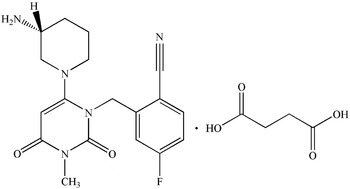
Trelagliptin succinate [chemical name, 2-[[6-[(3R)-3-amino-1-piperidinyl]-3,4-dihydro-3-methyl-2,4-dioxo-1(2H)-pyrimidinyl]methyl]-4-fluorobenzonitrile succinic acid salt (Figure 1), hereinafter abbreviated TS], is a novel once-weekly oral DPP-4 inhibitor for type 2 diabetes (Inagaki et al., Reference Inagaki, Onouchi, Sano, Kuroda and Kaku2014, Reference Inagaki, Onouchi, Maezawa, Kuroda and Kaku2015).
Structural formula of TS.

The crystal structure of TS has not been reported so far. The powder X-ray diffraction (XRD) data of TS were collected, analyzed, and evaluated in this literature.
II. EXPERIMENTAL
A. Sample preparation
The title compound, TS (99 % purity), in powder form was obtained from J&K Chemical Co., Ltd., and its melting range is 184–185 °C. It was recrystallized, dried, and then sieved by a 200-mesh screen to obtain the appropriate particle size. The TS sample was characterized by the melting point and Fourier transform infrared spectroscopy measurements.
B. Powder diffraction data collection and reduction
The diffraction pattern for the TS powder was collected at room temperature using an X’ Pert PRO diffractometer (PANalytical Co., Ltd., The Netherlands) with an X’celerator detector and CuKα radiation (generator setting: 40 kV and 40 mA). The diffraction data were collected in the angular range from 4 to 50°2θ with a step size of 0.013 13°2θ and a counting time of 30 ms step−1. Data structure solution was performed using the software package Material Studio 4.2 (Accelrys Co., Ltd. USA) in the State Key Laboratory of Polymer Materials Engineering (Sichuan University, China).
Through analyzing the peak positions in the powder XRD pattern by the X-Cell method from “Powder Indexing”, the preliminary unit-cell parameters were obtained. The indexing results were then refined with the type of Pawley (Pan et al., Reference Pan, Guo, Duan, Cheng and Li2012), which involves assigning the Miller indices (h, k, l) to each observed peak in the experimental powder XRD pattern (Harris, Reference Harris2012). To obtain the detailed powder XRD data, variables defining the structural model and the powder diffraction profiles from the results of Powder Indexing and the experiment powder diffraction pattern were recurrently refined by Pawley refinement techniques (Pawley, Reference Pawley1981). After the Pawley refinement, the final R wp of the spectrogram was converged to 6.28%.
III. RESULTS
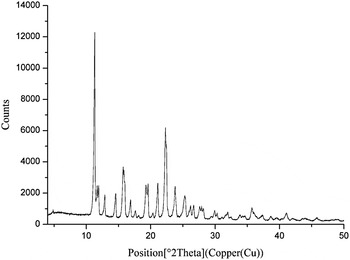
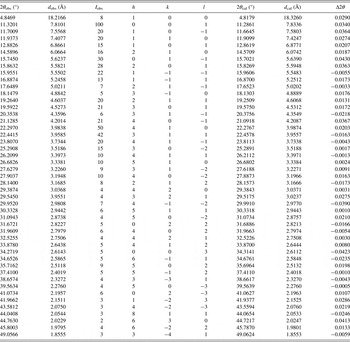
The experimental powder diffraction pattern is depicted in Figure 2. Indexing results confirmed that TS is triclinic with space-group P1 and unit-cell parameters: a = 18.481(6), b = 8.120(4), c = 7.903(4) Å, α = 89.972(0)°, β = 97.722(4)°, γ = 90.120(0)°, unit-cell volume V = 1175.37 Å3, Z = 2, and space-group P1 (Table I). Using the Pawley refinement, the detailed powder XRD data of TS was successfully determined.
Powder XRD pattern of TS using CuKα radiation (λ = 1.540 56 Å).

Powder XRD data of TS, C18H20FN5O2 C4H6O4. The d-values were calculated using CuKα1 radiation (λ = 1.540 56 Å).

SUPPLEMENTARY MATERIAL
To view supplementary material for this article, please visit http://dx.doi.org/10.1017/S0885715615001025