1 Introduction
The focus of this paper is nominal concord, where inflectional marking on nominal modifiers varies with the head noun. In a modular approach to grammar, where a narrow syntactic component builds up a hierarchical structure, and post-syntactic operations apply to that structure resulting in surface word order and phonological form, there are conflicting views as to the location of concord operations in the derivation. On one hand, nominal concord has been analyzed using the same tools that account for clausal agreement, where a verb agrees with the phi-features of a subject and/or object (Sigurdsson Reference Sigurdsson1993, Carstens Reference Carstens2001, Collins Reference Collins, Breitbarth and van Riemsdijk2004, Sigurdsson Reference Sigurdsson2004, Koopman Reference Koopman and Boeckx2006, Baker Reference Baker2008, Kramer Reference Kramer2009, Carstens Reference Carstens2011, Danon Reference Danon2011, Carstens & Diercks Reference Carstens and Diercks2013, Toosarvandani & van Urk Reference Toosarvandani and van Urk2014). Such models place nominal concord in the narrow syntax. On the other hand, concord has been analyzed as a separate mechanism from clausal agreement, where clausal agreement occurs in the narrow syntax, but nominal concord is the result of a post-syntactic agreement operation (Kramer Reference Kramer2010, Norris Reference Norris2014, Baier Reference Baier2015). This paper brings novel data to bear on whether nominal concord is syntactic or post-syntactic, concluding that, in order to maintain other key assumptions about the architecture of grammar, only a post-syntactic model of concord is possible.
This paper examines nominal concord in Guébie [ISO: gie], an endangered Kru language (Niger-Congo) spoken in Southwest Côte d’Ivoire. The description of the Guébie data presented throughout this paper is based on data collected in collaboration with the Guébie community over the past five years. Guébie and a number of other Kru languages (e.g. Kaye Reference Kaye1981) show a typologically remarkable nominal concord system in which concord, or agreement within the noun phrase, is determined not by semantic class but by the phonological form of the agreement-controlling noun. The term phonologically determined nominal concord is used here to refer to a system where agreement between a noun and its modifiers in person, number, gender, and/or case is determined by the phonological form of the noun controlling agreement, rather than by its semantics or syntactic features.
It is an assumption of most models of syntax that phonological features are not present during syntactic derivations, thus cannot influence syntactic structure (see Pullum & Zwicky (Reference Pullum and Zwicky1986, Reference Pullum and Zwicky1988)). The Minimalist Program and its predecessors assume that grammar is modeled as in (1) (Chomsky Reference Chomsky1993), where syntactic operations apply entirely before phonological ones.

A similar model is assumed by advocates of Distributed Morphology (DM), where morphological operations (including insertion of all phonological information associated with the relevant morphosyntactic features) take place between the syntactic and phonological modules of grammar (Halle & Marantz Reference Halle and Marantz1994, Harley & Noyer Reference Harley and Noyer1999, Embick & Noyer Reference Embick and Noyer2001).

If nominal concord was a purely syntactic operation, phonological information would need to be present in the narrow syntax in order to account for phonologically conditioned concord systems. The alternative is a post-syntactic view of concord, which is argued for here. By combining tools from extant models of post-syntactic nominal concord with constraint-based phonological grammars, we can account for both the phonologically and syntactico-semantically determined concord systems found across languages.
The goals of this paper are twofold: (a) to provide an initial description of the Guébie phonologically determined nominal concord system based on original research, and (b) to provide a model of nominal concord which accounts for phonologically as well as semantically conditioned concord systems. In addressing the latter, this paper argues that phonologically determined concord cannot be accommodated in theories that maintain both a phonology-free syntax and concord in the narrow syntax, favoring a post-syntactic view of nominal concord.
Section 2 provides background on the Guébie language, along with an exposition of Guébie phonologically determined nominal concord. This is followed in Section 3 with an analysis of the Guébie data rooted in DM agreement mechanisms in the post-syntax. The proposed analysis involves interaction between morphology, syntax, and phonology, and proposes a novel approach to ellipsis at PF. Section 4 tests the predictions of the proposed analysis by extending the model to other languages that display similar phonologically determined nominal concord phenomena. These include other Kru languages (cf. Innes (Reference Innes1966), Marchese (Reference Márchese1979), Kaye (Reference Kaye1981), Bing (Reference Bing1987), Marchese (Reference Márchese1988), Egner (Reference Egner1989)) as well as Bainuk (Atlantic) (Sauvageot Reference Sauvageot1967) and Abu’ (Arapesh) (Nekitel Reference Nekitel1986, Aronoff Reference Aronoff1992, Dobrin Reference Dobrin1995). Two other potentially phonologically determined systems can be found in  (Adamawa) (Van de Velde & Idiatov Reference Van de Velde, Idiatov and Kaji2017) and Fr`oʔ`o (Gur) (Traoré & Féry Reference Traoré and Féry2017). Section 5 discusses the implications of the data presented throughout the paper. I conclude in Section 6.
2 Guébie phonologically determined nominal concord
2.1 Language background
Guébie is a Kru language spoken by approximately 7,000 people in seven villages in southwest Côte d’Ivoire. It is part of the Dida sub-group of Eastern Kru, closely related to Vata, which is described by Koopman (Reference Koopman1984).
The data here come from a corpus of over 5,000 utterances, collected over the past five yearsFootnote [2] . Data was collected with one Guébie speaker in Berkeley, California (2014) and Gatineau, Canada (2015–2018), as well as seven other speakers in Gnagbodougnoa, Côte d’Ivoire during four two-month trips between September 2013 and August 2018. The majority of the data come from three speakers, a 28-year-old male, a 35-year-old male, and a 76-year-old male. Three other male speakers ages 35–52 and two female speakers ages 19 and 30 were also consulted. Natural and elicited speech were collected, and both are presented herein.
The remainder of this section details the phonologically determined nominal concord system of Guébie, beginning with syntactico-semantically determined agreement triggered by human nouns, and demonstrating that concord triggered by non-human nouns is determined phonologically.
2.2 Guébie pronouns
Basic word order in Guébie alternates between SAuxOV and SVO. When there is no overt auxiliary, the verb surfaces immediately after the subject (Sande Reference Sande2017), as described for other related Kru language (Koopman Reference Koopman1984). Like Kru languages in general (Marchese Reference Márchese1979), Guébie is highly tonal, with four distinct lexical tone heights and a number of contour tonesFootnote [3] . Tone is marked throughout with numbers 1–4, where 4 is high. Syllables are usually CV and maximally CLV on the surface, where L is a liquid. Words other than pronouns must be at least CV.
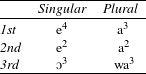
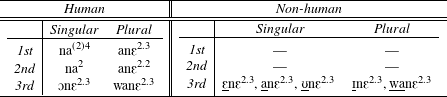
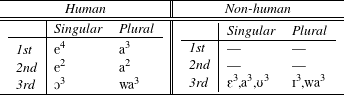
Pronouns take the form of a single vowel. The form of a human pronoun is determined by the person and number features of the concord-controlling noun. Human subject pronouns are given in Table 1.
Human subject pronouns.

Object pronouns are identical in segmental form to subject pronouns, but their tone surfaces one step lower than the pronouns in Table 1. Sande (Reference Sande2017) shows that subject pronouns are free words, while object pronouns form part of the phonological word of the auxiliary or inflected verb, based on the fact that subject pronouns can be coordinated and can stand alone as the answer to a question, while object pronouns cannot, (3).

Object pronouns must always surface immediately after the auxiliary or inflected verb, while subject pronouns can surface as the first conjunct in a coordinated subject.
2.3 Native non-human nouns
Human pronouns are sensitive to syntactico-semantic features such as person and number, Table 1. However, the quality of the vowel in non-human third person pronouns depends on the final vowel of the head noun. That is, pronouns agree with their nominal antecedents not in semantic features like person or number, but in phonological features, where the features of the final vowel of the noun stem determine the form of the pronoun.
Concord marking on pronouns that agree with native non-human nouns, as well as nonce and loan words, is predictable based on the backness feature of the final vowel of the noun stem. The final vowel of the stem could be the final vowel of the noun root, or a nominal suffix (plural, definite). Each of these cases is discussed in turn throughout this section.
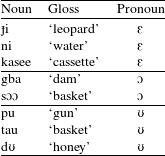
There are ten vowels in Guébie, [i, ɪ, e, ɛ, ə, a, u, ʊ, o, ɔ], and all words end in a vowel. The final vowel of a noun stem determines the vowel of the pronoun used to replace that noun according to Table 2. There are two possible plural suffixes on nouns, /-i/ and /-a/. When present, these plural suffixes determine the concord marking on pronoun vowels.
Mapping of Guébie stem-final vowels to pronoun vowels.

Third-person plural pronouns [ɪ, wa] are determined by the exponent of the plural morpheme, which surfaces as a suffix on the noun. I analyze the plural morpheme as a separate syntactic head.
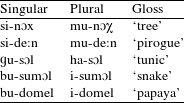
Based on over 500 singular/plural pairs of nouns, it does not seem to be predictable which plural suffix a given non-human noun will take. For example, both [ɟukpə3.1], ‘bracelet’, and [ɓitə2.3], ‘house’, end in central vowels and trigger the central vowel third-singular pronoun [ə]. However, [ɟukpə3.1] takes the /-a/ plural suffix, which surfaces as [-ə] due to ATR harmony with the root, [ɟukpə-ə3.1.2], while [ɓitə2.3] takes the /-i/ plural suffix, [ɓitə-i2.3.2]. Neither does there seem to be any semantic generalization to determine which nouns take which plural suffix. Because of the unpredictability of the plural suffix given the phonological shape and semantics of the noun, I conclude that each noun must be indexed, or lexically specified, for which plural class it falls into. Then, the form of a pronoun showing concord with a plural noun is predictable based on the phonological form of the plural suffix, as in Table 2.
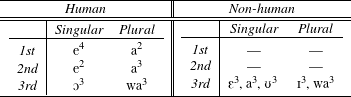
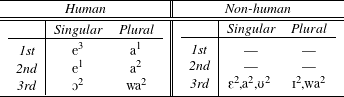
There are four sets of pronouns in Guébie, termed subject, object, possessive, and emphatic pronouns in the Kru literature (cf. Marchese (Reference Márchese1979)). The complete subject pronoun chart is given in Table 3. Segmentally, object pronouns are identical to subject ones, though tonally they are each one step lower on the 4-tone scale than the corresponding subject pronoun.
Human and non-human subject pronouns.

Object pronouns are given in Table 4 Footnote [5] .
Human and non-human object pronouns.

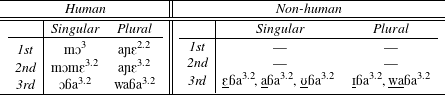
The pronominal base of subject and object pronouns is used in other pronominal forms, specifically possessive and emphatic pronouns. The set of pronouns called emphatic in the Kru literature are given in Table 5. These can be used in topic constructions or in object position when the object is in focus. Just as with nominative and accusative pronouns, the initial vowel in non-human emphatic pronouns is phonologically determined by the final vowel of the noun.
Emphatic pronouns.

Possessive pronouns, which surface immediately before the possessed noun, are shown in Table 6, where for non-human possessors, the initial vowel of the possessive marker is phonologically determined.
Possessive pronouns.

The forms in (6) are used for alienably possessed nouns: [na4 ɓitə2.3] ‘my house’. A separate set of possessive pronouns are used for inalienably possessed nouns, mostly kinship terms. The inalienable pronouns are identical to the personal pronouns in (3) with one exception; the first person singular inalienable pronoun is /a4/ instead of /e4/, [a4 no4] ‘my mother’. The inalienable pronouns are of less interest to us because they are quite infrequently, if ever, used with non-human pronouns.
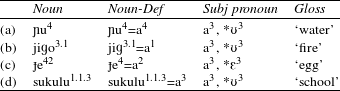
In (4) we see examples of phonologically predictable agreement with native non-human nouns. The noun in the first sentence of each example determines the form of the object pronoun in the second sentence and the subject pronoun in the third. The final vowel of the noun triggering concord, and the concord-marked pronoun vowels, are underlined.

As in (4), the antecedent does not have to be in the same utterance, nor nearby in the discourse for phonologically determined concord to hold.
Additional examples from natural speech are given in (5). These examples come from a recording of a female speaker explaining how to make plantain fufu, a starchy ball of dough eaten with sauce. Both examples show pronouns agreeing with a non-human antecedent in vowel quality, [i] in (5a), and [ɛ] in (5b). The agreeing element in (5a) is an object enclitic pronoun, while in (5b) it is an emphatic pronoun. The nominal trigger vowel and agreeing vowels are underlined.

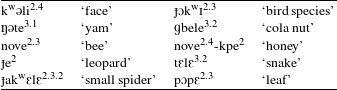
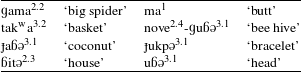
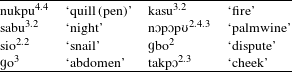
Examples of words that fall into each third-singular concord-marking class are given below, taken from a corpus containing over 3,000 distinct nouns. Note that there is no semantic distinction between the groups. The word for a small spider species falls into the /ɛ/ category and the word for a large spider species falls into the /a/ category, though neither of these classes is limited to small or large things. ‘Bee’ and ‘honey’, which is derived from ‘bee’, are in the /ɛ/ category, but ‘beehive’, also derived from ‘bee’, is in the /a/ class. Zogbo (Reference Zogbo Lynell2017) discusses possible semantic determinedness for Proto-Kru noun classes, but those semantic distinctions have been lost in Guébie, along with a number of other Kru languages (cf. Bing (Reference Bing1987) on Krahn, Kaye (Reference Kaye1981: 8–9) on Vata).
Words that take the front vowel pronoun, /ɛ/.

Words that take the central vowel pronoun, /a/.

Words that take the back vowel pronoun, /ʊ/.

There are examples of animals, liquids, large and small objects, round objects, nature, animates, and inanimates in each of the three non-human classes in Guébie, Tables 7, 8 and 9. While there is no synchronic semantic coherence to the nouns in a particular class, it is likely that this system stems from a semantically determined Proto-Kru noun class system (Marchese Reference Márchese1979, Zogbo Reference Zogbo Lynell2012, Reference Zogbo Lynell2017). A number of other Kru languages show tendencies for like-things to have the same final vowel, such as Godié (Marchese Reference Márchese1986b). Others, like Guébie, Tepo (Dawson Reference Dawson1975), Vata (Kaye Reference Kaye1981), and Krahn (Bing Reference Bing1987), show no semantic coherence of classes and are phonologically predictable. It seems that in the latter set of languages at least, the Proto-Kru semantic noun class system has been reanalyzed as phonologically determined for non-human nouns, where semantic distinctions have been lostFootnote [6] .
2.4 Non-human nonce and loan words
It is clear that one can quite generally predict the form of concord marking with a non-human head noun based on phonological features. The phonological assignment of nouns to noun classes is not only predictable for Guébie lexical items, but also for loan words (6) and nonce words (7).

Twenty loan words and ten nonce words were tested, each with three native Guébie speakers. Each possible noun-final vowel was represented at least twice among the chosen words. Among the thirty words tested, there were no exceptions to the phonological predictability across speakers. Similar results were found for Vata, a closely related Kru language (Kaye Reference Kaye1981: 18).
2.5 Definite non-human nouns
Further evidence for the phonological predictability of this agreement pattern in Guébie comes from definite nouns. The definite marker is an enclitic /=a/, which surfaces after all other nominal morphology. It is analyzed as an enclitic rather than a suffix due to its phonological and syntactic properties. Phonologically, /=a/ never undergoes ATR harmony with the root it attaches to, unlike other suffixes. Syntactically, there are two possible word orders in noun phrases, (8a, b), which do not appear to differ in meaning. When Numeral and Adjective surface in that order following the noun (8a), the definite marker surfaces on the noun itself. When the adjective surfaces before a numeral, (8b) the definite marker surfaces on the phrase-final element, in this case the numeral.

The orders in (8a, b) are possible for both definite-marked nouns and indefinite noun phrases. I assume that the two grammatical orders involve phrasal movement of the NP in (a) and a larger constituent in (b) (cf. Cinque (Reference Cinque2005)), but I leave for later work any further syntactic details of how the two orders arise.
Examples of nouns with definite markers and the pronouns they trigger are given in Table 10.
Definite nouns trigger central pronouns (lau_20150617).

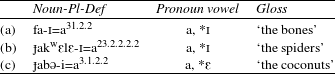
When using a pronoun to replace a definite-marked noun, the pronoun vowel does not agree with the final vowel of the noun root. Instead, it agrees with the final vowel of the definite marker, /=a/, which results in a central pronoun vowel surfacing, [a]. The same is true for definite-marked plural nouns Table 11. Definite markers surface outside of plural suffixes, and when both are present it is the definite marker which determines agreement.
Plural definite nouns trigger central pronouns (lau_20150617).

Definite markers surface outside of all other morphology on nouns. No matter their syntactic position, or what other morphology is present on the noun, definite-marked nouns trigger central vowel pronouns.
If each noun were arbitrarily indexed for a particular noun class, or if the final vowel of the noun were a noun class marker itself, we would not expect the definite marker to have any effect on the form of the pronoun. The fact that the presence of the definite marker triggers the central vowel pronoun serves as further evidence that the form of the pronoun is determined by the phonological features of the final vowel of the spelled-out noun stem.
Notably, even though the definite marker on non-human nouns triggers central vowel concord, the definite marker on a human noun has no effect. Human nouns trigger human-specific pronouns, given in Table 1, whether or not they are suffixed. For example, [ŋudi=a3.1.1], ‘the man’ triggers the third-singular human pronoun vowel [ɔ], not the front vowel or central vowel pronoun.
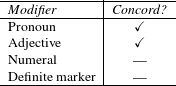
Definite markers never alternate based on the form of the noun. This is also true of numerals, though adjectives show concord marking (see Section 2.7). I analyze the lack of surface alternation of definite markers and numerals as a result of not entering into a concord relationship with the head noun. Only adjectives and pronouns vary with the form of the head noun, thus only adjectives and pronouns are analyzed as entering into a concord relationship with the noun.
2.6 Coordinated non-human nouns
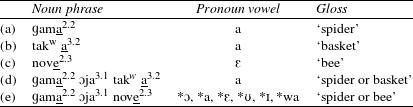
Judgments of which pronoun should be used to replace a given noun are incredibly consistent across speakers. However, speakers tend to avoid constructions where a pronoun replaces a coordinated noun phrase, particularly when the two nouns differ in final vowel: [ɡama 2.2 ɔja3.1 nove 2.3], ‘A spider or a bee’.
When attempting to coordinate nouns that end in vowels with different backness values, speakers prefer not to choose any pronoun vowel to replace those nouns. Instead, the construction using a pronoun in such cases is avoided in natural speech. Indeed, no such examples are found in the Guébie text corpus.
There has been extensive work on agreement with coordinated noun phrases (Aoun, Benmamoun & Sportiche Reference Aoun, Benmamoun and Sportiche1994, Reference Aoun, Benmamoun and Sportiche1999; Munn Reference Munn1999; van Koppen Reference van Koppen2005; Boskovic Reference Bošković2009; Benmamoun, Bhatia & Polinsky Reference Benmamoun, Bhatia, Polinsky and van Craenenbroeck2009; Bhatt & Walkow Reference Bhatt and Walkow2013; Marusic, Nevins & Badecker Reference Marusic, Nevins and Badecker2015; Willer-Gold et al. 2016; Gold et al. 2017). In Guébie, when coordinating nouns that end in the same vowel, speakers have no trouble replacing that coordinated structure with the appropriate phonologically agreeing pronoun (cf. the singular pronoun in disjunctive coordination in Table 12(d)). The same is true for two coordinated definite-marked nouns, where the appropriate pronoun vowel is the one which agrees phonologically with the definite marker. However, speakers are not happy with any third-person pronoun in the case of replacing two coordinated nouns that separately trigger distinct pronoun vowels, Table 12(e). We might assume that the final vowel of the final noun in the coordinated structure should determine the pronoun vowel, but it seems that speakers instead attempt to come up with a vowel that could replace both the first and second coordinated elements, and if no such pronoun vowel exists, the construction is avoidedFootnote [7] .
Pronouns used for coordinated noun phrases (lau_20150617).

2.7 Phonological agreement between nouns and modifiers
The same agreement pattern found in noun/pronoun agreement in Guébie also holds between nouns and the final vowel of adjectives that directly modify them, (9).

Word-internal ATR harmony influences the quality of the final vowel of the adjectives in (9); however the backness and rounding values of the final vowel are determined by the final vowel of the noun. That is, the difference between the final [ə] on ‘house’ and ‘new’ versus the final [a] on ‘red’ in (9a) is due to ATR harmony with the root. The difference between the final [ə, o, e] in ‘new’ in (9a), (9b), and (9c) is due to agreement with the different final vowels of the nouns in each example.
There are only six adjectives that can directly modify nouns in Guébie, while other modifiers are predicative, surfacing with verbal morphology. Those adjectives that can surface within a noun phrase include ‘big, small, new, red, black, white’, [kada4.2, tɛkɛla4.4.2, lelə2.3, ɟɛla1.1, kpa4, pɔpa4.3] in the central vowel /-a/ form in GuébieFootnote [8] . All six of these adjectives can also surface predicatively, and in predicative contexts do not show concord.
Adjectives also agree with human nouns, but not phonologically. Instead, all human nouns trigger an [-o/ɔ] ending on adjectives, as in (10).

The adjective ‘big’ ends in [-ɔ] in (10), and cannot end in any other vowel when agreeing with the human noun ‘man’, despite the fact that the word for ‘man’ in Guébie is [ŋudi3.1], ending in a front vowel.
I return to the analysis of noun-modifier agreement in Section 3.3.4.
2.8 Interim summary: Phonological concord facts
We have seen that the form of concord marking on non-human pronouns and adjectives is predictable from the final vowel of the noun stem. The form of definite markers and numerals does not vary with the noun (Table 13).
Modifiers that show concord with nouns.

The phonologically predictable form of the concord marker on pronouns and adjectives generalizes to bare non-human native nouns, loan and nonce nouns, plural nouns, and definite nouns. On the other hand, human pronouns take set forms. Specifically, third-person human pronouns take the form /ɔ3/, singular (11a), and /wa3/, plural (11d). The use of other pronouns is infelicitous when referring to humans (11b, c, e).

As discussed in Section 2.5, even when a human noun ends in a definite marker, the pronoun used to refer to that noun is the human pronoun [ɔ3], rather than [a3] which is the concord marker for all non-human definite-marked nouns (11a, b, c).
The form of human pronouns is invariant, agreeing in person and number with the noun. Adjectival concord marking is also unvarying when the head noun is a human. Human nouns trigger a fixed set of pronouns and a fixed concord marker on adjectives based on their person and number features.
Native bare non-human nouns, loans and nonce words, and definite- and plural-marked non-human nouns trigger predictable phonologically determined concord marking on pronouns and adjectives. If the head noun is bare, the final vowel of the noun root determines the vowel quality of the concord markers. However, if the head noun is morphologically complex, with a plural suffix or definite marker, the final suffix determines the form of the concord markers. In short, for all non-human nouns, the final vowel of the noun stem, which includes plural and definite marking, predictably determines concord marking.
3 An interface model of phonologically determined nominal concord
While phonologically determined nominal concord in Guébie could be what remains of a once-semantically determined noun class system, here I focus on the synchronic phonological predictability of the pattern.
Nominal concord is often analyzed using the same tools that account for clausal agreement, where a verb agrees with the phi-features of a subject and/or object in the narrow syntax (Sigurdsson Reference Sigurdsson1993, Carstens Reference Carstens2001, Collins Reference Collins, Breitbarth and van Riemsdijk2004, Sigurdsson Reference Sigurdsson2004, Koopman Reference Koopman and Boeckx2006, Baker Reference Baker2008, Kramer Reference Kramer2009, Carstens Reference Carstens2011, Danon Reference Danon2011, Carstens & Diercks Reference Carstens and Diercks2013, Toosarvandani & van Urk Reference Toosarvandani and van Urk2014). See Norris (Reference Norris2014: Chapter 3.2) for a thorough examination of previous models of concord in the narrow syntax.
On the other hand, Kramer (Reference Kramer2010), Norris (Reference Norris2014), and Baier (Reference Baier2015) show that nominal concord is distinct from clausal agreement in a number of ways, and thus utilize two distinct sets of tools to model clausal agreement and concord.
Based on the Guébie facts described in Section 2, I ultimately argue for nominal concord in the post-syntax, and propose a combination of theoretical tools which model both syntactico-semantic concord, as for Guébie human nouns, as well as phonologically determined concord, as for Guébie non-human nouns. This model expands on the work of Kramer (Reference Kramer2010), Norris (Reference Norris2014) and Baier (Reference Baier2015) to account for a larger range of nominal concord systems, namely, extending extant models to account for phonologically determined systems.
Before detailing the proposed analysis in Section 3.2, I demonstrate a number of problems with a purely syntactic approach to nominal concord in Guébie, Section 3.1.
3.1 Considering possible analyses
3.1.1 Ruling out a narrow-syntax approach to phonologically determined nominal concord
Any model of nominal concord must also account for phonologically determined concord systems like the one found in Guébie. A narrow-syntax approach to phonologically determined concord could take a number of forms.

Here I walk through each of these possible analyses, demonstrating that each of them encounters problems satisfactorily accounting for the Guébie data.
The first option is that phonological features are present in the syntax and available for copying during morphosyntactic agreement processes. This analysis relies on syntactic sensitivity to phonological information, which rejects the fundamental notion of a phonology-free syntax (Pullum & Zwicky Reference Pullum and Zwicky1986, Reference Pullum and Zwicky1988).
Most current theoretical frameworks assume the y-model of grammar (recall 1 and 2), where the syntax takes place before phonological information is present (cf. The Minimalist Program (Chomsky Reference Chomsky1993), Distributed Morphology (Halle & Marantz Reference Halle and Marantz1993, Reference Halle and Marantz1994)).
There are empirical reasons for adopting the Y-model of grammar, where syntactic operations occur before phonological ones. An analysis where phonological features are present during the syntactic module makes pathological predictions; if syntax was sensitive to phonology, we would expect word orders and other syntactic phenomena to be sensitive to phonological features such as segmental properties. Such phenomena are not found across languages. For example, we never see a language where a subject moves to pre-verbal position only if it begins with a voiceless consonant.
A model of grammar which disallows syntactic sensitivity to phonological features, like the Y-model, is more restrictive than one which allows phonology to affect syntactic operations, and makes better predictions about the linguistic systems we see cross-linguistically.
Option two in (12) assumes that all lexical items are arbitrarily indexed for the noun class they belong to: /ɓitə2.3/ ⇔central vowel class; /sukulu1.1.3/ ⇔back vowel class. In this case, the fact that the phonological form of the pronoun or concord marker is predictable given the form of the noun is coincidental. While this analysis is feasible, it assumes that all noun class assignments are memorized rather than productive. Additionally, on this analysis we might expect exceptions to the phonological predictability of the Guébie agreement system, or a lack of phonologically predictable extension to loan and nonce words. In certain Bantu languages we find two different /mu-/ noun class prefixes. These prefixes surface on the noun, and for one of the two mu- forms, there is a phonologically identical mu- which surfaces on agreeing elements in the noun phrase (ex: Class 18 in Ganda). However, there are other nouns which take a mu- prefix but trigger phonologically distinct prefixes on agreeing elements (ex: Class 1 in Ganda) (Meeussen Reference Meeussen1967). We never see such non-phonological agreement in the Guébie non-human class system.
A slight variation on this analysis would be to say that each noun in Guébie is composed of a root plus final vowel, where the final vowel expones noun class marking. The class marker would then determine the form of concord marking on pronouns and adjectives. Kaye (Reference Kaye1981) addresses this possible analysis and finds it untenable for Vata, a closely related Kru language. He rules out such an analysis for three reasons: (a) Claiming that each noun is underlyingly without its final vowel would mean that we have consonant-final roots in the language. This would be the only example of a consonant-final root, word, or syllable in Vata. The same reasoning holds in Guébie. (b) It is not possible to manipulate the final vowel of the noun to change the meaning of a word, and the final vowels of noun roots are not associated with any semantic meaning. Thus, there is no reason to consider the final vowels of nouns to be separate morphemes. (c) The final vowel of a noun root is not associated with an independent tone melody; its tone is determined by the lexical tone melody of the noun root. In Vata, there are no examples of toneless morphemes; every morpheme is underlyingly associated with a tone. Thus, analyzing the final vowel as a separate morpheme would be the only example of a toneless morpheme in the language. While the same is not true of Guébie, since other suffixes such as the definite marker lack a tone specification, I follow Kaye’s other arguments in ruling out this possible analysis. An additional reason for rejecting such an analysis is given below.
A particularly problematic set of data for this analysis comes from the fact that it is not always the final vowel of the noun which triggers concord. Recall that for nouns with plural suffixes or definite enclitics, it is the final vowel of the suffix or enclitic which triggers agreement. For example, the presence of the definite enclitic /=a/ always triggers the central vowel pronoun, agreeing with the definite marker rather than the noun itself, Table 14.
Definite enclitics trigger central vowel phonological agreement.

If each noun+final vowel were indexed for a particular lexical class, there would be no a priori reason to predict that the definite marker should suppress the noun class agreement triggered by the noun or final vowel itself. We would expect that the class marking on the noun would still determine concord.
The final option in (12) says that phonological agreement results from multiple copies of the noun being present in the syntax, some of which can be reduced phonologically to the final vowel of that noun. Dimitriadis (Reference Dimitriadis1997) proposes a version of this analysis for phonologically determined nominal concord in Bainuk (Atlantic) and Abu’ (Arapesh).
On this multiple-copy analysis, for the Guébie noun phrase ‘new red house’ in (13), we would need to say that there are three copies of the noun present in the syntax, one which surfaces as a full copy, and two at the end of each adjective, which are reduced to the final vowel of the noun.

A Guébie noun phrase like (13) would require three copies of the noun to be present in the syntactic structure, where one of them is fully pronounced and the other two are partially pronouncedFootnote [9] . The problem is that there is not supporting evidence, syntactic or morphophonological, for such redundancy in Guébie. If future work were to find that this analysis of multiple syntactic copies of the noun is in fact compatible with the syntactic structure of DPs in Guébie, we would still need to explain why in this particular case only, we see multiple copies of the noun (partially) spelled out, while other instances of multiple syntactic copies in Guébie only result in one overtly spelled out copy.
Additionally, this analysis predicts the existence of some language in which multiple copies of the noun exist and are fully pronounced on the surface. To my knowledge, this pattern is not attested.
The three models discussed here for accounting for phonologically determined concord encounter fatal flaws when faced with modeling the Guébie data.
In Section 3.1.2 I rule out a purely phonological approach, and I turn to the proposed analysis in Section 3.2.
3.1.2 Ruling out a purely phonological account
Instead of accounting for phonologically determined concord in the narrow syntax, one might consider pursuing a purely phonological analysis. This could take the form of long-distance phonological agreement in the Agreement-By-Correspondence (ABC) framework (Rose & Walker Reference Rose and Walker2004). In such a model, the concord marker on the pronoun and/or adjective would be in correspondence with the nominal antecedent, and phonological identity would be required between the two. However, the phonologically agreeing pronoun occurs even when the noun is not pronounced in the discourse, as in (14).

In the context above, the word ‘eggplant’, /trobiə3.2.2/ has not been uttered aloud; however, the pronoun must surface with the agreeing vowel [a3] and not another third-person singular pronoun vowel, #[ɛ, ʊ, ɔ].
ABC requires agreeing elements to be overt and within the same local domain so that one element can copy features from the other. Because agreement between a noun and pronoun is required in Guébie even when the noun is not present (14), ABC is not enough, at least on its own, to account for the phonological agreement of pronouns with nouns in Guébie. Because Guébie nominal concord is non-local, and the head noun need not be overt within the same utterance or even in the same discourse for agreement to hold, a long-distance phonological agreement analysis will not suffice (Sande Reference Sande2014).
The account proposed in Section 3.2 makes use of morphological agreement mechanisms, in combination with ABC-style constraints plus output-to-output paradigm correspondence in the phonological component to derive the Guébie facts.
3.2 The proposed model
Here I propose a novel model of phonologically determined nominal concord which relies on specific interactions between morphology and its interfaces. Under this analysis, there is a relationship between the form of the pronoun, the timing of syntactic spell-out, and deletion under phonological identity. Unlike the above analyses, the model proposed here predicts the phonological determinedness of the Guébie system, and it does not require syntax to be sensitive to phonological features. In addition to accounting for phonologically determined nominal concord in a manner compatible with current assumptions in linguistic theory, this model also explicitly details how ellipsis occurs during the phonological component (PF). This section focuses on deriving concord on subject and object pronouns, and I return to adjectival agreement and the additional pronoun series in Section 3.3.4.
The proposed analysis assumes a modular grammar, where syntax precedes morphological operations which precede phonology. As background for the post-syntactic model of concord presented here, I lay out my assumptions about the syntactic structure of DPs in Guébie in Section 3.2.1. The syntactic discussion is followed by the morphophonological analysis in Sections 3.2.2 and 3.2.3.
3.2.1 Syntactic structure
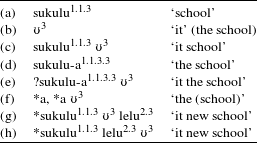
To determine the syntactic structure of DPs in Guébie, we examine one further set of data. Pronouns in Guébie can occur alone within a noun phrase, Table 15(b), but they can also co-occur with an overt noun, Table 15(c). For most speakersFootnote [10] , the definite marker can never co-occur with the pronoun. Unlike pronouns, definite markers cannot surface without an overt noun, Table 15(f). Adjectives and numerals are impossible in noun phrases that contain a pronoun, Table 15(g, h).
Distribution of nouns and pronouns (lau_20150617).

Constructions like Table 15 (c), where the noun and pronoun surface together within the same noun phrase, are similar to the ‘we linguists’ construction in English, except that in Guébie they are not restricted to first and second persons. This noun–pronoun construction is independent of topicalization; there is a separate topicalization construction in Guébie which can also result in an overt pronoun following an overt noun. However, in topicalization constructions, the noun must be clause-initial, and there is a pause between the topicalized noun and the pronoun, which surfaces in subject position, immediately before the inflected verb or auxiliary.

In [Noun Pronoun] constructions as in Table 15 (c), the noun and pronoun are phrased together, while in (15) the noun and pronouns are separated by a required pause.
Following Elbourne (Reference Elbourne2001)’s analysis of e-type pronouns, I assume that pronouns take a noun phrase complement which is optionally elided at PF. The pronoun is a D-head in a head-initial DP, and a phrasal projection containing the head noun moves to the specifier of D to result in Noun-Pronoun order. The noun, which has moved to a higher position, is optionally elided (where ellipsis is licensed by the presence of the pronoun), resulting in all and only the two grammatical overt pronoun structures, Table 15(b, c). To account for the fact that the definite marker and pronoun do not co-occur, the two are both analyzed as D heads, where only one element can surface in the D position in a given constructionFootnote [11] .
The syntactic structure which serves as the input to the morphological component is as in (16)Footnote [12] .

The crucial component of this structure is that the NP surfaces in the specifier position of the pronoun D-head, and can optionally be elided during the phonological component. This structure serves as the output of the syntactic component and the input to morphology.
Along with the structure above, I make one additional assumption about the syntax–morphology interface. Namely, that syntactic structures are made available to morphology and phonology in subparts, where each syntactic phase head triggers spell-out. At each syntactic phase boundary morphological and phonological operations take place (Chomsky Reference Chomsky, Martin, Michaels and Uriagereka2000, Marvin Reference Marvin2002), and DP is a phase (Svenonius Reference Svenonius2004, Cinque Reference Cinque, Aboh, Guasti and Roberts2014), or minimally the head noun and pronoun are spelled out simultaneously.
Synchronic syntactic evidence that DP is a phase in Guébie comes from the fact that extraction from a DP is impossible. For example, it is possible to say (17a), but not (17b, c).

Whenever a non-human pronoun is produced in Guébie, it agrees in phonological features with the noun in the same noun phrase, whether or not that nouns are overtly pronounced. I propose that the concord-triggering noun is always present in the syntax, within the same phase as the pronoun D-head. Then, phonological concord is conditioned by a morphological rather than syntactic agreement relationship between the noun and pronoun. This agreement relationship is founded during the morphological component, via insertion of an Agr(eement) node on the pronoun (Kramer Reference Kramer2010, Norris Reference Norris2014), as discussed in further detail in Section 3.2.2. Due to this agreement relationship, morphosyntactic features of the noun are copied to the pronoun. The phonology, which also applies at phase boundaries, has access to the morphosyntactic features of heads within that phase, and phonological constraints ensure phonological identity between those heads in the DP which agree in specific features, as detailed in Section 3.2.3. Ellipsis of the noun optionally occurs at PF, licensed by overt phonological agreement between the noun and the pronoun.
In Section 3.2.2 I discuss the morphological component, based on DM, and in Section 3.2.3 I provide a formal analysis of phonologically determined nominal concord in Guébie, reliant on morphosyntactic features being maintained through the morphology, available to the phonological component.
3.2.2 The morphological structure
In the proposed model, morphology and phonology apply cyclically to syntactic structures by phase, and each DP is a phase. The morphology takes the syntactic structure as an input. I assume a DM morphological component (Halle & Marantz Reference Halle and Marantz1993, Reference Halle and Marantz1994; Embick & Noyer Reference Embick and Noyer2001). The crucial reasons for choosing a DM-style morphology are late insertion of vocabulary items, spell-out at phase boundaries, and a mechanism for establishing post-syntactic agreement (concord) relationships. Any morphological framework which follows DM in these three respects would serve equally as well in the given account.
Via regular DM agreement mechanisms, an AGR(eement)-node is inserted on D, and the  feature is copied to it from the noun (see Noyer (Reference Noyer1997), Embick & Noyer (Reference Embick and Noyer2001), Kramer (Reference Kramer2010), Norris (Reference Norris2014)).

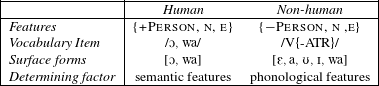
Node insertion in DM occurs only when the relevant morphological features have no bearing on semantics (cf. Oltra Massuet (Reference Oltra Massuet1999) and Embick (Reference Embick2010) on dissociated morphemes, and Harbour (Reference Harbour2003) on ‘default’ feature insertion). That is, only those terminal nodes which affect the truth value of the sentence are present in the syntax, and others are inserted during the morphological module of grammar, post-syntactically. After AGR-node insertion occurs, feature copying from the head noun to the AGR node applies.
Agreement proceeds as shown in the noun–pronoun construction in (19) for the noun sukulu ‘school’. The vocabulary item sukulu has two features, the feature  because it is a noun, and the feature motivating optional ellipsis at PF, which following Merchant (Reference Merchant2001, Reference Merchant2008) I call
 The
 feature is discussed further in Section 3.2.3. The noun feature of sukulu has been copied to the AGR node on D. Because the shape of pronouns, whether human or non-human, is always a -ATR vowel (V), I assume that the non-human pronoun vocabulary item is a vowel specified for the phonological feature
 but underspecified for other features, specifically
 The backness value will be specified via the constraint-based phonologyFootnote
[13]
.

For simplicity, I leave out the syntactic nodes below D in (19). These include positions for adjectives and numerals.
Lexical items are inserted into the structure in (21) via regular DM-style vocabulary insertion rules. For the majority of terminal node feature bundles in Guébie, there is some lexically associated phonological content. This content can be fully specified, as in ‘school’, /sukulu
1.1.3/, or partially specified, as in third-person non-human pronouns,  There could also be a set of morphosyntactic features for which there is no corresponding phonological content. This is seen elsewhere in Guébie, where the imperfective morpheme triggers a particular phonological process, but is not associated with any underlying phonological content (Sande Reference Sande2017: Chapter 5).
After vocabulary items and AGR nodes are inserted, the morphological structure in (19) is linearized via DM Linearization mechanisms, as laid out by Embick (Reference Embick2010).

Note that in the proposed analysis, the morphological features associated with terminal nodes are preserved through morphology, including Linearization, and are available to the phonology (following Gribanova & Harizanov (Reference Gribanova and Harizanov2015), Winchester (Reference Winchester2016); contra Halle (Reference Halle1990), Bobaljik (Reference Bobaljik2000))Footnote [14] . This feature preservation will allow the phonological component to see morphosyntactic agreement relationships.
3.2.3 The phonology
Here I adopt a constraint-based phonological component with paradigm output–output faithfulness (Burzio Reference Burzio1994, Benua Reference Benua1997, Kager, van der Hulst & Zonneveld Reference Kager, van der Hulst and Zonneveld1999). For other recent works combining a DM-style morphology with a constraint-based phonology, see Jenks & Rose Reference Jenks and Rose2015, Kastner Reference Kastner2016; Sande Reference Sande2017, Reference Sande2018.
While I choose to show the phonological component evaluated in parallel, a cyclic approach using strata, like Stratal OT (Kiparsky Reference Kiparsky2000, Reference Kiparsky, Vaux and Nevins2008; Bermúdez-Otero Reference Bermúdez-Otero1999), or serial derivation, like Harmonic Serialism (McCarthy Reference McCarthy and Hirotani2000) would work equally as well as the parallel approach provided hereFootnote [15] . Since my point here is not to choose between a parallel, stratal, or serial phonology, but rather to show that a model of grammar where phonology follows syntax and is sensitive to morphosyntactic features can account for phonologically determined nominal concord, I set aside the differences between stratal or serial and parallel approaches and use parallel evaluation for simplicity.
In this model, phonology applies at phase boundaries, and DP is a phase. Thus, the DP, which crucially includes nouns, pronouns, and adjectives, will be evaluated together as a unit by phonological constraints.
The linearized structure provided by the morphological component of grammar serves as the input to phonology. This linearized structure consists of vocabulary items and morphosyntactic features, (21). Note that the phonological features of the pronoun vowel other than [ATR] are not specified in the input to the phonological component. The quality of the pronoun will instead be determined via ranked constraints.

To arrive at the correct output, i.e. [sukulu ʊ] or  based on the linearized input in (21), we need a constraint ensuring identity between the final vowel of the noun and the vowel of the pronoun. This is accomplished with Anchor-R, which anchors agreement to the right edge of a word, (22).

This constraint is only active if the heads in question agree in some morphosyntactic feature. If they do agree morphosyntactically, segments at the right edge of each head will correspond. A constraint ensuring that heads in correspondence are phonologically identical must also be active. I propose the use of an output–output identity constraint Ident-OO which says that heads that agree in the feature  must agree in phonological features.

Ident-OO assigns a violation for each non-identical set of corresponding segments in two corresponding heads. This constraint will only affect nouns and their corresponding pronouns and adjectives, since other heads do not agree morphosyntactically.
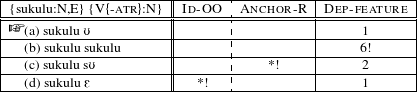
The combination of the two constraints in (22, 23) has the result that two heads agreeing in the morphosyntactic feature n within the same spell-out phase will be phonologically identical, starting from the right edge of the word. The optimal candidate violates a single constraint here, namely Dep-feature, which penalizes output features not present in the input. Dep-feature is violated by the optimal candidate because the pronoun vowel has fully specified vowel features in the output, but not in the input. The benefit of Dep-feature is that it rules out candidates like [sukulu sukulu] where the pronoun is identical to the noun in more than just one segment, because [sukulu sukulu] involves insertion of more new features from input to output than does [sukulu ʊ].

The tableau below shows that the presence of Ident-OO rules out a pronoun vowel that does not agree phonologically with the noun, Table 16(d). Anchor-R rules out a pronoun that is phonologically identical to the left edge of the noun, Table 16(c). Dep is necessary to rule out a pronoun that is identical to the entire phonological form of the noun, or even anything more than the final vowel, Table 16(b). Here I mark a single violation of Dep for each segment present in the output that was underspecified or not present in the input. This decision is for simplicity of reading the tableaux, because in fact each candidate below would incur many more Dep-feature violations than marked, namely, one for every phonological feature inserted, rather than one for every consonant/vowel segment inserted.
The justification for the ranking in Table 16 followsFootnote [16] .
Ident-OO, Anchor-R
 $\gg$
Dep.

The combination of the correspondence constraint Anchor-R and the identity constraint Ident-OO function to rule out candidates that fail to agree, as per ABC theory (Hansson Reference Hansson Gunnar2001, Rose & Walker Reference Rose and Walker2004). Candidate (d) is ruled out by the output–output correspondence constraint, Id-OO, since the vowel of the pronoun is not featurally the same as any corresponding segment in the noun. Anchor-R rules out candidate (c), where there are identical corresponding segments in the noun and pronoun, but the corresponding segments are at the left edge of the noun, rather than the right. Dep-feature rules out candidate (b), since more features are inserted between the input and output than in the winning candidate, (a).
While the tableau in Table 16 rules out a number of unwanted candidates, without an additional constraint, the candidate [sukulu] with a null pronoun would beat the optimal candidate because it involves no feature insertion. We must ensure that the pronoun surfaces overtly, despite its lack of fully specified phonological feature information in the input. This can be assured with a RealizeMorpheme constraint, which penalizes an output candidate that does not overtly realize an input morpheme, (25).

While the constraints in Table 17 explain why we get a surface pronoun that is a single segment and agrees with the final segment of the noun, they do not explain why the features of the final vowel of the output noun are identical to the input features. That is, why don’t we have an optimal output candidate [sukule ɛ] from input /sukulu V/? While Dep-feature rules out adding a feature from input to output, it does not rule out changing a feature from input to output. Thus, to rule out feature changing, which violates input–output identity, I propose the use of a highly ranked Ident-IO constraint.
Ident-OO, Anchor-R, RealizeMorph.


The full Guébie vowel inventory contains ten vowels, [i, ɪ, e, ɛ, u, ʊ, o, ɔ, ə, a], but there are fewer possible singular non-human pronoun vowels, [ɛ, a, ʊ]. The specified {-ATR} feature on the pronoun vocabulary item limits the possible pronoun vowels to [ɪ, ɛ, ʊ, ɔ, a]. Additional constraints such as PeriphVowel preferring peripheral vowels [ɪ, ʊ, a] and *ɪ dispreferring the output segment [ɪ] in Guébie account for the reduced number of pronoun vowels [ɛ, a, ʊ], compared to the full Guébie vowel inventory aboveFootnote [17] . As this is secondary to the point of this section, I leave these constraints out of the tableaux below.
Ranked as in (27), the above constraints lead to the correct output of a [Noun Pronoun] structure, where both the noun and the pronoun are overt. These constraints ensure that the pronoun agrees phonologically with the final vowel of the noun in question.

When a pronoun surfaces without an overt noun, I posit that the noun is present in the syntax but is elided at PF,  ‘it (school)’ (see Merchant (Reference Merchant2001), Lasnik (Reference Lasnik2007)). Constituents that can optionally be elided are marked with a feature
 in the syntax (Merchant Reference Merchant2001), and here I propose a model of ellipsis where the phonology has access to the
 feature of the noun, just as it has access to other morphosyntactic features, such as the
 feature triggering phonological agreement. The option of eliding the noun is then determined via constraints.
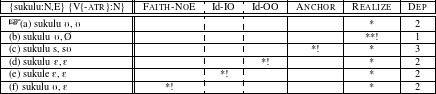
The presence of an  feature triggers what I call here an ellipsis paradigm. This paradigm involves two output forms evaluated together, one where ellipsis has occurred, and one where it has not. Both cells of the paradigm are evaluated simultaneously in the same instance of spell-out.
The novel constraint in (28) is an output–output paradigm correspondence constraint (Burzio Reference Burzio1994, Benua Reference Benua1997, Kager et al. Reference Kager, van der Hulst and Zonneveld1999, McCarthy Reference McCarthy, Downing, Hall and Raffelsiefen2005), which ensures that the phrase (or syntactic phase) containing the elided element is as similar to the optimal non-elided output as possible. For example, the elided form  must be faithful to the non-elided [sukulu ʊ].

In an output–output paradigm correspondence model such as this, candidates consist of paradigms, which are evaluated together as a unit. In Table 18 there are both input–output correspondence relationships, as well as output–output paradigmatic correspondence relationships. We see that in Guébie, when DPs containing elided and non-elided nouns are evaluated together in a paradigm, the undominated constraint in (28) together with those constraints in (27) gives the correct output. That agreement can be sensitive to unpronounced material is well known (Merchant Reference Merchant2015: 16), and the proposed constraints show an articulated model of this particular phenomenon.
A constraint-based approach to ellipsis.

Every form in Table 18 receives at least one RealizeMorph violation because the noun /sukulu1.1.3/ is unrealized in the second form of the paradigm.
The proposed analysis forces phonological agreement and provides the option of ellipsis at PF simultaneously via constraints (with regards to the latter, this analysis is similar to Bennett, Elfner & McCloskey (Reference Bennett, Elfner and McCloskey2015)’s analysis of Irish ellipsis at PF). A terminal node which has a morphosyntactic  feature, available to the phonology, can optionally be elided via an ellipsis paradigm at PF, as in Table 18.
By evaluating paradigms of elided and non-elided candidates at each syntactic phase boundary, we predict phonological agreement of elements within a phase (here, DP) that agree in some morphosyntactic feature. Further predictions of the proposed model are discussed in Section 4.
3.3 Extending the model
The model presented here not only accounts for phonologically determined concord marking on non-human subject and object pronouns, but for semantically determined human pronouns, concord on possessive and emphatic pronouns, concord marking on adjectives, and concord triggered by plural- and definite-marked nouns.
3.3.1 Possessive and emphatic pronouns
Non-human possessive and emphatic pronouns also show phonologically determined concord marking triggered by the head noun. However, unlike subject and object pronouns, the concord-marking vowel in possessive and emphatic pronouns is not rightmost within the word (ex: the front vowel emphatic pronoun ɛɓa3.2 and possessive pronoun ɛnɛ2.3). I propose that, just as for nominative and accusative pronouns, the initial vowel in non-human possessive and emphatic pronouns is underspecified for all phonological features except -ATR: /
 $V_{-\text{ATR}}$
ɓa/, /
 $V_{-\text{ATR}}$
nɛ/. The ranking of Ident-IO above Anchor-R prevents the rightmost segments of the emphatic and possessive pronouns from undergoing a change to show phonological identity with the final vowel of the noun, since those segments were present in the input. The rightmost manipulable segment in the emphatic and possessive pronouns is the featurally underspecified initial vowel. This segment, then, shows phonological identity with the right edge of the head noun, due to Anchor-R.
3.3.2 Plural and definite-marked nouns
When a non-human noun surfaces as plural or definite, the quality of the plural or definite vowel determines concord. This, too, is accounted for with the phonological constraint ranking above, since the definite marker and plural suffix are part of the same phonological word as the concord-triggering noun, and Anchor-R targets the right edge of a phonological word. Thus, the rightmost vowel within the noun word determines the features of concording vowels, whether that vowel is part of the root, suffix, or enclitic.
3.3.3 Guébie human pronouns
Third-person human pronouns in Guébie do not follow the phonological agreement pattern of non-human nouns. Instead, they predictably take the forms /ɔ/, singular, and /wa/, plural. I repeat the pronoun chart for Guébie from Table 3 in Table 19 below.
Human and non-human subject pronouns.

The model described in Section 3 extends to human pronouns in Guébie without modification. We saw that nouns are present in the syntax in the same DP as pronouns, and their features are copied to the pronoun via a morphological AGR node. I claim here that human nouns not only have a  feature which is copied to the pronoun, they also have a
 feature (Richards Reference Richards, Bornkessel-Schlesewsky, Malchukov and Richards2015, Van der Wal Reference Van der Wal2015), Table 20.
Pronoun features and realization.

The presence of the  feature triggers insertion of a different vocabulary item than for non-human pronouns. In the case of human pronouns, the inserted vocabulary item is fully specified for phonological features. This is exemplified for [ŋudi3.1
], ‘man’, in (29).

When AGR-node insertion on D occurs and features are copied from a human noun to the AGR node on the pronoun D,  and
 features are copied along with the
 feature. These
 and
 features are absent on non-human nouns.


Then, during vocabulary insertion, the particular bundle of features containing  and
 is spelled out as [ɔ], as in (31). That is, the 3rd singular human vocabulary item /ɔ/ is inserted in the context of the features
 Similarly, the plural human pronoun [wa] is inserted in the context of the features
 This differs from all non-human nouns which are not marked for person or number features in the syntax.

If certain semantic features of the noun such as person and number are copied to the pronoun D via morphological agreement mechanisms and spelled out by a vocabulary item with specified phonological features (
 $\rightarrow$
[ɔ]), that vocabulary item is not subject to phonological identity. Instead, a highly ranked constraint ensures faithfulness to the phonological content inserted during vocabulary insertion. This Ident-IO constraint must be ranked higher than the Ident-OO constraints requiring phonological agreement between agreeing elements in the DP, providing evidence for a more nuanced constraint ranking than the one presented in Table 18. We could imagine, then, a language with the same constraints but where input–output faithfulness was low-ranked, where the entire pronoun system would be phonologically determined, including first and second persons. As far as I know, no such language has been described, but the system proposed here predicts that it could exist.
Phonological identity between the pronoun and agreement-controlling noun seems to be a last resort agreement strategy in Guébie. Specifically, phonological identity holds only in those cases where there is no relevant vocabulary item with specified phonological content to insert. This prediction is supported by Corbett (Reference Corbett1991)’s generalization that when semantic and phonological criteria for determining noun class are at odds, semantic features take precedence. I return to the discussion of the relationship between semantically and phonologically conditioned concord in Section 5.
3.3.4 Guébie adjectives
Adjectives in Guébie agree in final vowel with the noun that they modify.

We can derive this agreement in the same way as noun–pronoun agreement. Syntactically, nouns, along with the adjectives that directly modify them, are present in a single syntactic phase (DP). An AGR node is inserted on the adjective by the morphology. Features of the noun (namely,  ) are copied to the adjective so that the adjective and noun are in morphosyntactic agreement. The phonology ensures that agreeing heads (the noun and its adjectival modifiers) are phonologically similar, via the same constraints discussed in Section 3.
Much in the same way that pronouns license ellipsis of the agreement-triggering noun (15b, c), adjectives that agree with the head noun license ellipsis of that noun, (34).

Just like optional nominal ellipsis in [Noun Pronoun] constructions, [Noun Adjective] candidates are evaluated in paradigms, with two forms in each paradigm: one where the noun is elided and one where it is overt. A Faith-NoElide constraint ensures output–output paradigm faithfulness so that the adjective agrees phonologically with the noun even when the noun is elided. The relevant constraint ranking is identical to the one shown for noun/pronoun agreement in Table 18.
3.3.5 Interim summary: Analyzing phonological concord in Guébie
A single analysis dependent on phase-based application of morphological and phonological operations explains the phonological concord marking on nominative, accusative, emphatic, and possessive pronouns, as well as adjectives in Guébie; all involve an element (pronoun or adjective) with an optionally elided noun in the same DP, undergoing morphological AGR-node insertion, followed by phonological correspondence and identity.
4 Typological predictions
The constraints presented in Section 3.2.3, together with the proposed syntactic and morphological structure of the DP, account for phonological concord on pronouns and adjectives, triggered by both human and non-human nouns in Guébie. We will see that the proposed analysis not only accounts for Guébie nominal concord, but it also accurately predicts the types of existing phonologically determined nominal concord systems cross-linguistically.
The analysis in Section 3.2 relies on the assumption that DP is a syntactic phase, and that morphology and phonology apply cyclically by phase. It predicts that any two elements within the same syntactic phase could show phonological agreement, as long as those two elements share some morphosyntactic feature. For Guébie, it is only the DP-specific phonological grammar which ensures phonological agreement; however, the constraints in Section 3 do not rule out phonologically determined concord in other domains.
Additionally, due to the nature of correspondence and identity constraints, the phonologically corresponding segments triggering phonological concord must be either edge-based or surface in some prominent position in a word. The Anchor-R constraint in Guébie ensures correspondence triggered by the right edge of the noun. However, we could imagine a system where Anchor-L is at play instead, requiring that corresponding segments be anchored to the left edge of the concord-triggering element.
Perhaps a more specific statement of the prediction above, only an edge-aligned or prominent segment (or suprasegment) can control phonological agreement. We saw in Section 3.2.3 that Ident-OO plus Anchor-R ensures that the final segment of two elements with  features are identical. This means that in Guébie, the final vowel of the noun will control agreement. Rather than a final vowel, we could imagine a system where the agreement-controlling segment is a consonant or is suprasegment.
The above predictions are summarized in (35).

Though they are few, other languages have also been described as having phonologically determined nominal concord systems. These include other Kru languages, Bainuk (Atlantic, Sauvageot Reference Sauvageot1967), Abu’ (Arapesh, Nekitel Reference Nekitel1986),  (Adamawa, Van de Velde & Idiatov Reference Van de Velde, Idiatov and Kaji2017), and Fròʔò (Gur, (Traoré & Féry Reference Traoré and Féry2017)). Like Guébie, phonological agreement in each of these other languages is productive, predictable, and not strictly local. Three of these systems are examined in the remainder of this section.
4.1 Other Kru languages
A similar phonologically determined nominal concord system to Guébie is present in other Kru languages. These include but are not limited to Krahn, a Western Kru language (Bing Reference Bing1987); Godié, an Eastern Kru language (Marchese Reference Márchese1986b, Reference Márchese1988); and Vata, another Eastern Kru language (Marchese Reference Márchese1979, Kaye Reference Kaye1981, Corbett Reference Corbett1991).
4.1.1 Krahn
Bing (Reference Bing1987) describes an agreement pattern in ɡbɔbo, a dialect of Krahn (Western Kru) spoken in Liberia and Côte d’Ivoire, that is quite similar to the Guébie pattern. There are nine vowels in the Krahn system, and there are four possible third-person singular pronoun vowels: one for humans and three phonologically determined ones for non-humans. Non-human nouns that end in front vowels take the front vowel pronoun [ɛ], those that end in non-high back vowels take the pronoun vowel [ɔ], and those that end in high back vowels take the pronoun vowel [ʊ], Table 21.
Krahn phonological agreement.

Since the Krahn system is so similar to the Guébie one, it requires no extra theoretical tools to account for the data. The proposed model would apply to Krahn just as it does to Guébie, ensuring phonological agreement between the final vowel of the noun and pronoun unless the noun is human, in which case the semantic features win out. The only significant difference is that Bing does not mention any category of element other than pronouns that agrees with the noun in Krahn. If adjectives do not agree phonologically with the nouns they modify, we can assume that adjectives in Krahn do not agree morphologically in features with nouns; thus, no phonological identity is required to hold between them.
4.1.2 Godié
Godié is an Eastern Kru language spoken in Côte d’Ivoire. Just like Guébie and Krahn, there are four possible third-person singular pronoun vowels in Godié: one human vowel and three phonologically determined vowels. However, Godié agreement processes target not only pronouns, but also definite clitics, demonstratives, and adjectives (Marchese Reference Márchese1986b, Reference Márchese1988).
In the Godié example below, the human word ‘man’ triggers the agreement vowel [ɔ] on the adjective and demonstrative following it. The final front vowel of the word ‘animal’ triggers the front agreement vowel [ɛ] on the adjective [kəd-ɛ] that describes the word ‘animal’.

Since demonstratives, definite clitics, pronouns, and adjectives are all within the DP domain, all of them should be equally likely to agree with the noun. I have proposed that the phonology applies by phase, and that DP is a phase, so the phonological analysis applies to any two elements within a DP phase as long as they are in a morphosyntactic agreement relationship. Thus, the difference between the Godié agreement system and the Guébie system is that in Godié demonstratives and definite markers are in morphosyntactic agreement with the noun, while in Guébie they are not. Guébie lacks demonstratives entirely but has a definite clitic /=a/ which surfaces on the noun. Further research is need to determine whether there are any true syntactic differences between Guébie and Godié definite markers which shows that they are in agreement with the noun in Godié but not Guébie. In the proposed model, demonstratives and definite markers in Godié are analyzed as agreeing morphologically with the head noun.
4.1.3 Vata
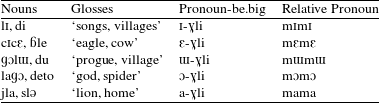
Vata is an Eastern Kru language spoken in south-central Côte d’Ivoire. The Vata system differs slightly from the phonological agreement systems of other Kru languages discussed thus far. There are ten contrastive vowels in Vata, at five places of articulation with an ATR contrast, /i, ɪ, e, ɛ, u, ɯ, o, ɔ, ə, a/. Rather than three possible non-human pronoun vowels like Guébie, Krahn, and Godié, Vata has five non-human singular pronoun vowels: one for each of the five degrees of height and backness /ɪ, ɛ, ɯ, ɔ, a/ (Kaye Reference Kaye1981).
The elements that show concord marking in Vata include pronouns, relative pronouns, definite markers, and a limited number of adjectives, Table 22.
Table 22 shows one noun ending in a +ATR and one ending in a -ATR vowel for each of the five height/backness distinctions. The pronoun and relative pronoun themselves remain -ATR even when the noun ends in a +ATR value. Only the backness, height, and rounding of the vowel are determined by the final vowel of the noun. Concord between nouns and definite markers is shown in (37).
Pronouns in Vata.


We can extend the analysis from Section 3 to Vata agreement with little changeFootnote [18] . We only need to rerank certain constraints to get the right output. In Guébie, there is a ten-vowel system in the language which is reduced to three possible agreeing vowels for non-human pronouns. I mentioned in Section 3 that in order to account for the reduced number of possible pronoun vowels in Guébie, [ɛ, a, ʊ] as opposed to the full ten [i, ɪ, e, ɛ, ə, a, u, ʊ, o, ɔ], we would need constraints like PeripheralVowel which prefers the peripheral -ATR vowels /ɪ, a, ʊ/, and *I to prefer /ɛ/ over /ɪ/. In Guébie these constraints must be highly ranked, only crucially out-ranked by Ident-IO. However, in Vata, the same constraints must be very low-ranked, because they play no role in the Vata agreement system. In Vata, for every distinct final vowel on nouns, there is a corresponding pronoun vowel that has the same height, backness, and rounding features. Only the ATR features of the pronoun are pre-specified on the pronoun vowel. Thus, by simply ensuring that Ident-OO outranks PeripheralVowel and other such vowel markedness constraints, we get the correct output for Vata without otherwise changing the analysis for Guébie presented in Section 3.
It is worth noting that the kind of minor typological variation we see between Guébie and Vata is predicted by a constraint-based analysis like the one presented here, where by reranking the proposed constraints we model another predicted system. However, this variation is less obviously expected in a rule-based phonology or a purely syntactic approach to phonologically determined nominal concord.
4.1.4 Summary of Kru phonological agreement
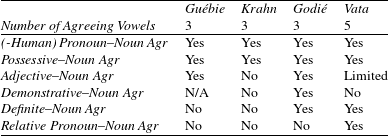
Krahn and Godié, like Guébie, have three possible forms for non-human third-person singular pronounsFootnote [19] . The optimal form is the one that agrees with the noun phonologically. In Vata, there are five possible vowels for non-human third-person singular pronouns, where height and backness, as opposed to just backness of the pronoun vowel is determined by the final vowel of the noun, Table 23.
Nominal concord across Kru.

We can see from Table 23 that the most likely elements among Kru languages to show concord with the noun are pronouns.
Interestingly, surface word order in Vata differs from that in Guébie, Krahn, and Godié. In Guébie, surface order in noun phrases is either Noun-Def Numeral Adjective, or Noun Adjective Numeral-Def. There are no demonstratives in Guébie. In Godié and Krahn, demonstratives are post-nominal. However, in Vata, demonstratives are pre-nominal, while all other modifiers follow the noun. Future work will determine whether these word order differences are related to the differences in which elements within the noun phrase show concord with the head noun across Kru languages.
The phonologically determined nominal concord systems in Krahn, Godié, and Vata all closely resemble the Guébie system except that a different set of elements agrees with the noun in each language. However, because all of the agreeing elements occur within the DP phase, each system above is predicted by the proposed analysis (cf. Prediction A in 35).
4.2 Bainuk
Bainuk, a Western Atlantic language spoken in Senegal and Guinea (Sauvageot Reference Sauvageot1967), also shows phonologically determined concord within DPs. Most nouns in Bainuk take one of 18 fixed noun class prefixes; however, there is a class of prefixless nouns that triggers phonologically determined nominal concord. Prefixed nouns are much like human pronouns in Guébie, where semantic feature bundles determine the concord marker as in Table 24.
Bainuk prefixed nouns.

Demonstratives (38a), numbers (38b), interrogatives (38c), pronouns (38d–e), and adjectives (38f) agree in noun class with the prefixing nouns. Prefixed nouns are marked for plural number by (38a,b)

Unlike prefixed nouns, agreement classes of prefixless nouns in Bainuk, (39), can be derived phonologically in the same way as the phonologically determined non-human pronouns in Guébie. Prefixless nouns do not have a noun class prefix to trigger agreement on the following modifiers. Because there is no prefix, there is no effect of plurality on prefixes for these nouns. Instead, there is a change in final vowel that makes a prefixless noun plural (Sauvageot Reference Sauvageot1987: 18). Though there is no noun class prefix for this group of nouns, the first syllable, no matter its shape, surfaces as the agreement marker on demonstratives, numerals, Wh-words, adjectives, and pronouns.

The possible number of agreement prefixes is extremely high in Bainuk, not limited to three possible vowels as in Guébie, but rather determined by the number of distinct first syllables in prefixless nouns. However, only a small set of nouns trigger such agreement in Bainuk, unlike Guébie where all non-human nouns require phonologically determined agreement.
Note that in Bainuk, phonological correspondence is anchored to the left edge of the agreement-controlling noun and the agreeing elements. Though this is distinct from Guébie right-edge vowel agreement, it is predicted by the proposed analysis (cf. Prediction B in (35)).
4.3 Abu’
Abu’, also spelled Abuq, a dialect of Arapesh spoken in Papua New Guinea (Nekitel Reference Nekitel1986), also shows phonologically determined nominal concord. Here, the final consonant of a noun triggers phonological agreement on demonstratives, adjectives, and verbs (Aronoff Reference Aronoff1992, Dobrin Reference Dobrin1995)Footnote [20] .

Traditionally there are 13 possible final consonants in Abu’. Since contact with Tok Pisin and other languages, words have been borrowed with other final consonants. Even in borrowed words with non-native segments, like /r, p/ in (41a, b), the final consonant of the noun triggers agreement, thus this is clearly a phonologically determined system.

In Abu’ it is right-aligned consonants, rather than vowels (Guébie) or syllables (Bainuk) that trigger concord. The analysis proposed in Section 3 predicts such a system (cf. Prediction C in (35)).
5 Discussion
We have seen that an interface approach to phonologically determined nominal concord accounts for the Guébie data as well as for a range of cross-linguistic phonologically determined nominal concord data. The data examined here has implications for the place of nominal concord within a modular grammar.
5.1 Descriptive and typological findings
Nominal concord for a subset of the lexicon of each of the languages discussed here, Guébie and other Kru languages, Bainuk, and Abu’, is purely phonologically determined. However, in each of these languages, there is part of the lexicon for which semantic features are also necessary to determine the concord markers. There is no attested noun class or gender system that is entirely phonologically determined (see Corbett (Reference Corbett1991)’s survey of cross-linguistic gender systems). In Guébie all human nouns have specified pronoun forms irrelevant of the phonological form of the noun; though, for all non-human nouns, phonological form determines concord.
While Guébie nominal concord is not quite entirely phonologically determined, the analysis in Section 3 does not rule out the possibility of a purely phonologically determined system. The proposed analysis follows DM vocabulary insertion rules in requiring insertion of the item which matches the most possible features of a given terminal node. If the inserted vocabulary item happens to be fully specified for phonological features, it surfaces faithfully to its input. However, if it is only partially specified for phonological content, phonological constraints determine the output form. In this way, the proposed model predicts exactly the generalization by Corbett (Reference Corbett1991) and Culbertson, Gagliardi & Smith (Reference Culbertson, Gagliardi and Smith2017) that when semantic and phonological features determining noun class are at odds, the semantics will win out. Vocabulary items inserted in the context of particular semantic features will be unaffected by phonological agreement, while those underspecified for phonological content are predicted to show phonologically determined nominal concord.
Given this analysis, we could imagine a language where no set of semantic person, number, gender, and/or case features is spelled out by a particular vocabulary item during the morphological vocabulary insertion operation. This would leave the phonology to determine the output of all phonologically underspecified agreeing heads. The fact that we do not find an entirely phonologically determined system is unsurprising from a functionalist perspective. As Corbett (Reference Corbett1991) notes, the most common noun class distinctions are human versus non-human, animate versus inanimate, and masculine versus feminine. All of these features are prominent ones in daily human interaction, and it is not surprising that many grammars distinguish between these semantic categories for ease of communication. While from the perspective of a formal grammatical model, the analysis in Section 3 predicts the existence of a purely phonologically determined system, the functional load of distinguishing between, say, human and non-human referents is too important for a grammar to ignore.
Gagliardi & Lidz (Reference Gagliardi and Lidz2014) show that children acquiring Tsez, a Northwest Caucasian language, primarily make use of phonological information to determine noun classFootnote [21] . However, phonological information is statistically less predictive of class marking in Tsez than semantic information is. The fact that children begin using phonological cues to class earlier could lead to change over time from a semantically determined class system to a phonologically determined one, which is perhaps what has happened in Guébie and its neighboring Kru languages. We could make a prediction based on Gagliardi and Lidz’s findings that children acquiring Guébie would learn the phonologically predictable non-human concord marking earlier than the semantically determined human concord marking. That is, a Guébie child might be more likely to use the front vowel pronoun when referring to Djatchi, a man’s name, which ends in a front vowel, than to use the human pronoun vowel [ɔ2].
5.2 Theoretical findings
Given the Y-model of grammar, and a phonology-free syntax (Pullum & Zwicky Reference Pullum and Zwicky1986, Reference Pullum and Zwicky1988), phonological features are not expected to influence syntactic operations. Since we see phonologically determined nominal concord in Guébie and other languages, I conclude that to maintain syntax as phonology-free, nominal concord must be a post-syntactic operation. Crucially, the analysis proposed in Section 3 does not require phonological information to be present in the syntax, nor does it require that syntax be sensitive to phonological information in any way. Instead, nominal concord is a separate operation from syntactic agreement (i.e. Preminger (Reference Preminger2009, Reference Preminger2011)). Nominal concord is determined by a morphological agreement operation resulting in two or more syntactic heads that share morphosyntactic features (Kramer Reference Kramer2010, Norris Reference Norris2014). Phonological constraints, active only after the syntactic and morphological components of grammar, have access to morphosyntactic features of heads and ensure phonological identity between agreeing elements. In this way, the proposed analysis does not question the assumption of a phonology-free syntax, and bears on the debate about whether nominal concord occurs during the narrow syntax, or post-syntactically, arguing that the post-syntactic view is the right one.
All of the nominal concord systems discussed here show phonologically determined concord within the nominal domain. By assuming a post-syntactic view of nominal concord, where concord is a distinct operation from syntactic agreement, and the narrow syntax is phonology-free, we make a clear prediction that while nominal concord can be fully or partially phonologically determined, syntactic agreement cannot be.
6 Conclusion
This paper describes the phonologically determined nominal concord system of Guébie (Kru, Niger-Congo), and proposes a post-syntactic analysis of nominal concord, where concord relationships are determined morphologically, and phonologically determined concord arises via constraints ensuring phonological identity to the output form of the concord-controlling noun. In addition to accounting for phonologically determined nominal concord, the proposed analysis includes a formal account of ellipsis via constraints at PF.
The proposed analysis accounts for the variation in attested cross-linguistic phonologically determined nominal concord systems, though the question remains whether it could serve as a model of gender and noun class systems more generally.
Crucially, I demonstrate that nominal concord is determined by phonological form in Guébie. In order to retain the assumption of a phonology-free syntax, nominal concord must be accounted for post-syntactically. The model adopted here expands on the post-syntactic view of concord in DM proposed by Kramer (Reference Kramer2010), Norris (Reference Norris2014) and Baier (Reference Baier2015), accounting for both phonologically and non-phonologically determined nominal concord systems. Additionally, the proposed model makes the clear prediction that nominal concord, but not clausal agreement, may be sensitive to phonological content.