Implications
This cafeteria study showed that goats actively selected leaves of tannin-rich plant species. However, feed selection was not influenced by the goats’ Haemonchus contortus infection status or the content of condensed tannins (CT). The absence of therapeutic self-medication perhaps resulted from the lifelong contact with nematodes in experimental animals. Goats seemingly aimed to balance their dietary energy : protein ratio. The selection behaviour described here do not exclude the possibility of prophylactic self-medication either to maintain a low parasitic infection or to prevent the excess of protein in the diet.
Introduction
Self-medication is defined as the use of plant secondary compounds or non-nutritional substances to alleviate or control diseases (Huffman, Reference Huffman2003). De Roode et al. (Reference de Roode, Lefèvre and Hunter2013) classified the self-medication behaviour of animals against parasites into two major categories: (1) therapeutic self-medication, when diseased animals alter their behaviour to medicate themselves, and (2) prophylactic self-medication, when animals with and without parasitic infection consume plants to prevent parasite infection, particularly when infection risk is high. Recently, the therapeutic self-medication behaviour against gastrointestinal nematode (GIN) infections has been studied in sheep (Villalba et al., Reference Villalba, Provenza, Hall and Lisonbee2010; Juhnke et al., Reference Juhnke, Miller, Hall, Provenza and Villalba2012; Copani et al., Reference Copani, Hall, Miller, Priolo and Villalba2013) and goat kids (Landau et al., Reference Landau, Azaizeh, Muklada, Glasser, Ungar, Baram, Abbas and Markovics2010). However, only one study was conducted to demonstrate the prophylactic self-medication against GIN in small ruminants (Amit et al., Reference Amit, Cohen, Marcovics, Muklada, Glasser, Ungar and Landau2013). The latter concluded that goats could express prophylactic self-medication when they were artificially infected with a mixed GIN infection.
On the other hand, it is also possible that goats display a feed resource selection behaviour simply to meet their nutritional requirements and to avoid foods that cause toxicosis (Provenza, Reference Provenza1995). Studies reporting either self-medication behaviour or nutritional wisdom in sheep and goats have used plant foliage dry matter intake (DMI) as the sole indicator of feeding behaviour. However, DMI as the sole behavioural measurement does not consider differences in the availability of plant species offered either in the feed-trough or in a given grazing area. Plant availability is an important aspect that could bias the quantity of plant material consumed as it may represent a constraint to the expression of animal behaviour. The resource selection methodology may help solving such bias on plant species intake data. To the best of our knowledge, there is one resource selection study exploring the self-medication behaviour in response to natural GIN infection recently performed with Criollo goats (Ventura-Cordero et al., Reference Ventura-Cordero, González-Pech, Jaimez-Rodriguez, Ortíz-Ocampo, Sandoval-Castro and Torres-Acosta2017). That cafeteria pen study measured the selection of tropical plant species and concluded that the parasitic status did not change the foliage selection behaviour. The lack of an effect of GIN infection on the selection behaviour of goats was attributed to the low level of infection, which might have been insufficient to cause any change on goats’ behaviour. To clarify whether goats’ feed selection behaviour can be modified by the GIN infection status, it could be necessary to use a high level of GIN infection using H. contortus as a model. Such a trial should also assess the goats’ nutrient requirements v. the supply of nutrients from the selected diet to clarify whether the selection behaviour could be an attempt to fulfil the hosts’ requirements. Therefore, this study investigated the effect of an artificial infection with H. contortus on the feed resource selection of goats in a cafeteria trial.
Material and methods
Study site and experimental animals
The study was performed at the Faculty of Veterinary Medicine and Animal Science, Universidad Autónoma de Yucatan, Mexico. The weather of the study site is tropical warm sub-humid with summer rainfall (AW0) (García, Reference García1988). A total of 12 adult Criollo goats (37.5±4.8 kg BW) with 5 years of browsing experience in the tropical deciduous forest were equally distributed into two experimental groups: (a) Infected group (IG): six goats artificially infected with 6000 L3 of a Mexican H. contortus isolate. (b) Non-infected group (NIG): six goats dewormed with ivermectin (Iverfull©, Laboratorios Aranda S.A. de C.V., México) at 0.4 mg/kg BW, sub-cutaneous route. Goats were housed in individual cages of 2.5×1.5 m with a concrete floor, individual feeders and water troughs. The ethical committee of the Faculty of Veterinary Medicine and Animal Science, Universidad Autónoma de Yucatán approved the experimental protocol used in the study (reference number CB-CCBA D-2014-003).
Artificial infection protocol
The H. contortus infective larvae (L3) used were isolated in Mexico (Paraiso isolate) and were produced from a monospecific donor animal. Experimental goats were dewormed before the onset of the study using levamisole (12 mg/kg BW) and benzimidazole (20 mg/kg BW). This protocol was performed to control the natural GIN infection of experimental animals. Faecal samples were obtained from the goats on the 7th day after the antiparasitic treatment to confirm the worm-free status of experimental animals. Once the goats were confirmed free of GIN infection, the artificial infection with H. contortus was initiated. Each goat received 6000 L3 divided in three oral doses of 2000 L3, administered on consecutive days (Githiori et al., Reference Githiori, Höglund, Waller and Baker2004). That protocol enhanced the likelihood of parasite establishment in the adult goats.
Experimental foliages
Eight species of trees from the tropical deciduous forest were selected according to a gradient of CT content (from high to null):
∙ High CT content: Gymnopodium floribundum, Mimosa bahamensis
∙ Medium CT content: Havardia albicans
∙ Low CT content: Acacia pennatula, Lysiloma latisiliqum
∙ Null CT content: Brosimum alicastrum, Leucaena leucocephala, Piscidia piscipula
With the exception of B. alicastrum foliage, all the plants species included in this study have shown anthelmintic activity against GIN under in vitro or in vivo. In vitro anthelmintic activity has been reported for extracts of H. albicans, Acacia gaumeri and L. leucocephala (Alonso-Díaz et al., Reference Alonso-Díaz, Torres-Acosta, Sandoval-Castro and Hoste2011), L. latisiliquum, L. leucocephala, S. gaumeri, P. piscipula, A. collinsii, H. albicans, G. floribundum and A. pennatula (Castañeda-Ramirez et al., Reference Castañeda-Ramírez, Torres-Acosta, Sandoval-Castro, González-Pech, Ortíz-Ocampo and Parra-Tabla2017). In vivo studies used the foliage of H. albicans (Méndez-Ortíz et al, Reference Méndez-Ortíz, Sandoval-Castro and Torres-Acosta2012), L. latisiliquum (Martínez-Ortiz-de-Montellano et al., Reference Martínez-Ortíz-de-Montellano, Vargas-Magaña, Canul-Ku, Miranda-Soberanis, Capetillo-Leal, Sandoval-Castro, Hoste and Torres-Acosta2010), M. bahamensis (Ventura-Cordero et al., Reference Ventura-Cordero, González-Pech, Jaimez-Rodriguez, Ortíz-Ocampo, Sandoval-Castro and Torres-Acosta2017). The foliage of experimental plants was harvested daily in the morning. The foliage was separated from the tree branches using scissors and simulating the foliage bites of goats as consumed in the tropical deciduous forest (González-Pech et al., Reference González-Pech, Torres-Acosta, Sandoval-Castro and Tun-Garrido2015). Foliage material included in the cafeteria trial consisted of edible material, avoiding thick stems or woody branches.
Experimental protocol
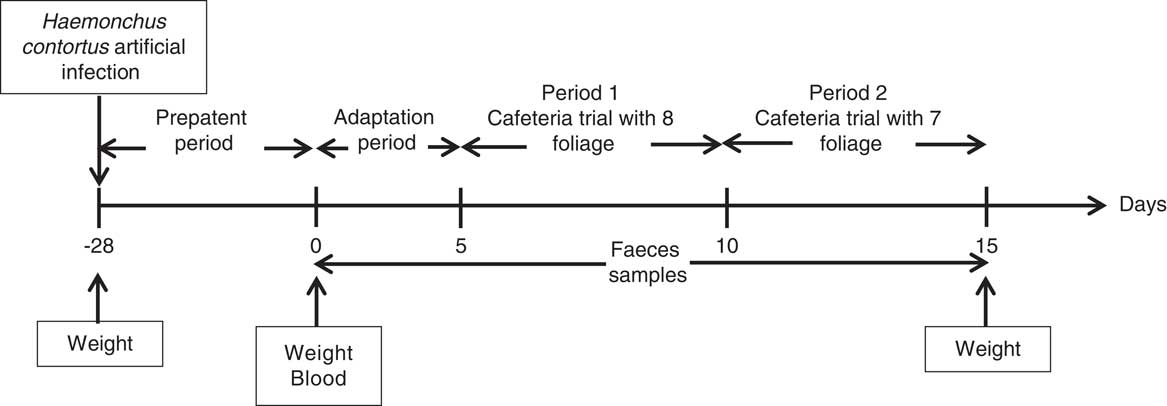
The experimental protocol is described in Figure 1. During prepatent period, both groups were fed a balanced concentrate grain-based feed plus Pennisetum purpureum grass. The quantity of concentrate feed offered to goats represented 1% of their BW in DM. Once goats consumed their concentrate feed in the morning, they received 2200 g fresh basis (FB) of chopped P. purpureum grass. At the beginning of the study, goats in the NIG group were dewormed with ivermectin (Iverfull© at a dose of 0.4 mg/kg BW). Faecal samples were obtained from these goats on a weekly basis to confirm that animals had zero egg excretion after deworming. Meanwhile, faecal samples were also obtained from the IG animals on a weekly basis, until the patency of H. contortus infection was confirmed.
Experimental protocol used to identify the effect of Haemonchus contortus infection on the feed resource selection of goats offered eight plant species with a gradient of condensed tannins.

Adaptation period
Once the infected and non-infected groups were confirmed, the adaptation period started. This period lasted 5 days, during which the goats were fed with the same concentrate feed at 1% BW in DM. After goats consumed their concentrate feed in the morning, they received 200 g FB of leaves from each of the eight experimental plant species, offered simultaneously in respective plastic containers. After a 1-h period, goats received 2200 g FB of chopped P. purpureum to complement their daily diet. Refused feedstuffs were weighed individually and recorded. All goats were weighed at the beginning of the adaptation period in the morning before the balanced feed was offered. Blood and faecal samples were also obtained (Figure 1).
Period 1
This experimental period lasted 5 days. At 0800 h the balanced feed was offered at 1% DM of respective goats’ BW. Approximately, 3 h later animals were offered 500 g FB of each foliage in individual containers, including: B. alicastrum, A. pennatula, H. albicans, M. bahamensis, L. leucocephala, L. latisiliqum, G. floribundum and P. piscipula. The time allotted to measure foliage intake and foliage selection lasted 1 h. During the observation time the plastic containers were constantly refilled with more foliage of the respective plant species whenever goats consumed the leaves from that container to ensure ad libitum supply. When the 1-h period was finished, the goats were separated from the fodder containers to avoid further foliage intake. Foliage remaining in the containers was removed, and refusals were weighed immediately. Then, goats received their respective 2200 g FB of P. purpureum grass. Refusals of grass were also removed and weighed every day before offering the concentrate feed.
Period 2
During this 5-day experimental period, the foliage with highest consumption was withdrawn to enable a possible change of plant selection in study goats. Feeding schedule and animal management were similar to those described for the experimental period 1. The BW of goats was registered at the end of experimental period 2.
Chemical analysis of experimental plants
Foliage samples from each plant species used in the study were taken daily during both experimental periods. Samples were oven dried at 60°C until constant weight was reached. Dry samples were milled and stored in respective plastic jars. The five samples obtained for each plant species during experimental period 1 were mixed in similar quantities to obtain a representative pooled sample of each foliage. The same procedure was repeated for experimental period 2. Foliage samples were analysed to estimate DM (method 7.007), CP (method 2.057) and ash (AOAC, 1980). The fibre components ADF, NDF and lignin were analysed with ANKOM200 method 10-21-05, methodology described by Mertens (Reference Mertens2002) and methodology described by Van Soest et al. (Reference Van Soest, Robertson and Lewis1991), respectively.
The Folin–Ciocalteu method was used to estimate the content of total phenols and total tannins (Makkar, Reference Makkar2003). The vanillin method was used to determine the CT content (Price et al., Reference Price, Van Scoyoc and Buttler1978). The in vitro dry matter (IVDMD) and organic matter (IVOMD) digestibility was performed as described by Barros-Rodríguez et al. (Reference Barros-Rodríguez, Solorio-Sánchez, Ku-Vera, Ayala-Burgos, Sandoval-Castro and Solíz-Pérez2012). The metabolizable energy (ME) content was estimated with a formula by AFRC (1993), where ME (MJ/kg DM)=0.016×digestible organic matter. Nutrient requirements of experimental goats were estimated as per AFRC (1993) using the actual BW of each goat and its BW gain (BWG) during periods 1 and 2.
Voluntary intake and selection index
The DMI of the different plant species was estimated as the difference between the respective foliage offered and foliage refused for each goat. The contribution of nutrients and secondary compounds of each experimental foliage were estimated based on the group mean DMI and the chemical composition of the experimental foliages. The selection index was calculated as follows:
Chesson selection index (αi)=(oi/πi)/∑ (oi/πi)
where αi is the Chesson selection index for each plant species; o the sample proportion of units used (consumed) for each plant species (category i); π the sample proportion of available units in each plant species (category i).
The Chesson selection index measured the strength of foliage selection by goats and its values vary from index 0 to 1.
Faecal and blood samples
Faecal samples were obtained directly from the rectum of individual goats using new polyethylene bags. Two samples were collected from each goat, one in the morning before the concentrate feed was offered, and a second sample was obtained in the afternoon, before the chopped P. purpureum grass was offered. Faecal samples were used to determine the egg count per gram of faeces (EPG) of each experimental goat using a modified McMaster technique (Figure 1).
Blood samples collected during the study were obtained directly from the jugular vein using vacutainer tubes with EDTA (Figure 1). Blood samples were used to determine haemoglobin concentration (g/dl) and packed cell volume (%). The BWG was estimated as the difference between the BW registered at the end of experimental period 2 and the BW at the start of the study.
Statistical analysis
The results of foliage consumption (DMI) and the selection indexes were analysed to determine normality with the Shapiro–Wilk test. Heterogeneity of variances were determined using respective Levene tests. A preliminary statistical analysis used a model that considered day (1 to 5) as the repeated measurement. The result showed that this component was not significant. Therefore, day was not included in the model as repeated measurements. Instead, day was included in the model as main independent factor. The final experimental design consisted of blocks with factorial arrangement, where periods 1 and 2 were the blocks and main independent factors were: days (1 to 5), experimental group (infected or non-infected), position of foliage inside the pen (1 to 8), plant species (1 to 8) and the individual animal as a random effect. The individual animal was the experimental unit. The interactions group×period, period×plant, group×plant and group×period×plant were also included in the model. The comparisons between experimental groups were performed only within each experimental period, because the B. alicastrum foliage was withdrawn from the study during Period 2.
The faecal egg count reduction test (FECRT) was used to determine any reduction in the excretion of H. contortus eggs (EPG) in individual animals using the following formula:
 $${\rm iFECRT}_{2} \,{\equals}\,\left( {l/n} \right)\,\Sigma \left( {100\,{\times}\left( {1\,{\minus}\,\left[ {T_{i} _{2} /T_{i} _{1} } \right]} \right)} \right.$$
where T i1 and T i2 are pre- and post-treatment individual EPG in host i from a total n in the treated group (Cabaret and Berrag, Reference Cabaret and Berrag2004). The EPG of individual goats at the start and end of each experimental period were compared with respective paired t-tests. All the analyses were performed using Minitab 16 Statistical Software (2013).
Results
Chemical composition of experimental plants
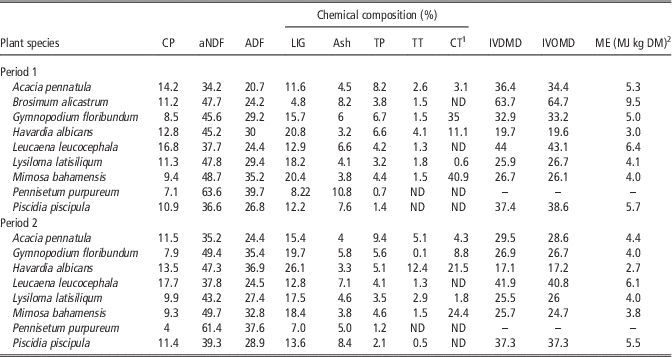
Table 1 shows the chemical composition of the different plant species included in both experimental periods. The foliage of B. alicastrum showed the best nutritional value for goats during period 1, with a medium CP content, the highest values for IVDMD, IVOMD and ME, and a null CT content. In that same period, the foliage of G. floribundum showed the lowest CP content and the second highest CT content. Meanwhile, the H. albicans foliage showed medium CP and CT content, while displaying the lowest values for IVDMD, IVOMD and ME.
Chemical composition (%) of foliage from eight different plant species offered to Criollo goats during the two experimental periods of a cafeteria pen study

LIG=lignin; TP=total phenols; TT=total tannins; CT=condensed tannins; IVDMD=in vitro dry matter digestibility; IVOMD=in vitro organic matter digestibility; ME=metabolizable energy; ND=not detected.
1 Equivalent to catequins.
2 Estimated as ME (MJ/kg DM)=digestible organic matter×0.016.
During period 2, the L. leucocephala foliage showed the highest values for CP content, IVDMD, IVOMD, ME and a null CT content. In contrast, the H. albicans foliage presented the lowest values for IVDMD, IVOMD and ME, with a medium CP content and a very high CT content. The plant that exhibited highest ME during period 2 was P. piscipula. Finally, the foliage of M. bahamensis presented the highest CT content on both periods.
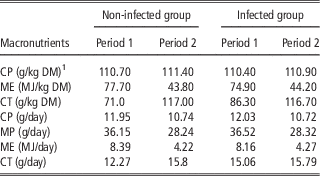
Table 2 displays the contribution of nutrients and secondary compounds for each foliage as estimated from the respective foliage DMI of each experimental group. Both experimental groups consumed similar amounts of CP estimated during periods 1 and 2. A reduction in the supply of ME was estimated for the IG and NIG during period 2 (see Table 2).
Consumption of CP, metabolizable protein, metabolizable energy and condensed tannins estimated from foliage intake of Criollo goats infected and non-infected with Haemonchus contortus during experimental periods

1 Estimation based on group mean DM intake and plant chemical composition.
During period 1, the consumption of CP from foliage, concentrate feed and grass was 112.3 and 112.4 g CP/kg DM for goats of NIG and IG, respectively. Meanwhile, during period 2 the complete diet supplied 108.5 and 108.2 g CP/kg DM for goats in NIG and IG, respectively. During period 1 the energy supplied by the complete diet was 8.85 and 8.8 MJ/kg DM for goats of NIG and IG, respectively. Similarly, during period 2 goats of NIG and IG groups consumed 8.84 and 8.86 MJ/kg DM, respectively.
Voluntary intake and Chesson selection indexes
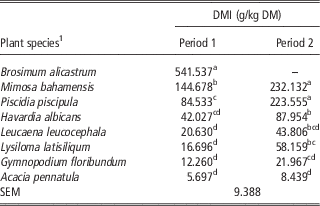
Table 3 displays the DMI of different plant species in the two experimental periods. The interaction period×plant species was significant (P<0.05), which indicates that the quantity of foliage consumed changed depending on the experimental period. During experimental period 1, the DMI pattern was B. alicastrum>M. bahamensis>P. piscipula=H. albicans=L. leucocephala=L. latisiliquum=G. floribundum=A. pennatula. Meanwhile, during experimental period 2, when B. alicastrum foliage was withdrawn, the pattern of intake by goats was M. bahamensis=P. piscipula>H. albicans=L. latisiliquum=L. leucocephala=G. floribundum=A. pennatula.
Dry matter intake (DMI) of foliage from different tropical tree species offered to Criollo goats during two experimental periods in a cafeteria trial

The Brosimum alicastrum foliage was withdrawn in the second period.
a,b,c,dDifferent superscript in the same column indicate statistical difference within periods (P<0.05).
1 Plant species were ordered according to their DMI in each period.
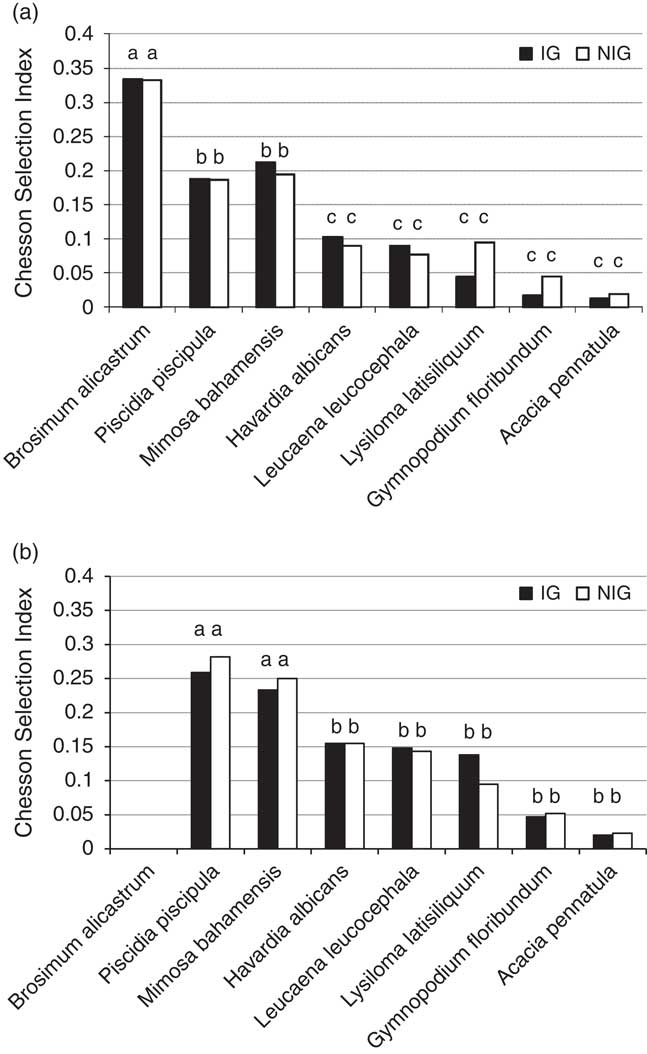
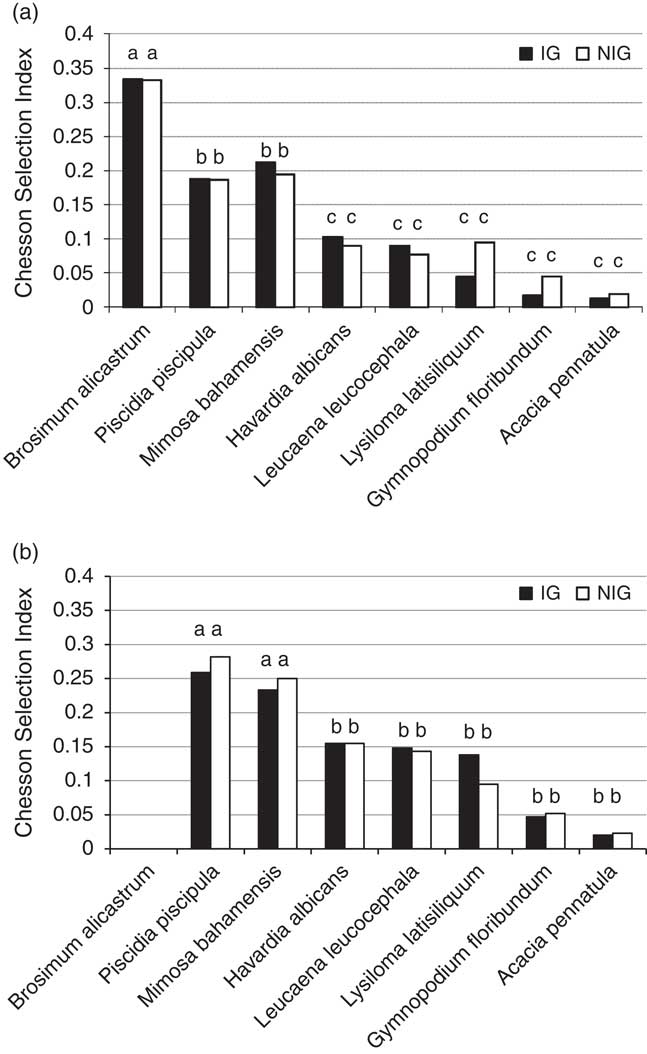
A significant plant×period×group interaction was found for the Chesson selection index (P<0.05). Goats from IG selected the same foliage as goats in NIG in both experimental periods (Figure 2). During experimental period 1, the Chesson selection index showed that the foliage of B. alicastrum was selected most by goats irrespective of their infection status (P<0.05), and the foliage of P. piscipula and M. bahamensis were the next most selected plant species (Figure 2a). During the second experimental period, the foliage of P. piscipula and that of M. bahamensis were the most selected by goats compared with other plant species included in the study (Figure 2b).
Foliage resource selection displayed by adult goats infected (IG) or non-infected (NIG) with Haemonchus contortus during two experimental groups; (a) period 1; (b) period 2. The Brosimum alicastrum foliage was withdrawn in the second period. a,b,cDifferent superscripts between plant species differ significantly at P<0.05.
Body weight gain, blood parameters and faecal egg count reduction test
The BWG was similar between NIG and IG with a mean (±SEM) of 208±27 g and 217±17 g, respectively (P>0.05). The mean packed cell volume percentage (±SEM) of IG and NIG were 28%±1.03 and 33%±1.35, respectively. The mean haemoglobin concentration of goats in IG was 8.02 g/dl±1.03 and 9.427 g/dl±0.396 for NIG. The FECRT showed a tendency to reduce EPG by 28.08% (3158 to 1825 EPG) for goats in the IG group during period 1 (P>0.05). For the second period the tendency of EPG reduction of IG was 13.61% (1950 to 1100 EPG) (P>0.05).
Discussion
The present study aimed to identify the role of an artificial infection with H. contortus on the feed resource selection behaviour of goats. The artificial infection with H. contortus did not influence the fodder DM consumption of experimental goats (P>0.05). Thus, the plant DMI was influenced by different aspects depending on the respective plant species. The plant with the highest DMI during the first experimental period was B. alicastrum (P<0.05). The latter may be due to its low lignin content which makes this foliage a highly digestible option for the goats, showing the highest IVDMD and IVOMD. The high nutritional quality reported for B. alicastrum foliage is consistent with previous study (Alonso-Díaz et al., Reference Alonso-Díaz, Torres-Acosta, Sandoval-Castro, Hoste, Aguilar-Caballero and Capetillo-Leal2008). Thus, a high consumption of B. alicastrum foliage was expected when compared with the foliage from other plant species from the tropical forest of Mexico when offered in cafeteria trials (Hernández-Orduño et al., Reference Hernández-Orduño, Torres-Acosta, Sandoval-Castro, Aguilar-Caballero, Capetillo-Leal and Alonso-Díaz2012). Conversely, a high DMI of M. bahamensis foliage displayed by goats was evident for the two experimental periods in spite of its low nutritional value (low CP and high lignin, aNDF, ADF and CT contents), which is probably aiming to limit the consumption of CP which results from ingesting the protein-rich foliages such as those included in the present cafeteria study. The high CT content (>24%) of M. bahamensis could also help to reduce degradable protein in the rumen of goats (Hagerman et al., Reference Hagerman, Rice and Ritchard1998). Similar high consumption of foliage from this plant species was reported in a recent cafeteria trial using goats with a natural GIN infection (Ventura-Cordero et al., Reference Ventura-Cordero, González-Pech, Jaimez-Rodriguez, Ortíz-Ocampo, Sandoval-Castro and Torres-Acosta2017).
The DMI of foliage from the other six plant species included in the present cafeteria study was significantly lower than that of B. alicastrum and M. bahamensis during the first period of the study. When B. alicastrum foliage was withdrawn from the study, M. bahamensis and P. piscipula foliages were the most consumed by goats. It was already mentioned that goats maintained a high DMI of M. bahamensis in spite of its low nutritional quality. Meanwhile, P. piscipula foliage was chosen by goats to substitute B. alicastrum foliage, as the former had the second best nutritional quality in terms of ME (5.7 MJ/kg DM) and a medium CP content (10.9%). All the other plant foliages maintained a constant level of intake by goats, without any clear relation with its nutritional quality.
As the DMI of goats was not influenced by the infection status, it was important to confirm whether the artificial infection with H. contortus could modify the feed resource selection of adult goats. The experimental goats used in this study presented a subclinical infection that reached a maximum between 3000 and 5000 EPG/day. Such EPG levels can be categorized within the highest 25% of EPG counts in previous GIN surveys performed with goats from Yucatán, Mexico (Torres-Acosta et al., Reference Torres-Acosta, Pérez-Cruz, Canul-Ku, Soto-Barrientos, Cámara-Sarmiento, Aguilar-Caballero, Lozano-Argáes, Le Bigot and Hoste2014), but the experimental animals showed no clinical signs of haemonchosis on packed cell volume or haemoglobin. Even more, the BW gain was close to 210 g/day in the goats of both experimental groups, which can be considered high for adult goats of any breed or physiological state.
The present study showed that, in spite of the high H. contortus infection level reached in the IG goats, their foliage selection was similar to that of the NIG group during periods 1 and 2 (Figure 2). The latter is consistent with previous results obtained for naturally infected goats with a moderate GIN infection (Ventura-Cordero et al., Reference Ventura-Cordero, González-Pech, Jaimez-Rodriguez, Ortíz-Ocampo, Sandoval-Castro and Torres-Acosta2017). Thus, a therapeutic self-medication as described by Villalba et al. (Reference Villalba and Provenza2014) was not evident. Goats in the IG did not attempt to eat more CT-rich foliage to counteract their parasitic infection. The present results differ to those of Juhnke et al. (Reference Juhnke, Miller, Hall, Provenza and Villalba2012) who reported that preference towards an antiparasitic fodder material was directly related to the severity of the parasitic infection in small ruminants. Perhaps the absence of a therapeutic self-medication in these Criollo goats results from the continuous (lifelong) contact with parasitic nematodes. That continuous contact with parasites imply that animals are prepared to limit their infection with their immune system, rather than changing their feeding behaviour.
In addition, it is possible that the good nutritional plane of the experimental goats, which allowed them to fulfil their requirements even to achieve weight gain (see above), may have reduced the need for goats to consume foliage with bioactive compounds to control their parasites. Previous studies with Criollo goats showed that animals with a good plane of nutrition are able to improve their resilience and resistance against GIN infections compared with undernourished goats (Gárate-Gallardo et al., Reference Gárate-Gallardo, Torres-Acosta, Aguilar-Caballero, Sandoval-Castro, Cámara-Sarmiento and Canul-Ku2015). Therefore, the intake of tannin-rich foliage as a therapeutic self-medication strategy could have been unnecessary. Under those conditions, it could be more logical to express a prophylactic self-medication against GIN, attempting to prevent any risk of large GIN infections. In the self-medication, the goats are supposed to consume external materials for the substances that contain (i.e. CT), which may help them to maintain their internal homeostasis (Villalba and Provenza, Reference Villalba, Miller, Ungar, Landau and Glendinning2007). Prophylactic self-medication has been cited in Damascus goats (Amit et al., Reference Amit, Cohen, Marcovics, Muklada, Glasser, Ungar and Landau2013) and the same was found for Criollo goats browsing in the tropical forest of Mexico (Novelo-Chi, Reference Novelo-Chi, González-Pech, Ventura-Cordero, Torres-Acosta and Sandoval-Castro2016).
Once it was confirmed that the H. contortus infection did not affect the selection of feed resources, it was necessary to confirm whether goats’ selection aimed at balancing the nutrient requirements with the available plant resources. The diet resulting from the mixture of selected plants plus the grass and concentrate feed consumed by goats during the study, supplied ~110 g CP/kg DM. Meanwhile, the experimental foliages consumed by goats in the IG and NIG groups provided 110.4 and 111.4 g CP/kg DM, respectively. Therefore, goats were able to select a foliage-mix that resulted in a CP content that is similar to the CP content of the full diet. Thus, the selection behaviour expressed by goats enabled them to discriminate against plants with high or very high CP content and this could be considered as evidence of homeostatic behaviour (Villalba and Provenza, Reference Villalba, Miller, Ungar, Landau and Glendinning2007).
With the evidence obtained in the present study, it is possible to propose that the goats’ selection could be aimed at reducing the consequences of an excess of protein in the rumen. The diet consumed by experimental goats supplied ~11.79 to 18.47 g MP above the requirements estimated for goats (AFRC, 1993). Excess MP represents an inefficiency where animals use energy to excrete the extra N in the urine (Van Soest, Reference Van Soest1994). Thus, goats may have selected tannin-rich foliage in order to block the excess of protein, consuming an estimated 15 g CT/day (see Table 2). In that manner, goats may have reduced the need to use their energy to urinate an excess of MP. If goats selected high-tannin forages to reduce excess rumen degradable protein this could be considered an example of both nutritional wisdom and prophylactic self-medication.
Conclusion
A high infection level of H. contortus did not affect foliage selection by goats fed with CT-rich plants. The absence of therapeutic self-medication against H. contortus perhaps resulted from the lifelong contact with GIN in experimental animals. Apparently, Criollo goats balanced their nutrient intake with the foliages offered showing evidence of nutritional wisdom. Nevertheless, such behaviour do not exclude the possibility of prophylactic self-medication aiming to maintaining a low GIN infection or aiming to prevent the protein excess in the diet of experimental goats.
Acknowledgements
This study received financial support from Consejo Nacional de Ciencia y Tecnología (CONACYT), Mexico with the project: CB-2013/221608, a doctoral grant no. 288564, a postdoctoral grant no. 25775. The authors would like to give thanks to C.E. Capetillo-Leal and the staff of the Nutrition laboratory.