It is well established that children's decontextualized language ability is closely related to their overall language and literacy development and school success (Snow et al., Reference Snow, Cancino, Gonzalez, Shriberg and Bloome1989; Watson, Reference Watson1985). Decontextualized language refers to language use that does not rely on the shared context or background knowledge between the speaker and listener, which requires more explicit, as opposed to deictic, language use with careful linguistic planning (Schleppegrell, Reference Schleppegrell2004). It is relatively more demanding to produce than contextualized language, as the speaker cannot assume any shared information with the listener or rely on the contextual support as cues for conversational repairs or clarifications.
Although children mainly rely on contextualized language in their early years, they gradually learn to produce decontextualized language, especially when they enter school, as regular school activities often ask students to talk about experiences that their classmates have not necessarily experienced, about the past or future events that are removed from the here-and-now contexts, and about abstract concepts or ideas. In a way, decontextualized language can be considered a school language that develops in response to school experiences and thus is related to literacy development and overall school achievement (Snow et al., Reference Snow, Cancino, Gonzalez, Shriberg and Bloome1989). To explain, Cummins (Reference Cummins, Street and Hornberger2008, p. 72) asserted that such context-reduced academic language proficiency “[reflects] primarily the language that children acquire in school and which they need to use effectively if they are to progress successfully through the grades.”
One function of language use associated with decontextualized language is word definitions, which is a task demanded in school contexts. The facilitative role of definition skills in school achievement and literacy development was evidenced in numerous research studies (Dickinson & Snow, Reference Dickinson and Snow1987; Kurland & Snow, Reference Kurland and Snow1997). Further, language transfer between bilingual children's first (native) language (L1) and second language (L2) was also observed (Carlisle et al., Reference Carlisle, Beeman, Davis and Spharim1999; Snow et al., Reference Snow, Cancino, De Temple, Schley and Bialystok1991). However, most research has focused on English-speaking children or bilinguals whose two languages are typologically similar, and little is known about the development of definition skills in children acquiring two distant languages. Thus, this study aims to investigate Korean–English bilingual children's ability to produce word definitions and specifically, which language and literacy factors are related to such decontextualized language production in the two languages.
BACKGROUND
A “good” and mature formal definition conforms to the Aristotelian definition conventions, which comprise a superordinate that identifies the membership category of the term to be defined and an appropriate qualifying complement in the form of a relative clause that provides information about the specific and qualifying attributes of the word (“X is Y that Z”; Litowitz, 1977; Snow, Reference Snow1990). In defining words, one has to (a) possess linguistic competence in producing sentences that fit conventional definition syntax, employing relative clauses with appropriate superordinates; (b) demonstrate metalinguistic awareness by stating explicitly and appropriately what is known implicitly (Watson, Reference Watson1985) without relying on the contextual information; and (c) show communicative ability and sensitivity by providing sufficient and appropriate information about the word meanings to enable listeners’ understanding. In the same way, producing decontextualized language, such as talking about family vacations at school and explaining scientific concepts to someone who does not have the same knowledge, requires both linguistic and metalinguistic skills, as the speakers are asked to talk about something that departs from the here and now. Performance on the definition task, therefore, is indicative of their ability to use decontextualized language.
Definition skills of bilingual children
Given that the definition task requires both linguistic and metalinguistic skills, how bilinguals perform on such a task is worth examining. Although they may be at a disadvantage linguistically because of limited L2 proficiency, they may possess heightened metalinguistic awareness as evidenced in superior performance of bilinguals on metalinguistic tasks such as phonological awareness (PA) performance (Campbell & Sais, Reference Campbell and Sais1995; Oller, Cobo–Lewis, & Eilers, Reference Oller, Cobo-Lewis and Eilers1998). In this respect, Cummins (Reference Cummins, Richard-Amato and Snow2005) hypothesized that context-reduced academic language is more likely to transfer to another language compared to context-embedded communication skills. Previous studies that examined bilingual children's definition skills have mostly shown (a) transfer of definition skills across languages (Carlisle et al., Reference Carlisle, Beeman, Davis and Spharim1999; Ordoñez et al., Reference Ordóñez, Carlo, Snow and McLaughlin2002), (b) a close relation between children's literacy and definition skills (Dickinson & Snow, Reference Dickinson and Snow1987; Snow et al., Reference Snow, Cancino, Gonzalez, Shriberg and Bloome1989; Watson, Reference Watson1985), and (c) effects of schooling or decontextualized language exposure on the development of definition skills (Snow, Reference Snow1990; Watson & Olson, Reference Watson, Olson, Horwitz and Samuels1987).
First, the positive relation between definition skills across languages in bilingual children has been observed (Carlisle et al., Reference Carlisle, Beeman, Davis and Spharim1999; Davidson et al., Reference Davidson, Kline and Snow1986; Ordóñez et al., Reference Ordóñez, Carlo, Snow and McLaughlin2002; Snow et al., Reference Snow, Cancino, De Temple, Schley and Bialystok1991). For example, Carlisle and colleagues (Reference Carlisle, Beeman, Davis and Spharim1999) investigated the factors that explain Spanish–English bilingual children's ability to provide formal and informal definitions in the two languages and showed that vocabulary knowledge in the language of the definition task and the definition skills in the other language were significant contributors. In contrast, Ordóñez and colleagues (Reference Ordóñez, Carlo, Snow and McLaughlin2002) confirmed Cummin's hypothesis (Reference Cummins1979, Reference Cummins, Richard-Amato and Snow2005) by showing that Spanish–English bilingual children's metalinguistic skills in providing paradigmatic responses, but not communicative tasks of including syntagmatic information in their word definitions, were transferred from L1 to L2. However, because their coding of paradigmatic aspect of definitions focused mainly on the quality of superordinates rather than the quality of relative clauses as a whole, whether the overall qualities of formal definitions transferred from Spanish to English is still unclear. In addition, because most studies of bilingual definitions focused exclusively on two Indo European languages such as English–Spanish and English–French, it remains to be examined whether definition skills transfer across two languages that are typologically distant, such as Korean and English.
Second, studies have revealed a positive relationship between definition and literacy skills. Snow and colleagues (Reference Snow, Cancino, Gonzalez, Shriberg and Bloome1989) claimed that “the reading and writing tasks expected of children in the later elementary, middle, and high school grades cannot be accomplished without both productive and receptive decontextualized skills” (p. 240) and showed that second to fifth grade bilingual children’ definition skills were significantly related to their school literacy performance. This finding is also in line with Dickinson and Snow's study (Reference Dickinson and Snow1987) with English monolingual children. However, much remains to be answered with regard to specifically which literacy skills (i.e., PA, letter name knowledge, etc.) are associated with decontextualized language production. Although Carlisle et al. (Reference Carlisle, Beeman, Davis and Spharim1999) reported significant relationship between Spanish–English bilingual children's PA and definition skills, but not between word reading and definitions skills, more detailed accounts for the role of specific emergent literacy skills remain to be answered, because they did not use these particular measures in predicting definition skills.
Third and finally, researchers have provided evidence that definition skills are mostly shaped by the “experience with [academic] context that may not be available in the home or community for many students, especially those who speak English as a second language” (Schleppegrell, Reference Schleppegrell2004, p. 24). Cummins (Reference Cummins, Street and Hornberger2008, p. 72), too, claimed that such context-reduced language proficiency is “specific to the social context of schooling.” That is, unless one has prior experience with or instruction on language features that reflect school-related tasks, it is unlikely that s/he will be able to produce such forms. Studies have shown that such decontextualized language exposure is not limited to school contexts, as some caregivers at home use more “literate” features found in school language in their oral discourse with children (Snow, Reference Snow1983), and that decontextualized language use is closely related to the home language and literacy environment (Beals, De Temple, & Dickinson, Reference Beals, De Temple, Dickinson and Dickinson1994; De Temple & Beals, Reference De Temple and Beals1991). However, such literate and academic language input at home may not be available for those from low socioeconomic status (SES) families (Dickinson & Snow, Reference Dickinson and Snow1987; Kurland & Snow, Reference Kurland and Snow1997; Purcell-Gates, Reference Purcell–Gates2001) or those whose school language is different from their home language (Snow, Reference Snow1990; Snow et al., Reference Snow, Cancino, Gonzalez, Shriberg and Bloome1989, Reference Snow, Cancino, De Temple, Schley and Bialystok1991). For example, Snow (Reference Snow1990) tested the definition skills of English–French bilinguals and found that home language was significantly related only to the amount of information children provided and not to the quality of formal definitions. In another study she conducted with colleagues (Snow et al., Reference Snow, Cancino, De Temple, Schley and Bialystok1991), home language exposure did not predict English–French bilingual children's definition skills while their school language exposure did. Because they did not assess the actual amount of exposure to definition-related tasks at home and school, the direct effects of home and/or school language practices on decontextualized language production are not supported. However, these findings with L2 learners do suggest that unlike monolingual children who may, depending on their SES and home language environment, get socialized to use the key features of decontextualized language at home, bilingual children whose home language differs from the target language are not likely to get such extra input and practice at home. This further highlights the importance of school instruction for these children. The role of school instruction is even more important for the L2 learners in foreign language contexts for whom the target language exposure is restricted to the school contexts. However, there has been little consideration for decontextualized language development of foreign language learners.
In sum, previous research on definition skills mainly concentrated on bilinguals of two Indo European languages (e.g., English–French and English–Spanish) residing in English-speaking countries. In addition, it is not yet clear whether the school context that requires the use of decontextualized language will remain facilitative of the development of such skills when children are in a foreign language context where they are exposed to the L2 only in school, and whether language transfer will still occur when they have no schooling experience in L1. Thus, this study is designed to examine the definition skills of learners of Korean English as a foreign language who have attended only English-medium schools without any L1 school experiences.
Defining words in Korean
Defining words in Korean involves similar skills and sentence formulation to English word definition, following the Aristotelian pattern with the use of the superordinate term and the provision of attributional characteristics of the target word in relative clauses. Similar to research findings with English-speaking children (Benelli, Arcuri, & Marchesini, Reference Benelli, Arcuri and Marchesini1988; Nippold et al., Reference Nippold, Hegel, Sohlberg and Schwarz1999), studies examining Korean monolingual children's definition skill have revealed that normally developing children's word definitions increasingly resemble the Aristotelian definitions with age (Kim, Reference Kim2004; Park, Reference Park1999, Reference Park2005; Shin, Reference Shin2002).
However, because of the syntactic differences between English and Korean, developing Korean–English bilinguals may experience difficulties in utilizing their definition skill in one language for the same task in the other language. Korean is a subject–object–verb language, unlike English which is an subject–verb–object language; incomplete sentences (sentences without a subject or verb) are considered grammatically correct in Korean while they are not in English; and relative pronouns are not required in producing relative clauses in Korean, unlike English. To produce relative clauses in Korean, the predicate verb of an independent sentence is transformed to a determiner by adding the adjectival/relative transformation ending suffix “/( )
 /-(nu)n” to precede and modify the modified noun, rather than creating a complement clause that modifies a relative pronoun (Kim, Reference Kim and Slobin1997; Lee, Reference Lee2004), as shown in the following exampleFootnote 1:
(1)


Thus, a mature formal definition in Korean looks like the following:
(2)

Defining words in English (L2) for Korean L1 speakers
Given the linguistic differences involved in the relative clause formation in English and Korean, the challenges Korean English learners may face in producing such forms in L2 can be easily assumed. Korean English learners not only have to alter the word order in sentence formation, which is already challenging (Lee, Reference Lee2004) but also need to manage embedding a complement clause with an appropriate relative pronoun which is not present in their L1, in constructing relative clauses required in conventional definition formation in English. Studies have shown that such relative clause construction is one of the most difficult English language properties to master, even for advanced Korean English learners (Cho, Reference Cho2004; Choi, Reference Choi2007; Lee, Reference Lee2005). The acquisition of relative pronouns is a late-emerging language skill even for English monolingual speakers (Miller, Reference Miller1981).
Transfer is considered as an important determining factor in L2 syntactic acquisition (Odlin, Reference Odlin1989), although many different explanations, such as language dominance (Paradis & Genesee, Reference Paradis and Genesee1996), quality of language input (Müller, Reference Müller1998), developmental sequences (Odlin, Reference Odlin1989), and individual differences have been acknowledged as possible factors that affect acquisition of specific L2 linguistic features. Furthermore, it has been argued that language distance is an important source of such language transfer (Chan, Reference Chan2004). In this respect, studies have identified L1 effects on L2 relative clause construction in relation to typological differences between the two languages (Comrie, Reference Comrie2007; Fender, Reference Fender2008). While syntactic transfer of relative clause formation was easily identified among Chinese–English bilinguals (Chan, Reference Chan2004; Yip & Matthews, Reference Yip and Matthews2000), “surprisingly little transfer” was observed in bilinguals acquiring two distant languages such as Japanese and Korean English learners (Comrie, Reference Comrie2007; Fender, Reference Fender2008). Thus, although Ordóñez and colleagues (Reference Ordóñez, Carlo, Snow and McLaughlin2002) argued that bilingual children who have control over constructing formal definitions with appropriate superordinate forms in L1 may find it easier to do so in L2, bilinguals acquiring two distant languages may not be able to take advantage of such skills in L1, if there are marked syntactic differences in constructing formal definitions in the two languages.
This study is designed to investigate the potential influences language-learning contexts and language distance have on decontextualized language development, by examining the definition skills of Korean English as a foreign language learners. More specifically, this study attempts to investigate (a) whether schooling experiences are associated with these Korean–English bilingual children's definition skills in two languages (in other words, whether they perform better on definition tasks in the school language or home language), (b) whether there is cross-language transfer of definition skills in either the syntactical forms or semantic content, and (c) what specific language and literacy factors contribute to the ability to provide word definitions in each language and whether there are any cross-language contributions of language and literacy skills to the ability to provide syntactically and semantically adequate word definitions.
METHODS
Participants
There were 70 participants (31 boys, 39 girls) aged from 5 years, 1 month (5;1) to 6;9 (mean age = 6;6). All participants were native speakers of Korean whose parents all reported speaking only Korean at home. They were attending private English-immersion kindergartens in Seoul, Korea, where all classes and activities were conducted only in English. All the participants were from middle- to upper-middle SES families and none of the participants had lived abroad. All of the participants had attended English immersion kindergartens and preschools for at least 2 years on a daily basis for about 5 hr per day and thus had received about 2 years of exposure to English language. At the time of data collection, the children were already capable of functioning in and producing contextualized discourse in English with little difficulty, being able to tell stories and converse freely with their peers and teachers. They were also receiving English literacy instruction regularly, although briefly for about 20–40 min per day, and most of them had fairly good alphabet knowledge in English. There was no formal Korean literacy, or language, instruction offered at school. Informal observations of the classrooms revealed that word-definition questions such as “What is ___?” or “Do you know what ___ is?” asked by the teachers were quite common in their classrooms, especially because the teachers were aware that these children had limited English exposure outside the school context and wanted to ensure that they were given sufficient opportunities to develop their English vocabulary knowledge. However, explicit instruction on how to form conventional definition sentences was never provided.
Measures
Definition task. In assessing the children's ability to provide conventional definitions for nouns in Korean and English, the definition task designed by Snow (Reference Snow, Cancino, Gonzalez, Shriberg and Bloome1989, Reference Snow1990) was adopted. The participating children were individually interviewed, and were asked to define 10 nouns that are commonly used in everyday conversation and that are thus familiar to the children in the two languages (hat, umbrella, bicycle, clock, thief, ball, shoes, book, glasses, and teacher). In order to ensure the children's familiarity with the words, they were asked whether they knew what each word meant before being asked to give definitions (e.g., “Do you know what a bicycle is? Then, Can you tell me what bicycle is?/What is a bicycle?”). There was no time limit given for answering each question, and their answers were recorded and transcribed verbatim. The interviewers were familiar adults for the participating children, as the interviewers previously observed their classes as participant observers. In order to control for the order effects, about half of the children were interviewed in English first and the other half were interviewed in Korean first. Both groups of children had at least a 2-week interval before they were interviewed in the other language, in order to minimize the language effects.
Each word definition was scored based on the adaptation of the coding scheme used in previous studies (Carlisle et al., Reference Carlisle, Beeman, Davis and Spharim1999; Snow, Reference Snow1990; Snow et al., Reference Snow, Cancino, De Temple, Schley and Bialystok1991). Because what constitutes a mature definition is very similar across the two languages, the coding criteria for English definitions were applicable to the Korean definitions as well. Thus, both English and Korean data were coded accordingly. The scoring scheme was largely divided into two definition qualities: formal definition quality (FDQ) and informal definition quality (IDQ). In general, FDQ assessed the closeness of the children's response to the generic formulation of definitions (e.g., “a hat is a thing you put on your head”) as opposed to particularistic formulations (e.g., “you put your hat on your head when you go out”), whereas IDQ assessed the appropriateness in the content and the amount of information children provided in conveying specific meaning, regardless of the form it took. More specifically, FDQ was a summary score of evaluations based on the following (for more detailed description, see Appendix A):
1. Syntax: The degree to which each definition resembled the generic formulation, for which absence of relative clause was scored 1, inclusion of incomplete or limited relative clause was scored 2, and a full relative clause was scored 3.
2. Nature of the superordinate: The specificity of the superordinate provided, for which a general term such as thing and someone was scored 1 and a more specific term such as tool and toy was scored 2.
3. Complement: The accuracy and sufficiency of the semantic content of the complement, for which incorrect or partially correct complement was scored 1, correct but not sufficiently limiting complement was scored 2, and a complement fully limiting the superordinate was scored 3.
In case a definition did not utilize a generic formulation and lacked a relative clause, all of the above criteria were scored 0. The summary scores for the three categories above for the 10 words were computed for each child in each language. Thus, the maximum possible score for a child in each language was 80.
The IDQ reflected the children's ability to provide correct and sufficient information about a word, regardless of the FDQ. If the child provided sufficient and accurate information about the word to the extent that a listener could easily infer the word, a score of 2 was given, even if s/he did not use the conventional definition forms. In contrast, definitions that left some ambiguity were assigned a score of 1, even if they were structurally well-formed Aristotelian definitions. Thus, the maximum possible IDQ score for the ten test items in each language was 20. Following Carlisle and colleague's (Reference Carlisle, Beeman, Davis and Spharim1999) coding scheme, all definitions were evaluated for FDQ, even if the content was inaccurate, and all definitions were scored for IDQ even when they did not take generic formulations with relative clauses. Two trained Korean–English bilingual researchers coded the data, and the Cohen kappa for interrater agreement for both Korean and English exceeded 0.92 for both FDQ and IDQ.
Language and emergent literacy measures. To examine the extent to which specific language and literacy factors are related to children's definition skills, the children were also tested on a range of language and emergent literacy skills, including vocabulary, PA, and word reading abilities, in each language. Because relatively less is known about the relationship between definition and literacy skills of bilingual children, it was important to include measures that are representative of literacy skills, within the participants’ capacities. Because not many of the participants were writing in English yet, measures of writing or spelling abilities were not included. In each language we assessed the Korean–English bilingual children's vocabulary knowledge, in order to consider their oral language proficiency, their PA, in order to account for their word-level metalinguistic awareness that requires their conscious analysis of the sound units and which is also an important predictor for overall reading abilities (Comeau et al., Reference Comeau, Cormier, Grandmaison and Lacroix1999; Durgunoğlu et al., Reference Durgunoğlu, Nagy and Hancin–Bhatt1993), and their word reading abilities, in order to account for their school-related literacy skills.
In measuring English vocabulary knowledge, the Peabody Picture Vocabulary Tests—III (Dunn & Dunn, Reference Dunn and Dunn1997) was administered. In testing the children's English word reading skills, the word identification section of the Woodcock Reading Mastery Tests—Revised (Woodcock, Reference Woodcock1987) was used. The phoneme matching task of the Comprehensive Test of Phonological Processing (Wagner et al., Reference Wagner, Torgesen and Rashotte1999) and rime matching task of the Process Assessment of the Learner Test Battery for Reading and Writing (Berninger, Reference Berninger2001) were used to assess their PA in English. For all of these tasks, each correct answer was scored 1 point. Because standardized tests for these constructs are not yet available in the Korean language, measures of vocabulary, PA, and word reading skills developed by Kim (Reference Kim2009), which were very similar in content and forms to the English counterparts, were used for this study. The Cronbach alphas for these Korean measures were all above 0.85. More detailed descriptions of these measures are provided in Kim (Reference Kim2009).
RESULTS
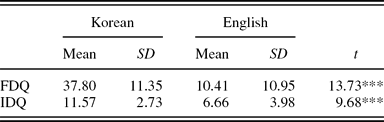
In order to first investigate whether schooling experiences are associated with Korean–English bilingual children's definition skills, t tests comparing their performances in the two languages were conducted. It was not surprising that there were big discrepancies in the children's abilities to provide definitions in the two languages in terms of both FDQ and IDQ (Table 1). In general, the bilingual children in this study performed significantly better in Korean than in English. Their FDQ score in Korean was over 3 times higher than their score in English (t = 13.73, p < .001), and their IDQ score in Korean was almost double their English score (t = 9.68, p < .001). Considering that they had equivalent receptive vocabulary knowledge in the two languages, as shown by a separate t test (t = 0.61, p = .54), it is interesting that they found it much more challenging to apply their linguistic and metalinguistic skills in defining words in English.
Means and standard deviations of definition scores
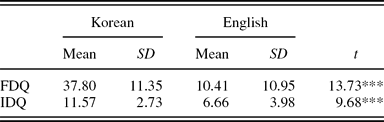
Note: FDQ, formal definition qualities; IDQ, informal definition qualities.
*** p < .001.
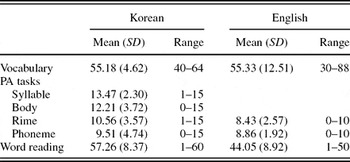
Table 2 provides information regarding the Korean–English bilingual children's emergent literacy skills. It seems that the Korean–English bilingual children in this study had a good command of emergent literacy skills, decoding most of the sight words on the word reading tasks and demonstrating good PA in both languages.
Means and standard deviations of emergent literacy scores in Korean and English

Note: PA, phonological awareness.
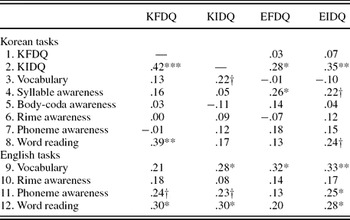
Correlation analysis was conducted next to examine the relation between the definition skills and emergent literacy skills within and across languages. As can be seen in Table 3, the Korean FDQ was significantly related to the participants’ Korean IDQ score (r = .42, p < .001), Korean decoding skill (r = .39, p < .01) and English decoding skill (r = .30, p < .05), but not with vocabulary knowledge or any of the PA measures in either language. Conversely, Korean IDQ was not significantly related to their word decoding skills in Korean (r = .17, p = .18), although it was to English vocabulary (r = .28, p < .05) and English decoding skill (r = .30, p < .05). Similar to Korean FDQ, Korean IDQ was not significantly correlated with PA in either language, although it did show a marginally significant relation with English phoneme awareness (r = .23, p < .10). It is important that there were cross-language associations between Korean and English IDQ (r = .35, p < .01) and between Korean IDQ and English FDQ (r = .28, p < .05). In sum, there was a cross-language relation between Korean IDQ and English emergent literacy skills and between Korean IDQ and English definition skills in both form and content.
Correlations among definition skills and emergent literacy measures in Korean and English

Note: K, Korean; FDQ, formal definition qualities; IDQ, informal definition qualities; E, English.
†p < .10. *p < .05. **p < .01. ***p < .001.
For English FDQ, the only English task that showed a significant relation was English vocabulary knowledge (r = .32, p < .05), as other English emergent literacy measures did not reveal correlations with English FDQ. In contrast, among all the PA measures and decoding abilities in Korean, only the children's syllable awareness showed a significant relation with their English FDQ (r = .26, p < .05). In other words, there was an interrelation in the two languages between the children's metalinguistic awareness in two different constructs; one in distinguishing and attending to sound structure at the syllable level, and the other in producing decontextualized language that is appropriate in forms.
Conversely, there was no cross-task language transfer observed for English IDQ, as none of the Korean tasks revealed a significant relation with English IDQ score, except for Korean IDQ score. In contrast, English emergent literacy skills, including English vocabulary knowledge, English phoneme awareness, and English word decoding ability showed significant correlations with English IDQ (r = .33, p < .01; r = .25, p < .05; r = .28, p < .05, respectively).
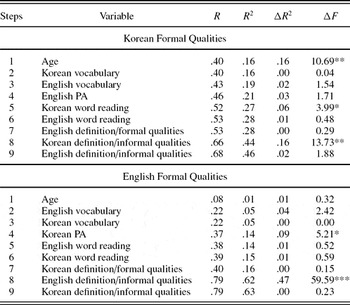
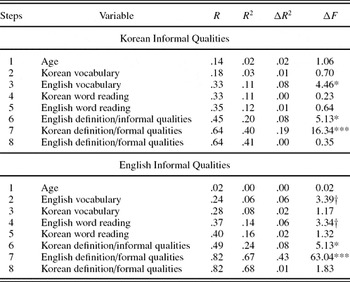
In order to identify the specific language and literacy factors that predict the Korean–English bilingual children's definition skills in the two languages and to examine whether there is any cross-language contribution, hierarchical regression analyses were conducted separately for Korean and English FDQ. In an attempt to explain the variance in their FDQ scores in the two languages, the children's ages were entered first as a background variable, and this was determined to be a significant predictor for only Korean FDQ (F = 10.69, p < .01). In the second step, the vocabulary knowledge of the language in which the definition task was conducted was entered to examine the effect of general oral proficiency in the particular language, and the vocabulary knowledge in the other language was entered next in Step 3 to determine whether there is any cross-language effect of oral language proficiency beyond the vocabulary knowledge of the language. In Step 4, the participants’ PA in the other language was entered to explore the presence of the cross-language contribution of the children's metalinguistic awareness. In Step 5, the children's word decoding skill in the language of the definition task was entered to account for the effects of their literacy skills beyond their oral language proficiency. Their word reading skill in the other language was entered in Step 6, to determine whether cross-language literacy skills made an additional contribution beyond their decoding skills in the particular language. Their FDQ score in the other language was entered in Step 7 to examine whether there is any cross-language transfer of FDQ. In Steps 8 and 9, their IDQ scores in the language and in the other language were entered, respectively, to determine whether their ability to achieve communicative adequacy in definition tasks in each language made any additional contribution in explaining the variance in their FDQ.
As Table 4 shows, cross-language and cross-task transfer of English language and literacy tasks was not observed in explaining the variance in the children's Korean FDQ. In addition, their language skills in Korean did not predict their ability to provide definitions that are well structured. For example, when the effect of age was controlled for, their Korean vocabulary knowledge did not contribute to their FDQ scores, and their English vocabulary knowledge did not contribute any additional variance, either. In contrast, their Korean decoding skill made a significant contribution (ΔF = 3.99, p < .05), once their age, vocabulary knowledge in the two languages, and English PAFootnote 2 were controlled for, while their English decoding skill did not make any additional contribution beyond their Korean decoding performance. When controlling for the effects of age and language and literacy factors, the only variable that was a significant predictor for the children's Korean FDQ was their Korean IDQ score. That is, when controlling for the effects of age and their performance on Korean and English language and literacy tasks, the children's ability to provide definitions that are communicatively adequate contributed a significant variance to their Korean formal definition score, contributing as much as 16% of the unique variance, whereas the same-task transfer from L2 was not observed.
Predictive formal definition qualities in Korean and English from hierarchical regression analyses

Note: PA, phonological awareness.
*p < .05. **p < .01. ***p < .001.
Similarly, in predicting their English FDQ, their English or Korean vocabulary knowledge did not make any significant contribution once their age was taken into account. However, their Korean PA made a significant contribution beyond the effects of age and their vocabulary knowledge in the two languages. Their Korean PA alone contributed an additional 9% of the unique variance in their English FDQ. By contrast, their decoding skills in English did not contribute any additional unique variance, and neither did their Korean decoding skill beyond their English decoding ability, nor was their FDQ score in Korean a significant predictor for their English formal definition score once their Korean and English language and literacy tasks were controlled for. Thus, there was no cross-language contribution of FDQ. As was the case in their Korean formal definition score, their IDQ in English was a significant contributor, adding as much as 47% of the unique variance. Their Korean IDQ did not make any additional contribution beyond that in English.
In predicting the Korean–English bilingual children's IDQ in the two languages, two additional hierarchical regression analyses were conducted (see Table 5). The predictor variables and the order of entry were similar to the regression analyses with FDQ as a dependant variable, except that the PA in the other language was not considered based on the results from the correlation analysis.
Predictive informal definition qualities in Korean and English from hierarchical analyses

†p < .10. *p < .05. ***p < .001.
It is interesting that, in predicting Korean IDQ, English vocabulary knowledge contributed a significant amount of variance beyond the effects of age and Korean vocabulary knowledge. That is, there was cross-language transfer of L2 oral language proficiency to L1 definition task. Their word decoding skills in Korean and English, entered in Steps 4 and 5, respectively, were not significant predictors once age and their oral language proficiency in the two languages had been controlled for. The children's performance on the English IDQ explained the unique variance beyond their L1 language and literacy measures, contributing an additional 8% of the variance. Thus, there was cross-language transfer of IDQ. Their FDQ in Korean contributed a significant amount of the variance, explaining an additional 20% of the variance when controlling for their language and literacy abilities and their English IDQ. Their English FDQ did not contribute any additional variance to their Korean IDQ. In short, cross-language and cross-task transfer were observed in predicting the children's Korean IDQ.
In predicting English IDQ, neither the children's oral vocabulary knowledge nor their decoding skills in the two languages was a significant predictor. Their English vocabulary knowledge made a marginal contribution when controlling for age, and their English decoding ability also contributed marginally once their vocabulary knowledge in the two languages and age had been controlled for. As was the case for Korean IDQ, cross-language transfer of IDQ was observed, as their Korean IDQ contributed a significant amount of variance (ΔF = 5.13, p < .05). In addition, their English FDQ contributed as much as 43% of the variance in explaining their English IDQ.
The findings from the regression analyses support the speculations made with correlation analysis results. In explaining FDQ, that is, the ability to construct syntactically acceptable definition sentence formulations, IDQ, that is, the degree to which the speaker attends to the listener's understanding with communicative adequacy of the definition, in the language was the most significant predictor when controlling for other language and literacy measures. Although Korean PA did contribute significantly, when controlling for vocabulary knowledge in the two languages, toward explaining the variance in English FDQ, no variables other than IDQ were a significant predictor for children's Korean FDQ and no cross-language contribution of FDQ was observed.
DISCUSSION AND CONCLUSION
The result of this study of Korean–English bilingual children who had no school experience in their L1 and had been exposed to English only through the school contexts has shown the following:
1. There was superior performance in their L1 word definition task, both in forms and content, compared to that in L2, which contradicts previous claims that definition skills are a school-related genre that develop in response to school tasks that require such language skills (Snow et al., Reference Snow, Cancino, De Temple, Schley and Bialystok1991).
2. Significant cross-language contribution was limited to only the communicative adequacy of the definition, and did not apply to the formal aspects, which contradicts Carlisle and colleague's (Reference Carlisle, Beeman, Davis and Spharim1999) finding of a significant cross-language contribution of FDQ, but not of IDQ.
3. Except for Korean PA and English vocabulary knowledge that contributed to predicting English FDQ and Korean IDQ, respectively, no other language or literacy measures contributed to the definition skills in the two languages.
The discrepancies between the findings from the present study and previous research may be attributed to the Korean–English bilingual children's lack of linguistic competence in English, as other researchers claim that the transfer of definition skills from L1 to L2 “does not occur until a relatively high level of proficiency in the second language is acquired” (Snow et al., Reference Snow, Cancino, De Temple, Schley and Bialystok1991, p. 109). Paradis and Genesee (Reference Paradis and Genesee1996) also suggested that linguistic transfer “is most likely to occur if the child has reached a more advanced level of syntactic complexity in one language than the other” (p. 3). Although the Korean–English bilingual children may have had metalinguistic awareness of the acceptable and sufficiently informative content of definitions to transfer such awareness to either language, they may not yet have developed sufficient productive linguistic skills in structuring conventional definition forms in their L2 to allow language transfer.
Such late development of definition forms may be related to the typologically and syntactically very distinguished pair of languages that the Korean–English bilingual children were acquiring. In this respect, this particular finding also conforms to previous studies on the less readily made syntactic transfer of Korean English learners’ relative clauses in the two languages (Comrie, Reference Comrie2007; Fender, Reference Fender2008). As construction of relative clauses in English is a late development for Korean English learners, possibly because of the linguistic differences between their L1 and L2 (Choi, Reference Choi2007; Lee, Reference Lee2005), producing word definitions that conform to the conventional Aristotelian form may have been challenging despite their awareness of conventional formal definitions. Those studies that identified the transfer of definition skills across languages and the superiority of definition skills in the school language in the foreign language setting mostly explored bilingual children whose two languages are typologically close (Davidson et al., Reference Davidson, Kline and Snow1986; Snow et al., Reference Snow, Cancino, Gonzalez, Shriberg and Bloome1989, Reference Snow, Cancino, De Temple, Schley and Bialystok1991). In the absence of any negative cross-language transfer of FDQ, it seems that the Korean–English bilingual children in this study may have avoided relative clause formation and settled with less formal and less mature definition forms for defining words in English, instead of capitalizing on their knowledge and awareness of more apt definitions. However, because of the Korean–English bilingual children's linguistic competence, and syntactic knowledge in particular, was not assessed, whether it was their lack of sufficient syntactic knowledge and skills that prevented them from producing fully accepted conventional definition forms in English and from actively transferring their L1 formal definition skills to L2 remains uncertain.
In addition, it is also important to consider the language learning contexts in explaining their superior definition skills in their home language, compared to their school language, and the cross-language transfer of only informal, and not formal, properties of definition skills. These children were learning English in a foreign language context, where English is not a societal language and thus had limited exposure outside the classroom, as opposed to a second language context where abundant language exposure and practice is available outside school. The participants in previous studies were mostly learners in a second language context (e.g., Carlisle et al., Reference Carlisle, Beeman, Davis and Spharim1999), so that their school language exposure might have been assisted by their language exposure outside school. That is, school exposure alone may be insufficient for children to gain control over decontextualized language production in a relatively short period of time.
It is interesting, however, that although no cross-language contribution of FDQ was observed in this study, cross-task transfer between FDQ and IDQ within each language was detected. That is, metalinguistic awareness in communicative adequacy and that in syntactic and formal adequacy may potentially have mutually facilitative roles. Despite mixed findings regarding the relationship between the formal and communicative aspects of definition skills (e.g., Snow et al., Reference Snow, Cancino, De Temple, Schley and Bialystok1991, reported an absence of any relationship between FDQ and IDQ, Dickinson & Snow, Reference Dickinson and Snow1987, revealed a high negative relationship between FDQ and IDQ, and Carlisle et al., Reference Carlisle, Beeman, Davis and Spharim1999, showed significantly positive correlations between FDQ and IDQ in the two languages of Spanish–English bilingual children), no research attention has been paid to the explicit relationship between the two definition subskills. Carlisle et al. (Reference Carlisle, Beeman, Davis and Spharim1999), for instance, only examined cross-language contribution of FDQ and IDQ separately and did not explore whether IDQ predicts FDQ or vice versa in each language. In order to investigate whether the discrepancies in the research findings in relation to the FDQ–IDQ relationship are associated with other factors such as language proficiency, age, degree of bilingualism, or the language distance between the two languages of bilingual children, further studies considering these factors are warranted.
Another interesting finding from this study was the cross-language contribution of Korean PA to English FDQ. This finding may suggest that L1 metalinguistic awareness, although in a different construct of distinguishing different sound units, can play an important role in language production tasks that require other kinds of metalinguistic awareness. Because no other study has investigated the predictive role of specific emergent literacy skills or metalinguistic awareness tasks in decontextualized language production, further research attention is called for in order to generate more conclusive evidences.
In short, compared to the participants in previous studies, the Korean–English bilingual children were at a relative disadvantage, being as they were in a foreign language context where the two languages share few linguistic similarities. Furthermore, the 2-year exposure may not have been long enough to overcome the linguistic distance and develop superiority over the home language, especially in a foreign language setting where there is only limited target language input.
However, there are other factors that should be considered in explaining the development of definition skills. For instance, the age of the participants should be considered. The participants in other studies that found transfer effects and school language superiority were older children, mostly in first to fifth grade (Carlisle et al., Reference Carlisle, Beeman, Davis and Spharim1999; Davidson et al., Reference Davidson, Kline and Snow1986; Kurland & Snow, Reference Kurland and Snow1997; Snow et al., Reference Snow, Cancino, Gonzalez, Shriberg and Bloome1989, Reference Snow1990, Reference Snow, Cancino, De Temple, Schley and Bialystok1991). In addition, other home language and literacy factors that might have played a role in children's development of decontextualized language production, such as quality and quantity of parent–child joint book reading (Snow, Reference Snow1983), should be considered. Similar to some shortcomings of previous studies (Snow et al., Reference Snow1990, Reference Snow, Cancino, De Temple, Schley and Bialystok1991), another limitation of this study was the absence of considerations for the actual amount of definition-related activities and instruction that occurred in school. Such information will provide important evidence for the role of school instruction on students’ decontextualized language production. Thus, in order to gain a more accurate and complete picture of the children's decontextualized language development, more studies are needed with bilingual children of a number of different language combinations in different language-learning contexts and with consideration for their syntactic competence in the two languages, as well as their school and home language practices.
Nevertheless, this study has made an important contribution in drawing our research attention to the role of the degree of linguistic similarities and differences in bilingual children's two languages, the potential effects of children's syntactic awareness in the target language, and the differential effects that foreign language, as opposed to L2, learning contexts may have in the development of decontextualized language in bilingual children. Furthermore, it has highlighted the need to provide L2 learners, especially those in foreign language contexts, with instruction on school-related decontextualized language, as their L1 proficiency in similar tasks may not automatically transfer to or facilitate such performance in L2. To this account, Schleppegrell (Reference Schleppegrell2004) asserts that “the language of school tasks is seldom explicitly discussed or taught in schools” (p. 19) and further suggests that “teachers can focus on helping students expand their linguistic repertoires for making meaning in academic contexts” (p. 40) by explicitly teaching the linguistic expectations of schooling.
APPENDIX A
Criteria for formal and informal definition qualities