

1. Introduction
Ende, a language of southern Papua New Guinea, demonstrates a floating segment pattern predicted to exist in Zoll’s (Reference Zoll1998) typology of ghost patterns but which has remained unattested until now. In this pattern, nasal segments float to precede the leftmost non-initial obstruent in the word. I analyze this nasal segment as a feature of the morpheme instead of a typical phonemic segment, similar to the way that Piggott (Reference Piggott1992) analyzes the feature [+nasal] as a floating feature of the morpheme in languages like Mixtec, Southern Barasano, Guarani, Tucano, and Máíhĩki (previously known as Orejon) or how Clements and Osu (Reference Clements and Osu2005) hypothesize a floating [+nasal] feature in Ikwere. Following Sylak-Glassman, Farmer, and Michael’s (Reference Sylak-Glassman, Farmer, Michael, Shih and Inkelas2014) analysis of Máíhĩki, I provide a complementary analysis for the Ende floating nasal pattern based in autosegmental phonology (Goldsmith Reference Goldsmith1976) and optimality theory (OT) (Prince & Smolensky Reference Prince and Smolensky1993 [2002]). This paper presents original Ende data, an analysis of the pattern, and relates it to other known nasalization and ghost patterns.
The term floating nasalization refers to the floating-like pattern observed of nasal segments that undergo phonological alternations in both linearization within the word and place assimilation. The pattern of floating nasals in Ende involves a morpheme-level feature of nasalization, meaning that every morpheme in Ende can be classified as [+nasal] or [–nasal]. Any Ende word containing a [+nasal] morpheme will have a floating nasal segment that will surface immediately before and assimilate to the leftmost non-initial obstruent in the word. If such an obstruent is unavailable, the nasal segment is not realized.
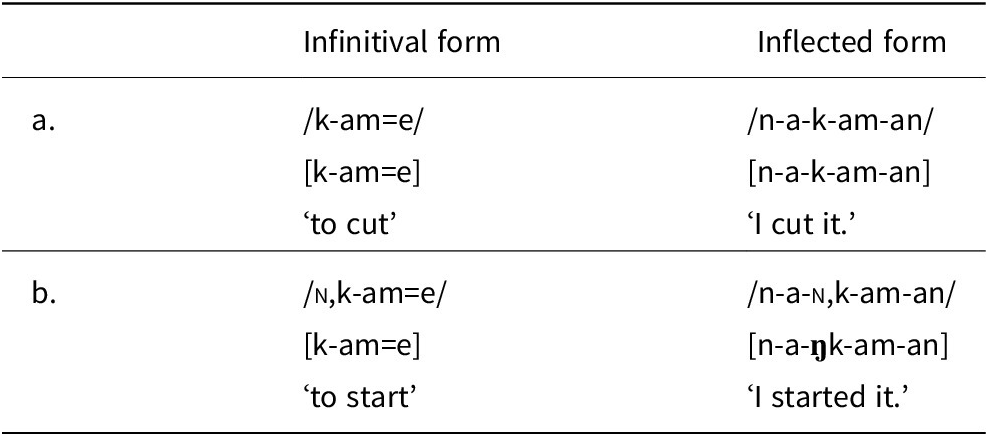
The distinction between [+nasal] and [–nasal] morphemes is evidenced by minimal pairs, such as the pair in Table 1. The surface forms of the infinitival verbs [kame] ‘to cut’ and [kame] ‘to start’ are identical. However, when these verbs are inflected, the verb root in ‘I started it’ is preceded by a floating nasal ([naŋkaman]), while the verb root in ‘I cut it’ is not ([nakaman]). We account for this contrast by analyzing the verb root ‘to start’ as [+nasal]. This is represented as /…/ in the underlying form of ‘to start.’Footnote 1
A minimal pair of morphemes contrasting in the feature [+nasal].

Table 1. Long description
The table consists of three columns: an unlabeled index column, Infinitival form, and Inflected form.
Row a. contains three sub-rows for the verb ‘to cut’:
* Phonemic representation: forward slash k minus am equals e forward slash and forward slash n minus a minus k minus am minus an forward slash.
* Phonetic representation: open bracket k minus am equals e close bracket and open bracket n minus a minus k minus am minus an close bracket.
* English translation: ‘to cut’ and ‘I cut it.’
Row b. contains three sub-rows for the verb ‘to start’:
* Phonemic representation: forward slash small capital N comma k minus am equals e forward slash and forward slash n minus a minus small capital N comma k minus am minus an forward slash.
* Phonetic representation: open bracket k minus am equals e close bracket and open bracket n minus a minus eng k minus am minus an close bracket. The eng symbol is bolded.
* English translation: ‘to start’ and ‘I started it.’
The floating nasal does not appear in the surface form of ‘to start’ because there is no non-initial obstruent in the word for the floating nasal to precede.Footnote 2
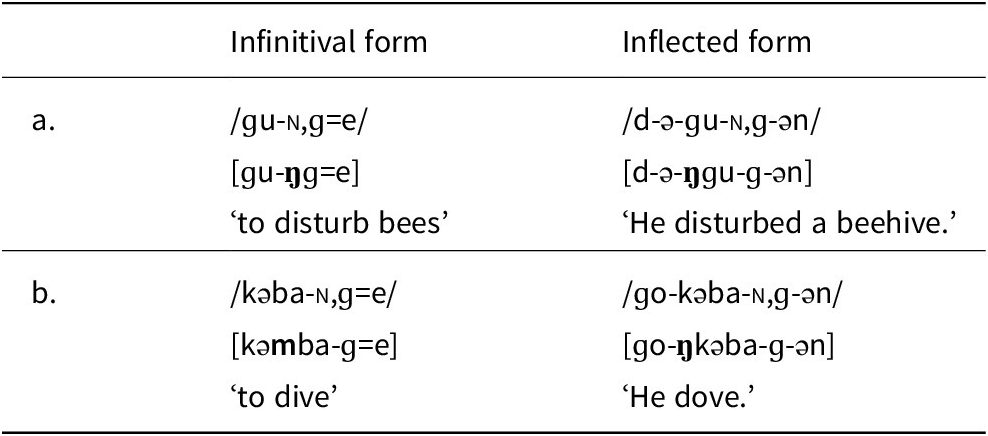
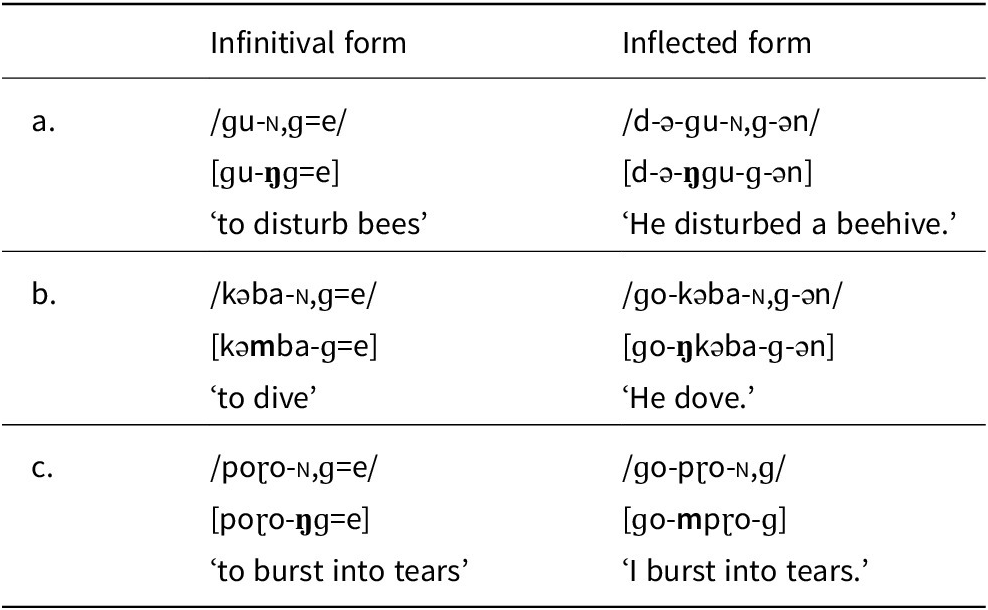
The two verbs in Table 2 have multiple obstruents and [+nasal] morphemes. When verbs have more than one obstruent, the floating nasal will frequently alternate in position and place of articulation between the infinitival and inflected forms. Floating nasals are present (and bolded) in the surface forms of infinitival [ɡuŋɡe] ‘to disturb bees’ (a) and [kəmbaɡe] ‘to dive’ (b) as well as inflected [dəŋɡuɡən] ‘he disturbed a beehive’ and [ɡoŋkəbaɡən] ‘he dove’. Notice how the homorganic nasal-consonant sequences (NCs) shift in linear order and place of articulation for both verb pairs. In all cases, the floating nasal shifts to the leftmost, noninitial, pre-obstruent position in the surface form. It then assimilates in place, surfacing as [m] before labial obstruents and [ŋ] before velar. In verbs with coronal and retroflex obstruents, the floating nasal surfaces as [n] and [ɳ], respectively.
Ende floating nasals alternate in location and place of articulation.

Table 2. Long description
The table consists of three columns: an unlabeled index column, Infinitival form, and Inflected form.
Row a:
- Phonemic representation: /g u - N, g = e/ in infinitival form and /d - schwa - g u - N, g - schwa n/ in inflected form.
- Phonetic representation: [g u - eng g = e] and [d - schwa - eng g u - g - schwa n].
- Translation: ‘to disturb bees’ and ‘He disturbed a beehive.’
Row b:
- Phonemic representation: /k schwa b a - N, g = e/ in infinitival form and /g o - k schwa b a - N, g - schwa n/ in inflected form.
- Phonetic representation: [k schwa m b a - g = e] and [g o - eng k schwa b a - g - schwa n].
- Translation: ‘to dive’ and ‘He dove.’
In the phonetic representations, the nasal consonants (eng and m) are bolded to highlight the alternation in place of articulation.
Floating-like patterns have been observed in other languages as well, notably in Chaha (South Ethiopic), where the third person masculine object suffix (represented as /-w/ in the underlying form) is realized as a labial feature ([ʷ]) that attaches to the rightmost labial or dorsal consonant (Banksira Reference Banksira2013). The floating patterns in Ende and Chaha are nearly identical. The alignment differs: Ende nasal segments are aligned left and Chaha labial features are aligned right, and the type of element differs: Ende nasals surface as independent segments, while Chaha floating labialization surfaces as a feature on another segment.
The following two sections describe the Ende floating nasal pattern in detail and provide a formal analysis treating the floating nasals as a ghost element that predicts a typology of ghost patterns, including Chaha floating labialization and palatalization (McCarthy Reference McCarthy, Barlow, Flickinger and Wescoat1983, Zoll Reference Zoll1998).
2. Description of Ende floating nasals
This section describes the static and dynamic phonotactic properties of floating nasals in Ende and compares them to similar alternations in local languages to the west, such as Idi (Pahoturi River), and also to languages further afield, such as Máíhĩ̀kì (Western Tukanoan) and Ngaju Dayak (Austronesian).
If a word with a [+nasal] morpheme does not contain an obstruent, as in example 1a, or if the only obstruent in the word is in word-initial position (1b), the floating nasal will not surface. The floating nasals in [+nasal] morphemes without non-initial obstruents can be recovered, however, if another morpheme in the word contains a noninitial obstruent, as in 2a, or if another morpheme shifts a root-initial obstruent into word-medial position (2b).
(1)
Floating nasals are unrealized in words without non-initial obstruents
(a)
/ŋonoj-n,meɲ/ → [ŋono-meɲ]
‘to ask multiple people’
(b)
/n,k-am=e/ → [k-am=e]
‘to start’
(2)
Floating nasals are realized when non-initial obstruents are available
(a)
/ʈ͡ʂəkoj-n,meɲ=e/ → [ʈ͡ʂəŋko-meɲ=e]
‘to chop for multiple beneficiaries’
(b)
/da-n,k-am/ → [da-ŋk-am]
‘I started it.’
Nearly all words with NC sequences can be analyzed as consisting of at least one [+nasal] morpheme underlyingly. The only NC sequences that should not be interpreted as containing floating nasals are those in which a morpheme boundary separates the nasal and the obstruent. For instance, the word [pampeme] ‘to fish a pond’ is the nonplural infinitival form of the [–nasal] verb root √pam, formed via infinitival reduplication.
(3)
[pam-pem=e]
‘to fish a pond’
The [mp] sequence in the infinitival form of 3 is technically an NC sequence (that is, it contains a sequence of a nasal and an obstruent that match in place). However, this [m] segment does not behave like a floating nasal. If it did, we would expect to see a floating nasal appear in other words that contain the morpheme √pam, such as in 4.
(4)
[d-ə-pem] (*[d-ə-mpem])
‘I fished a pond.’
The fact that no [m] segment precedes the leftmost non-initial obstruent [p] in [dəpem] indicates that the word does not contain a [+nasal] morpheme. The [mp] sequence in the infinitival form is an accidental artifact of infinitival reduplication, not an underlying [+nasal] morpheme.
Are Ende NC sequences one segment (i.e. [ᵑk] or [ᵐp]) or two? I argue two: NC sequences, such as those that contain floating nasals in 2 and those that do not in 3, are sequences of a nasal and consonant and should not be considered monosegmental, prenasalized obstruents.
The status of NCs as either unary segments or sequences has been debated in previous literature, with several diagnostic criteria emerging. Riehl (Reference Riehl2008), for example, argues that cross-syllable NCs whose components (nasals and obstruents) occur as independent phonemes in a language and are considered to be a separate coda and onset during syllabification are necessarily sequences of segments.
Evidence that Ende NCs split between syllables comes from an Ende language game called tongoe eka ‘silly language’.Footnote
3 In silly language, words are truncated after the first vowel-consonant sequence and suffixed with a fixed suffix [-sko]. This game is productive and can be applied to new loanwords in the language. Regardless of whether the first post-vocalic consonant is oral or nasal, or in an onset or coda position, as in 5a–c, the truncatum contains everything up to that first post-vocalic consonant. The verb roots in 5d and 5e contain NC sequences. Under a monosegmental analysis, we would expect both the nasal and the obstruent to be retained before the [-sko] affix ([*dəⁿd-sko, *pəᵑɡ-sko]). Only the nasal is retained in the truncatum, illustrating the nasal’s independent segment status.Footnote
4
(5)
Ende ‘silly language’ game
Consonant type
Inflected verb
Silly language
Gloss
a.
Non-nasal onset
[ɡo.də.me.nən]
[ɡodsko]
‘he sat’
b.
Nasal onset
[də.naj.mejo]
[dənsko]
‘they drank’
c.
Nasal coda
[ɡoŋ.ʈ͡ʂəɡ]
[ɡoŋsko]
‘I arrived’
d.
Floating nasal coda
[dən.də.raj.bejo]
[dənsko]
‘they heard it’
e.
Floating nasal cluster
[pəŋɡ.meɲ]
[pənsko]
‘to protect’
If we were to analyze these sequences of two sounds as monosegments instead, there must be enough evidence in the phonology of the language that these sequences contrast with, are distributed like, or behave like other segments. In an illustration of Ende’s phonemic inventory, Lindsey (Reference Lindsey2021) provides illustrative data to show that NCs do not meaningfully contrast with heterorganic sequences of nasals and obstruents. The distribution of NCs is also unlike that of phonemic segments: for example, NCs are impermissible in the onset position of any syllable and are rare or absent in coda position, unlike all other phonemic segments in the language.
Another compelling feature of these floating NCs is that they only occur once per morpheme and are aligned to the left edge of the word. This restriction of NC sequences to one per morpheme brings to mind NC dissimilation patterns in languages like Ngaju Dayak and Gurindji. In Gurindji, words with underlying NC1VNC2 sequences undergo deletion of the nasal component of the second NC cluster, as shown in 6.
(6)
Gurindji: deletion of NC2’s nasal component
(McConvell Reference McConvell, Evans and Johnson1988:138, as cited in Stanton Reference Stanton2019)
(a)
/kaɲɟu+mpal/ → [kaɲɟu-pal] ‘across below’
/kajiɾa+mpal/ → [kajiɾa-mpal] ‘across the north’
(b)
/kanka+mpa/ → [kanka-pa] ‘upstream’
/kani+mpa/ → [kani-mpa] ‘downstream’
Ende does not share this word-level restriction for NC sequences. Multimorphemic words may contain multiple NCs if they consist of more than one [+nasal] morpheme. For example, if a [+nasal] verb root, like [pəɲanz] ‘to grow’ is affixed with a [+nasal] suffix, like the nonplural applicative marker [-(ə)ŋɡ], the resulting word will have two NC sequences, as in 7. Another context in which a word may have multiple sequences is in cases of total reduplication of a [+nasal] verb root, like the infinitival verbal stems in 8.
(7)
Words containing two [+nasal] morphemes may result in multiple NC sequences.
(a)
/n,pəɲaz-n,əɡ=e/ → [pəɲanz-əŋɡ=e] ‘to grow (for s.o.)’
(b)
/da-n,dəmoj-n,ɡ/ → [da-ndəmoj-ŋɡ] ‘I sent it.’
(8)
Infinitival reduplication of [+nasal] verb stemsFootnote
5 may result in multiple NC sequences.
(a)
/V-n,məd=e/ → [mənd-mənd=e] ‘to adopt’
(b)
/V-n,məɖ͡ʐ=e/ → [məɳɖ͡ʐ-məɳɖ͡ʐ=e] ‘to drown’
Nasalization as a feature of the morpheme has also been observed in other languages. For instance, Idi (Pahoturi River) NC sequences have similar phonotactic patterns, such that the nasals in these sequences are also (i) aligned to the left edge of the word, (ii) restricted to the coda, and (iii) only occur once per morpheme. However, in Idi, only the voiced obstruents [b, d, z, ɖ͡ʐ, ɡ] may host these floating nasalsFootnote
6 (cf. in Ende, where all voiced and voiceless obstruents may host floating nasals). This means that a non-initial voiceless obstruent may precede an NC sequence in Idi, as in 9, which would not be possible in Ende, as seen in 10.
(9)
/bo-ko-n,ɡ/→ [bokoŋɡ]
(Idi; J. Dipa p.c.)
bo
moko=wa
ɖ͡ʐəɖ͡ʐəɡ=a
jaja=ble
b-o-ko-ŋɡ
1sg.poss
desire=core
meat=core
father=dat
npst-3nduP-cut-appl.npl
‘I want to cut the meat for my father.’
(10)
/bo-ko-n,ɡ/ → [boŋkoɡ]
(Ende; J. Dipa p.c.)
ŋəmo
moko=da
ɖ͡ʐəɖ͡ʐəɡ=de
jaja=bəɽe
b-o-ŋko-ɡ
1sg.poss
desire=nom
meat=acc
father=dat
npst-3nduP-cut-appl.npl
‘I want to cut the meat for my father.’
In Máíhĩ̀kì (Western Tukanoan; formerly known as Orejon), nasalization is also contrastive and treated as a morpheme-level feature (Sylak-Glassman et al. Reference Sylak-Glassman, Farmer, Michael, Shih and Inkelas2014). As in Ende and Idi, Máíhĩ̀kì nasalization is aligned leftward and docks preferentially on the leftmost voiced obstruent ([b, d, dʒ]), which is then realized as a nasal consonant, as in 11. If there are no voiced obstruents, the nasalization docks on the leftmost vowel, as in 12.
(11)
/[NAS] tídó/ → [tínó] ‘heal (tr.)’
(Máíhĩ̀kì; Sylak-Glassman et al. Reference Sylak-Glassman, Farmer, Michael, Shih and Inkelas2014:217)
(12)
/[NAS] tákè/ → [tã́kè] ‘monkey sp.’
(Máíhĩ̀kì; Sylak-Glassman et al. Reference Sylak-Glassman, Farmer, Michael, Shih and Inkelas2014: 217)
Clements and Osu’s (Reference Clements and Osu2005) analysis of Ikwere nasal harmony also hinges on what the authors call the ‘morpheme-feature hypothesis’, which states that ‘any morpheme may bear the feature [+nasal] in its lexical representation’ (p. 181) and ‘allows only one occurrence of the feature [+nasal] per morpheme’ (p. 183). This [+nasal] morpheme-level feature attaches to the leftmost vowel in the phonological root and then spreads bi-directionally to every adjacent morpheme until it reaches an obstruent.Footnote 7
Finally, nasal segments within NC sequences behave remarkably unlike any other segment in the language: in derived environments, the nasal segments may float to less marked positions within the word. The following sections describe this behavior.
2.1. Floating behavior
The floating nature of floating nasals can be observed when comparing [+nasal] morphemes in different morphological environments. This type of alternation has already been illustrated in Tables 1 and 2 (repeated below in Table 3), where we observed an alternation in position for the floating nasal between the infinitival and inflected forms of lexical verb roots containing the [+nasal] pluractional suffix /n,ɡ/. This context is a great place to observe this floating pattern because verb roots are necessarily word-initial in their infinitival form and word-medial in their inflected forms. So, if a [+nasal] verb root contains at least two obstruents, one of which is word-initial, the infinitival and inflected forms will always contrast in terms of the position of the floating nasal. This pattern holds even when there are sonorant consonants between the obstruents in a verb root, as in (example c in Table 3). Additional examples of the floating pattern are shown in Table A1 in the Appendix.
Ende floating nasals alternating in location and place of articulation.

Table 3. Long description
The table consists of three main rows labeled a, b, and c, comparing Infinitival forms to Inflected forms.
Row a:
- Infinitival: Phonemic /g u - N, g = e/, phonetic [g u - n g = e], meaning ‘to disturb bees’.
- Inflected: Phonemic /d - schwa - g u - N, g - schwa n/, phonetic [d - schwa - n g u - g - schwa n], meaning ‘He disturbed a beehive.’
Row b:
- Infinitival: Phonemic /k schwa b a - N, g = e/, phonetic [k schwa m b a - g = e], meaning ‘to dive’.
- Inflected: Phonemic /g o - k schwa b a - N, g - schwa n/, phonetic [g o - n k schwa b a - g - schwa n], meaning ‘He dove.’
Row c:
- Infinitival: Phonemic /p o r o - N, g = e/, phonetic [p o r o - n g = e], meaning ‘to burst into tears’.
- Inflected: Phonemic /g o - p r o - N, g/, phonetic [g o - m p r o - g], meaning ‘I burst into tears.’
In the phonetic transcriptions, the nasal consonants (m and n) are bolded to highlight their shifting positions and articulation points between the two grammatical forms.
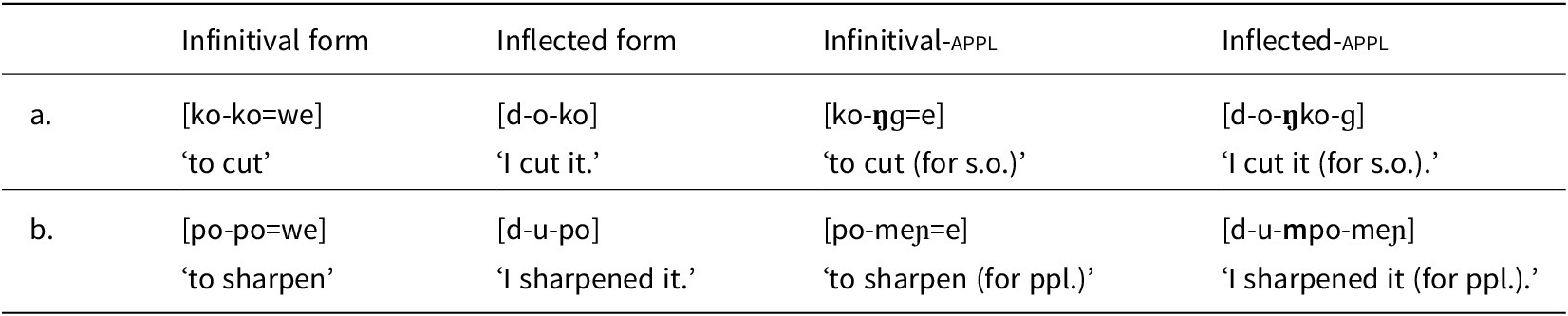
Another context where the floating behavior of NCs can easily be observed is by affixing lexical verb roots with at least one obstruent to one of the [+nasal] applicative suffixes: /-n,ɡ/ (appl.npl) and /-n,meɲ/ (appl.pl). When these two suffixes are affixed to verb roots containing obstruents, the floating nasal element from the suffix will float leftward into the root to the leftmost word-medial obstruent. Table 4 includes two examples where both the infinitival and inflected forms are provided for each verb root’s plain and applicative forms. Four additional examples of this pattern are shown in Table A2 in the Appendix. In each case, the verb root is [–nasal] as no floating nasals are present in either form of the word, despite the presence of non-initial obstruents. Only when the applicative suffix is added does the floating nasal appear.
Lexical verb roots without floating nasals in their plain forms (left two columns), but with floating nasals in their applicative forms (right two columns).

Table 4. Long description
The table consists of five columns and two primary rows labeled a and b.
Column headers from left to right are: Row Label, Infinitival form, Inflected form, Infinitival-A P P L, and Inflected-A P P L.
Row a:
- Infinitival form: [ko-ko=we] meaning ‘to cut’.
- Inflected form: [d-o-ko] meaning ‘I cut it.’
- Infinitival-A P P L: [ko-ŋɡ=e] meaning ‘to cut (for s.o.)’. Note the addition of the velar nasal ŋ.
- Inflected-A P P L: [d-o-ŋko-ɡ] meaning ‘I cut it (for s.o.).’ Note the prenasalized consonant ŋk.
Row b:
- Infinitival form: [po-po=we] meaning ‘to sharpen’.
- Inflected form: [d-u-po] meaning ‘I sharpened it.’
- Infinitival-A P P L: [po-meɲ=e] meaning ‘to sharpen (for ppl.)’. Note the addition of the bilabial nasal m.
- Inflected-A P P L: [d-u-mpo-meɲ] meaning ‘I sharpened it (for ppl.).’ Note the prenasalized consonant mp.
Notable in Table 4 is the infinitival, applicative form in example (b): [pomeɲ] ‘to sharpen (for people)’. This form contains the applicative plural suffix, which we know to be [+nasal], but there is no NC in the word. Indeed, the form of the applicative plural suffix /n,meɲ/ does not contain any obstruents to host the floating nasal segment, and thus the suffix must attach within a word with a non-initial obstruent in order for that segment to ever be realized. This form represents the disappearing behavior of these ghost elements described in the next section.
2.2. Disappearing behavior
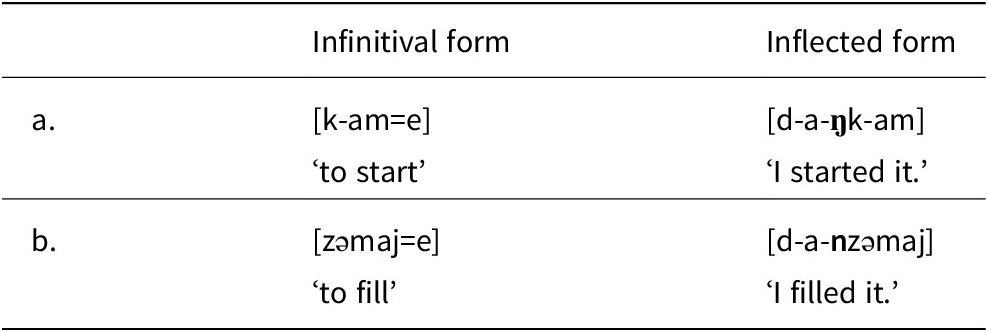
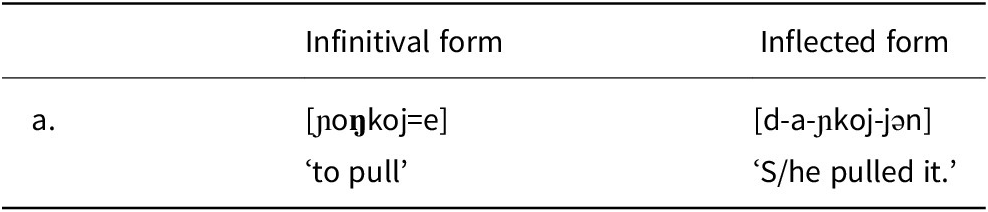
There are many instances where a word with a known [+nasal] morpheme does not contain an NC sequence. The floating nasal segments may not be realized in the surface form if any [+nasal] morpheme occurs in a word without a non-initial obstruent. Disappearing alternations are observed when comparing infinitival and inflected forms of nasal verb roots, in which only one form has a permissible pre-obstruent coda context for the nasal segment. For example, the infinitival and inflected forms for the [+nasal] verb root ‘to start’ are [kam] and [-ŋkam] respectively. In these cases, the nasal segment only appears in the inflected form because it contains a non-initial obstruent by virtue of an obligatory inflectional prefix. Table 5 showcases examples of [+nasal] verb roots in which the nasal segment only appears in the inflected forms. Seven additional examples of this pattern are shown in Table A3 in the Appendix. Table 6 showcases an example of a [+nasal] verb root in which the nasal segment only appears in the infinitival form.Footnote 8
Lexical verb roots with floating nasals absent in the infinitival form but realized in the inflected form.

Table 5. Long description
The table consists of three columns and two primary rows labeled a and b.
Row a shows the verb root for to start. The infinitival form is k dash a m equals e. The inflected form, meaning I started it, is d dash a dash eng k dash a m. The eng symbol represents the floating nasal realized in the inflected form.
Row b shows the verb root for to fill. The infinitival form is z schwa m a j equals e. The inflected form, meaning I filled it, is d dash a dash n z schwa m a j. The letter n represents the floating nasal realized in the inflected form.
Lexical verb roots with floating nasals realized in the infinitival form but absent in the inflected form.

Table 6. Long description
The table consists of three columns. The first column is a label for the row, marked as ‘a.’. The second column is titled ‘Infinitival form’ and contains the phonetic transcription [ɲ o ŋ k o j = e] followed by the English translation ‘to pull’. The third column is titled ‘Inflected form’ and contains the phonetic transcription [d - a - ɲ k o j - j ə n] followed by the English translation ‘S/he pulled it.’. The bolded letter ’ŋ’ in the infinitival form represents the floating nasal that is absent in the inflected form.
2.3. Static behaviors
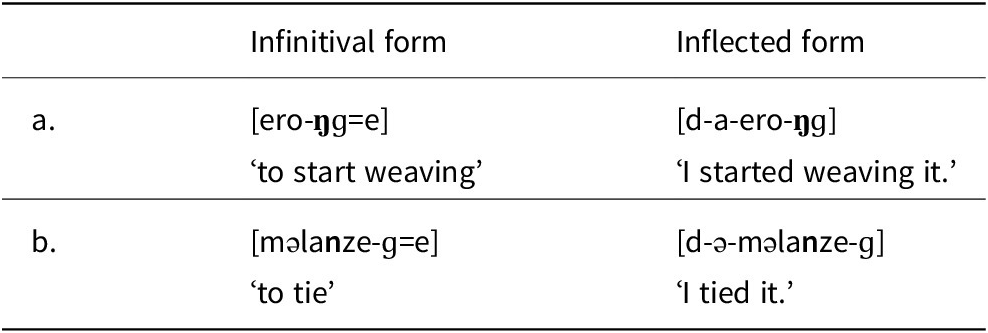
Finally, there are [+nasal] lexical verb roots where the floating nasal is realized in the same position in their infinitival and inflected forms. The floating nasal appears in the same position because the leftmost non-initial obstruent is the same in both forms. For example, in the infinitival and inflected forms for the verb root ‘to start weaving’, [eroŋɡ] and [-eroŋɡ], both forms have the same leftmost non-initial obstruent: [ɡ]. Thus, the floating nasal appears to be static or in the same position in both forms. This static pattern, illustrated in Table 7, occurs when verb roots only contain non-initial obstruents. Eight additional examples of this pattern are shown in Table A4 in the Appendix.
Lexical verb roots with floating nasals in the same position in their infinitival and inflected forms.

Table 7. Long description
The table consists of three columns: an unlabeled index column, Infinitival form, and Inflected form.
Row a:
- Infinitival form: [ero-ŋɡ=e], translated as ‘to start weaving’.
- Inflected form: [d-a-ero-ŋɡ], translated as ‘I started weaving it.’
Row b:
- Infinitival form: [məlanze-ɡ=e], translated as ‘to tie’.
- Inflected form: [d-ə-məlanze-ɡ], translated as ‘I tied it.’
In both examples, the nasal consonants (engma ŋ and n) are highlighted in bold to indicate their consistent position across both morphological forms.
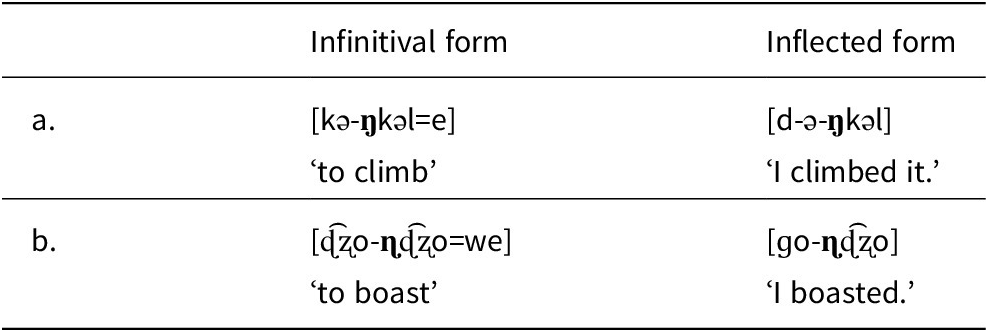
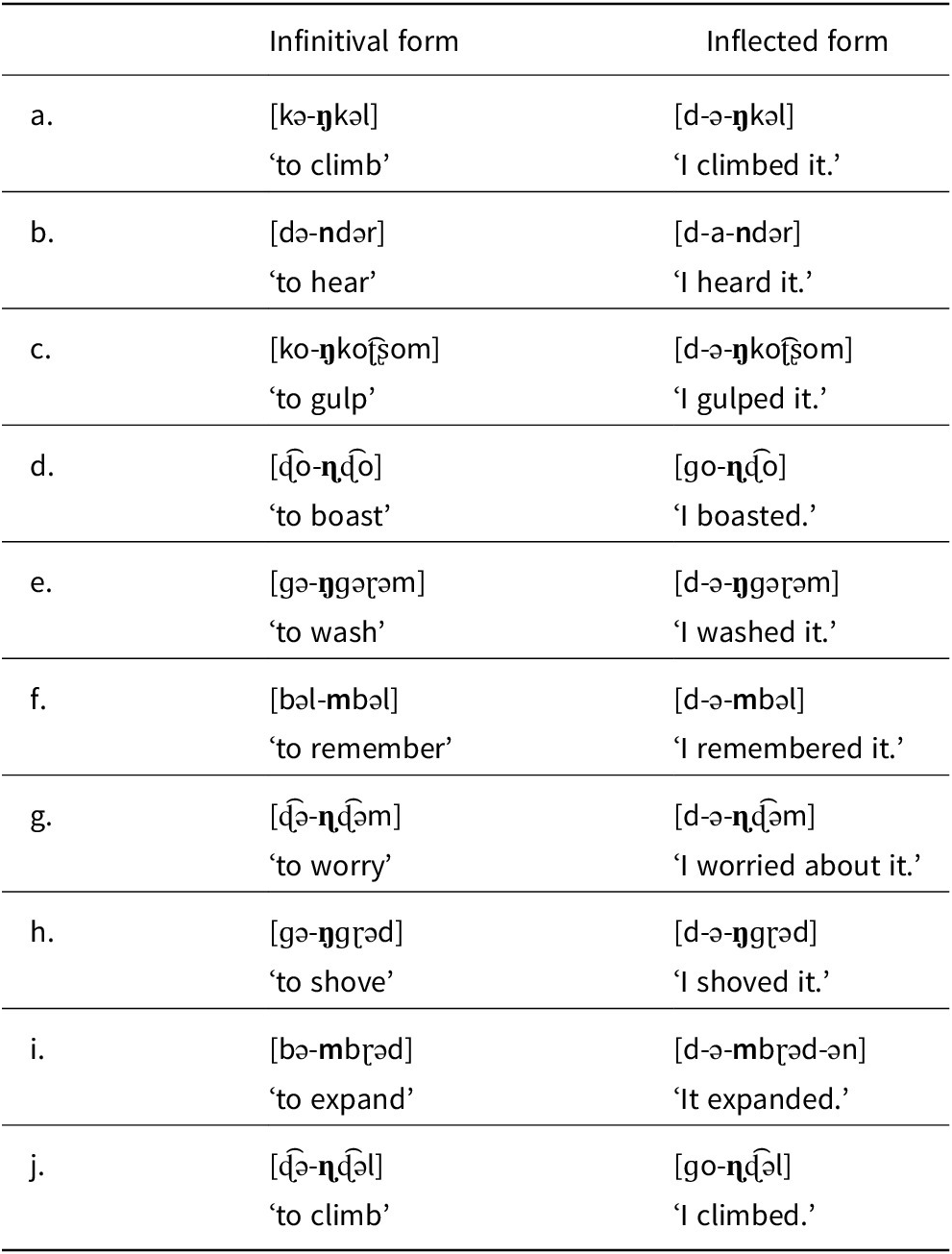
This static pattern where the floating nasal appears in the same position in both the infinitival and inflected forms also occurs when nasal verb roots undergo phonological reduplication in their infinitival form, as in Table 8. Eight additional examples of this pattern are shown in Table A5 in the Appendix. Infinitival reduplication is a phonological process that copies the root partially (CV) or fully into an empty prefix slot. In these examples, the reduplicant in the infinitival form and the inflectional prefix in the inflected form both provide a context for the floating nasal to appear in root-initial position. Because of this, the floating nasal docks in what seems to be the same position of the root in both forms.
Lexical verb roots exhibit a static pattern in the infinitival and inflected forms because infinitival reduplication and prefixation generate identical environments for nasal alignment.

Table 8. Long description
The table consists of three columns and two primary data rows labeled a and b.
Row a:
- Infinitival form: [k ə - ŋ k ə l = e] translated as ‘to climb’.
- Inflected form: [d - ə - ŋ k ə l] translated as ‘I climbed it’.
Row b:
- Infinitival form: [ɖ ʐ o - ɳ ɖ ʐ o = w e] translated as ‘to boast’.
- Inflected form: [ɡ o - ɳ ɖ ʐ o] translated as ‘I boasted’.
In both rows, the nasal consonants (eng ŋ and retroflex n ɳ) are bolded to highlight their identical alignment in both the reduplicated infinitival prefix and the inflected prefix environments.
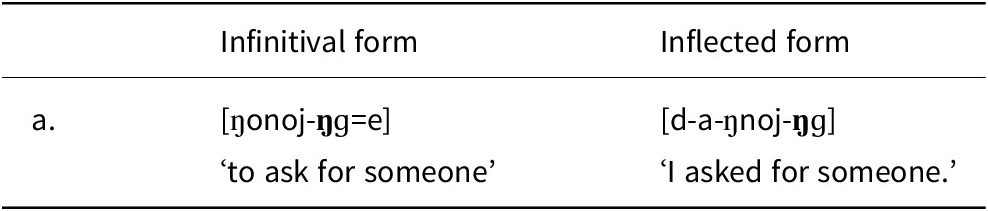
Finally, static patterns are observed when [+nasal] affixes such as the nonplural applicative suffix /n,ɡ/ attach to verb roots without any obstruents, as in Table 9. The example in Table 9 is also another instantiation of the vowel deletion process discussed in Footnote 8.
Static pattern when [+nasal] applicative suffix attaches to lexical verb roots without obstruents.

Table 9. Long description
The table consists of three columns and two rows of data under the headers Infinitival form and Inflected form.
Row a. contains the following linguistic data:
* Infinitival form: open bracket n j o n o j minus n j g equals e close bracket, translated as ‘to ask for someone’.
* Inflected form: open bracket d minus a minus n j n o j minus n j g close bracket, translated as ‘I asked for someone’.
In both forms, the letter n j is bolded within the suffix to highlight the nasal applicative pattern.
An alternative analysis for the static patterns in the data shown in Tables 8 and 9 is that these NC sequences are not composed of a floating nasal but of a static nasal instead. Such an analysis would predict that there are two types of NC sequences (instead of one), perhaps with phonological or morphological implications. The static nature of these floating nasals is not an issue for the floating nasal analysis, as these floating nasals are predicted to be stable.
3. Analysis of Ende floating nasals
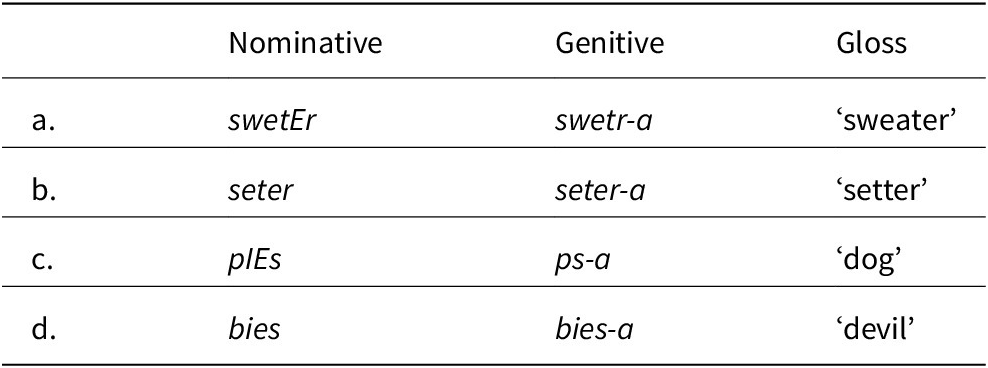
At this point in the paper, I will begin referring to Ende floating nasals as a type of ghost element. Ghosts are an abstract representation used in theoretical phonology to describe, for example, the disappearing act of Slavic yer vowels such as in Polish in Table 10.
Polish yer vowels (Szpyra Reference Szpyra1992: 279).

Table 10. Long description
The table consists of four rows labeled a through d, organized into three columns: Nominative, Genitive, and Gloss.
* Row a: Nominative swetEr, Genitive swetr-a, Gloss sweater.
* Row b: Nominative seter, Genitive seter-a, Gloss setter.
* Row c: Nominative pIEs, Genitive ps-a, Gloss dog.
* Row d: Nominative bies, Genitive bies-a, Gloss devil.
In rows a and c, the capital letters E and I E in the nominative forms indicate vowels that disappear in the genitive forms, illustrating the yer vowel alternation.
As can be seen by comparing the two minimally contrastive pairs, the phonetically identical front-mid vowels can be classified into two types: yer vowels (capitalized) are present in the nominative but absent in the genitive form (Table 10a,c), while non-yer vowels persist in both nominative and genitive forms (Table 10b,d). The differential behavior of the two types of vowels is regulated by a distinction in representation in Szpyra’s (Reference Szpyra1992) analysis. In contrast to non-yer vowels, which are represented as fully present in the underlying form, yer vowels are often represented as only partially present or partially specified in the input. This partial presence explains their increased vulnerability to deletion in the genitive form. The term ghost element has been used to distinguish phonological elements that exhibit these types of patterns. Other terms in use in the literature include floating features, such as Chaha object labialization (McCarthy Reference McCarthy, Barlow, Flickinger and Wescoat1983, Rose Reference Rose1994, Zoll Reference Zoll1994, Reference Zoll1998), latent segments, such as French liaison consonants (Gabriel & Meisenburg Reference Gabriel, Meisenburg, Kügler, Féry and Vijver2009, Smolensky & Goldrick Reference Smolensky and Goldrick2016, Tranel Reference Tranel and Zagona1996a,Reference Tranelb), phantom consonants, such as in Basaa (Schmidt Reference Schmidt1994), and ghost consonants, such as those that lurk after some Finnish nouns (Kiparsky Reference Kiparsky, Manninen and Nelson2003).
Ghosts are phonological elements, whether consonants, vowels, features, or moras, that surface or delete in phonologically predictable contexts. This alternation with zero means that ghosts are sometimes visible and sometimes hidden. However, the quality or underlying distribution of these elements is idiosyncratic or unpredictable, which differentiates these elements from canonical epenthetic or syncopic elements. For example, a ghost vowel may disappear in contexts where other vowels would not, as seen in Table 10, or a ghost vowel may appear in a predictable phonological environment but have unpredictable vowel quality. For this reason, ghost elements must be represented in the underlying form to account for their unpredictable quality. Still, their representation must be deficient in some way to account for their idiosyncratic behavior.
Ende floating nasals can be analyzed as a type of ghost element. They are prespecified for only one feature: [+nasal]. Ende floating nasals are deficient in the same sense that the Polish yer vowels are deficient: they are not a full segment. They consist of a specified melody, but do not have a skeletal root node (see Lindsey Reference Lindsey2019 for more on melodic vs. skeletal ghosts).
Zoll (Reference Zoll1998) develops a typology of both regular and ghost segments (which she does not distinguish from floating features) and their surface patterns. She refers to three properties of surface realization: whether the segment is underlyingly a ghost, whether it surfaces as a full segment or as a feature on an existing segment, and whether its surface position in the word is fixed. Table 11 visualizes this typology, with Ende (and Máíhĩki; Sylak-Glassman et al. Reference Sylak-Glassman, Farmer, Michael, Shih and Inkelas2014) filling what was previously a gap in the typology.
Summary of Zoll’s (Reference Zoll1998) typology of (sub)segment realization.

Table 11. Long description
The table is organized into two main columns for Fixed position in word and two for Mobile position in word. Each of these is further divided into Full segment and Feature on segment.
Row 1, Regular segments:
- Fixed position, Full segment: Iloko ag- prefix.
- Fixed position, Feature on segment: empty.
- Mobile position, Full segment: Tagalog -um- infix.
- Mobile position, Feature on segment: Máíhĩki nasalization.
Row 2, Ghost segments:
- Fixed position, Full segment: Polish yer vowels.
- Fixed position, Feature on segment: Inor palatalization.
- Mobile position, Full segment: Ende nasals, which is highlighted in bold.
- Mobile position, Feature on segment: Chaha labialization.
In the following analysis, I will use an OT framework to account for the different behaviors of segments and ghost elements. This analysis includes faithfulness constraints such as Dep and Ident (McCarthy & Prince Reference McCarthy and Prince1995; see examples 13–15, below) that consider elements below the level of the segment such as features, including [+nasal].
(13)
Max
(McCarthy & Prince Reference McCarthy and Prince1995:16)
Every segment of S1 has a correspondent in S2.
(14)
Dep
(McCarthy & Prince Reference McCarthy and Prince1995:16)
Every segment of S2 has a correspondent in S1.
(15)
Ident(Feature)
(McCarthy & Prince Reference McCarthy and Prince1995:16)
Let α be a segment in S1 and β be any correspondent of α in S2. If α is [γF], then β is [γF].
This analysis will account for the following properties of Ende nasals (example 16):
-
(16)
-
(a) Stable nasals are underlyingly specified for place and always surface in the same location within the word.
-
(b) Floating nasals must match in place with an adjacent segment.
-
(c) Floating nasals must be in coda position preceding an obstruent.
-
(d) Floating nasals are aligned left but may float to the right.
-
(e) Floating nasals must surface when there is a non-initial obstruent.
-
(f) Floating nasals surface as full segments, not as features on other segments.
-
(g) Floating nasals are more likely to delete than other segments.
-
3.1. Stable nasals are underlyingly specified for place and always surface in the same position within the word
Although the present paper focuses on floating nasals in Ende, the language also has stable nasals that are underlyingly specified for place and do not assimilate to adjacent consonants when not in intervocalic position. These nasals also always appear in the same location within a word, regardless of preceding or following phones. We can account for these stable nasals using a highly ranked Linearity constraint (example 17).
(17)
Linearity
(McCarthy & Prince Reference McCarthy and Prince1995:123)
S
1 is consistent with the precedence structure of S
2, and vice versa. Let x, y ∈ S
1 and x′, y′ ∈ S
2. If xℛx′ and yℛy′, then x < y iff ¬(y′ < x′).
The word [inpjak] ‘eagle’ has a stable nasal [n] that does not assimilate to its neighboring [p], suggesting that it is underlyingly /inpjak/. The tableau in example 18 illustrates the stability of its placement within the word.
(18)
Linearity (small caps) maintains underlying linear order.

Notably, since floating nasals are floating features that are not linearized with respect to the word, Linearity does not affect floating nasals. This will be explored further in the following sections.
3.2. Floating nasals must match in place with an adjacent segment
3.2.1. Floating nasals receive their place features from a less or equally sonorous segment
In Ende, the place of articulation for every floating nasal matches the place of articulation specified for the following obstruent, such that the floating nasal is realized as labial [m] before labial stops [p, b], as coronal [n] before coronal stops and fricatives [t, d, s, z], as retroflex [ɳ] before retroflex affricates [ʈ͡ʂ, ɖ͡ʐ] and velar [ŋ] before velar stops [k, ɡ].
This behavior can be accounted for using Ito’s (Reference Ito1988) melody spread, which results in the structure below in 19 (her 27). By Ito’s definition, ‘[t]he nasal assimilates to an obstruent or to another nasal, but does not assimilate to a liquid or glide […] a segment only assimilates to another segment with less or equal sonority’. In 19, the [+nasal] feature appears on a manner tier, C1 and C2 are consonant slots on the skeletal tier, and αF is an arbitrary feature on the melodic tier.
(19)
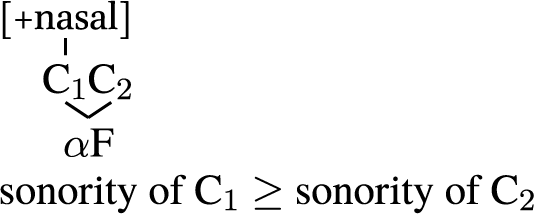
(Ito Reference Ito1988:66)
We can rework this definition into a constraint, as in 20.
(20)
MelodySpread
Assign one violation to any segment that receives a place of articulation from a more sonorous segment.
The manner tier allows us to account for the syllable-final positioning and regressive place assimilation of floating nasals in Ende. A sample derivation for [kəmbaɡe] ‘to dive’, whose underlying and surface forms are repeated below in 21, is pictured in 22--24.
(21)
/kəba-n,ɡ=e/ → [kəmba-ɡ=e] ‘to dive’
First, we can represent the underlying structure in 22. Each element except for the floating nasal consists of elements on both a skeletal and melodic tier. Notably, the floating nasal is not linearized with respect to the other morphemes.
(22)
C
V
C
V
+
C
+
V
[nasal]
׀
׀
׀
׀
׀
׀
k
ə
b
a
ɡ
e
Next, in 23, the floating nasal floats to immediately precede the leftmost non-initial obstruent, attaching to an epenthetic consonant slot.
(23)

Finally, via MelodySpread, the floating nasal takes on the place features of the following obstruent, resulting in a doubly linked item in the melody tier in 24.
(24)

3.2.2. The segment that gives a floating nasal its place feature must be adjacent to it
Floating nasals always receive their place features from adjacent segments, so this analysis must prevent the nasal from receiving place features from a distant segment as well as the epenthesis of any place features in general. We can account for these forms by introducing (in 25 and 26) the NoCrossing and Dep(Feature) constraints.
(25)
NoCrossing
(Goldsmith Reference Goldsmith1976:27)
Assign one violation for any instance of feature assimilation through autosegmental association in which association lines cross.
(26)
Dep(Feature)
Assign one violation for every output subsegment with a feature that does not appear in the input.
In the tableau in example 27, the floating nasal in candidate 27a could only surface as [n] through the epenthesis of a place feature since there are no coronals in the word; this candidate is prevented from surfacing by the Dep(Feature) constraint. Similarly, the floating nasal in candidate 27c could only surface as [ŋ] by receiving its place features from [ɡ], which would necessarily involve line crossing in the autosegmental repsentation; this candidate is prevented from surfacing by the NoCrossing constraint.
(27)
NoCrossing (small caps) and Dep(Feature) (small caps) penalize surface forms with epenthetic or long-distance feature mapping.

Notably, these constraints also prevent floating nasals from surfacing word-initially before a vowel, as in the tableau in example 28, despite a simple nasal onset being phonotactically allowed in Ende. Here, a word-initial simple nasal onset would necessarily have gotten its place feature either through epenthesis, like candidate 28a, or through line-crossing, like candidate 28c. Both forms are prevented from surfacing in favor of the optimal candidate, [eroŋɡ], where the floating nasal receives its place features from an adjacent consonant.
(28)
NoCrossing (small caps) and Dep(Feature) (small caps) prevent word-initial floating nasals.

3.3. Floating nasals must be in coda position preceding an obstruent
We see that MelodySpread restricts floating nasals to receiving their place of articulation from either obstruents or nasals and NoCrossing and Dep(feature) restrict the segment that gives a floating nasal its place of articulation to being immediately adjacent to the floating nasal. Thus, the combination of these constraints limits the surface location of a floating nasal to the following possible combinations: complex onsets consisting of an obstruent and a nasal, a nasal and an obstruent, or two nasals; syllable boundaries consisting of an obstruent and a nasal, a nasal and an obstruent, or two nasals on either side of the boundary; and complex codas consisting of an obstruent and a nasal, a nasal and an obstruent, or two nasals.
However, only two of these sequences actually surface in Ende: nasal-obstruent syllable boundaries and nasal-obstruent codas. In fact, of the 1,758 unique words in the Ende spoken corpus with floating nasals (N = 11,542 unique words), 100% of these floating nasals are in coda position within the syllable. This categorical observation is because floating nasals are necessarily pre-obstruental and therefore cannot be in the onset. Nasal-obstruent sequences, whether heterorganic or homorganic, are not permissible onsets in Ende. Not only are these sequences never found in word-initial position, but this sequence also violates the Sonority Sequencing Principle (SSP; example 29).
(29)
Sonority Sequencing Principle (SSP)
Assign one violation for every syllable in which the sequence of elements before the most sonorous element in the syllable does not rise in sonority and for every syllable in which the sequence of elements after the most sonorous element in the syllable does not fall in sonority, as defined by the sonority scale in 30.
(30)
Sonority scale
(Bell & Hooper [Bybee] Reference Bell, Hooper, Bell and Hooper1978, Clements Reference Clements, Kingston and Beckman1990)
vowels > glides > liquids > nasals > obstruents
(abbreviated as v > g > l > n > o)
If a nasal is to be part of a complex onset and satisfy the SSP, it must be followed by a liquid or a glide, or it must be preceded by an obstruent. Nasal-liquid and obstruent-nasal sequences are not observed in Ende, and nasal-glide sequences are found only rarely in ideophones or loan words. Complex onsets more commonly include obstruents followed by liquids or glides. This restriction in possible complex onset sequences can be attributed to the active ranking of a minimal sonority distance (MSD) constraint (Greenberg Reference Greenberg and Greenberg1978; see example 31), which states that adjacent segments in the onset must have a sonority distance of two steps or greater.
(31)
Minimal Sonority Distance (MSD(Onset;2))
Assign one violation for every tautosyllabic consonant sequence in the onset, in which the distance in sonority level between the two consonants is not two steps or greater.
Floating nasals are always linearized preceding an obstruent, which in Ende includes the voiceless and voiced stops, affricates, and fricatives: [p, b, t, d, k, ɡ, ʈ͡ʂ, ɖ͡ʐ, s, z]. If floating nasals are non-linearized in the input, the phonological grammar must be able to explain why floating nasals only precede obstruents and not any other segment in the word. From a diachronic perspective, a reasonable hypothesis is that Ende at one point in time distinguished prenasalized voiced and voiceless obstruents as phonemes and it is this historical distinction that provides the blueprint for the modern phonological pattern. This analysis, however, takes a synchronic approach and posits a set of constraints that can generate the present pattern without referencing any historical patterns, which themselves would require an explanation.
One way in which we can approach this restriction of nasals to pre-obstruent contexts is to consider the principles of the syllable contact law (Vennemann Reference Vennemann1972), which states that optimal coda-onset contacts should fall in sonority, such that codas are maximally sonorous, and onsets are minimally sonorous. This pattern can be derived from the multi-valued sonority scale, in 30 above, which states that vowels are more sonorous than glides and so on, and the binary moraicity scale in 32, which holds that codas are more sonorous positions than onsets (Gouskova Reference Gouskova2004).
(32)
Moraicity scale
(Gouskova Reference Gouskova2004)
Coda > Onset
Gouskova (Reference Gouskova2004) derives the syllable contact scale, in 34, by first applying harmonic alignment to the set of scales in 30 and 32, to return the harmonic scales in 33.Footnote
9
(33)
(a)
Onset sonority scale
(Gouskova Reference Gouskova2004)
Ons/o ≻ Ons/n ≻ Ons/l ≻ Ons/g
(b)
Coda sonority scale
(Gouskova Reference Gouskova2004)
Coda/g ≻ Coda/l ≻ Coda/n ≻ Coda/o
Gouskova translates the harmonic scales in 33 using relational alignment into a syllable contact scale, set out in 34. The syllable contact scale is split into seven strata that each contain one or multiple combinations of coda onset contacts. Here, the combinations of codas and onsets (separated by syllable boundaries [.]) are assessed based on their relational harmony. The most harmonic coda (i.e. a glide) when combined with the most harmonic onset (i.e. an obstruent), is more harmonic than the second most harmonic coda with the most harmonic onset (liquid-obstruent) or the most harmonic coda with the second most harmonic onset (glide-nasal), and so on.
(34)
Syllable contact scale
(Gouskova Reference Gouskova2004)
1
≻
2
≻
3
≻
4
≻
5
≻
6
≻
7
g.o
g.n
g.l
g.g
l.g
n.g
o.g
l.o
l.n
l.l
n.l
o.l
n.o
n.n
o.n
o.o
–3
–2
–1
0
+1
+2
+3
The harmony of each combination is based on the distance between the two classes of consonants on the sonority scale. For example, in stratum 1 a glide is three steps more sonorous than an obstruent, so the distance between the two is –3. Gouskova incorporates this syllable contact scale into her analysis of output candidates by translating the syllable contact scale in 34 into a family of OT constraints (35), which are hierarchically ranked. The highest-ranked constraints ban the least harmonic combinations (*Dist+3) and the lowest-ranked constraints ban the most harmonic combinations (*Dist–3).
(35)
Syllable contact hierarchy
(Gouskova Reference Gouskova2004)
*Dist+3 » *Dist+2 » *Dist+1 » *Dist+0 » *Dist–1 » *Dist–2 » *Dist–3
The ranking of the constraints in the syllable contact hierarchy is fixed, so any language that bans syllable contact combinations of any given distance prohibits syllable contact combinations of any less harmonic distance as well.
Even though, in general, Ende phonotactics allow for a variety of syllable contacts (see Table A6 in the Appendix), if floating nasals create a new syllable contact, the sonority distance between the two must be falling. That is, floating nasals may in principle only precede obstruents or follow glides or liquids. This behavior can be accounted for using the constraints *Dist+3, *Dist+2, *Dist+1, and *Dist+0, which all punish rising sonority across syllable contacts. This is illustrated in the tableaux in examples A1–A4 in the Appendix, where the candidates with falling sonority at the syllable contacts are evaluated as more optimal than those with stable or rising sonority.
3.4. Floating nasals are aligned left but may float to the right
The fact that floating nasals always precede the leftmost non-initial obstruent in the word is a testament to an inherent leftward alignment of the feature. As Zoll (Reference Zoll1998:104) illustrates for melodic ghost elements in Chaha and Inor, this alignment characteristic can be attributed to a family of alignment constraints called NoIntervening(y; E), which prohibits any elements of the base from intervening between any part of the element (y) and a given edge (E) of the word.
(36)
NoIntervening(y; E)
(Zoll Reference Zoll1998:78)
Assign one violation for every segment that intervenes between element (y) and edge (E).
Ende’s alignment pattern can be accounted for by ranking the ParseFeat constraint, given in 37, above an alignment constraint: NoIntervening([+nasal];L), defined in 38.
(37)
ParseFeat
(Embick Reference Embick1994:38)
For a segment γ and feature F, parse the value of F that is linked to γ in its underlying representation.
(38)
NoIntervening([+nasal];L)
Assign one violation for every element of the base that intervenes between any nasal consonant and the left edge of the word.
Nointervening(+n;L) must also be ranked below all the phonotactic constraints so that the floating nasal surfaces immediately before the leftmost non-initial obstruent. This constraint ranking is also necessary to generate Chaha floating labialization, in which the labial [-w] is aligned to the right edge of the word but may float leftward to be hosted by the rightmost labial or dorsal consonant. The alignment effect is illustrated in 39, which expands the tableau in example A2 in the Appendix.Footnote 10
Of the seven possible alignments of the floating nasal within the base [kəbaɡe], five of these alignments violate Ende phonotactics in some way. Of the two candidates that satisfy the phonotactic constraints, 39c [kəmbaɡe] violates NoIntervening(+n;L) twice because two elements of the base, [kə], intervene between the left edge of the word and the floating nasal. However, candidate 39c violates NoIntervening(+n;L) fewer times than 39e [kəbaŋɡe], which has four elements of the base intervening between the left edge and the floating nasal. Candidate 39c is, therefore, the optimal form, illustrating the effect of leftward alignment on the floating nasal.
The fact that candidate 39c, which does indeed violate NoIntervening(+n;L), is the observed output in the language also illustrates that the Ende grammar orders faithfulness to the floating feature higher than the alignment of the floating feature.
(39)

Additionally, Linearity must be ranked higher than NoIntervening([+n];L) in order for underlyingly specified nasals to surface in the correct places; this ranking does not affect floating nasals because they are not linearized with respect to the word. In the examples in 40, the floating nasal is bolded while the stable nasal is italicized; the high ranking of Linearity prohibits candidate 40b, where the stable nasal has moved, even though these candidates equally violate NoIntervening([+n];L).
(40)

3.5. Floating nasals must surface when there is a non-initial obstruent
Floating nasals always surface if there is a non-initial obstruent in a word. We account for this using the constraint ParseFeat, defined in 37, which assigns a violation to candidates that do not contain features that appear in the underlying form.
In the examples in 41, we see that ParseFeat must be ranked higher than NoIntervening(+n;L) in order for floating nasals to actually surface.
(41)

Additionally, the three phonotactic constraints (SSP, MSD and DistX) are also ranked higher than PARSEFEAT because the floating nasal will fail to be realized if there is no phonotactically acceptable position for it. This is illustrated in 42, which has a single word-initial obstruent; nasal-obstruent sequences are disallowed by the SSP, so candidate 42a cannot surface despite not violating ParseFeat.
(42)

We can also rank ParseFeat with respect to the three constraints restricting how the floating nasals receive their place of articulation: NoCrossing, Dep(Feature) and MelodySpread. Consider an input in which the only phonotactically permissible position for the floating nasal to be realized in is word-initial; for example, the verb /a-ŋonoj-n,meɲ-an/ ‘he wondered’ contains the [+nasal] applicative morpheme /-n,meɲ/. However, this form does not contain any obstruents to host the floating nasal. If the floating nasal is realized in word-initial position (candidate 43a), this will violate NoCrossing. However, if the floating nasal fails to be realized (candidate 43b), this would violate ParseFeat. Candidate 43b is the observed output, indicating that NoCrossing as well as the other constraints on how floating nasals receive their place of articulation are ranked higher than ParseFeat.
(43)

3.6. Floating nasals surface as full segments, not as features on other segments
Additionally, floating nasals always surface as full nasal segments, not as features on another existing segment. This can be accounted for by introducing a high-ranked Ident-[–nasal]-IO constraint, defined in 44, which punishes candidates where the floating nasal does not surface as a full segment, such as pre-nasalized obstruents or nasal vowels.
(44)
Ident-[–nasal]-IO
Assign one violation for every segment that is specified to be [–nasal] in the input but is [+nasal] in the output.
This constraint effectively prevents the floating nasal from surfacing as a feature on another segment. This effect is illustrated in 45, where candidates 45b and 45c cannot surface because the surface prenasalized obstruent and nasal vowel were both underlyingly [–nasal]. Furthermore, Ident-[–nasal]-IO must be ranked above NoIntervening(+n;L) so that a form with a left aligned nasal vowel (such as 45c) does not surface.
(45)

3.7. Floating nasals are easier to delete than other segments
Finally, the grammar must be able to explain why in cases where a root does not contain a docking position for the floating nasal, it is the floating nasal that gets deleted and not a different segment. For example, consider the inflected form of the verb [ɲoŋkoj] ‘to pull’: [da-ɲkoj] ‘s/he pulled it’. Evidence that the root of the verb is [+nasal] comes from the infinitival form of the verb, which is [ɲoŋkoj]. Thus, the underlying representation of this infinitival form is /n,ɲkoj/Footnote 11. However, the floating nasal is not realized in the surface representation of the inflected form.
For the input /da-n,ɲkoj/, the position preceding the first obstruent in the word, [d], is unavailable as it is in word-initial position and would form an onset that violates the SSP (see example 47a). The position preceding the second obstruent in the word, [k], is also unavailable as the floating nasal would have to form a complex coda with the nasal segment or a complex onset with the obstruent [k], which are both phonotactically prohibited. There are two available repairs for this situation. Either the full nasal segment [ɲ] is deleted, as in candidate 47b, or the floating nasal is deleted, as in candidate 47c. The difference between the deletion of a full segment [ɲ] and a floating nasal /n/ is that the full segment is specified for both a melody and a skeleton in the input, while the floating nasal is only specified for manner.
We can account for this preference for the full segment by introducing a Max(Seg) constraint (defined in 46) that is ranked higher than ParseFeat.
(46)
Max(Seg):
Assign one violation for every full segment in the underlying form that does not surface.
In this way, deletion of a full segment violates two faithfulness constraints ParseFeat and Max(Seg), while deletion of a floating nasal only violates one faithfulness constraint, ParseFeat. Max(Seg) must be ranked higher than ParseFeat to correctly predict the surface form.Footnote
12
(47)

3.8. Floating nasals only occur once per [+nasal] morpheme
Finally, it is important to address the curious distributional fact that floating nasals are seemingly restricted to one occurrence per morpheme, but are allowed multiple times per word. The richness of the base hypothesis of OT does not allow any restrictions on the underlying form or input to the grammar. There is precedent for restricting the number of NC clusters in a word or syllable, as seen with, for example, contrastive markedness constraints like Mindist N–NC: V-Oral x (Stanton Reference Stanton2019). To account for this in Ende, we would need to index this constraint to the morpheme domain, similarly to the way in which distributional phonotactic patterns need morpheme-specific indexing to account for facts like /Cj/-initial suffixes in Dutch (Booij Reference Booij, van Oostendorp, Ewen, Hume and Rice2011). By situating the behavior of Ende floating nasals within the broader typology of ghost segments (Szpyra Reference Szpyra1992), nasal cluster dissimilation (Stanton Reference Stanton2017, Reference Stanton2019), and nasal harmony systems (Piggott Reference Piggott1992), we can observe that these patterns, though previously unattested, are consistent with known phonological phenomena across diverse language families.
3.9. Constraint ranking for Ende floating nasals
The final ranking for the constraints that explain the floating nasal pattern is given in 48, and schematized in 49.
(48)
(a)
Linearity » NoIntervening(+nasal;L)
(b)
ParseFeat » NoIntervening(+nasal;L)
(c)
Ident-[–nasal]-IO » NoIntervening(+nasal;L)
(d)
SSP, MSD, DistX, NoCrossing, Dep(Feature), MelodySpread, Max(Seg) » ParseFeat
(49)

4. Conclusion
This paper detailed a unique floating nasal pattern in Ende, which fills out Zoll’s (Reference Zoll1998) expected typology of ghost elements: fixed segments, fixed features, mobile segments, and mobile features. An example of a mobile segment pattern was not included in her work, but original empirical work on Ende revealed that such a pattern indeed exists. This floating segment pattern is easily accounted for using the same machinery that Zoll used to account for other types of floating patterns, including floating labialization in Chaha and floating palatalization in Inor. Moreover, the same types of autosegmental processes used to account for nasal assimilation by Ito (Reference Ito1988) straightforwardly account for floating features in Ende.
Grammatical glosses
- 1
-
first person
- 3
-
third person
- acc
-
accusative
- appl
-
applicative
- cop
-
copular clitic
- core
-
core argument
- dat
-
dative
- du
-
dual
- ndu
-
nondual
- nom
-
nominative
- npl
-
nonplural
- npst
-
nonpast
- P
-
patient
- pl
-
plural
- poss
-
possessive
- prs
-
present
- pst
-
past
- sg
-
singular
Acronyms
- MSD
-
Minimal Sonority Distance
- NC
-
homorganic nasal-consonant sequence
- OT
-
Optimality Theory
- SSP
-
Sonority Sequencing Principle
Symbols
- √
-
Marks the beginning of the root morpheme
Acknowledgements
The author would like to acknowledge the contributions of the Ende language community, especially Tonny (Tonzah) Warama and Warama Kurupel (Suwede), for their assistance with data collection and analysis; Arto Antilla for his mentorship; the participants of AMP 2018, especially Eva Zimmermann and Laura McPherson, for their feedback; Liza Sulkin for her assistance with revisions and typesetting; and multiple anonymous reviewers for their comments, which all improved the current manuscript.
Data availability statement
Supplementary data files are available on the author’s github site: https://github.com/katelynnlindsey/pda-ende/
Conflict of interest statement
The author declares no conflict of interest.
Funding disclosure statement
The author received funding from Stanford University and the Firebird Fellowship for Anthropological Research for travel, supplies, and compensation of linguistic consultants.
Ethics statement
The author declares that the research presented in this article has been conducted in accordance with the ethical requirements of the IRB and Boston University.
Sources
The data presented in this article are original data collected during eleven months of on-site fieldwork conducted by the author between 2015 and 2018 in the village of Limol. The primary data sets, including the alternation observed between infinitival and inflected forms of verb roots and the alternation between plain and applicative-marked verb roots, began as a spontaneous observation within natural speech data (primarily daily life stories) and were then systematically elicited with expert Ende language consultants, especially Tonny (Tonzah) Warama and Warama Kurupel (Suwede). Tonzah and Warama are son and father (respectively) and approximately 40 and 60 years of age at the time of data collection. Like many members of the Ende community, Tonzah and Warama are multilingual, expertly conversing in English and other local languages. Both consultants received a post-secondary education. Knowledge in the Ende community is considered a shared resource, so many other Ende speakers circulated and checked the datasets to ensure accuracy. Tonzah and I had many conversations about the interesting behavior of the floating nasals, and he came up with many of the illustrative examples included here to ensure a broad coverage of data types.
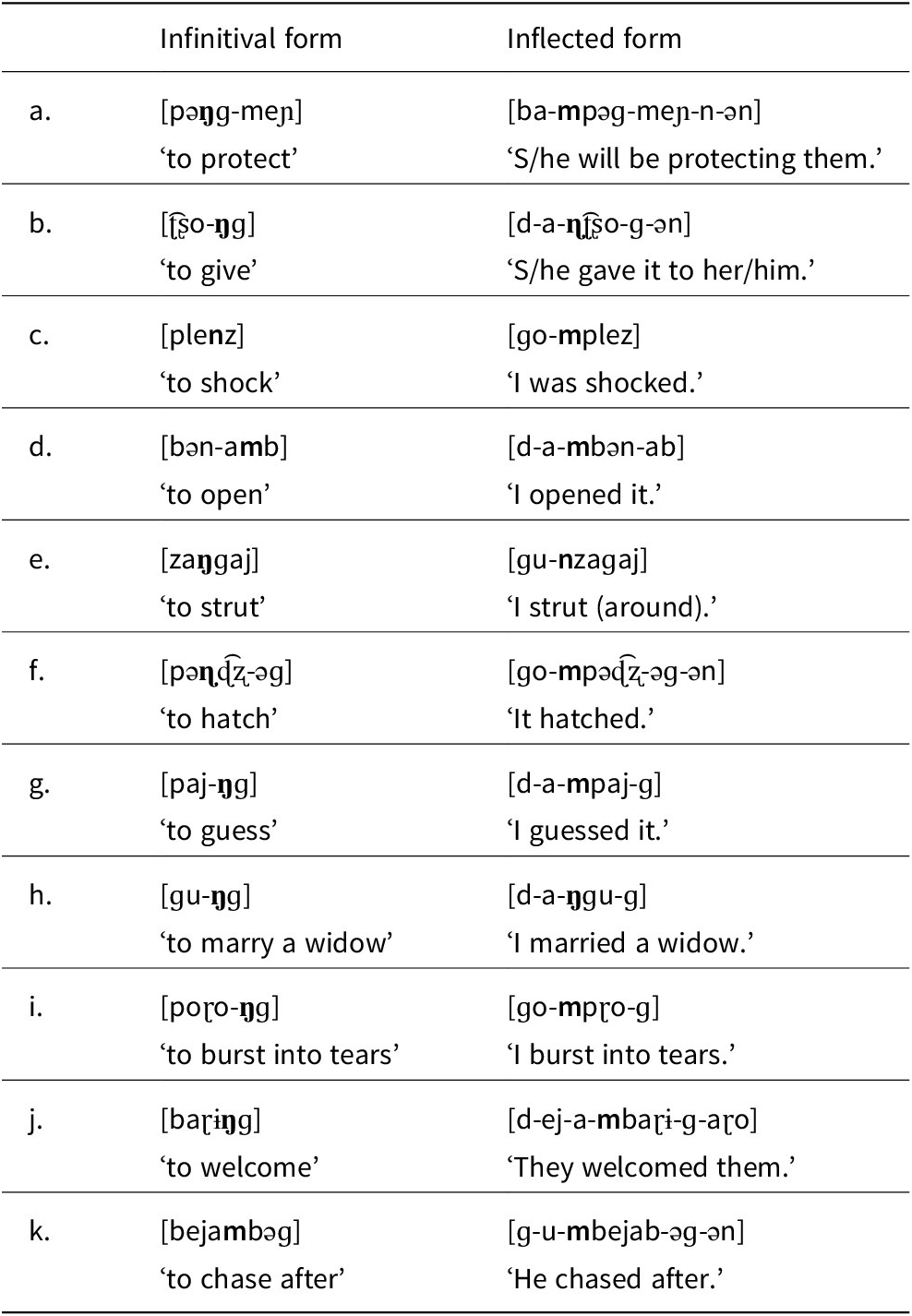
Appendix
Lexical verb roots where the position of the floating nasal differs between infinitival and inflected forms.

Table A1. Long description
The table consists of three columns: an index letter, the infinitival form with its English translation, and the inflected form with its English translation. Bolded nasal consonants indicate the shifting position.
* a. Infinitival [p schwa eng g - m e n-retroflex] ‘to protect’; Inflected [b a - m p schwa eng g - m e n-retroflex - n - schwa n] ‘S/he will be protecting them.’
* b. Infinitival [t-retroflex s-hook o - eng g] ‘to give’; Inflected [d - a - n-retroflex t-retroflex s-hook o - g - schwa n] ‘S/he gave it to her/him.’
* c. Infinitival [p l e n z] ‘to shock’; Inflected [g o - m p l e z] ‘I was shocked.’
* d. Infinitival [b schwa n - a m b] ‘to open’; Inflected [d - a - m b schwa n - a b] ‘I opened it.’
* e. Infinitival [z a eng g a j] ‘to strut’; Inflected [g u - n z a g a j] ‘I strut (around).’
* f. Infinitival [p schwa n-retroflex d-hook z-hook - schwa g] ‘to hatch’; Inflected [g o - m p schwa d-hook z-hook - schwa g - schwa n] ‘It hatched.’
* g. Infinitival [p a j - eng g] ‘to guess’; Inflected [d - a - m p a j - g] ‘I guessed it.’
* h. Infinitival [g u - eng g] ‘to marry a widow’; Inflected [d - a - eng g u - g] ‘I married a widow.’
* i. Infinitival [p o r-hook o - eng g] ‘to burst into tears’; Inflected [g o - m p r-hook o - g] ‘I burst into tears.’
* j. Infinitival [b a r-hook i-stroke eng g] ‘to welcome’; Inflected [d - e j - a - m b a r-hook i-stroke - g - a r-hook o] ‘They welcomed them.’
* k. Infinitival [b e j a m b schwa g] ‘to chase after’; Inflected [g - u - m b e j a b - schwa g - schwa n] ‘He chased after.’
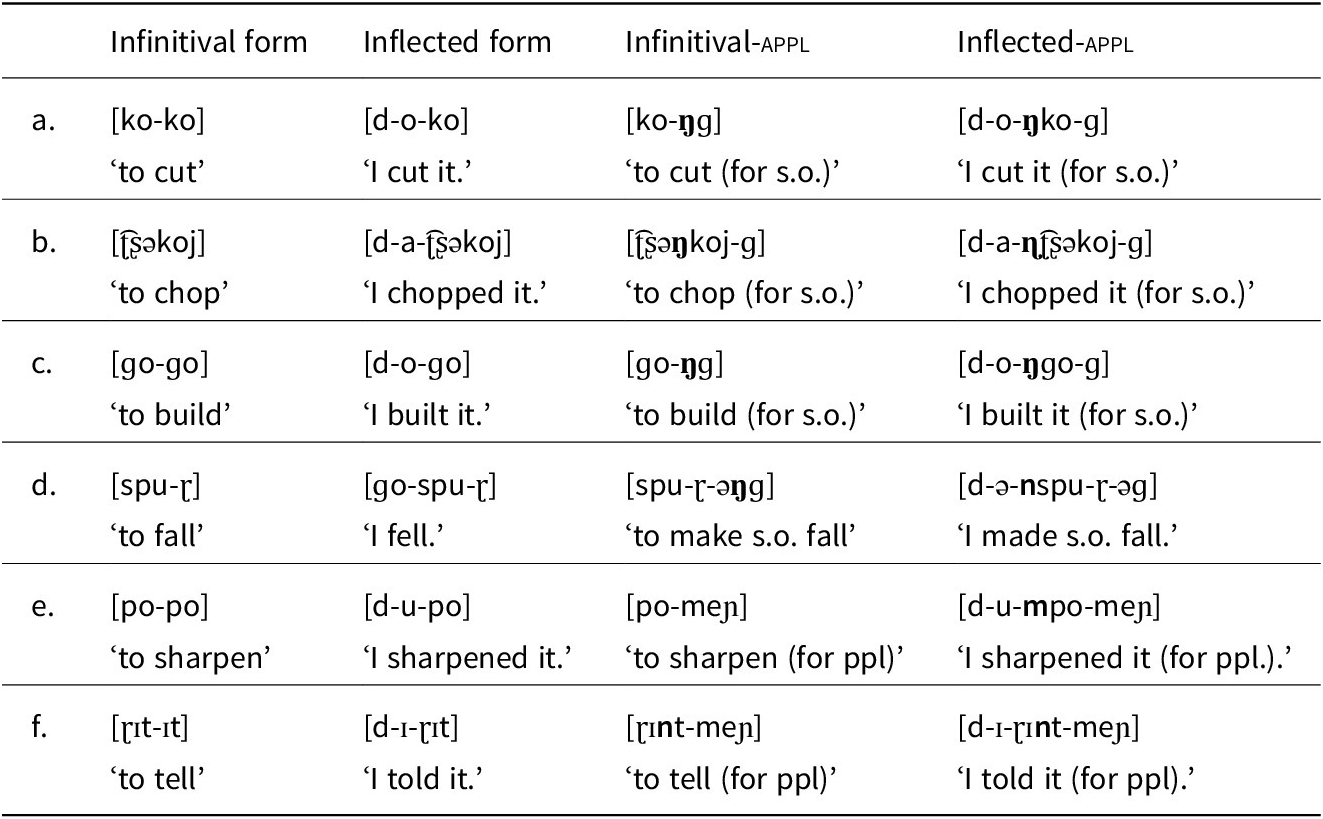
Lexical verb roots without floating nasals in their plain forms (left two columns), but with floating nasals in their applicative forms (right two columns).

Table A2. Long description
The table consists of four main columns of linguistic data across six rows labeled a through f.
Row a: ‘to cut’. Infinitival [ko-ko], Inflected [d-o-ko], Infinitival-A P P L [ko-eng g], Inflected-A P P L [d-o-eng ko-g].
Row b: ‘to chop’. Infinitival [t-s-schwa k o j], Inflected [d-a-t-s-schwa k o j], Infinitival-A P P L [t-s-schwa eng k o j-g], Inflected-A P P L [d-a-retroflex n t-s-schwa k o j-g].
Row c: ‘to build’. Infinitival [g o-g o], Inflected [d-o-g o], Infinitival-A P P L [g o-eng g], Inflected-A P P L [d-o-eng g o-g].
Row d: ‘to fall’. Infinitival [s p u-flap], Inflected [g o-s p u-flap], Infinitival-A P P L [s p u-flap-schwa eng g], Inflected-A P P L [d-schwa-n s p u-flap-schwa g].
Row e: ‘to sharpen’. Infinitival [p o-p o], Inflected [d-u-p o], Infinitival-A P P L [p o-m e palatal n], Inflected-A P P L [d-u-m p o-m e palatal n].
Row f: ‘to tell’. Infinitival [flap i t-i t], Inflected [d-i-flap i t], Infinitival-A P P L [flap i n t-m e palatal n], Inflected-A P P L [d-i-flap i n t-m e palatal n].
Floating nasals (eng, retroflex n, n, m) are bolded in the applicative columns to show their emergence compared to the plain forms.
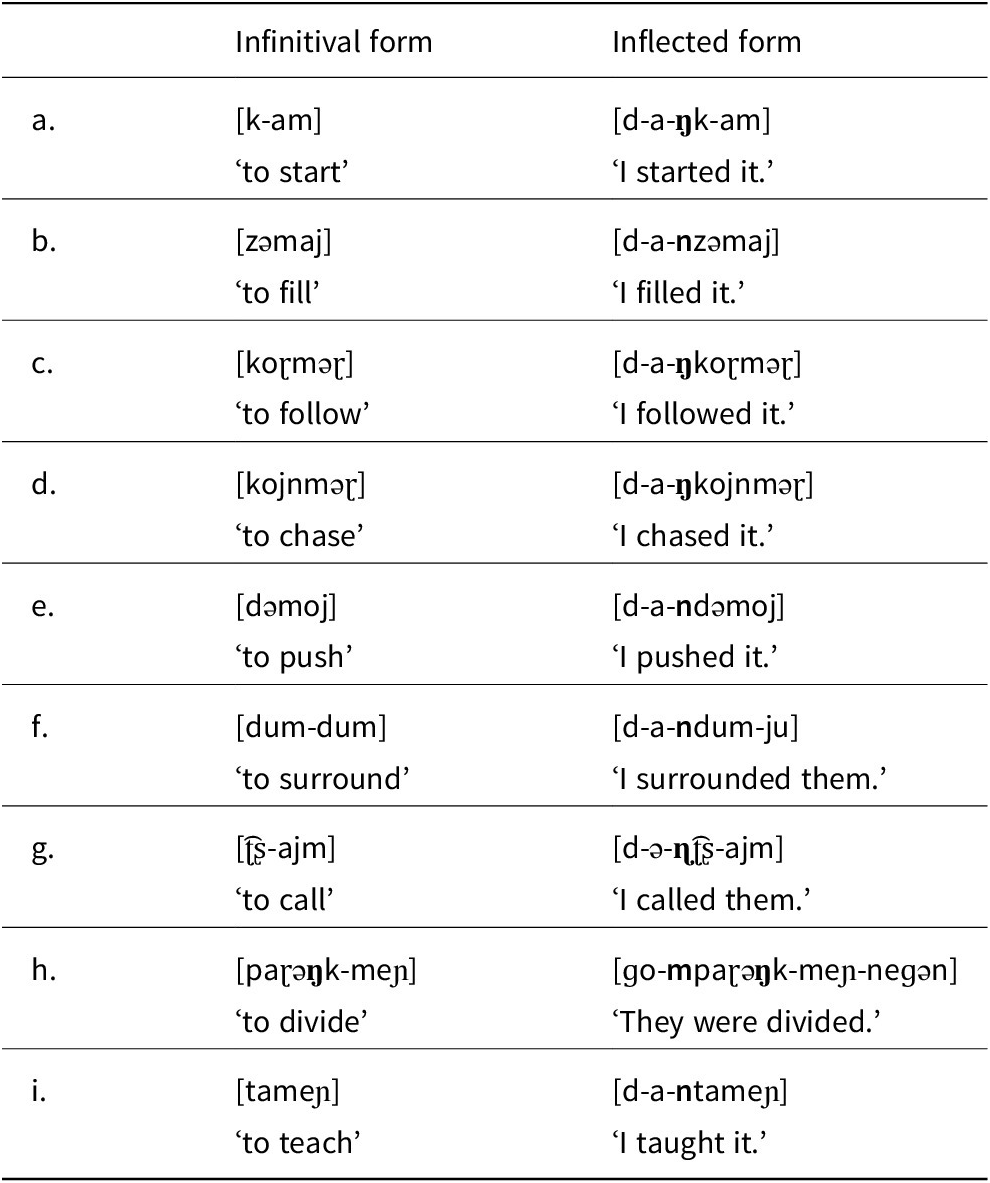
Lexical verb roots with floating nasals absent in the infinitival form but realized in the inflected form.

Table A3. Long description
The table consists of three columns: an index letter, the Infinitival form, and the Inflected form. Each entry includes phonetic transcriptions in brackets and English translations in single quotes.
* Row a: [k-am] ‘to start’ corresponds to [d-a-eng-k-am] ‘I started it.’
* Row b: [z schwa m a j] ‘to fill’ corresponds to [d-a-n z schwa m a j] ‘I filled it.’
* Row c: [k o r m schwa r] ‘to follow’ corresponds to [d-a-eng k o r m schwa r] ‘I followed it.’
* Row d: [k o j n m schwa r] ‘to chase’ corresponds to [d-a-eng k o j n m schwa r] ‘I chased it.’
* Row e: [d schwa m o j] ‘to push’ corresponds to [d-a-n d schwa m o j] ‘I pushed it.’
* Row f: [d u m - d u m] ‘to surround’ corresponds to [d-a-n d u m - j u] ‘I surrounded them.’
* Row g: [t-s-h-a-j-m] ‘to call’ corresponds to [d-schwa-retroflex n t-s-h-a-j-m] ‘I called them.’
* Row h: [p a r schwa eng k - m e n-y-e] ‘to divide’ corresponds to [g o - m p a r schwa eng k - m e n-y-e - n e g schwa n] ‘They were divided.’
* Row i: [t a m e n-y-e] ‘to teach’ corresponds to [d-a-n t a m e n-y-e] ‘I taught it.’
In the inflected forms, the floating nasals (eng, n, m, or retroflex n) are bolded in the original source to indicate their realization.
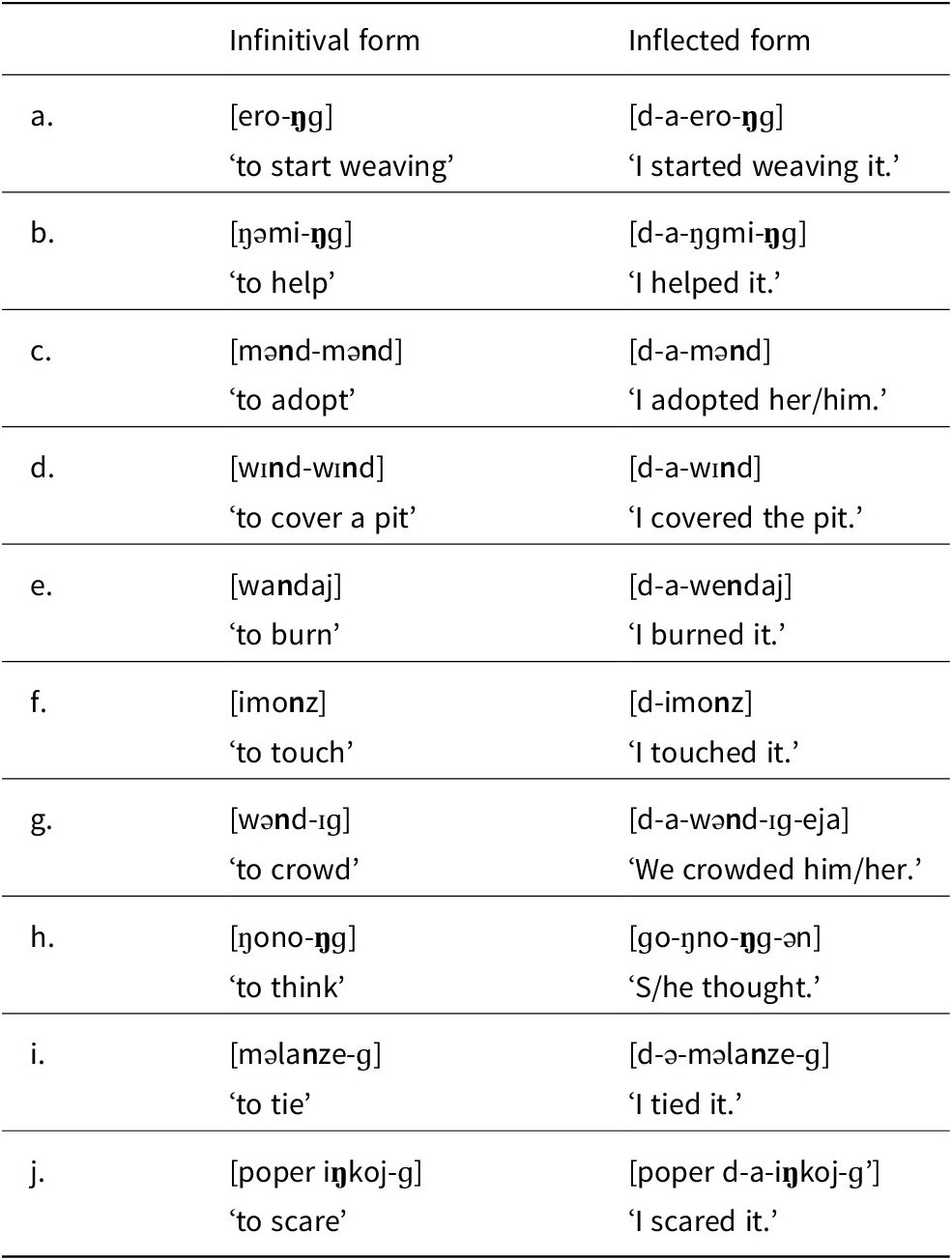
Lexical verb roots with floating nasals in the same position in their infinitival and inflected forms.

Table A4. Long description
The table consists of three columns: an index letter, the Infinitival form, and the Inflected form. Each entry includes phonetic transcriptions and English translations.
* Row a: Infinitival [ero-ng g] ‘to start weaving’; Inflected [d-a-ero-ng g] ‘I started weaving it.’
* Row b: Infinitival [ng schwa mi-ng g] ‘to help’; Inflected [d-a-ng gmi-ng g] ‘I helped it.’
* Row c: Infinitival [m schwa n d-m schwa n d] ‘to adopt’; Inflected [d-a-m schwa n d] ‘I adopted her/him.’
* Row d: Infinitival [w i n d-w i n d] ‘to cover a pit’; Inflected [d-a-w i n d] ‘I covered the pit.’
* Row e: Infinitival [wa n daj] ‘to burn’; Inflected [d-a-we n daj] ‘I burned it.’
* Row f: Infinitival [imo n z] ‘to touch’; Inflected [d-imo n z] ‘I touched it.’
* Row g: Infinitival [w schwa n d-i g] ‘to crowd’; Inflected [d-a-w schwa n d-i g-eja] ‘We crowded him/her.’
* Row h: Infinitival [ng ono-ng g] ‘to think’; Inflected [g o-ng no-ng g-schwa n] ‘S/he thought.’
* Row i: Infinitival [m schwa la n ze-g] ‘to tie’; Inflected [d-schwa-m schwa la n ze-g] ‘I tied it.’
* Row j: Infinitival [poper i ng koj-g] ‘to scare’; Inflected [poper d-a-i ng koj-g] ‘I scared it.’
In the phonetic transcriptions, the nasal consonants n and ng are highlighted as floating nasals.
Lexical verb roots which exhibit a static pattern in the infinitival and inflected forms because infinitival reduplication and prefixation generate identical environments for nasal alignment.

Table A5. Long description
The table consists of three columns: an unlabeled index column with letters a through j, a column for the Infinitival form, and a column for the Inflected form. Each entry includes a phonetic transcription in I P A and an English translation in single quotes.
* Row a: Infinitival [k schwa - eng k schwa l] ‘to climb’; Inflected [d - schwa - eng k schwa l] ‘I climbed it.’
* Row b: Infinitival [d schwa - n d schwa r] ‘to hear’; Inflected [d - a - n d schwa r] ‘I heard it.’
* Row c: Infinitival [k o - eng k o t-curly-tail-s-curly-tail o m] ‘to gulp’; Inflected [d - schwa - eng k o t-curly-tail-s-curly-tail o m] ‘I gulped it.’
* Row d: Infinitival [d-curly-tail-z-curly-tail o - n-retroflex d-curly-tail-z-curly-tail o] ‘to boast’; Inflected [g o - n-retroflex d-curly-tail-z-curly-tail o] ‘I boasted.’
* Row e: Infinitival [g schwa - eng g schwa r-long-leg schwa m] ‘to wash’; Inflected [d - schwa - eng g schwa r-long-leg schwa m] ‘I washed it.’
* Row f: Infinitival [b schwa l - m b schwa l] ‘to remember’; Inflected [d - schwa - m b schwa l] ‘I remembered it.’
* Row g: Infinitival [d-curly-tail-z-curly-tail schwa - n-retroflex d-curly-tail-z-curly-tail schwa m] ‘to worry’; Inflected [d - schwa - n-retroflex d-curly-tail-z-curly-tail schwa m] ‘I worried about it.’
* Row h: Infinitival [g schwa - eng g schwa r-long-leg schwa d] ‘to shove’; Inflected [d - schwa - eng g schwa r-long-leg schwa d] ‘I shoved it.’
* Row i: Infinitival [b schwa - m b r-long-leg schwa d] ‘to expand’; Inflected [d - schwa - m b r-long-leg schwa d - schwa n] ‘It expanded.’
* Row j: Infinitival [d-curly-tail-z-curly-tail schwa - n-retroflex d-curly-tail-z-curly-tail schwa l] ‘to climb’; Inflected [g o - n-retroflex d-curly-tail-z-curly-tail schwa l] ‘I climbed.’
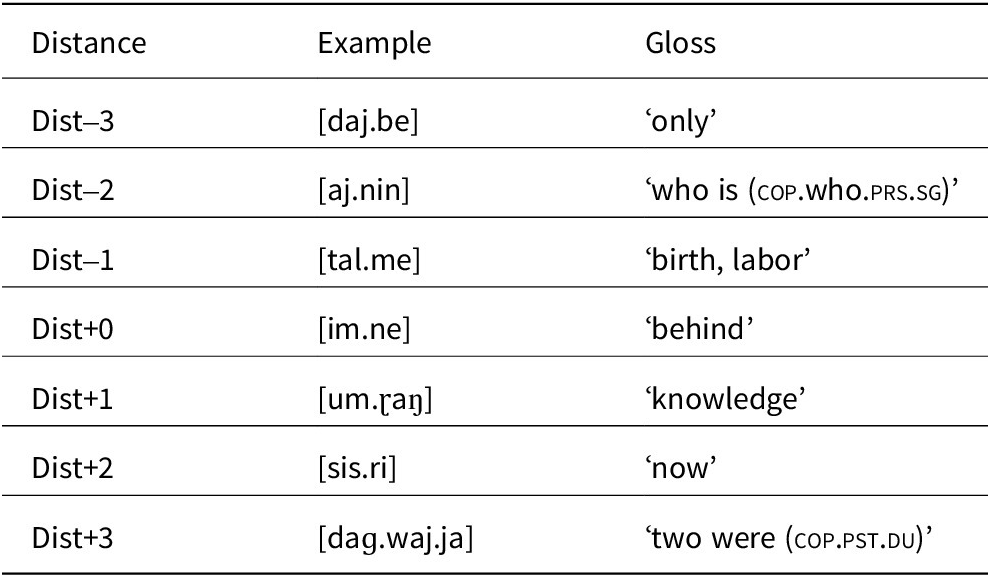
Ende words with syllable contact types with all sonority distances as defined in example 34.

Table A6. Long description
The table consists of three columns: Distance, Example, and Gloss.
* Row 1: Distance minus 3. Example open bracket d a j dot b e close bracket. Gloss: only.
* Row 2: Distance minus 2. Example open bracket a j dot n i n close bracket. Gloss: who is (C O P dot who dot P R S dot S G).
* Row 3: Distance minus 1. Example open bracket t a l dot m e close bracket. Gloss: birth, labor.
* Row 4: Distance plus 0. Example open bracket i m dot n e close bracket. Gloss: behind.
* Row 5: Distance plus 1. Example open bracket u m dot r-flap a n-hook close bracket. Gloss: knowledge.
* Row 6: Distance plus 2. Example open bracket s i s dot r i close bracket. Gloss: now.
* Row 7: Distance plus 3. Example open bracket d a g-script dot w a j dot j a close bracket. Gloss: two were (C O P dot P S T dot D U).
The tableau in example A1 illustrates how *Dist+0 is unranked relative to SSP and MSD. While candidates A1a,b,f violate principles of sonority within a syllable, candidates A1c,d display stable sonority across the syllable boundary. Stable sonority is a violation of *Dist+0. Candidate A1e does not violate any principles of sonority within or across syllables and is thus the most optimal.
(A1)
*Dist+0 (small caps), SSP, and MSD penalize outputs with sonority violations.

In A2, candidates A2a,b,f,g violate principles of sonority within a syllable, while candidate A2d displays rising sonority across the syllable boundary, which violates *Dist+1. Thus, the tableau in A2 results in two optimal candidates: [kəmbaɡe] and [kəbaŋɡe]. Both of these forms are phonotactically allowed in Ende; however, only the former surfaces. This is addressed in Section 3.4
(A2)
Outputs with NC sequences violate fewer sonority constraints than outputs with alternative linearizations.

The tableaux in A3 and A4 differ in that they each have medial sonorants: a liquid and a glide, respectively. To eliminate the candidates in which the floating nasal occurs immediately following the sonorant—A3d [baɽ.nɨɡ] and A4d [bej.ɲa.bəɡ]—we must invoke the MelodySpread constraint since these candidates do not violate any sonority principles within or across the syllables.
(A3)
MelodySpread (small caps) penalizes outputs in which floating nasals derive their place features from sonorants.

The tableau in A4 also results in two optimal candidates: [be.jam.bəɡ] and [be.ja.bəŋɡ]. Both of these forms are phonotactically allowed in Ende; however, only the former surfaces. This is addressed in Section 3.4.
(A4)
Outputs with NC sequences receive fewer sonority violations than outputs with other linearizations.



 Open access

