Introduction
The innominate artery (also known as the brachiocephalic trunk) is the first and largest branch of the aortic arch. Arising from the convexity of the aortic arch in the midline, it ascends obliquely and posterolaterally to the right, at first anterior to the trachea and then on its right, where it divides into the right common carotid and right subclavian arteries posterior to the right sternoclavicular joint. The innominate artery commonly crosses the trachea at the level of the ninth tracheal ring, but this point may vary from the sixth to the 13th tracheal ring.Reference Oshinsky, Rubin and Gwozdz1
The innominate artery can be abnormally long, reaching up to the level of the upper tracheal rings. In a case reported by Upadyaya and colleagues,Reference Upadhyaya, Bertellotti, Laeeq and Sugimoto2 the innominate artery was found to cross the trachea horizontally between the cricoid cartilage and the first tracheal ring. Other authors have reported aberrant innominate arteries reaching the level of the second,Reference Racic, Matulic, Roje, Dogas and Vilivic3 third,Reference Ozlugedik, Ozcan, Unal, Yalcin and Tezer4 and fourth to fifthReference Comert, Comert, Ozlugedik, Kendir and Tekdemir5 tracheal rings.
Injury of the innominate artery during tracheotomy is often reported, along with tracheoarterial fistula. These complications, although rare, have a significant potential for mortality without immediate, aggressive surgical intervention. The risk of tracheoinnominate artery fistula formation may be increased by: pressure necrosis due to high cuff pressure; mucosal trauma due to malpositioned cannula tip; low tracheotomy stoma; excessive tube mobilisation; steroid administration; radiotherapy; prolonged intubation; and infection.Reference Grant, Dempsey, Harrison and Jones6 A bleeding prevalence of 0.1–1 per cent has been reported, peaking at 7–14 days post-operatively;Reference Grant, Dempsey, Harrison and Jones6 72 to 78 per cent of bleeding occurs within three weeks post-operatively. Many cases of delayed bleeding have been reported,Reference Ridley and Zwischenberger7 even years after tracheostomy.
In a post-mortem study, Oshinsky and colleaguesReference Oshinsky, Rubin and Gwozdz1 found that 10 standard incisions placed in the second and third tracheal rings resulted in all subsequently placed tracheotomy tubes having either their cuff or tip anatomically adjacent to the innominate artery. This suggests that, contrary to general belief, placement of the tracheotomy through the second and third tracheal rings will not protect the innominate artery from rupture.
In cases of an abnormally long and high innominate artery, massive, catastrophic haemorrhage can occur as a complication of tracheotomy or other invasive procedures involving the anterior neck. Even if the tracheotomy is initially successful, there is a significant risk that the rigid cannula's concavity will erode into adjacent vessels secondary to the patient's neck movements.Reference Mukadam8
The Rambam Health Care Campus is the major tertiary medical centre in the northern part of Israel, and is also the major trauma centre in this region. From 1998 to 2007, 2185 tracheotomies were performed in this centre. Over this period, percutaneous tracheotomy gained acceptance as an alternative to conventional open tracheotomy, and the number of surgical procedures decreased gradually to an average of 100 per year in the latter five years.
Seven cases of high aberrant innominate artery were incidentally encountered during the above period in patients undergoing conventional open tracheotomy. In an attempt to prevent any damage to the artery from the tracheotomy tube, our department designed a modification of the permanent tracheostomy technique.Reference Eliachar, Zohar, Golz, Joachims, Goldsher and Permanent9
Materials and methods
Surgical technique
All seven patients had been endotracheally intubated for different periods of time, and were scheduled for open tracheotomy.
In the operating theatre, following hyperextension of the neck, prominent pulsation was noticed in the anterior neck in two cases. In both these patients, Doppler ultrasound examination of the anterior neck revealed a large, pulsating vessel lying anterior to the fourth tracheal ring, suggesting a high-riding innominate artery. In the remaining five patients, no apparent abnormality was seen or palpated in the anterior neck, but a high innominate artery was incidentally encountered during surgery.
A horizontal skin incision was made two finger breadths below the lower border of the cricoid cartilage. The incision was carried through the platysma muscle, and skins flaps were developed upward to the level of the cricoid cartilage and downward to the level of the sternal notch. A midline vertical incision separated the right and left groups of strap muscles, exposing the thyroid gland. The thyroid isthmus was excised, and the medial margins of the thyroid lobes were secured with suture ligatures.
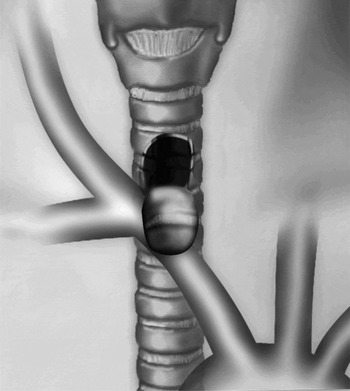
With the trachea now well exposed, a large, pulsating innominate artery was found to be located in front of the fourth tracheal ring in five cases, and in front of the fifth ring in the other two cases (Figure 1).
A high-riding aberrant innominate artery crossing the trachea at the level of the fifth and sixth tracheal rings.

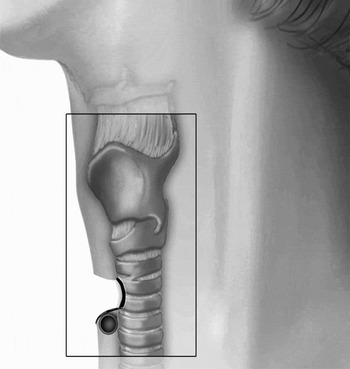
A wide, inferiorly based, inverted U-shaped flap was created on the anterior wall of the trachea from the second and third tracheal rings. The flap was averted downward over the innominate artery (Figure 2) and sutured to the lower margins of the skin incision, thus placing the innominate artery between the skin and the anterior tracheal wall, well protected against erosion from the rigid concavity of the tracheotomy cannula (Figure 3). The remaining free margins of the upper and lower skin flaps were sutured, and a tracheotomy tube replaced the pre-existing endotracheal tube.
An inferiorly based, inverted U-shaped flap is created on the anterior wall of the trachea from the second and third tracheal rings. The flap is averted downward over the innominate artery.

The flap is sutured to the lower margins of the skin incision, thus placing the innominate artery between the skin and the anterior tracheal wall.

Results and analysis
The post-operative period was uneventful. None of the patients had any bleeding from the tracheotomy site during a nine to 46 month follow-up period.
Discussion
An aberrant innominate artery crossing the trachea anteriorly above the sixth tracheal ring is extremely rare, with very few cases reported in the English literature.Reference Upadhyaya, Bertellotti, Laeeq and Sugimoto2–Reference Comert, Comert, Ozlugedik, Kendir and Tekdemir5, Reference Mukadam8, Reference Davis and Southwick10–Reference Maldjian, Saric and Tsai13
When a high innominate artery is encountered at tracheotomy, it poses a great risk of arterial trauma, massive bleeding and a lethal outcome.Reference Jarvis12 Therefore, although uncommon, such an abnormality must be anticipated as the complications can be catastrophic.
We present our experience with seven cases of high-riding aberrant innominate artery encountered at open tracheotomy. During the 10 years between 1998 and 2007, 2185 tracheotomies were performed in our centre, mainly in multiple trauma or critically ill patients, to assist long-term ventilation support. The incidence of high aberrant innominate artery in our series was 0.32 per cent.
• A long, high-riding aberrant innominate artery is very rare, but can result in serious and potentially fatal complications if not recognised before or during tracheotomy
• Pulsation in the anterior neck should be suspected of indicating an aberrant major artery, and the surgeon should perform Doppler ultrasound to identify the pulsating vessel
• Bedside Doppler ultrasound is also recommended for any patient undergoing percutaneous dilatational tracheotomy
• When a high aberrant innominate artery is encountered during tracheotomy, an inferiorly based, inverted U-shaped flap from the anterior tracheal wall can be used to protect the artery against erosion from the concave under-surface of the tracheotomy tube
When faced with an aberrant innominate artery, either just prior to tracheotomy or peri-operatively, we performed a modification of the standard technique described for permanent tracheostomy creation.Reference Eliachar, Zohar, Golz, Joachims, Goldsher and Permanent9 A wide, inferiorly based, inverted U-shaped flap (instead of a superiorly based, U-shaped flap) was created on the anterior wall of the trachea and sutured to the lower margins of the skin incision. This technique completely protected the innominate artery against direct injury from the concave surface at the ‘elbow’ of the tracheotomy cannula.
Another method designed to protect a high-riding innominate artery encountered during tracheotomy was described by Dellon and colleagues,Reference Dellon, Wells and Cowley14 who used a local muscle flap rotated to protect the artery.
Based on our experience and on the literature, we suggest that a pulsatile mass in the anterior part of the neck should be suspected of indicating an aberrant innominate artery. When such a pulsation is seen or palpated, bedside Doppler ultrasonography should be performed to prevent unexpected, fatal complications. Even when such a pulsation cannot be identified, the surgeon should maintain a high index of suspicion for aberrant vascular anatomy, especially during percutaneous dilatational tracheotomy, and should investigate any possible anomaly with diagnostic Doppler ultrasound. Other authorsReference Ozlugedik, Ozcan, Unal, Yalcin and Tezer4, Reference Comert, Comert, Ozlugedik, Kendir and Tekdemir5, Reference Maldjian, Saric and Tsai13, Reference Muhammad, Major, Wood and Patton15–Reference McCormick and Manara17 have recommended the use of ultrasound, magnetic resonance imaging or computed tomography to identify major vascular structures at risk, before performing a tracheotomy.
The surgeon should also take care not to fully extend the neck during the operation, to avoid bringing the innominate artery closer to the upper tracheal rings.
Acknowledgement
We thank Mrs Liane M Westerman for her careful review of this manuscript.