Introduction
A patient should never expect to receive a lower standard of care because of their race, age, gender or any other irrelevant characteristics. However, implicit associations (unconscious, uncontrollable or impulse processes) may influence our judgements, resulting in bias. The term ‘bias’ is typically used to refer to both implicit stereotypes and prejudices, and raises serious concerns in healthcare.Reference Fitzgerald and Hurst1
There is growing evidence that such bias may exist within the US healthcare system, from history-taking to clinical management. Black patients in the USA (but not the UK) were found to be more likely to be questioned about smoking than White patients.Reference McKinlay, Link, Arber, Marceau, O'Donnell and Adams2 Another study, by Burgess et al., found evidence indicating that race influenced a physician's decision-making in prescribing opioids for chronic lower back pain.Reference Burgess, Crowley-Matoka, Phelan, Dovidio, Kerns and Roth3 There is a relative paucity of similar studies in the UK.
Names may be assumed to imply ethnicity, and there are several studies demonstrating that perceived race may influence decisions around employment applications. For instance, one widely cited study found that simply changing names from White-sounding ones to Black-sounding ones on curricula vitae in the USA significantly reduced those offered interviews.Reference Bertrand and Mullainathan4 A replication of the study in Sweden, using Arab-sounding names instead of Swedish-sounding names, demonstrated a clear preference for Swedish applicants, and implicit bias against those perceived to be of Arabian origin.Reference Rooth5
The implicit biases of greatest concern to healthcare professionals are those that may further disadvantage individuals who are already vulnerable. Examples include minority ethnic populations, immigrants, individuals from a low socioeconomic background, individuals with low health literacy, sexual minorities, children, women, older adults, people suffering from mental health conditions, people classified as overweight, and physically disabled people, but anyone may be rendered vulnerable given a certain context.Reference Martin, Tavaglione and Hurst6
Our institution instructs clinicians to discharge all elective patients after failing to attend or rearrange an appointment, provided that the underlying health condition prompting referral is unlikely to lead to long-term morbidity or mortality. However, patients may be given a ‘second chance’ at the discretion of the clinician.
We hypothesise that implicit bias may influence decision-making in offering a further appointment and we aimed to evaluate this with a retrospective audit.
Materials and methods
We used the Strengthening the Reporting of Observational studies in Epidemiology (‘STROBE’) checklist to prepare this manuscript in order to ensure quality reporting of this study.
We retrospectively analysed a database of 285 patients who missed an outpatient appointment between 1 May 2020 and 1 April 2021 at Guy's and St Thomas’ Hospital. A missed appointment was defined as an appointment that the patient did not attend and gave no prior warning for their absence.
We included patients aged 18 years and older. We excluded patients who had been referred or treated for suspected cancer or a condition that required urgent ENT treatment, necessitating a further appointment on clinical grounds. We also excluded patients who had previously failed to attend an appointment.
We only included patients referred to non-Black, Asian and minority ethnic (‘non-BAME’) consultants, to preserve anonymity.
This study aimed to compare discharge rates between males and females, and according to perceived ethnicity (i.e. White British; Black, Asian and minority (non-White) ethnic (‘BAME’); and other White).
Initially, we analysed clinical records for patient-reported ethnicity and gender. In a real-life setting when deciding whether a further appointment is offered following a missed appointment, ethnic identity and gender details are not available to the physician and may be assumed on the basis of name, as the patient is not present. In order to classify patients according to the most likely ethnic group, five assessors were given patient names as they appeared on their patient records, and were asked to assign perceived ethnicity and gender. Each assessor worked independently and was blinded as to whether a further appointment had been offered. The most chosen (modal) ethnic group and gender for each patient was noted.
In order to examine the impact of ethnicity or gender on missed appointment outcomes, we retrospectively compared discharge rates between White British, other White, Black, Asian and minority ethnic, and gender groups. A p-value of less than 0.05 was considered significant and analysis was performed using the chi-square test. Odds ratios for discharge rates were calculated for other White, and Black, Asian and minority ethnic groups, using White British as the comparator.
Results
A total of 285 patients who failed to attend their out-patient ENT appointment at Guy's and St Thomas’ Hospital were included in the study. Most of the patients self-reported being White British (n = 156 (63 per cent)). There were slightly more females than males (n = 154 (54 per cent)), and the median patient age was 45 years (range, 18–89 years). The overall discharge rate was 40 per cent (n = 115). In 69 patients, self-reported ethnicity information was missing.
All 285 patients were assessed for perceived gender and ethnic origin of names. The judges were able to categorise all 285 patients into predefined perceived ethnic categories: White British; Black, Asian and minority ethnic; and other White. Judges were not able to determine the gender of 13 patients.
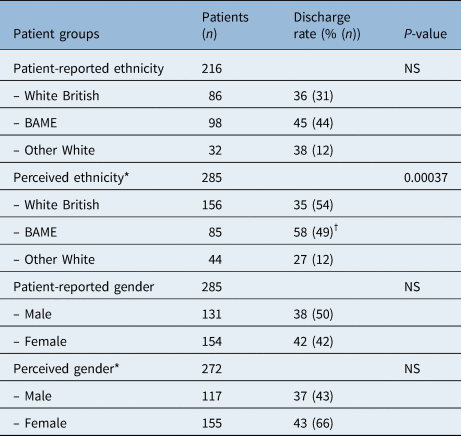
Table 1 shows discharge rates by gender and ethnicity. Gender and ethnic origin of names and self-reported gender and ethnicity were analysed separately. In the self-reported group, we did not observe significant differences in discharge rates based on patient-reported gender and ethnicity.
Comparison of discharge rates among different patient groups

* Perceived ethnicity and gender based on patients’ names as they appear on their records; †White British versus Black, Asian and minority ethnic patients’ discharge rates were significantly different (p = 0.000496). NS = non-significant; BAME = Black, Asian and minority (non-White) ethnic
When ethnicity and gender were defined based on perceived origin of names, we found a significant difference in discharge rates between the White British group and the Black, Asian and minority ethnic group (35 per cent vs 58 per cent, p = 0.0005). Then, we separately analysed Black, Asian and minority ethnic patients with a mismatch between their perceived ethnicity and self-reported ethnicity versus patients where self-reported and perceived ethnicity were matching. Discharge rates between these two groups did not significantly differ (51 per cent and 30 per cent, p = 0.061).
Discharge rates for perceived gender did not differ.
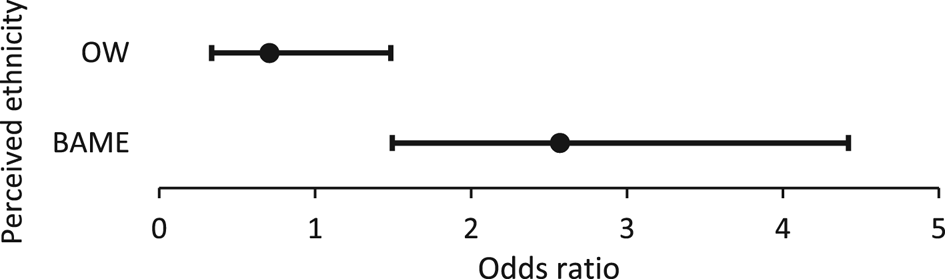
We subsequently analysed odds ratios for other White, and for Black, Asian and minority ethnic groups, as depicted in Figure 1.
Odds ratios for discharge rates according to perceived ethnicity. Odds ratio of 1 represents White British (comparator); odds ratio of more than 1 reflects an increased chance of being discharged after missing an appointment. Other White (‘OW’) odds ratio = 0.7083 (95 per cent confidence interval = 0.34, 1.49), p = 0.3617. Black, Asian and minority ethnic (‘BAME’) odds ratio = 2.571 (95 per cent confidence interval = 1.50, 4.42), p = 0.0006.

We also performed correlation analysis between perceived ethnicity and patient-reported ethnicity (r = 0.558 for the whole cohort). Further sub-analysis showed a strong correlation for White British (r = 0.606), other White (r = 0.624), and Black, Asian and minority ethnic (r = 0.537) groups.
Discussion
The default position in our hospital is to discharge patients who fail to attend appointments, provided that they are not thought to have conditions which require urgent assessment and care. However, clinicians may offer a further appointment at their discretion.
In this retrospective study, we found that patients who were perceived to be non-White British (both Black, Asian and minority ethnic, and other White) based on the names shown on the patients’ notes were less likely to be rebooked following a missed appointment. This suggests that implicit bias may play a role in the clinician's decision-making process regarding rebooking.
The Black, Asian and minority ethnic population in the UK have historically been shown to have poorer health outcomes in comparison to the White British population.7 The disparity between health outcomes of different ethnic groups is multifactorial, and is affected by social determinants (e.g. over-crowding and poor-quality housing) and health-related practice (e.g. smoking rates and regular physical activity). In particular, there is reportedly poorer access to healthcare services among the Black, Asian and minority ethnic population, linked to lower levels of health literacy or a lack of health promotion initiatives for these patients, affecting the access of services and interventions.7 It remains unclear as to how much implicit bias adds to this health inequality.
However, Black, Asian and minority ethnic patients are not less likely (and in some cases are more likely) to attend primary healthcare services than White British patients.Reference Nazroo, Falaschetti, Pierce and Primatesta8 This can be interpreted as a greater need for healthcare services among Black, Asian and minority ethnic patients than among the White British population, rather than an inequality in the access of healthcare services.
This study's findings suggest that implicit bias regarding ethnicity may impact access to healthcare. Patients perceived to be of White British origin were more likely to be offered a further appointment, while Black, Asian and minority ethnic patients were more often penalised for missing an appointment. This may contribute to poorer outcomes in patients from Black, Asian and minority ethnic groups. It is vital to address this discrepancy of access to healthcare to ensure that Black, Asian and minority ethnic patients are given the healthcare they need.
• Implicit bias may still exist in healthcare today
• Implicit bias may play a role in decision-making regarding whether to rebook a patient following a missed appointment
• Black, Asian and minority ethnic patients were more likely to be discharged after missing an appointment than White British patients
• There was no evidence that gender influenced the discharge rate for patients who missed an appointment
• Individual clinicians and departments should review and devise methods to reduce implicit bias when delivering healthcare
We did not find evidence that gender influenced the rate at which patients were discharged after missing an appointment.
One explanation for the difference in discharge rates may be the clinician's previous experience. If in their experience one group is more likely to re-attend if given another appointment, it may alter a doctor's practice. A total of 169 patients were rebooked (1 patient was referred to another specialty), with 82 patients attending their second appointment; 87 did not attend for a second time. There were similar numbers of Black, Asian and minority ethnic, and White British patients – 16 (19.5 per cent) and 20 (23.0 per cent) – from the two respective groups. However, with Black, Asian and minority ethnic individuals making up 45 per cent of the patient group, but with only 23 per cent of those failing to attend a second appointment, we did not find evidence to support this explanation.
This study provides a new perspective to barriers that Black, Asian and minority ethnic patients face in healthcare. In response, we suggest strategies that individual clinicians or departments can employ. For example, clinicians can be mindful of who they offer a second appointment to after non-attendance. They can have a strict rule applied to all patients, regardless of demographic or reason for non-attendance. A system can be implemented where no patient identifiers are displayed to clinicians, to reduce subconscious bias. In addition, clinicians could state why they are rebooking or discharging a patient, to improve transparency and probity.
A limitation of the current study is the exclusion of referrals from Black, Asian and minority ethnic consultants. In future studies, we will aim to evaluate a wider group to see if Black, Asian and minority ethnic consultants also appear to exhibit implicit bias.
Conclusion
Our results suggest that implicit bias may play a role in decision-making regarding whether to provide a patient with another opportunity to attend the clinic after missing an appointment. Measures need to be taken to raise awareness of the potential implicit bias that still exists in healthcare today. The implementation of a system where non-attenders are rebooked based on clinical need will reduce inequalities in healthcare.
Acknowledgements
This research was supported by Women in ENT Surgery (‘WENTS’) UK, affiliated with ENT UK, and funded by the 2021 WENTS UK Shyamala Grant, ENT UK.
Competing interests
None declared