Measurement evaluation is an essential component of research since one could argue that conclusions of a study are only as valid as the validity of the measures used in the study. Psychometric evaluation and validation of measures are essential to any field, particularly when assessing complex and multifaceted constructs such as cognition. There are numerous measures of cognition that evaluate cognitive performance, functioning, and screen for cognitive impairment. One such measure is the Cognitive Abilities Screening Instrument (CASI) that was developed “(a) as a screening instrument for dementia, (b) to monitor disease progression, and (c) to provide a profile of impairment among various cognitive domains” (Teng et al., Reference Teng1994, p. 46). As described by Teng et al., the CASI was adapted from items on three cognition and dementia screening tests: the Hasegawa Dementia Screening Scale (HSD; Hasegawa, Reference Hasegawa and Bergener1983), the Mini-Mental State Examination (MMSE; Folstein et al., Reference Folstein, Folstein and McHugh1975), and the Modified Mini-Mental State (3MS; Teng and Chui, Reference Teng and Chui1987). Although not as widely known as these scales, the CASI is a multidimensional measure that is composed of a greater number of items that offer additional item-level complexities than the previous scales. The CASI assesses nine cognitive domains including long-term memory, orientation, visual construction, judgment/abstraction, language, short-term memory, attention, mental manipulation/concentration, and list-generating fluency. Teng et al. relied on face validity when developing the measure. To our knowledge, the factor structure of the CASI has yet to be empirically tested; thus, we factor analyzed the measure in the current study using data from the Kuakini Honolulu-Asia Aging Study (HAAS; Kuakini Health System, 2018). Tsai et al. (Reference Tsai, Lin, Wang and Liu2007) conducted a factor analysis of a Chinese version of the CASI (i.e. CASI C-2.0) and found support for a one-factor solution reflecting an overall cognition factor; however, the CASI C-2.0 (Tsai et al.) differs from the CASI (Teng et al.) in regards to items content, difficulty, and number of items.
To investigate the factor structure of the CASI in the current study, we used a theoretically grounded approach rooted in the cognitive aging literature and hypothesized that factors of crystallized and fluid abilities would be reflected by the CASI factor structure. Crystallized abilities refer to culturally influenced dimensions of intelligence (e.g. language, professional, and life skills), whereas fluid abilities include basic processing of sensory information and visual memory (Baltes, Reference Baltes1987; Reference Baltes1993; Staudinger et al., Reference Staudinger, Cornelius and Baltes1989). Research demonstrates that crystallized dimensions are often built across the life course and maintained in older adulthood, whereas fluid dimensions tend to peak earlier in life and decline in late life (Hartshorne and Germine, Reference Hartshorne and Germine2015; Salthouse, Reference Salthouse2004). These age-related declines in fluid abilities are often due to several factors, including limited cognitive resources available across the life span (Craik and Byrd, Reference Craik, Byrd, Craik and Trehub1982; Park and Festini, Reference Park and Festini2017). Research on non-normative changes in these abilities suggests there are accelerated declines in fluid abilities approximately 10 years before a dementia diagnosis and accelerated declines in crystallized abilities approximately 5 years prior to a dementia diagnosis among older adults from population-based samples in Sweden (Thorvaldsson et al., Reference Thorvaldsson2011). Neuroimaging research supports a brain–behavior relationship and elucidates how changes in cognitive abilities may potentially be markers of preclinical dementia; for example, declines in crystallized and fluid abilities were associated with reduced cortical thickness and greater presence of amyloid-beta deposits (McDonough et al., Reference McDonough2016). Research also demonstrates that changes in specific brain regions are linked to cognitive abilities; specifically, greater performance in fluid abilities was associated with cortical expansion (i.e. white matter tracts) in brain regions associated with memory and attention, whereas crystallized abilities were linked to cortical thinning among participants from the Human Connectome Project (Tadayon et al., Reference Tadayon, Pascual-Leone and Santarnecchi2020).
Although there is evidence for distinct cognitive abilities, as well as how these abilities tend to change over time, there is also support for the dedifferentiation hypothesis of cognitive aging. This framework posits that there are greater levels of inter-relatedness among cognitive abilities overtime such that abilities may coalesce in older adulthood (Baltes et al., Reference Baltes, Cornelius, Spiro, Nesselroade and Willis1980; de Frias et al., Reference de Frias, Lövdén, Lindenberger and Nilsson2007; Hülür et al., Reference Hülür, Ram, Willis, Schaie and Gerstof2015; Tucker-Drob, Reference Tucker-Drob2009; Wilson et al., Reference Wilson, Segawa, Hizel, Boyle and Bennett2012). For example, Hülür et al. used data from deceased participants of the Seattle Longitudinal Study, conducted analyses using an intra-individual change approach that worked backward from time of death and found support for this framework such that as participants became older and closer to death, there was coupling between fluid and crystallized abilities.
Within the Kuakini HAAS sample, CASI performance has been associated with a variety of factors, including blood pressure (Launer et al., Reference Launer, Masaki, Petrovitch, Foley and Havlik1995), inflammation (Laurin et al., Reference Laurin, Curb, Masaki, White and Launer2009), and diet (Masaki et al., Reference Masaki2000). As the CASI is used in both research and clinical settings, it would behoove researchers to empirically test the factor structure underlying the measure. Consistent with the use of other cognitive assessments, identification of the underlying factor structure confirms a two-factor model of the MMSE and provides an opportunity to investigate such a factor structure in the CASI. For example, Brugnolo et al. (Reference Brugnolo2009) assessed the factor structure of the MMSE in a sample of older adults who had probable Alzheimer’s disease and found that two factors reflective of fluid abilities and crystallized abilities fit their data well. Thus, the objective of the current study was to develop and test a parsimonious conceptualization of the CASI rooted in cognitive aging literature with factors representing crystallized and fluid abilities. Keeping the differentiation hypothesis of cognitive aging in mind, we tested the proposed two-factor model along with a one-factor model of the CASI, empirically tested if one model fit the data significantly better than the other, and performed validity tests.
Method
Data source and sample
We obtained IRB approval and utilized data from the Kuakini Honolulu Heart Program, a longitudinal and prospective study that was established to explore factors related to health, genetics, and cardiovascular disease of men of Japanese descent (Kuakini Health System, 2018). There are currently 12 waves (exams) of data, ranging from 1965 (M age = 54.40, Rangeage = 45–68) to 2012 (M age = 93.50, Rangeage = 91–106) with late life surveys occurring approximately every 3 years. The Kuakini HAAS is a continuation of the Kuakini Honolulu Heart Program and it aimed to study dementia and other diseases of aging. A total of 3,734 men participated in Exam 4 (1991–1993) of the Kuakini HAAS, which was when cognitive testing began. Due to our interest in examining cognition in a non-clinical sample, we excluded 226 men from the analyses who had a dementia diagnosis at Exam 4. Additionally, 17 men had missing data and were excluded from analyses, resulting in a final sample of 3,491 men. On average, these men were 77.48 years old (SD = 4.42 years) with ages ranging from 71 to 93 years. They had completed on average approximately 11 years of education (M = 10.57, SD = 3.19 years; Range = 1–24).
Measures
Cognition
The CASI is a 25-item measure that assesses nine cognitive domains via 39 tasks (Teng et al., Reference Teng1994). Although the CASI was developed based on three cognition measures (i.e. HSD, 3MS, and MMSE), it is important to note that some items are identical to the parent measures, other items are adaptations, and many are not included in the parent measures.
Based on face validity, Teng et al. (Reference Teng1994) categorized CASI items into nine domains of orientation (eight tasks assessing awareness of context such as time and place), short-term memory (seven tasks assessing working memory and recall), language (six tasks requiring participants to read, write, and follow directions), mental manipulation/concentration (six tasks requiring participants to repeat a set of numbers backwards), long-term memory (five tasks assessing autobiographical and semantic memory), attention (three tasks assessing working memory), judgment/abstraction (two tasks assessing semantic and procedural memory), visual construction (one task assessing comprehension and visual-spatial abilities), and list-generating fluency (one task assessing word fluency). Domain scores are computed through the summation of task scores within a domain with most scores weighted equally and some tasks receiving differential weighting (Teng et al.).
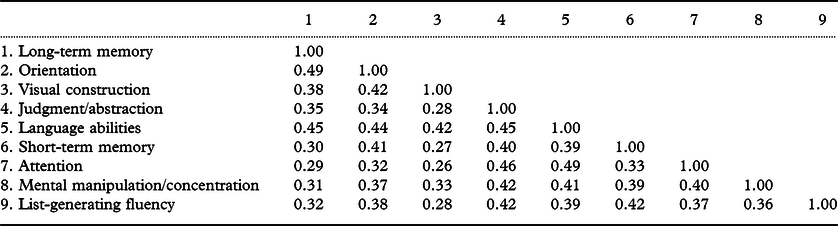
Researchers and clinicians tend to employ a total score on the CASI created by summing the nine domain scores; CASI total scores can range from 0 to 100, with higher values indicating better levels of cognitive functioning. A CASI total score less than 74 roughly corresponds to a score of 23 on the MMSE, which is indicative of probable cognitive impairment (Abbott et al., Reference Abbott, White, Ross, Masaki, Curb and Petrovitch2004; Gelber et al., Reference Gelber, Launer and White2012). Cronbach’s α for the total CASI in the current study was 0.87. The average CASI total score was 85.05 (SD = 10.75 years; Range = 0–100) and approximately 90% of men (n = 3,133) had a score greater than 74. See Table S1 published as supplementary material online attached to the electronic version of this paper for descriptive statistics of the nine domain scores. Correlations among the nine domain scores are presented in Table 1.
Zero-order correlation matrix of CASI domains (N = 3,491)

Note. All correlations were significant, p ≤ 0.01.
Future diagnosis of dementia
Dementia screening was a multi-phase process that included: CASI performance, a neurological examination, proxy data regarding changes in participant behavior and cognition in the past decade, and an evaluation by a panel of clinicians with expertise in geriatric medicine and dementia who came to a consensus on all diagnoses (see White et al., Reference White1996). Data include information regarding if and when a participant was diagnosed with all-cause dementia across Exams 5 to 12. A total of 741 men (21.23%) received a dementia diagnosis during this 18-year period.
Analytic approach
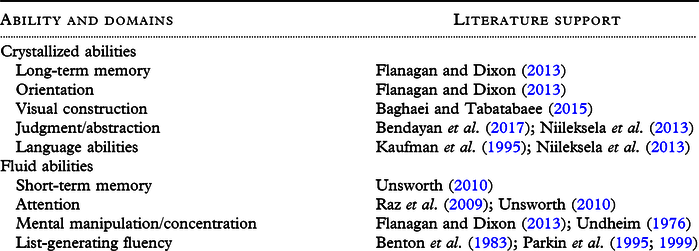
The goal of this study was to use empirical methods to develop a parsimonious conceptualization of the structure of the CASI that was framed within the cognitive aging literature. We hypothesized that a two-factor model representing crystallized and fluid dimensions would fit the Kuakini HAAS CASI data. We classified domains as crystallized or fluid based on cognitive aging theory and literature. Through this process, we identified five domains within the crystallized category and four domains in the fluid category. Domains categorized as crystallized encompassed long-term memory, orientation, visual construction, judgment/abstraction, and language; the fluid category was comprised of short-term memory, attention, mental manipulation/concentration, and list-generating fluency. Table 2 provides details on this categorization along with literature that supported this classification of the domains. The fit of this hypothesized factor model to the data was then tested by conducting a confirmatory factor analysis (CFA) using the Mplus 8.1 software (Muthén and Muthén, Reference Muthén and Muthén2010). We tested the proposed two-factor solution, a one-factor solution, and conducted a χ2 difference test to determine which model had the best fit to the data.
Literature support regarding categorization of domains to crystallized and fluid abilities

Results
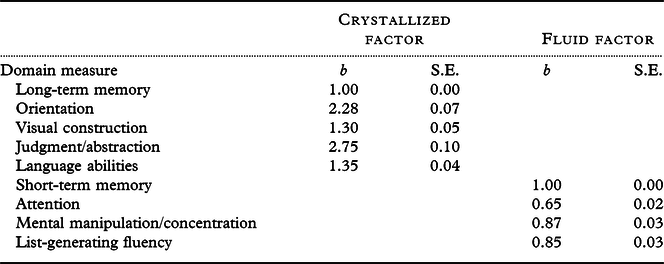
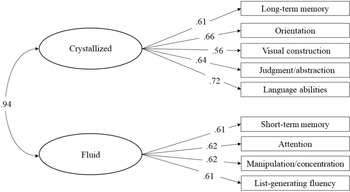
First, we conducted a CFA to assess whether the proposed two-factor structure of crystallized and fluid abilities fit the data well. As noted in Table 2, we specified that five domains (long-term memory, orientation, visual construction, judgment/abstraction, and language) loaded on the crystallized factor, four domains (short-term memory, attention, mental manipulation/concentration, and list-generating fluency) loaded on the fluid factor, and allowed the two factors to correlate with one another. The results indicated that this model fit the data well: χ2 (26) = 616.40, p < 0.001, comparative fit index (CFI) of 0.94, root mean square error of approximation (RMSEA) of 0.08, and Akaike information criterion (AIC) of 112,834.12, which met the goodness of fit cutoff values recommended by Hu and Bentler (Reference Hu and Bentler1999). The loadings of the domain measures on the two factors are presented in Table 3 and the standardized loadings are presented in Figure 1. As depicted, all loadings were statistically significant. In terms of the crystallized factor, the greatest loading was the language abilities domain measure with a standardized loading of 0.72; the lowest loading was the visual construction domain measure (λ = 0.56). There was not much variability in the loadings of the domain measures on the fluid factor and all loadings were greater than 0.60.
Unstandardized domain measure loadings for the two-factor model

Note. All loadings were significant, p ≤ 0.001.
Standardized confirmatory factor analysis results of two-factor model.

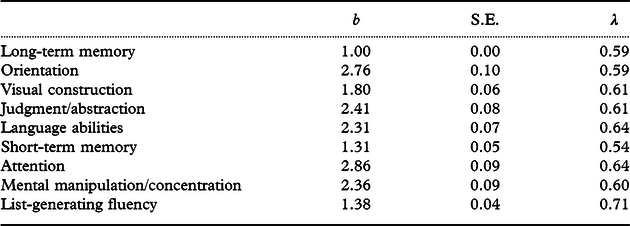
Given that the correlation between the two factors was 0.94, it raised the issue of whether or not the association between these factors was significantly different than 1.0. Thus, we tested an alternate one-factor model, in which we fit the nine domain measures to a single dimension. This one-factor model fit the data well: χ2 (27) = 659.70, p < 0.001, CFI = 0.93, RMSEA = 0.08, and AIC = 112,875.42. The loadings of the domain measures on the factor are presented in Table 4 and all the loadings were statistically significant. The list-generating fluency domain measure had the highest loading (λ = 0.71), whereas the lowest loading was for the short-term memory domain measure (λ = 0.54).
Confirmatory factor analysis domain measure loadings for the one-factor model

Note. All loadings were significant, p ≤ 0.001.
The fits of the one-factor and two-factor models to the data were compared. A χ2 difference test indicated that the two-factor model provided a significantly better fit to the data compared to the one-factor model, Δχ2 (1) = 43.30, p < 0.001.
Based on this finding, we computed crystallized and fluid scores by summing domain scores that loaded on each of the factors. Crystallized scores ranged from 0 to 60 (maximum) with an average score of 54.17 (SD = 5.51). Fluid scores ranged from 0 to a maximum of 40 (M = 30.88, SD = 6.14). The correlation between these two scores was 0.70.
Next, we conducted criterion validity tests to assess how crystallized and fluid scores were related to participant characteristics. Criterion validity describes the extent to which scores on one measure correlate with other measurements (Cohen and Swerdilk, Reference Cohen and Swerdlik2005). Participant age at Exam 4 was significantly and negatively correlated with crystallized (r = −0.29, 95% CI = −0.33 to −0.26, p < 0.001) and fluid abilities (r = −0.40, 95% CI = −0.43 to −0.36, p < 0.001), indicating that participants who were older tended to perform more poorly on both crystallized and fluid tasks. Years of education, on the other hand, was significantly and positively correlated with crystallized (r = 0.34, 95% CI = 0.31 to 0.38, p < 0.001) and fluid (r = 0.36, 95% CI = 0.33 to 0.39, p < 0.001) scores.
Finally, we examined how crystallized and fluid scores at Exam 4 were associated with a subsequent diagnosis of all-cause dementia across Kuakini HAAS Exams 5 through 12 (years 1994–2012). Two logistic regression analyses were conducted to examine how crystallized and fluid scores were associated with dementia; the binary outcome variable was dementia diagnosis (yes/no). To enhance the interpretably of the results, we standardized the crystallized and fluid scores before conducting the analyses. Findings indicated that crystallized scores were not significantly associated with dementia diagnosis (β = 0.03, OR = 1.03, 95% CI = 0.95 to 1.12, p = 0.46). Fluid scores, on the other hand, were significantly and negatively associated with dementia diagnosis (β = −0.12, OR = 0.88, 95% CI = 0.82 to 0.96, p = 0.002), indicating that a one standard deviation unit increase in fluid performance at Exam 4 was associated with a 12% reduction in the likelihood of a dementia diagnosis during the subsequent 18-year period of time.
Discussion
The primary aim of this study was to factor analyze the CASI using theoretically grounded methods stemming from cognitive aging literature with factors representing crystallized and fluid abilities. Although the current study demonstrated that both the one- and two-factor solutions fit the data well, a χ2 difference test indicated that the proposed two-factor model rooted in the cognitive aging literature had a significantly better fit to the data than the one-factor model. Five domains within the crystallized factor were long-term memory, orientation, visual construction, judgment/abstraction, and language; whereas the four domains of the fluid factor were short-term memory, attention, mental manipulation/concentration, and list-generating fluency.
A closer look into the two-factor solution showed that the language abilities domain measure and the mental manipulation/concentration domain measures had the highest loadings for the crystallized factor and fluid factor, respectively. The language domain measure was composed of six CASI tasks that assessed participants’ language abilities, including their capability to read, write, identify objects, and follow directions. Given that crystallized abilities reflect culturally influenced dimensions of intelligence (e.g. language, professional, and life skills; Baltes, Reference Baltes1993), it is not surprising that language abilities had the highest loading on the crystallized factor. Fluid abilities, on the other hand, encompass basic processing of sensory information and visual memory (Baltes); thus, the fact that the attention and mental manipulation/concentration domain measures had the highest loadings on this factor is in line with expectations. For example, there were six tasks within the mental manipulation/concentration domain measure that require participants to think on their feet and perform mental subtraction along with repeating a number series backward. The fact that the two-factor model was grounded in cognitive aging and fit the data better than the one-factor model is promising.
When performing validity tests, we found that age was negatively associated with both cognition scores. These findings are in line with prior research, which suggests that older adults tend to have poorer performance on cognitive tasks reflective of fluid abilities (Murman, Reference Murman2015) and slightly better performance on measures of crystallized abilities (Glisky, Reference Glisky and Riddle2007; Murman, Reference Murman2015). We also found that educational attainment was positively associated with both scores and this is consistent with extant research demonstrating the protective effect of education on cognition (Davey et al., Reference Davey2010; Stern, Reference Stern2002; Vallesi, Reference Vallesi2016). Through our tests, we also determined that fluid performance was significantly and negatively associated with future dementia diagnoses. This finding is of interest because it sheds light on how fluid performance, which encompasses the four domains of short-term memory, attention, mental manipulation/concentration, and list-generating fluency, significantly influences one’s risk of dementia. Since a one standard deviation decrease in fluid performance at Exam 4 was associated with an increased risk of dementia over an approximate 20-year period, we can conclude that fluid abilities seem to be a pivotal factor for cognitive health.
It is important to note that the correlation between the two factors was close to one. This raises potential issues of discriminant validity by questioning whether crystallized and fluid abilities are distinct constructs. Cognitive aging literature supports the notion that crystallized and fluid abilities are distinct constructs, and longitudinal studies demonstrate that crystallized abilities are developed across the life span and maintained in older adulthood, whereas fluid abilities tend to peak early in life and decline in late life (Schaie, Reference Schaie1994). There are theoretical perspectives that pertain to how cognitive abilities change in later life, including the dedifferentiation hypothesis of cognitive aging that suggests cognitive abilities coalesce in late life such that there are increases in age-related associations of cognitive abilities in older adulthood (Baltes et al.,Reference Baltes, Cornelius, Spiro, Nesselroade and Willis1980; de Frias et al., Reference de Frias, Lövdén, Lindenberger and Nilsson2007; Hülür et al., Reference Hülür, Ram, Willis, Schaie and Gerstof2015; Tucker-Drob, Reference Tucker-Drob2009; Wilson et al., Reference Wilson, Segawa, Hizel, Boyle and Bennett2012). Given that men in the current study were an average of 77.48-year old at the time of baseline CASI testing with ages ranged from 71 to 93 years, it may be the case that the high correlation between the two factors reflected this coalescence effect. Other possible interpretations for the high correlation between factors may be due to the fact that our sample consisted of largely cognitively intact individuals, which reduced the range of cognitive scores. As such, future research could include individuals with mild cognitive impairment (MCI) in their analyses in an effort to capture a larger range of cognitive functioning.
That being noted, the current study shed light on and supported the two-factor model in an older adult sample. The utility and advantage of the two-factor model are that it provides details on underlying cognitive processes, which may have greater real-life applicability compared to a one-factor, global measure of cognition. Investigators and clinicians, for example, may be able to parse out how specific cognitive processes change over time as well as develop refined interventions that target underlying cognitive processes using the two-factor model of the CASI. Furthermore, it may be advantageous for clinicians to utilize the two-factor model of the CASI and assess intra-individual changes in fluid abilities as performance may be an influential aspect of MCI and dementia development, particularly since fluid ability scores were significantly associated with a later-life dementia diagnosis in the current study and researchers, such as Thorvaldsson et al. (Reference Thorvaldsson2011), demonstrated how accelerated declines in fluid abilities occurred approximately a decade prior to a dementia diagnosis. Practically speaking, the implementation of the two-factor model could also positively impact older adults as they may be able to focus cognitive training efforts on domain measures within the factor they are having difficulty with, thus fostering a manageable approach to strengthening cognition.
We recommend future research investigate if there is support for the two-factor model using diverse samples that include women and other races/ethnicities; as such, would like to note that for some situations, it may be better to employ our two-factor solution; whereas in other scenarios, it may be advantageous to use the one-factor summary score. Furthermore, additional research is needed to better understand the structure of cognitive processes in later life. As such, we recommend future research capitalize on the longitudinal nature of the Kuakini HAAS to investigate how crystallized and fluid abilities change over time. Determining if/how factor structures change as individuals get older as well as investigating if/how these patterns are associated with dementia diagnoses may be a method to better understanding dementia progression. It would also be advantageous to investigate how factors are associated with MCI. Moreover, future research could incorporate additional cognitive or neuropsychological measures in their empirical tests to provide greater psychometric support for constructing validity related to factors and later-life cognitive health.
This study used theoretically and empirically grounded methods to develop and test a parsimonious conceptualization of the CASI that was rooted in the cognitive aging literature. Our paper advances current knowledge because we factor analyzed a cognitive screening instrument that was developed using face validity, our sample size is relatively large (N = 3,491), and there was support for the factors being associated with later-life dementia. Since fluid performance at Exam 4 was associated with a greater likelihood of later-life dementia development, it may be advantageous for individuals to strengthen their skills in domain measures within the fluid factor to prevent or deter dementia. They may be able to do this by partaking in cognitive training focusing on building and/or maintaining their fluid abilities (Ball et al., Reference Ball2002; Butler et al., Reference Butler2018). For example, they could engage in programs that focus on training modules related to building their short-term memory, attention, mental manipulation/concentration, and list-generating fluency domains. We encourage investigators to use this model of the CASI in research as it could shed light on underlying cognitive processes, which may be more informative than using a global measure of cognition.
Conflict of interest
None.
Description of authors’ roles
H.K. Obhi formulated the research question, analyzed the data, and wrote the manuscript. J.A. Margrett assisted in formulating the research question and editing the manuscript. D.W. Russell assisted in formulating the research question, statistical modeling, and editing the manuscript. P. Martin assisted in formulating the research question and editing the manuscript. L.W. Poon assisted in formulating the research question and editing the manuscript. K. Masaki provided guidance regarding the data collection and edited the manuscript. B.J. Willcox provided guidance regarding the data collection and edited the manuscript.
Acknowledgements
Research reported in this publication was supported by the National Institute on Aging of the National Institutes of Health under grant F31AG058370 awarded to H.K. Obhi. USDA National Institute of Food and Agriculture (project # IOW04116) supported J.A. Margrett and P. Martin. Research was also supported by the Kuakini Medical Center; NIH (Contract N01-AG-4–2149); NIA (Grants U01 AG019349, R01AG027060, and R01AG038707); National Heart, Lung, and Blood Institute (Contract N01-HC-05102); and the Hawaii Community Foundation (Grant 2004-0463).
Supplementary material
To view supplementary material for this article, please visit https://doi.org/10.1017/S1041610220000861