Introduction
Internalizing and externalizing problems are prevalent in children and adolescents, beginning in early childhood (Fanti & Henrich, Reference Fanti and Henrich2010; Murray et al., Reference Murray, Eisner, Nagin and Ribeaud2022). High levels of internalizing and externalizing problems are associated with impairments in social functioning (Hoglund & Chisholm, Reference Hoglund and Chisholm2014), cognitive skills (Flouri et al., Reference Flouri, Papachristou, Midouhas, Ploubidis, Lewis and Joshi2019), and psychopathology during childhood and beyond (Weeks et al., Reference Weeks, Ploubidis, Cairney, Wild, Naicker and Colman2016). Internalizing problems represent overinhibited or internally focused symptoms such as anxiety, fearfulness, and social withdrawal, whereas externalizing problems represent disinhibited or externally focused symptoms such as aggression and delinquency (Achenbach et al., Reference Achenbach, Ivanova, Rescorla, Turner and Althoff2016). Although internalizing and externalizing problems are manifested by distinct symptoms, they tend to co-occur highly (Willner et al., Reference Willner, Gatzke-Kopp and Bray2016). Compared to peers with pure internalizing or externalizing problems, children with co-occurring problems may suffer from longer durations, higher stability, and higher levels of maladjustment in social functioning, academic performance, and behavioral adjustment (Achenbach et al., Reference Achenbach, Ivanova, Rescorla, Turner and Althoff2016; Fanti & Henrich, Reference Fanti and Henrich2010; Shi & Ettekal, Reference Shi and Ettekal2021). They are also at heightened risk for subsequent psychopathology (Weeks et al., Reference Weeks, Ploubidis, Cairney, Wild, Naicker and Colman2016).
By using the composite of symptoms to reflect global internalizing and externalizing problems, previous studies have demonstrated their co-occurrence and the heterogeneity in their developmental trajectories with growth modeling and other traditional longitudinal analysis techniques (e.g., cross-lagged panel models; latent profile analysis; Fanti & Henrich, Reference Fanti and Henrich2010; Shi & Ettekal, Reference Shi and Ettekal2021; Wang & Liu, Reference Wang and Liu2021). Although the nuanced dynamics of internalizing and externalizing problems at the symptom level have been examined less frequently, recent studies have provided initial evidence that symptoms of internalizing and externalizing problems are closely related in middle childhood and early adolescence (Freichel et al., Reference Freichel, Pfirrmann, de Jong, Cousijn, Franken, Oldehinkel, Veer and Wiers2024; Funkhouser et al., Reference Funkhouser, Chacko, Correa, Kaiser and Shankman2021; McElroy et al., Reference McElroy, Shevlin, Murphy and McBride2018; Speyer et al., Reference Speyer, Eisner, Ribeaud, Luciano, Auyeung and Murray2021). However, when it comes to early childhood, it is still unclear how the distinct symptoms of internalizing and externalizing problems are related and how the dynamics of these symptoms may evolve over time. There are compelling reasons to examine behavioral problems in preschoolers. Internalizing and externalizing problems tend to emerge early during the preschool years and remain stable throughout childhood and adolescence (Fanti & Henrich, Reference Fanti and Henrich2010; Gilliom & Shaw, Reference Gilliom and Shaw2004). High levels of internalizing and externalizing problems in preschool years regularly precede psychopathology and other maladjustments in middle childhood and beyond (Achenbach et al., Reference Achenbach, Ivanova, Rescorla, Turner and Althoff2016; Weeks et al., Reference Weeks, Ploubidis, Cairney, Wild, Naicker and Colman2016). By understanding the dynamics between symptoms of internalizing and externalizing problems in the preschool years, researchers may lay the groundwork for timely and effective interventions. Therefore, using a novel panel network approach, this study investigated the co-occurrence of internalizing and externalizing problems by exploring the dynamic interplay between the distinct symptoms of internalizing and externalizing problems in American and Chinese preschoolers.
Conceptual frameworks
This study is based on two theoretical perspectives. The Developmental Cascade Perspective emphasizes that dysfunction in one domain triggers changes in another over time, shaping the course of ontogenesis and epigenesis (Masten & Cicchetti, Reference Masten and Cicchetti2010). Consistent with this perspective, symptoms in the domain of internalizing or externalizing problems may promote dysfunction in the other domain, which, in turn, contributes to the co-occurrence of both problems over time (Moilanen et al., Reference Moilanen, Shaw and Maxwell2010). Similarly, the Network Approaches to Psychopathology proposes that co-occurring psychopathology may arise because symptoms in one domain may lead to further symptoms in other domains, both within the same time window and across time, and that the interplay between symptoms may create feedback loops that exacerbate each other over time (Borsboom & Cramer, Reference Borsboom and Cramer2013; Borsboom, Reference Borsboom2017). Thus, both theoretical perspectives consistently underline the necessity to consider the dynamic interplay of internalizing and externalizing problems at the symptom level to better understand their co-occurrence.
Co-occurrence of internalizing and externalizing problems
Existing studies tend to explore the co-occurrence of global internalizing and externalizing problems using traditional longitudinal analysis techniques. Beginning in the preschool years, internalizing and externalizing problems are likely to co-occur despite their unique symptoms (Fanti & Henrich, Reference Fanti and Henrich2010; Gilliom & Shaw, Reference Gilliom and Shaw2004; Shi & Ettekal, Reference Shi and Ettekal2021; Willner et al., Reference Willner, Gatzke-Kopp and Bray2016). These techniques have also demonstrated that the levels and rates of change for both problems are related (Gilliom & Shaw, Reference Gilliom and Shaw2004; Wang & Yan, Reference Wang and Yan2019). Additionally, longitudinal evidence shows that children with co-occurring internalizing and externalizing problems can be stably identified in preschool, childhood, and adolescence in both community and high-risk samples (Fanti & Henrich, Reference Fanti and Henrich2010; Shi & Ettekal, Reference Shi and Ettekal2021; Willner et al., Reference Willner, Gatzke-Kopp and Bray2016).
The observed co-occurrence may be explained by the following three theoretical perspectives, each proposing a unique direction for the relations between internalizing and externalizing problems. First, supporting the importance of externalizing problems in promoting internalizing problems, the Failure Theory (Capaldi, Reference Capaldi1992) poses that disruptive behavior may interfere with children’s social and academic performance, leading to aversive experiences (e.g., peer rejection and academic difficulty) that precede internalizing problems. Consistent with this theory, empirical evidence has shown a positive unidirectional relation from externalizing to internalizing problems (Boutin et al., Reference Boutin, Roy, St-Pierre, Déry, Lemelin, Martin-Storey, Poirier, Toupin, Verlaan and Temcheff2020). Second, supporting the opposite direction from internalizing to externalizing problems, the Acting Out Model (Wolff & Ollendick, Reference Wolff and Ollendick2006) proposes that children with internalizing problems may have difficulty regulating irritability and negative affect and, consequently, may channel these negative arousals through acting out, such as increased aggression and rule-breaking behaviors at home and at school. This theoretical account has also gained empirical support that internalizing problems significantly predict subsequent externalizing problems, but not vice versa (Poirier et al., Reference Poirier, Déry, Temcheff, Toupin, Verlaan and Lemelin2016). Third, supporting a bidirectional relation, the Adjustment Erosion Hypothesis (Moilanen et al., Reference Moilanen, Shaw and Maxwell2010) posits that initial externalizing or internalizing symptoms may disrupt children’s competence and increase their subsequent vulnerability to symptoms in the other domain. Consistent with the Adjustment Erosion Hypothesis, studies have demonstrated a bidirectional and mutually reinforcing relation between internalizing and externalizing problems (Flouri et al., Reference Flouri, Papachristou, Midouhas, Ploubidis, Lewis and Joshi2019; Morin et al., Reference Morin, Arens, Maïano, Ciarrochi, Tracey, Parker and Craven2017). Overall, the literature on the direction of associations underlying the co-occurrence of internalizing and externalizing problems is mixed, with competing theories and findings based on traditional analytical methods. This discrepancy may occur partly because previous studies have investigated at the wrong level, the disorder level, which views internalizing and externalizing problems as constellations of distinct symptoms (Borsboom & Cramer, Reference Borsboom and Cramer2013). Thus, it is helpful to delve deeper into the symptom level to clarify the direction of associations underlying the co-occurrence of internalizing and externalizing problems.
The panel network approach
While traditional longitudinal analysis assumes disorders as latent constructs, the network approach conceptualizes mental disorders as complex networks of locally associated symptoms (Borsboom & Cramer, Reference Borsboom and Cramer2013) and suggests that comorbidity may reflect the interactions between symptoms of distinct disorders (Borsboom, Reference Borsboom2017). The network approach is ideal to examine the co-occurrence of internalizing and externalizing problems. It can reveal how symptoms of internalizing and externalizing problems are related in the network and how the pattern of associations may change over time. In networks, distinct symptoms (e.g., depressive moods and aggressive behavior) are presented graphically as nodes, and the associations between nodes are presented as edges, with edge weights representing the strength of association between nodes in the form of partial correlation. The network approach can also identify bridge symptoms, the symptoms that connect different disorders and may act as a driving force in the emergence of comorbidity (Cramer et al., Reference Cramer, Waldorp, van der Maas and Borsboom2010). This has important implications for interventions. Identifying bridge symptoms that may underlie the development of co-occurring internalizing and externalizing problems allows for more targeted and thus more effective interventions. Additionally, the network approach facilitates the investigation of cross-sectional and longitudinal networks that serve unique purposes. Examining cross-sectional networks at various time points could reveal bridge symptoms that are key to active the co-occurring problems, whereas examining cross-lagged panel networks (CLPN) could inform the direction of temporal associations – that is how internalizing and externalizing symptoms predict each other over time. We thus examined both cross-sectional and longitudinal networks.
Given that network analysis is promising for investigating the complex networks of internalizing and externalizing symptoms, it has been less frequently used relative to traditional analytical methods. Using the network approach, initial efforts have highlighted the importance of examining the associations between symptom-level internalizing and externalizing problems (Freichel et al., Reference Freichel, Pfirrmann, de Jong, Cousijn, Franken, Oldehinkel, Veer and Wiers2024; Funkhouser et al., Reference Funkhouser, Chacko, Correa, Kaiser and Shankman2021; McElroy et al., Reference McElroy, Shevlin, Murphy and McBride2018; Speyer et al., Reference Speyer, Eisner, Ribeaud, Luciano, Auyeung and Murray2021). For example, three consistent cross-sectional networks have been identified for the association between depression and oppositional defiant disorder in children and adolescents aged 7.5, 10.5, and 14 years (McElroy et al., Reference McElroy, Shevlin, Murphy and McBride2018). Regarding temporal associations, although studies using CLPNs have consistently demonstrated that symptoms of internalizing and externalizing problems are highly interconnected in middle childhood and early adolescence (Freichel et al., Reference Freichel, Pfirrmann, de Jong, Cousijn, Franken, Oldehinkel, Veer and Wiers2024; Funkhouser et al., Reference Funkhouser, Chacko, Correa, Kaiser and Shankman2021; Speyer et al., Reference Speyer, Eisner, Ribeaud, Luciano, Auyeung and Murray2021), they have been inconsistent about the direction of temporal associations. One study reported a unidirectional relation that internalizing symptoms (e.g., depressed mood, worry, and inattention) predicted subsequent externalizing symptoms (Funkhouser et al., Reference Funkhouser, Chacko, Correa, Kaiser and Shankman2021), whereas others reported reciprocal relations between internalizing and externalizing symptoms over time (Freichel et al., Reference Freichel, Pfirrmann, de Jong, Cousijn, Franken, Oldehinkel, Veer and Wiers2024; Speyer et al., Reference Speyer, Eisner, Ribeaud, Luciano, Auyeung and Murray2021). However, because these initial efforts have predominantly focused on school-aged children and early adolescents in Western cultures, the dynamics of symptom-level internalizing and externalizing problems that may underlie their co-occurrence in early childhood and across various cultural backgrounds remain unknown and were examined in this study.
Cultural differences
Despite that cultural differences in internalizing and externalizing problems have been noted (Rothenberg et al., Reference Rothenberg, Bizzego, Esposito, Lansford, Al-Hassan, Bacchini, Bornstein, Chang, Deater-Deckard, Di Giunta, Dodge, Gurdal, Liu, Long, Oburu, Pastorelli, Skinner, Sorbring, Tapanya, Steinberg, Tirado, Yotanyamaneewong and Alampay2023), whether the dynamics underlying the co-occurring internalizing and externalizing problems may be culturally different has rarely been examined. Previous studies using the network approach have predominantly relied on Western populations (e.g., Freichel et al., Reference Freichel, Pfirrmann, de Jong, Cousijn, Franken, Oldehinkel, Veer and Wiers2024; Funkhouser et al., Reference Funkhouser, Chacko, Correa, Kaiser and Shankman2021; Speyer et al., Reference Speyer, Eisner, Ribeaud, Luciano, Auyeung and Murray2021), it is unclear how symptoms of internalizing and externalizing problems may be related to other cultures. Therefore, using samples from diverse cultural backgrounds may provide mechanistic insights into the development of co-occurring internalizing and externalizing problems in diverse cultures, which can better inform culturally sensitive practice.
On the one hand, symptoms of internalizing and externalizing problems may be closely interconnected in both American and Chinese cultures. Although there is a lack of evidence in Chinese preschoolers, the co-occurrence of internalizing and externalizing problems has been supported in Chinese adolescents (Wang et al., Reference Wang, Shi, Wang, Li, Wang, Hu and Li2023) and American samples in studies of preschoolers using traditional analytical techniques (Gilliom & Shaw, Reference Gilliom and Shaw2004; Wang & Yan, Reference Wang and Yan2019) and in studies of older children and adolescents using the network approach (Funkhouser et al., Reference Funkhouser, Chacko, Correa, Kaiser and Shankman2021). Thus, it is likely that internalizing and externalizing problems may be closely related at the symptom level in both American and Chinese preschoolers.
On the other hand, cultural differences may manifest in two ways. First, the network structure may differ in American and Chinese preschoolers featuring diverse bridge symptoms. In American culture, similar to other individualistic cultures, depressive moods and anxiety of internalizing problems may be among the bridge symptoms that connect to externalizing problems (Funkhouser et al., Reference Funkhouser, Chacko, Correa, Kaiser and Shankman2021; Speyer et al., Reference Speyer, Eisner, Ribeaud, Luciano, Auyeung and Murray2021). In Chinese culture, in addition to anxiety and depressive moods, aggressive behavior of externalizing problems has also been observed as an important bridge symptom in adolescents (Zhou et al., Reference Zhou, Zhang and Gong2023). However, little is known about the pattern in early childhood. Second, the direction of associations underlying the co-occurring internalizing and externalizing problems may be culturally different. In Chinese culture characterized by both Confucianism and collectivism, maintaining interpersonal harmony and conforming to collective norms is a top priority (Chen et al., Reference Chen, Zhang, Ji and Deater-Deckard2019). These cultural values facilitate a powerful socialization context. In violation of cultural norms, Chinese children’s aggressive behaviors that disrupt social relationships are less tolerated and more likely to be disciplined by parents and teachers, which can lead to timely intervention for externalizing problems. Chinese culture also emphasizes emotional restraint and submissiveness (Yang et al., Reference Xiaoli, Chao, Wen, Wenming, Fang, Ning, Huijuan, Jun, Ming, Xiaoxia, Chuanyou, Zenguo, Lili, Lianzheng, Lijuan, Guowei and Suzuki2014). Because internalizing symptoms (e.g., shy, inhibited, and restrained behaviors) largely overlap with cultural values, they may be overlooked. Therefore, Chinese children may manifest a unidirectional pattern from internalizing to externalizing problems as suggested by the Acting Out Model. In contrast, the American culture highly values assertiveness, expressiveness, and competitiveness (Rotenberg & Hymel, Reference Rotenberg and Hymel1999). American children who display internalized symptoms, such as solitude and inhibited behavior, are likely to be viewed as socially incompetent and immature (Rubin et al., Reference Rubin, Asendorpf and Asendorpfz2014). These children are at risk for later depressive symptoms (Lee et al., Reference Lee, Jamieson, Reis, Beevers, Josephs, Mullarkey, O’Brien and Yeager2020) and aggression (Pascual-Sanchez et al., Reference Pascual-Sanchez, Hickey, Mateu, Martinez-Herves, Kramer and Nicholls2021) characterizing internalizing and externalizing problems, respectively. Additionally, there is evidence that American children with externalizing problems are likely to experience peer rejection and other peer difficulties, which are risk factors for internalizing problems (Pedersen et al., Reference Pedersen, Vitaro, Barker and Borge2007). Therefore, for American children, the co-occurring pattern may be bidirectional, as proposed by the Adjustment Erosion Hypothesis. This study thus used American and Chinese preschoolers to examine symptom-level associations between internalizing and externalizing problems and whether cultural differences may exist.
The present study
Using longitudinal data from American and Chinese preschoolers, this study sought to examine symptom-level associations between internalizing and externalizing symptoms and whether cultural differences may manifest. The aims are twofold. First, we examined the cross-sectional networks of internalizing and externalizing symptoms at two waves to identify bridge symptoms underlying the co-occurrence of internalizing and externalizing problems. We also examined whether bridge symptoms in cross-sectional networks may differ between American and Chinese preschoolers. Second, we examined the CLPN to clarify the direction of temporal associations between symptom-level internalizing and externalizing problems over time, and whether cultural differences may be present. It was hypothesized that internalizing and externalizing symptoms would be closely related in cross-sectional and longitudinal networks. Although the identification of bridge symptoms in cross-sectional networks was exploratory, it was hypothesized that the direction of temporal associations in the CLPN may differ, with American preschoolers showing a bidirectional relation between internalizing and externalizing problems and Chinese preschoolers showing a unidirectional one from internalizing to externalizing problems.
Methods
Participants
Data were obtained from two separate studies of preschool children in the United States and China. First, American preschoolers were from the NICHD Study of Early Child Care (NICHD Early Child Care Research Network, 1999), a longitudinal sample of 1,364 children (51.69% were boys). Because some participants were missing all assessments of internalizing and externalizing problems, they were removed (n = 162). In the analytical sample (n = 1,202), most mothers (91%) had received at least a high school education and were white (85%). The average household income-to-needs ratio was 2.89 (SD = 2.50; a number below 2 indicates economically disadvantaged families).
Second, Chinese preschoolers were recruited from two kindergartens in a major metropolitan city in eastern China (N = 185; 51.45% were boys). This study was approved by the research ethics committee of East China Normal University. Oral and written consents were obtained from preschoolers and their parents, respectively, before data collection. Participants missing at all measures of internalizing and externalizing problems were excluded (n = 5). The final analytical sample consisted of 180 preschool children and their families. The demographic background of the Chinese sample was comparable to that of the American sample, with the majority coming from slightly advantaged families. That is, most mothers (84.3%) had a high school or above degree and most families (76.1%) had annual household income above ¥ 100,000 (approximately 16,666 US dollars).
Procedure
This longitudinal study included two waves. At both waves, internalizing and externalizing problems were rated by mothers. When the children were 36 months old (T1), American and Chinese mothers reported their children’s internalizing and externalizing symptoms. The second wave (T2) was collected when the children were 54 (American) or 48 (Chinese) months old. This study was not preregistered. Although data and materials are not publicly available, the analytic code will be available upon request.
Measures
Internalizing and externalizing problems
Internalizing and externalizing problems were evaluated with the Child Behavior Checklist (CBCL): the CBCL/2-3 (Achenbach, Reference Achenbach1992) for children at 36 months (T1) and the CBCL/4-18 (Achenbach, Reference Achenbach1991) for older preschoolers at T2. Mothers were asked to rate the extent to which each item resembled the study child within the last six months on a 3-point Likert scale (0 = not true, 1 = somewhat or sometimes true, 2 = very true or often true). Internalizing problems were indicated by three scales, including the withdrawal, anxiety and depressive moods, and somatic complaints. The withdrawal scale measured children’s behavioral tendency to withdraw from social interactions (e.g., will not talk, being shy, and withdrawn). The anxiety and depressive moods scale examined children’s anxiety- and depression-related moods (e.g., being sad, nervous, and feeling worthless). The somatic complaints scale reflected children’s complaints of dizziness, tiredness, nausea, headaches, and other physical symptoms. Externalizing problems were measured with the scales of aggressive behavior and disruptive behavior. The aggressive behavior scale assessed children’s aggression (e.g., attacking and temper tantrums), and the disruptive behavior scale measured their disruptive and delinquent behaviors (e.g., stealing and lying). The sum of each subscale was used to represent distinct symptoms of internalizing and externalizing problems. For both the American and Chinese samples, the internal consistency of these scales was satisfactory (αs = .85–.95).
Statistical analyses
Network construction
Both cross-sectional networks and CLPNs were constructed. First, the estimation of cross-sectional networks was performed with the R package “bootnet.” The graphical Gaussian model was employed to perform the cross-sectional network using the Least Absolute Shrinkage and Selection Operator (LASSO) algorithms with 0.5 gamma as an extended Bayesian information criterion tuning parameter, which is effective to address potential overfitting and false positive edges by shrinking all edge weights and setting the smallest to zero (Epskamp et al., Reference Epskamp, Borsboom and Fried2018).
Second, to explore the direction of temporal associations between internalizing and externalizing problems from T1 to T2, CLPNs were estimated using the R package “glmnet.” Following Funkhouser and colleagues (2021), the CLPNs were estimated using a series of nodewise logistic regression models to compute autoregressive (i.e., a node at T1 predicting itself at T2) and cross-lagged (i.e., a node at T1 predicting others at T2) effects. To increase interpretability, we used LASSO with tenfold cross-validation parameter selection to obtain a sparse network structure and reduce the number of false positives.
Centrality
Using the R package “networktools,” centrality indices were evaluated to investigate the importance of each node in the network. For cross-sectional networks, the bridge Expected Influence (bEI) was used to identify bridge symptoms that connect internalizing and externalizing problems. To reflect bridge centrality, we chose the 1-step bEI, the sum of all values of the edges between a node and all other nodes from a different community (Jones et al., Reference Jones, Ma and McNally2021). Nodes with high bEI are likely to activate or be activated by a nearby community of problems.
Additionally, in the CLPNs, centrality indices are estimated to describe directionality using the out-Expected Influence (out-EI) and in-Expected Influence (in-EI). The out-EI, the sum of outgoing edge weights of a particular node, represents the influence of this node on others in the network (Funkhouser et al., Reference Funkhouser, Chacko, Correa, Kaiser and Shankman2021). In contrast, the in-EI is the sum of incoming edge weights and could indicate the extent to which a node is influenced by others (Funkhouser et al., Reference Funkhouser, Chacko, Correa, Kaiser and Shankman2021).
Accuracy and stability test
The R package “bootnet” was used to test the accuracy and stability of networks. We used 1,000 nonparametric bootstraps to evaluate the 95% confidence intervals of edges and differences in bEI, in-EI, out-EI, and edges. The lower the overlapping among the confidence intervals of the edges, the greater the edge accuracy (Armour et al., Reference Armour, Fried, Deserno, Tsai and Pietrzak2017). To test the stability of centralities, correlation stability coefficients (CSC) were calculated based on a 1,000 case-dropping subset bootstrapping procedure. Although centralities are interpretable when the CSC are larger than 0.25, higher values (≥0.5) may be preferred (Epskamp et al., Reference Epskamp, Borsboom and Fried2018).
Results
Preliminary analyses
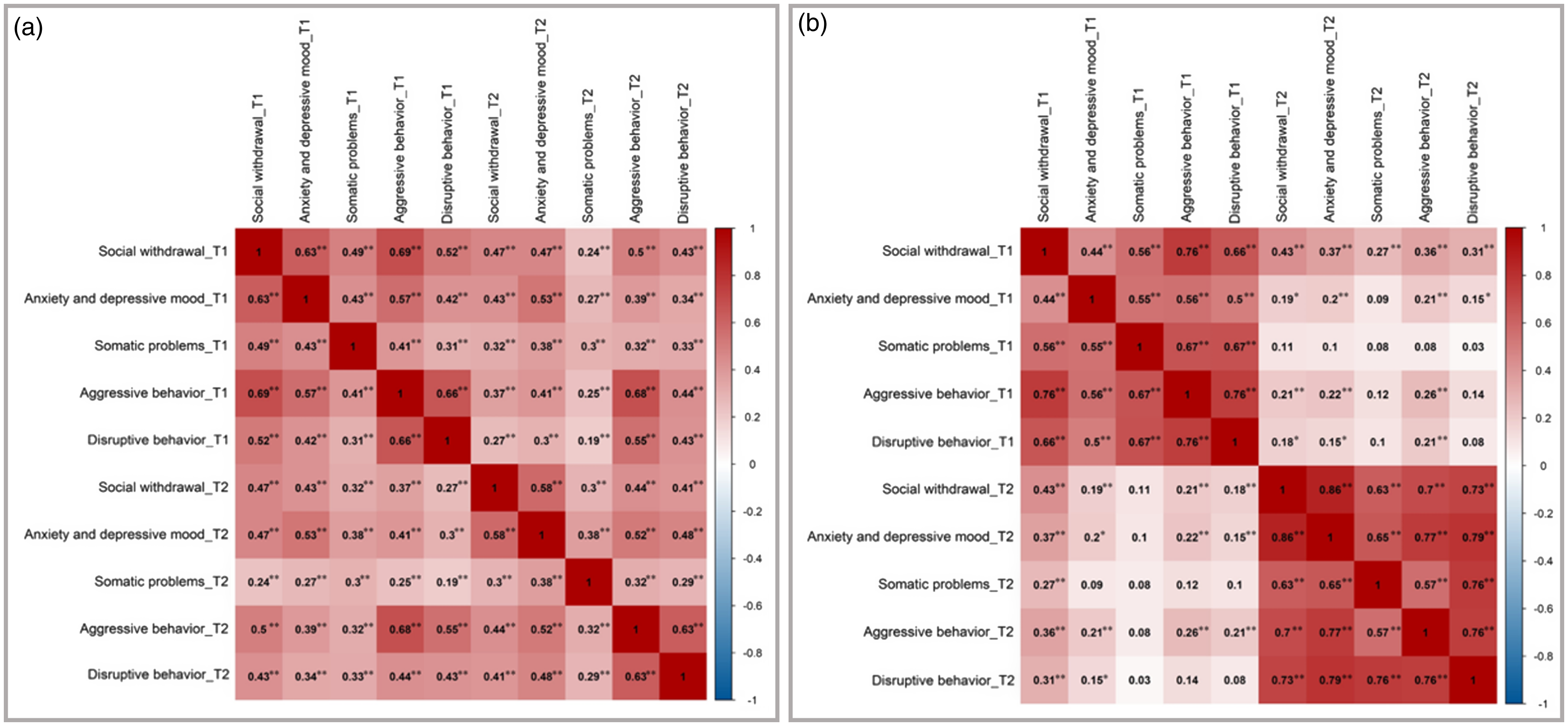
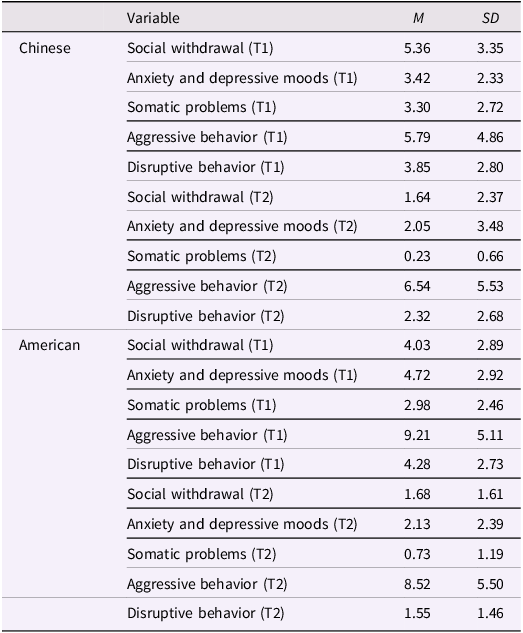
Descriptive statistics (Table 1) and heatmaps of bivariate correlations between internalizing and externalizing symptoms (Figure 1) are presented. As expected, symptoms of internalizing problems were significantly associated with both concurrent (rs = .68–.86, p < .01) and subsequent (rs = .27–.50, p < .01) externalizing symptoms in American and Chinese preschoolers.
Heatmaps of the Pearson correlation matrix in the American (panel a) and Chinese (panel b) samples. * p < .05. ** p < .01.

Descriptive statistics of main study variables in American and Chinese preschoolers

Cross-sectional networks
Cross-sectional networks in American preschoolers
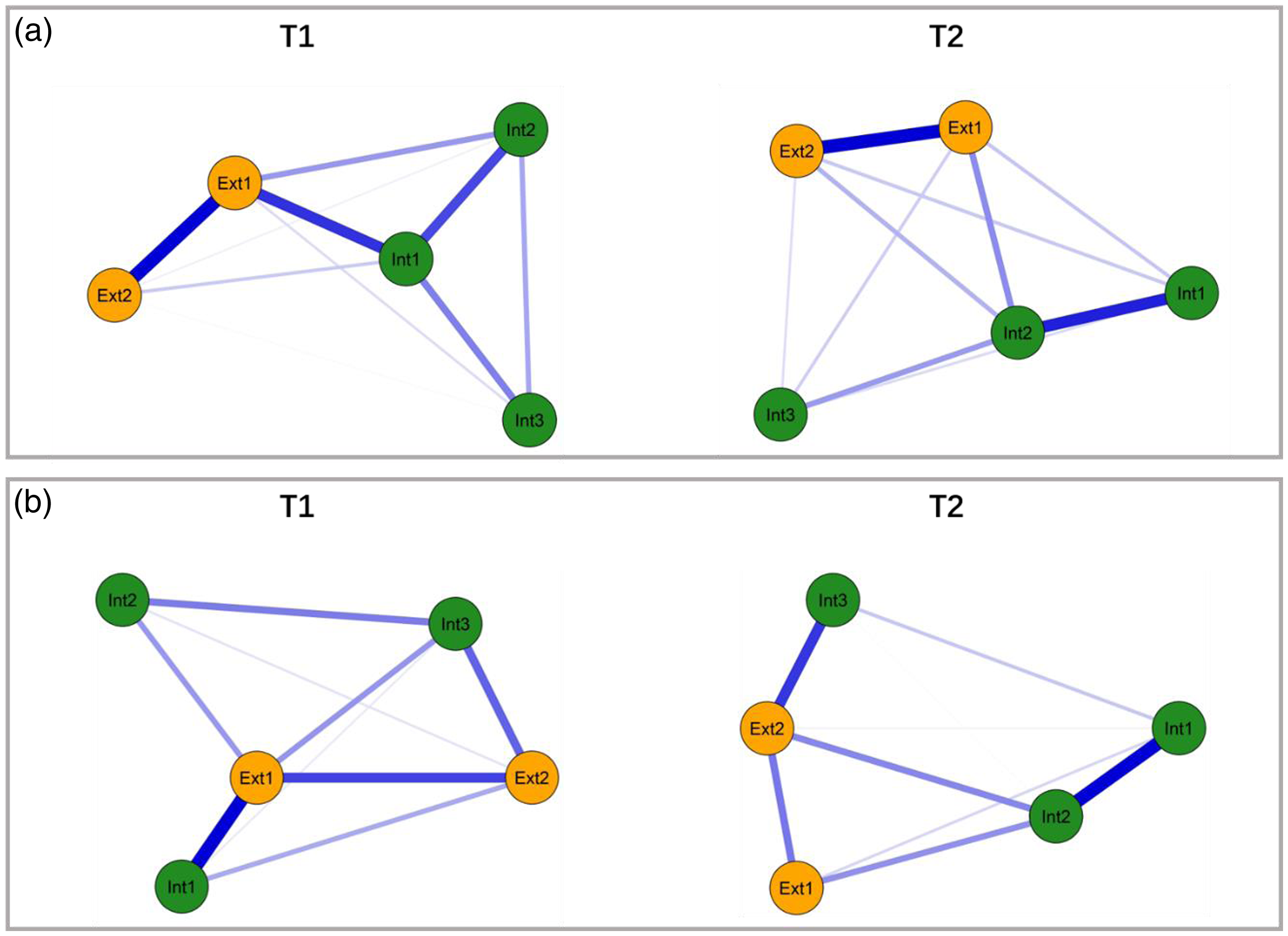
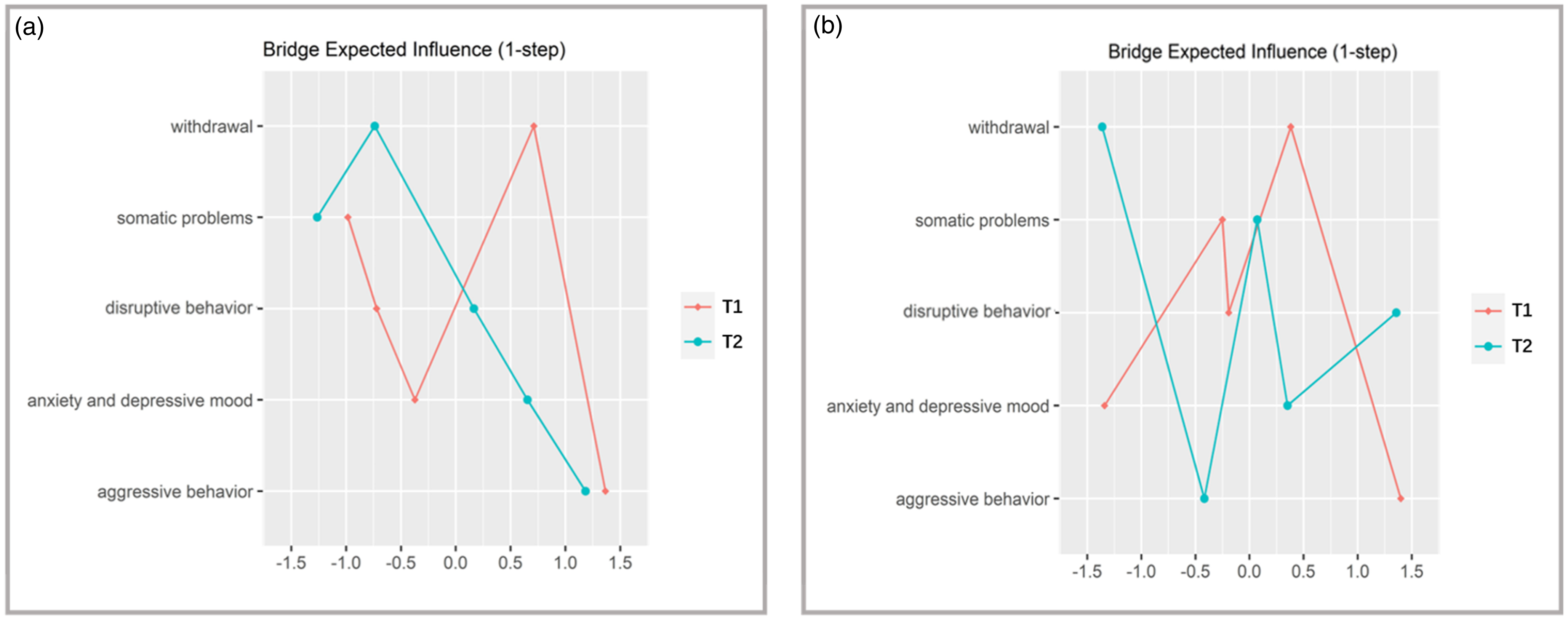
The cross-sectional networks in American preschoolers showed partial moderate correlations among nodes of internalizing and externalizing problems at both waves (panel a, Figure 2). The LASSO estimation yielded 9 and 10 nonzero edges (out of 10 maximum possible edges) in the T1 and T2 networks, respectively. At both waves, the edges between “aggressive behavior” and “disruptive behavior” (edge weightT1 = 0.47, edge weightT2 = 0.47) and between “anxiety and depressive moods” and “withdrawal” (edge weightT1 = 0.34, edge weightT2 = 0.42) were among the strongest, suggesting the strong connections within distinct clusters of internalizing and externalizing symptoms. Both waves also demonstrated connections between internalizing and externalizing problems through edges between “withdrawal” and “aggressive behavior” at T1 (edge weight = 0.38) and between “anxiety and depressive moods” and “aggressive behavior” at T2 (edge weight = 0.42). In terms of bridge symptoms (panel a, Figure 3), “aggressive behavior” of externalizing problems (bEIT1 = 0.63, bEIT2 = 0.41) was consistently identified as the most influential bridge node linking to all internalizing symptoms at both waves. “Withdrawal” (bEI = 0.47) and “anxiety and depressive moods” (bEI = 0.35) of internalizing problems were also influential bridge symptoms at T1 and T2, respectively. This implies that aggressive behavior, withdrawal, and anxiety and depressive moods may represent key symptoms underlying the co-occurring internalizing and externalizing problems in American preschoolers.
Cross-sectional networks in American (panel a) and Chinese (panel b) preschoolers. Blue edges indicate positive associations. Edge thickness reflects the magnitude of the association. Int1 = social withdrawal (internalizing problems); Int2 = anxiety and depressive moods (internalizing problems); Int3 = somatic problems (internalizing problems); Ext1 = aggressive behavior (externalizing problems); Ext2 = disruptive behavior (externalizing problems).

Centrality indices (z-scores) of bridge expected influence (1-step) for cross-sectional networks among American (panel a) and Chinese (panel b) preschoolers. Larger values reflect greater centrality.

Cross-sectional networks in Chinese preschoolers
The cross-sectional networks in Chinese preschoolers showed similar patterns (panel b, Figure 2), with internalizing and externalizing symptoms forming distinct clusters. Nine and 8 nonzero edges (out of 10) emerged in the T1 and T2 networks, respectively. In both waves, influential edges featured links within the same cluster (e.g., aggressive behavior and disruptive behavior; edge weightT1 = 0.37, edge weightT2 = 0.32) and across two clusters (e.g., disruptive behavior and somatic problems; edge weightT1 = 0.30, edge weightT2 = 0.48). With regard to bridge symptoms (panel B, Figure 3), “aggressive behavior” (bEI = 0.90) and “withdrawal” (bEI = 0.66) were identified at T1, and “disruptive behavior” (bEI = 0.79) and “anxiety and depressive moods” (bEI = 0.55) were identified at T2. This pattern may reflect that aggressive behavior, withdrawal, disruptive behavior, and anxiety and depressive moods were all important symptoms underlying the co-occurring internalizing and externalizing problems in Chinese preschoolers.
Accuracy and stability test in cross-sectional networks
As shown in the supplement (Figures S1 and S2), bootstrapped confidence intervals of edge weights suggested that the edges were stable in both samples. There were some significant between-edge differences in the edge weights (Figures S3 and S4 in the supplement). The estimation of centralities was stable. (a) Most CSC for bEI in the cross-secthetional networks were stable (American preschoolers: CSC of bEIT1 = 0.75, CSC of bEIT2 = 0.60; Chinese preschoolers: CSC of bEIT1 = 0.59), except for the T2 network in Chinese sample (CSC of bEIT2 = 0.21). (b) For these networks, bootstrapped difference tests revealed that influential bridge symptoms were significantly different from other nodes (Figures S5 and S6 in the supplement).
Cross-lagged panel networks
Cross-lagged panel network in American preschoolers
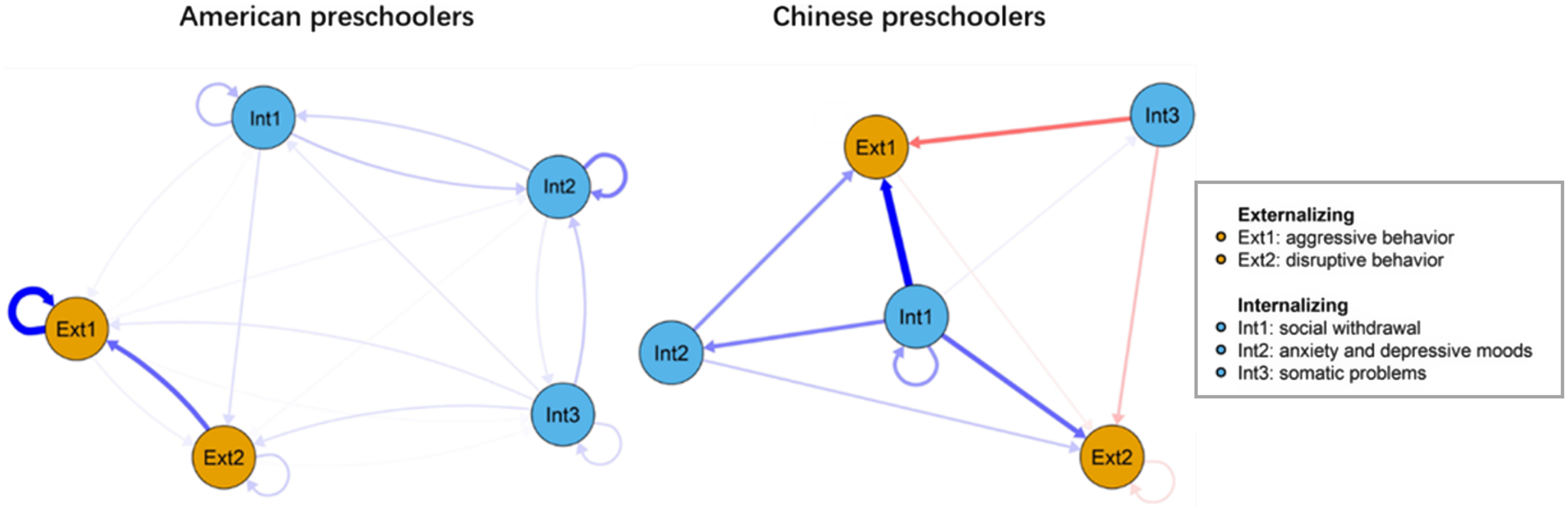
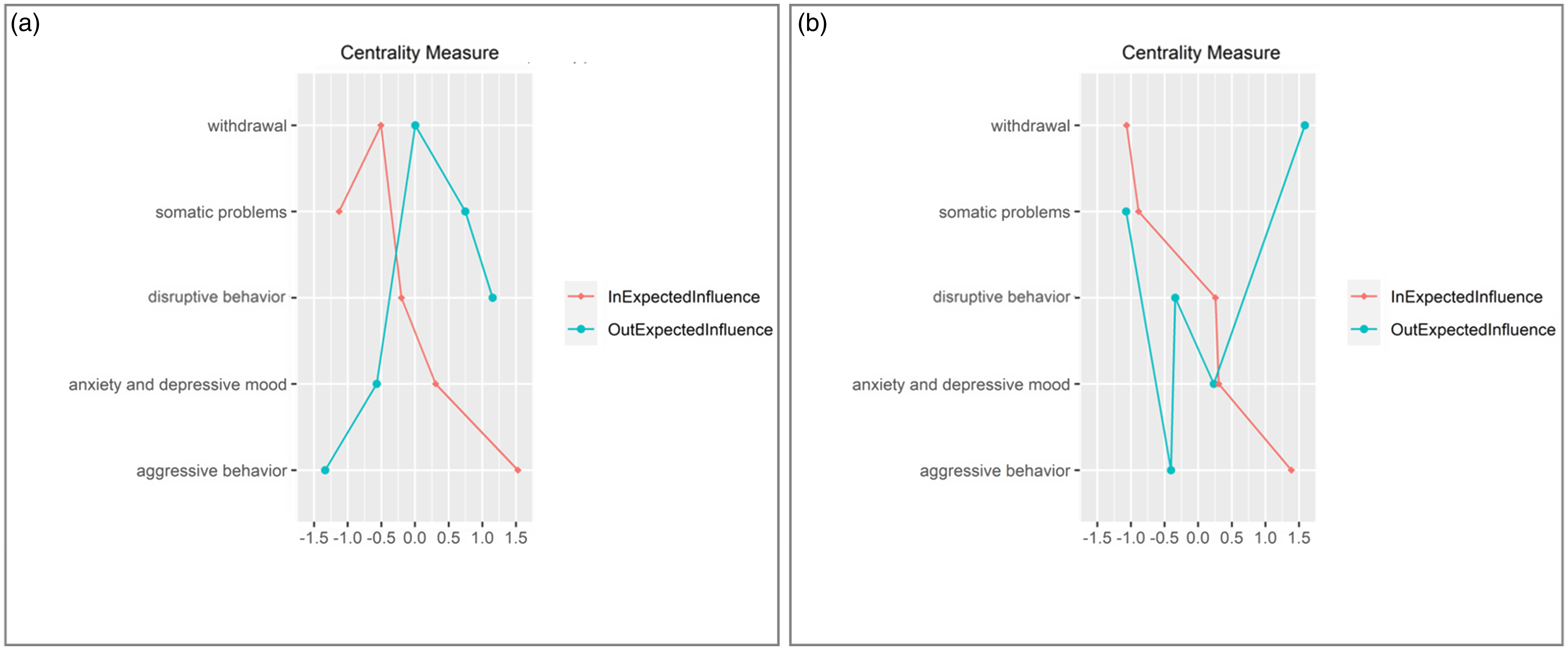
The longitudinal dynamics between internalizing and externalizing symptoms were examined using the CLPN (Figure 4). For the CLPN of American preschoolers, 21 out of 25 edges were not zero. All nodes showed substantial autoregressive effects. Within the distinct internalizing and externalizing clusters, the temporal association from “disruptive behavior” to “aggressive behavior” was the strongest (β = .35), suggesting the self-sustaining tendency of externalizing symptoms. Across two clusters, the strongest temporal edges linking internalizing and externalizing problems were from “withdrawal” to “disruptive behavior” (β = .08) and from “somatic problems” to “disruptive behavior” (β = .08). Additionally, as displayed in Figure 5, the out-EI nodes “disruptive behavior” (out-EI: 0.36) and “somatic problems” (out-EI: 0.31) were among the highest. In particular, partially supporting the hypothesis, “somatic problems” of internalizing symptoms positively predicted all subsequent internalizing and externalizing symptoms, demonstrating a unidirectional relation from internalizing to subsequent externalizing problems.
The cross-lagged panel networks in American and Chinese preschoolers. Arrows represent longitudinal relations (blue = positive, red = negative). Edge thickness reflects the magnitude of the associations. Int1 = social withdrawal (internalizing problems); Int2 = anxiety and depressive moods (internalizing problems); Int3 = somatic problems (internalizing problems); Ext1 = aggressive behavior (externalizing problems); Ext2 = disruptive behavior (externalizing problems).

Centrality indices (z-scores) of in-expected influence and out-expected influence for cross-lagged panel networks of American (panel a) and Chinese (panel b) preschoolers. Larger values reflect greater centrality.

Cross-lagged panel network in Chinese preschoolers
For the CLPN of Chinese preschoolers (Figure 4), 12 out of 25 edges were not zero with most nodes showing substantial autoregressive effects. Within the distinct internalizing and externalizing clusters, the edge from “withdrawal” to “anxiety and depressive moods” (β= .30) was among the highest, indicating that withdrawal positively predicted subsequent anxiety and depressive moods. Across the internalizing and externalizing clusters, the edges from “withdrawal” to “aggressive behavior” (β = .62) and “disruptive behavior” (β = .36) were among the highest, suggesting that withdrawal was positively related to later aggressive and disruptive behavior. Moreover, as shown in Figure 5, the node with the highest out-EI was “withdrawal” (out-EI = 1.32), which predicted subsequent internalizing and externalizing symptoms of “aggressive behavior,” “disruptive behavior,” and “anxiety and depressive moods.” In contrast to the CLPN in American children, there were two negative edges in the Chinese CLPN, including links from “somatic problems” to “aggressive behavior” (β = –.34) and “disruptive behavior” (β = –.16), indicating that somatic problems were negatively related to later externalizing symptoms. Therefore, supporting the hypothesis, the CLPN in Chinese preschoolers showed a unidirectional temporal association from internalizing to subsequent externalizing problems, albeit with mixed effects.
Stability analysis
Regarding the stability and accuracy of the above CLPNs, bootstrapped confidence intervals of edge weights suggested that the edges were stable in both samples (Figure S7 in the supplement), and significant between-edge differences in the edge weights existed (Figures S8 and S9 in the supplement). The estimation of centralities was also stable based on the following evidence. (a) The correlation stability coefficients for out-EI (CSC of out-EIChinese = 0.59; CSC of out-EIAmerican = 0.75) and in-EI (CSC of in-EIChinese = 0.59; CSC of in-EIAmerican = 0.75) in both CLPNs were all larger than 0.5, indicating that the centrality estimates were excellent. (b) Significant differences were observed between the out-EI and in-EI for some nodes using the bootstrapped difference test (Figures S10 and S11 in the supplement).
Discussion
Although previous studies using traditional techniques have revealed the co-occurrence of global internalizing and externalizing problems, the nuanced dynamics of symptom-level internalizing and externalizing problems have been less frequently examined, particularly among preschool children. This contrasts sharply with the emerging network approaches to psychopathology that emphasize the importance of examining symptom-level dynamics to fully understand the co-occurring tendencies among disorders. Using two-wave longitudinal data from American and Chinese preschoolers, this study applied a novel panel network analysis approach to elucidate the co-occurring patterns of internalizing and externalizing problems in early childhood at the symptom level. As expected, symptom-level internalizing and externalizing problems were closely related in both cross-sectional and longitudinal networks. The results from cross-sectional networks showed that withdrawal (T1), aggressive behavior (T1 and T2), and anxiety and depressive moods (T2) emerged as bridge symptoms in American preschoolers, and aggressive behavior (T1), withdrawal (T1), disruptive behavior (T2), and anxiety and depressive moods (T2) were bridge symptoms in Chinese preschoolers. Moreover, the results from the CLPN networks further revealed that for both American and Chinese preschoolers, the co-occurring pattern was manifested by unidirectional relations from internalizing to subsequent externalizing symptoms. Collectively, the findings elucidate the nuanced dynamics between preschool internalizing and externalizing problems at the symptom level, both concurrently and longitudinally, and contribute needed cross-cultural evidence to better understand the co-occurrence of internalizing and externalizing problems in early childhood.
Consistent with the Network Approaches to Psychopathology (Masten & Cicchetti, Reference Masten and Cicchetti2010), the findings of cross-sectional networks demonstrated that internalizing and externalizing problems were related concurrently at the symptom level through bridge symptoms, such as “withdrawal” and “anxiety and depressive moods” of internalizing problems and “aggressive behavior” of externalizing problems, which was consistently identified for American and Chinese preschoolers. This culturally convergent pattern may be interpreted using the shared risk hypothesis (Angold et al., Reference Angold, Costello and Erkanli1999), which proposes that the co-occurring internalizing and externalizing problems may be driven by common culturally universal risk factors. First, as preschoolers start spending more time outside their families, they may perceive this transition as challenging and stressful, particularly for those with low social competence (Kiel & Buss, Reference Kiel and Buss2014), and, consequently, withdraw from social interactions (Morneau-Vaillancourt et al., Reference Morneau‐Vaillancourt, Andlauer, Ouellet‐Morin, Paquin, Brendgen, Vitaro, Gouin, Séguin, Gagnon, Cheesman, Forget‐Dubois, Rouleau, Turecki, Tremblay, Côté, Dionne and Boivin2021). Social withdrawal is closely related to children’s aversive peer experiences, characterized by disruptive peer interactions, low peer acceptance, and high peer victimization (Barzeva et al., Reference Barzeva, Richards, Meeus and Oldehinkel2020), which are predictors of both internalizing (Wang & Zhou, Reference Wang and Zhou2019) and externalizing problems (Lansford et al., Reference Lansford, Malone, Dodge, Pettit and Bates2010). Second, high levels of aggressive behavior are related to peer rejection and exclusion (Bierman et al., Reference Bierman, Kalvin and Heinrichs2015), which in turn may be related to deleterious feelings of depression and anxiety (Wang & Zhou, Reference Wang and Zhou2019). Thus, in line with the meta-analytic evidence (Huber et al., Reference Huber, Plötner and Schmitz2019), aggressive behavior and social withdrawal characterizing social incompetence may be culturally universal risk factors underlying the co-occurring internalizing and externalizing problems.
Additionally, only for Chinese children, “disruptive behavior” emerged as an additional bridge symptom. This may occur because disruptive behavior is closely related to aggressive behavior in the network. Since aggressive behavior undermines harmony in interpersonal relations, which is highly valued in Chinese culture (Chen et al., Reference Chen, Zhang, Ji and Deater-Deckard2019), children with high levels of aggressive behavior are likely to be punished by parents and teachers and rejected by peers. These negative experiences may lead to children’s development of rejection sensitivity (Levy et al., Reference Levy, Ayduk, Downey and Leary2001), a biased perception closely related to loneliness, anxiety, and depression characterizing internalizing problems (Gao et al., Reference Gao, Assink, Cipriani and Lin2017).
The findings of longitudinal networks based on the CLPN examined the temporal associations between internalizing and externalizing symptoms over time. In partial support of our hypothesis, we observed a unidirectional temporal association from internalizing to later externalizing problems in both samples, consistent with the Acting Out Model (Wolff & Ollendick, Reference Wolff and Ollendick2006) and previous studies using traditional techniques (Poirier et al., Reference Poirier, Déry, Temcheff, Toupin, Verlaan and Lemelin2016; Zaharakis et al., Reference Zaharakis, Mason, Brown, Moore, Garcia, Foster and Richards2018) and the network approach (Funkhouser et al., Reference Funkhouser, Chacko, Correa, Kaiser and Shankman2021). Expanding initial efforts (Funkhouser et al., Reference Funkhouser, Chacko, Correa, Kaiser and Shankman2021; Poirier et al., Reference Poirier, Déry, Temcheff, Toupin, Verlaan and Lemelin2016), this study provides culturally consistent evidence using the network approach and clarifies the direction of associations underlying the co-occurring tendency of both problems during preschool years. This pattern of unidirectional temporal association from internalizing to subsequent externalizing problems may occur because preschoolers with internalizing problems tend to be viewed as socially incompetent by their peers and are more likely to be rejected and victimized (Bierman et al., Reference Bierman, Kalvin and Heinrichs2015). Overwhelming stress from aversive peer experiences may be channeled through acting out, such as heightened disruptive behavior and aggression toward peers, particularly when they are inadequate to regulate aversive feelings (Lansford et al., Reference Lansford, Malone, Dodge, Pettit and Bates2010).
We also observed that among Chinese children only, the unidirectional temporal associations from internalizing to externalizing symptoms were mixed with both positive and negative relations. That is, while withdrawal of internalizing problems was positively related to subsequent aggressive and disruptive behavior, somatic problems were negatively related to these externalizing symptoms, suggesting the heterogeneity of the temporal associations between distinct internalizing and externalizing symptoms. Presumably, chronic and high levels of somatic symptoms act as stressors challenging children’s coping threshold. Although overwhelming arousal associated with somatic symptoms was channeled through acting out in American children, this is less likely to occur in Chinese children because maintaining interpersonal harmony is a top priority in Chinese culture (Chen et al., Reference Chen, Zhang, Ji and Deater-Deckard2019), and aggressive behavior that threatens this cultural value is deemed unacceptable. In addition, consistent with previous studies (Freichel et al., Reference Freichel, Pfirrmann, de Jong, Cousijn, Franken, Oldehinkel, Veer and Wiers2024; McElroy et al., Reference McElroy, Shevlin, Murphy and McBride2018; Speyer et al., Reference Speyer, Eisner, Ribeaud, Luciano, Auyeung and Murray2021), we observed that the edges between bridge symptoms were generally weaker than those between symptoms within the same construct. This pattern confirms that internalizing and externalizing problems represent distinct problems regardless of their co-occurrence at the symptom and global levels.
Given that this longitudinal study contributed cross-cultural evidence to understand the dynamics of symptom-level internalizing and externalizing symptoms using a novel panel network approach, the findings should be interpreted in light of several limitations. First, although the Chinese sample was relatively small, the sample size was sufficient to estimate reliable networks (Constantin, Reference Constantin2018). The stability of our networks was established, which further confirmed that the sample size was sufficient. Indeed, prior studies of network analysis also used small samples to construct networks (Chavez-Baldini et al., Reference Chavez-Baldini, Verweij, de Beurs, Bockting, Lok, Sutterland, van Rooijen, van Wingen, Denys, Vulink and Nieman2022; Hu et al., Reference Hu, Liu, Zhang, Wang, Chu, Li, Lv, Lui, Hui, Yi and Chan2023). Second, the observed associations between internalizing and externalizing symptoms are correlational in nature and may not be appropriate for inferring causality. Third, we relied on community samples from the United States and China. Although the findings can be generalized to American and Chinese preschoolers from slightly advantaged families, they may not be generalizable to those from low-income families and those with clinically diagnosed adjustment problems such as major depression and conduct disorders. Fourth, although the two samples had slightly different time intervals between waves, the results of the cross-sectional and longitudinal networks revealed noticeable similarities, albeit with differences, in the bridge symptoms underlying the co-occurring internalizing and externalizing problems and in the unidirectional temporal association from internalizing to externalizing problems. This culturally convergent evidence provided some support for the validity of our findings given the issue of slightly different time intervals in two samples. Fifth, the network approach is exploratory in nature and should be replicated in independent samples. Given the ongoing controversy regarding the replicability of network models (Funkhouser et al., Reference Funkhouser, Correa, Gorka, Nelson, Phan and Shankman2020), future studies are needed to replicate the networks with larger samples and with children from diverse cultural and economic backgrounds. Finally, although we focused on cross-cultural comparisons, there is intracultural diversity in values and practices and their influences on patterns of symptom networks. This could be explored in future research.
Conclusions
Within the frameworks of the Network Approaches to Psychopathology and the Developmental Cascade Perspective, this study contributes needed cross-cultural evidence to understand the co-occurrence of preschool internalizing and externalizing problems at the symptom level. The findings of cross-sectional and longitudinal networks reveal culturally convergent patterns of associations underlying co-occurring internalizing and externalizing problems and highlight the temporal heterogeneity of symptom networks during the preschool years. Interventions to alleviate internalizing and externalizing problems in preschoolers need to start early, target bridge symptoms, and prioritize interventions for internalizing symptoms.
Supplementary material
The supplementary material for this article can be found at https://doi.org/10.1017/S0954579424001706.
Funding statement
This work was supported by the STI 2030-Major Projects 2021ZD0200500 and the Open Fund of Key Laboratory of Philosophy and Social Science of Anhui Province on Adolescent Mental Health and Crisis Intelligence Intervention (SYS2024A02).
Competing interests
None.