Implications
The effect of in vitro ova ageing on egg quality in Eurasian perch was examined. Stripped eggs could be stored for at least 12 h at 4°C to 12°C without a significant reduction in their quality. This finding provides the possibility of synchronous fertilization for different females and consequently homogenous larval size, reductions in cannibalism among the obtained larvae, and thereby maximizing the efficacy of mass production in Eurasian perch hatcheries.
Introduction
The Eurasian perch, Perca fluviatilis L., is a highly valuable and a promising species for aquaculture purposes in Europe (Kucharczyk et al., Reference Kucharczyk, Kujawa, Mamcarz, Skrzypczak and Wyszomirska1998; Szczerbowski et al., Reference Szczerbowski, Kucharczyk, Mamcarz, Łuczyński, Targońska and Kujawa2009). Controlled reproduction of Eurasian perch has been improved (e.g. Kucharczyk et al., Reference Kucharczyk, Kujawa, Mamcarz, Skrzypczak and Wyszomirska1998; Policar et al., Reference Policar, Kouřil, Stejskal and Hamáčková2008; Żarski et al., Reference Żarski, Bokor, Kotrik, Urbanyi, Horvath, Targonska, Krejszeff, Palinska and Kucharczyk2011a), However, asynchronous ovulation among females is still a bottleneck toward commercial aquaculture for this species (Kucharczyk et al., Reference Kucharczyk, Kujawa, Mamcarz, Skrzypczak and Wyszomirska1998; Szczerbowski et al., Reference Szczerbowski, Kucharczyk, Mamcarz, Łuczyński, Targońska and Kujawa2009; Żarski et al., Reference Żarski, Bokor, Kotrik, Urbanyi, Horvath, Targonska, Krejszeff, Palinska and Kucharczyk2011a). This leads to the subsequent differences in larval size. Therefore, the cannibalism among larvae from different females is not surprising (Baras et al., Reference Baras, Kestemont and Mélard2003; Kestemont et al., Reference Kestemont, Jourdan, Houbart, Mélard, Paspatis, Fontaine, Cuvier, Kentouri and Baras2003) and provides real challenges for the mass production.
The eggs, upon ovulation, are arrested in metaphase, the second stage of meiotic division (Lubzens et al., Reference Lubzens, Young, Bobe and Cerda2010), waiting to be fertilized. Delayed spawning in nature, delayed egg collection in capture and even delayed fertilization after egg stripping can lead to excessive ova ageing and finally over-ripening phenomenon. After ovulation, ova ageing has been reported to be the most important factor affecting egg quality of several fish species (Rime et al., Reference Rime, Guitton, Pineau, Bonnet, Bobe and Jalabert2004). During ova ageing, major morphological, physiological, biochemical, histological, cellular and molecular changes occur inside the eggs. These changes deteriorate the quality of ovulated eggs rapidly after ovulation and leads to decreasing the ability of the eggs to be fertilized and the developmental success of the embryo, reaching to the eyed-egg and hatched-larvae stages (e.g. Craik and Harvey, Reference Craik and Harvey1984; Lahnsteiner, Reference Lahnsteiner2000; Aegerter et al., Reference Aegerter, Jalabert and Bobe2005). In addition, the malformation rates have been reported of higher incidence in larvae obtained from more aged ova (e.g. Gisbert and Williot, Reference Gisbert and Williot2002; Bonnet et al., Reference Bonnet, Jalabert and Bobe2003; Samarin et al., Reference Samarin, Policar and Lahnsteiner2016). Successful egg storage, either in vivo (inside the body of the fish) or in vitro (outside the body of the fish), particularly for cultured fish species, allows fertilization to be synchronized for different females, thereby facilitating hatchery management. In vivo egg storage is typically more laborious because the spontaneous spawning of eggs needs to be prevented (Żarski et al., Reference Żarski, Bokor, Kotrik, Urbanyi, Horvath, Targonska, Krejszeff, Palinska and Kucharczyk2011a); in addition, females need to be taken care of. Storage of stripped eggs is a viable alternative approach. Long-term storage, using cryopreservation and vitrification techniques, of fish ova has been unsuccessful to date because of the difficulties associated with the removal of intercellular water during cooling, the toxicity of cryoprotectants, and non-homogeneous freezing and thawing rates (Guan et al., Reference Guan, Rawson and Zhang2008). Therefore, the only feasible method of egg storage is via short-term in vitro storage of unfertilized eggs, which has been used in various finfish species (e.g. Rizzo et al., Reference Rizzo, Godinho and Sato2003; Komrakova and Holtz, Reference Komrakova and Holtz2009; Samarin et al., Reference Samarin, Policar and Lahnsteiner2016). The time interval during which eggs remain viable after stripping has been reported to be from a few minutes to a few days depending on the fish species and the storage temperature (reviewed by Samarin et al., Reference Samarin, Mojazi Amiri, Soltani, Nazari, Kamali and Naghavi2015).
To date, the duration of egg viability after stripping has not yet been assessed for Eurasian perch. The possibility of in vitro egg storage in perch hatcheries may permit synchronous fertilization for different females and following homogenous larval size, reductions in cannibalism among the obtained larvae, and facilitation of hatchery work, thereby maximizing the efficacy of mass production of larvae and juveniles. This approach can also be helpful when completely mature male brood fish are unavailable or shipment of the eggs is needed. The present study was conducted to identify the effects of in vitro egg storage duration, up to 72 h after stripping, and storage temperatures of 4°C, 8°C and 12°C on egg viability rates and the occurrence of larval malformations in Eurasian perch.
Material and methods
Fish
In April 2014, brood fish (~100 fish) were captured from earthen ponds of Żurawia Fish Farm (Biała Rawska, Central Poland) (when the average daily temperature of the water reached 10°C) and transferred to fish experimental facilities of Department of Lake and River Fisheries, University of Warmia and Mazury, Olsztyn, Poland. The fish were kept in indoor holding tanks (1000 l capacity) supplied with water from a recirculating aquaculture system. The fish were kept in dim conditions (<20 lx) at 12°C for 1 week (2 days of acclimation and 1 to 5 days after hormone injection depending on the non-ovulated oocyte maturation stage). After a 2-day period of acclimation, six females were selected on the base of the pre-ovulatory maturation stage of oocytes, as described by Żarski et al. (Reference Żarski, Bokor, Kotrik, Urbanyi, Horvath, Targonska, Krejszeff, Palinska and Kucharczyk2011a). For the purpose, a non-ovulated oocyte sample from each female (~50 oocytes) was taken with a catheter, cleared in a Serra’s solution (70% ethanol, 36% formaldehyde and glacial acetic acid in the proportion of 6 : 3 : 1) and classified according to the six-stage classification (for details see Żarski et al., Reference Żarski, Bokor, Kotrik, Urbanyi, Horvath, Targonska, Krejszeff, Palinska and Kucharczyk2011a). For the experiment, four females representing stages IV and V were used (weighting between 135 and 320 g). Next, females were treated with 500 IU of hCG (Argent, Redmond, WA, USA) per kg of female BW (Żarski et al., Reference Żarski, Krejszeff, Horváth, Bokor, Palińska, Szentes, Łuczyńska, Targońska, Kupren, Urbányi and Kucharczyk2012b). The time of ovulation was determined on the basis of the oocyte maturation stage of the females, as described by Żarski et al. (Reference Żarski, Bokor, Kotrik, Urbanyi, Horvath, Targonska, Krejszeff, Palinska and Kucharczyk2011a). The state of ripeness was judged by gentle palpation of the abdomen. If eggs could be removed by applying gentle pressure to the abdomen, the fish were considered to have already ovulated. To examine if ovulation occurred and to collect gametes, fish were anaesthetized with 100 ppm tricaine methanesulfonate (MS-222; Argent) to minimize stress and to make them easier to handle.
In vitro egg storage
Eggs from four ovulated females were selected based on the morphological quality criteria described by Żarski et al. (Reference Żarski, Palinska, Targonska, Bokor, Kotrik, Krejszeff, Kupren, Horvath, Urbanyi and Kucharczyk2011b). Eggs were collected separately from each individual. In total, 13 batches of ~250 egg aliquots from each of the four females were stored in six-well sterile cell culture plates (each well diameter: 3.5 cm). The eggs were stored in two layers deep (Komrakova and Holtz, Reference Komrakova and Holtz2009). No solution, artificial media or extender was used for the egg storage. All plates were individually covered by their own lids and kept in the dark at 4°C, 8°C and 12°C. For storage of the eggs at 4°C, the plates were transferred to a domestic refrigerator with an adjusted constant temperature. For storage of the eggs at 8°C and 12°C, the plates were stored in a water bath adjusted at the constant required temperature. To provide the humidified atmosphere, a few plates were filled with water and placed into the storage chambers (Babiak and Dabrowski, Reference Babiak and Dabrowski2003; Komrakova and Holtz, Reference Komrakova and Holtz2009). Batches of eggs from each female were fertilized immediately after stripping and at 6, 12, 18, 24, 30, 36, 42, 48, 54, 60, 66 and 72 h post-stripping (HPS) after storage at the three tested temperatures.
Artificial fertilization
In all, 30 mature males weighing between 55 and 145 g were randomly selected for the experiment. To provide a uniform fertilizing ability for all egg batches, 0.5 ml of milt was collected from each of three males for each fertilization step. Sperm motility was assessed empirically for each male separately before egg insemination by observing the sperm under a microscope at a magnification of 40× using a glass slide without a coverslip (Fauvel et al., Reference Fauvel, Suquet and Cosson2010). A total volume of 1.5 ml was then mixed gently and stored at 4°C until it was used for fertilization.
Each batch of 250 eggs was separately fertilized using 0.15 ml of mixed milt. The fertilization procedure was performed according to the protocol described by Żarski et al. (Reference Żarski, Horváth, Kotrik, Targońska, Palińska, Krejszeff, Bokor, Urbányi and Kucharczyk2012a). A quantity of 5 ml of hatchery water was poured into a Petri dish. The eggs were then submerged in the water and gently dispersed in the Petri dish; after 15 s, sperm were added. This sperm-to-egg ratio was confirmed to be sufficient to fertilize all of the eggs in preliminary tests.
Incubation and examination of egg developmental success
All batches of fertilized eggs were placed into separate small cubic-square-shaped incubators (75 cm3 capacity) with recirculating water at 14±0.5°C. To avoid the probable problems causing from thermal shock, hatchery water was added slowly to the dishes while transferring the fertilized eggs and before placing them into the incubators. The ratios of the number of embryos reaching the eyed-egg and hatched-larvae stages to the number of initially fertilized eggs were used as indices of egg quality (Bonnet et al., Reference Bonnet, Jalabert and Bobe2003; Aegerter and Jalabert, Reference Aegerter and Jalabert2004). Eyed eggs were counted macroscopically 6 days after fertilization as the presence/absence of pigmented eyes in each embryo. Hatched-larvae rates were determined by counting the number of hatched larvae 14 days after fertilization. Eyed-egg mortality was defined as the percentage of dead eyed-eggs out of the total number of eggs that reached the eyed-egg stage. Malformed larvae (spinal cord torsion, yolk sac and eye deformations) were counted at the same day, that is 14 days after fertilization, using a stereomicroscope (Leica MZ 16.5, Wetzlar, Germany) to determine the incidence of malformation rates.
Statistical analysis
The normality of the data was assessed using SPSS software version 18. Differences between the means of the groups for each measured parameter were evaluated using ANOVA followed by Duncan’s multiple range test. P<0.05 was considered to be significant.
Results
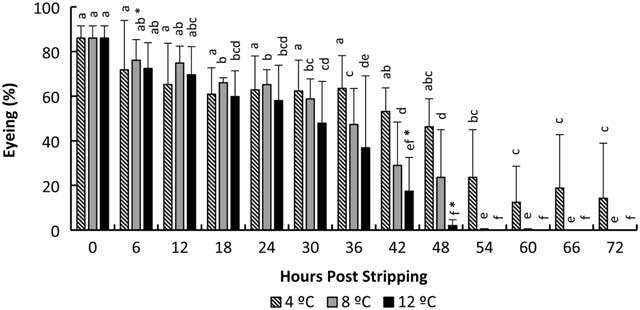
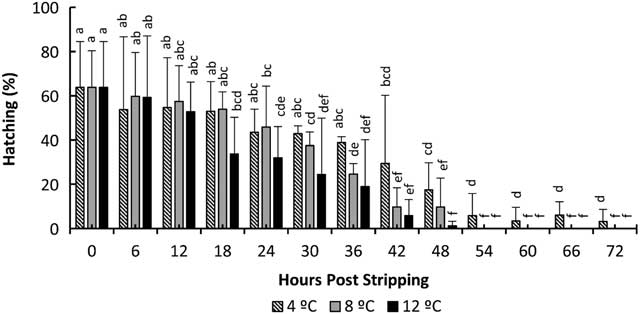
The results indicated that the embryos reaching the eyed-egg and hatched-larvae stages did not show any significant decrease for at least up to 12 HPS at the storage temperatures of 8°C and 12°C and up to 36 HPS at 4°C. The highest eyed-eggs and hatched-larvae rates (86% and 63%, respectively), although do not differ significantly, were obtained at 0 HPS, when the eggs were fertilized immediately after stripping. After 24 h of egg storage at all examined temperatures, the embryos reaching the eyed stage were still measured to be almost 70% of their initial rates at 0 HPS (Figure 1). After 48 h of egg storage at 4°C, 8°C and 12°C, the eyed-egg rates were 46%, 23% and 2%, respectively. Thus, these results indicate that there is a negative relationship between temperature and the effectiveness of egg storage. At 72 HPS, the eyed-egg rate was 14% for eggs stored at 4°C, whereas for the eggs stored at 8°C and 12°C were completely lost at 66 and 54 HPS, respectively. Hatched-larvae rates followed the same trends (Figure 2). When the eggs were stored for 72 HPS at 4°C, 3% of the eggs reached to the hatching stage, whereas the values were totally lost for the eggs stored >48 HPS at 8°C and 12°C. The differences among storage temperatures began to reach significance at 42 HPS for the eyed-egg rates. Although determining fertilization rate would be as the first sign of egg quality, we did not determine the fertilization percentages in the present study.
Effects of post-stripping ova ageing on the eyed-egg rates of the stored eggs at different temperatures (mean±SD). a,b,c,d,e,fMeans sharing a common alphabetical symbol do not differ significantly among different hours post-stripping (HPS) at the same temperature. *Significant differences among measured temperatures at the same HPS.

Effects of post-stripping ova ageing on the hatched-larvae rates of the stored eggs at different temperatures (mean±SD). a,b,c,d,e,fMeans sharing a common alphabetical symbol do not differ significantly among different hour post-stripping (HPS) at the same temperature. No significant differences were detected among measured temperatures at the same HPS for the hatched-larvae rates.

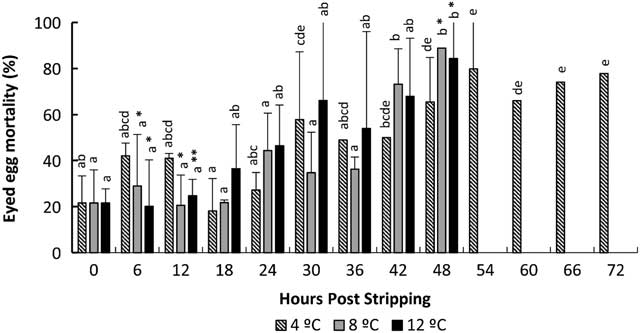
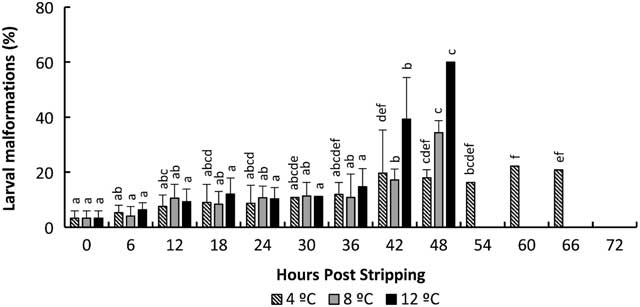
Eyed-egg mortality (Figure 3) and larval malformation rates (Figure 4) were not significantly affected by post-stripping ova ageing for up to 36 h. Thereafter, both indices increased significantly in more aged ova. After 48 h of egg storage at 8°C and 12°C, no eyed-egg mortality and larval malformations could be observed. When the eggs were stored for 72 HPS at 4°C, the eyed-egg mortality was measured to be 77%. In addition, larval malformation rates increased significantly to 21% at 66 HPS. At the time point of 48 h of egg storage, the effect of temperature was found to significantly affect the incidence of malformations where 18%, 34% and 60% deformed larvae could be found at 4°C, 8°C and 12°C, respectively.
Effects of post-stripping ova ageing on eyed-egg mortality rates of the stored eggs at different temperatures (mean±SD). a,b,c,d,eMeans sharing a common alphabetical symbol do not differ significantly among different hour post-stripping (HPS) at the same temperature. *, **Significant differences among measured temperatures at the same HPS.

Effects of post-stripping ova ageing on larval malformation rates of the stored eggs at different temperatures (mean±SD). a,b,c,d,e,fMeans sharing a common alphabetical symbol do not differ significantly among different hour post-stripping (HPS) at the same temperature. No significant differences were detected among measured temperatures at the same HPS for the larval malformation rates.

Discussion
The results of this study revealed that the rates of embryos reaching the eyed-egg and hatched-larvae stages decrease and the eyed-egg mortalities and larval malformations increase with ova ageing. General trends of decreasing egg viability rates with elapsed time after stripping are similar to those reported for several other fish species (reviewed by Samarin et al., Reference Samarin, Mojazi Amiri, Soltani, Nazari, Kamali and Naghavi2015). However, the successful duration of storage that retains the fertilizability of the eggs ranges from minutes to days, depending on the fish species and the storage temperature (for details see Samarin et al., Reference Samarin, Mojazi Amiri, Soltani, Nazari, Kamali and Naghavi2015). In the present study, when the eggs were stored for 36 h at 4°C, not significantly different hatched-larvae rates in Eurasian perch were obtained. In addition, the hatched-larvae rates remained nearly constant when the eggs were stored up to 18 and 12 h at 8°C and 12°C, respectively. These hatched-larvae rates are considerably higher compared with the rates that have been reported for other species, where only eggs of salmonids were found to be successfully stored for longer periods (up to 9 days) (Niksirat et al., Reference Niksirat, Sarvi, Mojazi Amiri and Hatef2007a). This difference can be explained by the protective role of the gelatinous layer which covers the eggs in the Eurasian perch, provides the ribbon shape for the egg strand and prevents the eggs from being in direct contact with the air and surrounding media. Thus, damages from the effect of egg drying are reduced, and a longer viability is achieved. However, the composition of the gelatinous layer and its probable positive effect on the duration of successful egg storage needs to be examined in the future studies.
As the rate of physiological processes is mostly affected by temperature, storage of the unfertilized eggs at lower temperatures is expected to be more successful. In the present study, egg quality, as inferred from the eyed-egg and hatched-larvae rates, were guaranteed much longer when eggs were stored at lower temperatures. The most successful egg storage was observed at 4°C, whereas the natural spawning occurs during April and May, when water temperature rise above 10°C. This trend has been observed previously in rainbow trout (Oncorhynchus mykiss) (Aegerter and Jalabert, Reference Aegerter and Jalabert2004) and kutum (Rutilus frisii kutum) (Samarin et al., Reference Samarin, Blecha, Uzhytchak, Bytyutskyy, Żarski, Flajshans and Policar2011). In few fish species such as turbot (Psetta maxima) (Suquet et al., Reference Suquet, Chereguini, Omnes, Rasines, Normant, Souto and Quemener1999) and curimata (Prochilodus marggravii) (Rizzo et al., Reference Rizzo, Godinho and Sato2003), lower egg storage temperatures resulted in a decrease in egg viability rates. Therefore, the optimal storage temperature for the unfertilized eggs varies among species and may be dependent on the spawning temperature of particular species. It is possible that the low-temperature storage of the eggs for only those fish species that naturally reproduce at high temperatures is not successful. The underlying mechanisms for ova ageing and the loss of egg viability through over ripening are currently poorly understood (Samarin et al., Reference Samarin, Mojazi Amiri, Soltani, Nazari, Kamali and Naghavi2015).
The observed increasing trend in eyed-egg mortality rates with ageing of the stripped eggs is consistent with previous studies. In Caspian brown trout (Salmo trutta caspius), eyed-egg mortality increased from 2% at 0 HPS to 17% at 120 HPS when the eggs were stored at 2°C to 3°C (Niksirat et al., Reference Niksirat, Sarvi, Mojazi Amiri, Karami and Hatef2007b). Eyed-egg mortality rates in kutum increased from 13% at 0 HPS to 15%, 23% and 25% at 4°C, 10°C and 12°C, respectively at 8 HPS (Samarin et al., Reference Samarin, Blecha, Uzhytchak, Bytyutskyy, Żarski, Flajshans and Policar2011). In northern pike (Esox lucius), eyed-egg mortality since time after stripping sharply increased after 72 h of egg storage at 10°C and was measured to be 27% at 96 HPS (Samarin et al., Reference Samarin, Policar and Lahnsteiner2016). These authors concluded that the mortality of embryos may be indicative of the progression of over-ripening. However, the range of eyed-egg mortality rates in the present study was measured to be between almost 20% in the recently stripped eggs and 80% in the most aged ova, which is considerably higher than what has been reported in previous studies in other fish species. This difference may be attributed to the ribbon shape of the eggs in Eurasian perch. The ribbon shape makes removing dead eggs nearly impossible; thus, the risk of contagious fungal infections is much higher in these eggs (Kucharczyk et al., Reference Kucharczyk, Kujawa and Mamcarz1996).
The occurrence of larval malformations in this study increased slowly as ova aged up to 36 h, after which a drastic increase in malformed larvae was observed. The same increasing trend has also been documented for other species. When European catfish Silurus glanis eggs were stored for 8.5 h at 19°C and 3.5 h at 25°C, the incidence of abnormal larvae increased to 37% and 73%, respectively (Linhart and Billard, Reference Linhart and Billard1995). The percentages of normal hatched larvae decreased significantly after 4 h of egg storage in Sterlet Acipenser ruthenus and after 6 h in Siberian sturgeon Acipenser baeri (Gisbert and Williot, Reference Gisbert and Williot2002). Babiak and Dabrowski (Reference Babiak and Dabrowski2003) demonstrated that refrigeration of rainbow trout (Oncorhynchus mykiss) ova or embryos has a negligible effect on the occurrence of larval malformations. In addition, after 3 days of in vitro egg storage in rainbow trout, larval malformation rate was not significantly decreased (Bonnet et al., Reference Bonnet, Jalabert and Bobe2003). However, this parameter was not measured for more aged ova. In curimata, decreasing fertilization rate with a simultaneous increase in the number of deformed larvae was observed after 1 h and reported to be a consequence of limiting factors during in vitro egg storage (Rizzo et al., Reference Rizzo, Godinho and Sato2003). In northern pike, larval malformation rates generally increased in more aged ova stored at 10°C, sharply increased after 72 HPS and reached 33% at 96 HPS (Samarin et al., Reference Samarin, Policar and Lahnsteiner2016). Chromosomal abnormalities was associated with ova ageing in European catfish (Váarkonyi et al., Reference Váarkonyi, Bercsényi, Ozouf-Costaz and Billard1998). In rainbow trout, the abundance of IGF1 messenger RNA which is required for proper embryonic development was found to be lower in more aged ova (Aegerter et al., Reference Aegerter, Jalabert and Bobe2005). In higher vertebrates, ova ageing is associated with epigenetic changes (Liang et al., Reference Liang, Zhu and Miao2008), misaligned chromosomes (Wakayama et al., Reference Wakayama, Thuan, Kishigami, Ohta, Mizutani, Hikichi, Miyake and Wakayama2004) and premature chromosome separation (Mailhes et al., Reference Mailhes, Young and London1998). Ova ageing is also accompanied by biochemical changes inside the eggs (Craik and Harvey, Reference Craik and Harvey1984; Lahnsteiner, Reference Lahnsteiner2000), and the leakage of several ova components such as protein fragments into the ovarian fluid (Rime et al., Reference Rime, Guitton, Pineau, Bonnet, Bobe and Jalabert2004). As the egg yolk nutritionally supports the embryo, these components are most likely required for the proper embryonic development and larvae. The aforementioned cellular and molecular changes through ova ageing may be used to infer increases in eyed-egg mortality and the occurrence of larval malformation rates with ova ageing. No study has yet been performed examining the effect of fish ova ageing on the growth and genetic structure of progeny. This topic can be addressed in the future studies.
The present study demonstrated for the first time that stripped perch eggs can be stored for at least 12 h at 4°C to 12°C to obtain hatched-larvae rates higher than 50%. Complete loss of egg viabilities were observed at 54, 66 and after 72 HPS when the eggs were stored at 4°C, 8°C and 12°C, respectively. Future studies should explore methods to improve the duration of egg storage in Eurasian perch with the use of antibiotics, antioxidants and/or aeration of the storage medium, etc., as these approaches have had positive effects on the duration of in vitro egg storage in other teleostei fishes and higher vertebrates (e.g. Komrakova and Holtz, Reference Komrakova and Holtz2009; Takahashi et al., Reference Takahashi, Igarashi, Amita, Hara, Matsuo and Kurachi2013).
Acknowledgements
This study was financially supported by the Ministry of Education, Youth and Sports of the Czech Republic – projects ‘CENAKVA’ (No. CZ.1.05/2.1.00/01.0024) and ‘CENAKVA II’ (No. LO1205 under the NPU I program), POSTDOC JU (No. CZ.1.07/2.3.00/30.0006), NAZV (QJ 1510117), GAJU (060/2016/Z), NF-CZ07-MOP-3-184-2015 and NF-CZ07-ICP-3-185-2015. The authors would like to thank Elsevier Language Editing Service for improving the English of the text.