INTRODUCTION
Parasite species are not randomly distributed among host species or geographical areas. The structure of parasite communities is influenced by many factors including biogeography and phylogenetic history, host specificity, and parameters of host biology such as population size, habitat, diet, dispersal, and anti-parasite defences (Poulin and Morand, 2004). Understanding the relative contribution of each factor and of their interactions is a great challenge for ecologists. At large spatial and taxonomic scales, the comparative method, with appropriate phylogenetic control, has permitted considerable progress in identifying correlations that potentially reveal host traits as key structuring factors (Poulin and Morand, 2004). At the host population level, intrinsic factors such as host age and sex are now well documented for some host-parasite systems such as those involving rodents and their parasites (Behnke et al. 2004; Pawelczyk et al. 2004; Hawlena et al. 2005; Krasnov et al. 2005). However, the considerable variability of parasite community structure between different populations of the same host species remains largely unexplained (Behnke et al. 2001).
Many taxa of gastrointestinal helminths in vertebrates are found in several more or less related species (Ezenwa, 2003), sometimes on a large geographical area. Strict host-parasite coevolution seems to be rare in such systems (Poulin and Morand, 2004). However, helminth communities do not vary haphazardly across space. Significant correlations between community richness and host population density, host diet or the degree of geographical isolation of the habitat have been shown in studies that are mostly at an interspecific level (Poulin and Morand, 2004). Host microhabitat may also be a source of potential structuring factors of parasite communities, influencing the free stages of parasite life-cycle (Hulbert and Boag, 2001; Krasnov et al. 2006). Some helminth life-cycles are complex and involve intermediate hosts that can be patchily distributed in the environment (Halmetoja et al. 2000). Also, the opportunities for completing the cycle of some parasites might be determined by abiotic conditions outside their hosts, such as humidity or temperature (Galaktionov, 1996; Hubert and Boag, 2001). Nevertheless, few attempts have been made to correlate parasite community structure and potential explaining factors related to host population or habitat, especially in mammalian hosts (Calvete et al. 2004; Krasnov et al. 2006).
Comparative population studies among closely related host species living in sympatry but in different habitats may be a valuable approach to evaluate the impact of environmental factors on helminth community diversity and parasite abundance. For this study, we focus on the comparison of species richness and abundance of gastro-intestinal parasites from 2 rodent species of Mastomys living in the same area of south-eastern Senegal. The ecology of both species is well known due to the considerable work conducted since the eighties on their population dynamics (Hubert, 1982; Leirs et al. 1993, 1997; Julliard et al. 1999), and their ecological requirements (Granjon and Duplantier, 1989; Duplantier et al. 1996). Mastomys natalensis and M. erythroleucus are morphologically sibling, chromosomally well- differentiated species (Granjon et al. 1997). They are sister species that are thought to have diverged around 3 Myr ago (Lecompte et al. 2002). In South-eastern Senegal, M. natalensis and M. erythroleucus differ markedly in their habitat choice (Duplantier and Granjon, 1988). Mastomys natalensis is known to be a commensal species living inside villages and reaches there the northern limit of its distribution area. Mastomys erythroleucus is found in all habitats everywhere in Senegal, but is present only occasionally inside villages of the south-eastern part of the country. Environmental conditions are very different in commensal and non-commensal habitats, requiring rodents (and probably their parasites) particular life-history traits in order to persist (Pocock et al. 2004). Climatic variables such as temperature and humidity, are more stable in human-made environments compared with non-commensal habitats, with less marked seasonal changes. Also, food supply is less seasonally dependent and may be continuously superabundant. Commensal habitats may harbour high densities of predators such as domesticated animals, which could have an impact on the demography of rodent populations. Finally, commensal habitats are patchily distributed in a matrix of savannah and fields, which can affect dispersion rates of commensal animals.
In this paper, our aim was to evaluate the role of environmental factors on the structure of helminth communities of 2 closely related species of rodents. The effects of habitat type and of host species were not formally disentangled, as host species differed in their habitat choice. However, the comparison of parasite communities permitted us to answer the following questions. (1) Are M. natalensis and M. erythroleucus parasitized by the same helminths? (2) Are there any observable patterns relative to the host species/type of habitat (commensal/wild habitat) in the structure of helminth communities? (3) Inside each host species, is variability in parasite community structure more or less related to some environmental factors chosen to easily characterise the variation in each habitat?
MATERIALS AND METHODS
Study area
The study area was located in South-eastern Senegal, inside the soudano-guinean biogeographic area, on about 1300 km2 around the town of Kedougou (12 °33′23″N; 12 °10′17″W). The landscape of this low altitude area (60–450 m high) is essentially constituted of large areas of savannas grazed by cattle, interrupted by riparian forests along the streams. Near the villages, temporary fields (millet, sorghum) are cultivated during the rainy season, and at a distance large areas are now cultivated with cotton. The mean annual rainfall is 1200 mm (from 1991 to 2000), and there is only 1 annual rainy season in this region, from June to October.
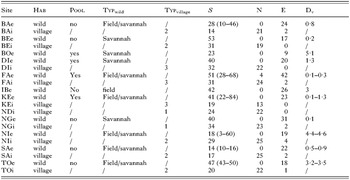
Fieldwork was conducted during 3 weeks in January 2001 in the middle of the dry season. Twenty-one sampling sites were chosen, belonging to 2 types of habitats. Ten sites were located inside villages, and 11 were in fields or savannah (Fig. 1). The distance between sampling sites was between 0·1 and 69·6 km.

Fig. 1. Location of the 21 trapping sites in south-eastern Senegal. Black circles: village sites. White circles: wild habitat sites.
Trapping and sampling
Rodents were collected alive using Sherman and wire-meshed traps. Between 30 and 60 traps were used in each sampled site. Inside villages, traps were set inside houses (2 traps per house). Out of villages, traps were set in lines of 20 traps with a 10 m interval between consecutive traps (1–5 lines per site). Trapping sessions comprised from 1–3 nights, with traps being inspected in the early morning and in late afternoon, to ensure the capture of a least 20 animals per site. On average, 4 new sites were thus sampled every 3 days by 2 teams of fieldworkers (4 persons per team). For each site and each transect, we recorded the number of captured rodents (including all species, Mastomys species being largely dominant) per night∗trap (trap success=S) as a measure of relative abundance of hosts in each site (Table 1).
Table 1. Site variation (HAB=village/wild habitat. TYPwild: types of wild habitat (fields or savannah) crossed by the transects. See text for TYPvillage categories. S (%)=trap success for each site (extreme values per transect). Number of sampled M. natalensis (N) and M. erytholeucus (E). Dv (km): distance to the nearest village for sites of wild habitats, extreme values given when several transects per site.)

Sampled rodents were identified, sexed, measured, weighted and dissected. Two age classes (adults and juveniles) were established on the basis of body weight (more or less than 30 g) and reproductive status (length and position [abdominal or scrotal] of testicles for males; vagina open or not, presence/absence of embryos or placental scars in the uterus for females). Finally, the entire alimentary tract was removed, and placed in plastic universals containing 95% ethanol until their examination. Helminths were subsequently identified by conventional microscopy.
Environmental data
Several variables, such as the village size and structure, presence/absence of storehouse, presence/absence of foodstuffs in bedrooms, could be important for host biology. However, these variables are often interrelated, and thus cannot be analysed separately. Based on our sampled sites, we thus defined a factor (TYPvillage) summarizing village characteristics in 3 different categories: (1) scattered small villages (<500 inhabitants), composed of traditional earthen houses interspersed in fields; (2) dense villages (no field between houses) of medium size composed of traditional houses; (3) dense villages of medium or big size composed of concrete houses (Table 1).
For sampled sites out of the villages, we recorded the nature of the habitat (factor TYPwild: field/savannah), presence/absence of pools (factor POOL), and the distance towards the nearest village (Dv, between 0·1 km and 4·4 km) (Table 1).
Statistical analyses
Most analyses were performed using SAS v. 9.1. (Sas Institute, 2002). As there was a nearly perfect congruence between the host species (M. natalensis/M. erythroleucus) and the habitat type (village/wild habitat) (see Table 1), the 2 factors cannot be disentangled in statistical analyses, and it is important to understand that the reported host species effect might correspond to a combination of both factors.
Component community structure
For each host species in each sampled site, component community diversity was measured as the total number of helminth species (Nh), the Berger-Parker Dominance Index (BPh) and the Simpson's index of Diversity (Sh) (see Behnke et al. 2004). Generalised linear models were performed to analyse variations in measures of component community structure of nematodes. We first tested for the effect of host species, and then for each host species the effects of qualitative environmental variables that were homogeneous for one site (TYPvillage for M. natalensis; POOL for M. erythroleucus; the variable TYPwild was heterogeneous as some transects may have been set in savannah and others in fields for the same sampled site), and of mean S. We considered a Poisson distribution for the total number of helminth species (PROC GENMOD, SAS), and a normal distribution (PROC GLM, SAS) for the Berger-Parker and the Simpson indices (arcsine transformation to achieve normality).
The degree of similarity in each pair of helminth component communities was assessed on prevalence data by the Sørensen's index (following Magurran, 2004), using the software ESTIMATES 7.50 (Colwell, 2005). Kruskal-Wallis tests were performed to test for differences of similarity indices in intra- and inter-host species comparisons of parasite communities.
Infracommunity structure
Infracommunity structure was assessed by mean number of helminth species per rodent (Nbh), species density distribution across the sample, mean Brillouin's Index (BI) per rodent (infected and uninfected: BI=0), and mean abundance, aggregation and prevalence of individual parasite species.
The frequency distribution of parasite infracommunity species richness (in terms of species number) for each host species was tested for goodness of fit to the negative binomial distribution (assumption is an aggregated distribution), the Poisson distribution (assumption is a random distribution), and the null model of Janovy et al. (1995) (assumption of the null model is absence of associations and interactions between species). All distributions were tested for goodness of fit by χ2. Frequency distributions of individual parasite species were tested using the software Quantitative Parasitology 3.0 (Rózsa et al. 2000) for goodness of fit to negative binomial by χ2, in each sampled site. The degree of aggregation in the helminth counts was quantified by the negative binomial exponent k. Parasite aggregation increases as k approaches zero (Wilson et al. 2001). For parasite species for which the calculation of k was possible in several sampled sites, non-parametric ANOVAs (Kruskal-Wallis tests) were performed to test the effect of host species, the effect of POOL for M. erythroleucus and the effect of TYPvillage for M. natalensis, on k.
Generalised linear models were employed to analyse variations in infracommunity structure between host species (one factor) and then inside each host species, using the GENMOD procedure of SAS. We considered a normal distribution for the Brillouin's index (arcsine transformation to achieve normality), a binomial distribution for the infection probability of each parasite species (presence/absence) and a negative binomial distribution for the number of helminth species per rodent, abundance and intensity of each parasite species considered. Within each host species, we first investigated the effects of sampling site, age class and sex, including all possible two-way interactions. This first stage of analysis offers the possibility to test whether variability between sites may be explained by confounding factors relative to the individual structure of the sampling (age class structure or sex ratio). A second step of the analysis was to replace the term ‘sampled site’ by a combination of demographic (S) and environmental variables, including all possible two-way interactions. In this second step, we just considered adult individuals (age class 2), as the age effect was significant in most of the first analyses. Compared to young individuals, adults were likely to have been exposed to infective stages of all parasites by this age. As S was significantly related with TYPvillage in M. natalensis (one-way ANOVA: F2,125=8·75, P=0·003) and with TYPwild, POOL and the interaction between the two factors in M. erythroleucus (Two-ways ANOVA: F3,129=29·28, P<0·0001), and as Dv was significantly related with TYPwild in M. erythroleucus (one-way ANOVA: F1,129=8·25, P=0·005), S and Dv were replaced in the models by the residuals of their relationship with the corresponding qualitative factors. The factor sex was included in the model when it was detected as significant in the first step of the analysis. We began in all cases with models including all main effects and two-way interactions, and then progressively simplified them by backward deletion.
RESULTS
A total of 648 rodents were collected in the 21 study sites. As expected, M. natalensis was only found in villages (except four individuals in FAe), and was largely the dominant rodent species in these sampled sites (Table 1). Mastomys erythroleucus was the dominant species in wild habitats, but was occasionally found in villages (always less than 5% of captures in these sites; Table 1).
The autopsied individuals considered in this study corresponded to 220 M. natalensis and 264 M. erythroleucus. Trap success was significantly higher in wild habitats than in villages (one-way ANOVA: F1,20=5·27; P=0·03). The ratios adult/juvenile individuals (one-way ANOVA: F1,20=3·59; P=0·07) and males/females (one-way ANOVA: F1,20=1·13; P=0·3) in sampled sites were not different between M. natalensis and M. erythroleucus.
Component community structure
We recorded 11 taxa of nematodes (Protospirura muricola, Pterygodermatites senegalensis, Pseudophysaloptera sp., Anatrichosoma sp., Abbreviata sp., Neoheligmonella sp., Heligmonina sp., Limucolaria sp., Syphacia sp., Trichuris sp., Subulura salarmensis, 8 taxa of cestodes (Hymenolepis nana, Hymenolepis straminea, Hymenolepis uranomidis, Inermicapsifer madagascariensis, Raillietina baeri, Raillietina trapezoides, Sudarikovina monodi, Skrjabinotaenia occidentalis), and one trematode (Echinostoma sp.).
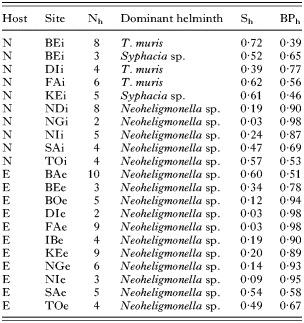
Neoheligmonella sp. was always the dominant taxon in wild habitats. Preliminary work on this taxon tends to show that the huge number of collected individuals (7874 individuals) corresponded to only 1 species, presumably new (Durette-Desset, personal communication). Inside villages, the dominant species was Trichuris sp., Syphacia sp. or Neoheligmonella sp. (Table 2). Protospirura muricola, P. senegalensis, and S. salarmensis can also be locally abundant in M. erythroleucus (>50 individuals per sampled site). Cestodes were often represented by few individuals per sampling sites, except R. trapezoides and S. monody that locally reached around 20 individuals. The number of helminth species was equally abundant between host species (χ2(1)=0·31; P=0·58), and the diversities of parasite communities were similar (Sh: F1,20=3·95; P=0·06; for BPh: F1,20=3·41; P=0·08).
Table 2. Helminth component community structure per sampled site (N=M. natalensis, village sites; E=M. erythroleucus, wild habitats. Nh: total number of helminth species found per sampled site. The dominant helminth taxon is defined as the most abundant per sampled site. Sh=Simpson's index of diversity; BPh=Berger-Parker dominance index.)

For M. natalensis, TYPvillage was significantly related with the Simpson's index of diversity (F2,9=5·37, P=0·046) and with the Berger-Parker index (F2,9=6·77, P=0·03) indicating lower diversity or higher dominance in villages of the category 1. S was positively correlated with the Berger-Parker index (F2,9=6·77, P=0·04), suggesting more diverse nematode communities when rodent abundance was low. However, this effect was only explained by 3 points corresponding to localities (NDi, NGi and NIi) with high S and in which Neoheligmonella was largely more dominant and abundant (>300 individuals) than elsewhere (<170 individuals of the dominant parasite). For M. erythroleucus, the presence of a pool on a sampled site was significantly associated with low Simpson (F1,9=7·61, P=0·02) and high Berger-Parker indices (F1,9=8·06, P=0·02).
Helminth component communities were more similar in intra-host species than in inter-host species comparisons (Kruskal-Wallis test on Sørensen's indices: χ2(2)=21·27; P<0·0001).
Infracommunity structure
Mean species richness and infracommunity diversity
The number of helminth species was not significantly different between M. natalensis and M. erythroleucus (χ2(1)=0·15; P=0·69). However, the Brillouin's index was higher in M. natalensis than in M. erythroleucus (F1,460=6·04; P=0·01).
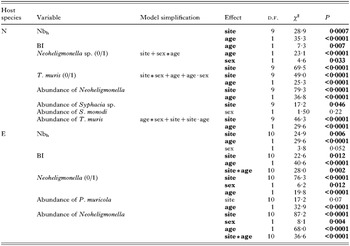
Generalised linear models revealed that age class and site were associated with significant variations in parasite diversity for M. natalensis and for M. erythroleucus (Table 3). Adult individuals harboured more diverse helminth communities than juveniles. There was no difference in helminth diversity between host sexes. Interactions between site and age and between site and sex were not significant for both host species (except for BI in M. erythroleucus), suggesting that the site effect, when significant, was not related to the individual structure of the sampling in term of age structure or sex-ratio.
Table 3. Generalised linear models of helminth infections in M. natalensis (N) and M. erythroleucus (E), considering the effects of site, age, sex, and their two-way interactions (When there was no convergence with the global model, analyses were performed on simpler models specified in the table, with a∗b indicating that the factor a, the factor b, and their interaction (noted aċb) were entered in the model. Significant effects are in bold. Nbh=number of helminth species per host; BI=Brillouin's index of diversity; (0/1)=presence/absence.)

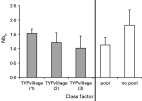
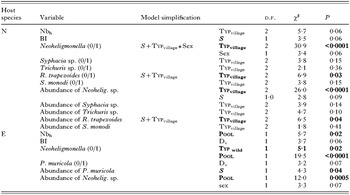
When the site effect was replaced by environmental and demographic variables in the model, the minimum acceptable models for adults of M. natalensis showed no significant effect (Table 4, Fig. 2). For adult individuals of M. erythroleucus, Nbh was positively affected by POOL (Table 4, Fig. 2).

Fig. 2. Means and standard deviation of Nbh for Mastomys natalensis (grey bars) and M. erythroleucus (white bars) for each category of village (no significant differences) or of wild habitat (P<0·05).
Table 4. Generalised linear models of helminth infections on adults individuals of M. natalensis (N) and M. erythroleucus (E) considering the effects of habitat and demographic variables (When sex was significant in the first analysis, it was added as a factor, along with the corresponding interactions, in the model. When there was no convergence with the global model, analyses were performed on simpler models specified in the table (a∗b indicates that the factor a, the factor b, and their interaction (noted aċb) were entered in the model). Significant effects are in bold. Nbh=number of helminth species per host; BI=Brillouin's index of diversity. (0/1)=presence /absence.)

Number of helminth species
In M. natalensis and M. erythroleucus, the majority of individuals harboured 0 or 1 parasite species. No rodent harboured more than 4 helminth species. Helminth species density distributions were adequately described by negative binomial and/or Poisson models in all sites, except in NDi for M. natalensis and in FAe, NGe and TOe for M. erythroleucus. No significant difference was found with the null model for interactions of parasite species in an assemblage (Janovy et al. 1995), except for M. natalensis in NDi (χ2(4)=9·67, P=0·03).
Prevalence of individual taxa
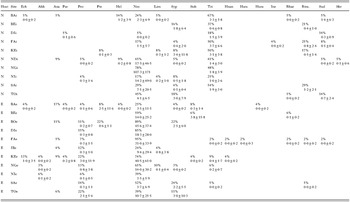
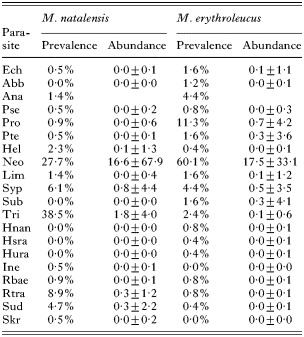
The prevalence data are summarized per site in Table 5. Some parasite species were very rare (Table 6) i.e. found in fewer than 10 hosts (the trematode, the nematodes Abbreviata sp., Pseudophysaloptera sp., P. senegalensis, Heligmonina sp., Limucolaria sp. and S. salarmensis, and all the cestode species but R. trapezoides and S. monodi) and were thus not considered in analyses. Whereas Trichuris sp. (χ2(1)=90·5, P<0·0001) and the cestodes R. trapezoides (χ2(1)=16·8, P<0·0001) and S. monodi (χ2(1)=9·4, P=0·002) were more prevalent in M. natalensis, P. muricola (χ2(1)=22·1, P<0·0001), and Neoheligmonella sp. (χ2(1)=45·0, P<0·0001) were more prevalent in M. erythroleucus.
Table 5. Prevalence (%) and abundances (mean±standard deviation) of helminth species collected from M. natalensis (N) and M. erythroleucus (E) for each sampling site (Ech=Echinostoma sp.; Nematodes: Abb.=Abbreviata sp.; Ana=Anatrichosoma sp. (no abundance measure reported as difficult to quantify), Pse=Pseudophysaloptera sp.; Pro=Protospirura muricola; Pte=Pterygodermatites senegalensis; Hel=Heligmonina sp.; Neo=Neoheligmonella sp.; Lim=Limucolaria sp.; Syp=Syphacia sp.; Sub=Subulura sp.; Tri=Trichuris sp.; Cestodes: Hnan=Hymenolepis nana; Hsra=H. straminea; Hura=H. uranomidis; Ine=Inermicapsifer madagascariensis; Rbae=Raillietina baeri; Rtra=R. trapezoides; Sud=Sudarikovina monodi; Skr=Skrjabinotaenia occidentalis.)

Table 6. Overall prevalences and abundances (mean±S.D.) of helminth species collected from M. natalensis and M. erythroleucus (Ech: Echinostoma sp.; Nematodes: Abb=Abbreviata sp.; Ana=Anatrichosoma sp. (no abundance measure reported as difficult to quantify), Pse=Pseudophysaloptera sp.; Pro=Protospirura muricola; Pte=Pterygodermatites senegalensis; Hel=Heligmonina sp.; Neo=Neoheligmonella sp.; Lim=Limucolaria sp.; Syp=Syphacia sp.; Sub=Subulura sp.; Tri=Trichuris sp.; Cestodes: Hnan=Hymenolepis nana; Hsra=H. straminea; Hura=H. uranomidis; Ine=Inermicapsifer madagascariensis; Rbae=Raillietina baeri; Rtra=R. trapezoides; Sud=Sudarikovina monodi; Skr=Skrjabinotaenia occidentalis.)

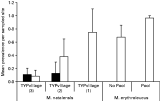
For M. natalensis, generalised linear models testing the effect of age class, sex, site and their interaction did not converge. However, simple models without interactions involving the site effect converged and showed significant variations in the probabilities of infection between sites, ages and sexes for Neoheligmonella sp., and between sites and ages for Trichuris sp. (Table 3). When TYPvillage and S effects were considered, the complete model converged for Trichuris sp., Syphacia sp. and S. monodi, but no effect was significant (Table 4). Without the interaction term between TYPvillage and S, the model converged for Neoheligmonella sp. (with the sex effect retained in the first step of the analysis), and R. trapezoides, showing higher infection probabilities in traditional villages of the category 1, then of category 2, than in villages with modern houses for Neoheligmonella and lower infection probabilities in villages of the category 1 for R. trapezoides (Table 4; Fig. 3).

Fig. 3. Effect of significant environmental class factors on prevalence of major parasite species, in Mastomys natalensis and M. erythroleucus. Means and standard deviation of prevalence of Raillietina trapezoides (black bars), and Neoheligmonella sp. (white bars) in each host species.
For M. erythroleucus, the generalised linear model testing the effect of age class, sex, site and their interaction converged only for Neoheligmonella sp. For this parasite, the minimum acceptable model revealed significant effects for site, sex, and age class (Table 3). Interactions were not significant. Females and adults were more susceptible to infection by Neoheligmonella than males or juveniles. When TYPwild, Dv, POOL and S (and sex for Neoheligmonella sp.) were considered, models converged for P. muricola (but no significant effect) and Neoheligmonella sp. (Table 4). For Neoheligmonella sp., prevalence was higher in sites around pools, and in savannah rather than in fields (Table 4, Fig. 3).
Distribution of parasite species within the host population
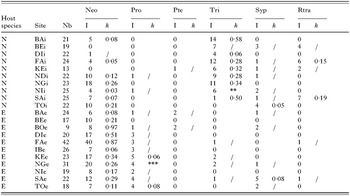
It was not possible to fit negative binomial distributions to all species of parasites because there were insufficient degrees of freedom in some cases, arising from too few infected animals. However, of the 33 distributions fitted, 31 did not differ significantly from the negative binomial distribution (Table 7). For Neoheligmonella sp., P. muricola, Trichuris sp., Syphacia sp., and R. trapezoides, k<1 indicated highly aggregated distributions. When present, P. senegalensis seems to be more uniformly distributed among hosts (Table 7). Neoheligmonella sp., the sole parasite species for which it was possible to test the effect of host species on k, was significantly more aggregated in M. natalensis than in M. erythroleucus (χ2(1)=4·3, P<0·04), and less aggregated in sites around pools (χ2(1)=5·04, P<0·02) in M. erythroleucus. The variable TYPvillage had no effect on k of Neoheligmonella sp. or Trichuris sp.
Table 7. Degree of aggregation (k) of dominant helminth worms collected from M. natalensis (N) and M. erythroleucus (E) for each sampled site (Nb=number of host sampled. I=number of infected hosts per parasite species. Neo=Neoheligmonella sp.; Pro=Protospirura muricola; Pte=Pterygodermatites senegalensis; Tri=Trichuris sp.; Syp=Syphacia sp.; Rtra=R. trapezoides.)

Abundance of infection
Abundance data are summarized in Tables 5 and 6. Only species found in at least 10 rodents were considered in the analyses, which were Neoheligmonella sp. and P. muricola in M. erythroleucus, and Syphacia sp., Neoheligmonella sp., Trichuris sp. and the cestodes R. trapezoides and S. monodi in M. natalensis.
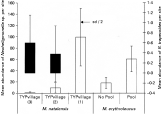
For M. natalensis, the generalised linear model testing the effect of age class, sex, site and their interactions converged only for three parasite taxa (but no significant effect for S. monodi). Minimum acceptable models revealed significant effects for site and age for Neoheligmonella, and for site for Syphacia. Without the interaction between site and age, models converged for Trichuris sp., showing significant effects of site and age class (Table 3). When TYPvillage and S effects were considered, models converged for Neoheligmonella, Trichuris sp., Syphacia, R. trapezoides (without the interaction term) and S. monodi. Hosts sampled in traditional villages with fields between houses harboured significantly more Neoheligmonella and less R. trapezoides than others (Table 4, Fig. 4).

Fig. 4. Effect of significant environmental class factors on abundance of parasite species, in Mastomys natalensis and M. erythroleucus. Means and standard deviation of prevalence of Raillietina trapezoides (black bars), and Neoheligmonella sp. (white bars; standard deviation/2 for one category) in each host species.
For M. erythroleucus, the minimum acceptable model of the first step revealed a significant effect of age on abundance of P. muricola (Table 3). Variations in abundance of Neoheligmonella were significantly affected by site, age class, sex and the interaction between site and age class. Neoheligmonella was more abundant in adults than in juveniles, and in females than males. When TYPwild, Dv, POOL and S were considered, there was a significant positive effect of trap success on abundance of P. muricola (Table 4), but this result was only due to a high abundance in one host (when this individual was not considered, the relationship was not significant). Neoheligmonella abundance was positively related to the presence of a pool (Table 4; Fig. 4).
DISCUSSION
The hypothesis that the host identity was the major determinant of parasite community structure has been supported by various studies on endoparasites of fishes (Bell and Burt, 1991; Buchman, 1991; Guégan et al. 1992). One reason invoked was the relative stability of the internal environment of a host organism (Sukhdeo, 1997). Among the factors related to host identity that we considered, host age was the most important, having a strong positive effect on parasite communities of both Mastomys species. Host age is known as a key characteristic for parasites. When there is no vertical transmission, no reproduction within the host and no strong immunity stimulated by the worm (Gregory, 1992), parasites are acquired from the environment over time and mean intensity increases with host age (Wilson et al. 2001), as does parasite community diversity (Lo et al. 1998). The age-dependent patterns of diversity, prevalence and abundance of helminths found in this study were consistent with those reported in rodents for various ecto- and endo-parasite communities (Behnke et al. 1999, 2001, 2004; Hawlena et al. 2005).
As in numerous other studies (e.g. Behnke et al. 2001, 2004; Pawelczyk et al. 2004) on gastrointestinal helminths however, we found a considerable variability of parasite community structure between different sampled sites for each host species. Confounding factors linked to host identities (sex, age) in each population do not explain such variability, as there was neither difference in age or sex structure between the sampled sites for each of the 2 Mastomys, nor significant effects of the interactions between age and site or sex and site on community structure. Gastro-intestinal helminths of terrestrial mammals spend at least one part of their life-cycle in the external environment outside their host, and habitat characteristics might be crucial for the survival of eggs or larvae. Previous studies, although often based on the comparison of 2 sites, have already shown a potential effect of habitat on endoparasite community structure in vertebrates (Gortazar, 1998; Hulbert and Boag, 2001; Calvete et al. 2004). For each of the 2 rodent species studied here, we showed that helminth community diversity, species prevalence and/or abundance varied among habitats. As in ectoparasite communities (Krasnov et al. 1997, 1998, 2006), changes in community structure correlated with precise habitat characteristics. As envisaged at the beginning of the study, it was difficult to formally disentangle the effects of habitat type and of host species in inter-host species comparisons of helminth communities, as few individuals of both host species were captured outside of their main habitat. Nevertheless, the differences in parasite community structure found between the commensal M. natalensis and the wild M. erythroleucus may also be discussed, together with within host species variations, in the light of habitat-effect hypotheses.
Habitat differences in patterns of parasite communities may be explained either by biotic or abiotic effects (Krasnov et al. 2006). Parasites represent one biotic component of the habitat, and different combinations of parasite species in each habitat might be a result of parasite inter-specific competition. Nevertheless, the role of species interactions in helminth community structure has often been shown to be negligible (Poulin, 2001), and our results did not indicate important species interactions. Among-habitat variation in biotic components can also be related, for example, to the host community richness (Krasnov et al. 2006), to host population characteristics such as life-history traits (Krasnov et al. 1998) or demography, or to the presence/absence and abundance of intermediate hosts (Halmetoja et al. 2000). In south-eastern Senegal, rodent communities were comparable among sampling sites in each habitat type, being largely dominated by one of the two focus species of this study (Brouat C., unpublished results). Host richness was thus not a potential factor in explaining differences between parasite communities. Habitat differences in host population demography were suggested by trap success differences between M. natalensis populations. The negative relationship between trap success and community diversity in this host species suggested that the higher the host density, the poorer the helminth infra- and component communities, but it was more probably an artefact due to the large dominance of Neoheligmonella sp. in some sites characterized by a high trap success. Trap success cannot be used in interspecific comparisons of host densities, as the sampling design was not the same inside and outside villages. In house mice however, densities were found to be generally higher in commensal populations than in feral ones (Pocock et al. 2005), due to resource permanence and environmental stability. Consistent with the prediction that host species living at high density will increase their number of parasite species per population (Altizer et al. 2003), parasite infracommunities of M. natalensis were slightly richer than those of M. erythroleucus. The hypothesis related to intermediate hosts might explain why the cestode R. trapezoides was absent in traditional villages, or why P. muricola was more prevalent out of villages.
As biotic components, environmental factors such as humidity, temperature or vegetation cover, may be represented by significant effects of village type or presence/absence of a pool. Vegetation structure may have profound impacts on parasites that require suitable environment for egg laying and the production of new larvae (Hulbert and Boag, 2001). Vegetation cover might, for example, explain why Neoheligmonella sp. was less prevalent and abundant in dense villages (where there are no space with herbaceous plants between houses) and in wild habitats, and why this species was more prevalent and abundant around pools (where green herbaceous plants were plentiful and provided food for the rodents). Trichostrongylid species can be transmitted by host grooming (Hernandez and Sukhdeo, 1995), or by ingestion of grass to which the infective free-living larvae adhere. Mastomys species feed mainly on seeds and arthropods (Hubert et al. 1981), but in wild habitats, grasses form a small but regular part of their diet, which can become more important during the rainy season. Also, environmental conditions such as temperature and humidity are less variable in commensal habitats compared with wild environments (Pocock et al. 2004). In dense villages, the dominant parasite species was Trichuris muris, which is transmitted by egg ingestion. These eggs that remain in the soil for about 1 month to mature, could be less prone to desiccation in villages than in fields or savannah, especially during the dry season.
As habitat type and host species are confounded factors in our study, between habitat types differences may also reflect that some parasites might prefer one of the two host species, due to host specific characteristics such as metabolism, immunity or genetics (Poulin and Morand, 2004). Helminth communities of Mastomys species differed in prevalence and abundance of some helminth species (Neoheligmonella sp., P. muricola, Trichuris sp. and the cestodes R. trapezoides and S. monodi), but all these parasites were found in both host species. Neoheligmonella sp., the dominant parasite species in every population of M. erythroleucus, was highly prevalent and abundant as well in some populations of M. natalensis. This taxon was also found in individuals of R. rattus and Tatera guineae, sampled at the same time as Mastomys individuals in south-eastern Senegal (personal observation). Trichuris sp., P. muricola and the cestodes R. trapezoides and S. monodi were locally found respectively in M. erythroleucus and M. natalensis. Some of these taxa are known to infect a variety of rodent species, for example P. muricola found in Acomys in Egypt (Behnke et al. 2004), and R. trapezoides found in Psammomys in Tunisia (Fichet-Calvet et al. 2003). The Trichuris species found in Mastomys looked like Trichuris muris, a species that was reported from several other species of Muridae (Feliu et al. 2000). Genetic and morphological investigations are currently conducted on some of the major parasite taxa that we had sampled, to determine them at the species level. As nematodes in vertebrates are sometimes very specific (Brant and Orti, 2003; Sehgal et al. 2005), we can expect to find new species in our sampling, and even different cryptic parasite species in each of the two closely related Mastomys.
In conclusion, this study showed that species composition of helminth parasites on a host species may be determined not only by host-parasite relationships, but also by host-habitat or parasite-habitat relationships. Similar trends were found for ectoparasite communities in different geographical regions (Krasnov et al. 1997, 1998, 2006), underlying that habitat variations have to be considered in studies of parasite community structure. Nevertheless, at this stage we still lack accurate data on the ecological requirements of most of the parasite taxa reported in this study, and thus the precise mechanisms underlying the habitat effects cannot be clearly elucidated. Further explanation of our results will depend on the outcome of follow-up studies focusing for example on temporal stability of both hosts and parasites. Experimental infections are also required to evaluate the stability of helminth communities in each rodent species through time, and the potential effect of some of the dominant species on host population dynamics.
The authors gratefully acknowledge the assistance of A. Loiseau and C. Bâ during field sampling, V. Rougeron during dissections, and N. Charbonnel, J.-F. Cosson, S. Morand and an anonymous reviewer for their critical comments on the manuscript. M.-C. Durette-Desset and S. Bouamer provided valuable help for parasite identification.