The 1970s were a critical period for the national political mobilization of business in the United States.Footnote 1 Faced with the challenges presented by the growing regulatory state, labor activism, and a weak economy plagued by high unemployment and inflation, business executives expanded their presence in national politics and developed new forms of political organization to influence federal policy. Although political analysts have largely focused their attention on businesses’ increasing strength in Washington, corporate mobilization was not confined to the national level. During the same period, a number of companies began working closely with conservative activists to develop an infrastructure for influencing state legislation—yet far less attention has focused on this transformation of American politics.Footnote 2 Over time, this durable “conservative-corporate” subnational coalition, represented most clearly by the American Legislative Exchange Council (ALEC), proved to be quite successful, simultaneously promoting their preferred policies in statehouses across the country and systematically changing the state policy landscape in ways that disadvantaged their political opponents over the long run.Footnote 3
The success of controversial model legislation from ALEC in Wisconsin that removed collective bargaining rights from most public-sector workers in 2011, for example, represents just one recent victory for this organization. At its peak in the mid-2000s, ALEC could claim nearly a third of all state legislators as members of the group and could count on the resources of a number of leading conservative political organizations and several hundred Fortune 500 companies from a diverse array of industries.Footnote 4 According to some accounts during this time, the group could claim authorship of about 600 to 800 introduced state bills each year and 100 to 200 state laws ranging across issues as varied as elections, health care, education, the environment, taxes, and gun rights.Footnote 5
ALEC's success defies a series of important predictions about corporate capacity for collective action in American politics. Comparative political economists stress that the United States lacks national and encompassing business associations that could proactively lobby on behalf of the business community, as in more coordinated economies like Denmark or Sweden.Footnote 6 This literature expects that American business groups will either be dominated by sectoral interests or will be too hamstrung by internal divisions to adopt anything other than lowest common denominator policy stances; more often than not this entails simply opposing all government action. While still a far cry from the corporatist business associations of Western Europe, ALEC does represent a much more diverse and legislatively active group compared with other American business associations in recent times, like the U.S. Chamber of Commerce, the National Association of Manufacturers, and the Business Roundtable, which are generally characterized as being riddled with too many sectoral cleavages to adequately represent broad segments of the business community.Footnote 7 Moreover, ALEC does not simply oppose government action, but it also proactively lobbies on a range of issues, alongside political activists.
Aside from comparative political economy, research in business history and economic sociology also suggests that coordinated business action should have become more challenging in recent decades given a fragmentation of corporate interests.Footnote 8 This line of work argues that American firms faced a set of shared threats in the 1970s, which prompted collective action and mobilization. But since that time, business succeeded in eliminating those threats—perhaps most notably the specter of aggressive national regulation and labor activism—so that the original impetus for organization no longer exists. Yet here too the historical development of ALEC runs against received wisdom: The group was least successful in the 1970s and early 1980s (as measured by revenue, membership, and legislative victories) and most successful in the decades that followed, precisely during the waning influence of other national business groups.
Why, then, has ALEC succeeded where other business organizations have failed? And what can ALEC's success tell us about the politics of business mobilization in the United States? These are the questions I address in this article, examining variation in this particular business coalition over time and drawing on an especially rich set of previously unreleased documents from the group. These documents trace leaders’ decisions across both ALEC's victories and missteps, providing insights into the strategies that the group did and did not consider, as well as the outcomes of those efforts.
ALEC's success in the face of these barriers to business organization makes it a case that defies explanation by existing theories for business association behavior, and thus offers an opportunity to better understand the mechanisms for firm mobilization in U.S. politics. As comparative historical methodologists have emphasized, unusual cases such as this one can provide crucial leverage for scholars to explore the limits of existing theoretical models and to generate new propositions that might apply to a broader universe of cases.Footnote 9 To this end, I identify three associational strategies deployed by ALEC's leaders to unite otherwise disparate business interests. I argue that the deployment of these three strategies can better explain the variation in the organization's development—and especially its successes—than either the comparative political economy or business history theories of corporate mobilization. First, I find that ALEC was most successful at attracting firms when it was able to make a compelling case for why the group could offer selective benefits to its members that companies would not be able to procure in other business associations. By positioning its services as selective goods to individual firms, ALEC was able to overcome the collective action problems inherent in corporate political mobilization that other scholars have extensively documented. Firms would not be able to leverage ALEC's extensive network of state lawmakers—an area in which ALEC enjoyed a relative monopoly—if they were not dues-paying members of the group.
Next, I identify a role for internal differentiation within ALEC as a mechanism for resolving disputes between its member firms with conflicting policy preferences. Aside from the collective action problems faced by political groups when they seek to attract the support of individual firms, groups must grapple with the fact that many firms may have different and often divergent preferences for policy. By creating an organizational structure that divided responsibility for developing legislation into discrete issue task forces, each operating relatively autonomously from one another, ALEC was able to reduce conflicts between businesses with potentially opposing interests. And within each task force, there was further differentiation between firms; businesses that contributed more to the group were given greater voice in crafting legislative proposals. This in turn provided a clear procedure for adjudicating—and ultimately preventing—conflicts within task forces, again addressing the problems of mobilizing firms with varying policy preferences in the context of a fragmented corporate sector.
Last, I argue that the group was most successful when it could design policy proposals that achieved not only short-term, substantive objectives for businesses, but that also shifted the terrain on which future policy battles were waged by disadvantaging the group's political opponents, or by advantaging its allies. In this way, the ALEC coalition was able to, over time, change the structure of state politics in ways that would benefit the group in later policy struggles.
These three strategies help to make sense of an anomalous case of business mobilization in American politics. And aside from its substantive relevance for understanding the history of U.S. business and politics, a closer understanding of this case can provide important insights for students of business power and comparative political economy. In particular, it illuminates the sources of variation in the structure of business political coalitions, highlighting concepts that could be fruitfully deployed to understand business mobilization and partnerships with political activists in other countries and historical periods. These organizational strategies may be especially useful in understanding business coalitions in liberal market economy countries, like the United States, previously thought to have only weak capacities for collective business action.Footnote 10
THEORIES OF BUSINESS COALITION MANAGEMENT
What explains the conditions under which national business groups representing a diverse array of sectors, promoting a proactive policy agenda, and fostering close ties between corporate and political leaders can emerge? The comparative political economy literature gives a clear set of answers to these questions that are rooted in the institutional configuration of national polities, specifically the structure of party systems and the centralization of the state.Footnote 11 In countries with proportional representation and multiparty political systems, dedicated business parties on the right help to organize business into national and encompassing groups to support their political ambitions. The development of national business groups is further aided by the centralization of state authority, as firms will have a stronger incentive to organize at the national, rather than the regional, level. Both of these theories bode poorly for the fate of nationally organized business groups in the United States. The American two-party system divides employers between the Democrats and Republicans, making it harder to achieve the coordination of interests necessary for the creation and maintenance of enduring national corporate coalitions. Moreover, the federal system of governance in the United States ought to encourage firm action at the state, rather than the national, level, further impeding the possibilities for cross-state coordination.
While these explanations provide a great deal of analytical leverage to understand variation in the mobilization of business across countries, these theories have less to say about variation over time within the United States given stability in political institutions. Thus any instance of sustained national and encompassing business mobilization, such as ALEC, would be unaccounted for by these theories. Indeed, in some ways ALEC is especially puzzling from this perspective precisely because it is a national group intended to coordinate policy activity at the state and regional level; far from hampering the development of ALEC, the presence of federalism in the United States was actually the basis for the development of the group.
A second set of explanations for business mobilization emerges from the business history literature, perhaps most prominently the work of Mark Mizruchi, Benjamin Waterhouse, and David Vogel.Footnote 12 Both Waterhouse and Vogel emphasize the importance of shared threats to employers as a motivation for otherwise fragmented business interests to form cross-industry, national groups to advance their interests in the policymaking process. In both of their accounts, American firms in varied industries faced an increasingly hostile political landscape from the mid-1960s to the early 1970s. Under pressure from consumer and environmental movements, politicians from both parties began enacting sweeping new regulatory regimes addressing motor vehicle safety, lending practices, pharmaceutical production, pollution, and occupational health and safety. These threats, and specifically the fact that they crossed traditional sectoral lines, motivated managers to engage in the policymaking process by developing new national business groups and strategies for influencing lawmakers. Although this timeline is consistent with creation of ALEC—conservative leaders formed the group in 1973 in response to the rising threat of liberal state policy networks, especially state public-sector labor unions—it is inconsistent with the group's evolution over time. As I will explain, the group was most successful in the late 1980s through the mid-2000s, precisely the juncture when the threat to business had diminished, thanks to the sustained thrust of mobilization in earlier years, and when Waterhouse and Mizruchi argue that business lost its capacity for coordinated, cross-sectoral policy activism.
If electoral institutions, federalism, and shared political threats cannot explain the rise and development of ALEC, what can? I argue that the answer lies with the structure of the organization itself and, in particular, the strategies that its leaders deployed to overcome the obstacles to coordinated business action in the United States that I have just described. Perhaps the most pressing problem for ALEC's leaders to address was that firms faced few incentives to join any one business group in the United States, presenting a classic dilemma of collective action and organizational maintenance. In contrast to corporatist countries, there are no U.S. business associations with recognized authority to bargain with national or state governments. Thus unlike in those more organized economies, groups cannot implicitly or explicitly compel individual firms to join. How, then, can political entrepreneurs obtain the support of corporate leaders? The strategy I emphasize draws on Mancur Olson's canonical solution to this puzzle: Business political coalitions must offer selective benefits to their corporate members that those members cannot receive elsewhere.Footnote 13 In essence, business associations that seek to build long-term relationships between firms and political leaders in the United States have to make the case to managers that membership entails benefits that firms could not receive in other associations or on their own. In the case of ALEC, the group's leaders came to recognize that they could market their organization as granting firms the ability to simultaneously pursue the same policies across many different states without firms having to establish a lobbying presence in each state.
But even if a business group manages to secure a broad membership of firms from across many different sectors, political entrepreneurs still face a second obstacle to maintaining that coalition over time. Firms, and even firms within the same industry, may have very different policy preferences that they seek to pursue through the business association. There are two general kinds of conflicts that businesses might face within an encompassing group. First, companies might prefer a policy that runs directly against the interests of other corporate members of the group. For instance, a group representing both health care providers and insurers might face the challenge that the economic interests of those two sectors come into conflict with one another; while providers have an incentive to maximize their payments, and thus their profits, insurers have an opposing interest to minimize payments to doctors. A second problem is that even if firms do not hold directly opposing policy preferences, companies may still differ in their prioritization of various proposals. Thus an energy company might seek preferential contracts from state governments, and while retailers might not directly oppose that proposal, those retail firms might see little to gain from investing their resources to advance a policy that is irrelevant to their own firms’ bottom lines. James Q. Wilson identified this problem clearly in Political Organizations, arguing that “if creating and maintaining a business association in a single industry is difficult, launching a general, or ‘umbrella’ business association is doubly so. Any organization that seeks to speak politically for all, or any substantial part, of businessmen will confront the fact that the particular interests of various firms are often in conflict.”Footnote 14
These two kinds of cleavages have prevented many American business groups from advancing proactive policy proposals. As Mark Smith has highlighted in his analysis of the U.S. Chamber of Commerce, only a minority of policy issues—3 percent of all enacted laws from 1953 to 1992—could unify that organization's corporate members.Footnote 15 Given the challenge of representing firms with varied interests, most associations instead choose to cater to “lowest common denominator” legislative priorities, such as simply resisting taxes or regulations, rather than developing and promoting new policy initiatives. National business associations, in Cathie Jo Martin's felicitous formulation, are “like feisty two-year-olds … good at saying no … but bad at saying yes.”Footnote 16 To overcome the diversity of interests within national business groups, I argue that political entrepreneurs must establish clear decision rules that specify how conflicts of firm preferences will be adjudicated. Without those rules, groups will be saddled by the need to continually decide which firms’ priorities will be honored. ALEC's leaders, as I will describe, would create a highly delegated structure of task forces that permitted its policy agenda to be set by the firms most invested in each policy domain. Moreover, within each task force, the group established a clear decision rule for which firms would have the last say over conflicts: Firms that offered greater contributions to the group through annual dues and fees would be more likely to have their proposals promoted by the organization.
The final impediment to the persistence and legislative success of national business coalitions is the need not only to appeal to the short-run interests of firms, but also to ensure that the organization remains politically successful in later periods. This priority is problematic because individual firms may have strong incentives to underinvest in the sort of legislative priorities that would result in organizational success in the future, rather than the present or near term—that is, the long-run interests of any individual firm might not be aligned with the long-run interests of an association.Footnote 17 Thus durable business coalitions must not only satisfy the short-run preferences of their members, but also ensure that they are changing the political landscape in ways that can facilitate future victories by the organization. This strategy could be thought of as a form of political or institutional investment, as described by Steven TelesFootnote 18 and Daniel Galvin,Footnote 19 where actors incur short-run costs (or delay benefits) in order to reap larger returns in the future.Footnote 20 In the organization I examine, political leaders settled on a set of legislative priorities that both appealed to corporate members and disadvantaged ALEC's political opponents, especially public-sector labor unions, thus ensuring ALEC's continuing political success.
Although I describe these three strategies as collectively necessary for the persistence and success of durable business coalitions, it is important to note that I do not argue that the implementation of these strategies occurred in a functionalist or preordained manner. Organizational leaders within ALEC did not immediately arrive at these strategies as ways of overcoming the various obstacles that I have described. Rather, key leaders experimented with various strategies, not all of which were ultimately successful, much as what Steven Teles has described in the rise of the conservative legal movement: “Developing an alternative governing coalition … is an extraordinarily difficult process, and one that is likely to be characterized by significant mistakes, long periods of learning and lesson-drawing, and significant lags between the emergence of opportunities and their effective exploitation.”Footnote 21 Social learning was thus an important driver of organizational change, as leaders drew on their past failures and successes. An important catalyst for this learning process was organizational failure, manifested in the case of ALEC as repeated financial crises.Footnote 22 Moreover, early experiences with successes, such as one I will describe with state liability insurance reform, prompted ALEC leaders to repeat certain strategies in subsequent years.Footnote 23 Last, ALEC also borrowed some of its institutional structures from the private and public sectors.Footnote 24 Participation in a Reagan-era initiative on federalism, for instance, institutionalized the use of delegated task forces within the group that were focused on specific policy domains, helping to address the issue of division of labor between diverse firms interested in very different policy agendas. And when ALEC sought to build stronger support in the corporate community, its leaders drew up a proposal to run the organization more like a firm, conceptualizing its services as products to sell to members.
In the following empirical sections, I describe the creation of ALEC and its initial missteps from 1973 to the late 1980s, and then move to describing the subsequent period from the 1990s to the mid-2000s when its leaders were able to successfully deploy the three organizational strategies I have outlined above. Across both historical periods, I consider how the organization fared along three dimensions—the size of its budget, the breadth of its membership and its legislative successes—to gauge the durability and persistence of the group, which I expect to be weaker in the initial periods when ALEC did not deploy these three strategies and much stronger in the latter period when its leaders arrived at these organizational reforms. I conclude the empirical analysis with a shadow comparison between ALEC and the U.S. Chamber of Commerce to further develop the importance of organizational strategies for associational membership and success over time.
A BUSINESS COALITION FORMS AND INITIALLY FLOUNDERS: 1973–1989
As David Vogel has chronicled in his canonical account of business mobilization in the United States, “during the first half of the 1970s, the business community found itself increasingly frustrated by the decline in its ability to affect the direction of public policy.”Footnote 25 Vogel quoted General Foods' chairman as lamenting that “business was getting kicked around compared to labor, consumer and other groups and the constant cry within the business community was, ‘How come we can't get together and make our voices heard?’”Footnote 26 Over the next decade, business did exactly that, investing heavily to strengthen their previously anemic presence in Washington, DC, and developing new strategies for influencing national legislators, such as mobilizing small businesses.Footnote 27 These investments paid off handsomely, as business succeeded in defeating the key national priorities of labor in the 1970s, such as more expansive union organizing rights and progressive tax reform, as well as the goals of the consumer rights movement, such as the creation of a new consumer protection agency.Footnote 28 The 1970s were also a crucial period in the development of the conservative movement, with right-leaning political leaders developing new institutions to influence public policy and developing linkages with corporate groups.Footnote 29
One group that formed in the 1970s that would later become a key member of the state-level coalition between conservative political activists and the business community was the American Legislative Exchange Council (ALEC). Paul Weyrich, a conservative activist and an organizational architect for the political right, was an early proponent of the idea of a group of conservative state legislators.Footnote 30 Weyrich would later be credited with the creation of a number of other important conservative policy institutions, perhaps most notably the Heritage Foundation, with which ALEC would share resources and an office for many years.Footnote 31 The other organizers of ALEC included prominent national and state elected officials involved in the conservative movement.Footnote 32
The motivation of many of these political leaders was the perception of an increasingly liberal bent to other national associations of state lawmakers, like the National Society of State Legislators, as well as the rise of new liberal groups, especially public-sector labor unions (and particularly teachers’ unions), which had a formidable presence in state government but were also part of a national federation and thus could quickly disseminate policy proposals across the states.Footnote 33 Sam Brunelli, a conservative activist and executive director of ALEC, lamented that at the time of ALEC's founding,
the substantial policy initiatives taking place in the increasingly important state capitals have been and are generally liberal. It is ironic that one of our movement's great successes—the resurgence of federalism—presents us with one of our greatest, and yet unmet, challenges. Conservatism is weakest at the local level. . . . Government at the state and local level is still overwhelmingly controlled by liberals, in large part because conservatives have concentrated too much of their attention and energy on Washington.Footnote 34
Brunelli argued that in contrast to the conservative movement, “liberals understood the importance of the states some time ago,” and that liberal state legislators “are supported by a vast array of special interest groups that have been active in the states for a long time,” perhaps most notably public-sector unions (and especially the National Education Association).Footnote 35 The empirical record backs up Brunelli's perception of a lack of conservative or business groups focused on the states: According to a survey commissioned by the U.S. Chamber of Commerce in 1965, only 7 percent of business groups reported having an exclusive focus on lobbying state government, compared to 35 percent focused on lobbying the federal government.Footnote 36 ALEC, in Brunelli's view, would remedy this imbalance by providing an infrastructure of support to respond to liberal (and especially labor-backed) legislation and by proactively generating new conservative and pro-business legislation to disseminate across the states.
These two goals are reflected in ALEC's original bylaws, which described the organization's mission as to “assist legislators in the states by sharing research information and staff support facilities; establish a clearinghouse for bills at the state level, and provide for a bill exchange program; disseminate model legislation and promote the introduction of companion bills in Congress and state legislatures; [and] formulate legislative action programs.”Footnote 37
But while the general goals of ALEC had been established at this point, it had not yet used these objectives to differentiate itself from other conservative groups or business associations. Rather than focusing on ALEC's ability to promote business-backed, conservative policy ideas across statehouses—something that other groups were poorly equipped to do—in its initial years, ALEC generally focused on responding to the liberal policy ideas of the day at the national level. And, reflecting the personal priority of social issues for co-founder Paul Weyrich, as well as the strong ties of ALEC's initial leaders to the social conservative movement, ALEC prioritized the defeat of high-profile liberal social policies, such as the passage of the Equal Rights Amendment, abortion rights, gun control, DC voting rights in Congress, and gay rights.Footnote 38 The heavily socially conservative tone of ALEC's initial work is conveyed in the account of a group of Minnesota state legislators who attended one of ALEC's first meetings on welfare reform. Those lawmakers had hoped to learn about new solutions for controlling state welfare costs, but instead were dismayed to discover that the group served as “nothing more than a campaign school for far right political candidates.”Footnote 39 I heard a similar account from a conservative Southern state lawmaker I interviewed, who attended one ALEC meeting in the group's early years only to find that the group was too conservative even for him. In a sign of just how desperate the group was to build its membership in these years, however, that lawmaker was later listed as not only being a member of ALEC, but also as having served in a leadership position in the group—even though his participation was limited to attending a single conference as an observer.Footnote 40
What little economic policy ALEC did cover in these early years focused either on very general changes in state economic policy—such as producing estimates of the fiscal and regulatory impact of potential legislation—or symbolic gestures, like calling for a constitutional balanced budget amendment, creating a right to private property in state constitutions, or calling for “free enterprise” education in schools.Footnote 41 Such initiatives were not only of little substantive importance, but they also did little to change the state political landscape in ways that would benefit the group in later years; that is, they did little to invest in the group's “organizational maintenance” imperatives.
Similarly, ALEC had little to offer most individual firms in these years, which were uninterested in wading into controversial debates over social issues. Indeed, writing about ALEC and other new state-based conservative groups in 1980, one commentator observed that the “potential allies with which [ALEC and other new conservative groups] have been most frustrated with is the moderate business community.”Footnote 42 As a result, most of ALEC's funding in its early years came from conservative foundation grants, as opposed to corporate membership fees.Footnote 43 These foundation grants were small and tended to be earmarked for specific projects, especially related to social policies like civic literacy and education.Footnote 44 Reflecting that lack of appeal to firms and reliance on foundation grants, ALEC had only a small staff, membership roll, and budget in these early years—starting with only two volunteer employees, thirteen legislative members, and an annual budget of $2,700 (nearly $14,000 in 2012 dollars; all subsequent dollar figures are in 2012 dollars).Footnote 45 The legislative success of the group was very limited as well. As one investigative report conducted by a teachers’ union summed up in 1982, “except for laws requiring student proficiency testing” (which was a major priority of ALEC's foundation backers), “the group's track record in getting its legislation enacted is not all that impressive.”Footnote 46 One advantage, however, to the group's shallow corporate support was that it did not need to find ways of navigating conflicts between firms; records do not indicate substantial conflicts between the companies that were members of the group in these years.
ALEC's mediocre organizational performance would begin to change in the mid-1980s, as its leaders launched efforts to forge deeper ties with the business community.Footnote 47 It was aided in this endeavor by its tax-exempt status, meaning that donations to the group, including those from individual firms, could be written off of a donor's tax bill.Footnote 48 One early episode that demonstrated to ALEC's leaders the value of attracting corporate backers came from the group's involvement in a coalition promoting state liability insurance reform.Footnote 49 The experience the group had in this coalition would provide animportant template for ALEC's strategies in later decades, in particular, the advantages of marketing itself as offering a distinct set of benefits to firms that those companies could not obtain from other business associations.
The impetus for state insurance reform came from the fact that premiums for general liability insurance skyrocketed during the early 1980s, increasing the amount that entities as diverse as state and municipal governments, manufacturers, medical providers, and day care centers needed to pay for their insurance coverage.Footnote 50 While insurers and corporate purchasers of insurance blamed the tort system, pointing to frivolous lawsuits and calling for tighter caps on tort claims, trial lawyers and consumer advocacy groups responded by blaming the insurers and proposing tighter regulation of the insurance market.Footnote 51
ALEC entered the debate by working closely with private insurers and other businesses calling for tighter restrictions on tort claims, operating against consumer advocates and labor unions. It found its niche in the newly formed American Tort Reform Association acting as the main conduit between groups like the American Society of Association Executives, the National Federation of Independent Business, and the Mechanical Contractors Association to state legislatures.Footnote 52 As ALEC's executive director explained at the time, “The states are the prime focus. . . .There are more than 1,000 bills out there addressing the issue.”Footnote 53 ALEC's lobbying blitz ultimately paid off: after the campaign, twenty-three states would introduce caps for tort suit damages, thirty-four states would limit, or even ban, tort suit punitive damages, and thirty-eight states would introduce a maximum amount for which a defendant could be held liable.Footnote 54 The tort reform coalition ultimately brought a number of new corporate members within the ALEC fold as well; the group's civil justice initiative now included Amoco, the Alliance of American Insurers, the National Federation of Independent Business, the Chemical Manufacturers Association, and the National Association of Independent Insurers.Footnote 55
Building in part on the lessons of its tort reform effort, ALEC also established close ties to the tobacco industry, which at the time was seeking to curb state regulation of their products.Footnote 56 ALEC, for example, hosted a 1986 seminar for state legislators on the issue, which argued that there was “no persuasive scientific evidence that substantiates a causal or exacerbating relationship between environmental tobacco smoke exposure and chronic health disturbances … we seriously delude ourselves if we believe that the health implications of poor indoor air will be magically eliminated, even significantly ameliorated, by banning smoking.”Footnote 57 Instead, ALEC recommended that states needed to adopt stiffer indoor ventilation standards that required technology produced by another firm affiliated with ALEC.Footnote 58 The tobacco industry would provide an important source of funding for the group for many decades to come.
While the antismoking ban campaigns ultimately failed, the overall effort of reaching out to individual firms paid off handsomely for ALEC itself. Thanks to new corporate members such as Edison Electric, Procter & Gamble, Mary Kay Cosmetics, Eli Lilly, Adolph Coors, and Atlantic Richmond, ALEC had amassed a budget of nearly $3 million and a staff of twenty by the mid- to late 1980s.Footnote 59 Boasted ALEC's executive director: “I have more big corporations who want to see me, get involved and become members than we can practically cope with.”Footnote 60 These firms participated in ALEC as leaders on the newly created private-sector advisory board, as individual members, as donors for the group's annual meetings, and as sponsors of other events for state lawmakers.
Yet ALEC's pride in its increasingly successful corporate relations masked continued tensions between its policy advocacy activities around controversial social issues and the preferences of its new corporate members. While acknowledging his company's strong support of ALEC's state activities, Rick Rothschild, director of government affairs for Sears, Roebuck & Company, explained, “I'm aware of no corporation that has a position on social issues.” Another corporate governmental affairs officer was even blunter: “We like ALEC's conservatism and probusiness attitude. But abortion, school prayer and the like are just not issues for us. We nod and accept the rest of it but we aren't supportive of it. You have to grin and bear it.”Footnote 61 Ultimately, these more moderate business preferences on social policy prevailed, and ALEC began to shift away from its focus on such controversial issues. By the mid-1980s, for example, its suggested legislation source books no longer included new proposals to restrict abortions.Footnote 62
As the concept of selective benefits helps to illustrate, ALEC was most successful at attracting business support when it could promote policies that financially benefited individual firms and sectors, rather than ideologically oriented social-issue legislation of little interest to corporate managers.Footnote 63 But of course, the selective benefits that ALEC was increasingly offering to firms went beyond a shifting focus to economic, rather than social, issues: Even in its earlier years, the group promoted legislation related to fiscal and economic policy. The key distinction was that in the later period, the economic policies that ALEC was promoting went beyond broad issues important to free-market, conservative policy advocates, like careful state review of federal grants (a proposal featured in the 1977 book of suggested state policy) to very detailed proposals dealing with business opportunities for specific firms and sectors, such as private contracting of public transportation systems or the use of drug testing in workplaces, provided by private laboratories, both discussed at the 1989 annual conference.Footnote 64
ALEC also experimented with new organizational forms in the 1980s that would prove critical in later periods. Inspired in part by the structure of President Ronald Reagan's Task Force on Federalism (in which many ALEC leaders participated), ALEC institutionalized internal “task forces” to facilitate discussion around specific policy issues between legislators, private businesses, and ALEC staff.Footnote 65 This was an idea that had only been casually used before the late 1980s, according to one group leader—task forces were only “loosely organized” and tended to come in and out of existence depending on the priorities ALEC was pushing in any given year.Footnote 66 The initial task forces focused on civil justice (especially the tort reform agenda), health care (especially medical savings accounts), and telecommunications policy. As we shall see in the next section, these task forces would become an important route for businesses to directly define ALEC's legislative priorities in the coming decades, helping to market ALEC's selective benefits to companies that might not otherwise join the group, as well as managing interfirm conflicts that threatened to undermine the group's success.
A direct reason for the formation of the task forces was to build greater appeal for corporate members to generate more revenue for the group, according to the ALEC leader who developed the task-force model. Before he arrived in the late 1980s, ALEC leaders “would raise money around a certain project and nothing else would be funded,” leaving the group “mortgaged to the hilt” when this leader arrived in the 1980s. The task forces, this leader envisioned, would help firms to become “much more involved” in the group by giving corporate executives the opportunity to “come where the [policy] action” was most relevant for their particular firm.Footnote 67 This was a clear moment of social learning, where the group's leaders explicitly cited past failures as the basis for future strategy, and it provides a useful counterfactual for my analysis: had ALEC not institutionalized the task forces at this juncture, it seems likely that the group would not have been able to attract more firms and more revenue—and might have gone under, given its liabilities.
GROWING PAINS AND THE DEVELOPMENT OF NEW STRATEGIES: 1990–2011
If the 1970s marked the formation of ALEC, and the 1980s saw ALEC's transformation from a collective of mostly socially conservative activists into a coalition of conservatives and corporate interests, then the 1990s were a period of rapid expansion and consolidation of ALEC's operations. ALEC entered the decade with a membership base of around 2,400 legislators (out of 7,600 nationwide), more than 250 firms, and annual revenues of about $7 million, roughly double the revenue the organization received in the late 1980s.Footnote 68 The vast majority of this income was generated by donations from corporate members through dues and conference sponsorships, although ALEC continued to receive support from conservative foundations, especially those associated with the Coors, Olin, Scaife, Koch, Milliken, and Bradley families.Footnote 69 Still, as we shall see, the group carried considerable debt from its earlier era, when it was not as focused on attracting corporate support as it would later be.Footnote 70 This debt would generate an important source of pressure on the organization to continue to change its structure to attract and retain corporate backers.
Notwithstanding ALEC's considerable legacy costs, the group's growing influence in the states during the early 1990s was readily apparent. In the 1990–1991 legislative session, a total of 240 ALEC model bills were introduced (with at least one in each state); of those, ninety-two bills were enacted in forty-six states, for a passage rate of 38 percent (20 percent higher than the average for all state legislation).Footnote 71 The success of ALEC led one progressive leader to lament to a journalist that “big business is extraordinarily well-organized at the state level. The more progressive community has got to get organized, because frankly we're being taken to the cleaners.”Footnote 72
ALEC's task forces were quickly becoming a central component of its organization, too, changing from being mere clearinghouses for discussions between ALEC members to formal bodies that each had their own official memberships, boards of state legislators and private firms, and annual meetings.Footnote 73 These task forces, covering health care, tax and fiscal policy, civil justice, education, commerce and economic development, criminal justice and public safety, energy and the environment, telecommunications and IT, and trade and transportation, would now be individually responsible for producing and disseminating model bills directly to state legislatures.
This fit with a broader effort on the part of ALEC leadership in the mid-1990s to explicitly adopt a “business philosophy” in order to rebuild its finances and pay off its sizeable legacy debts. One board member estimated in the early 1990s that ALEC might need a short-run infusion of $744,000, followed by a longer-term capital campaign to raise at least $2.2 million, even worrying that ALEC “will go under if there is not a significant influx of money in a short period of time.”Footnote 74
At the same time that it acknowledged that ALEC was a nonprofit entity, a report prepared for ALEC's leadership that intended to improve the organization's finances argued that “nevertheless, like a business, ALEC must generate sufficient revenue to cover operating costs, maintain a reserve fund, and have the resources to expand services and make capital investments. Therefore ALEC must begin to function more like a business, and recognize that it has a product that it provides to a defined customer base for a ‘profit.’”Footnote 75 As the report put it bluntly, the “product” that ALEC was selling was state policy, and it was selling the opportunity to write state policy to private-sector businesses.Footnote 76 ALEC, this report argued, needed to highlight and aggressively market the selective benefits that it could offer to firms that were unavailable in other business groups. Task forces would now be responsible for covering their own costs, so to that end, ALEC's Board of Directors encouraged task-force staff to “identify ‘hot topics’ to generate enough [corporate] interest to cover costs” using ALEC's unique ability to help companies promote particular policy ideas across many different states at once.Footnote 77 Task forces that could not attract corporate support were told to turn to conservative foundations (as with welfare and education policy), or else would be dropped from the group.Footnote 78
This juncture represents a second clear turning point for the group, where financial imperatives again forced the organization to reevaluate past strategies and formulate new responses in order to survive, much like in the late 1980s when the group's leaders created the task-force structure in response to funding difficulties. In this way it serves as a second counterfactual for my analysis: Had ALEC not adopted such an explicitly business-driven approach to gain more business participants and revenue, it is likely that it would have gone under yet again with the amount of debt it still held.
The private sector thus became a model for the group's own operations, and its task forces would be a mechanism for selling specific—and unique—products to individual firms, offering “an invaluable resource to businesses seeking to prosper in today's challenging public policy environment.”Footnote 79 In contrast to other national business associations or conservative policy groups, ALEC could credibly claim to firms that it was “uniquely positioned as a legislative network that crosses geographic, political, and economic lines. . . . No other organization in America has as many valuable assets . . . in as many key [state] decision-making positions as does ALEC.”Footnote 80 In a crowded field of conservative think-tanks and advocacy groups, trade associations, and national business groups, then, this organization was able to stand out thanks to the niche it had carved out in connecting firms with state legislatures. The development of this strategy also contrasts sharply with ALEC's behavior in its initial years, when it was more focused on responding to liberal initiatives, often involving social issues or broad economic priorities at the national level, rather than pursuing proposals in which individual firms were most invested in state politics.
Even as ALEC's increasingly entrepreneurial task forces addressed the challenge of attracting corporate support in the mid-1990s, the group began facing another obstacle: conflicting policy preferences between corporate members. Here again, task forces developed a clear set of standards for adjudicating between the diverse policy preferences and ideas held by ALEC's corporate participants. There were two components to this strategy. First, there would be an explicit division of labor between ALEC's task forces by substantive policy domains, so for instance, only the agricultural task force could produce and disseminate policy proposals related to agriculture. ALEC's leaders developed highly specific and elaborate language for assigning potential model bills and policy activities (such as workshops and conferences) to each task force and for dealing with issues that might cross task-force jurisdictions.Footnote 81 The significance of this division of labor is that it mitigated potential conflicts about which sorts of issues and policies the group should be promoting. While other national business associations might find their membership deadlocked over deciding which legislative issues to prioritize each year, ALEC delegated its agenda to the firms most invested in those corresponding policy domains. Thus there were few cases where the group would need to choose whether to pursue, say, policy proposals related to agriculture instead of proposals related to health care.
The effectiveness of this strategy is evident in the diversity of policy proposals the group has advanced over time, and also by the fact that model bills produced by one policy task force may have, in some instances, run against the intent of model bills produced by another task force. For instance, while its tax and fiscal policy task-force members were promoting bills to reduce state spending, the criminal justice task force advanced bills that would have greatly increased state spending on prisons through more punitive sentencing laws.Footnote 82 In another national business group without such a highly delegated governance structure, these conflicting proposals might not have both been advanced by the association, leading the firms promoting the opposing perspectives to leave the group (or to never have joined the group at all).
Of course, even as firms were contributing to individual task forces, the money they directed towards ALEC still subsidized other activities as well, including the infrastructure for the whole organization. As an ALEC leader I interviewed explained, although companies came to ALEC to work on a “certain model bill,” their “X dollars came in and it funded everything—the company's issue and everything else.” This ensured that the entire organization could be supported and, according to the leader, was a very explicit reaction to the earlier ALEC era in which ALEC sought project-specific funding from foundations to the detriment of the rest of the organization, which was how the group ended up with so many “unfunded liabilities.”Footnote 83
While the strict delegation of policy activities to the task forces managed conflicts between policy domains, ALEC still needed to address the issue of opposing preferences within task forces. To do so, the group's leaders established clear criteria for which firms would prevail in conflicts within task forces: firms that contributed more to the organization and enjoyed a higher level of membership would have the last word. The basic level of membership, for instance, qualified firms to participate in task forces, but did not grant voting rights over task-force decisions; for that, firms would need to contribute at least three times more ($7,500 versus $23,000 per year).Footnote 84 And for an even higher level of membership (about $40,000 per year), firms could be guaranteed that their issues would be addressed by a task force: “In addition to the benefits of Lincoln Club membership, Madison Club members may have a Legislative Director work on their behalf on a specific project.”Footnote 85 Similarly, for even higher levels of membership, firms could be assured that they would have specific input into the selection of topics and speakers for the group's annual meetings.Footnote 86
Thus if a company found itself at odds with another ALEC member over a particular model bill, both firms would have a clear expectation of how that conflict would be resolved: The matter would come down to the amount that managers at each company were willing to pay to have that idea disseminated across ALEC's membership. This decision rule prevented ALEC from suffering many of the same intra-association conflicts described by other authors in groups such as the U.S. Chamber of Commerce and the Business Roundtable.
Perhaps the best example of this strategy for managing interfirm conflicts comes from state battles over electricity deregulation, which pitted state-level utilities against firms seeking to trade across state lines, as well as heavy industrial consumers of electricity. Both types of firms were active in ALEC during this period, with the former represented by the Edison Electric Institute (the trade association for investor-owned utilities) and the latter represented by Enron (which sought to sell electricity across the states) and Koch Industries (which was a major power consumer). The task force responsible for energy-related policy was deeply divided between these two sets of interests.Footnote 87 Ultimately, however, Enron and Koch Industries decided to invest in greater access, and their position was reflected in a series of model bills, resolutions, and research produced by the group.Footnote 88 Indeed, Enron was such a large contributor to ALEC that Enron CEO Ken Lay was offered a keynote address at the subsequent annual ALEC meeting in New Orleans. At that meeting, Lay made the pitch for deregulated electrical markets before the assembled body of state legislators from across the country. Had the investor-owned utilities been willing to offer a greater sum of contributions to ALEC, it would have been their representatives at the annual meeting instead of Lay. In this way, ALEC was able to maintain its neutrality and let the opposing firms decide for themselves how much they valued ALEC's services. As summed up by the Edison Electric Institute's manager of state government affairs: “It's a situation where you buy a seat at the table and then you have the opportunity to vote and drive policy. We don't have enough votes. If they are going to do something we like, they don't need our votes, and if they are going to do something we do not like, we can't stop them.”Footnote 89
Having dealt with the problems of attracting a deep bench of corporate members and managing conflicting preferences between diverse firms, ALEC had one final obstacle during this period: the need to not only focus on the short-term interests of its patrons, but also to invest in the pursuit of policy objectives that would aid in the long-run political success of the organization. Here the group took advantage of the budget strains of many states in the 1990s to advance reforms that would not only bring about short-run substantive changes favored by its corporate members but also longer-term structural changes in the political landscape.
ALEC exploited poor state budget conditions in a two-step process. First, the group defined the cause of weak budgets as “principally … the result of rapid increases in state spending, not diminished revenues.”Footnote 90 Given that diagnosis, ALEC's solutions focused on ways for states to cut spending, rather than raising taxes. But ALEC's recommendations did not just include onetime cuts to state spending; rather, ALEC heavily emphasized reforms that would change the ways in which future policies were made to make it permanently harder for proponents of greater spending and taxes to pursue their objectives.Footnote 91
These changes are an excellent example of strategic investment in the group's future political success. For example, ALEC proposed placing constitutional and statutory tax and expenditure limits on state government, as well as legislative supermajority requirements for additional tax increases.Footnote 92 These are both procedural reforms that would make it more challenging to raise taxes and thus to fund liberal policy priorities. Other reforms aimed not at placing procedural roadblocks to opponents of the group, but rather focused on reducing the political resources available to opponents. Examples include legislation that would privatize public-sector services and cut the public workforce—moves that would weaken the strength of public-sector labor unions indirectly—as well as reforms to directly reduce the organizing capacity of public-sector unions, for example, by preventing payroll deductions of public-sector union dues or making those deductions substantially more difficult.Footnote 93
To build credibility for those proposals, ALEC periodically released a publication called Assessing the Human Toll of America's Protected Class, which claimed to show overly high public-employee compensation across the states (public employees being the protected class), and argued that excessive compensation imposed social and economic costs on states, including additional unemployment and slower economic growth.Footnote 94 ALEC also collaborated with state-level think-tanks to produce similar reports tailored to specific states, with great success.Footnote 95 The natural conclusion from these reports was that states could not afford not to curb public-sector compensation in the short run and to make it more challenging for public-sector unions to operate over the longer term to prevent future claims on taxpayers.Footnote 96
ALEC pointed to the success of its proposals for structural changes in the budget process in previously cash-strapped states such as Alabama, Louisiana, Illinois, West Virginia, North Carolina, Connecticut, and Texas, which all introduced commissions to examine waste and excess in government spending and to consider privatization.Footnote 97 A more recent example of ALEC's success at exploiting poor budget conditions to pass policies with an eye to future political struggles can be found in Wisconsin, which enacted versions of ALEC legislation restricting public-sector union mobilization while using state fiscal shortfalls and a poor economy as justifications for the reform.Footnote 98 With Wisconsin's public-sector unions weakened and on the defensive, state Republicans were able to press through a number of other conservative measures drawn from ALEC legislation.Footnote 99
As one labor reporter bemoaned, “The fiscal crisis of the states provided the pretext for Republicans to try to take out their foremost adversaries, public-employee unions.” The logic for this was simple, according to that reporter: “Labor was the chief source of funding and volunteers for their Democratic opponents.”Footnote 100 In short, poor state budgets provided an important opportunity for ALEC to promote legislation that would both achieve short-term substantive ends and reshape the political process in ways that would disadvantage their political opponents in later political skirmishes.Footnote 101 These strategies continue to pay off as public-sector labor unions have found themselves on the defensive end of persistent legislative campaigns to weaken their bargaining authority across the country.Footnote 102
Thanks to these three organizational innovations by ALEC leaders, by the end of the 2000s, the group had developed into a formidable institution, commanding a budget of $9 million, with another $6 million in assets, and thirty-six staff members, according to the group's 2011 tax returns. In 2008, ALEC identified 751 of its model bills that had been introduced by states, and of those, 118 were ultimately enacted; in the following year, ALEC found that 826 of its bills were introduced, and 115 were enacted.Footnote 103 Last, its board of directors in the late 2000s included members from prominent Fortune 500 firms such as GlaxoSmithKline, Intuit, Walmart, UPS, Johnson & Johnson, DIAGEO, AT&T, Bayer, PhRMA, ExxonMobil, State Farm, Altria, Kraft, Coca-Cola, and Pfizer.Footnote 104
Although ALEC has encountered significant opposition since 2011 due to persistent and negative media coverage and attacks from left-wing political groups, this setback did not emerge out of tensions and conflicts within the organization that we might have expected to undermine the group, as with other American business coalitions. Rather, it was generally exogenous factors—namely, progressive groups’ successful campaign to link the organization to controversial legislation in Florida on gun rights and voter ID laws—that ultimately led to the backlash that ALEC endured in recent years as companies and legislators left the group out of fears of being associated with the controversy.Footnote 105 According to a report prepared for ALEC's annual board meeting in 2013, the group lost nearly a fourth of its corporate members between 2011 and 2013, and nearly a fifth of its public-sector members over the same period.Footnote 106
Still, there are signs that ALEC has regained its clout in very recent times, especially in states that are under full or near-full GOP control. And while many consumer-facing firms that are wary of public backlash have left the group, many others still remain—especially those that are either not vulnerable to public pressure (such as firms that do not sell their products or services directly to consumers) or those that are already so identifiable with conservative causes that they do not mind left-wing opposition (like Koch Industries or tobacco firms).Footnote 107 ALEC members have been especially successful in promoting policies to stymie local-level progressive objectives related to paid sick leave and minimum wage rises with state preemption proposals.Footnote 108 And the group has also helped to spread new proposals to challenge the organization and funding of unions with a new spin-off group called the American City County Exchange, which is focused on model right-to-work ordinances for U.S. localities.Footnote 109 The growth and success of these new campaigns suggests that ALEC is not going anywhere anytime soon, so long as there are firms with concrete interests in shaping local and state public policy.
HOW IS ALEC DISTINCTIVE FROM OTHER BUSINESS GROUPS?
It is worth spelling out how the strategies that ALEC has developed over the years compare with other major business associations—and what those differences have meant for the operation of the various associations. This comparison can provide a shadow case with which to better understand the importance of organizational characteristics for business association success over time. One fruitful comparison is between ALEC and the U.S. Chamber of Commerce, given that the Chamber has been such an important political organization throughout American history since its founding in 1912. An examination of the Chamber shows how the concepts developed thus far can account for variation in the political clout, membership, and sectoral diversity of other business associations. More specifically, the case of the Chamber illustrates both how the introduction of selective firm benefits can help associations to grow their political clout. But the analysis of the Chamber also shows how the pursuit of such selective benefits without a means of adjudicating interfirm disputes can cause groups to lose members and to become less diverse over time.
Aside from providing an opportunity to test the utility of the organizational strategies described above, a review of the Chamber is additionally revealing because of the conflicting ways that scholars have described the organization over the years. While some political observers have described the organization as being politically ineffective given its stark internal divisions, others, especially in the popular press, have described the Chamber as being an incredibly effective lobbying operation—an “influence machine” in the phrasing of one journalist who has covered the Chamber.Footnote 110 As we well see, a brief contrast with ALEC helps to makes sense of these two very different interpretations of the Chamber.
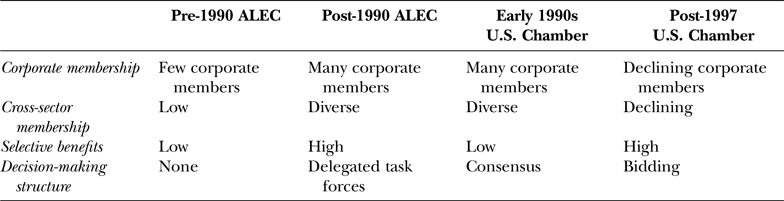
Table 1 summarizes the characteristics of ALEC in both its early and later years, after Sam Brunelli and other organizational leaders had instituted a greater focus on selective benefits and delegated task-force decision making. As should be clear by now, ALEC in its pre-1990 years had few corporate members, but enjoyed growth in corporate membership from a diverse array of sectors after it put into place the delegated task-force structure that offered valuable selective benefits to its members.
Contrasting ALEC and the U.S. Chamber of Commerce

How does ALEC's evolution compare to that of the U.S. Chamber of Commerce? One important distinction to make in the Chamber's historical trajectory is to differentiate between the period before and after the arrival of Thomas Donohue in 1997, the Chamber's current president and CEO, who ushered in a new style of management focused intensely on corralling large corporate donations to the group and building strong ties with Republicans.Footnote 111 Making this distinction can help clarify the radically different descriptions of the group in the scholarly and popular literature. Before Donohue's arrival, the Chamber, under President Richard Lesher, was more willing to support a variety of policy positions, so long as the Chamber had the support of a majority of its members. This explains why political scientists like Cathie Jo Martin and Mark Smith have characterized the group as being hamstrung by internal divisions in these years, especially the late 1980s and early 1990s; their broad and diverse membership kept the group from taking many proactive stances. But the combination of a broad and industrially diverse membership and a consensus-driven approach to decision making also explains why the Chamber did make some forays into policy debates that might seem unthinkable today, such as when the group, spurred by big business members tired of dealing with the expensive and fragmented health care system, toyed with an endorsement of President Clinton's health reform proposal.Footnote 112
Following a swift Republican backlash to such bipartisan stances, however, Chamber leadership replaced Lesher with Donohue, who sought to restore the Chamber's political clout through a combination of unwavering commitment to conservative ideological positions and aggressive fundraising. Under Donohue, for instance, the Chamber has more than quadrupled both its lobbying and campaign contribution budgets from 1998 to 2014.Footnote 113 While Donohue's changes to the Chamber have unquestionably increased the Chamber's political heft in Washington, they have also come at a cost. To raise revenue to support those political activities, the Chamber began to focus on the issues prioritized by a small handful of its wealthiest contributors—issues that have alienated many other corporate members. The difference is that while the Chamber would not have pursued those issues under the Lesher regime, since they lacked the backing of a majority of their members, under Donohue, a small—but vocal—minority of firms could drive the organization's agenda. As one careful observer of the Chamber has summed up, “Donohue has transformed the group from a staid business association to Washington's most ruthless political mercenary. The Chamber allows its biggest donors to set its positions on key issues … and it will set up a campaign promoting a company's pet cause if it donates at least $1 million annually.”Footnote 114
Donohue himself has emphasized this shift in the Chamber's management strategy, arguing that while “people have criticized us for helping industries or individual companies … What the hell do you think we do? That's our business!”Footnote 115 Donohoe has even made an explicit comparison between his strategy for attracting corporate donations and the insurance industry, saying that the Chamber is “going to be the reinsurance salesmen … we're the people that you could come to … when you were in trouble … you couldn't get something passed. . . . You come in, and if you were our members, you were our supporters, we were going to be there for you.”Footnote 116 To that end, Donohue created special accounts for companies that wanted to contribute to the Chamber for political advocacy but did not want their names publicly linked to the Chamber's activities.Footnote 117 Examples of these covert reinsurance policies include energy companies working through the Chamber to defeat climate change legislation and health insurers pursuing a similar strategy to defeat health reform under the Obama administration.Footnote 118
To put the Chamber's evolution in the theoretical terms described throughout this article, under Donohue, the Chamber began to provide strongly selective benefits to members through the “reinsurance” policies companies could purchase to defend their narrow interests. But the Chamber did not adopt an explicit policy to manage the conflicts that emerged between these divergent corporate interests, like ALEC's task forces, and so firms that disagreed with the Chamber's increasingly narrow agenda have left the group. As one observer of the Chamber has described, “for the past 15 years, [the Chamber has] been taking increasingly extreme, partisan stands, often setting policies in concert with small numbers of powerful donors who may not share the interests of many of the Chamber's members.”Footnote 119 That same reporter estimates that actual membership in the Chamber has dropped from 1997, the year when Donohue took control, to 2001—and likely more since then.Footnote 120 Nike, Apple, Best Buy, Johnson & Johnson, and Exelon are just a few of the large firms that have recently distanced themselves from the group.Footnote 121 In a press release justifying its decision, Best Buy cited its frustration with the fact that its interests were not being represented by the Chamber's aggressive new posture on climate change.Footnote 122
In sum, the post-Lesher Chamber provides another model for how a business association can, perhaps paradoxically, increase its political war chest while becoming less and less representative of the business community as a whole. The key contrast with post-1990s ALEC is that the Chamber did not create structures that would accommodate a diversity of interests within the group, undermining its ability to attract a growing and representative set of corporate interests. The comparison of the two groups, in turn, shows how the organizational strategies I have identified within ALEC can help to explain both the tensions and successes faced by other business associations operating in the United States. Though American business groups face common obstacles, they have dealt with these challenges in very different ways. These choices about organizational structure, moreover, have important implications for the degree to which an association can amass political capital, draw in a large and growing membership, and represent diverse sectors of the economy.
CONCLUSION
Scholars have dedicated substantial attention to the “right turn” in American politics since the 1970s, which produced a surge of new conservative and corporate mobilization. Yet the focus of the vast majority of this research has been at the national level, ignoring similarly important shifts across American statehouses. Our understanding of conservative mobilization is thus incomplete, especially because the decision to move to the states was a deliberate and strategic one on the part of conservative activists like Paul Weyrich and Sam Brunelli, who advocated state-based activity precisely because it would provide better payoffs than continued efforts at the national level.Footnote 123 This article has begun to fill that scholarly lacuna by examining the evolution of one organization—ALEC—at the center of state-level conservative-corporate mobilization.
Studying ALEC is also important because this organization defies much of the conventional wisdom about American business and politics. Although its creation and growth in the 1970s and 1980s fit with the historical narrative of the right turn in American politics, its continued success and expansion throughout the 1990s and 2000s does not. As Benjamin Waterhouse has summed up, “By the end of the 1980s, much of the luster of business's political mobilization [from the 1970s] appeared to have worn off. Policy battles over taxes, deficits, trade, and regulation exposed the tensions not only among various business constituencies but also between business interests and conservatives.… Looking to the 1988 election and beyond, many business lobbying organizations adopted a defensive position quite at odds with the ebullient optimism for reform they had embraced in the late 1970s.”Footnote 124 The inability of national business leaders to sustain the coalitions that they had formed with one another and with conservative political organizations fits with the comparative political economists’ accounts of business mobilization in fragmented liberal polities like the United States, too. Lacking a centralized state and a proportional representation, multiparty political system, there are minimal incentives for firms to enter into enduring, national, and encompassing political coalitions that intervene regularly into the policymaking process.Footnote 125
Given that ALEC stands so far apart from these patterns, I have argued that it offers an important instance of a case unaccounted for by existing theories that can thus help us to understand the limits of deterministic institutional explanations for variation in business mobilization. While it is true that ALEC's leaders encountered all of the obstacles enumerated by scholars of comparative political economy—fractious business interests, intense competition with other associations for members, and the need for long-term organizational investment—its leaders eventually arrived at a set of strategies for overcoming those obstacles, to great success. This article thus affirms the arguments offered by political economists about the challenges of constructing durable business coalitions in American politics, but also emphasizes the importance of considering the agency of savvy political entrepreneurs who can create new organizational forms to overcome those institutional challenges. In so doing, this single case provides implications for other work studying American business and politics, and it suggests new lines of inquiry in these areas.
For instance, my work suggests that scholars need to pay closer attention to variation over time within the United States in the success or failure of business mobilization. Not all efforts at creating durable business coalitions have been thwarted by the institutional configuration of the American polity, and the explanation for this variation may be found in the organizational structures pursued by group leaders. This in turn invites the question of how organizational strategies are developed and disseminated between groups and over time. In particular, future work ought to tackle the question of why other traditional American business groups that have fallen prey to the institutional obstacles of the American polity have not been able to adopt organizational forms that might have more closely resembled ALEC's key strategies. Why, for example, have other associations been unable to adopt the highly delegated task-force model for organizing their political activities that might have reduced the potential for interfirm squabbles? How do the leaders of these different organizations perceive the challenges facing their groups and the various options at hand to address those difficulties? When and why do groups decide to capitalize on new opportunities for mobilization, as ALEC did with the states? The shadow comparison I offered between ALEC and the U.S. Chamber of Commerce has only hinted at answers to these issues. Finding the answers to these questions will provide an important window into the ways in which business has mobilized in the American political economy over time, and how those patterns of organization are distinct from other advanced democracies.