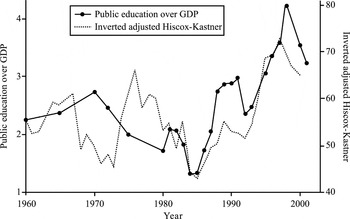
Education policy resembles the proverbial magic bullet. In the developing world, numerous studies have shown a powerful and robust effect of education on economic growth.1
In developed states, politicians of every stripe rush to extol the benefits of education policy. Given that the global average of education spending rose from 2.5 percent to 4.7 percent of national income between 1960 and 1995, it might appear that states have matched this rhetoric with action. Yet, while the average level of education spending has increased, there remains enormous variation both across and within countries. Intercountry education spending differs tremendously, even within geographic regions such as Sub-Saharan Africa: in 2000 Lesotho spent 10 percent of national income on public education whereas Equatorial Guinea spent only 0.5 percent. Furthermore, many states have experienced sizeable cross-time fluctuations in education spending. Chile, for example, spent 2.5 percent of gross domestic product (GDP) on public education in 1960, 4.5 percent under the Salvador Allende government, 2.5 percent under the Augusto Pinochet regime, and 4.3 percent in 2000. Countries as varied as Portugal, the Philippines, and Zimbabwe, have seen fluctuations of a similar magnitude over the past four decades. Education spending may be universally beneficial but not every government has heeded that advice.What explains this massive variation in education spending, both among states and across time within states? Political economists have developed a broad array of theories about variation in government spending, emphasizing its redistributive and insurance roles.2
However, these analyses are less useful in terms of examining education spending. First, redistribution through education can be both fiscally progressive, in the form of universal education, and fiscally regressive, for example, in funding tertiary education. Accordingly, the composition of spending determines the differential redistributive impact of education. Second, education has powerful labor market effects. Expanding the supply of education increases the relative abundance of skilled labor and thus potentially reduces skilled wages relative to unskilled wages. Consequently, a model of education spending, linking these redistributive and labor market effects with political preferences, is considerably more complex than one of simple income transfers.The current literature on the political economy of public education spending has demonstrated a strong positive effect of democracy on aggregate education outcomes.3
See Baum and Lake 2003; Lake and Baum 2001; Brown and Hunter 2004; Lindert 2004; Rudra and Haggard 2005; and Stasavage 2005.
In this article, I argue that two key forces determine these spending outcomes: the level of democracy and the level of openness. Because expanded access to public education chiefly benefits the middle class and poor, democratization should lead to increased public education spending, reduced private education spending, and a focus on universal primary education rather than elite-targeted tertiary education. For two reasons, I also expect that open states will spend more on education. First, in a closed economy the increased supply of education will, all else being equal, reduce the rate of return to educated workers. This creates strong incentives for the elite to try to restrain education spending in autarkies. In an open economy, however, educated individuals can sell their product to foreign buyers; hence an expansion of education does not necessarily reduce skilled wages. Thus, the relative aversion of the elite to education is dependent on a state's level of openness. Second, when openness leads to technology transfer, there will be increased demand for education so that firms can implement skill-biased foreign technologies. Openness also affects the composition of education spending, with developing states shifting spending from tertiary to primary education and the reverse occurring in developed states.
The structure of this article is developed as follows. In the first section, I develop a formal model of education spending, which generates hypotheses on the effects of regime type and openness on public education spending, private spending, and the composition of education spending. The second section tests these hypotheses on a data set of 113 states from 1960 to 2000 using a variety of empirical specifications and measures. The following two sections dig beneath the aggregate measures employed in these econometric tests, employing case historical analysis to tease out the causal mechanisms developed in the formal model. In particular, these cases aid in separating out the strongly correlated effects of democracy and openness. The third section examines the dual impact of regime type and openness on education policy in the Philippines, a country that has experienced significant volatility on all three of these measures since 1960. This within-country volatility neatly corresponds to the formal model, which examines changes within states. The fourth section contrasts two states whose experiences with education spending have been “off the diagonal” of autarkic autocracies and open democracies: India—an autarkic democracy—and Malaysia—an open autocracy—thereby testing the mechanism developed in the formal model on atypical cases. The final section concludes by examining the article's policy implications, focusing on the promotion of development in low-income states and the response of developed states to wage competition from the developing world, particularly China and India.
A Simple Model of Public Education Spending
This section outlines a simple formal model of how democracy and globalization affect total education spending and its composition (the Appendix provides a more detailed derivation). The model demonstrates two key components of education spending. First, although public education provision necessitates fiscal redistribution, this redistribution can be either progressive or regressive depending on the ability to differentially target education spending to particular groups. Second, education spending is inseparable from the labor market. The returns to education, and thus the political incentives to provide it publicly, are determined by supply and demand in the market for educated labor. These market forces are, in turn, dependent on a state's integration into the global economy. Building on these two components, I model political preferences over education under different political regimes and varying labor market conditions.
I consider a country with three groups of individuals: a high-income group, a middle-income group, and a poor group. Individuals earn income from two sources. First, they receive group wealth qi, where i ∈ {H,M,P} and qH > qM > qP. This income is not derived from the labor market: it can be considered as unequally distributed wealth. Individuals also receive income wj from their factor endowments of either skilled or unskilled labor.4
Throughout, I assume that “skill” and “education” provision are synonymous.
When education spending is increased, the provision of education expands from the richest to the poorest person. This assumption mirrors the historical expansion of education in both the developing and developed world.5
If education is distributed uniformly throughout society but in a probabilistic manner, the basic results still hold. If the poor receive education first, the results hold provided that the elite also receive private education and that expanded public education has a negative effect on the returns to private education.

The income equations show how the relative scarcity effects, a and b, and the productivity parameters, σs and σu, affect the preferences of individuals over education spending. For those who already possess education, any expansion reduces their wages by a factor b. Those who receive education for the first time will receive a jump in their income through the skill premium σs − σu. Finally, if a is greater than 0, the unskilled individuals benefit indirectly through skill provision as unskilled labor becomes scarcer.
I assume there are two generations where parents, who live in period 0, decide how much to tax themselves to provide public education for their children, who live in period 1.6
I assume no time-inconsistency problems, in that tax rates decided in round 0 systematically lead to spending levels in round 1. Adding a measure for the durability of political regimes into the empirical analysis in Table 1, Ansell 2006 suggests that the positive effects of democracy on education are stronger in “durable” democracies, which have smaller time-inconsistency problems.
I examine private education in proposition (1b).

Finally, individual utility is comprised of round 0 income net of taxes and round 1 income (discounted by δ), which is determined by whether children receive skilled or unskilled wages wj1(S1) and by positive externalities produced by education g(S1).8
I assume that g(S) is increasing and quasiconcave and represents the noncaptured benefits of education that increase economic growth.

I begin analyzing the effect of democratization on education spending by examining the distribution of education under autocracy, where the high-income group receives education but the middle-income and poor group remain uneducated. Following democratization, the locus of political power switches from the elite to the democratic median voter, who is a member of the middle-income group. Will this voter choose to expand education spending and if so, how far will they do so? To answer these questions, I examine how increasing education to incorporate the middle class affects each group.


All groups suffer a strictly negative impact from the tax cost of providing education, albeit weighted by relative income.9
This simple fiscal impact resembles the result from Meltzer and Richard 1981 that a poorer median voter relative to the mean prefers higher redistribution, although I emphasize changing the identity of the median voter through regime change rather than the effect of changes in inequality.
The model assumes that the high-income group in autocracies earns significant returns from education. If this elite is land- or capital-abundant, the effect of education on their returns depends on the substitutability or complementarity of education and other endowments in production. I assume the elite earn at least some of their income from their privileged educational position.
Extending education to the poor may nonetheless occur. First, if the poor themselves control political decision making. Second, if externalities from further education spending are high enough, or costs low enough, to encourage the middle class to extend education to the poor. Finally, if b is small enough, the negative effects of expanding education on wage returns are attenuated. Still it is not obvious, paraphrasing Ross 2006, that democracy is “good for the poor” in terms of education.
Proposition 1a: The expansion of democracy increases public education spending.
The model above precluded citizens from purchasing private education, although private education is a sizeable sector in many states. However, adapting the model to include private education does not substantially alter any of its propositions. The rich strictly prefer private to public education, because they can access education without paying for others to receive it. The masses, conversely, prefer public education, because at least some proportion of this education is subsidized for any individual with income below the mean. In the presence of a sizeable public education sector, private education is even less attractive for most citizens since they would have to pay for education twice—once privately and once through the tax system. Consequently, democratization will lead to a shift away from private to public education, as noted in proposition (1b):
Proposition 1b: The expansion of democracy reduces private education spending.
I now turn to examine the effects of globalization on education spending, starting with its supply-side effects on the labor market. The “law of one price,” as developed by Samuelson, presumes that as countries become fully integrated with the global economy, the returns to factors become increasingly determined by global rather than domestic supply.12
Samuelson 1948. Rybczynski 1955 extends Samuelson, showing that changes in factor supply are met under free trade by changes in the production mix rather than factor returns.
Hanson and Slaughter 2002 show that the Samuelson theorem is empirically confirmed by the absence of a response of relative wages in U.S. states to factor supply. This suggests that as trade between nations approximates that between U.S. states, factor returns become increasingly detached from domestic supply.
Applying this logic to the model, this implies that the parameters a and b will be smaller in open states. Reexamining equations (4) through (6) shows that integrating into the global economy increases the attractiveness of education provision for both the elite and middle class. Since the expansion of education in an open economy has a smaller impact on skilled wages than in an autarky, the high-income group is less harmed by education spending and may favor increased spending if externalities outweigh tax costs. For the middle-income group there is a similar, albeit smaller positive impact. However, for the poor, globalization actually weakens the positive effects of education expansion since they benefit less from the relative scarcity of unskilled labor. These results imply two propositions. First, if, as in most countries, either the high- or middle-income group control government, education spending should expand when states globalize. Second, since the positive effect of globalization on preferences over education is greatest for the high-income group and smallest for the poor, I expect the positive impact of globalization on education to be stronger in autocracies than democracies.
Proposition 2a: Increased integration with the global economy will lead to increased education spending in both democracies and autocracies.
Proposition 2b: Increased integration with the global economy has a larger positive supply-side effect on education spending in autocracies than in democracies.
Globalization also affects labor market demand. Acemoglu argues that contemporary globalization produces skill-biased technology transfer from developed to developing states.14
Acemoglu 2003.
Goldin and Katz 1998.
Turning to the model, skilled wages are now ws = γ(σ − σs) + σs − bS1, where σ is the level of technological productivity in the most developed state, and γ ∈ [0, 1] is the degree to which globalization leads a country to close the gap between domestic productivity and that of the most developed state. Where there is a large potential jump in the skill premium from technology transfer, or where technology transfer γ and skill provision S are complementary, globalization will increase overall education spending. Furthermore, the effects of increasing technology transfer γ on education spending will be stronger for states that are further away from the level of productivity in the most advanced state σ. Thus, developing states will see a greater demand-side impact on education spending than developed states. These results provide proposition (2c):
Proposition 2c: Increased integration with the global economy has a greater demand-side effect on education spending in developing states than in developed states.
Greater openness is not predicted to have a significant impact on private spending. On the demand side, the effect of openness on private spending might be positive, if technology transfer increases private incentives to invest in education that are not met by public provision. On the supply side, however, the predicted increase in public education spending is likely to substitute for private education, thereby reducing private spending. These two countervailing effects provide proposition (2d):
Proposition 2d: Increased integration with the global economy will have a negligible effect on private education spending.
I conclude the analysis by examining the impact of “targeted spending,” where increased education spending is spent on greater “depth” (more per student funding) rather than greater “breadth” (increasing student enrollment). Since the baseline model assumed that education enrollment moves from rich to poor, increased “depth” implies targeting resources toward the well-off. This kind of regressive targeted spending captures the funding of tertiary education, which is de facto limited to upper-income individuals in most states. Where the elite group controls political decision making, its members will choose to increase the depth of education spending rather than its breadth, since this focuses resources on their own children. The key implication is that if education can be targeted to groups with higher levels of income, as with university education as opposed to primary education, its provision will be fiscally regressive and thus favored in more autocratic regimes. This produces proposition (3a):
Proposition 3a: Autocracies will favor a higher tertiary to primary education spending ratio than democracies.
Finally, I derive a proposition from the Stolper-Samuelson theorem about the impact of globalization on the composition of education spending in developed versus developing countries.16
Samuelson and Stolper 1941.
Proposition 3b: Following globalization, the tertiary to primary education spending ratio should decrease in developing states and increase in developed states.
Empirical Analysis
This section tests the several propositions derived from the formal model on a data set of 113 countries between 1960 and 2000. I begin by considering the effect of regime type and openness on aggregate education spending before examining how these effects play out in different subsamples (autocracies versus democracies; developed versus developing states). I finish the empirical analysis by examining the impact of regime type and openness on the composition of education spending. Before turning to the statistical analysis, I briefly discuss the variables I use. The formal model of education spending focuses on tax revenues spent on moving individuals from an unskilled group to a skilled group. Since this is a simplification of the process of education provision, it is impossible to find a precise analog. However, in terms of aggregate national spending, the most tractable measure is public expenditure on education as a percentage of GDP. This measure comes from the World Development Indicators and is available for 113 states from 1960 to 2002, with an average of 15.4 observations for each state. The variable covers all state expenditures on primary, secondary, and tertiary education and at both subnational and national levels. Across the sample this variable has a mean of 4.2 and a standard deviation of 1.9. Private education spending is also measured as a percentage of national income. Finally, the composition of education spending is measured by using the ratio of per student funding on tertiary (university) education versus that on primary education.17
These variables are from the World Bank's EdStat database. See World Bank 2004.
The model developed in the last section implied that whether the high- or middle-income group controls political decision making affects the level of education spending. To capture this mechanism I use the polity index.18
Marshall and Jaggers 2002.
A further justification for using the polity score is its use in the existing literature on education provision; see Lake and Baum 2001. Elsewhere (Ansell 2006), I show that the results carry through with the binary measure of democracy developed by Przeworski et al. 2000.
To operationalize openness, I first use the log of exports plus imports over GDP. While this is a commonly used measure, it is highly affected by state size.20
Accordingly, I incorporate country fixed effects in some regressions, thus averaging out such idiosyncrasies and focusing on dynamic changes. I also employ a variable created by Hiscox and Kastner that measures the distance of a state from its gravity-model-predicted optimal level of trade.21Hiscox and Kastner 2006. I employ their “amended” variable, which controls for GDP and factor endowments. Note that by controlling for GDP, the variable averages out economic shocks that reduce both trade and national income.
The log openness and hiscox-kastner variables pick up slightly different aspects of economic integration. log openness includes export levels, which indicate the ability of citizens to sell their skills internationally, thereby reducing the dependence of wage returns on domestic skill supply. The hiscox-kastner variable focuses on the deviation of imports from expected levels, indicating the degree to which domestic firms are protected from international competition, and presumably also from technology transfer. Hence the log openness variable more closely resembles the supply-side mechanism of propositions (2a) and (2b), whereas the hiscox-kastner variable resembles the demand-side mechanism of proposition (2c), although this distinction is not sharp.
I also include a number of control variables in the data analysis to capture key factors that may affect educational expenditure. I include government consumption (excluding education) as a percentage of GDP to control for the size of the public sector, which is known to be larger in democracies.22
Rodrik 1998.
These variables, and log openness, were obtained from the World Development Indicators database. See World Bank 2003.
A variety of other time specifications have been examined including quadratic time trends and time dummies. These analyses demonstrate a linear pattern in education spending, hence the decision to use a linear time trend.
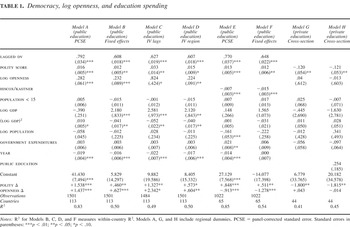
Table 1 presents the first set of tests, which analyze the effect of regime type and openness on aggregate education spending. The first test in Model A uses the Beck-Katz panel-corrected standard error (PCSE) technique.25
Beck and Katz 1995.
Democracy, log openness, and education spending

Models C and D deal with a potential problem in the analysis: the possibility of reverse causation. It is conceivable that education may itself lead to democratization, a theme touched on in many works of modernization theory.26
For example, Lipset 1959.
For completeness, I also instrument log openness similarly, although there is little theoretical reason to be particularly concerned about endogeneity.
This regional instrument does not avoid the possibility that omitted long-run or structural regional forces could be affecting both democracy and education (for example, religious adherence). However, the use of country-fixed effects mitigates the problem of such slow-moving omitted variables since cross-sectional variation is removed.
Models E and F repeat the analysis from Models A and B but replace log openness with the hiscox-kastner measure, which reduces the data set from 113 to sixty-five countries.29
Since the data set is truncated in terms of country coverage, I do not replicate the regional mean instrumental variables estimation with the Hiscox-Kastner data set. Using the five-year lag for polity as an instrument produces statistically significant results at the p < 0.01 level.
Across Models A through F in Table 1 the coefficient relating the polity score to public education expenditure is statistically significant at the p < .05 level, except in Model D where it is significant at the p < .10 level. The effects of increased openness are also all statistically significant—in both log openness and hiscox-kastner forms—at the p < .05 level, except for Model C, which is significant at the p < .10 level. In order to interpret these coefficients, it is most useful to examine long-run first differences. To calculate these effects I use the following formula: β/(1 − γ), where β is the coefficient on the independent variable and γ is the coefficient on the lagged dependent variable. This index is then multiplied by two standard deviations of the independent variable (15 points on the polity index; 1.06 on log openness; and 30 on the hiscox-kastner index).30
For comparison, between 1960 and 2000, the Philippines, discussed in the third section, experienced a range of 17 points on the polity index, 1.7 points on log openness, and 38 points on the Hiscox-Kastner index.
Removing the lagged dependent variable does not alter the statistical significance of the coefficients on the independent variables. However, despite using first-order autoregressive error terms in the regression, there may remain serial correlation given the reliance on annual data. Using the Arrelano-Bond bias correction technique to adjust for autocorrelation, the results remain robust, albeit with wider confidence intervals and a reduced sample size.
Comparing subsamples

I conclude by examining Models G and H, which test the effects of democracy and openness on private education spending on a cross-sectional data set of country means. Model H differs from Model G by adding a control for public education spending. In both models I find a robust and substantial negative effect of democracy on private spending, with a fifteen-point shift on the polity score associated with a reduction in private spending of 1.8 percent of GDP. This support for proposition (1b) is amplified by the fact that no other variable comes close to statistical significance. Even in unpromising data conditions, democracy appears to have a strong impact on private education spending. However, openness has a negligible effect on private education, as predicted by proposition (2d).
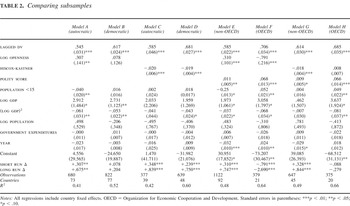
Table 2 splits the sample into two sets of subsamples—first, autocracies and democracies in Models A through D; and second, Organization for Economic Cooperation and Development (OECD) and non-OECD states in Models E through H. All models use fixed-effects regression and are thus directly comparable to Models B and F in Table 1. Models A and B compare the effects of log openness on education spending in autocracies and democracies. In both cases, the coefficient on openness is positive but it is only statistically significant in the autocracy subsample. This result is likely to reflect the greater impact of supply-side forces on education in autocracies, as implied by proposition (2a). However in Models C and D, which compare the effect of the hiscox-kastner variable in autocracies and democracies, I find coefficients of similar magnitude and statistical significance. Here the models show that deviations from “free trade” levels of imports have a similarly negative impact on education spending in both autocracies and democracies. Though the analogy is imperfect, if the hiscox-kastner variable better picks up demand-side forces such as technology transfer, with log openness picking up supply-side forces, this finding suggests that demand-side forces have equal impact on education across autocracies and democracies, whereas supply-side forces have a different impact, as implied by propositions (2b) and (2c).32
This result is not caused by the smaller size of the subsample. Using the same smaller subsample as Models C and D but with log openness, I find a similar pattern to Models A and B.
I directly test proposition (2c) in Models E through H, which break the sample into OECD and non-OECD subsamples.33
The OECD subsample excludes Mexico, Korea, Turkey, and Eastern European states.
Using education as a proportion of government spending as the dependent variable, I find a negative effect following changes in openness in OECD states but a positive effect in non-OECD states.
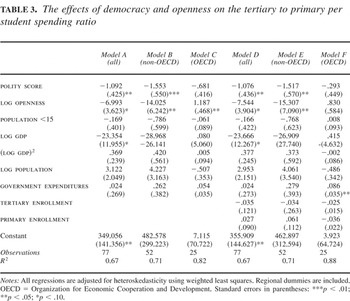
I conclude the empirical analysis with Table 3, which tests propositions (3a) and (3b) on a data set of country mean spending on primary and tertiary education during the 1990s. Because time series evidence on the composition of education spending is fragmentary, it is necessary to conduct a between effects analysis on the data rather than analyzing dynamic patterns. Models A through C use the standard set of controls, whereas Models D through F also include measures of overall enrollment levels in tertiary and primary education, in order to isolate the impact of increased per student spending from changes in enrollment. Each set of tests examines three subsamples: first, all the cases; second, non-OECD states; and third, OECD states. Models A through C show the expected effect of democracy on the tertiary to primary spending ratio as presented in proposition (3a). The ratio variable has significant variability in the data set, ranging from 0.4 to 85. A two standard deviation shift in polity is predicted to lead to a reduction in the ratio variable of fifteen points in the full sample and twenty-three points in developing states. For OECD states the negative effect remains but is much smaller (the highest level of the ratio is 4.6 in the OECD) and statistically insignificant. These patterns are robust to inclusion of the enrollment variables in Models D through F. Turning to the effect of openness, I find ample support for proposition (3b). In the full sample there is a statistically weak negative effect of openness on the ratio variable. However, in developing states there is a robust and sizeable negative effect of openness on the ratio variable, as states move resources to sectors of comparative advantage, which demand lower-skilled labor. Conversely, Model C shows a robust positive effect of openness on the ratio in OECD states, whose comparative advantage lies in university-educated labor. Models D through F replicate this pattern, controlling for enrollment. However, Model F shows that the statistical significance of openness on the ratio is weakened in the OECD once I control for enrollment levels. Overall, however, propositions (3a) and (3b) appear strongly supported by this cross-sectional analysis.
The effects of democracy and openness on the tertiary to primary per student spending ratio

Bringing together the statistical results from this section, there are robust and substantive effects of both regime type and openness on a variety of forms of education spending. Aggregate public education spending is estimated to increase dramatically, by up to 30 percent, following shifts of two standard deviations in democracy or openness. Private spending is also strongly affected by democracy, this time negatively, although openness appears to have a negligible impact. The estimated impact of openness on public education spending varies significantly across states, with autocracies and developing states seeing stronger effects. Finally, I found that democracy is everywhere associated with a shift in spending from tertiary to primary education but that the effect of openness reverses when one moves from developing to developed states.
The Philippines: Examining Democratic and Trade Volatility
The previous section demonstrated a robust relationship between democracy, openness, and education spending over a broad data set. But the aggregate nature of statistical analysis necessarily glosses over how the casual mechanisms developed in the formal model actually play out in historical practice. Accordingly, this section traces these mechanisms in the Philippines, which has experienced significant volatility since 1946 in regime type, economic openness, and education spending, thus providing a fertile test of the propositions outlined in the formal model. Furthermore, the Philippines is a strong test case because it is commonly portrayed as having an idiosyncratically pro-education culture, where one might expect uniformly high spending.35
Swinerton 1991.
Following independence in 1946 the Philippines had a moderately democratic political system, which soon responded to pent-up popular demand for increased education spending. Consequently, under the Liberal government of Diosdado Macapagal, enrollment in primary education expanded from 56 percent to 97 percent between 1960 and 1965.36
Kang 2002, 59.
Synott 2002.
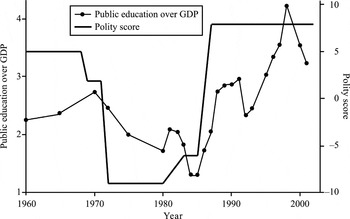
In 1972, however, Marcos declared martial law, forcing a transition to personal rule. The authoritarian turn precipitated a sharp decline in education from 2.8 percent to below 2 percent of GDP. Marcos's policies increasingly reflected the education spending preferences of his elite client base. As Kang notes, “under martial law in the 1970s the priorities of the government, as reflected in the budgetary allocations to defense and industry, shifted away from education,” with education spending declining from 29.1 percent of government spending in 1965 to just 11.4 percent by 1975.38
Kang 2002, 58.
Swinerton 1991.
It was not until the late 1980s, after Marcos was forced to relinquish power, that educational expenditure recovered to its pre-1972 level, under the post-Marcos government of Corazon Aquino. One of Aquino's first acts as president was the convocation of a Congressional Commission study on education (EDCOM), which highlighted the collapse in education funding relative to comparator nations and recommended massive reinvestment, particularly in teachers' salaries. Consequently, by 1998, educational expenditure had tripled its late-Marcos level and climbed to over 4 percent of GDP, with poorer Filipinos the chief beneficiaries of expanded coverage, thanks to the stipulation that education be made available free at the primary and secondary levels, stated in Article XIV of the Philippine constitution of 1987.40
Ibid.

The effects of democracy on education spending in the Philippines
Education funding in the Philippines has not solely been driven by political regime change. The integration of the Philippine economy with the global economy has varied considerably over the past fifty years. Figure 2 shows the change in the inverted hiscox-kastner variable over this time period.41
The index is inverted so that increases correspond to an opening of the economy.

The effects of openness on education spending in the Philippines
Political independence in 1946 did not foster economic independence since the Philippines signed the Bell Trade Act with the United States, which established a series of asymmetric tariffs and U.S. quotas on imports from the Philippines: as Hawes notes, “it was a splendid example of neocolonialism.”42
Hawes 1987, 28.
de Dios and Hutchcroft 2003, 49.
Haggard 1986.
Marcos's declaration of martial law in 1972 was followed by a rhetorical shift toward export-oriented trade policy. Rhetoric was, however, largely unmatched by action, since Marcos, once keen to remove industrial firms from elite family control, set about protecting industry in the name of his cronies. Export zones were established but remained niches. As McKay explains:
Marcos pursed a contradictory but politically savvy, two-pronged strategy: he created a limited export platform or enclave economy to please foreign investors and development agencies while maintaining a highly protectionist domestic economy and coercive state to fend off political rivals and enrich himself and his closest allies.45
McKay 2006, 56.
Thus, Marcos's rhetoric bore little resemblance to the structure of the Philippine economy outside the export zones. With manufacturing protected and uncompetitive, the Philippines did not face the same demand for primary and secondary education felt in the East Asian “Tiger” economies. Contrary to Philippine comparative advantage, it was spending on higher education that grew most dramatically: with an annual growth rate of 5.2 percent during the early 1980s versus just 1.1 percent for primary education.46
Callanta 1988, 29.
Swinerton 1991, 78.
Political liberalization in 1986 was swiftly followed by economic liberalization under Aquino—who removed most import controls—and during the administration of Fidel Ramos. Following Ramos's election in 1992, education spending spiked upward to more than 4 percent of national income. Ramos's “Philippines 2000” strategy explicitly connected trade liberalization and education spending, with an emphasis on the following the East Asian model. Under Ramos's administration, manufactured goods became the majority of Philippine exports for the first time, forcing up the demand for an educated labor force to aid in their production.48
de Dios and Hutchcroft 2003, 55.
Explaining Two Puzzles—India and Malaysia
India and Malaysia provide symmetric, contrasting puzzles. Why has India, perhaps the most successful democratic experiment in the developing world, failed so dramatically in terms of providing education to its citizenry? Why, conversely, has authoritarian Malaysia had higher levels of education spending than any other major Asian state? Examining openness allows one to address these twin puzzles, where regime type appears an insufficient explanation. Furthermore, these cases test whether the casual mechanism developed in the first section works in countries that are “off the diagonal” of autarkic autocracies and open democracies.
India's failure to educate its workforce, particularly in rural areas, is infamous. Half of the Indian population remains illiterate, comprising 40 percent of the world's illiterates.49
Lindert 2004.
Tilak 2003.
Krueger 1974.
The failure to meet government rhetoric about education began in the 1950s, with the composition of India's Five Year Plans for development of infrastructure and social services. During the First Five Year Plan, education spending amounted to a fairly substantial 8 percent of all spending, half of which was devoted to elementary education. While this only amounted to about 15 percent of overall education spending, the share of education spending in the Plans directly reflected government preferences over development, rather than nonpolicy variables such as demographic pressures. After the First Five Year Plan, however, education spending dropped to 5.8 percent of spending in the Second Five Year Plan and to just 2.7 percent by the Sixth Five Year Plan in the early 1980s. During that period the emphasis on elementary education was replaced by investment in higher education, with the former sector's share of spending reduced to 30 percent. Tilak notes that “1956 to 1969 marked the beginning of a drastic decline of resources allocated to elementary education and a doubling or trebling of resources allocated for higher education.”52
Tilak 2003, 36.
Thus, India's developmental strategy was focused away from areas of comparative advantage toward import-substituting high-end manufacturing. The government began to limit investment in education and channel it toward the children of the elite (those most likely to attend higher education) in an ill-fated attempt to jumpstart the Indian industrial sector. However, because Indians were exporting few manufactures abroad, the limited size of the market for such goods led to an oversupply of high-end skills and a consequent collapse in the returns to such education. Tilak notes a “growth of educated unemployment [and] mismatches in the labor market” by the mid 1970s.53
Ibid., 37.
The Indian development strategy from the late 1950s to 1990s, based on autarkic industrialization, artificially deflated education spending and likely hindered Indian economic growth. Frustration with the slow “Hindu rate of growth,” combined with an economic crisis in the early 1990s, led to a breakthrough in trade orientation during Narasimha Rao's administration, elected in 1991. Rao's finance minister Manmohan Singh developed a broad range of liberalization policies, which permitted majority foreign ownership of Indian companies, reduced tariffs, and eliminated many quotas. In doing so, he catalyzed the development of India's rapidly growing high-technology and outsourcing industries, with the growth rate increasing from around 5 to 7 percent. Currently, and in stark contrast to the experience of the 1970s, India cannot educate workers fast enough at present for the skill demands of the newly globalized Indian companies and Western multinationals engaging in outsourcing.54
Wood and Calandrino 2000.
The Malaysian experience provides a dramatic contrast to India. Since the 1960s, Malaysia has spent more than 5 percent of its national income on public education and at various points, including the early and late 1990s, more than 7 percent of GDP, which placed it firmly in within the top decile of international spenders. However, for most of this period, Malaysia has been an authoritarian state, with a powerful executive that is largely uncontrolled by the legislative and judiciary. Thus, on a political level, Malaysia does not appear a likely candidate to spend large amounts on public education. However, because of Malaysia's early entry into the global economy, these unpromising initial conditions have nonetheless supported major investments in education.
Malaysia's experience with British colonialism was mixed. Malaysia was abundant in natural resources but colonial government was beneficial largely for the British and for the Chinese and Indian immigrant communities. The indigenous Malays fared less well, becoming a numerical and economic minority. As in most colonies, there was little interest in providing public services for the indigenous population: as Snodgrass notes, “colonial governments in Malaya provided little education … most of what happened occurred through private rather than public initiative.”55
Snodgrass 1998, 64.
The post-1969 shift toward export-oriented industrialization led to further education investment. The New Economic Program (NEP), lasting from 1970 to 1990, had as a key aim “the development of a strong human resource orientation in order to be internationally competitive during the process of industrialization.”56
Mukherjee and Singh 1995, 162.
Khalafalla and Webb 2001.
The New Development Program, established in 1991, responded to these export-led demands for skills. The key aim during the 1990s was to supply high-end skills that would facilitate the transition to production higher up the value-chain. Skills shortages were now considered a key threat to further development as international demand for Malaysian goods pushed up demands for skills. As implied by proposition (3b), Malaysia's transition to developed status precipitated a shift toward tertiary education spending during the 1990s. In response to this development, the government has pushed the education budget to more than 7 percent of GDP.
This section has demonstrated the substantial impact of trade policy on education across both democracies and autocracies. Although ostensibly democratic, India lagged in education spending due to its autarkic trade policy. Malaysia, though authoritarian, nonetheless invested heavily in education thanks to its export orientation. Why did regime type not overwhelm the effect of openness? One possible answer is that both India and Malaysia have mixed regime types.58
Not all “democracies” are equally representative nor all “autocracies” equally elitist. For example, I show elsewhere that communist states spend relatively more, and oil-rich autocracies relatively less, on public education; see Ansell 2006.
Weiner 1991.
Conclusion
In this article I argue that cross-national and within-state variation in education spending can be best explained by examining the impact of democracy and economic integration. The strong redistributive impact of education spending explains why democracies, with poor median voters relative to autocracies, prefer to fund public education more heavily. Furthermore, democracies are also more likely to tilt spending toward universally provided primary education and away from elite-targeted tertiary education and private education. This impact of an open polity is accompanied by the positive effect of an open economy on education spending through supply-and-demand channels. First, where citizens can “export” their skills to foreign buyers through free trade, the negative impact of education supply on the returns to skill, which prevails in autarky, is diminished. Second, where globalization facilitates technology transfer, skill-biased technological adaptation increases the demand for education. Globalization also shifts the ratio of primary to tertiary spending upward in developing states and downward in developed states, as countries focus funding on their relatively abundant resources. To summarize broadly, democracy and openness appear to be powerful predictors of the level and composition of education spending.
These results must, however, be qualified by noting the bluntness of the aggregate measures of democracy and openness used in this article. The formal model suggests explicitly that the extent of popular representation is the key determinant of education spending and further implies that the public's preferences will be properly enacted by the legislature and executive. However, the aggregate polity variable does not distinguish between these and other components of democracy. Elsewhere, I show that those components of the polity measure that better reflect the underlying principles of franchise extension, popular representation, and a responsive executive, rather than those measuring factionalism or regime stability, have the strongest and most robust effects on education spending.60
Ansell 2006.
Olson 1993.
The logic and findings of this article may at one level be intuitive. Yet they suggest a set of implications that are strangely absent from popular discussions of education policy, in which education is often recommended as a policy “cure-all” for what ails both developing and developed states. This optimistic language in mainstream debate seems curiously disembodied from politics. By integrating political and labor market constraints with the analysis of education policy, this article suggests a reinterpretation of three popular policy tropes: the importance of channeling aid to education in developing states; the strategy of “upskilling” as a bulwark against globalization in developed states; and the likely impact of China and India's entry into global markets.
International institutions, heeding the advice of development economists, have increasingly focused on targeting development aid on education, for example the World Bank's “Education For All” initiative. However, the effectiveness of education as a development policy will differ dramatically between autocracies and democracies. Whatever the wishes of Western donors, autocracies may have a vested interest in curtailing foreign aid marked for education. Where possible, autocracies will instead target such funds to their preferred political constituencies, typically by subsidizing tertiary education for the elite. Furthermore, education policy cannot be divorced from countries' labor market conditions, especially their integration with the global economy. Expanding education in autarkic states may produce only educated unemployment or a collapse in the wage returns to education. Autarkic developing states also typically target education at areas of comparative disadvantage such as tertiary education. Thus, development advice that recommends education spending must be conditioned on a state's ability to actually employ educated labor effectively and on the political incentives of the government to differentially target spending.
Within the OECD this article also suggests a new lens through which to view responses to globalization. Politicians on both the neoliberal center-left and the free-market right typically disavow protectionism as a response to the apparent threat of globalization, preferring to draw on a rhetoric of “upskilling” the newly unemployed to make them competitive in global markets. However, this article finds that openness is, if anything, associated with declines in education spending in OECD states and with a shift in composition toward higher education. These empirical patterns suggest that the upskilling strategy may be ineffective. The members of society most at threat from global market forces—lower income/lower education individuals—are not the chief beneficiaries of the tilt in education spending toward universities.62
The shift to higher education has varied across the OECD with the Anglo-American and Nordic states expanding university enrollment dramatically but continental European states more reliant on vocational training; see Ansell 2006. In both cases, however, it is labor-market insiders who benefit most from the direction of education policy.
Kok 2004.
Rodrik 1998.
Finally, it is worth considering the systemic effect of the recent expansion of education spending in India and China. While Western commentators emphasize the absolute size of Chinese and Indian college cohorts, this surge is dwarfed by the enormity of spending increases in primary and secondary education that have accompanied China and India's entry into the global market. This latter pattern alone should significantly reduce global inequality. However, the sheer size of spending may in time weaken one of the theoretical propositions of this article—that domestic skill supply can be counterbalanced, even outweighed, by global market conditions. Domestic skill supply in states the size of India and China actually alters global skill supply dramatically, potentially reducing the returns to skill worldwide. Following this article's logic, this collapse in the skill premium would actually reduce the demand for education worldwide. Thus, the rise of China and India is not only cause for concern for blue-collar workers in advanced industrial states. A collapse in the global skill premium could both undermine the push for increased education spending in the developing world and overwhelm incipient “upskilling” strategies in developed states. Further analysis of Chinese and Indian education supply, from primary to postgraduate education, would aid in identifying which groups are most likely to be winners and losers from globalization in the early twenty-first century. More broadly, as the West's most valuable resource—its abundance in human capital—is challenged, the seemingly domestic politics of education in China and India is likely to have colossal global political ramifications, potentially ushering in a new era of high-skilled protectionism.
Appendix
This Appendix formally develops the propositions from the first section. I begin with the derivation of income in the formal model. Individual income can be calculated as the sum of individual wealth qi and factor returns wj:

Factor returns are defined by labor market equilibria for skilled and unskilled wages, determined by their relative productivity σj and abundance S.


S expands from the richest to poorest individual, as indexed by si, which is inversely related to wealth qi.


S is paid for through a flat tax t on round 0 income and is realized in round 1. The budget constraint is thus:

Individual utility is round 0 net income plus discounted round 1 income.

Taking derivatives of this utility function produces the instantaneous result:

Democracy
For a state where only the elite receives education in round 0 and where both the elite and the middle class receive education in round 1, I obtain the following derivatives of group utility:


The elite prefers a lower level of education spending than does the middle class. Thus autocracies spend less than middle class-controlled democracies, producing proposition (1a). The middle class's optimal level of education spending is as follows:

Proposition (1b) follows from the fact that any individual with income below the mean would prefer to receive subsidized education than privately pay full cost c. Individuals with incomes higher than the mean prefer to pay privately. Assuming the democratic median voter has income below the mean, private education spending should be lower than in autocracies.

Globalization
The supply-side effects of globalization operate through reducing a and b. To show the extreme case of perfect convergence, I alter equations (A9) through (A11) by setting a, b = 0.


Equations (A14) and (A15) are both unequivocally larger than equations (A9) and (A10). Equation (A16) is smaller than (A11). Provided that either the elite or the middle-class control political decision making, globalization will lead to higher education spending. The reverse effect for the poor group means that education provision in governments that also incorporate the poor will not respond as positively to globalization. Furthermore, if b > (b + a)S before globalization, the elite will benefit more greatly from globalization than will the middle class. This produces propositions (2a) and (2b). The demand side effect of globalization works through technology transfer parameter γ, and the technology threshold of σ. Following globalization, wages are ws = γ(σ − σs) + σs − bS1 and the utility function is:

To examine technology transfer, I note how the effect of S on utility is affected by γ:


If S and γ are complements in producing externalities g(S), the right-hand side (RHS) of equations (A18) through (A20) will be strictly positive, and all groups will desire higher levels of education spending following globalization. The middle group always prefers higher levels of education provision following globalization because of the increased skill premium. As the gap between developed and developing nations decreases, the RHS of equation (A19) is reduced. This implies that the demand-side impact of globalization on education spending decreases as countries get wealthier, producing proposition (2c). Since demand-side effects increase the demand for private education and supply-side effects decrease private education spending (because of the increase in public education), openness has no predicted impact on private spending, producing proposition (2d).
Targeted Spending
I model targeted per student spending with depth parameter π. The budget constraint and wage equations can now be reframed as:


Only skilled wages are directly affected by the depth parameter, which pushes the productivity of skills upward. I rephrase utility as:

To examine the effects of targeting I fix the breadth of education, or S(π) = S, and look at the autocratic case where only the high-income group currently receives education. I express the derivatives of group utility with respect to the depth parameter as:


Note that only the high-income group receives a positive benefit from targeting, since only they receive the good. Where groups are able to restrain provision and increase per student funding, as in autocracies, I expect higher targeted tertiary education spending and lower universal primary education spending, producing proposition (3a). Proposition (3b), on the impact of openness on tertiary versus primary spending, follows straightforwardly from the Stolper-Samuelson theorem.