Osteoporosis is a systemic skeletal disease, characterised by low bone mass and micro-architectural deterioration of bone tissue, with a subsequent increase in bone fragility and susceptibility to fractures(1). As the global elderly population increases, the prevalence of osteoporosis and the incidence of osteoporosis-related fractures are becoming a major social and medical concern in both developed and developing countries(Reference Johnell and Kanis2).
In particular, as the ‘baby boomers’ of Asia grow older, osteoporosis and its resulting fractures are becoming a considerable cause of morbidity, leading to increased household, societal and economic burdens(3–Reference Melton5). A previous study has reported that Asian women have a lower bone mineral density (BMD) than white or black women due to their relatively small body size, genetics, lifestyle and culture(Reference Barrett-Connor, Siris and Wehren6). The prevalence of osteoporosis among Korean elderly women is high, 34·9 % in 2010(7), and has been increasing gradually(Reference Shin, Choi and Chung8).
Dietary behaviours are important factors in regulating bone loss in postmenopausal women as well as in achieving peak bone mass in adolescents. Most previous studies on diet and bone health have focused on a single nutrient, such as Ca or vitamin D(Reference Lowe, Ellahi and Bano9–Reference Islam, Shamim and Viljakainen11) with protein, vitamin K, K and caffeine, or on foods, including fruits, vegetables and milk(Reference Hooshmand, Chai and Saadat12–Reference Macdonald, New and Golden19). However, these classical approaches may not thoroughly explain the complex interactions and synergistic effects among nutrients and foods on bone health outcomes.
Recently, methods of dietary pattern analysis have been used to examine possible relationships between overall diet quality and health outcomes in the field of nutrition research(Reference Sugiura, Nakamura and Ogawa20). Dietary pattern analysis evaluates subjects' overall tendencies to eat certain types of foods and meals, rather than a single food or nutrient(Reference Schulze, Hoffmann and Kroke21).
Several studies have shown that specific dietary patterns are associated with osteoporosis or BMD. ‘Healthy’ dietary patterns were associated with a reduced risk of fractures or bone resorption among Canadian postmenopausal women and men(Reference Langsetmo, Hanley and Prior22) and Scottish women aged over 50 years(Reference Hardcastle, Aucott and Fraser23). Several studies have identified positive associations between dietary patterns and BMD in diverse age groups: a ‘nutrient-dense’ pattern in Canadian younger men(Reference Kontogianni, Melistas and Yannakoulia24), a ‘nuts and meat’ pattern in Northern Irish young adults(Reference Whittle, Woodside and Cardwell25) and a dietary pattern characterised by a high intake of dark-green and deep-yellow vegetables in young children in the USA(Reference Wosje, Khoury and Claytor26). On the other hand, inverse associations between ‘energy-dense, nutrient-poor’ dietary pattern in Australian women(Reference McNaughton, Wattanapenpaiboon and Wark27), a ‘refined’ pattern in Northern Irish young adults(Reference Whittle, Woodside and Cardwell25) and a ‘traditional English’ dietary pattern in UK postmenopausal women(Reference Fairweather-Tait, Skinner and Guile28), and BMD have been reported.
Because little information on the association between dietary patterns and osteoporosis in Asian populations has been reported to date, and because dietary patterns in Western countries differ from those in Asian countries, these reported results are of limited value in the prevention or management of osteoporosis in Asian populations. The traditional Korean diet is composed primarily of grains, vegetables and fermented foods with salt, and seldom includes dairy items, such as milk and yogurt, resulting in a high intake of Na and a low intake of Ca.
Although the dietary pattern in Korea has recently been changing to a more Western diet, most adults still consume a rice-based diet with low dairy food and Ca contents(Reference Kim, Jo and Joung29). The mean Ca intake among 50- to 64-year-old women was 506·8 mg/d, only 72·4 % of the recommended intake (700 mg/d)(30). Moreover, the prevalence of low Ca intake is especially high among the elderly(7). Additionally, the mean frequency of milk intake was as low as 1·5 times per week(7), which may negatively affect bone health.
Thus, the purpose of the present study was to identify dietary patterns associated with osteoporosis in Korean postmenopausal women using data from the Korea National Health and Nutrition Examination Survey (KNHANES), a nationwide survey of Korean residents.
Experimental methods
Study design and population
The KNHANES has been performed periodically since 1998 to investigate the health and nutritional status of Koreans; BMD measurements were first included in the second year (2008) of KNHANES IV. The present study was based on the data from the fourth (2008 and 2009) and fifth (2010) KNHANES (IV and V), which were cross-sectional and nationally representative surveys performed by the Division of Chronic Disease Surveillance, Korea Centres for Disease Control and Prevention. The survey used a stratified, multistage, clustered probability sampling method and consisted of a health interview survey, a health examination survey and a nutrition survey. Data were collected by household interviews and through standardised physical examinations conducted in mobile examination centres. In total, 16 326 individuals completed the health interview survey, the nutrition survey and the health examination survey, including BMD measurements. Menopausal status was categorised as pre- or postmenopausal. Postmenopausal status was defined as not having had a menstrual period during the previous 12 months, and included surgical menopause. Among the 3786 postmenopausal women, we excluded those who reported implausibly low or high daily energy intakes ( < 2092 or >20 920 kJ/d). In total, 3735 postmenopausal women were ultimately eligible for analysis.
The present study was conducted according to the guidelines laid down in the Declaration of Helsinki, and all procedures involving human subjects were approved by the Institutional Review Board at the Korea Centres for Disease Control. Written informed consent was obtained from all participants.
Dietary patterns
Dietary intakes were assessed using data from a single 24 h recall. A nutrition survey was conducted through in-person interviews at participants' homes by trained dietitians using supplemental instruments, such as measuring cups, spoons and a ruler. Information on the dishes, food items, the amount of food intake, preparation methods, recipes and brand names that were consumed on the day before the survey was collected. For dietary pattern analysis, food items consumed by subjects were categorised into twenty food groups based on common food groups classified in the Korean Nutrient Database(30). Consumption of grains and grain products is typically very high among Korean adults. As a result, this group was divided into four subgroups to address the following types of staple foods(Reference Kim and Jo31): white rice; whole grains; noodles and dumplings; flour and bread. Kimchi (traditional Korean fermented cabbage) was placed in a separate group because it is commonly eaten as a side dish in Korea. Nutrient intakes were estimated from the food composition tables of the Rural Development Administration in combination with the nutrient database of the Korea Health and Industry of Development Institute(30).
Dietary patterns were derived using factor analysis, based on the percentage of total daily energy intake from each food group. The average daily intake of the twenty foods or food groups was calculated for each participant, and the percentage of energy obtained from each food or food group was calculated. Finally, the twenty food variables were used as input variables for each participant in the next dietary pattern analysis. To identify dietary patterns, we conducted principal component analysis, entering the twenty food groups into the FACTOR PROCEDURE. The factors were rotated by orthogonal transformation (varimax rotation function in SAS) to achieve a simpler structure with greater interpretability. The number of factors was determined based on eigenvalues (>1·5), a scree plot and interpretability of the factors derived. The factor scores for each dietary pattern and for each individual were determined by summing the intake of each food group, weighted by the factor loading. Each individual was categorised by factor score into groups using quintiles. Quintile categories of pattern scores were used in the present analysis because they reflected the distinct characteristics of each dietary pattern within a large sample, and were used in previous studies(Reference Esmaillzadeh, Kimiagar and Mehrabi32–Reference Heidemann, Scheidt-Nave and Richter34).
Health examination and bone mineral density measurements
Height and body weight were measured by standard methods, with subjects wearing light clothes and no shoes as part of the health examination survey. BMI was calculated as weight divided by height squared (kg/mReference Johnell and Kanis2). The cut-off point for obesity (BMI ≥ 25 kg/m2) was that defined by the International Obesity Task Force for adults in Asian and Pacific regions(35).
The BMD (g/cm2) of the lumbar spine (L1–4 spine) and five regions of the femur (femoral neck, trochanter, intertrochanter, Ward's triangle and total) were obtained using dual-energy X-ray absorptiometry (DISCOVERY-W fan-beam densitometer; Hologic, Inc.) at the health examination site. BMD measurements were performed according to a standardised protocol based on the 2007 International Society for Clinical Densitometry official positions and guidelines(Reference Lewiecki, Gordon and Baim36). The CV in BMD measurements, based on reproducibility scans, was 1·9 % for the L1–4 spine and 2·5 % for the femoral neck(37). We used the L1–4 spine and femoral neck values for BMD analysis. The definition of osteoporosis was made using the WHO T-score criteria (T-score ≤ − 2·5), and we used the maximum BMD value for Asian (Japanese) patients as a reference(Reference Orimo, Hayashi and Fukunaga38).
Covariates
Demographic variables including current age, household income and education level were obtained using a self-reported questionnaire. Education level was classified into three categories: elementary school or less; middle or high school; college or more. The equivalent household monthly income was calculated by dividing the obtained monthly household income by the square root of family size. The equivalent income was categorised as one of three levels: low ( < 710 000 Korean won (KRW)); middle (710 000–1 400 000 KRW); high ( ≥ 1 410 000 KRW)(Reference Jang, Kim and Ju39). Health-related behavioural risk variables included smoking status (current smoker, ex-smoker or none), frequency of alcohol consumption (never or up to one drink per month, < 4 times per month or ≥ 3 times per week), moderate physical activity per week ( ≥ 5 times or < 5 times) and supplement consumption (no or yes more than 2 weeks during the most recent 1 year, including any type of vitamin or mineral supplement). Women's health variables included oral contraceptive use and ovarian reserve. Laboratory tests related to bone health included serum levels of parathyroid hormone and serum 25-hydroxyvitamin D (25(OH)D) levels. The level of parathyroid hormone was measured by a chemiluminescence immunoassay using LIAISON (DiaSorin). Serum 25(OH)D levels were measured using a gamma counter (1470 WIZARD; Perkin Elmer) with a RIA kit (DiaSorin)(37).
Statistical analyses
Categorical data are expressed as percentages and continuous data as means and standard deviations. Correlations between dietary patterns and BMD and nutrient intakes were calculated by partial Pearson's correlations, including age, BMI and energy intake as covariates. Multivariable-adjusted logistic regression analysis was conducted to examine the OR and 95 % CI for osteoporosis across the quintile categories of each dietary pattern score, adjusting for covariates known to be related to bone health in postmenopausal women. Model 1 of logistic regression was adjusted for age, BMI and energy intake. Model 2 was adjusted for the variables in model 1 as well as potential confounders (parathyroid hormone and serum 25(OH)D) relevant to the regulation of women's bone health. Model 3 was adjusted for additional covariates, such as smoking, alcohol intake, moderate physical activity, supplement use and oral contraceptive use. Trends of association were assessed by a logistic regression model, assigning scores to the levels of the independent variable. All statistical analyses were performed using SAS software (version 9.3; SAS Institute, Inc.). Statistical significance was set at P< 0·05.
Results
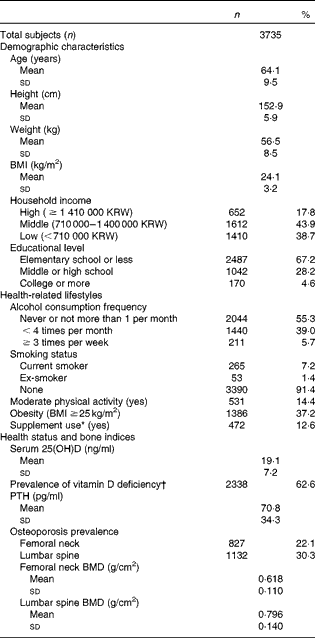
The general characteristics and bone health status of the study participants are summarised in Table 1. The average age and BMI for the subjects were 64·1 years and 24·1 kg/m2, respectively. Among the subjects, 5·7 % consumed alcohol three times or more per week and 7·2 % were current smokers. The prevalence of osteoporosis was 22·1 % at the femoral neck and 30·3 % at the lumbar spine, according to the WHO T-score criteria for Asian (Japanese) patients(Reference Orimo, Hayashi and Fukunaga38). The prevalence of vitamin D deficiency was 62·6 %.
General characteristics of the study subjects (Mean values and standard deviations; number of subjects and percentages)

KRW, Korean Won; 25(OH)D, 25-hydroxyvitamin D; PTH, parathyroid hormone; BMD, bone mineral density.
* No or yes: more than 2 weeks during the most recent 1 year, consumption of any type of vitamin or mineral supplement.
† Serum 25(OH)D < 20 ng/ml.
The factor loading scores, which reflect correlation coefficients between food groups and dietary patterns, are presented in Table 2. The following four dietary patterns were identified by factor analysis, named according to the food groups that had high positive loadings: ‘meat, alcohol and sugar’; ‘vegetables and soya sauce’; ‘white rice, kimchi and seaweed’; ‘dairy and fruit’ patterns. The ‘meat, alcohol and sugar’ dietary pattern had high positive loadings for oils, starch syrup and sugar, meat and its products, and alcohol, and a negative loading for legumes. The ‘vegetables and soya sauce’ pattern loaded highly for vegetables and mushrooms, soya sauce and red pepper, garlic and onion, legumes, and white rice. The ‘white rice, kimchi and seaweed’ dietary pattern featured high positive loadings for white rice, seaweed, kimchi, and fish and shellfish, but negative loadings for whole grains, potatoes, eggs, and noodles and dumplings. The ‘dairy and fruit’ pattern was characterised by high positive loadings for legumes, milk and dairy foods, flour and bread, fruits and nuts. These patterns explained 30·9 % of the total variance in food intake (11·3 % in ‘meat, alcohol and sugar’, 7·7 % in ‘vegetables and soya sauce’, 6·0 % in ‘white rice, kimchi and seaweed’ and 5·9 % in ‘dairy and fruit’).
Factor loading* matrix of food groups for major factors in Korean postmenopausal women

* Factor loading scores of − 0·20 and +0·20 are not shown.
Correlations between the dietary factor scores and BMD and nutrient intakes, after adjusting for age, BMI and energy intake, are presented in Table 3. The ‘white rice, kimchi and seaweed’ dietary pattern score was significantly negatively associated with the BMD of Ward's triangle (P< 0·05) and the lumbar spine (P< 0·05). The ‘dairy and fruit’ dietary pattern showed positive associations with the five regions of the femur (femoral neck, trochanter, intertrochanter, Ward's triangle and total) and the lumbar spine. However, no association was found between the ‘meat, alcohol and sugar’ pattern and the ‘vegetables and soya sauce’ pattern, and BMD. The ‘white rice, kimchi and seaweed’ dietary pattern score was positively associated with energy, carbohydrates, Na and niacin, but showed no association with minerals or vitamins, including Ca, P and Fe. The ‘dairy and fruit’ dietary pattern score was positively associated with most nutrient intakes, except carbohydrates and Na. The ‘meat, alcohol and sugar’ pattern score was positively associated with energy, protein, fat, Na, vitamin A, thiamin, riboflavin and niacin, while it was negatively associated with carbohydrates and vitamin C. The ‘vegetables and soya sauce’ dietary pattern score was positively associated with the intake of most nutrients, except fat and carbohydrates.
Correlation coefficients† among the four dietary pattern scores and bone mineral density (BMD) and nutrient intakes

RE, retinol equivalents.
* P< 0·05, ** P< 0·01, *** P< 0·001.
† Partial Pearson's correlation, including age, BMI and energy intake (excluding energy variables) as covariates.
Table 4 shows the multivariate-adjusted OR of having osteoporosis of the femoral neck and lumbar spine across the four dietary patterns. The subjects in the highest quintile of the ‘dairy and fruit’ pattern showed a decreased likelihood of osteoporosis of the lumbar spine compared with those in the lowest quintile, after adjusting for parathyroid hormone, serum 25(OH)D, smoking, alcohol intake, moderate physical activity, supplement use and oral contraceptive use (OR 0·47, 95 % CI 0·35, 0·65, P for trend < 0·0001). The ‘white rice, kimchi and seaweed’ pattern was associated with an increased risk of osteoporosis of the lumbar spine after adjustment for potentially confounding factors (multivariate OR 1·40, 95 % CI 1·03, 1·90, P for trend = 0·0479).
Risk for osteoporosis of the femoral neck and lumbar spine across the quintile (Q) categories of the dietary pattern scores in Korean postmenopausal women (Odds ratios and 95 % confidence intervals)

* Model 1 adjusted for age, BMI and energy intake.
† Model 2 adjusted as model 1+parathyroid hormone and serum 25-hydroxyvitamin D.
‡ Model 3 adjusted as model 2+smoking, alcohol intake, moderate physical activity, supplement use and oral contraceptive use.
Discussion
We identified four distinct dietary patterns (‘meat, alcohol and sugar’, ‘vegetables and soya sauce’, ‘white rice, kimchi and seaweed’ and ‘dairy and fruit’) among Korean postmenopausal women using data from the KNHANES. After adjusting for potentially confounding factors, subjects with high scores on the ‘dairy and fruit’ pattern had a 53 % lower risk of osteoporosis in the lumbar spine, while those with high scores on the ‘white rice, kimchi and seaweed’ pattern had a 40 % higher risk of osteoporosis in the lumbar spine.
In the present study, the four identified dietary patterns explained 30·9 % of the total variance in food intake. Most dietary pattern studies concerning bone health have used a threshold eigenvalue of 1·0 to verify two to five dietary patterns, explaining 17·1–30·3 % of the total variance(Reference Sugiura, Nakamura and Ogawa20, Reference Langsetmo, Hanley and Prior22–Reference Whittle, Woodside and Cardwell25, Reference Okubo, Sasaki and Horiguchi40). Although the dietary pattern in the present study cannot be directly compared with those of others, due to differences in the protocols used, such as the number of food records and food group classifications, the dietary patterns derived in the present study are similar to those reported previously(Reference Kim, Jo and Joung29, Reference Hong, Song and Lee41, Reference Song and Joung42).
The ‘dairy and fruit’ dietary pattern identified in the present study is similar to the ‘healthy’ dietary pattern obtained from elderly adults aged 69–93 years in the Framingham Osteoporosis Study and in a study of Scottish early postmenopausal women, which were characterised by high positive loadings of fruit, vegetable, dairy foods and cereals, and showed a positive association with BMD(Reference Hardcastle, Aucott and Fraser23, Reference Tucker, Chen and Hannan43). Additionally, both the ‘dairy and fruit’ dietary pattern in the present study and the ‘healthy diet’ pattern in previous studies had high loadings of milk and dairy foods, which are Ca-rich(Reference Hardcastle, Aucott and Fraser23, Reference Tucker, Chen and Hannan43). Ca is a crucial component of the bone matrix and a determining factor in bone metabolism. It has been shown that the milk food group component of the Healthy Eating Index had a significant negative linear relationship with urinary N-telopeptides:creatinine (Cr), a biomarker of bone resorption in American postmenopausal women. Subjects in the lowest tertile of the milk intake group had a significantly higher N-telopeptide:creatinine level than did those in the middle and highest tertiles(Reference Hamidi, Tarasuk and Corey44). Postmenopausal white women consuming dairy products at least once per d were 62 % less likely to have osteoporosis than those consuming dairy products less than twice per week(Reference Matthews, Knutsen and Beeson45).
Our ‘dairy and fruit’ dietary pattern was positively associated with a variety of minerals and vitamins, including Fe, K, vitamin A, thiamin, riboflavin, niacin and vitamin C, which have recently received significant attention with regard to bone health, as well as Ca. Macdonald et al. (Reference Macdonald, New and Golden19) found that Ca and several nutrients found in fruit and vegetables (K, vitamin C and Mg) were positively correlated with BMD and negatively correlated with bone loss in Scottish women. Furthermore, a previous cross-sectional study showed that the intakes of Mg and K were positively associated with the BMD of elderly men and women in the Framingham Osteoporosis Study(Reference Tucker, Hannan and Chen46). Thus, we conclude that the ‘dairy and fruit’ dietary pattern may have reduced the risk of osteoporosis in our subjects, through interactions and synergistic effects of the nutrients included in this dietary pattern. The effects of the ‘dairy and fruit’ dietary pattern on bone health would be more beneficial if vitamin D status improves simultaneously, because the prevalence of vitamin D deficiency among Korean menopausal women is very high. Pfeifer et al. (Reference Pfeifer, Begerow and Minne47) reported that supplementation with vitamin D and elemental Ca is effective in reducing the risk of osteoporotic fracture in European older people with serum 25(OH)D levels below the desirable range.
The ‘white rice, kimchi and seaweed’ and ‘vegetables and soya sauce’ dietary patterns identified in the present study were similar to the traditional rice-based Korean dietary pattern that has been reported previously. However, the ‘white rice, kimchi and seaweed’ pattern showed a negative association only with osteoporosis. The ‘white rice, kimchi and seaweed’ pattern exhibited characteristics of high energy density and low nutrient density. Participants in the highest quintile of the ‘white rice, kimchi and seaweed’ dietary pattern consumed 76·6 % of their food energy from carbohydrates and 10·9 % from fat. On the other hand, even though the subjects in the highest quintile of the ‘vegetables and soya sauce’ dietary pattern consumed 73·7 % of their food energy from carbohydrates and 13·8 % from fat, this pattern was associated with the consumption of protein and various minerals and vitamins. It may have affected the non-significant association between the ‘vegetables and soya sauce’ pattern and the risk of osteoporosis.
A high-carbohydrate, low-fat diet is generally recommended to reduce cardiovascular risk; it has a relatively higher dietary acid load(Reference Nowson, Patchett and Wattanapenpaiboon48). A diet with a high acid load can lead to an increased risk of chronic low-grade metabolic acidosis and can influence a negative Ca balance and increased bone loss(Reference Lemann, Litzow and Lennon49). Nowson et al. (Reference Nowson, Patchett and Wattanapenpaiboon48) found that a high-carbohydrate, low-fat diet increased the levels of indicators (N-terminal propeptide and type I procollagen) of an increased rate of bone turnover. Macdonald et al. (Reference Macdonald, Black and Aucott16) also suggested that a change in acid loads may have a significant adverse effect on bone health only if accompanied by a low-Ca diet. The low Ca intake (391·6 mg/d, 55·9 % of Ca recommended intake for Korean adults) in addition to their high-carbohydrate, low-fat diet could negatively affect the bone health of the subjects in the highest quintile.
In the present study, dietary patterns had an effect only on the lumbar spine, not on the femoral neck. Several meta-analysis studies of the effects of nutrition on bone health have reported that a high intake of Ca and dairy food significantly improved the bone health of the lumbar spine and total body, but not the femur, pelvis or radius in children(Reference Huncharek, Muscat and Kupelnick50). Indeed, soya isoflavone extract increased the lumbar spine bone health of menopausal women, but had no significant effect on the femoral neck, hip total or trochanter bone health(Reference Taku, Melby and Takebayashi51), consistent with the present results. Further research on the mechanism underlying the effect of nutrition factors on specific bone sites is needed.
The present study has several limitations. First, the results do not indicate a causal or resultant relationship between dietary patterns because the present study was of a cross-sectional design. Thus, the results need to be confirmed in longitudinal studies. Second, we assessed the dietary intakes of the subjects using a single 24 h recall, which might not represent the individual's usual intake. FFQ are commonly used in dietary pattern analysis; however, the FFQ used in the KNHANES was not developed to evaluate usual food intakes and has not yet been validated. Thus, dietary intake data from a single 24 h recall were used in the dietary pattern analysis. Third, the dietary pattern approach can be somewhat subjective and difficult to identify in other populations. In factor analysis for the derivation of dietary patterns from dietary data, researchers generally make arbitrary decisions on, for example, the number of foods or food groups included, the number of factors and the rotational method(Reference Martinez, Marshall and Sechrest52). To minimise subjectivity, we defined the dietary patterns based on a procedure used in previous studies(Reference Kim, Jo and Joung29, Reference Hong, Song and Lee41, Reference Song and Joung42). Despite these limitations, the present study is the first to verify an association between Korean dietary patterns and the risk of osteoporosis in Korean postmenopausal women.
Recently, dietary patterns in Korea have been changing from the traditional diet, composed primarily of steamed white rice and kimchi, to a more Western-style diet(Reference Kim, Moon and Popkin53). However, this transition is occurring more rapidly in children and adolescents than in adults. Our subjects, postmenopausal women, typically still adhered to rice-based diets with high carbohydrate and low dairy food and Ca contents. The present dietary pattern analysis identified the complex nature of age- and culture-specific dietary behaviours and their associations with bone health in Korean postmenopausal women. Thus, the results may facilitate both the development of dietary guidelines to prevent osteoporosis and further research into the relationship between diet and bone health.
In conclusion, the present findings suggest that increased intakes of dairy foods and fruits in the traditional Korean diet – which is based on white rice and vegetables – may decrease the risk of osteoporosis in Korean postmenopausal women. The ‘white rice, kimchi and seaweed’ dietary pattern, however, had a negative influence on bone health in Korean postmenopausal women. Dietary guidance to Korean postmenopausal women should focus more on the desirable effects of various vitamins and minerals from the ‘dairy and fruit’ dietary pattern, whereas those sticking to the ‘white rice, kimchi and seaweed’ dietary pattern may require more careful attention for the prevention and management of osteoporosis.
Acknowledgements
The authors' responsibilities were as follows: H. J. conceived and designed the study and critically reviewed the manuscript; S. S. contributed to the data analyses and wrote the draft of the manuscript. The present study received no specific grant from any funding agency in the public, commercial or not-for-profit sectors. The authors report no conflict of interest.