Introduction
Fermi's Paradox remains one of the most important questions in astrobiology and SETI (the search for extraterrestrial intelligence). In short, the Paradox asks: ‘If the timescale for a civilization forming and crossing the Galaxy is much lower than the age of the Galaxy, why have we seen no evidence of extraterrestrial intelligence?’ A variety of solutions have been formulated.
1. There are very few or no other civilizations (The Rare Earth Hypothesis: Ward & Brownlee Reference Ward and Brownlee2000).
2. They are here, but in secret (sometimes jokingly referred to as ‘the X-Files Hypothesis’).
3. Civilizations find it too expensive or damaging to colonize the Galaxy, and instead choose not to (The Sustainability Solution, e.g. Cirkovic Reference Cirkovic2008; Haqq-Misra & Baum Reference Haqq-Misra and Baum2009).
Thorough reviews of the Paradox can be found in Brin (Reference Brin1983) and Cirkovic (Reference Cirkovic2009). This paper shall focus on the so-called Zoo Hypothesis or Zoo Solution – the concept that Mankind is being deliberately shielded from (or ignored by) the Galactic community, either because humans are deemed ‘too primitive’, interfering with civilizations at our stage of development is dangerous, or simply because we provide an interesting example of a developing civilization for alien anthropologists or historians (Ball Reference Ball1973). We should expect that such a policy can only be enforced in two circumstances:
1. Only one extraterrestrial civilization exists within contact range.
2. A universal legal policy or treaty exists which forbids signatories to interfere (e.g. Freitas's (Reference Freitas1977), description of potentially global Earth Law).
Hair (Reference Hair2011) has studied the second circumstance in more detail. If such a treaty is to exist, a uniformity of motive is required among the Galactic community, something which grows less and less likely as more civilizations arise. Afterall, only one civilization must break the treaty to interfere with Earth's development, making the Zoo Hypothesis a ‘soft’ solution (using the definitions in Cirkovic (Reference Cirkovic2009) and references therein). To maintain uniformity of motive, all civilizations must evolve towards similar standards and conduct, an eventuality greatly assisted if there is a dominant culture already in existence. Hair proposes that the first Galactic civilization could provide this dominant culture. This first civilization can be present at the beginning of other civilizations, shepherding them towards a common culture and the required uniformity of motive.
Hair studies the distribution of the first inter-arrival time (referred to hereafter as IAT 1):

where t i is the time at which civilization i becomes ‘intelligent’ (i.e. it constructs its first radio telescope or equivalent, and can receive interstellar messages). If t i is distributed as a Gaussian, it can be demonstrated that IAT 1 is representable by an inverse exponential distribution (Snyder & Miller Reference Snyder and Miller1991). In this simplified model, Hair shows that the first civilization may exist for up to 300 Myr alone in the Galaxy. This may allow the ‘chain of culture’ to be set up, but how likely is the chain to break? For the Zoo Hypothesis to be strong, we require that this hegemony must be passed from civilization to civilization without the chain being broken.
Once a civilization arises, the maximum speed at which it can spread its influence is the speed of light in vacuo. A time limit is therefore imposed – if IAT i+1 between civilizations i and i+1 is short compared to their spatial separation, then we expect the chain of culture to be broken – civilization i+1 will arise before civilization i can communicate its cultural identity, and uniformity of motive is likely to fail.
It is true that hegemony may continue if the first civilization is sufficiently long-lived that t 3−t 1 is large compared with the relative separation of civilizations 1 and 3, and so on up to higher civilization numbers. As we will see later in this paper, total hegemony will require the first civilization (or at least one early civilization) to persist for an extremely long time, further softening this variant of the Zoo Hypothesis, as we cannot say anything conclusive currently about the lifetime of civilizations. In this work, I will focus on the harder alternative – that the chain of culture is not forced by any individual civilization, but instead by all civilizations in their turn. The chain of culture is therefore only as strong as its weakest link.
While IAT analysis is an important and necessary component of any study of the Zoo Hypothesis, we cannot forget the constraints imposed by the spatial distribution of civilizations (Freitas Reference Freitas1980). This paper will investigate combined spatio-temporal constraints in two separate studies. The first will consider a simple toy model, much in the same fashion as Hair (Reference Hair2011), with the added constraints of spatial distribution. In this model, the arrival times and spatial locations of each civilization are strictly uncorrelated.
The second study will use more realistic datasets, culled from Monte Carlo Realization (MCR) simulations of life and intelligence in the Milky Way (Forgan Reference Forgan2009; Forgan & Rice Reference Forgan and Rice2010). Because of its explicit incorporation of the Milky Way's star formation history, age-metallicity relation and metallicity gradients, the arrival times and spatial locations of each civilization will be somewhat correlated.
The results of both studies indicate that the added constraints imposed by spatial location will work to break the hegemony established by the first civilization, and that the chain of culture is in fact several separate chains of culture. While this does not completely eradicate the possibility of the Zoo Hypothesis being correct, it seriously impairs it. If one partial hegemony advocates interference and begins doing so, it weakens the Zoo Solution in the same fashion as single civilizations do when they make a similar choice.
The paper is set out as follows: I describe the construction of the first (toy) model in Section 2 and the MCR model in Section 3; I describe how hegemony is measured in both models in Section 4; I discuss the results of both models in Section 5 and summarize the work in Section 6.
The simple toy model
In the same vein as Hair (Reference Hair2011), the simple toy model proposes that the distribution of the civilization arrival times t i be Gaussian-distributed. We will see in the following sections that this is a reasonable approximation to that found from the MCR model. For the spatial location of the civilizations, I assume that they are evenly distributed in an annulus, with inner radius 7 kpc and outer radius 9 kpc (1 kpc=1000 pc≈3000 light years). This corresponds roughly to the location of the Galactic Habitable Zone (Lineweaver et al. Reference Lineweaver, Fenner and Gibson2004), which describes the region of the Galaxy most amenable to the development of life and intelligence (our Sun sits near the middle of this annulus at around 8 kpc). I assume for simplicity that the annulus has zero thickness – this will not affect the overall result significantly.
Having sampled t i from a Gaussian, the spatial location of i, given in cylindrical coordinates (r i, φi), is sampled as described above. The parameters of civilization i are randomly sampled without relation to civilization i+1, ensuring such civilizations are uncorrelated. Also, there is no relationship between t i and the location of civilization i, so the set of parameters for any individual civilization is also uncorrelated.
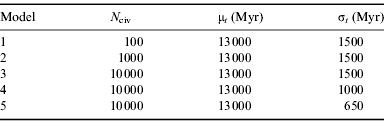
Each model was run for 10 000 iterations. A total of five models were run, for varying values of the mean and standard deviation of the Gaussian distribution for t i (μt and σt, respectively). These correspond to the same models run by Hair (Reference Hair2011), who used 100 iterations in his work: we select 10 000 to confirm these results at higher precision, providing a strong framework for investigating any subsequent spatio-temporal constraints.
The MCR model
The MCR model used in this work was first described in Forgan (Reference Forgan2009). The data used in this analysis were first presented in Forgan & Rice (Reference Forgan and Rice2010) – the reader is referred to this work for a detailed description of the model, but for convenience I shall present a brief summary here.
The model generates a Galaxy of N * stars, whose properties (e.g. mass, location in the Galaxy, age, luminosity and metallicity) are sampled according to the known statistical distributions for these parameters – the initial mass function (Miller & Scalo Reference Miller and Scalo1979), the star formation history (Rocha-Pinto et al. Reference Rocha-Pinto, Maciel, Scalo and Flynn2000a), the age-metallicity relation (Rocha-Pinto et al. Reference Rocha-Pinto, Maciel, Scalo and Flynn2000b) and the structure of the stellar component of the Galaxy (Ostlie & Carroll Reference Ostlie and Carroll1996), including its metallicity gradients (Rolleston et al. Reference Rolleston, Smartt, Dufton and Ryans2000). Having created these stars, some will be assigned planets, based on their metallicity (Wyatt et al. Reference Wyatt, Clarke and Greaves2007). The properties of these planets are again sampled according to their expected statistical distributions. In this instance, theoretical distributions are preferred to empirical data, as using current exoplanet observations introduces significant bias (Forgan Reference Forgan2009).
Having generated a Galaxy containing billions of stars and planets, a hypothesis for life is imposed on the model (e.g. ‘if a planet resides within the Stellar Habitable Zone, then life can exist upon it’). This gives a population of inhabited planets, and the evolution of these biospheres is calculated using stochastic equations (see Forgan (Reference Forgan2009) for details). This produces one realization of the civilization population. In total, 30 separate realizations of the model were generated, to allow averaging of the output variables and characterization of the random uncertainty.
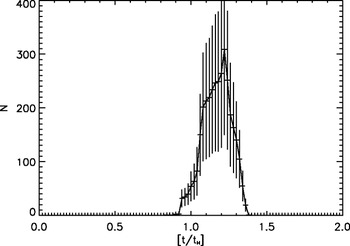
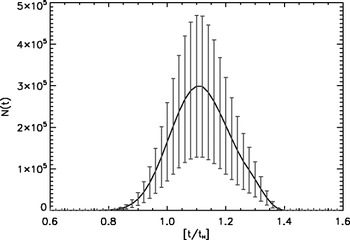
The key data produced by the MCR model (for our purposes) are the multiplicity of civilizations (Figs. 1 and 2), their arrival times and their spatial distribution. Through the combined action of the age-metallicity relation and the Galaxy's metallicity gradient, a weak correlation is obtained between the civilization's arrival time and its cylindrical distance from the Galactic centre, r. However, the other cylindrical coordinates (φ and z, respectively) have no such correlation. The three-dimensional nature of these simulations (in comparison with the simple toy model's two dimensions) will allow civilization spacing to be even larger – at this point it is unclear whether this effect will supersede that of weak spatio-temporal correlation.
The number of existing civilizations in the ‘Rare Earth’ MCR model as a function of time, in units of the Hubble time (t H=13 700 Myr). The mean from 30 iterations of the model is displayed, with error bars indicating one sample standard deviation.

The number of existing civilizations in the ‘Baseline’ MCR model as a function of time, in units of the Hubble time (t H=13 700 Myr). The mean from 30 iterations of the model is displayed, with error bars indicating one sample standard deviation.

Two separate data sets will be investigated for this model. The first is a ‘Rare Earth’ type simulation, where the conditions for complex life to develop are stringent (see Forgan & Rice (Reference Forgan and Rice2010) for details), and a ‘baseline’ simulation where the conditions for complex life are significantly less stringent. As such, the ‘Rare Earth’ simulation has a significantly lower population than the baseline, allowing us to test the ‘crowded galaxy’ concepts of Hair (Reference Hair2011).
Measuring hegemony in both models
We must place spatial and temporal constraints on the same footing, and construct a parameter that shows definitively when hegemony can be established, and when it must be broken. We can construct such a quantity, H, by multiplying the IAT by the speed of light, c:

where ri is the vector describing the location of civilization i (relative to the Galactic centre). This is similar to the construction of the space-time interval in Minkowskian space-time, and has the following limits:

This will show unequivocally where the ‘chain of culture’ is, and is not, broken (cf. the connectivity parameters described in Forgan & Rice (Reference Forgan and Rice2010) and Forgan & Nichol (Reference Forgan and Nichol2010)). It also allows us to quantify the strength of the influence civilization i holds over civilization i+1. If H i=x (in these units, where distance is in kpc, time in Myr), then we can say that civilization i is capable of broadcasting signals to i+1 for  Myr before civilization i+1 becomes sufficiently intelligent to receive such signals. It is straightforward to create a variant of H which determines whether civilization i can be physically present at i+1's homeworld before they become intelligent:

where v craft,i is the maximum velocity of spacecraft belonging to civilization i.
Results and discussion
The toy model
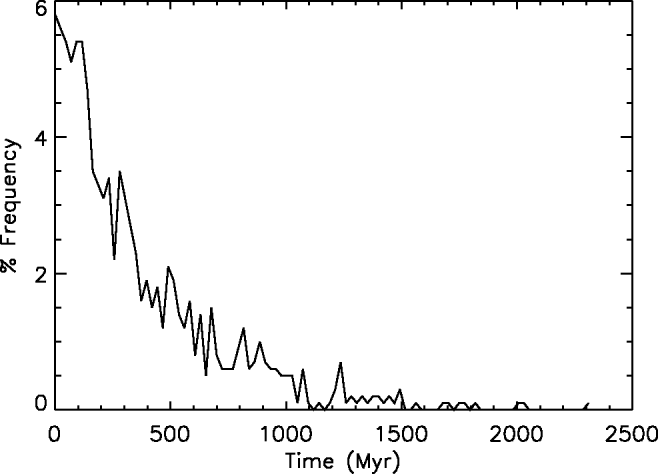
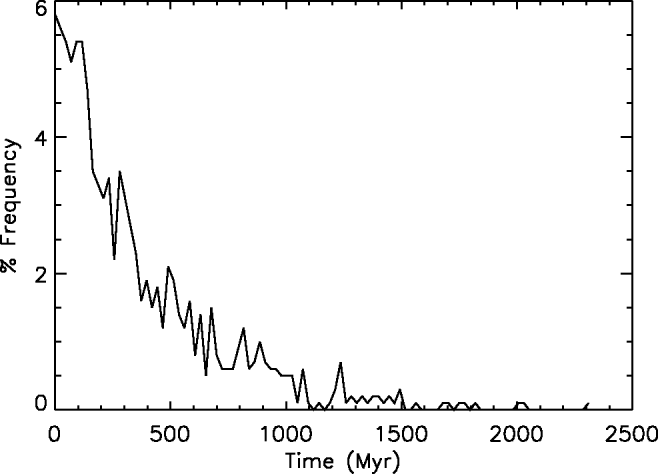
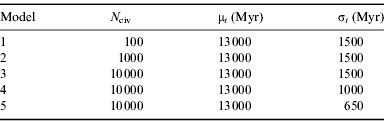
The toy model was run using the parameters of Hair (Reference Hair2011), which can be seen in Table 1. I recover the same distribution of IAT 1, as shown in Fig. 3. The maximum IAT 1 obtained in this set (from 10 000 iterations) is approximately 2 Gyr, seemingly a long period of time for the first civilization to establish itself.
The distribution of IAT 1, from 10 000 iterations of toy model 3 (where μt=13 000 Myr, σt=1500 Myr, see Table 1).
Summary of the toy model parameters investigated in this work. All models were subjected to 10 000 iterations
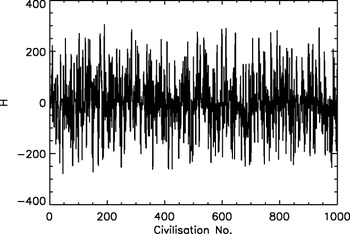
However, the hegemony parameter H tells a different story. Fig. 4 shows the value of H for each civilization in one iteration, using parameter set 3. H oscillates rapidly between positive and negative values, showing that the chain of culture is repeatedly broken. The amplitude of H is roughly the same both at positive and negative values, and appears to be centred around zero, an intuitive result for uncorrelated variables. We can confirm this result by calculating themean value of H for all the civilizations in each iteration.
The breakdown of total hegemony. The graph displays the hegemony parameter for 1000 civilizations in one iteration of the model using parameter set 3 (where μt=13 000 Myr, σt=1500 Myr, see Table 1). Areas where the hegemony parameter are negative show the spatial separation to be too great for one civilization to communicate its culture to the next, showing that total hegemony does not occur. This behaviour is found across all 10 000 civilizations – only the first 1000 are shown for the sake of clarity.

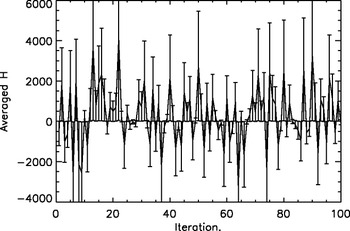
Figure 5 shows that while the mean value of H (averaged over all civilizations),  , varies between positive and negative values, the standard deviation of H,
 . Therefore,
 is approximately consistent with zero to within 1σ, and less than zero to within 3σ. This behaviour is found in all five sets of model parameters, and is clearly a direct consequence of decoupling the spatial and temporal coordinates of civilizations. This underlines the importance of considering both space and time together in such analyses. We can also be certain that any variant
 based on colonization speed (equation (4)) will most likely be consistent with zero, if not a negative value, as c is the ultimate speed limit in the Universe.
The mean value of the hegemony parameter, averaged over 1000 civilizations, from 100 iterations of model 3 (where μt=13 000 Myr, σt=1500 Myr). Also plotted are the sample standard deviations calculated over the 1000 civilizations, showing that each value of the hegemony parameter is approximately consistent with zero at 1σ (and strictly consistent with zero at 3σ). The same behaviour is found for all 10 000 iterations of model 3 – again, only the first 100 are shown for the sake of clarity.

What this analysis does not capture is the establishment of partial hegemonies, which are likely to be localized in space but will not necessarily constitute an unbroken consecutive chain of civilizations. A more detailed study of the growth of individual groups is left for further work, but what can be stated is that if more hegemonies of civilizations exist in one Galaxy, less uniformity of motive exists (much as it does for unconnected individual civilizations). The hegemony is simply redefined as the basic unit of civilization that now includes many biospheres as opposed to one.
The MCR model
The rare earth model
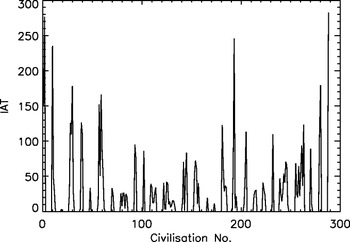
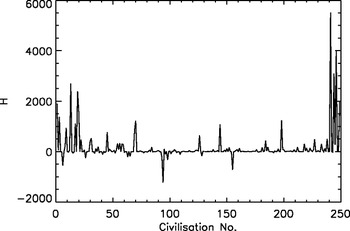
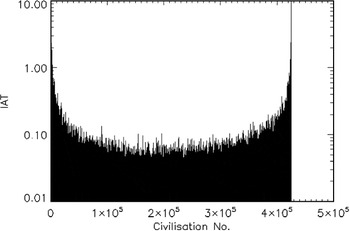
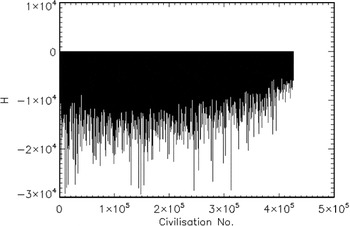
Does partially correlating spatial and temporal position improve the establishment of hegemony? The evidence would suggest otherwise – Fig. 6 shows the inter-arrival time, and Fig. 7 shows H (both against civilization number) for several iterations of the ‘Rare Earth’ model. Civilizations can colonize multiple planets in the same star system, hence there are chains of H=0 scattered throughout the simulation, but there is always one value of H<0 in the chain for all 30 iterations, confirming that the chain of culture is broken, even in a sparsely populated Galaxy with IATs peaking at around 300 Myr. This suggests that total hegemony is unlikely even in relatively empty Galaxies (although the resulting hegemony could still be quite large). Note in the early phases that H∼2000, i.e. these civilizations can send signals to the next civilization for approximately 50 Myr before the next civilization receives them. These early, smaller hegemonies are therefore expected to be well established (although such hegemonies occur at different civilization numbers depending on the iteration of the simulation, so any discussion of when strong hegemonies arise is beyond the bounds of this work). Also, while H may be large, is likely to be much smaller. Mankind's current velocity record is around 10−5c – as a lower limit on colonization speeds, this would make extremely small and most likely negative. If physical presence is required to initiate hegemonies, it is essentially impossible in the ‘Rare Earth’ model.
The IAT for each civilization as a function of civilization number for one iteration of the ‘Rare Earth’ simulation. The maximum IAT is approximately 300 Myr, with a minimum of zero. The minimum is zero because some star systems contain more than one inhabited planet due to colonization, and hence the IAT is effectively zero.

The hegemony factor for each civilization as a function of civilization number for one iteration of the ‘Rare Earth’ simulation. Again, H becomes zero frequently due to civilizations colonizing multiple planets in their home star system. While H is often positive, the chain is broken several times.

The baseline model
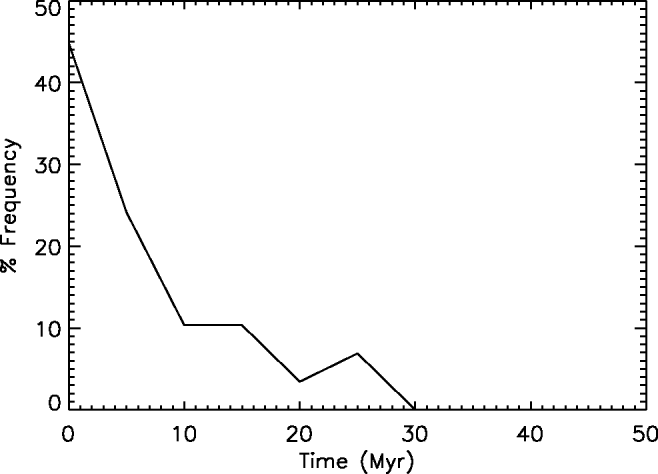
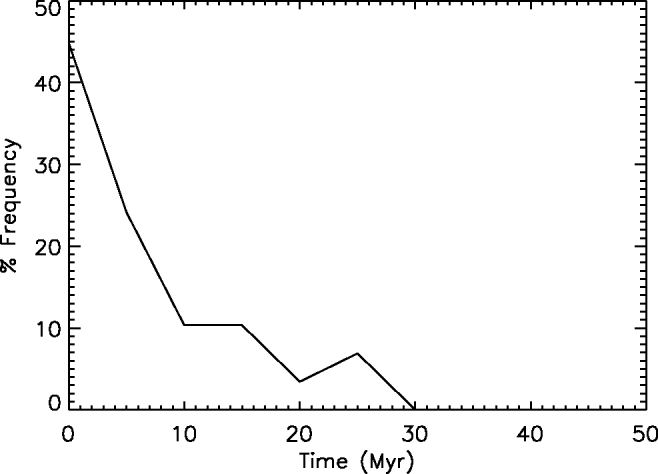
In the second, baseline model, there are significantly more civilizations, arriving within a similar timescale (cf. Fig. 2), presenting a more crowded Galaxy. This increase in numbers, within approximately the same timescale for arriving (given by the width of the Gaussian in Fig. 2), reduces the IATs significantly. Figure 8 shows that 60% of civilizations have IATs less than 10 Myr. This is confirmed by Fig. 9, which shows again that the typical IAT is less than 1 Myr. But will this affect H, i.e. will this decreased IAT be accompanied by a sufficiently decreased spatial separation? As the civilizations tend to occupy the same regions of the synthetic Galaxy (i.e. the Galactic Habitable Zone), it might be reasonable to assume that H might be maintained at values similar to that shown for the Rare Earth model. This however is not the case (Fig. 10) – in fact H is even more negative (with absolute values increased by as much as an order of magnitude). Note also that there are essentially no circumstances where H is significantly larger than zero. Again, if hegemony is limited by some colonization speed, this proves without doubt that this baseline model would never develop strong hegemonies.
Binned values of IAT 1 for 30 iterations of the ‘Baseline’ simulation. These statistics exclude IATs calculated between inhabited planets in the same star system.
The IAT for each civilization as a function of civilization number for one iteration of the ‘Baseline’ simulation. The maximum IAT is approximately 1 Myr, with a minimum of 0. The minimum is exactly zero because some star systems contain more than one civilization, and hence the IAT is effectively zero.

The hegemony factor for each civilization, as a function of civilization number for one iteration of the ‘Baseline’ simulation. H is typically less than zero across the entire history of this Galaxy – the chain of culture is never truly established.

Conclusions
I have investigated a key assumption of the Zoo Solution to Fermi's Paradox – generally that many civilizations establish a uniformity of motive, and more particularly that this motive emanates from the first Galactic civilization, and remains in an unbroken ‘chain of culture’ across Galactic history. I have performed a combined spatio-temporal inter-arrival analysis for civilizations in the Galaxy, using both a simple toy model and more realistic data obtained from MCR simulations.
In the toy model, spatial and temporal location of civilizations are uncorrelated, and the establishment of a constant ‘chain of culture’ is broken quickly and easily. In fact, on average the hegemony parameter H, which measures the space-time separation of the arrival of two civilizations, is consistent with negative values to 3σ, implying that hegemony is never truly established in these circumstances. This result remains constant despite varying the parameters of the IAT distribution, and appears to rule out total hegemony by any one culture.
These trends are also found in the data from MCR simulations, despite spatial and temporal location being weakly correlated. Total hegemony is broken both in the case where there are few civilizations and in the case where the Galaxy is crowded. What is more likely is that partial hegemonies are established by several civilizations – the total number of ‘empires’ in this case is unclear, and requires further analysis. We must not disregard the possibility that empires are not pursued by ETIs, due to their being economically untenable (Cirkovic Reference Cirkovic2008; Haqq-Misra & Baum Reference Haqq-Misra and Baum2009). This aside, the more hegemonies exist, the less likely it is that uniformity of motive can be established (in the exact same manner as if unconnected civilizations attempted to establish uniformity without contact or cultural exchange). In this revised model, hegemonies are the basic unit of civilization, where a ‘civilization’ incorporates many different sub-civilizations (much as the Roman Empire encompassed other civilizations such as the Greeks and the Britons).
The only exception to these conclusions is if any one civilization survives for a significantly long time to ‘repair’ the chain of culture wherever it is broken. Postulating such a civilization weakens the Zoo Hypothesis by requiring its occurrence early on in the chain, which reduces its probability significantly. Of course, the large number of galaxies in the Universe will increase the absolute occurrence of such low-probability events, allowing the required special circumstances for the ‘Eerie Silence’ to exist in some galaxies (Davies Reference Davies2010). In this sense, the Zoo Solution is only defensible using the weak anthropic principle (glibly, ‘things are the way they are because we observe them’). Therefore, we cannot invalidate the Zoo Hypothesis, but it is definitely a ‘soft’ solution, and in that respect unsatisfactory as a means of resolving Fermi's Paradox.
Acknowledgements
This work has made use of the resources provided by the Edinburgh Compute and Data Facility (ECDF, http://www.ecdf.ed.ac.uk/). The ECDF is partially supported by the eDIKT initiative (http://www.edikt.org.uk).