Implications
Silage allows the use of good-quality forage throughout the year. Although numerous papers have focused on the effect of condensed tannins (CTs) on the nutritive value of fresh forages, only few reports give data on preserved tanniniferous forages. The potential of tannins in legumes has not been fully exploited in temperate regions where livestock production occurs, largely because the CT-containing fodder legumes have poorer agronomic characteristics than tannin-free legumes. This study assessed the nutritive value of sainfoin-wrapped silage bales. The effect of CT on in vivo and on in situ rumen degradability of sainfoin, which had been ensiled at two stages of maturity, was investigated in sheep. In order to investigate the effects of CT, measurements were recorded with and without polyethylene glycol, which inactivates CT throughout the digestive tract.
Introduction
Condensed tannins (CTs) are polyphenols that bind proteins and protect them from degradation in the rumen and during ensiling process (Min et al., Reference Min, Batty, Attwood and McNabb2003; Waghorn, Reference Waghorn2008). Preserving legumes as silage is a good way to provide an on-farm source of energy and protein, and offers advantages over haymaking because it is less weather dependent and allows for high-quality forage preservation (Cavallarin et al., Reference Cavallarin, Antoniazzi, Borreani and Tabacco2005).
Numerous papers have focused on the effect of CT on the nutritive value of fresh forages; however, only few reports give data on preserved tanniniferous forages. Therefore, it is important to investigate the effects of the ensiling process on the nutritive value of CT-containing forages and on the activity of CT.
The objective of this study was to investigate the effect of ensiling sainfoin at two phenological stages on the in vivo digestibility and nitrogen (N) balance and on in situ rumen degradability in sheep. The effect of CT on the ensiling process was assessed by the addition of polyethylene glycol (PEG), which forms complexes with CT and inactivates them, throughout the entire digestive tract (Barry et al., Reference Barry, McNeill and McNabb2001).
Material and methods
The study was conducted indoors at the INRA-UR1213 experimental farm in France (45°42′N, 03°30′E). The animals were handled by specialized personnel who applied animal care and welfare in accordance with European Union Directive no. 609/1986, under agreement no. A63 565.
Forage management and silage making
Sainfoin (Onobrychis viciifolia) cv. Perly was grown in Clermont-Ferrand (France) on the INRA's Crouël site at an altitude of 320 m on a fertile basic loamy soil (37.4% sand, 45.8% loam, 16.8% clay, 3.7% organic matter, pH 8.2). No mineral fertilizer was applied. The experiments were conducted during 2008 with wrapped silage bales of sainfoin made from fresh forage harvested at the end of flowering (50% of stems showed open flowers on their upper half of the flower stem) during the first vegetation cycle (silage 1) and at the early flowering (50% of stems showed open flowers on the lowest half of the flower stem) during the second vegetation cycle (regrowth; silage 2). Sainfoin yield was 8.5 ± 1.1 t DM/ha and 3.3 ± 0.4t DM/ha, respectively, for each of the two vegetation cycles.
The fresh forages were cut with a mower conditioner (‘VICON’ type 3001 HPC, Merseyside, UK). The forages were wilted for 1 day after cutting, then made into wrapped silage bales using a fixed chamber baler (Welger, RP 200, type 1721, Kverneland, Blanchot, avenue de l'Europe 02402 Château-Thierry Cedex, France) and stored until use.
Animals and experimental design
Twelve castrated male Texel sheep (12 months old, 60 ± 3 kg liveweight) with an indwelling cannula in the rumen were used for digestibility and N balance measurements (Demarquilly et al., Reference Demarquilly, Chenost and Giger1995), ruminal fluid sampling and rumen degradability measurements on sainfoin silages (Michalet-Doreau et al., Reference Michalet-Doreau, Vérité and Chapoutot1987; modified by Dulphy et al., Reference Dulphy, Demarquilly, Baumont, Jailler, L'Hotelier and Dragomir1999). The sheep were treated with anthelmintic (Ivomec, Merial, France) 30 days before the start of experiment to eliminate internal and external parasites.
All the sheep were offered 60 g DM/kg BW0.75 of sainfoin silages on a daily basis, that is, two equal meals at 0800 and 1600 h. They were given ad libitum access to water and a salt block.
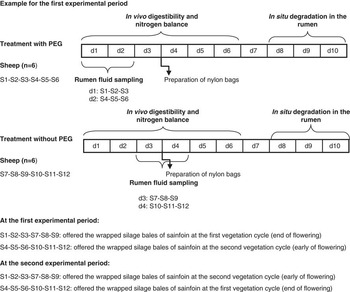
A group of six sheep was dosed daily with 60 g of PEG 4000 (2 × 30 g in 200 ml water) delivered through the rumen cannula before each meal, whereas the other group was dosed with 2 × 200 ml of water (without PEG; Figure 1).
Timeline of the experimental design for the in vivo and in situ measurements.

During the experimental periods, the animals were housed in individual crates for in vivo and in situ measurements. Sainfoin silages were tested in an incomplete crossover design experiment in two periods. Each experimental period included a 2-week adaptation phase and 2 weeks for measurements: the first 6 days to measure digestibility, N balance and kinetics of ruminal fluid, and the second week to measure in situ degradation kinetics.
In the first experimental period, three sheep from each group (with or without PEG) were randomly assigned to receive sainfoin silages harvested at the first vegetation cycle (silage 1), whereas the other three sheep received sainfoin silages harvested at the second vegetation cycle (silage 2).
In the second experimental period, sheep that received silage 1 were switched over to silage 2, and vice versa.
Forage and CT analyses
Sample collection
Four representative samples were obtained from silages 1 and 2. These samples were used for the analyses of forage chemical composition, ensiling characteristics and CTs.
All the analyses for the concentration and biological activity of CTs were performed on freeze-dried plant material.
Determination of forage chemical composition and DM of daily feed samples and refusals were performed on samples dried in a forced air oven at 60°C for 72 h and grounded through a 1-mm sieve. Analyses on the silage fermentative characteristics were conducted on fresh silage and juices.
Laboratory analyses
NDF, ADF and ADL of the dried samples of sainfoin silages were analysed in filter bags according to Van Soest and Wine (Reference Van Soest and Wine1967) as modified by Pagan et al. (Reference Pagan, Wolfe, Terrill and Muir2009). N concentration was analysed using the Kjeldahl method. Neutral detergent insoluble N (NDIN) and acid detergent insoluble N (ADIN) were determined on dried samples of sainfoin silages. Pepsin–cellulase digestibility was determined according to Aufrère and Michalet-Doreau (Reference Aufrère and Michalet-Doreau1983).
Analyses were performed on the fermentative characteristics of the sainfoin silages (pH, NH3-N, soluble N, VFA and lactic acid). The soluble N was determined by the Kjeldahl method and ammonia N (NH3-N) according to the method of Conway (Reference Conway1957). The lactic acid was determined by the enzymatic method of Noll (Reference Noll1974). In fresh silage juice, VFA concentration was analysed using gas chromatography (Chrompack CP 9002, France) according to Jouany (Reference Jouany1982).
CT concentrations (extractable and non-extractable) at two vegetation cycles were measured using HCl-butanol (Reed, Reference Reed1986). The biological activity of CT in terms of protein-binding capacity was determined using the radial diffusion assay. This assay measures precipitation of bovine serum albumin using tannins, with the area of the precipitation ring being proportional to the amount of extracted CT. CT extraction from freeze-dried samples was performed using a 70% acetone solution (Makkar et al., Reference Makkar, Mueller-Harvey and Hagerman2000).
In vivo digestibility and N balance
Sample collection
For organic matter digestibility (OMD), total-tract N digestibility and N balance measurements, both treatment groups were kept in metabolic crates during each experimental period. Urine was collected and the volume was recorded on a daily basis. Urine was collected using a funnel with a spout draining into a collection flask. Faeces were also collected in a bin located behind the sheep and weighed on a daily basis. Loss of NH3 from urine was prevented by daily addition of 50 ml of 30% (w/v) sulphuric acid to the collection flask. Aliquots of faeces and urine obtained on a daily basis were pooled per sheep for the 6 days of measurements. During this week, the sainfoin silages offered were sampled daily, weighed and then fed to the sheep.
Laboratory analyses
All samples were analysed for N concentration using the Kjeldahl method. Pooled samples of urine were stored at −20°C for later analysis of total N concentration using the Kjeldahl method.
Ruminal fluid sampling
Sample collection
Over four consecutive days, rumen fluid was sampled from three sheep each day, that is, six sheep with PEG over the first 2 days and six sheep without PEG over the following 2 days (Figure 1). Sampling was performed before the morning meal (T0) and at 1.5, 3 and 6 h after feeding.
Laboratory analyses
At each time point, 250 ml of rumen fluid was sampled, measured for pH using a pH meter (Mettler SevenEasy S20, France) and filtered through layers of muslin. After the filtration of rumen fluid, the solid particles were re-introduced into the rumen. The rumen fluid was then centrifuged at 3000 g for 5 min at 4°C, to remove large dietary particles. Samples for the analysis of volatile fatty acids (VFAs) were obtained by taking 0.8 ml from the supernatant mixed with 0.5 ml of crotonic acid and then centrifuged at 14 000 g for 10 min at 4°C. The supernatant from the first centrifugation of rumen fluid was centrifuged again at 4°C and 27 000 g for 20 min to remove small dietary particles and bacteria. In the supernatant, the tN was analysed using the Kjeldahl method and NH3-N was determined according to Weatherburn (Reference Weatherburn1967). In the rumen fluid, VFA concentration was analysed using the method described for the silage juices.
In situ degradation in the rumen
Sample collection
DM and N degradation in the rumen were measured using the nylon bag procedure, using Dacron bags (pore size 53 ± 15 μm, Ankom Co., Macedon, NY, USA) with an internal surface area of 5 × 11 cm. For each phenological stage, after opening up the sainfoin silages, representative samples from the bale were collected, cut into 1-cm length to mimic sheep mastication and placed in the Dacron bags. The bags were filled with a forage quantity equivalent to 2.5 g DM, heat-sealed, then quickly frozen in liquid N and stored at −20°C before use.
In situ degradation was measured in the rumen of the 12 sheep (six with and six without PEG) after incubation times of 2, 4, 8, 16, 24 and 48 h, with two bags for 2, 4 and 8 h and three bags for 16, 24 and 48 h (Figure 1). Samples of common grass hay, used as a standard, were incubated in duplicate for 8 h in the rumen of each animal to detect any changes in level of rumen degradation activity during the experiment.
Laboratory analyses
After removal from the rumen, the bags were stored at −20°C until washing. They were then thawed and washed in a washing machine (3 × 10 min) under a cold-water cycle until the rinse water was clear. The bags were then beaten for 7 min in a ‘stomacher’ (Stomacher 80, Seward, France) to reduce microbial contamination of the undegraded sample fraction, re-washed (3 × 10 min) and freeze-dried. A correction was made to take into account adherent bacteria not detached by this treatment, as described by Michalet-Doreau and Ould-Bah (Reference Michalet-Doreau and Ould-Bah1989). The soluble N fraction was determined by soaking the bags containing samples of the silages that were not placed in the rumen, in warm water (40°C) for 1.5 h, and was considered as the proportion of forage N that had disappeared from the bags at T0. The residues obtained from in situ incubation were analysed for N using the Dumas method (Buckee, Reference Buckee1994).
Calculations
The in situ rumen DM and N disappearance curves obtained from the silage samples were fitted to the model of Ørskov and McDonald (Reference Ørskov and McDonald1979) using a non-linear regression procedure (Statistical Analysis Systems Institute (SAS), 2000). The proportion of N degraded at time t was calculated using the equation: N degraded = a + b (1−e−ct), where ‘a’ is the rapidly degraded fraction, ‘b’ is the slowly degraded fraction and ‘c’ is the degradation rate of the slowly degradable fraction, whereas (100 – a – b) was considered the undegradable fraction. The effective degradability of N (DegN) was calculated according to the equation: DegN = a + bc/(c + kp), where fractional passage rate kp was assumed to be equal to 0.06 per h.
The same model was used to calculate the effective degradability of DM (DegDM).
Statistical analysis
Data were analysed using the MIXED procedure of the SAS Software Package (SAS, 2000). Data related to forage chemical composition were analysed according to a model including phenological stage. Data from in vivo and in situ measurements were submitted to ANOVA to test phenological stage and treatment (with or without PEG) as fixed effects, and sheep nested within treatment and experimental period as random effects. The model included the interaction between treatment and phenological stage. Rumen fluid data were submitted to repeated-measures ANOVA, with phenological stage and treatment as fixed effects, and sheep nested within treatment and experimental period as random effects. Time was considered as a repeated variable. The model also included the interactions between time, treatment and phenological stage.
Results
Chemical composition and characteristics of CT
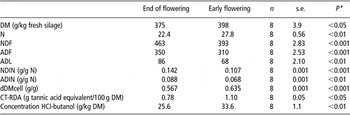
The chemical composition of the sainfoin silages is presented in Table 1. DM concentration of silage 2 was greater (P < 0.05) (398 g/kg DM) than that of silage 1 (375 g/kg DM). N concentration of silage 1 was 22.4 g/kg DM, and smaller (P < 0.01) than that of silage 2 (27.8 g/kg DM). Silage 1 had greater ADF and NDF (P < 0.001) than that of silage 2. NDIN and ADIN were smaller (P < 0.001) in silage 2 than in silage 1. The increasing cell wall concentration led to a decrease in pepsin–cellulase digestibility (P < 0.001).
Chemical composition (g/kg DM), dDMcell, concentration and biological activity of CTs in sainfoin silages harvested at two Phs: end of flowering and early flowering

DM = dry matter; dDMcell = pepsin–cellulase digestibility; CTs = condensed tannins; Phs = phenological stages; N = nitrogen; NDIN = detergent insoluble nitrogen; ADIN = acid detergent insoluble nitrogen; CT-RDA = condensed tannins–radial diffusion assay.
*Probability of significant effect due to Phs.
Protein-binding capacity of CT and their concentration (extractable and non-extractable) in sainfoin silages were greater at early flowering (1.10 tannic acid equivalent and 33.6 g/kg DM) than at the end of flowering (0.78 tannic acid equivalent and 25.6 g/kg DM) (Table 1).
Ensiling characteristics in silages
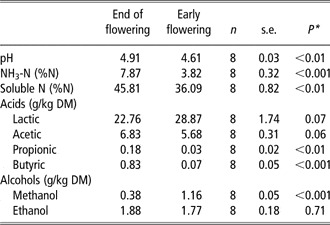
The fermentation parameters of the sainfoin silages are reported in Table 2. Silage 1 had a greater butyric acid concentration (P < 0.001), propionic acid concentration (P < 0.01) and greater pH (P < 0.01) than silage 2. The pH increased approximately 0.3 points between the early (4.61) and the end of flowering (4.91) stages. Lactic acid was the major acid found, at 22.76 and 28.87 g/kg DM at end of flowering and early flowering, respectively. Acetic acid production tended to be greater at the end of flowering (6.83 g/kg DM) than at the early flowering (5.68 g/kg DM). The concentration of ethanol, a predominant fermentation product, was not significantly different between the two phenological stages. Methanol concentration was smaller (P < 0.001) at the end of flowering (0.38 mg/g) than at the early flowering (1.16 mg/g).
Ensiling characteristics of wrapped silage bales of sainfoin harvested at two Phs: end of flowering and early flowering

Phs = phenological stages; DM = dry matter; NH3-N = ammonia nitrogen; N = nitrogen.
*Probability of significant effects due to Phs in the analysis for wrapped silage bales of sainfoin.
Soluble-N and NH3-N levels expressed in %N were smaller (P < 0.001) at early flowering than those at the end of flowering (36.09 and 3.82 v. 45.81 and 7.87, respectively).
In vivo digestibility and N balance
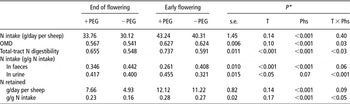
OMD, total-tract N digestibility and N retention were greater (P < 0.001) for silage 2 than for silage 1 (Table 3). PEG addition affected OMD in sheep fed silage 1 (P < 0.01), but no differences were found for silage 2.
Total-tract OM and N digestibility, N losses and N retention for sheep fed silage at the end of flowering and early flowering with (+) or without (−) the addition of PEG in the rumen (n = 6 for each treatment)

OM = organic matter; N = nitrogen; PEG = polyethylene glycol; T = treatment; Phs = phenological stage; T × Phs = interaction between T and Phs; OMD = OM digestibility.
*Probability of significant effects due to the T, Phs and T × Phs in the analysis for wrapped big bales sainfoin.
Total-tract N digestibility increased markedly with the addition of PEG (P < 0.001) at both phenological stages. The amount of N retained was not significantly affected by PEG addition (P > 0.05), which, however, increased N excretion in urine (P < 0.05) and decreased faecal N excretion (P < 0.001).
Rumen fluid composition
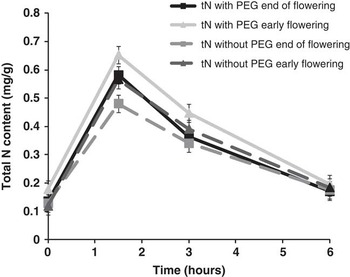
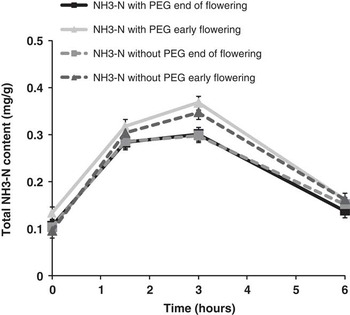
The greatest rumen NH3-N and N concentration was recorded at the sampling point of 1.5 h after feeding and decreased until 6 h after feeding (Figures 2 and 3), and was greater (P < 0.001) at early flowering than at the end of flowering. VFA concentrations were greater (P < 0.001) at early flowering than at the end of flowering, whereas acetate-to-propionate ratio was greater (P < 0.001) at the end of flowering (Table 4). Addition of PEG did not change the concentration of tN and NH3-N in the rumen fluid compared with feeding sainfoin silage without PEG (Table 4). The addition of PEG had no significant effect on VFA concentration. Acetate-to-propionate ratio was decreased by the addition of PEG (P < 0.01).
Evolution of the concentration (mg/g) of total nitrogen (tN) in the rumen fluid for silages 1 and 2 with or without addition of polyethylene glycol (PEG) in the rumen, before the morning meal (T0) and 1.5, 3 and 6 h after the meal.

Evolution of the concentration (mg/g) of ammonia nitrogen (NH3-N) in the rumen fluid for silages 1 and 2 with or without addition of polyethylene glycol (PEG) in the rumen, before the morning meal (T0) and 1.5, 3 and 6 h after the meal.

Mean concentration of tN (mg/g), NH3-N (mg/g) and VFA (mmol/l) in the rumen fluid of sheep fed silage at the end and early flowering with (+) or without (−) the addition of PEG in the rumen

tN = total nitrogen; NH3-N = ammonia nitrogen; VFA =volatile fatty acids; PEG = polyethylene glycol; T = treatment; Phs = phenological stage; T × Phs = interaction between T and Phs.
*Probability of significant effects due to T, Time, Phs and T × Phs in the analysis for sainfoin silages.
Mean values were calculated from the measurements before the morning meal (T0) and 1.5, 3 and 6 h after the meal.
In situ DM and N degradability in the rumen
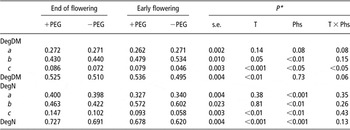
There was no difference in DegDM between the two phenological stages (Table 5). In contrast, there was an effect of phenological stage on the DegN of sainfoin. The latter was greater at the end of flowering than at early flowering (P < 0.001). Addition of PEG significantly increased the DegDM (P < 0.01) and DegN (P < 0.001) of sainfoin silages. For both DM and N, the soluble fraction ‘a’ and the potentially degradable fraction ‘b’ were unaffected by PEG addition, in contrast to the degradation rate ‘c’, which was increased (P < 0.001).
In situ ruminal DegDM and DegN of silage at the end of flowering and early flowering with (+) or without (−) the addition of PEG in the rumen

DegDM = degradability of dry matter; DegN = degradability of nitrogen; PEG = polyethylene glycol; T = treatment; Phs = phenological stage; T × Phs = interaction between T and Phs; a = rapidly degradable fraction; b = slowly degradable fraction; c = degradation rate of fraction b.
*Probability of significant effects due to T, Phs and T × Phs in the analysis for sainfoin silages.
DegDM or DegN was calculated with a passage rate of 0.06/h.
Discussion
Despite the importance of forage legumes (i.e. sainfoin) in the livestock production systems and their potential for improving protein self-sufficiency, there are only few experiments in the literature that focus on conserved tanniniferous legume forages.
Chemical composition and fermentation profiles of silages
N concentration in the sainfoin silages was greater at the early flowering stage, which is in accordance with the lower cell wall concentration (NDF) than at the end of flowering. Comparative results were reported by Scharenberg et al. (Reference Scharenberg, Arrigo, Gutzwiller, Wyss, Hess, Kreuzer and Dohme2007) for sainfoin silage at the early flowering stage, although N and cell wall concentration were even greater and smaller than ours, respectively. This difference appeared perhaps because of the presence of 14.5% of dandelion in their study. CTs are considered beneficial for silage fermentation, as they protect forage proteins from degradation (Salawu et al., Reference Salawu, Acamovic, Stewart, Hvelplund and Weisbjerg1999) by inhibiting plant and microbial enzymes and/or by forming complexes with proteins (Waghorn, Reference Waghorn2008). Forages containing CT undergo less ensilage-process proteolysis and less transformation of their plant protein N into NPN compared with forages without CT (Albrecht and Muck, Reference Albrecht and Muck1991; Fraser et al., Reference Fraser, Fychan and Jones2000). The values for NH3-N, soluble N and acetic acid in the juice of sainfoin silages indicated a good-quality conservation according to the Dulphy and Demarquilly classification (Reference Dulphy and Demarquilly1981). The smaller amount of NH3-N, soluble N and acetic acid in silage 2 could indicate a less-extensive N degradation due to greater binding tannins effect. The NH3-N and soluble N levels (expressed in %N) reported by Dentinho et al. (Reference Dentinho, Bessa, Belo and Ribeiro2006) on sulla (Hedrysarum coronarium L) silages were lower than those in our study (5.85 v. 6.43 for NH3-N and 21.8 v. 40.95 for soluble N), despite similar N concentrations. However, Cavallarin et al. (Reference Cavallarin, Antoniazzi, Borreani and Tabacco2005) found high NH3 levels (>12%N) in sainfoin silages, possibly because of clostridial activity and enterobacteria, although tannins are known to reduce the activities of silage bacteria and moulds (Guo et al., Reference Guo, Zhou, Yu and Zhang2007). Albrecht and Muck (Reference Albrecht and Muck1991) found that the level of non-protein N in different legume silages was negatively correlated to tannin concentration, and especially sainfoin silage showed almost constant values ranging from 350 to 430 g/kg N, in agreement with our results.
In our study, CT activity, at both phenological stages, was smaller in sainfoin silages compared with the results obtained by Theodoridou et al. (Reference Theodoridou, Aufrère, Andueza, Pourrat, Le Morvan, Stringano, Mueller-Harvey and Baumont2010) on the corresponding sainfoin fresh forages. Moreover, at the same phenological stage (end of flowering) total CT concentration (extractable and non-extractable) in sainfoin silages was lower than the corresponding fresh forage as found previously by Theodoridou et al. (Reference Theodoridou, Aufrère, Andueza, Pourrat, Le Morvan, Stringano, Mueller-Harvey and Baumont2010). Our last mentioned result contrasts the results obtained by Minnee et al. (Reference Minnee, Woodward, Waghorn and Laboyrie2002) on Lotus corniculatus and Hedysarum coronarium and by Scharenberg et al. (Reference Scharenberg, Arrigo, Gutzwiller, Wyss, Hess, Kreuzer and Dohme2007) on sainfoin, who reported that total CT concentration is not affected by ensiling. However, they reported that the amount of ‘free’ CTs (CTs not in complex with other molecules) was markedly reduced in ensiled forages. The remaining CT was ‘bound’ to other molecules (protein or fibre). This alteration in proportions is believed to be due to the ensiling process causing cell rupture and release of the CT from the plant cells, allowing them to bind with other molecules (Minnee et al., Reference Minnee, Woodward, Waghorn and Laboyrie2002).
In vivo digestibility and N balance
The in vivo digestibility coefficients of sainfoin silages (0.541 and 0.624 at the end of flowering and early flowering, respectively) were smaller compared with the results on corresponding fresh forages (0.607 and 0.654) observed by Theodoridou et al. (Reference Theodoridou, Aufrère, Andueza, Pourrat, Le Morvan, Stringano, Mueller-Harvey and Baumont2010). Demarquilly et al. (Reference Demarquilly, Dulphy and Andrieu1998) stated that conservation as wrapped silage reduces digestibility because of forage wilt.
In this study, the stage of flowering was confounded by the stage of growth. The great differences in in vivo digestibility between end and early flowerings were not only due to the effect of the phenological stage but also due to the vegetation cycle. Theodoridou et al. (Reference Theodoridou, Aufrère, Andueza, Pourrat, Le Morvan, Picard, Stringano, Mueller-Harvey and Baumont2011) showed that in a comparison of three fresh sainfoin varieties, studied during the first and second vegetation cycles, at the same phenological stage, pepsin–cellulase digestibility, N content and biological activity of CT were greater at regrowth. Therefore, in our results, the greater OMD at regrowth can be also explained by the effect of the vegetation cycle.
In vivo digestibility without PEG was smaller than the one found by Demarquilly and Jarrige, (Reference Demarquilly and Jarrige1973; 0.660), but similar to the values reported by Scharenberg et al. (Reference Scharenberg, Arrigo, Gutzwiller, Wyss, Hess, Kreuzer and Dohme2007; 0.608) and Arrigo (Reference Arrigo2009; 0.637) in sainfoin silages and by Dentinho et al. (Reference Dentinho, Bessa, Belo and Ribeiro2006) in sulla haylage (0.596).
Addition of PEG did not affect in vivo digestibility at the early flowering stage. This contrasts with Scharenberg et al. (Reference Scharenberg, Arrigo, Gutzwiller, Wyss, Hess, Kreuzer and Dohme2007) who poured a solution of PEG onto sainfoin silage at the early flowering and obtained an increase in digestibility from 0.608 to 0.644.
Tannins decreased total-tract N digestibility from 0.591 at early flowering to 0.548 at the end of flowering. These values are in line with Arrigo (Reference Arrigo2009) who reported a total-tract N digestibility of approximately 0.60. Fraser et al. (Reference Fraser, Fychan and Jones2000) on sainfoin silage and Dentinho et al. (Reference Dentinho, Bessa, Belo and Ribeiro2006) on sulla haylage found low total-tract N digestibility, which led to a negative N balance. In this study, in vivo N digestibility of the whole digestive tract was smaller for sainfoin silages than the corresponding fresh forages, (Theodoridou et al., Reference Theodoridou, Aufrere, Andueza, Montet and Baumont2008), leading to a greater N quantity in the faeces, despite similar N intake.
PEG addition significantly increased (P < 0.001) total-tract N digestibility, thus confirming the presence of active CT in the silages. The typical effect of CT on the partitioning of N losses was demonstrated in this study with an increase in faecal N excretion and a decrease in urinary N excretion, in agreement with Hervás et al. (Reference Hervás, Frutos, Ramos, Giráldez and Mantecón2004) and Waghorn (Reference Waghorn2008). Our results on N losses fit with those obtained on the same fresh studied forages (Theodoridou et al., Reference Theodoridou, Aufrere, Andueza and Baumont2009). The smaller differences between the treatment (with and without PEG) observed for total-tract N digestibility, N in faeces and in urine at the end of flowering were related to smaller biological activity and concentration of CT at that phenological stage.
An important result for animal nutrition was that N retention (expressed in g/g N intake or in g/day per sheep) was not affected by the addition of PEG, and thus by the presence of active CT. As a result of greater N intake and digestibility, N retention was greater for the less mature forage.
In situ DM and N degradability in the rumen
The CT effect on DM and N degradability in the rumen could be evaluated by the addition of PEG. This effect could be explained by the combination of the reduction in the rate of degradation of potentially degraded material together with the capacity to bind protein or fibre (Aharoni et al., Reference Aharoni, Gilboa and Silanikove1998). The same is confirmed by our results, as PEG affected rate of degradation and effective degradability for DM and N. Sainfoin silage DegN harvested at early flowering was close to fresh sainfoin DegN harvested at vegetation and early flowering measured by Aufrère et al. (Reference Aufrère, Dudilieu and Poncet2008; 0.591 to 0.625, respectively). In our study, DegN measured without PEG at early flowering (0.620) was not only smaller than other varieties sainfoin silages DegN (Ambra: 0.657 and Sepial: 0.696; Theodoridou et al., Reference Theodoridou, Aufrere, Andueza, Montet and Baumont2008), but also smaller than that measured on sulla by Dentinho et al. (Reference Dentinho, Bessa, Belo and Ribeiro2006; 0.742).
In our study, the smaller DegN at early flowering than at the end of flowering was related to greater CT concentration at the early flowering stage and may be partially explained from the fact that less soluble N was present in that silage.
Rumen fluid composition
The average tN and NH3-N concentration in the rumen fluid tended to decrease with plant maturity in relation with a less greater N concentration, which was consistent with Kawas et al. (Reference Kawas, Jorgensen and Lu1990) and Aufrère et al. (Reference Aufrère, Graviou, Baumont, Detour and Demarquilly2000), on lucerne. tN and NH3-N concentration remained greater in sainfoin silages than in the corresponding fresh forages (means of 0.24 mg/g silages v. 0.19 mg/g fresh forages; Theodoridou et al., Reference Theodoridou, Aufrere, Andueza, Montet and Baumont2008), despite similar forage N concentration. PEG addition did not significantly increase tN and NH3-N concentration in the rumen fluid, and this could be attributed to a decrease in the amount of ‘free’ CTs and an increase of CT bound to fibre during ensiling resulted in less CT available bind to PEG. During all sampling times, although PEG addition tended to lessen tN at both phenological stages, NH3-N concentration tended to be smaller only at early flowering.
It needs to be noted that, in this study, the effect of PEG is confounded with day of sampling. The more important factors that affect the composition of ruminal fluid content are the variation along the day, level of intake and forage preservation (Rémond et al., Reference Rémond, Brugère, Poncet and Baumont1995). In our study, the variation of the composition of the ruminal content along the day was taken into account. The effect of other previously mentioned factors was small, as the forages were given in limited quantity and sheep were offered on a daily basis the same quantity of sainfoin in two equal meals. Moreover, the variation of silage preservation quality was negligible during the sampling days (results not shown).
Numerous papers have suggested that CT concentration below 50 g/kg DM in the diet does not have important effects on ruminal fermentation (Barry and McNabb, Reference Barry and McNabb1999; Salawu et al., Reference Salawu, Acamovic, Stewart, Hvelplund and Weisbjerg1999). In our study, the CT concentration was smaller than the recommended values, which vary according to laboratory methods used for CT analysis and may not be applicable for all forages (Mueller-Harvey, Reference Mueller-Harvey2006).
Makkar et al. (Reference Makkar, Blummel and Becker1995) and Waghorn and McNabb (Reference Waghorn and McNabb2003) explained that high CT concentration leads to smaller VFA concentration in the rumen because of the increase in rumen pool size caused by the slower rate of ruminal digestion. Our study recorded a decrease in DegDM by the presence of CT, but no decrease in VFA concentration. Moreover, acetate-to-propionate ratio was decreased by PEG addition (P < 0.01), which is in agreement with Ben Salem (Reference Ben Salem1998) on acacia but in contrast with Yáñez Ruiz (Reference Yáñez Ruiz, Moumen, Martín García and Molina Alcaide2004) on olive cake.
Conclusion
The results of this study indicated that sainfoin preserved as silages may provide forages that combine good energy and N value. The CTs in sainfoin-made silage at early flowering did not reduce the forage digestibility. In sainfoin conserved as wrapped silage, CTs decreased total-tract N digestibility but not N retention, a result that is beneficial for the animal. CTs greatly increased the in situ estimates of forage N escaping from the rumen, which could be beneficial for animal nutrition, in terms of flow of dietary N. Moreover, CTs increased faecal N and decreased N losses in urine. In contrast with the ensiling process of tannin-free legumes, sainfoin has great potential in animal nutrition and may be used by farmers. The beneficial action of CTs is not reduced by this mode of conservation and CTs are able to prevent proteolysis. Further studies on preserved tanniniferous forages are required in order to identify the mode of action of CT during ensiling and the optimum levels of CT concentration.
Acknowledgements
This study was supported by the EU Marie Curie Research Training Network ‘HealthyHay’ (MRTN_CT-2006-035805). The authors thank Bernard Debotte and his staff for growing and harvesting the forages. They also thank all the staff at the ‘Annexe Elevage’ experimental farm who took care of the animals, plus Jean-Marie Ballet and Eric Villeneuve and the laboratory staff of INRA's Herbivores Research Unit (RAPA research group) for their assistance with the fieldwork and laboratory analyses.