INTRODUCTION
Hope is important for palliative care patients and has been associated with their psychospiritual well-being (Kylmä et al., Reference Kylmä, Duggleby and Cooper2009; Lin & Bauer-Wu, Reference Lin and Bauer-Wu2003; Sinclair et al., Reference Sinclair, Pereira and Raffin2006). The existential being of hope, described as “living with hope,” has been distinguished from hope as a goal-oriented phenomenon (Kylmä et al., Reference Kylmä, Duggleby and Cooper2009). Patients may lose hope but find new hope when they are able to alter their perceptions and see positive possibilities (Duggleby et al., Reference Duggleby, Hicks and Nekolaichuk2012; Kristiansen et al., Reference Kristiansen, Irshad and Worth2014; Philip et al., Reference Philip, Gold and Brand2012; Schaufel et al., Reference Schaufel, Nordrehaug and Malterud2011). In addition, despair and hopelessness include the word “hope” in several languages and are therefore related, although these concepts have been defined in various ways (Kylmä, Reference Kylmä2005; Nekolaichuk et al., Reference Nekolaichuk, Jevne and Maguire1999; Paley, Reference Paley2014; Steinbock, Reference Steinbock2007; Sullivan, Reference Sullivan2003).
Hope, hopelessness, and despair may change over time. These changes may be understood in terms of staged models, in which, for instance, despair may be followed by hopelessness or hope. However, staged models have normative end stages, and they may turn people in directions they would rather avoid (Corr, Reference Corr1993; Day, Reference Day and Hermans2002). Recent qualitative studies suggest that palliative care patients are able to, and do, live with contradictions around hope: like hope for cure and preparation for death (Robinson, Reference Robinson2012), or the coexistence of hope and hopelessness (Sachs et al., Reference Sachs, Kolva and Pessin2013). A description of hope, hopelessness, and despair that acknowledges these contradictions and helps to understand them over time is lacking in the literature.
The objective of our study was to describe hope, hopelessness, and despair over time, as experienced by palliative care patients. The central question was: “How can palliative care patients' hope, hopelessness, and despair be understood over time?” The results of our study may help healthcare professionals to recognize patterns of hope, hopelessness, and despair in their patients over time. Healthcare professionals may also better recognize hopelessness in severely ill patients, which has been associated with negative health outcomes, like depression (Davidson et al., Reference Davidson, Dracup and Phillips2007; Lemay & Wilson, Reference Lemay and Wilson2008; O'Brien & Moorey, Reference O'Brien and Moorey2010). In addition, while hope has been perceived as a barrier for end-of-life discussions (Barclay et al., Reference Barclay, Momen and Case-Upton2011; Clayton et al., Reference Clayton, Hancock and Parker2008; Garland et al., Reference Garland, Bruce and Stajduhar2013), the results of our study may encourage healthcare professionals to address death and dying while at the same time acknowledging patients' hopes.
METHOD
A qualitative longitudinal approach was employed, which enables understanding of change over time (Calman et al., Reference Calman, Brunton and Molassiotis2013; Neale & Flowerdew, Reference Neale and Flowerdew2003).
Theoretical Underpinnings
The study was underpinned by narrative and postmodern identity theories, which are able to acknowledge paradoxes in identities and stories (Holstein & Gubrium, Reference Holstein and Gubrium2000; Kaufmann, Reference Kaufmann2005; Ricoeur, Reference Ricoeur1990), and in which voice is a central concept (Hermans & Hermans-Konopka, Reference Hermans and Hermans-Konopka2010; Poirier, Reference Poirier, Charon and Montello2002). These theories approach human beings as relational beings instead of isolated, detached individual entities (Day, Reference Day and Hermans2002; Hermans & Hermans-Konopka, Reference Hermans and Hermans-Konopka2010), which is important because the relational dimensions of hope have been found to be significant (Kylmä et al., Reference Kylmä, Duggleby and Cooper2009).
Data Collection
Semistructured interviews with palliative care patients in The Netherlands were conducted, audiotaped, and transcribed. The researchers purposively sampled aiming at diversity in gender, age, place of residence, and disease. The following diseases were chosen because they are some of the most prevalent causes of death in Western countries and because they follow different illness trajectories (Murray et al., Reference Murray, Kendall and Boyd2005): severe heart failure (HF), New York Heart Association (NYHA) class III or IV; severe chronic obstructive pulmonary disease (COPD), global initiative for chronic obstructive lung disease (GOLD) stage 3 or 4; and incurable cancer. Physicians, nurses, and chaplains working in different healthcare settings were informed about the sampling strategy and asked to approach eligible participants. During the process of inclusion, healthcare professionals were informed about groups that were underrepresented, like very old patients or patients with severe HF.
Based on the literature and three pilot interviews, a topic list with open-ended questions was developed. Interviews began with the interviewer asking “Could you tell me what your first ideas were when you heard about the topic of this research: hope?” In some instances, we varied this question, for example, when participants had stated prior to the interview that they found it a difficult topic because they experienced “a lack of hope.” Topics also included questions about hopelessness and despair. (See Appendix 1 for the topic list.)
Hospice patients were interviewed every month because of their limited prognosis, whereas the other participants were interviewed every six months. Participants were interviewed a maximum of three times, and all of them agreed to be called every six weeks. During telephone conversations, they were asked whether something related to their hope, hopelessness, or despair had changed. If this appeared to be the case, another interview was planned earlier than the six-month point (Neale & Flowerdew, Reference Neale and Flowerdew2003). During all stages, memos were discussed within the research team about, for instance, interview setting, research questions, and preliminary findings. In addition, the constant factor of having a single interviewer (EO) established trust between participants and the interviewer, which is an important factor in longitudinal qualitative research (Calman et al., Reference Calman, Brunton and Molassiotis2013).
Research Ethics
According to Dutch law, a review of the study by an ethics committee was not necessary, which was confirmed by the ethics committee at the Academic Medical Center at the University of Amsterdam. Palliative care patients can benefit from participating in such research (Fairhall et al., Reference Fairhall, Reid and Vella-Brincat2012; Terry et al., Reference Terry, Olson and Ravenscroft2006; White & Hardy, Reference White and Hardy2010); however, risks for participants include intrusion into their lives and difficulties arising from serial consent, and the main researcher is faced with the potential for emotional distress (Calman et al., Reference Calman, Brunton and Molassiotis2013; Murray et al., Reference Murray, Kendall and Carduff2009). The risks and benefits were discussed within the research team. Being an experienced nondenominational chaplain in psychiatry as well, the main researcher easily attuned to participants' needs.
Eligible participants were informed orally and by letter about the study, and terms like “palliative care” were avoided in order not to confront participants with medical information. Participants signed an informed consent form. In the few cases where they were unable to do so, the form was read aloud and participants gave their consent orally, which was audiotaped, and a witness confirmed their voluntary participation. The main reasons for nonparticipation or dropout were death and fatigue. The interviewer regularly checked the status of the participant during interviews, and, when possible, the last interview included an evaluation of the interview process.
Data Analysis
Hope and its derivatives were not defined prior to the study because of the multiplicity of definitions and approaches to hope in healthcare (Eliott, Reference Eliott and Eliott2005; Kylmä et al., Reference Kylmä, Duggleby and Cooper2009; Olsman et al., Reference Olsman, Leget and Onwuteaka-Philipsen2014 b; Olver, Reference Olver2012), but most of all because we wanted to start with the participants' concepts of hope, hopelessness, and despair. Each case was first thematically analyzed by hand, and then the analysis focused on data, in which the terms “hope,” “hopelessness,” or “despair” were used. (See Appendix 2 for an example of the identification of similarities and differences between the concepts.) The three concepts were employed to analyze each case over time. Specific attention was paid to what led to changes within or between the three concepts over time. (For data summaries reflecting the three concepts over time, see Appendix 3.)
The researchers worked together with researchers from different professional backgrounds in order to sharpen their understanding of interview transcripts and their synthesis of findings (Tong et al., Reference Tong, Sainsbury and Craig2007). The first author analyzed all interviews, and researchers with backgrounds in neurology, nursing/sociology, humanistic studies, medicine, ethics, religious studies, and general practice analyzed a total of 18 interviews. Transcripts were sent to participants, and interpretations of transcripts were checked during subsequent interviews and telephone conversations (Calman et al., Reference Calman, Brunton and Molassiotis2013; Tong et al., Reference Tong, Sainsbury and Craig2007). Saturation was reached after approximately 24 participants had been included (i.e., there appeared to be no new themes around the dynamics of hope, hopelessness, and despair). However, in order to further refine our findings, inclusion continued until 29 participants were included.
RESULTS
Participants
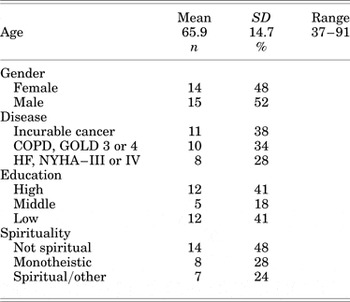
A total of 29 patients were included in our sample (see Table 1 for demographic information). Between December of 2010 and November of 2012, 52 interviews were conducted, each of which lasted around an hour (range 14–101 minutes). The first interview took place at either the participant's home (n = 19), their home-care institution (n = 3), or a hospice (n = 7), and participants were interviewed alone (n = 21) or with someone else present, like their partner (n = 8). The present paper only highlights patients' stories. Some 17 participants were interviewed a second time, after an average of 6.9 months (range 0.5–13 months), and 6 were interviewed for a third time after an average of 5.3 months (range 1.5–8 months).
Characteristics of participants (N = 29)

COPD = chronic obstructive pulmonary disease; GOLD = global initiative for chronic obstructive lung disease; HF = heart failure; NYHA = New York Heart Association.
Hope, Hopelessness, and Despair
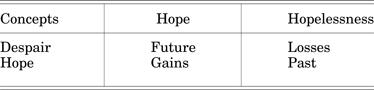
Similarities and differences between hope, hopelessness, and despair were found, which are presented in Table 2. These characteristics will be elucidated in the following paragraphs.
Characteristics of hopelessness and despair

Hope: Gains in the Future and the Past
Participants hoped for a future gain, like spending time with others or physical improvement. One participant stated, “You've got the hope to experience certain events, to see your grandchild growing, to stay longer with him [partner]” (female, 60, cancer). Another participant favored the zoo and the market: “You hope that you're able to do these things several times again” (female, 37, HF). Another explained, “I just hope that I will gain many more years” (male, 60, cancer).
Participants also spoke about hope in relation to the past, which expressed how they had received hope as a gift. One participant looked back on beautiful experiences in his life: “That is hope that isn't oriented toward something in the future but more a feeling of hope that you get by looking back” (male, 60, cancer). The treatments of another participant had been effective for a long period: “It was stable. And then you get hope” (female, 60, cancer). Another had received love and care from his children, which he described as hope: “My children are my hope. (. . .) They are so close to my heart” (male, 88, HF).
Hopelessness: Losses in the Past
Participants associated hopelessness with past losses, which ultimately meant that they had lost their (meaningful) future. One participant concluded that he felt constantly hopeless because he had lost several family members: “And I lost my job. Well, you know, I've got social security benefit, so [I lost] my income. My health.” (male, 63, HF). Another participant felt hopeless often because there had been no curative treatments available: “So the hospital has already written me off as well” (female, 60, COPD). Particularly participants with COPD and some with HF had experienced hopelessness. One participant defined hopelessness as follows: “If you feel hopeless, you're not up to anything at all. You don't do anything. You just remain seated, and then you easily sink down” (male, 69, COPD).
Despair: Losses in the Future
Participants related despair to possible future losses, ultimately indicating the risk of losing the future itself: “Well, I really despaired—that's the way to put it. I thought, ‘This has been my life. I won't manage anymore. I'm losing the fight’” (female, 50, COPD). Another stated that despair would be further metastasis of his tumor: “Despair in my situation would be that they make the diagnosis that it [treatment] doesn't work anymore, and that it will start to metastasize” (male, 60, cancer). Several participants expressed the uncertainty of the future when talking about despair: “I've got moments of fear, moments of despair, like: ‘Oh, my god, where will this lead to?’ Because you don't know anything” (female, 51, cancer). Some participants described despair as lasting shorter than hopelessness, though the findings were not univocal in this regard.
Dynamics of Hope, Despair, and Hopelessness
Participants often associated the dynamics between hope, despair, and hopelessness with changes in their physical condition. The metaphor of a singing choir is helpful in understanding these dynamics, in which hope, despair, and hopelessness are three voices. (For data summaries reflecting the three voices over time, see Appendix 3.)
Coexisting Voices
Over time, the voices could coexist, and they sometimes mutually reinforced each other. One participant expressed how despair and hope for cure mutually reinforced each other. She compared her situation with being thrown into the sea: “I'll have to go to the bottom of the sea. But I hope against hope, which is of course in desperation. But I still have hope for reaching the surface” (female, 51, cancer). In another participant's story, hopelessness coexisted with hope. During “bad days” he felt hopeless, which made him hope for a better day tomorrow: “Today it may be good, and tomorrow it may be bad. Often it is bad. And then I always hope that tomorrow will be better” (male, 61, COPD).
Alternating Voices
Hope could also alternate with despair or hopelessness. One participant told how he had experienced despair when he was about to lose his life: “That's why I say hope played no role. It was despair because they tell you your death sentence” (male, 76, HF). However, some months later he physically improved. He drew hope from the geriatrician, who confirmed his experiences: “Hope is that the geriatrician hasn't said, ‘This stuff is ready for the scrap heap.’” He started to take nutritional supplements: “You hope for that future!” Another participant (female, 48, cancer) had received the message that the heavy treatment had had no effect: “Well, you hope that there will be a bit of positivity. But well, then it's a very raw deal when you hear that it has had no effect.” The days after that she felt hopeless. However, her hope increased when she was about to start a next course of chemotherapy: “Monday I will start with a new chemotherapy. Then you try to find the hope to go for it.”
Unrelated Voices
Hope, hopelessness, and despair could also be understood as coexisting voices singing unrelated melodies, without attuning to each other. One participant reported that his situation, from a medical point of view, was hopeless. However, he and his wife hoped for a miracle cure through God's intervention: “From the first day onwards there is hope” (male, 39, cancer). Another expressed how he kept hope apart from hopelessness and fear: “Hope just stays the same. It remains hope because I separate it. If I wouldn't separate it, I would feel insecure about that hope” (male, 60, cancer).
DISCUSSION
The results of our study suggest that palliative care patients relate hope to a gain in the past or future, despair to a future loss, and hopelessness to a past loss, and that over time their physical condition plays a central role in the dynamics of hope, hopelessness, and despair. Our findings also suggest that over time the three concepts can be best understood as singing voices in a choir.
One of the strengths of our study is its longitudinal character, which allowed the researchers to do member checking with participants. Another strength is that it reflects the tendency to increasingly include non-cancer-patient populations in palliative care research (Embrey, Reference Embrey2008; Jaarsma et al., Reference Jaarsma, Beattie and Ryder2009). However, future studies in other patient groups, like those suffering from progressive neurological diseases, are necessary to revise or confirm our findings. Our study was also limited in that it only included Dutch patients, which restricts its generalizability to other cultures. Future studies should therefore examine hope, hopelessness, and despair in other languages and cultures. In addition, our study focused on hope, hopelessness, and despair, and future research should examine relationships with other themes, such as acceptance, fear, and faith.
Some of our findings are in line with those of other studies. For example, loss as characteristic of despair has been reported by a synthesis study on hope and despair within the context of human immunodeficiency virus (Kylmä, Reference Kylmä2005), and “losing” and “receiving” may reflect our findings of losses and gains (Kylmä et al., Reference Kylmä, Vehvilainen-Julkunen and Lahdevirta2001). The coexistence of contradicting concepts, in addition, has been found in terminally ill cancer patients (Sachs et al., Reference Sachs, Kolva and Pessin2013), and an association between changes in physical condition and changes in hope has been reported by several others (Duggleby et al., Reference Duggleby, Hicks and Nekolaichuk2012; Hsu et al., Reference Hsu, Lu and Tsou2003; Kristiansen et al., Reference Kristiansen, Irshad and Worth2014).
The temporal dimensions of hope, hopelessness, and despair, in addition, suggest that, while living in the present and telling their story, palliative care patients connect their past and future. This may be in line with the difference found by a synthesis study on hope in palliative care that found two overarching themes of patients' hope that were not separate contents: hoping for something as future- and goal-oriented phenomena, and living with hope, which included the presence of confirmative relationships (Kylmä et al., Reference Kylmä, Duggleby and Cooper2009). Future studies should further scrutinize the temporal dimensions of hope, hopelessness, and despair. In this regard, narrative analyses may be particularly helpful because of their focus on the temporal dimensions of stories (Ricoeur, Reference Ricoeur1990, pp. 5–30).
Our findings also suggest that particularly patients with severe COPD or severe HF may suffer from hopelessness. Hopelessness has been associated with depressive symptoms, and these symptoms are indeed common in patients with severe COPD or HF (Curtis, Reference Curtis2008; Disler et al., Reference Disler, Green and Luckett2014; LeMond & Allen, Reference LeMond and Allen2011; Seamark et al., Reference Seamark, Seamark and Halpin2007). In addition, hope has often been interpreted as a barrier to end-of-life discussions (Barclay et al., Reference Barclay, Momen and Case-Upton2011; Clayton et al., Reference Clayton, Hancock and Parker2008; Garland et al., Reference Garland, Bruce and Stajduhar2013), and healthcare professionals may not begin end-of-life discussions because they are afraid of triggering anxiety and depression in their patients (Low et al., Reference Low, Pattenden and Candy2011, p. 243). However, the results of our study suggest that palliative care patients may hope for cure while acknowledging that they are approaching death, which has also been found in other previous work (Robinson, Reference Robinson2012). The metaphor of a singing choir may support healthcare professionals in attuning to hope, hopelessness, and despair in their patients (Olsman et al., Reference Olsman, Duggleby and Nekolaichuk2014 a; Penz & Duggleby, Reference Penz and Duggleby2011).
Contrary to the staged models of coping with dying (Corr, Reference Corr1993), approaching hope, hopelessness, and despair as voices in the stories of patients offers possibilities for healthcare professionals to recognize dominant voices and see how voices are separated from or resonate with each other (Hermans & Hermans-Konopka, Reference Hermans and Hermans-Konopka2010; Poirier, Reference Poirier, Charon and Montello2002). For example, when hope for cure is a dominant voice in patients' stories, healthcare professionals may say, “I understand that this hope for cure (or improvement) is very important for you. Would it be okay for you to talk once or twice about other scenarios?” Questions like this one are important when patients have experienced physical changes, which, as our findings suggest, may lead to changes around hope, hopelessness, and despair.
In conclusion, the results of our study have reinforced the understanding of hope, despair, and hopelessness over time, as experienced by palliative care patients. These results offer new possibilities for clinical practice, and future studies should provide healthcare professionals with tools they can employ to attune to hope, hopelessness, and despair in their palliative care patients. Future studies should also evaluate the use of these tools in clinical practice, ultimately leading to better care for people in the last phase of their life.
DISCLOSURES AND ACKNOWLEDGMENTS
This work was funded by ZonMw (grant number 1151.0013), Netherlands Organization for Health Research and Development. The authors state that they have no conflicts of interests to declare.
SUPPLEMENTARY MATERIALS AND METHODS
The supplementary material referred to in this article can be found online at journals.cambridge.org/pax.
APPENDIX 1
Topic List
The topic list was based on the literature and three pilot interviews. This paper mainly focuses on the results of topics 1–3.
-
1. Opening
-
a. Could you tell me what your first ideas were when you heard about the topic of this research: hope?
-
b. Answers (and stories) were further explored by explorative questions: “What do you mean by . . .?” “Could you tell something more about . . .?” etc.
-
-
2. Concept of hope
-
a. What does hope mean for you, and what is its relation to hopelessness or despair?
-
b. Are there other themes related to hope?
-
-
3. Dynamics of hope
-
a. Have there been changes in your hope?
[Prompts:] If yes, in what way? Did your hope, for example, increase, decrease, or remain the same? Could you tell me more about that?
-
b. Have there been changes in your hopelessness?
[Prompts:] If yes, in what way?
-
c. Have there been changes in your despair?
[Prompts:] If yes, in what way?
-
d. Did other themes play a role in these changes?
[Prompts:] If yes, which themes?
-
-
4. Social dimensions of hope
-
a. What is the role of other persons in your hope?
[Prompts:] Which actions, responses, or relationships help you to keep hope? Who threatens your hope? How did others respond to [changes in] your hope?
-
b. Is hope the same for you, your family, and healthcare professionals? If not, in what way is it different, and how do you deal with that difference? If yes, how do you notice that it is the same?
-
-
5. Ethics of hope
-
a. What do you see as a good way of dealing with [changes in] hope?
-
b. What do you see as a good way of dealing with hopelessness?
-
c. What do you see as a good way of dealing with despair?
[Prompts:] Could you give an example? Could you tell me more about that?
-