Introduction
Junglerice and feather fingergrass are summer weeds widely distributed throughout Australia. These species are major weeds in sorghum, cotton (Gossypium hirsutum L.), and other summer crops grown across the subtropical region of Australia (Walker et al. Reference Walker, Michael, Andrew and Vikki2004; Werth et al. Reference Werth, Boucher, Thornby, Walker and Charles2013). In 2008 and 2010 survey reports, feather fingergrass was ranked in the top 20 problematic weeds of Australia’s northern cropping region (Werth et al. Reference Werth, Boucher, Thornby, Walker and Charles2013). In another survey, it was the third most common weed in a summer fallow of Australia (Widderick et al. Reference Widderick, Cook, McLean, Churchett, Keenan, Miller and Davidson2014). More recently in Australia, feather fingergrass was found in the top 10 weeds of the national ranking and in the top four weeds of the northern grain region ranking (Llewellyn et al. Reference Llewellyn, Ronning, Ouzman, Walker, Mayfield and Clarke2016). In Australia, total grain yield loss due to feather fingergrass and junglerice is estimated to be 39,329 and 77,734 t, respectively (Llewellyn et al. Reference Llewellyn, Ronning, Ouzman, Walker, Mayfield and Clarke2016).
Junglerice is also a troublesome weed in Australia during the summer season and is in the top five weeds of the national ranking (Llewellyn et al. Reference Llewellyn, Ronning, Ouzman, Walker, Mayfield and Clarke2016). One of the survey reports for the northern grain region reported it as the most common weed in sorghum in the summer fallow (Walker et al. Reference Walker, Michael, Andrew and Vikki2004). Overreliance on glyphosate for managing these weeds in the no-till system has caused the problem of glyphosate resistance in junglerice (Gaines et al. Reference Gaines, Cripps and Powles2012; Nguyen et al. Reference Nguyen, Malone, Boutsalis, Shirley and Preston2016) and feather fingergrass (Ngo et al. Reference Ngo, Boutsalis, Gill and Preston2017). In the northern grain region of Australia, residual weeds in sorghum cause a loss of AU$ 36 million per annum. Llewellyn et al. (Reference Llewellyn, Ronning, Ouzman, Walker, Mayfield and Clarke2016) found that the majority of these losses were from junglerice, which caused a loss of AU$ 14.6 million, whereas feather fingergrass accounted for a loss of AU$ 7 million.
Weeds compete with crops for moisture, nutrients, light, and space. However, the extent of competition depends on weed density (Dunan et al. Reference Dunan, Westra, Schweizer, Lybecker and Moore1995), weed type, and weed species (Marshall et al. Reference Marshall, Brown, Boatman, Lutman, Squire and Ward2003). Weed emergence time (Dieleman et al. Reference Dieleman, Hamill, Fox and Swanton1996), growth habit, and duration of the competition (Rasool et al. Reference Rasool, Mahajan, Yadav, Hanif and Chauhan2017; Swanton et al. Reference Swanton, Nkoa and Blackshaw2015) influenced the extent of weed-crop competition. Characteristics like tall height (100 to 200 cm tall) and long emergence time of feather fingergrass enable this weed to become competitive, causing substantial seed production (GRDC 2014; Ngo et al. Reference Ngo, Boutsalis, Gill and Preston2017). There is little information available on orghum yield loss with respect to feather fingergrass and junglerice. However, in a closely related species, barnyardgrass [Echinochloa crus-galli (L.) P. Beauv.], Norris (Reference Norris1980) observed a 10% reduction in grain sorghum yield for one barnyard plant m−1 crop row and a 52% reduction in grain sorghum yield for 175 barnyardgrass plants m−1 crop row. One season’s seed production by uncontrolled junglerice and feather fingergrass plants will ensure a high level of infestation in subsequent years. A single plant of feather fingergrass can produce more than 40,000 seeds (Ngo et al. Reference Ngo, Boutsalis, Gill and Preston2017) and junglerice can produce 29,000 seeds (Mutti et al. Reference Mutti, Mahajan and Chauhan2019). Dormancy in junglerice may increase the longevity of viable seeds in soil and, therefore, may carry over its infestation in subsequent years. The persistence of junglerice seeds was reported to be longer in deeper soil layers. The percentage of viable seeds decreased from 80% to 19% at 0 to 2 cm and 46% at 10-cm soil depths after 6 months of burial (Wu et al. Reference Wu, Walker, Osten, Taylor and Sindel2004). Freshly harvested feather fingergrass seeds have dormancy after-ripened of about 2 mo (Ngo et al. Reference Ngo, Boutsalis, Gill and Preston2017). A recent study of seed germination ecology of junglerice in Australia revealed that germination is stimulated under light conditions and seeds could germinate under a wide range of alternating day/night temperatures from 20/10 C to 35/25 C (Mutti et al. Reference Mutti, Mahajan and Chauhan2019). Similarly, in a study from South Australia, seeds of feather fingergrass germinated over a wide temperature range (10 to 40 C) (Ngo et al. Reference Ngo, Boutsalis, Gill and Preston2017). These studies highlighted the potential seedbank problem due to substantial seed production and seed dormancy in junglerice and feather fingergrass.
Weed seeds can be spread by water, birds, agricultural implements, and compost (Barroso et al. Reference Barroso, Navarrete, Sánchez del Arco, Fernandez-Quintanilla, Lutman, Perry and Hull2006; Farmer et al. Reference Farmer, Webb, Pierce and Bradley2017). Feather fingergrass seeds are of light weight and are easily blown by wind; therefore, they have a tendency to spread over a large area (Ngo et al. Reference Ngo, Boutsalis, Gill and Preston2017). The seeds of junglerice could be spread through stock movement, machinery, floods, and movement of feral animals.
In the northern grain region of Australia, summer crops such as sorghum are grown in crop-fallow rotation. Development of glyphosate resistance in these weeds has made fallow control difficult, increasing the detrimental impact that infestations of feather fingergrass and junglerice are having on cropping systems in Australia. The absence of effective summer fallow control of these weeds allows populations to increase and have a greater impact on subsequent summer crops. It is likely that concurrent maturation of sorghum and these annual weeds may result in unintentional harvesting of weed seeds with the crop grain (Walsh et al. Reference Walsh, Newman and Powles2013). During harvest, the collected feather fingergrass and junglerice seeds are expelled from the rear of the harvester in the chaff fraction as it is spread across the harvest swath and into the soil seedbank. The collection of weed seeds during harvest creates the opportunity to use harvest weed-seed control (HWSC) tactics and prevent their input into the weed seedbank. (Walsh et al. Reference Walsh, Newman and Powles2013).
There are a range of HWSC systems now commercially available that effectively target weed seeds during harvest (Walsh et al. Reference Walsh, Newman and Powles2013). However, the efficacy of these systems relies on a high proportion of weed seeds being retained on the plant and collected during harvest. The present study was planned with the objective to evaluate the percentage of junglerice and feather fingergrass seeds retained on the plant above a low practical harvest height at sorghum maturity.
Materials and Methods
Site Description
Field experiments were conducted during the summer growing seasons of 2017–2018 and 2018–2019 (November–March) at the Gatton research farm (27.55°S, 152.34°E) of the University of Queensland, Australia. The soil at the experimental site was medium clay and had a pH of 7.1 and an organic matter of 2.6%.
Experimental Design and Observations
In each year, two separate experiments were conducted in a sorghum crop—one with junglerice and the other with feather fingergrass. Treatments in each experiment were four transplanting times of weeds (0, 2, 4, and 6 wk after crop emergence [WAE]) arranged in a randomized complete block design with three replications. The field was selected with a history of low infestation of junglerice and feather fingergrass.
The field sites were prepared for planting by two passes with a cultivator. Sorghum was planted in 100-cm spaced rows at a density of 7 plants m−2 on November 29, 2017, in the first year and on November 9, 2018, in the second year. Sorghum varieties used in the experiments were Buster with Concep II (safener) in 2017 and imidazolinone-tolerant Elite Sentinel IG (both from Pacific Seeds, Toowoomba, QLD, Australia) in 2018. Weed species were planted in trays filled with a potting mix per respective treatments (0, 2, 4, and 6 WAE) and kept in a screenhouse. For these treatments, the 2017 planting time of weeds in the screenhouse was November 29 (0 wk), December 13 (2 wk), December 27 (4 wk), and January 10 (6 wk). In 2018, the planting time of weeds in the screenhouse was November 9 (0 wk), November 23 (2 wk), December 7 (4 wk), and December 21 (6 wk).
At the two-leaf stage, five plants of each weed species were transplanted between two 1-m length of crop rows. The site was irrigated twice a week over the growing season, depending on rainfall, and harvested on March 26, 2018, and March 3, 2019. Other weeds were controlled using a PRE treatment of 1.0 L ha−1 S-metolachlor (960 g L−1) in 2017; and a POST treatment of 0.75 L ha−1 imazamox (33 g L−1) plus imazapyr (15 g L−1; plus 1 L Hasten oil 100 L−1 water) 2 d before the first transplanting of junglerice and feather fingergrass in 2018. The spots where junglerice and feather fingergrass were to be transplanted were covered with plastic trays prior to spraying to keep these areas herbicide free. Herbicides were sprayed with a CO2-pressurized backpack sprayer equipped with flat-fan nozzles delivering a water volume of 100 L ha−1.
To estimate seed numbers of junglerice and feather fingergrass, lobes in each seed head and rachilla segment (pedicel base) in each lobe were counted. Each of the rachilla segments in the lobe had one seed. The total number of seed heads and number of seed heads greater than 15 cm above the soil surface were counted separately. Although a sorghum crop in Australia typically is harvested just below the panicles, our purpose was to evaluate the highest potential of HWSC; therefore, the crop was harvested at a height of 15 cm from the soil surface.
To estimate seed production per head, two intact seed heads were chosen randomly from each plot above and below the 15 cm height. To estimate the total number of seeds, each rachilla segment (pedicel base) was counted and then averaged to calculate seeds per head. The seeds that were still attached to the rachilla segment at harvest were counted separately to estimate seed loss due to shattering. At harvest, aboveground biomass of weed plants from each plot was bagged separately, dried in an oven at 70 C for 72 h, and weighed. The height of each plant in the respective plot was measured from the base of the plant to the tip of the plant and then averaged.
Statistical Analyses
In a combined analysis of data (i.e., plant height, aboveground biomass, seed head, total seed production, and seed retention) across years, there was no significant (P < 0.05) interaction between years and treatments (weed emergence time); therefore, data were pooled for both years. Data were subjected to ANOVA using the software Elementary Designs Application, version 1.0 Beta (AgriStudy.com: www.agristudy.com) (verified with GENSTAT 16th ed.; VSN International, Hemel Hempstead, United Kingdom). The relationships between weed biomass and percentage of seed retention, as well as between weed biomass and seed production level were assessed using the following linear model (SigmaPlot 13; Systat Software, San Jose, CA):
 $$y = ax + b$$
where y is seed production (seed number plant−1) or seed retention (%) at aboveground biomass x, and b is the slope. The fitness of the selected model was determined using the r value.
All the data met assumptions of normality of residuals and homogeneity of variance. Means were separated using a Fisher protected LSD test at P = 0.05.
Results and Discussion
Junglerice
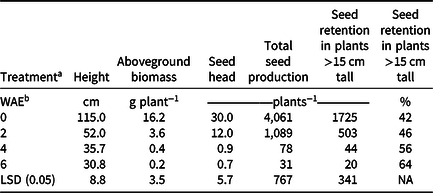
Above the 15-cm harvest height, junglerice retained 42%, 46%, 56%, and 64% of seeds in the 0, 2, 4, and 6 WAE treatments, respectively. Therefore, a substantial amount of junglerice seeds had already dispersed (shed on the surface or tillers lodged below 15 cm) before the crop was harvested in these treatments (Table 1). Seed-head numbers were highest (30 seed heads plant−1) for weeds transplanted at crop emergence, which was reduced by 60% for weeds transplanted at 2 WAE (Table 1). Junglerice plants produced, on average, 4,060 seeds plant−1 when transplanted with the crop emergence (i.e., 0 WAE) and seed production was reduced (P < 0.05) to 1,090, 80, and 30 seeds plant−1 in the 2, 4, and 6 WAE treatments, respectively (Table 1). The number of junglerice seeds in different treatments ranged between 44 and 135 seeds per seed head. Weeds that were transplanted at crop emergence accumulated the greatest aboveground biomass (16.2 g plant−1), which was reduced by 77%, 97%, and 99% for weeds transplanted at 2, 4, and 6 WAE, respectively. Junglerice plants were tallest (115 cm) when they were transplanted at crop emergence, with large reductions (P < 0.05) in plant height for weeds transplanted at 2 and 4 WAE. A similar trend was observed for aboveground shoot biomass.
Characteristics of interest of junglerice in sorghum.

a Abbreviations: NA, not applicable; WAE, wk after emergence.
b WAE of the sorghum crop.
The results of this study revealed that in sorghum, late transplanted seedlings of junglerice produced fewer seeds compared with early transplanted seedlings. These results are similar to those reported in previous studies (Bosnic and Swanton Reference Bosnic and Swanton1997; Chauhan and Johnson Reference Chauhan and Johnson2010; Clay et al. Reference Clay, Kleinjan, Clay, Forcella and Batchelor2005), where late transplanted weeds of junglerice were smaller (biomass) and produced fewer seeds than early transplanted weeds. However, previous results reported on the growth and development of junglerice in rice and corn crops, not for sorghum. The study by Gibson et al. (Reference Gibson, Fischer, Foin and Hill2002) revealed that when junglerice emerged with rice, the weed showed plasticity (i.e., quickly acclimatized) for leaf morphology and biomass partitioning, thereby competing highly for resources with the crop. However, late cohorts of junglerice could not survive and it is likely that weeds were suppressed by the shading effect of the crop.
Feather Fingergrass
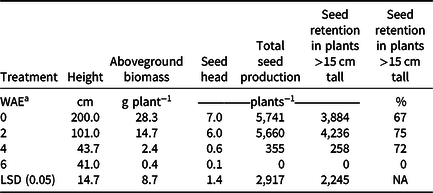
Above 15 cm from the surface, feather fingergrass retained 67% and 75% of the total seeds for seedlings transplanted at 0 and 2 WAE, respectively. These results suggest that HWCS could capture a significant proportion of feather fingergrass seeds in sorghum. The seed-head number of feather fingergrass remained similar (6 to 7 seed heads plant−1) for the weeds transplanted at 0 and 2 WAE; however, this was reduced significantly (approximately 1 seed head plant−1) for late transplanted weeds (4 and 6 WAE) (Table 2).The results clearly indicate that strong competition from sorghum on feather fingergrass started after 2 WAE. Before this, feather fingergrass seedlings were less affected.
Characteristics of interest of feather fingergrass in sorghum.

a Abbreviations: NA, not applicable; WAE: wk after emergence of the sorghum crop.
Feather fingergrass produced 5,660 to 5,740 seeds plant−1 for the first two transplantings. The third transplanting (i.e., 4 WAE) produced only 355 seeds plant−1, and no seeds were produced by the last transplanting (Table 2). The number of feather fingergrass seeds in different treatments varied between 592 to 943 seeds per seed head. The largest reductions in weed height occurred for the late transplanting date compared with 0 WAE; feather fingergrass height was reduced by 50% at 2 WAE (Table 2). Feather fingergrass attained maximum height of 200 cm when it was transplanted at the time of crop emergence; later transplanting dates resulted in progressively shorter plants (Table 2). Similarly, for aboveground biomass of feather fingergrass, the weeds transplanted at 0 WAE accumulated the highest aboveground biomass (28 g plant−1), which was reduced by 48%, 91%, and 99% for the seedlings transplanted at 2, 4, and 6 WAE, respectively.
Our results revealed that the weeds (junglerice and feather fingergrass) transplanted with crop emergence experienced less competition for resources compared with weeds transplanted at a later stage of the crop. Seed production of late emerging weeds of several species of junglerice and rigid ryegrass is affected by competition for light, moisture, and nutrients (Clay et al. Reference Clay, Kleinjan, Clay, Forcella and Batchelor2005; Gibson et al. Reference Gibson, Foin and Hill1999, Reference Gibson, Fischer, Foin and Hill2002; Mahajan et al. Reference Mahajan, Kerry and Chauhan2019). A previous study revealed that the growth and seed production of Palmer amaranth (Amaranthus palmeri S. Watson) under competition was affected by limitation of growth resources, including light (Ballare et al. Reference Ballare, Scopel and Sanchez1990; Jha et al. Reference Jha, Norsworthy, Riley, Bielenberg and Bridges2008). Therefore, it is likely that sorghum shading might have suppressed late transplanted seedlings compared with early transplanted seedlings (0 WAE).
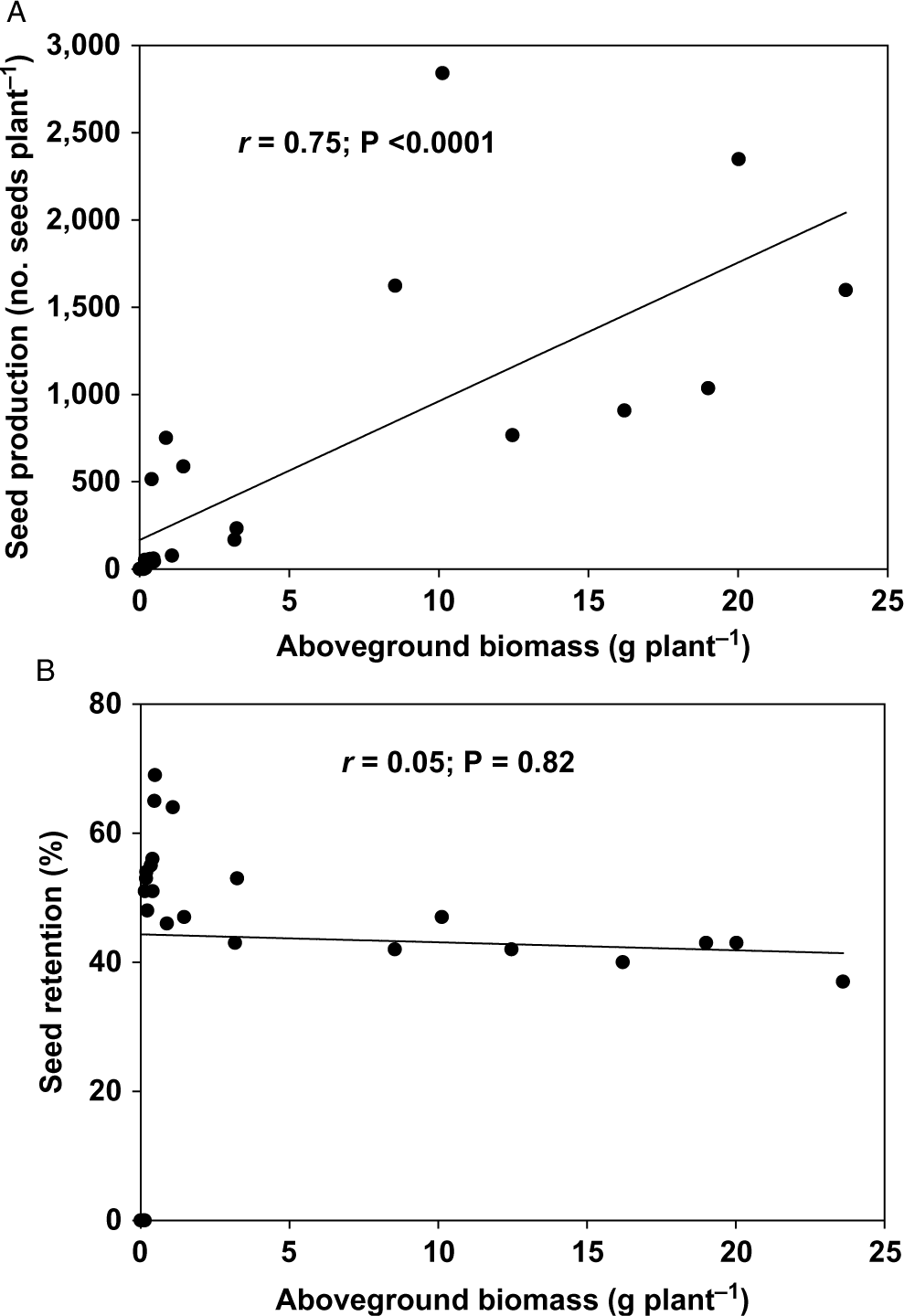
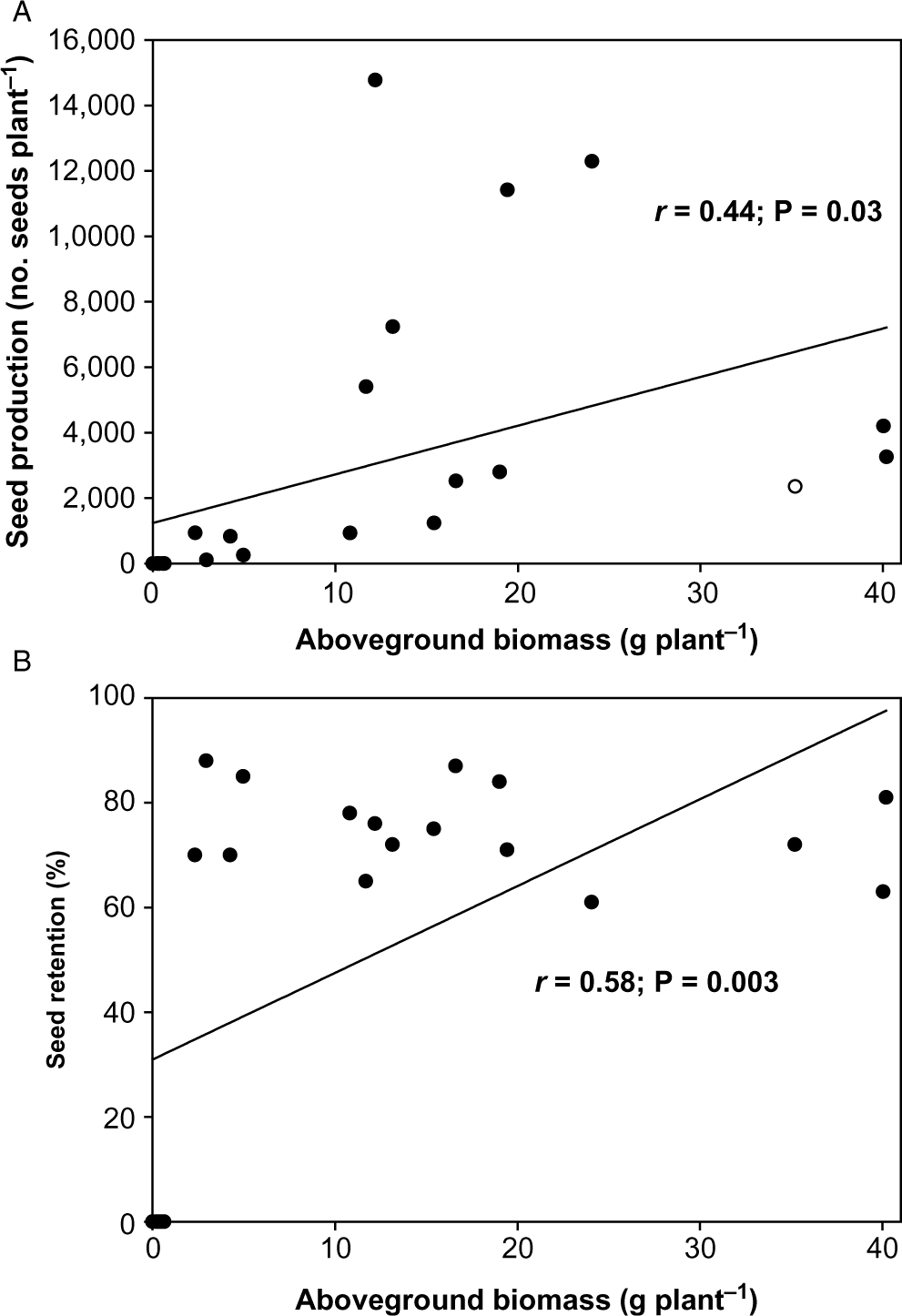
A linear positive correlation was found between aboveground biomass and seed production for junglerice (r = 0.75; P < 0.01) (Figure 1) and feather fingergrass (r = 0.44; P = 0.03) (Figure 2). These results indicate that late-transplanted weed plants were smaller and had lower seed production than early-transplanted weed plants. However, this relationship was not as strong for feather fingergrass. A strong correlation between weed biomass and seed production has been observed in various studies on summer weeds (Schwartz et al., Reference Schwartz, Norsworthy, Young, Bradley, Kruger, Davis, Steckel and Walsh2016; Steckel and Sprague Reference Steckel and Sprague2004; Webster and Grey Reference Webster and Grey2008). Percent seed retention and weed shoot biomass were not correlated in the present study for junglerice (Figure 1). Irrespective of plant size and emergence time, seed retention was high. A positive correlation was found between feather fingergrass biomass and percent seed retention (r = 0.58; P = 0.003), indicating that percent seed retention was greater for larger plants compared with smaller plants (Figure 2). The crop competition effect resulted in the late-transplanted feather fingergrass producing fewer panicles than the early-transplanted plants.
Predicted linear correlations for (A) junglerice biomass and seed production, and (B) for junglerice biomass and seed retention (n = 24).

Correlation between (A) feather fingergrass biomass and seed production, and (B) correlation between feather fingergrass biomass and retention (n = 24).

This study provides knowledge of seed retention for these weeds and could be useful when incorporating HWSC to reduce the amount of junglerice and feather fingergrass seeds replenishing the soil seedbank. In this study, we demonstrated that HWSC has the potential to be successfully reduce the amount of viable seed return of feather fingergrass and, to a limited extent, of junglerice. Late emerging cohorts of junglerice and feather fingergrass did not produce enough biomass and seeds in the sorghum crop. The time from transplanting to maturity of junglerice (approximately 50–60 d [visual observation; unpublished data]) was shorter than that of the sorghum crop (approximately 115 d); therefore, a majority of junglerice seeds had already been dispersed at crop maturity. The opportunities for HWSC of junglerice seed production, therefore, might be greater in short-duration crops, such as mungbean [Vigna radiata (L.) R. Wilczek]. Our results also suggest that delayed harvesting of sorghum is not a complementary practice with HWSC, because junglerice seeds shatter and feather fingergrass seeds are likely to be blown by the wind. More studies are required to determine if the seed-retention behaviors of junglerice and feather fingergrass in corn and soybean crops are similar to the results reported herein.
Acknowledgements
The authors thank the Grains Research and Development Corporation for investing in this research under Project US00084. The authors also thank Cheryl Brugman and two anonymous reviewers for critically reviewing this manuscript. No conflicts of interest have been declared.