


1. Introduction
Hotspot and mantle plume-related magmatism can vary in duration from tens of millions of years to less than one Ma (e.g. Richards, Duncan & Courtillot, Reference Richards, Duncan and Courtillot1989; Coffin & Eldholm, 1994; White & McKenzie, Reference White and McKenzie1995). Some mantle plume-derived large igneous provinces have punctuated periods of magmatism while others have sustained periods of magmatism, and still others have a complete cessation of magmatism after the initial emplacement (e.g. Hooper, Reference Hooper, Mahoney and Coffin1997; Courtillot et al. Reference Ernst, Buchan and Campbell1999; Ernst, Buchan & Campbell, 2005). Magmatism within a large igneous province will be sustained, providing that there is plentiful material to melt and the anomalous thermal conditions are maintained (e.g. White & McKenzie, Reference White and McKenzie1989; Campbell & Griffiths, Reference Campbell and Griffiths1990).
The mantle plume-derived Emeishan large igneous province (ELIP) of southwestern China was emplaced at ~ 260 Ma and consists of voluminous flood basalts and numerous ore-bearing mafic intrusions and associated felsic plutons (Zhou et al. Reference Carter, Roques, Bristow and Kinny2002a; Ali et al. Reference Begemann, Ludwig, Lugmair, Min, Nyquist, Patchett, Renne, Shih, Villa and Walker2005). The age of the Emeishan large igneous province is controversial. The flood basalts have 40Ar–39Ar ages ranging from ~ 251 Ma to ~ 255 Ma while the plutonic rocks have U–Pb zircon ages of ~ 260 Ma (Lo et al. Reference Lo, Chung, Lee and Wu2002; Boven et al. Reference Boven, Pasteels, Punzalan, Liu, Luo, Zhang, Guo and Hertogen2002; Zhou et al. Reference Bowring, Erwin, Jin, Martin, Davidek and Wang2002a, Reference Bruguier, Lancelot and Malavieille2005, Reference Campbell and Griffiths2006; Fan et al. Reference Fan, Wang, Peng, Miao and Guo2004; Guo et al. Reference Guo, Fan, Wang and Li2004; Zhong & Zhu, Reference Zhong and Zhu2006). However, Ali et al. (Reference Ali, Lo, Thompson and Song2004, Reference Ali, Thompson, Zhou and Song2005) have scrutinized the 40Ar–39Ar dates and suggest that the younger ages may have resulted from overprinting of the 40K–40Ar system during periods of tectonism in south China from the Permian to the Tertiary. Also, 40Ar–39Ar dates will yield slightly younger ages due to problems with the K-decay constant (Begemann et al. Reference Begemann, Ludwig, Lugmair, Min, Nyquist, Patchett, Renne, Shih, Villa and Walker2001). It has been suggested that the Emeishan large igneous province had a short duration of magmatism with nearly all volcanic and plutonic magmas emplaced within 1 Ma (Huang & Opdyke, Reference Huang and Opdyke1998; Thompson et al. Reference Thompson, Ali, Song and Jolley2001; He et al. Reference He, Xu, Chung, Xiao and Wang2003, Reference He, Xu, Huang, Luo, Shi, Yang and Yu2007). Recent studies have suggested that there was another period of magmatism in the same region at ~ 252 Ma (Shellnutt & Zhou, Reference Shellnutt and Zhou2006; Zhong et al. Reference Zhong, Zhu, Song and He2007). The younger period of magmatism implies that Emeishan-related magmatism was not continuous and was punctuated by magmatic episodes ~ 8–9 Ma apart. The cause for the Late Permian melting event is unknown, however, it is likely that post-260 Ma extension of the crust was responsible for the magmatism.
Mafic dykes represent periods of tensional magmatism that can be used to reconstruct palaeo-continents and examine the plumbing system of large igneous provinces (e.g. Halls, Reference Halls1982; Pollard, Reference Pollard, Halls and Fahrig1987; Fahrig, Reference Fahrig, Halls and Fahrig1987). In this paper we report mafic dykes that cross-cut Middle and Late Permian felsic and mafic intrusions of the Emeishan large igneous province. Our new SHRIMP zircon dating reveals that these dykes represent another post-ELIP magmatic event at ~ 242 Ma. To date, these dykes have been ignored in the literature. In this paper, we present SHRIMP zircon U–Pb ages, major and trace element analyses, and Nd–Sr isotopic analyses to determine the age and petrogenesis of the mafic dykes and their relationship to the Middle Triassic (~ 230 Ma) collision of the North and South China blocks.
2. Geological background
2.a. Regional geology
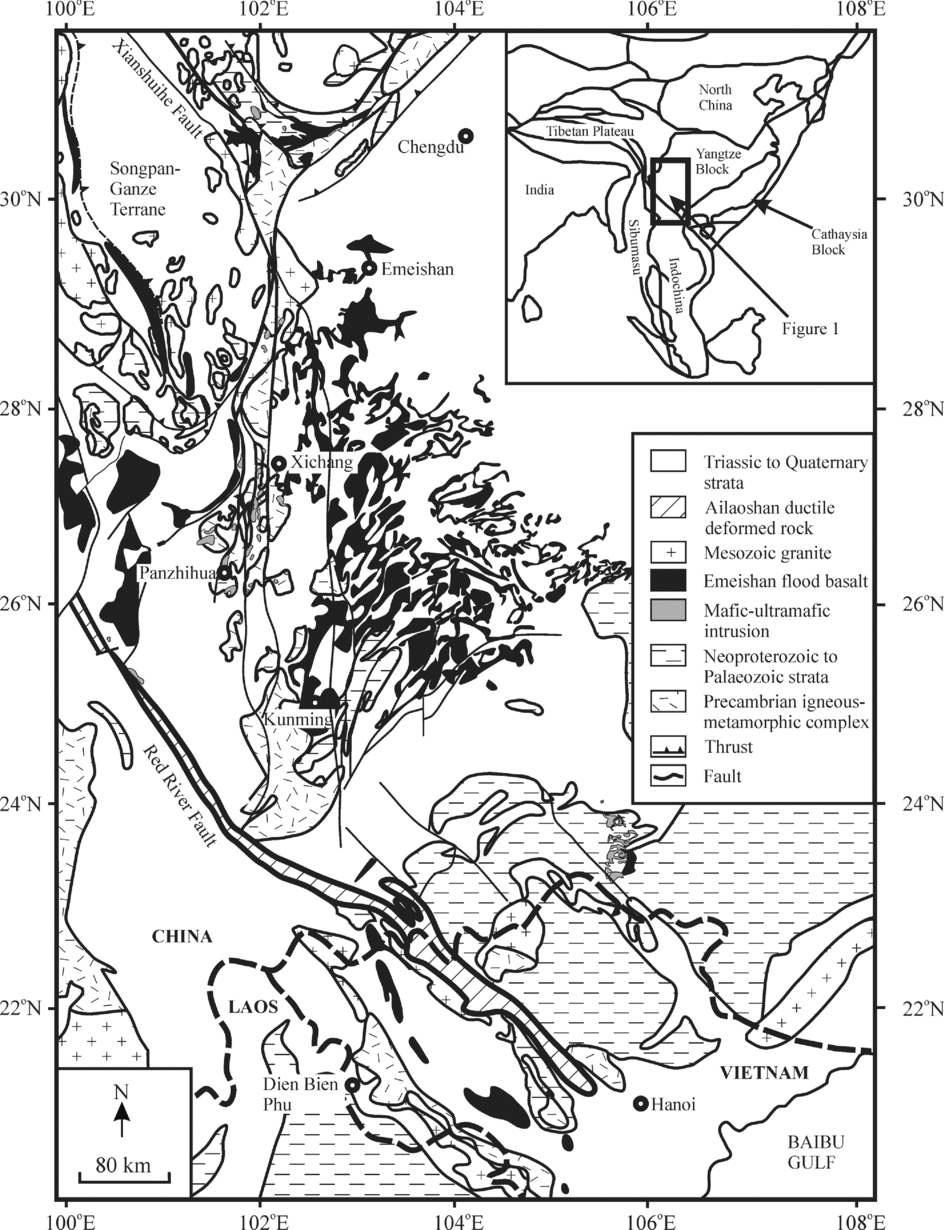
Southwestern China comprises the western margin of the Yangtze block to the east and the easternmost part of the Tibetan Plateau to the west (Fig. 1). The Yangtze block consists of Mesoproterozoic granitic gneisses and metasedimentry rocks that have been intruded by Neoproterozoic (~ 800 Ma) granites (Zhou et al. Reference Zhou, Malpas, Song, Robinson, Sun, Kennedy, Lesher and Keays2002b). The granites are overlain by a series of marine and terrestrial strata deposited from the Late Neoproterozoic (~ 600 Ma) to the Permian. The eastern part of the Tibetan Plateau is the Songpan–Ganze terrane, a Late Triassic–Early Jurassic thrust sequence composed of 10 km thick marine sediments known as the Xikang Group (Bruguier, Lancelot & Malavieille, 1997; Yan et al. Reference Yan, Zhou, Song and Fu2003a).
Regional geological map of the Emeishan large igneous province (modified from Zhou et al. Reference Zhou, Malpas, Song, Robinson, Sun, Kennedy, Lesher and Keays2002b).
The South China block consists of the Cathaysia and Yangtze blocks, which collided during Neoproterozoic times (~ 1000 Ma) and may have been part of the Rodinian supercontinent (Li, Zhang & Powell, Reference Li, Zhang and Powell1995; Yan et al. Reference Yan, Zhou, Song, Wang and Malpas2003b, Reference Yan, Zhou, Wang and Xia2006). The South China Block was situated along the margin of Gondwana from Cambrian to Silurian times and eventually rifted off during the Carboniferous and moved northward (Metcalfe, Reference Metcalfe2006). A low near-equatorial latitude is postulated for the South China block during the Permian because tropical to subtropical faunas with no Gondwanan affinities are found (Metcalfe, Reference Metcalfe2006).
Following northward movement, the Indochina block collided with the south margin of the South China block. The timing of collision, also known as the Indosinian tectonothermal event, between the two blocks remains controversial but was likely during Late Permian–Early Triassic times as recorded by metamorphic and igneous rocks (Nam, Reference Nam1998; Meng & Zhang, Reference Meng and Zhang1999; Carter et al. Reference Carter, Roques, Bristow and Kinny2001; Lepvrier et al. Reference Lepvrier, Maluski, Tich, Leyreloup, Thi and Vuong2004; Yan et al. Reference Yan, Zhou, Wang and Xia2006). As a result, back-arc extension may have occurred in the South China block and produced a small volume of volcanic rocks. Continued northward drifting of the South China block eventually resulted in collision with the North China block during the Triassic, at ~ 230 Ma, creating the Qingling–Dabie–Sulu ultra-high pressure belt (Li et al. Reference Li, Xiao, Liou, Chen, Ge, Zhang, Sun, Cong, Zhang, Hart and Wang1993).
2.b. Outline of the Emeishan large igneous province
The largest single geological feature of southwestern China is the Middle–Late Permian Emeishan large igneous province located along the western edge of the Yangtze Block near the boundary with the Songpan–Ganze terrane (Fig. 1). The distribution of the Emeishan large igneous province was subsequently affected in the Mesozoic and Cenozoic by post-emplacement faulting associated with the development of the Songpan–Ganze terrane and the Indo-Eurasian collision (Chung & Jahn, Reference Chung and Jahn1995). The Emeishan large igneous province covers an area of 0.3 × 10⁶ km2 within southwestern China and northern Vietnam and consists of flood basalts, spatially associated felsic plutons and layered mafic–ultramafic intrusions, some of which host giant Fe–Ti–V oxide deposits (e.g. Zhong et al. Reference Zhong, Zhou, Zhou, Sun and Liu2002; Zhou et al. Reference Zhou, Robinson, Lesher, Keays, Zhang and Malpas2005). The volcanic succession includes picrites, basaltic andesites and basalts that are subdivided on the basis of TiO2 into high- and low-Ti/Y groups (Xu et al. Reference Xu, Chung, Jahn and Wu2001; Song et al. Reference Song, Zhou, Hou, Cao, Wang and Li2001). The basalt piles range in thickness from 1.0 to 5.0 km in the western part and 0.2 to 2.6 km in the eastern part. A mantle plume model is used to explain the geological features such as the extensive flood basalts, ultramafic lavas, short-duration, structural doming and lower crustal seismic velocity layers (Chung et al. Reference Chung, Jahn, Genyao, Lo, Bolin, Flower, Chung, Lo and Lee1998; He et al. Reference He, Xu, Chung, Xiao and Wang2003; Xu et al. Reference Xu, He, Chung, Menzies and Frey2004).
3. Field relations and petrography of the mafic dykes
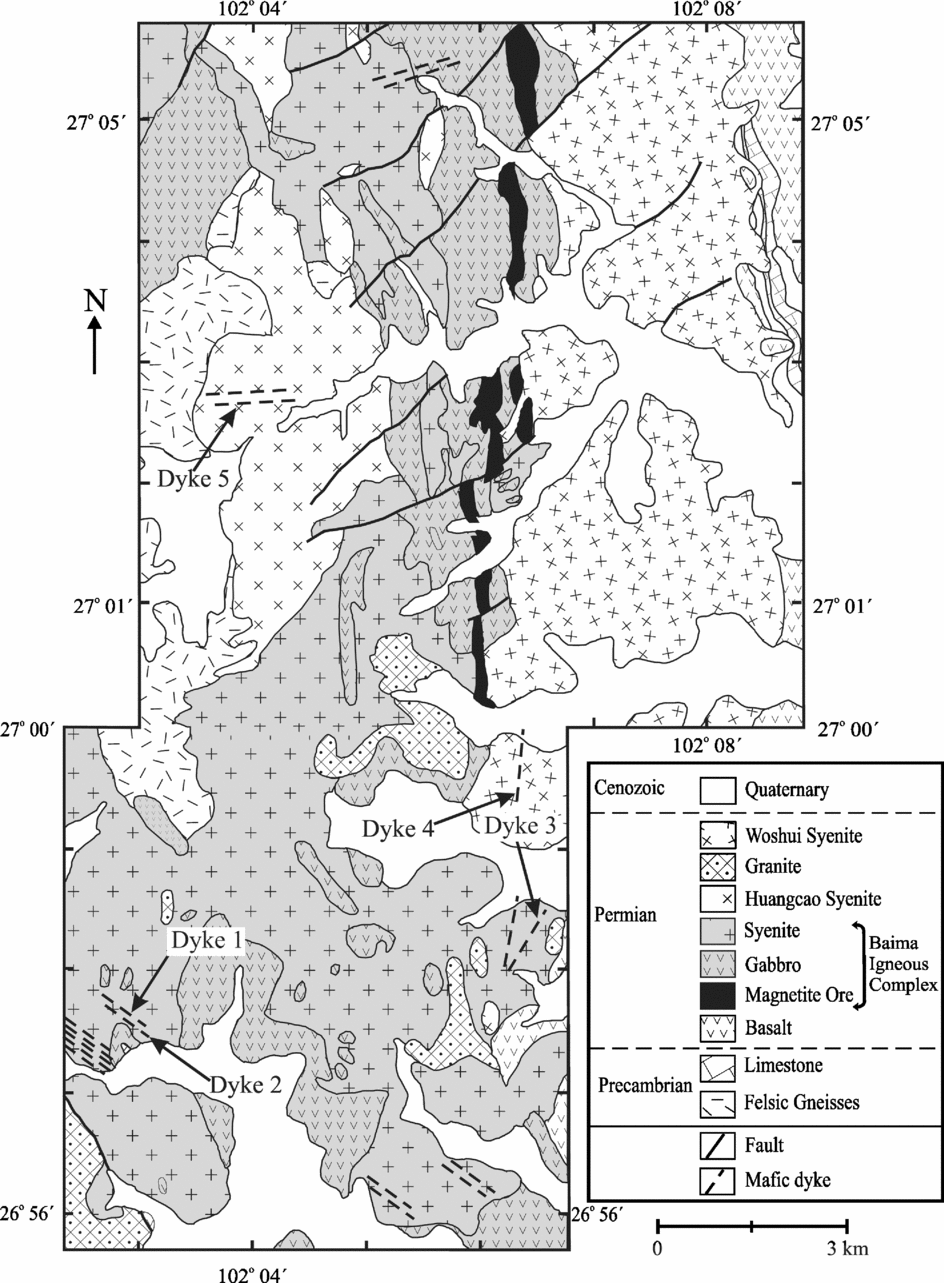
In the Panxi region, between the cities of Panzhihua and Xichang (Fig. 1), there are abundant felsic and mafic plutonic rocks. Intruding these plutons are narrow (generally ≤ 5 m wide) mafic dykes. These dykes have variable strikes of 306°, 185° and 85°; most have steep E to SE dips of 70–90° (Fig. 2). In some instances the dykes may be responsible for recrystallization of their hosts because they are parallel to recrystallization fabrics. The dykes are relatively easy to spot because of their colour contrast with that of their felsic hosts. However, they are seen intruding mafic intrusions as well. Due to their limited volume and exposure, it may be inappropriate to identify them as a dyke swarm until more systematic mapping reveals their total extent. For this study, dykes intruding the ~ 260 Ma Baima, ~ 260 Ma Woshui and ~ 252 Ma Huangcao plutons were sampled to determine if they are related to Emeishan magmatism (Fig. 2). One coarse-grained dyke intruding the Baima pluton was sampled for radiometric age dating and samples of this dyke and the other dykes were analysed for bulk rock compositions.
Local geological map of the Baima region showing the distribution and sampling locations of the mafic dykes (modified from Wang et al. Reference Wang, Xie, Wang and Tao1994 and Xiong et al. Reference Xiong, Xie, Nie, Kan, Ding and Guo1996).
The mafic dykes show variable textures, with most being aphanitic, however, there are medium-grained varieties with ophitic to sub-ophitic textures. The dykes consist primarily of plagioclase (50 %), clinopyroxene (35 %), biotite (5–10 %), and Fe–Ti oxides (5–10 %), with minor amounts of olivine (< 5 %), apatite (< 5 %) and sulphides. Alteration of clinopyroxene to hornblende is common, and there are many cases of biotite forming an alteration rim around magnetite. The dykes differ considerably from other mafic intrusions of the Panxi region because they have diabasic textures, while the other mafic intrusions are granular and have cumulate textures.
4. Analytical methods
4.a. SHRIMP zircon analyses
Zircon crystals were separated from a sample (GS04-119) of one dyke (dyke 2) using conventional heavy liquid and magnetic techniques, mounted in epoxy, polished, coated with gold, and photographed in transmitted and reflected light to identify grains for analysis. U–Pb isotopic ratios of zircon crystals were measured from a single spot of each mineral using the SHRIMP II at the Chinese Academy of Geological Sciences, Beijing, China. The measured isotopic ratios were reduced off-line using standard techniques (see Claoué-Long et al. Reference Claoué-Long, Compston, Roberts, Fanning, Berggren, Kent, Aubrey and Hardenbol1995) and the U–Pb ages were normalized to a value of 417 Ma determined by conventional U–Pb analysis of zircon standard TEMORA 1 (Black et al. Reference Black, Kamo, Allen, Aleinikoff, Davis, Korsch and Foudoulis2003a,b). Common Pb was corrected using the methods of Compston, Williams & Meyer (Reference Compston, Williams and Meyer1984). The 206Pb/238U and 207Pb/235U data were adjusted for systematic bias in the measurements of the TEMORA 1 standard.
4.b. Major and trace elemental analyses
Major elements were analysed by X-ray fluorescence spectroscopy at the University of Hong Kong using glass discs (Gill, Reference Gill1997). Trace elements were analysed by inductively coupled plasma mass spectrometry (ICP-MS) using the technique of Qi, Jing & Gregoire (Reference Qi, Jing and Gregoire2000), also at the University of Hong Kong. Standard reference materials for the major elements were BHVO-2, JGB-2 and GXR-1. For the trace element analysis, the standard reference materials were AMH-1 and GBPG-1 (Thompson et al. Reference Thompson, Potts, Kane and Wilson1999; Potts et al. Reference Potts, Thompson, Kane and Petrov2000, Reference Potts, Thompson, Webb and Watson2001). The precisions for the major and trace element results are better than 5 % and 10 %, respectively.
4.c. Rb–Sr and Sm–Nd isotopic analyses
Isotopic ratios were measured using a Finnigan MAT-262 thermal ionization mass spectrometer in the Laboratory for Radiogenic Isotope Geochemistry, Institute of Geology and Geophysics, Chinese Academy of Sciences, Beijing. The raw data were processed using the Isoplot program which gave the 2σ error (Ludwig, Reference Ludwig2001). 143Nd/144Nd ratios were normalized to 146Nd/144Nd = 0.7219 and 87Sr/86Sr ratios to 86Sr/88Sr = 0.1194. Details of analytical procedures are described in Chen, Hegner & Todt (Reference Chen, Hegner and Todt2000) and Chen et al. (Reference Chen, Siebel, Satir, Terzioglu and Saka2002). The USGS reference material used was BCR-1, which is indistinguishable from the updated reference material BCR-2 (Raczek, Jochum & Hofmann, Reference Raczek, Jochum and Hofmann2003).
5. Results
5.a. SHRIMP zircon U–Pb dating
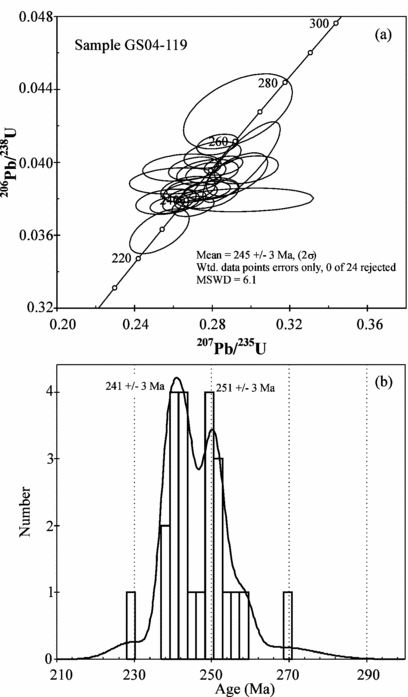
Zircon grains from sample GS04-119 have both euhedral and anhedral shapes and are subdivided into two populations based on smaller (≤ 150 μm) and larger grain size (> 150 μm). Their Th/U ratios vary from 0.21 to 0.58 with an average of 0.37 and standard deviation of 0.08 (Table 1). All individual zircon data were plotted on a concordia diagram and yield an age of 245 ± 3 Ma with a high mean square of weighted deviates (MSWD) of 6.1 (Fig. 3a). Both grain sizes produced nearly identical ages, with the smaller grains yielding an age of 243 ± 5 Ma and the larger grains yielding an age of 246 ± 4 Ma; however, their MSWD are still very high at 5.6 and 6.4, respectively. The cumulative Gaussian distribution profile shows clusters of 206U/238Pb mean ages at 241 ± 3 Ma and 251 ± 3 Ma (Fig. 3b). We interpret the age of the dyke to be 242 ± 2 Ma (MSWD of 0.75) because dykes of similar composition to sample GS04-119 cut the 252 Ma Huangcao pluton, therefore they likely represent the younger ages. The ~ 250 Ma age cluster shown in the distribution profile is not likely the intrusion age because it would be highly improbable that a dyke would contain a majority of zircons younger than its emplacement age.
(a) Concordia diagram of the SHRIMP zircon U/Pb dating results for sample GS04-119. (b) Gaussian distribution profile of the ages yielded from individual zircon crystals.
SHRIMP zircon U–Pb data of mafic dyke 2
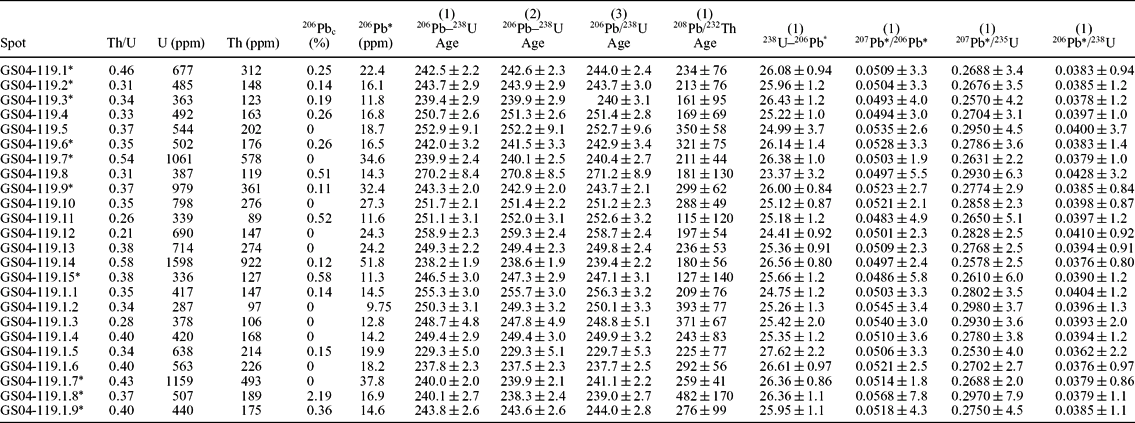
Errors are 1σ; Pbc and Pb* indicate the common and radiogenic portions, respectively. Error in standard calibration was 0.64% (not included in above errors but required when comparing data from different mounts). (1) Common Pb corrected using measured204Pb. (2) Common Pb corrected by assuming 206Pb/238U–207Pb/235U age-concordance. (3) Common Pb corrected by assuming 206Pb/238U–208Pb/232Th age-concordance. Populations of zircons > 150 μm listed as 119.1–119.15 and < 150 μm listed as 119.1.1–119.1.9. Samples which comprise the 242 Ma age are denoted by *
5.b. Whole rock geochemistry
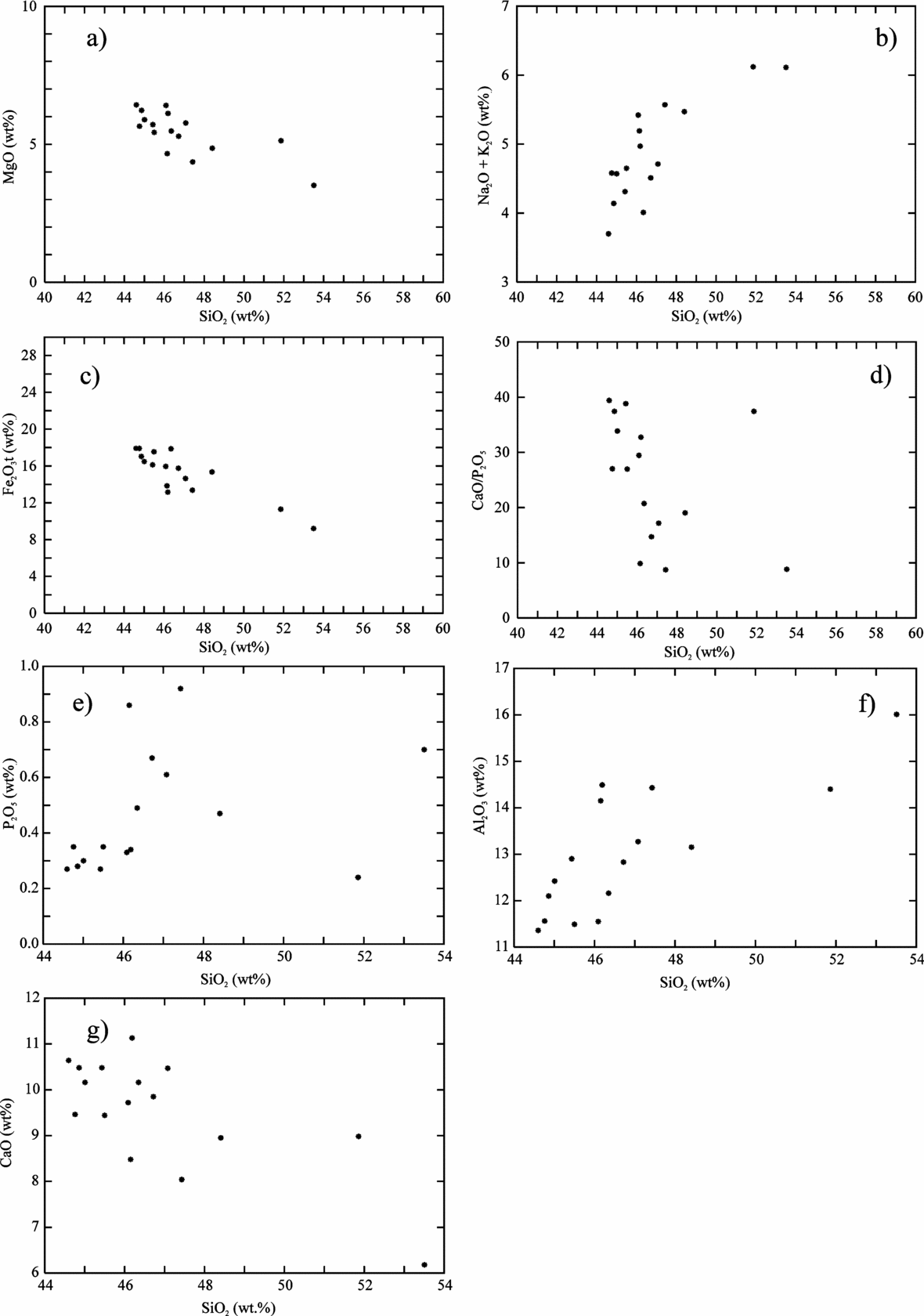
The five mafic dykes sampled have evolved mafic compositions, with Mg no. (100 × (Mg2+/(Mg2++Fe2+)) ranging from 37.8 to 60.2 (Table 2). The rocks are alkaline in composition (Na2O+K2O = 3.96–6.75 wt %) and contain variable SiO2 (44.6–53.5 wt %), Fe2O3t (11.3–17.9 wt %; t = total Fe expressed as Fe3+), MgO (3.5–6.5 wt %), CaO (6.2–11.7 wt %) and P2O5 (0.2–1.2 wt %) (Fig. 4). The negative correlations of Fe and Ca, and positive trends of Al, K and Na against Si, strongly suggest that these dykes were products of fractionation crystallization of a primitive parental magma (Fig. 4). Most of the samples were collected from dyke 1 which is ~ 25 metres wide. The dyke does not show chemical variation across (GS03-021-030) with the exception of samples GS03-117 and -118, which have the highest SiO2 wt % and lowest MgO wt % content and are located near the northeastern contact with the Baima syenitic pluton.
Major and trace element variations of the mafic dykes.
Whole rock chemical analyses of the mafic dykes
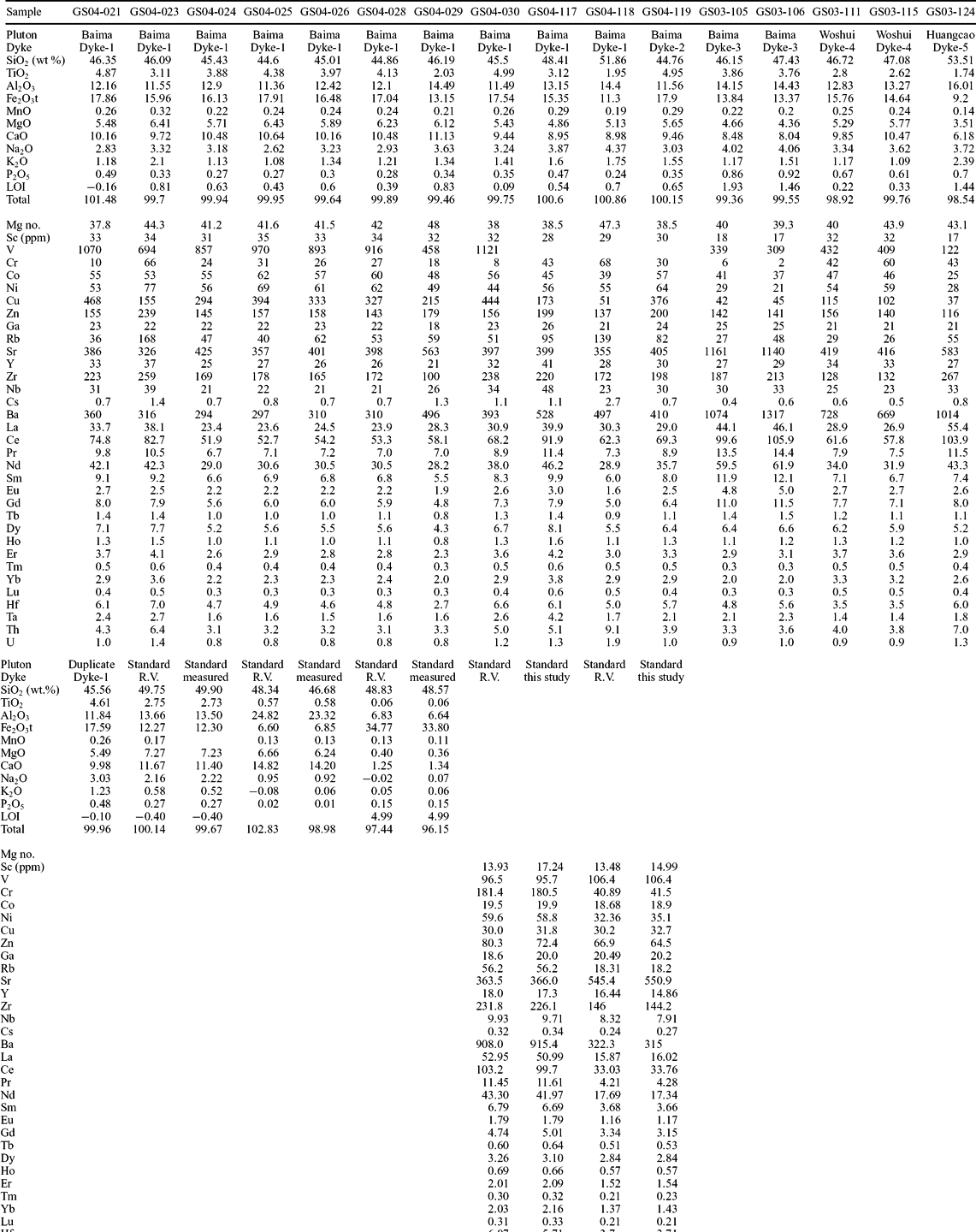
Fe2O3t – total Fe; LOI – loss on ignition; Mg no. – 100*(Mg2+/(Mg2++Fe2+); R.V. – recommended value.
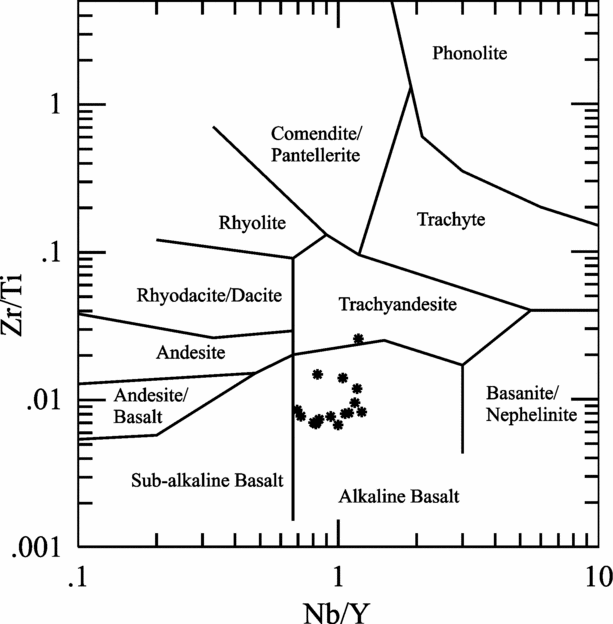
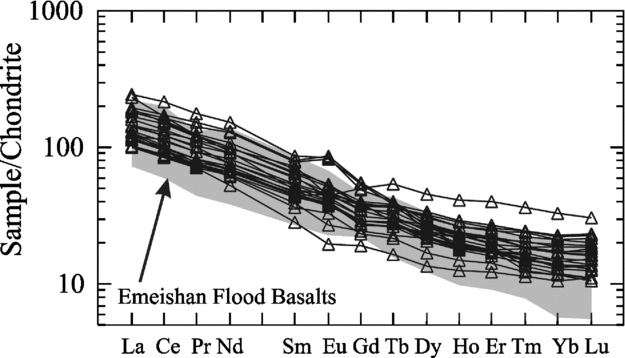
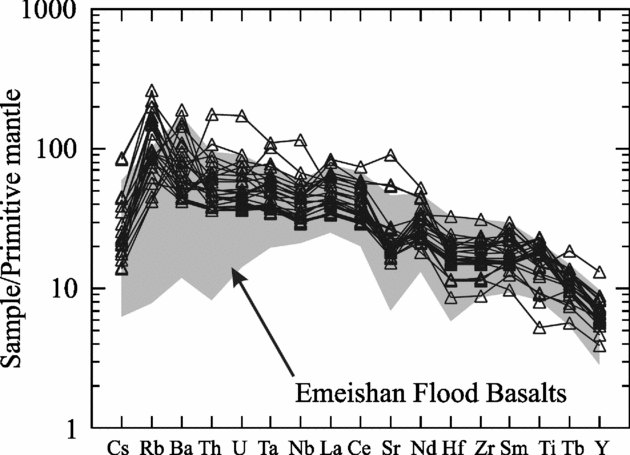
The mafic dykes have highly variable concentrations of compatible trace elements, for example, Sc (15–35 ppm), Ni (17–87 ppm), Co (25–62 ppm), Cu (36–468 ppm), V (121–1121 ppm) and Cr (2–85 ppm). The trace element classification diagram of Winchester & Floyd (Reference Winchester and Floyd1977) shows the data are consistent with alkaline olivine basalts (Fig. 5). The dykes have rare earth element (REE) profiles enriched in light REE (La/Yb = 4.4–18.8) with a range of Eu/Eu* (Eu/Eu* = 2*EuN/(SmN+GdN)) ratios (0.70–1.27) (Fig. 6). The primitive mantle-normalized incompatible trace element plots show a slight enrichment of the large-ion lithophile elements (LILE) (Cs, Rb, Ba), a negative Sr anomaly and a slight depression of Hf–Zr (Fig. 7). A slightly negative Hf–Zr anomaly is common in the intrusive mafic igneous rocks from the Emeishan large igneous province, however, it is not universal (Zhou et al. Reference Zhou, Robinson, Lesher, Keays, Zhang and Malpas2005, Reference Zhou, Yan, Kennedy, Li and Ding2006; Zhang et al. Reference Zhang, Mahoney, Mao and Wang2006). The depletion in Hf–Zr could be related to previous extraction of mafic magmas from the same source.
Trace element classification of the mafic alkaline dykes using the Zr/TiO2 v. Nb/Y of Winchester & Floyd (Reference Winchester and Floyd1977).
Chondrite-normalized rare-earth element data patterns of the mafic dykes and Emeishan flood basalts normalized to values of Sun & McDonough (Reference Sun, McDonough, Saunders and Norry1989). Flood basalt data from Song et al. (Reference Shellnutt and Zhou2001, Reference Song, Zhou, Cao and Robinson2004) and Xu et al. (Reference Xu, Chung, Jahn and Wu2001).
Primitive-mantle-normalized trace element data patterns plots of the mafic dykes and Emeishan flood basalts normalized to values of Sun & McDonough (Reference Sun, McDonough, Saunders and Norry1989). Flood basalt data from Song et al. (2001, 2004) and Xu et al. (Reference Xu, Chung, Jahn and Wu2001).
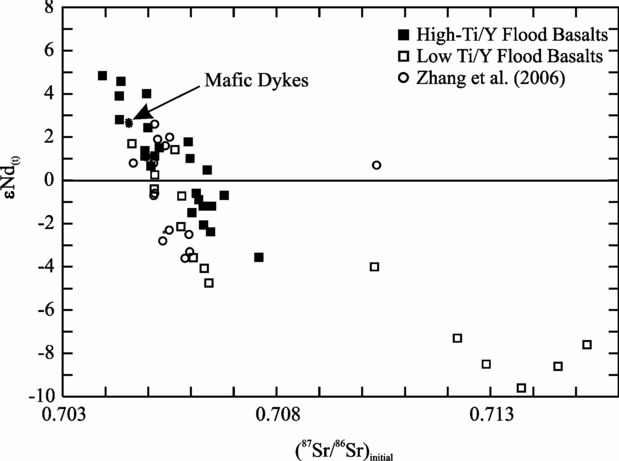
Whole rock Sr and Nd isotope ratios were determined for two samples of dyke 1 (Table 3). The ɛNd(t) ratios and (87Sr/86Sr)i ratios have been age-corrected to 242 Ma. The samples from dyke 1 intrude the Baima pluton and are ~ 20 m apart. The ɛNd(t) values (+2.6 and +2.7), as well as their initial 87Sr/86Sr ratios (0.704542 and 0.704554), are similar to values of the Emeishan flood basalts and surrounding intrusions (Fig. 8).
Radiogenic isotope ratios and concentrations of Nd, Sm, Rb and Sr of a mafic dyke

(87Rb/86Sr)m, (87Sr/86Sr)m, (147Sm/144Nd)m and (143Nd/144Nd)m – measured isotopic ratios, respectively. (87Sr/86Sr)i and ɛNd(t) are calculated 242 Ma. Concentrations of Nd, Sm, Rb and Sr were determined by thermal ion mass spectrometer. BCR-1m – this study; BCR-1 r.v. – recommended value. All isotope values have 2σ of 14 or less.
Sr–Nd isotope diagram showing the range of high-and low-Ti Emeishan Flood basalts and two mafic dykes (data from Song et al. Reference Song, Zhou, Hou, Cao, Wang and Li2001, Reference Sun, McDonough, Saunders and Norry2004; Xu et al. Reference Xu, Chung, Jahn and Wu2001; Zhou et al. Reference Zhou, Zhao, Qi, Su and Hu2006 and Zhang et al. Reference Zhang, Mahoney, Mao and Wang2006).
6. Discussion
6.a. Petrogenesis of the 242 Ma dykes
The mafic dykes of the Panxi region are chemically and petrographically similar to alkaline olivine basalts. They have evolved Mg no. and low Ni content, and show chemical evolution trends which suggest they fractionated from a primitive magma. Their LREE-enriched patterns and incompatible trace element patterns are similar to the Emeishan flood basalts (Figs 6, 7) and their compositions also correspond to those of within-plate basalts and continental rift-related basalts on the tectonomagmatic discrimination diagram of Pearce & Cann (Reference Pearce and Cann1973).
The positive ɛNd(t) values (+2.6 and +2.7) and low (87Sr/86Sr)i ratios suggest a mantle source which is consistent with basaltic and granitic rocks of the Panxi region (Xu et al. Reference Xu, Chung, Jahn and Wu2001; Shellnutt & Zhou, Reference Shellnutt and Zhou2007) (Fig. 8). Many trace element ratios (Zr/Nb = 3.8–8.2, La/Nb = 0.4–1.7, Ba/La = 7.5–25.6) are consistent with an OIB-like source (Weaver, Reference Weaver1991; Song et al. Reference Song, Zhou, Hou, Cao, Wang and Li2001). This similarity leads us to conclude that the mafic dykes were also derived from the same plume-type source as the Emeishan flood basalts.
6.b. Magmatic history of the Emeishan large igneous province
Shellnutt & Zhou (Reference Shellnutt and Zhou2006) and Zhong et al. (Reference Zhong, Zhu, Song and He2007) have reported ages of ~ 252 Ma. Identification of a ~ 242 Ma mafic dyke suggests another minor magmatic event in the Panxi region after the initial emplacement of the Emeishan flood basalts. We summarize the major magmatic periods of the Emeishan large igneous province and speculate on their causes.
6.b.1. ~ 260 Ma Emeishan large igneous province magmatism
The first reliable date for the Emeishan large igneous province was a U–Pb SHRIMP zircon date of 259 ± 3 Ma of a mafic intrusion in the Panxi region (Zhou et al. 2002a). Prior to the publication of this date, the age of the Emeishan large igneous province was thought to be Permo-Triassic and contemporaneous with the Siberian Traps (Chung & Jahn, Reference Chung and Jahn1995; Xu et al. Reference Xu, Chung, Jahn and Wu2001). During the last few years, numerous U–Pb SHRIMP dates of Emeishan large igneous province felsic and mafic intrusions have yielded ages around 260 Ma (Guo et al. Reference Guo, Fan, Wang and Li2004; Zhou et al. Reference Zhou, Robinson, Lesher, Keays, Zhang and Malpas2005, Reference Zhou, Yan, Kennedy, Li and Ding2006; Luo et al. Reference Luo, Xu, He, Huang and Shi2006; Zhong & Zhu, Reference Zhong and Zhu2006; He et al. Reference He, Xu, Huang, Luo, Shi, Yang and Yu2007; Shellnutt & Zhou, Reference Shellnutt and Zhou2007; Zhong et al. Reference Zhong, Zhu, Song and He2007). The 260 Ma date is considered to be the eruption age for the Emeishan flood basalts because the compositions of mafic intrusions are similar to those of the flood basalts, and in many cases the plutonic rocks have intruded the lowermost Emeishan basalt flows, which suggests that the intrusions are nearly contemporaneous with volcanism. He et al. (Reference He, Xu, Chung, Xiao and Wang2003) described the extent of erosion of the Maokou Formation (limestone) in southwest China and determined that the most extensive erosion was located in the west-central portion of the Emeishan large igneous province and decreased radially outward. The Maokou Formation was the last unit deposited prior to the eruption of the flood basalts and contains Late to Middle Permian fauna (He et al. Reference He, Xu, Chung, Xiao and Wang2003). They interpreted the differing erosion rates as a result of crustal doming caused by the arrival of a mantle plume. Xu et al. (Reference Xu, He, Chung, Menzies and Frey2004) have also documented extensive geophysical features of the crust beneath the Emeishan large igneous province, which they interpret to represent the fossil Emeishan plume-head. The varying thickness of the seismically defined layers documented by Xu et al. (Reference Xu, He, Chung, Menzies and Frey2004) corresponds with the surface erosion zones of He et al. (Reference He, Xu, Chung, Xiao and Wang2003). He et al. (Reference He, Xu, Huang, Luo, Shi, Yang and Yu2007) also have dated a volcanic ash layer just above the Emeishan flood basalts at ~ 260 Ma, which they have interpreted to represent the termination age. Many of the published dates are from the Panxi region with a few from the eastern margin of the Emeishan large igneous province. The location of the dated rocks is important because the Panxi region is located in the inner zone (centre) of the crustal doming model and therefore would represent the oldest portion of the Emeishan large igneous province. The fact that 260 Ma ages are also found in the eastern margin of the Emeishan large igneous province suggests that a relatively uniform and rapid emplacement occurred.
6.b.2. ~ 252 Ma magmatism
In contrast to the plutonic rocks, the Emeishan flood basalts have consistently yielded younger ages, between 251 Ma and 255 Ma, using 40Ar–39Ar methods (Boven et al. Reference Boven, Pasteels, Punzalan, Liu, Luo, Zhang, Guo and Hertogen2002; Lo et al. Reference Lo, Chung, Lee and Wu2002; Fan et al. Reference Fan, Wang, Peng, Miao and Guo2004). There have been a few U–Pb dates for acidic ash layers in southwestern China which correspond to the Permo-Triassic boundary, however, no flood basalts have been dated using this method (Chung & Jahn, Reference Chung and Jahn1995; Bowring et al. Reference Bowring, Erwin, Jin, Martin, Davidek and Wang1998; Gradstein, Ogg & Smith, Reference Gradstein, Ogg and Smith2005). Fan et al. (Reference Fan, Wang, Peng, Miao and Guo2004) proposed a model in which Emeishan large igneous province magmatism began at ~ 260 Ma with the emplacement of some mafic intrusions, followed by eruption of the flood basalts within a short period around ~ 255 Ma and ending between 251 and 253 Ma. The implication is that Emeishan large igneous province magmatism spanned the Late Permian and contributed to two separate mass extinctions, the end-Guadalupian (260 Ma) and Permo-Triassic (251 Ma), and may have been synchronous with the much more voluminous Siberian Traps magmatism (Lo et al. Reference Lo, Chung, Lee and Wu2002; Fan et al. Reference Fan, Wang, Peng, Miao and Guo2004; Gradstein, Ogg & Smith, Reference Gradstein, Ogg and Smith2005). Two plutons in the Panxi region, the Huangcao and Ailanghe plutons, have yielded SHRIMP zircon ages of 252 ± 2.5 and 251 ± 6 Ma, respectively (Shellnutt & Zhou, Reference Shellnutt and Zhou2006; Zhong et al. Reference Zhong, Zhu, Song and He2007). This is the first evidence from the plutonic rocks that Emeishan magmatism may have extended to the Late Permian.
Palaeomagnetic, geological and geochronological evidence suggests that volcanism was not likely to have extended far beyond ~ 260 Ma because the flood basalts erupted within one normal-polarity episode and there is no evidence of weathered flow tops indicating rapid eruption rates (Huang & Opdyke, Reference Huang and Opdyke1998; Thompson et al. Reference Thompson, Ali, Song and Jolley2001; Ali et al. Reference Ali, Thompson, Zhou and Song2005; He et al. Reference He, Xu, Huang, Luo, Shi, Yang and Yu2007). The ages of the Huangcao and Ailanghe plutons are the only U–Pb ages of ~ 252 Ma, however, the results of Zhong et al. (Reference Zhong, Zhu, Song and He2007) have a large error (± 6 Ma). These two plutons are volumetrically insignificant when compared to the volume of the flood basalts and likely represent a different stage of post-flood basalt magmatism because the sources of the two plutons are different, with the Huangcao pluton being mantle derived (ɛNd(t) = +1.3 to +1.9) and the Ailanghe pluton being crustally derived (Shellnutt & Zhou, Reference Shellnutt and Zhou2007; Zhong et al. Reference Zhong, Zhu, Song and He2007).
The U–Pb ages from acidic ash flow layers that define the Permian–Triassic boundary in southwestern China are definitive evidence for Permo-Triassic volcanism in this region (Bowring et al. Reference Bowring, Erwin, Jin, Martin, Davidek and Wang1998; Fan et al. Reference Fan, Wang, Peng, Miao and Guo2004). However, widespread volcanism at this time is well known throughout southwest China and Eurasia in general, but whether or not Emeishan large igneous province magmatism is responsible for those layers remains to be confirmed (Yin et al. Reference Yin, Huang, Zhang, Hansen, Yang, Ding, Bie, Sweet, Yang, Dickins and Yin1992).
6.b.3. ~ 242 Ma magmatism
The age of the mafic dyke at ~ 242 Ma is the first reported Early–Middle Triassic age for mafic igneous rocks in the Panxi region (Gradstein, Ogg & Smith, Reference Gradstein, Ogg and Smith2005). Zircons retrieved from the Huangcao pluton, intruded by mafic dykes of similar composition, revealed a bimodal distribution of ages at 240 Ma and 252 Ma, respectively (Shellnutt & Zhou, Reference Shellnutt and Zhou2006). The presence of the 240 Ma zircons in the Huangcao pluton may be the result of contamination from the dykes. The Rb–Sr isotopic data from the Huangcao pluton yield an isochron age of ~ 248 Ma, which is close to the ~ 252 Ma interpreted age. The implication is that the ~ 240 Ma zircon results from the Huangcao pluton may have originated from the dykes.
6.c. Possible mechanisms for post-260 Ma melting events
There are at least two, volumetrically minor, post-260 Ma magmatic events in the Yangtze Block. It is unclear why there were periods of mafic magmatism after the main effusive period of the Emeishan large igneous province, however, we suggest that the fossil plume-head as documented by Xu et al. (Reference Xu, He, Chung, Menzies and Frey2004) was the ultimate source of the ~ 252 Ma Huangcao pluton and the ~ 242 Ma mafic dykes. Although the same mantle source was melted, they were distinct melting events under different conditions. Technically, this would not represent melting associated with the Emeishan large igneous province plume, merely melting of fossil plume-head material. Shellnutt & Zhou (Reference Shellnutt and Zhou2007) have suggested that post-ELIP relaxation of the Yangtze crust was likely responsible for melting underplated mafic rocks emplaced at ~ 260 Ma and likely melted the crust as well, and caused the formation of the Ailanghe pluton at 251 ± 6 Ma (Zhong et al. Reference Zhong, Zhu, Song and He2007).
The dykes are spatially associated with the flood basalts but their relationship to them is not known. The dykes suggest that either the Emeishan mantle-plume was continually active and produced flood basalts for 18 Ma, or that another period of melting unrelated to the flood basalt magmatism occurred. The fact that the dykes were formed by extensional processes suggests that they could be related to the Emeishan large igneous province but why did the mafic dykes form so late (cf. Fahrig, Reference Fahrig, Halls and Fahrig1987; Pollard, Reference Pollard, Halls and Fahrig1987)?
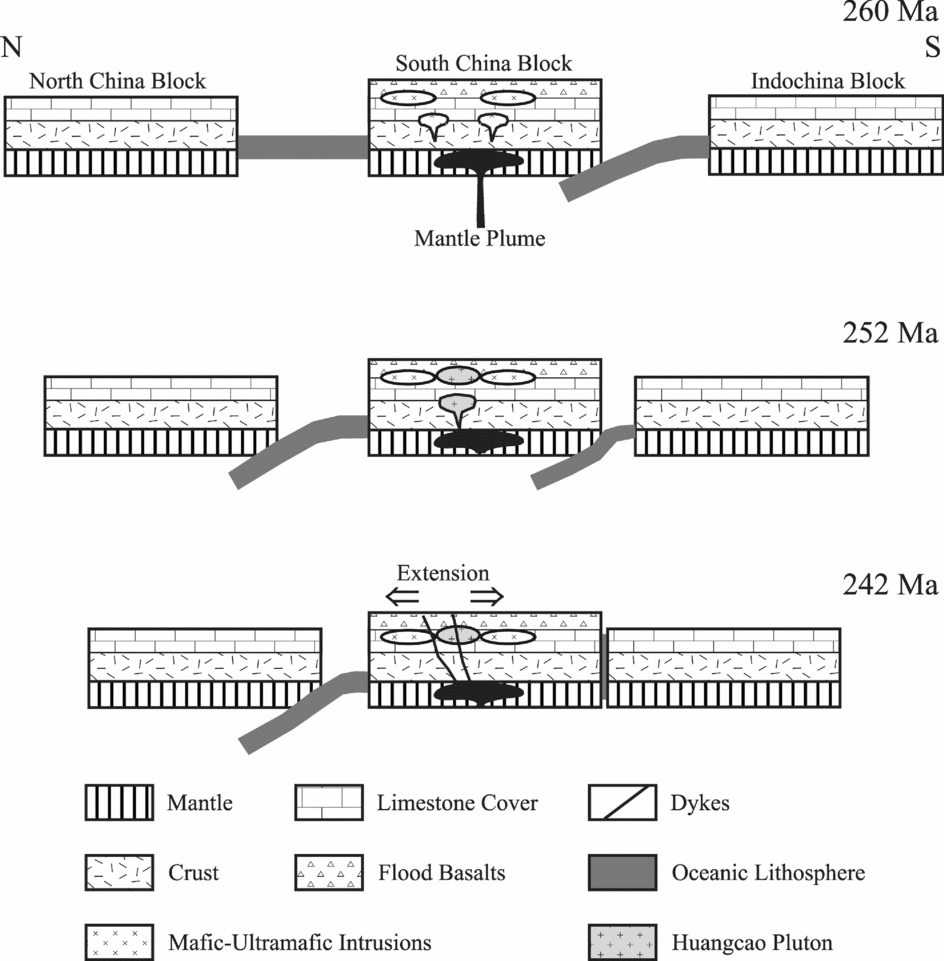
Regional tectonic studies of South China–Indochina indicate there was a major tectonothermal event during Late Permian and Middle Triassic times (Nam et al. Reference Nam, Sano, Terada, Toriumi, Quynh and Dung2001; Lepvrier et al. Reference Lepvrier, Maluski, Tich, Leyreloup, Thi and Vuong2004; Yan et al. Reference Yan, Zhou, Wang and Xia2006). The cause of the tectonothermal event is thought to be the collision between the South China and Indochina blocks (Fig. 9). Afterward, northward subduction of an amalgamated South China–Indochina block collided with the North China block at ~ 230 Ma (Lan et al. Reference Lan, Chung, Shen, Lo, Wang, Hoa, Thanh and Mertzman2000; Lepvrier et al. Reference Lepvrier, Maluski, Tich, Leyreloup, Thi and Vuong2004; Liu et al. Reference Liu, Jian, Kröner and Xu2006; Yan et al. Reference Yan, Zhou, Wang and Xia2006). The mafic dykes are older than the collision between North China and the South China–Indochina block but younger than the South China–Indochina collision. The age of 242 Ma indicates that extension-related magmatism must have occurred within the western margin of the South China–Indochina Block just prior to final suturing of the North China and South China–Indochina blocks (Fig. 9).
A simplified model summarizing the three magmatic periods involving the ELIP mantle plume-head and the relative locations of the North China block and Indochina block to the South China block. At 260 Ma the flood basalts and layered mafic–ultramafic intrusions are emplaced. At 252 Ma, extension-related magmatism causes remelting of the ELIP mantle plume head and also melting of the Yangtze basement rocks. Collision between North China and South China causes a volumetrically minor melting of the fossil plume-head.
6.d. Duration of the Emeishan large igneous province magmatism
Mantle plumes and hotspot magmatism have been known to be continuously active for long periods of time, but ~ 18 Ma between the eruptions of the first basalts and dyke injection is on the high side for the duration of mantle plume-derived continental large igneous provinces (Abbott & Isley, Reference Abbott and Isley2002). Long-lived hotspot and mantle plume magmatism is common in the ocean basins and is responsible for the formation of ocean-island/seamount chains and oceanic plateaux (e.g. Morgan, Reference Morgan1972; Richards, Duncan & Courtillot, Reference Richards, Duncan and Courtillot1989). A long chain of ocean islands and seamounts across the central Pacific leading back to an active hotspot, for example, Hawaii, is intuitive evidence of a long eruptive history (Wilson, Reference Wilson1965). It is difficult to assess intuitively the duration of mantle plume-derived continental large igneous provinces because the time-dependent geological evidence (e.g. hotspot track) is usually absent or there is a complex magmatic history. Instead, the duration of continental large igneous provinces is largely determined by dating techniques, although some geological relationships can be used (e.g. absence of sedimentary layers between lava flows). Many continental large igneous provinces are thought to erupt with variable time spans but generally within 10 million years with peak volcanic activity lasting less than a few million years (e.g. Coffin & Eldholm, Reference Coffin and Eldholm1994; Abbott & Isley, Reference Abbott and Isley2002; Ernst, Buchan & Campbell, 2005). Age dates by Shellnutt & Zhou (Reference Shellnutt and Zhou2006) and Zhong et al. (Reference Zhong, Zhu, Song and He2007) have confirmed that magmatism occurred 8 to 9 million years after the main effusive period of the Emeishan large igneous province, and now an age date from a mafic dyke confirms that compositionally similar mafic magmatism occurred even later. At least three periods of magmatism in southwestern China can be identified and likely correspond to the melting of the Emeishan mantle plume at ~ 260 Ma and further remelting of the fossil plume head at ~ 252 Ma and ~ 242 Ma. This does not imply that Emeishan magmatism was a continuous process, although it is possible, only that the plume-head served as a source for a diverse set of magmas for ~ 18 million years and possibly longer.
The precise duration of Emeishan flood basalt volcanism remains unknown. Huang & Opdyke (Reference Huang and Opdyke1998), Thompson et al. (Reference Thompson, Ali, Song and Jolley2001) and He et al. (2003, 2007) suggested that volcanism and doming were short-lived, probably within one magnetic reversal cycle, or less than 1 million years (Ali et al. Reference Ali, Thompson, Zhou and Song2005). This interpretation is consistent with estimated eruption rates and emplacement models for many large igneous provinces (e.g. Coffin & Eldholm, Reference Coffin and Eldholm1994). Radiometric dates of Permo-Triassic (~ 251 Ma) mafic and acidic layers in SW China may be correlative with the Emeishan large igneous province, however, it is not confirmed (Fan et al. Reference Fan, Wang, Peng, Miao and Guo2004; Kamo, Crowley & Bowring, Reference Kamo, Crowley and Bowring2006).
7. Conclusions
There have been at least two post-260 Ma magmatic events in the Yangtze Block in which the magmatic rocks have geochemical characteristics similar to the Emeishan flood basalts. Magmatism at 252 Ma produced at least two small felsic plutons. The plutonic rocks were likely generated by melting of the Yangtze basement and underplated mafic magmas of the Emeishan large igneous province due to post-emplacement relaxation of the Yangtze crust. The second melting event at ~ 242 Ma occurred ~ 10 million years after formation of the felsic plutons and produced the mafic alkaline dykes in the Panxi region of the Emeishan large igneous province. The dykes indicate that there was extension-related magmatism prior to the collision between the South China and North China blocks.
Acknowledgements
We thank Andy Saunders and John Mahoney for their constructive reviews of our manuscript. We also thank Professor Ma Yuxiao and Mr Zhao Hao, both from Chengdu University of Science and Technology, for their field support, and Dr Liang Qi and Mrs Xiao Fu for their analytical support at the University of Hong Kong. This study is supported by grants from the Research Grant Council of Hong Kong, SAR (HKU7057/05P) and the Chinese 111 Project B07011.



