Implications
The evaluation of body measures and sexual dimorphism in Hucul horses with the use of disciminant analysis is the first analysis carried out in breeding of this racehorse. This research is very important for the environment because Hucul horses are the oldest, the most primitive montage race in Poland and they are threatened with extinction. Furthermore, the results of this study may be used to compare body measures and sexual dimorphism in other race horses.
Introduction
The term ‘sexual dimorphism’ denotes differences in dimensions and proportions of the body between males and females (Glucksmann, Reference Glucksmann1974) of a species of horses. This phenomenon has been described at length for many animal species; but again it has not been investigated in depth in horses, primitive breeds in particular. Koch (Reference Koch1954) claims that gender dimorphism in horses is not pronounced, similar to that in species such as the cat, the rabbit or the Guinea pig. On the other hand, recent years have been bringing us more and more information with regard to gender dimorphism observed in horses; however, this information pertains to differences between males and females only in the scope of individual biometric traits.
Studies of differences in the measurement of post-foetal development between stallions and mares of the Mangalara Marchador breed were carried out by Pinto et al. (Reference Pinto, de Almeida, Quirino, Cabral, de Azevedo and Santos2005), who observed that all parameters except chest circumference, which is greater in mares, were greater in stallions. In a recent study Pinto et al. (Reference Pinto, de Almeida, Quirino, de Azevedo, Cabral, Santos and Corassa2008) generated discriminant functions in order to evaluate sexual dimorphism in Mangalara Marchador horses. They presented that stallions are larger than mares for almost all linear measurements, except for back-loin length, hip width and distance from elbow to knee. On the other hand, Lovšin et al. (Reference Lovšin, Fazarinc, Pogačnik and Bavdek2001) observed no gender dimorphism in Lipizzan horses in early stages of post-foetal development, whereas Rastija et al. (Reference Rastija, Baban, Antunović and Mandić2004) noted Lipizzan mares to possess wider and longer pelvises than stallions. Zechner et al. (Reference Zechner, Zohman, Sölkner, Bodo, Habe, Marti and Brem2001) used discriminant analysis by multivariate analyses for Lippizan horses to characterise the population of horse breeding, separately for stallions and mares. They observed that width of thurls, chest circumference and width of hips were important traits for discriminating studs for stallions, whereas length of neck, cannon bone circumference and width of thorax were important for mares.
Hintz et al. (Reference Hintz, Hintz and Van Vleck1979) proved Thoroughbred colts to be larger than fillies not only in their youth but also at further stages of development; the same was observed by Saastamoinen (Reference Saastamoinen1990) in his studies of the Finnhorse breed. Next, Kashiwamura et al. (Reference Kashiwamura, Avgaandorj and Furumura2001) in their studies of Banei draft racehorses observed the investigated parameters of the pelvis area to be greater in mares, whereas chest width and metacarpus circumference are greater in stallions. Glucksmann (Reference Glucksmann1974) observed the head to be proportionally larger in stallions. While analysing biometric traits of Arabe-Barbe horses, Boujenane et al. (Reference Boujenane, Touati and Machmoum2008) noted gender dimorphism in this breed to be strongly pronounced in most parameters other than head dimensions, which is likely related to differences in work performed by stallions and mares. Gender dimorphism based on breeding indices was analysed in feline ponies by Kolstrung (Reference Kolstrung2006). He determined that the indices of chest depth and circumference as well as that of trunk length are greater in mares, whereas the boniness index is greater in stallions. Moreover, this claims that metacarpus circumference and head length significantly differ between males and females. A similar study was carried out on Hucul horses by Purzyc (Reference Purzyc2007) and Purzyc et al. (Reference Purzyc, Kobryń, Komosa and Bojarski2007, Reference Purzyc, Kobryń, Komosa and Bojarski2008a and Reference Purzyc, Kobryń, Komosa and Bojarski2008b), showing a large difference between mean values of head- and pelvis-length indices in the youngest animals, of the force, pelvis width and chest circumference indices in adults.
The goal of this study was to determine gender dimorphism using discriminant functions based on indices used, among other purposes, in horse breeding. According to Sasimowski et al. (Reference Sasimowski, Kaproń, Pietrzak, Kolstrung, Słomiany and Wojciechowski1990) and Pruski (Reference Pruski2007), indices characterise animal body build better than absolute morphological traits. Pinto et al. (Reference Pinto, de Almeida, Quirino, de Azevedo, Cabral, Santos and Corassa2008) stated that discriminant functions can be useful for the selection of horses and avoiding registration of animals not meeting the phenotypic standards of the breed association.
The Hucul horses belong to primitive mountain horse breeds (Purzyc, Reference Purzyc2007). This research is very important for biodiversity because they are threatened with extinction; therefore, the authors believe that this study could be considered pioneering. Furthermore, the results of this study may be used to compare body indices and sexual dimorphism with other races of horses.
Material and methods
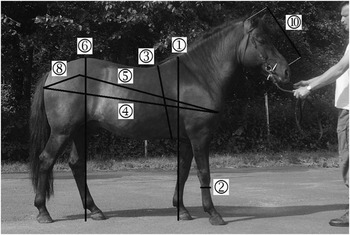
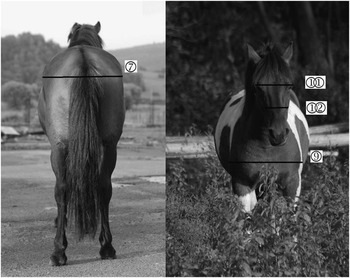
This study was carried out on 243 Hucul horses, classified into age groups (Table 1). The age of animals was determined from breeding documentation. The horses originated from state and private stables in Poland, with similar upbringing and feeding conditions on all locations. Twelve morphological measurements were taken on each horse: (i) height at the withers, (ii) circumference of the metacarpus, (iii) circumference of the chest, (iv) greater trunk length, (v) smaller trunk length, (vi) height at the croup, (vii) width of the pelvis, (viii) length of the pelvis, (ix) width of the chest, (x) length of the head, (xi) zygomatic width of the head and (xii) facial width of the head.
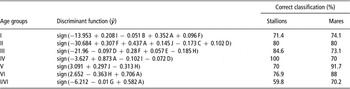
Research data, divided by gender and age

These traits are presented in Figures 1 and 2. The measurements were taken using a zoometric cane, non-elastic measuring tape and zoometric compasses. During the measurements, the horses stood on a firm surface, assuming a natural position. No sedatives were used. The measurements were taken twice by the same person; mean values were calculated from each of the two results, which were then used to calculate standard biometric indices commonly used in horse breeding in Poland. These indices specify the breed of a horse (Purzyc, Reference Purzyc2006; Pruski, Reference Pruski2007). The indices in question were:













Biometric traits presented on the photo of the Hucul horse; (1) height at the withers, (2) circumference of the metacarpus, (3) circumference of the chest, (4) greater trunk length, (5) smaller trunk length, (6) height at the croup, (8) length of the pelvis, (10) length of the head (photo: P. Peckiel).

Biometric traits presented on the photo of the Hucul horse; (7) width of the pelvis, (9) width of the chest, (11) zygomatic width of the head and (12) facial width of the head (photo: P. Peckiel).

In the following investigation the discriminant analysis was based on a linear model, as specified by the formula (Timm, Reference Timm2002):

where y = the vector codes of sex (‘1’ for stallions; ‘−1’ for mares); β 0, …, βk = unknown value of parameters; x 0, …, xk = the vectors of indices A to M; ε = the vector of random residual effect.
Values of parameters in the linear model were estimated using the least squares method. Inputting these values into the model and neglecting randomness allowed us to obtain the estimated vector  . It is unlikely for that vector to contain only the values −1 and 1, therefore the signum function is ultimately applied to the vector
 – transforming negative values to −1 and positive values to 1. Eventually, we obtained the following discriminant function:

where  the sign of a real number is 1, 0 or −1 if the number is positive, 0 or negative, respectively; β 0, …, βk = unknown value of parameters; x 0, …, xk = the vectors of indices A to M.
The purpose of this study has been to specify the minimal number of indices that could reasonably well classify an animal into the right gender group. It is generally difficult to define ‘reasonably well’ in this context; in this case, we decided to treat discrimination as reasonably good if at least 70% animals in each gender group have been classified correctly.
Selection of variables was based on the Wilks’ lambda test, thus ordering the variables in accordance with their significance. From this list we repeatedly selected parameters for the model until our discriminant function was considered reasonable.
Further analyses were divided into age and gender groups. At the first stage, we provided, when important, plots showing importance (in percentage) of each of the 10 variables to correct discrimination, thus allowing preliminary assessment of what indices can correctly classify an animal into each group. Afterwards, variable selection criteria were presented.
For calculation and graphical display, R program was used, version 2.9.0 (The R Development Core Team, 2009).
Results
In group I, we examined 28 stallions and 27 mares. A minimal number of indices was obtained using an alternative method, which pointed to the discriminant function. This function correctly classifies 71.4% stallions and 74.1% mares (Table 2). The most important indices for discriminating studs were index of pelvis length (I), index of chest circumference (B), index of metacarpus circumference (A) and index of croup height (F).
Discriminant function of biometric indices and correct classification of stallions and mares of Hucul horses

In group II, we examined 25 stallions and 15 mares. As one could see, a linear model with one variable exhibits a strong tendency to classify animals as stallions. This could result from a significantly larger number of observations for stallions, as well as only small differences of the given index between stallions and mares. At least five variables are required to classify animals reasonably well; these are index of croup height (F), index of metacarpus circumference (A), index of chest width (J), index of trunk length (greater; C) and smaller trunk length (D). This function correctly classifies 80% stallions and 80% mares (Table 2).
In group III, we examined 26 stallions and 26 mares. One can see that even one variable (E) classifies animals into gender groups reasonably well, that is, at over 70%. However, the Wilks’ lambda test gives this variable only the third place on the list of significant indices. The final form of the discriminant function correctly classifies 84.6% stallions and 73.1% mares (Table 2). The most important indices for discriminating studs in this age group were: index of trunk length (smaller; D), index of croup height (F), index of stockiness (E) and index of pelvis width (H).
In group IV, we examined 10 stallions and 26 mares. Single-variable models have a strong tendency to classify animals as mares. This could result from a significantly larger number of observations for mares, as well as only small differences of the given index between both genders. Classification becomes reasonably good for three-variable models: index of metacarpus circumference (A), index of pelvis length (I) and index of smaller trunk length (D). This discriminant function correctly classifies 100% mares and 70% stallions (Table 2).
In group V, we examined 10 stallions and 12 mares. As few as two variables were shown to classify the animals well; these are index of chest width (J) and index of pelvis width (H). The function correctly classifies 70% stallions and 91.7% mares (Table 2).
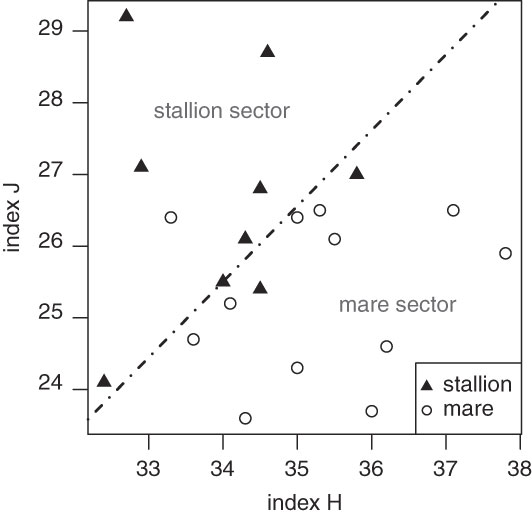
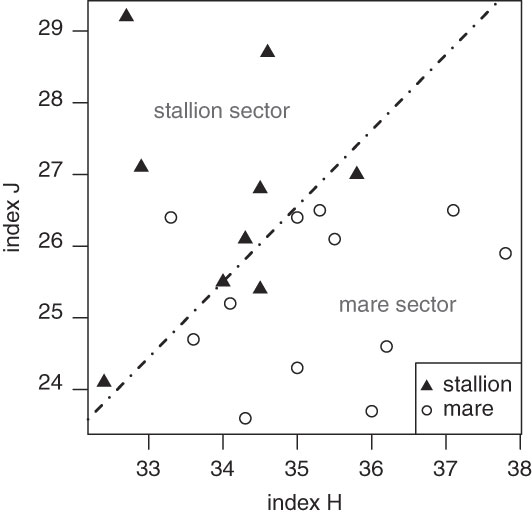
Two-variable discriminant functions can be visualised as plots of variable selection. Figure 3 presents regions of gender–group classification within group V. Each animal was entered into the co-ordinate system based on values of two of its traits: the chest width index (J) and the pelvis width index (H). A regression line marks the boundary between the two classification regions; at this line the estimated regression function has the value 0, which could be interpreted as the case when an animal with corresponding values of J and H cannot be classified. The area above the regression line corresponds to combinations of values of the traits for which an animal is classified as a stallion; conversely, the area below the line denotes classification as a mare.
Graphical classification into gender groups within age group V, based on a linear regression model using the pelvis width index (H) and the chest width index (J).
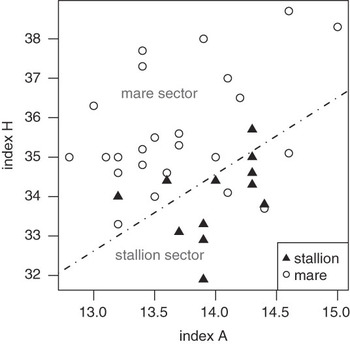
In group VI, we examined 13 stallions and 25 mares. Here too, two variables are enough to classify animals reasonably well; these are index of pelvis width (H) and index of metacarpus circumference (A). The function correctly classifies 76.9% stallions and 88% mares (Figure 4; Table 2).
Graphical classification into gender groups within age group VI, based on a linear regression model using the pelvis width index (H) and the metacarpus circumference index (A).

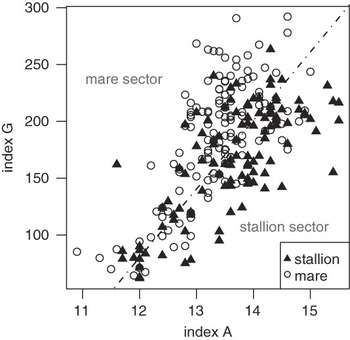
Overall, that is, for all age groups together, we have found no discriminant classifying animals better than at 70%. The most important indices for discriminating studs were index of force (G) and index of metacarpus circumference (A). This discriminant function correctly classifies 70.2% mares but only 59.8% stallions (Figure 5; Table 2).
Graphical classification into gender groups for all age groups (I to VI) together, based on a linear regression model using the force index (G) and the metacarpus circumference index (A).

Discussion
The study of the discriminant function in the research that has been conducted is satisfactory, as in all the cases in which the individuals had been assigned to particular age groups, the correct classification of individuals is 70%.
The study that has been carried out indicates that the following indices significantly contribute to discriminant models: metacarpus circumference (A), smaller trunk length (D), croup height (F), pelvis width (H) and chest width (J).
With the exception of the stockiness index (E), that is, eurisomy, all other indices are different functions of height at the withers. In case of the discriminant function proposed for stallions and mares from group VI, the most important parameters for gender discrimination were the circumference of chest and metacarpus – implying adult stallions feature smaller circumference of the chest and larger circumference of the metacarpus than adult mares; this statement is in agreement with studies performed on horses by Pinto et al. (Reference Pinto, de Almeida, Quirino, Cabral, de Azevedo and Santos2005) and Kolstrung (Reference Kolstrung2006). In adult horses, proportions of body parts have already been fixed. A stallion has its front body parts rebuilt more than a mare, causing greater stress on its front limbs. This results in os metacarpale III being more massive – that is, shorter yet thicker – in stallions. This observation confirms results obtained from horse studies by Kashiwamura et al. (Reference Kashiwamura, Avgaandorj and Furumura2001). As a consequence, equine os metacarpale III found during excavations can be considered highly reliable material for gender determination (Kobryń and Kobryńczuk, Reference Kobryń and Kobryńczuk1985). The observation of chest circumference with respect to height at the withers being smaller in case of stallions than mares, is in agreement with results of Pinto et al. (Reference Pinto, de Almeida, Quirino, Cabral, de Azevedo and Santos2005). Furthermore, we consider the hypothesis that subsequent pregnancies in mares additionally transfer some of the function of the thoracic diaphragm, through indirect pressure, to inhaling muscles of the chest; this could result in greater arching of the ribs, and by extension – greater circumference of the chest, in mares.
In younger age groups of horses under study, gender dimorphism of the shape of their bodies is not strongly pronounced and can be difficult to specify. In case of adult and 3-year-old horses it can be described using two parameters, whereas for younger ones this number is larger (group I: 4, II: 5, III: 4 and IV: 3 indices). In group I, the sucklings, the foremost traits distinguishing males from females are greater pelvis length and smaller chest circumference in stallions. In group II, the weanlings, the discrimination process sees an unexpected increase in the significance of height at the croup, relatively greater in males than in females. The second place is taken by, present also in other equations, the metacarpus circumference; it is, as usual, greater in males. In group III, the yearlings, the primary role is played by smaller trunk length, relatively smaller in males, followed as in the previous group by height at the croup (greater in males). In group IV, the 2-year-old animals, metacarpus circumference (significantly greater in males) and pelvis length (unexpectedly, smaller in males) are of foremost importance as well. In group V, comparison of 3-year-old stallions and mares reveals, above all, relatively greater chest width and smaller pelvis width in the former. This is a result of hormonal activity, which manifests itself through sideways development of the pelvis in mares and development of chest, or to be exact – chest muscles, in stallions.
Unlike other indices, the index of stockiness, that is, eurisomy (E) is not a ratio with height at the withers in the denominator, but a ratio of chest circumference to greater trunk length. This index only appears in the equation derived for group III, and even there its role is minor. It shows the aforementioned ratio to be greater in males than in females. The hitherto unmentioned index G, the so-called index of force, indicates that percentage of height at the withers to squared chest circumference, and is therefore a reinforced variant of index B. It appears as a first-order index, right after A in importance, in the discriminant function for the whole data sample, which does not serve its purpose of distinguishing genders. However, it can be considered a strong hint for carrying out biometric studies on animals in groups of similar age, as body proportions of both males and females change in time in response to both internal and external stimuli.
Last but not least, this study has shown that indices of length and width of the head do not play a major role in discriminant functions for different age groups of Hucul horses, which are at odds with claims by Glucksmann (Reference Glucksmann1974) that a stallion’s head is proportionally larger than that of a mare.
Acknowledgement
We thank the owners of Hucul horses.