

Introduction
The domestic goat is one of the most important livestock species most adaptable and geographically wide-spread, ranging from the mountains of Siberia to the deserts and tropics of Africa (Porter, Reference Porter1996; Zeder and Hesse, Reference Zeder and Hesse2000; Luikart et al., 2001; Pereira and Amorim, Reference Pereira and Amorim2010). Their inherent characteristics such as resistance to dehydration, preference for browse and wide-ranging feeding habits, enable them to thrive in regions that receive <750 mm of rainfall (Devendra and McLeroy, Reference Devendra and McLeroy1982). Goats are valued primarily for the production of meat, milk, skins and fibre and have fulfilled agricultural, economic, cultural and religious roles from very early times in human civilization (Joshi et al., Reference Joshi, Rout, Mandal, Tyler-Smith, Singh and Thangaray2004; Dong et al., Reference Dong, Xie, Jiang, Xiao, Du, Zhang, Tosser-Klopp, Wang, Yang, Liang, Chen, Chen, Zeng, Hou, Bian, Pan, Li, Liu, Wang, Servin, Sayre, Zhu, Sweeney, Moore, Nie, Shen, Zhao, Zhang, Li, Faraut, Womack, Zhang, Kijas, Cockett, Xu, Zhao, Wang and Wang2013).
Studies on domestic goat (Capra hircus) origins and genetic diversity are still not conclusive. Archaeological evidences indicate domestication of goats in the Fertile Crescent region of the Near East 10 000 years ago (Pringle, Reference Pringle1998; Luckert et al., 2001; MacHugh and Bradley, Reference MacHugh and Bradley2001). Using highly variable mitochondrial DNA segments, various authors have shown that the maternal lines of the current breeds comes from three founder lineages A, B and C (Bradley et al., Reference Bradley, MacHugh, Cunningham and Loftus1996; Luikart et al., Reference Luikart, Gielly, Excoffier, Vigne, Bouvet and Taberlet2001). Lineage A is the most common in all continents. Lineage B was found in the Indian subcontinent, Mongolia and Southeast Asia. Lineage C was observed in a few samples from Mongolia, Switzerland and Slovenia. Further increase in local sample sizes have prompted re-definition of these three lineages and the number of haplogroups has increased to six (A, B, C, D, F and G) (Bradley et al., Reference Bradley, MacHugh, Cunningham and Loftus1996; Manceau et al., Reference Manceau, Despres, Bouvet and Taberlet1999; Naderi et al., Reference Naderi, Rezaei, Taberlet, Zundel, Rafat, Naghash, el-Barody, Ertugrul and Pompanon2007, Reference Naderi, Rezaei, Pompanon, Blum, Negrini, Naghash, Balkiz, Mashkour, Gaggiotti, Ajmone-Marsan, Kence, Vigne and Taberlet2008). These studies found close matches in the alleged ancestor of the domestic goat, the bezoar, Capra aegagrus (Hughes et al., Reference Hughes, Fernàndez, Cucchi, Duffraisse, Casabianca, Istria, Pompanon, Vigne, Hanni and Taberlet2012; Doro et al., Reference Doro, Piras, Leoni, Casu, Vaccargiu, Parracciani, Naitana, Pirastu and Novelletto2014).
Kenya Indigenous goat breeds have never been accurately described. Therefore, there is threat of erosion of unique genotypes such as those associated with adaptability to certain habitat and disease resistance, through indiscriminate crossbreeding. The current classification based on phenotype/morphology identifies three breeds: Small East African (SEA) goats, the Galla goat and crosses of SEA and the Galla (Abate et al., Reference Abate, Wanyoike and Badamana1989). SEA goat has compact body, with short-haired coat of no definite colour though varied mixtures of black, brown and white are common. They have short erect ears and small horns. Galla goats have smooth short-haired coat that is white but the skin is black. Ears are long and dropping and the goat frequently have dewlap. Their horns are short and bent backwards (Devendra and Mcleroy, Reference Devendra and McLeroy1982).
In this study, we sampled DNA from indigenous goats from remote locations of pastoralists in Kenya, mainly, the Maasai and Somali/Boran communities and utilized mitochondria DNA (mtDNA) cytochrome-b/D-loop sequence to analyse their phylogenetic relationships and genetic diversity.
Materials and methods
Population description
Sampling regions were determined based regional and pastoral communities demographic distribution within Kenya. SEA goats were sampled from pastoralists in Narok and Kajiado (Southern Rift valley) while the Galla populations were sampled from Garissa and Isiolo, Northern Rift Valley). Other sampling was done at Kenyan coast (Kwale) and the Nyika plateau in Eastern Kenya.
Ethical clearance
This study was passed as a Master of Science dissertation project at University of Nairobi Veterinary School, Kabette and by National Commission of Science and Technology, Kenya (Nacosti). Ethical guidelines in the humane treatment of animals were followed.
Blood sample collection
Fifty blood samples representative of each of the various Kenyan indigenous goat breeds/regions were collected by a veterinarian. Approximately 2 ml of peripheral blood was obtained by jugular vein puncture into a 10 ml EDTA Vacutainer tubes. The samples were stored on ice, transported to the laboratory within 24 h, and preserved at −20 °C until use.
DNA extraction
DNA was extracted from the whole blood (Sambrook, Maniatis and Fritsch, Reference Sambrook, Maniatis and Fritsch1987). The blood was incubated in 50 µg/ml proteinase K, 1 percent SDS in STE buffer (150 mM NaCl, 100 mM EDTA, 10 mM Tris–HCl, pH 7.4) at 55 °C for 3 h. The DNA was extracted from the lysate by the phenol: chloroform method and precipitated from the aqueous phase by adding 2–3 volumes of absolute ethanol. The pellet was suspended in 50–100 µl TE (10 mM Tris–HCl, 1 mM EDTA, pH 8.0). DNA concentration was measured by absorbance at 260/280 nm and the quality analysed by electrophoresis in 1 percent agarose gel in 1× TAE buffer (40 mM Tris acetate, 1 mM EDTA, pH 8.0). The respective tubes with DNA were appropriately labelled and stored at –20 °C.
Polymerase chain reaction (PCR) and gene-clean procedures
In this study, 60 DNA samples representing SEA and Galla goats from Kenyan indigenous communities were analysed. PCR was carried out using the following parameters: denaturation at 94 °C, 1 min annealing at 56 °C, 1 min and extension at 72 °C for 1.5 min. The primers flanking region of cytochrome b and D-loop region were applied. The amplification product was verified on 1percent agarose gels and the fragment excised from the gel, solubilized in sodium iodide solution then bound to (silica) column in the gene clean procedure. Bound DNA was eluted in 30 µl nuclease-free ddH2O.
Sequencing
Gene cleaned DNA of the amplified fragments were sequenced at Beckman Coulter Genomics Inc., France using the AppliedBiosystems ABI dye terminator method. Each of the analysed samples was independently sequenced three times and the raw sequences with non-ambiguous consensus selected. Representative consensus sequences were deposited in NCBI nucleotide database (GenBank Accession ID: 683928–683967).
Phylogenetic and diversity analysis
Sequences were aligned utilizing the Clustal-W program in BioEdit (Version 7.05) and the phylogenetic relationships inferred from the aligned nucleotide sequences by the neighbour-joining method at Boostrap 1 000 replicates using Phylip program (Felsentein, Reference Felsenstein1993) as implemented in the MEGA6 version suite (Tamura et al., Reference Tamura, Stecher, Peterson, Alan Filipski and Kumar2013). Multiple monophyletic lineages were deleted to simplify data presentation. Analysis of allele diversity and population divergence was done in DNA sequence polymorphism statistics pakages implemented in MEGA 6 and dnaSP V5 software (Librado and Rozas, Reference Librado and Rozas2009).
Results
Phylogenetics of indigenous goats within Kenya
Neighbour-joining tree analysis of Kenya's indigenous goats show a distance relationship to the root Capra aegagrus, extinct ancestral goats (Figure 1). Within Kenya population, two major clusters were observed but did not associate with any morphological trait description of Kenyan indigenous goats.
Kenyan indigenous goats dendograph rooted against C. aegagrus: Capra hircus isolates from Kenya's main pastoralist communities. Observed clusters are indicated in brackets. The tree is drawn to scale with branch lengths proportional to evolutionary distances.

Relationship of Kenyan goats to Iberian Peninsula and Mediterranean Islands isolates
Databases DNA on mitochondrial D-loop from goats of phylogeographic origins was analysed against same region of D-loop of sampled Kenyan indigenous goats. Boostrap phylogenetic trees were constructed by Neighbour-joining analysis and edited to determine closest relationships to Kenya goats. This analysis of mtDNA defines Iberian Peninsula/Mediterranean islands goats as the dominant stock related to Kenyan indigenous goats (Figure 2) but there are a few lineages that cluster with Lehri and Pak Angora isolates from Pakistan.
Relationship of Kenyan indigenous goats to isolates of phylogeographic origin. The dendograph is rooted to two ancestral goats, C. aegagrus and C. falconeri. Different clusters of interest are indicated by bracket and the Iberia Peninsula/Mediterranean isolates are italized. The tree is drawn to scale with branch lengths proportional to evolutionary distances.

Different phylogeographic goat isolates in relation the ancestral goats
DNA (D-loop) databases of goats from phylogeographic origins were analysed using un-rooted tree to determine phylogeographic clusters in relationship to Kenyan indigenous goats in relation to different ancestral goat lineages that determines today's goat breeds. Kenyan indigenous stock (thick lines) include an old lineage and a diverse group of isolates that clusters with goats lineage A, found in Southern Europe and parts of Middle East (Figure 3).
Phylogeographic goat isolates in relation to lineages of the ancestral wild goats: C. sibirica, C. falconeri, C. aegagrus, C. caucasica, C. ibex nubiana and C. cylindricornis (Unrooted dendograph). Kenya's indigenous goat clusters lineages are shown in thick lines. The tree is drawn to scale with branch lengths proportional to evolutionary distances.

Population nucleotide diversity
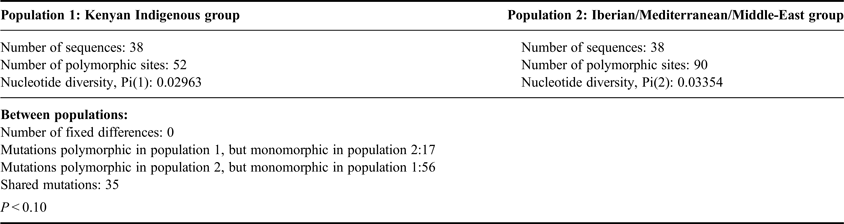
Partial cytchrome b/D-loop region nucleotide sequences diversity in phylogeographic datasets and similar sequences derived from Kenya's indigenous goats were subjected Tajima-D test (Tables 1 and 2) to assess departure from neutrality. Data showed weak positive values for Kenyan dataset and slightly pronounced negative value for the Iberian/Mediterranean/Middle-East dataset. Divergence between the Kenyan indigenous goats and the Iberia/Mediterranean/Middle-East isolates showed no fixed differences and 35 shared mutations (Table 3).
Results from Tajima's neutrality test.

The analysis involved 39 nucleotide sequences of Kenyan indigenous goats. There were a total of 479 positions in the final dataset. Evolutionary analyses were conducted in MEGA6. m = number of sequences, n = total number of sites, S = number of segregating sites, p s = S/n, Θ = p s/a 1, π = nucleotide diversity, and D is the Tajima test statistic (π and S/a 1 both estimate Θ, where E (expected) E [π] = Θ, E [S] = a 1Θ), software default significant at P < 0.10.
Results from Tajima's neutrality test.

The analysis involved 38 nucleotide sequences from Iberian/Mediterranean/Middle-East group. There were a total of 442 positions in the final dataset. Evolutionary analyses were conducted in MEGA6. m = number of sequences, n = total number of sites, S = number of segregating sites, p s = S/n, Θ = p s/a 1, π = nucleotide diversity, and D is the Tajima test statistic (π and S/a 1 both estimate Θ, where E (expected) E [π] = Θ, E [S] = a 1Θ), software default significant at P < 0.10.
DNA divergence between populations.

Genetic divergence between Kenyan indigenous goats and Iberian/Mediterranean region isolates (significant at P < 0.10) conducted using dnaSP V5 software.
Discussion
Determination of origins and phylogeographic relationships of goat breeds in sub-Saharan Africa is a necessary step in conservation of genetic diversity and their upgrading to higher productivity phenotypes Ajmone-Marsan et al. (Reference Ajmone-Marsan, Colli, Han, Achilli, Lancioni, Joost, Crepaldi, Pilla, Stella, Taberlet, Boettcher, Negrini and Lenstra2014). These goat populations are managed traditionally and preferred trait selection has maintained flow of important genes in high phenotype diversity (Taberlet et al., Reference Taberlet, Valentini, Rezaei, Naderi, Pompanon, Negrini and Ajmone-Marsan2008). In this study, we sampled indigenous goats from traditional pastoralist communities in remote locations within Kenya. These goats are classified: (i) SEA goat and its crosses, reared by Maasai communities in South and South Eastern rangelands and (ii) the Galla goat reared by Boran and Somali communities in North and North Eastern rangelands and semi-deserts of Kenya (Abate et al. Reference Abate, Wanyoike and Badamana1989; Kibegwa et al., Reference Kibegwa, Githui, Jung'a, Badamana and Nyamu2015). The phylogenetic structure (Tamura, Nei and Kumar, Reference Tamura, Nei and Kumar2004) based on mitochondria DNA sequences (Figure 1) show no distinct breed types since goats from different traditional communities cluster together and their diversity is uniformly spread. Mitochondria are maternally inherited and the inferred genetic relationship apply to the founder female goats, while introgression to these gene pools by the male goat is not accounted for. However, most studies on ancient lineages use mtDNA because there is high chance to get full-length genes in the preserved old specimen (Luikart et al., Reference Luikart, Gielly, Excoffier, Vigne, Bouvet and Taberlet2001; Fernandez et al., Reference Fernandez, Hughes, Vigne, Helmer, Hodgins, Miquel, Hanni, Luikart and Taberlet2006; Naderi et al., Reference Naderi, Rezaei, Taberlet, Zundel, Rafat, Naghash, el-Barody, Ertugrul and Pompanon2007) and many comparative studies apply mtDNA to infer population phylogenetic structure. The phylogenetic data observed in the Kenyan indigenous goats (Figure 1) indicate that the mtDNA lineages are spread across preferred phenotypes shared among the different communities. These goats are adapted to the dry rangeland habitats and selection of goat weight for meat rather than daily goat is the preferred trait. This implies that the pastoralist communities exchange or trade in preferred male or female for breeding and that the founder female population(s) are spread among the Kenya indigenous goats.
The origin of indigenous goat breeds in Kenya is not documented and available details are not evidence-based but rather, speculation. Nucleotide sequence data will enable estimation of genetic distance in the phylogenetic relationships between and within species, and the comparisons of local databases to those in geographically similar landscapes. We analysed partial mitochondria D-loop/cytochrome b sequences from sequence data we generated (GenBank Accession ID: 683928 to 683967) in relation to similar dataset of phylogeographic distribution. The goat breeds in Kenya mainly clustered together with isolates: Blceltiberica, Pirenaica, Blandaluza, Moncaina, Azpi-Gorri, Nserrana and Malta (MAL) from Iberia peninsula and Mediterranean coastal regions and islands belonging to the haplogroup A while a few Kenyan isolates clustered with Pak Angorra and Lehri from Pakistan goats (Figure 2) that belong to haplogroup C (Luikart et al., Reference Luikart, Gielly, Excoffier, Vigne, Bouvet and Taberlet2001; Fernandez et al., Reference Fernandez, Hughes, Vigne, Helmer, Hodgins, Miquel, Hanni, Luikart and Taberlet2006; Naderi et al., Reference Naderi, Rezaei, Taberlet, Zundel, Rafat, Naghash, el-Barody, Ertugrul and Pompanon2007). This shows that Kenya indigenous goat breeds are more related to the Mediterranian region haplogroups and may suggest migration routes, initially by Berbers and Bedouins and then via Sahel region by Fulani tribesmen pastoralists and/or Portuguese sailors (Pereira and Amorim, Reference Pereira and Amorim2010; Pieter, Reference Pieter2013). While this analysis relates to female lineages it is presumed that such migrations or/and trade include both sexes. The data also show Kenya's indigenous goats to be diverse stock, since their clusters are widespread over different phylogeographic isolates indicating diversity of founder stocks. Notably, there appears an early branching stock (Figures 2 and 3) that may represent a distinct haplogroup in this region and derived from one of ancestral wild goats and now has gene introgressions with haplogroup A. Further elaborate sampling and phylogenetic analysis can shed light on possible geographic Eastern African haplogroup related to the ancestral goats.
Studies (Hanotte et al., Reference Hanotte, Toll, Iniguez and Rege2006) have shown that genetic diversity found in today's indigenous livestock populations and breeds greatly exceeds that found in their commercial counterparts therefore breeding programmes should include utilization of these genetic resources as long-term conservation strategies. The most significant threat to genetic diversity of indigenous breeds is the marginalization of traditional production systems and the associated local breeds, driven mainly by the rapid spread of intensive livestock production, often large-scale and utilizing a narrow range of breeds (FAO, 2007). In this study, genetic diversity was assessed on sequence dataset using Tajima-D neutrality test (Tajima, Reference Tajima1989; Nei and Kumar, Reference Nei and Kumar2000). Analysed data output gave weak positive value (0.082581) for Kenya indigenous goats and slightly pronounced negative value (−1.087796) for the Iberian/Mediterranean/Middle Eastern dataset (Tables 1 and 2). Values close to zero indicate that the nucleotide diversity is near neutrality and the population from which we sampled was almost in equilibrium with respect to drift and mutation. Kenyan indigenous goat population show positive value, though small, indicating that the population may have undergone a recent bottleneck or there is overdominant selection of a trait that is linked to analysed locus. Iberian/Mediterranean/Middle-East breeds dataset showed negative Tajima-D value implying purifying selection or population expansion resulting in low heterozygozity. Nucleotides divergence between the two goat populations revealed great variation in polymorphic sites with 35 shared mutations but no fixed differences (Table 3). The two datasets may indicate different selection pressure due to different management systems.
Indigenous livestock breeds are the result of thousands of years of natural and human selection that allows productivity in different ecological zones (FAO, 2007, 2012). Goats in arid/semiarid regions of Kenya form an integral part of a fragile livelihood systems and the pastoralist communities are endowed with indigenous knowledge on management of these ecosystems. The goats they stock have inherent characteristics such as resistance to dehydration, preference for browse and wide-ranging feeding habits, enabling them to thrive in regions that receive <750 mm of rainfall (Devendra and McLeroy, Reference Devendra and McLeroy1982; Georgoudis, Reference Georgoudis1995, Reference Georgoudis, Belhadj, Boutonnet and DiGiulio1998). This study has provided further information on genetic diversity of Kenya indigenous goats as a conservation interest in order to avoid erosion of unique genotypes due to uncontrolled breeding. Investment in animal weight over agility may limit tolerance to heat/drought and can limit pastoralists’ long-distances migratory nature but the communities can adopt ecological improvement by intensifying shrubs conservation and growth in the browsing regions. Breeding programmes should select for tolerance to local diseases because large scale loss of goats and sheep reared by Kenya's pastoralist communities is attributed to disease outbreaks that cannot be managed by traditional methods. Government investment in epidemiological research to define etiological pathogens and apply interventions using alternatives in veterinary medicine is a plausible supplementary strategy that may not necessarily discourage approaches based on traditional medicines.
Conclusions
Based on genetic characterization data, Kenyan Indigenous goats phenotypic/morphological description as, (i) Galla goat and (ii) SEA goat would better be classified as mixed genotype of the two defined populations. Kenya Indigenous goats have an early lineage genetic stock that indicates distinct cluster and there has been introduction of other goats defining the introgression signatures mainly from Iberian Peninsula/Mediterranean stock. Kenyan indigenous goats are customarily rated on meat/weight and can be upgraded using related phylogeographic stocks.
Acknowledgements
This study was supported by National Commission for Science Technology and Innovation (Nacosti), Kenya. The project was facilitated by Molecular Genetics Laboratory at National Museums of Kenya/Institute of Primate Research.