INTRODUCTION
Klinefelter syndrome is a genetic disorder that affects approximately 1 in 700 men. Men with this disorder have an extra X chromosome, creating the 47,XXY chromosomal pattern. Although general intelligence is within the normal range, XXY men display specific deficits in brain development and cognition. Behavioral problems in men with Klinefelter syndrome are found in the social domain, such as social withdrawal, social anxiety, shyness, impulsivity, and inappropriate social behavior (Bender et al., 1999; Geschwind et al., 2000; Ratcliffe, 1999).
It has been proposed that difficulties in social interactions, and specifically those related to communication, are largely attributable to disabilities in the language domain that have been observed in XXY boys and men (Rovet et al., 1996). The reported verbal disabilities in Klinefelter syndrome include impairments in both language production and perception, and indicate compromised semantic language functions that are typically associated with the left hemisphere (Boone et al., 2001; Rovet et al., 1996). For example, Klinefelter boys and men may display disabilities in reading, articulation, phonemic processing, spelling, language expression, verbal memory, language comprehension, understanding words, finding words, and verbally expressing their thoughts, all resulting in a verbal IQ that is somewhat lower than their performance IQ (Boone et al., 2001; Geschwind et al., 2000). Some of these language dysfunctions have been related to left hemisphere abnormalities in Klinefelter syndrome (Itti et al., 2006).
Although deficits in semantic language functions have been widely described for XXY men and boys, it is not yet clear whether deficits in understanding affective prosodic aspects of language are present. The term prosody has been introduced to describe nonsemantic cues in spoken language. Prosodic cues can have linguistic as well as affective functions. Linguistic functions are, for example, emphasizing important parts of the message or presenting information as a statement or a question. Affective functions of prosody are also important for understanding intentions of others, because variations in tone of voice, such as intonation and loudness, provide information about the emotional state of the speaker. Thus, the emotional relevance of a spoken message may not only be conveyed by the meaning of words (i.e., emotional semantics), but also expressed in emotional prosody. Although semantic processing may be more lateralized to the left hemisphere, affective prosody represents a pragmatic aspect of language that may be lateralized to the right hemisphere (Mitchell et al., 2003; Ross et al., 1997). Indeed, deficits in perceiving and understanding emotional prosodic aspects of language are often seen after damage to the right hemisphere and may lead to difficulties in social communication (for an overview, see Joanette et al., 1990). In a functional magnetic resonance imaging (fMRI) study, Mitchell et al. (2003) found that attention to semantics increased activation in widespread left hemisphere regions, whereas attention to emotional prosody increased activation in generally right-sided brain regions. Importantly, subtracting the activation associated with semantic processing from the activation during affective prosody processing resulted in a pattern of almost exclusively right-sided activation. Vingerhoets et al. (2003) have measured blood flow velocity (BFV) with functional transcranial Doppler ultrasonography (fTCD) to study the contribution of the right and left hemisphere to the detection of emotion in prosody versus detection of emotion in semantics of spoken language. During detection of emotion in semantics a significant left-hemispheric lateralization of BFV was observed. This lateralization effect disappeared when attention was shifted to discriminating emotion in prosody, due to a rise in right hemispheric BFV. Using identical tasks (Van Rijn et al., 2005), we have been able to provide evidence that the right hemisphere plays a crucial role in processing affective prosody. In that study, we examined the effects of transcranial magnetic stimulation (TMS) over the frontoparietal operculum in the right hemisphere on affective prosody detection. Temporarily disrupting neural processing in the right hemisphere delayed reaction times in detecting specific emotions in prosody but not in verbal content, which suggests that this region within the right hemisphere is critically involved in processing emotional prosody.
The current study is the first exploration of affective prosody performance in men with the XXY karyotype. We contrasted the ability to discriminate emotions in prosody with the capacity to discriminate emotions based on verbal content (semantics) in both XXY men and men from the general population. We used affective prosodic and affective semantic stimuli designed by Vingerhoets et al. (2003). Findings from the above-mentioned TMS, fTCD, fMRI, and lesion studies, which used tasks identical or very similar to ours, suggest that the task we used for assessing emotion detection in prosodic cues versus semantic cues, may be considered as task contrasting language functions that are either more lateralized to the right or the left hemisphere, respectively.
In summary, we investigated the ability of XXY men and control men from the general population to label emotions based on prosodic versus semantic cues in spoken language. In addition, we assessed performance in a spatial, three-dimensional (3D mental rotation, task that allowed us to compare performance of both groups in a cognitive task outside the language domain. We hypothesized that in Klinefelter syndrome, deficits are present in discriminating emotions not only based on verbal content, but also on tone of voice.
METHODS
Subjects
Twenty-six men with Klinefelter syndrome (mean age, 42.7 years; SD 8.7) were recruited from the Dutch Klinefelter Association. Diagnosis of Klinefelter syndrome was confirmed by karyotyping, using standard procedures. Twenty-two men were treated with testosterone supplements, with a mean age of treatment onset of 26.9 years (SD 6.8).
Twenty male controls from the general population (mean age, 38.6 years; SD 13.3) were recruited using advertisements in local newspapers or were drawn from an already existing database in our department. None of the control subjects had a history of psychiatric illness as confirmed with the Mini International Neuropsychiatric Interview plus (MINI; Sheehan et al., 1998).
There were no significant differences in age between the groups [t(1,43) = −1.1; p = .26]. All subjects in the study were right-handed. Mean handedness score, as indicated by the Edinburgh Handedness Inventory (Oldfield, 1971), in the Klinefelter group (17.6; SD 12.8) did not significantly differ from that in controls [17.8; SD 13.3; t(1,43) = .23; p = .98]. Scores can range from −24 (completely left-handed) to 24 (completely right-handed). The study was approved by the local ethics committee, and written informed consent was obtained according to the declaration of Helsinki.
General Intelligence
Raven's advanced progressive matrices (short form)
This test is commonly accepted as a measure of general intelligence and has been shown to correlate with several standardized intelligence tests (Lezak, 1995). Subjects are shown 12 pictures of matrices (i.e., related patterns), each of which is a figural design with a part removed. The subject must choose the correct missing part from eight options.
National Adult Reading Test
The Dutch translation of the National Adult Reading Test (NART; Nelson, 1982; Schmand et al., 1991) provides an estimate of verbal IQ and is based on the high correlation between reading ability, specifically of irregular words, with intelligence in the normal population. Subjects are required to read 50 irregular words aloud, and, on the basis of the number of errors made in pronunciation, a reliable estimate of WAIS-R IQ can be calculated (Willshire et al., 1991).
Experimental tasks
Emotion discrimination in speech
Subjects were required to identify the emotion conveyed by prosody or semantics of several sentences. We used an emotion discrimination task with four conditions designed by Vingerhoets et al. (2003). As described by Vingerhoets et al. (2003), sentences were articulated by two professional actors, one male and one female. Only the sentences that were correctly classified by at least six of seven independent raters were selected for the tasks. The sentences were digitally recorded (Sony Digital Mega Bass MZ-R55) and were of approximately equal length.
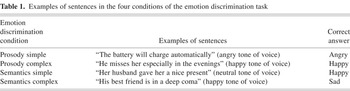
In the two prosody conditions, subjects were required to discriminate emotions based on the affective tone of voice and ignore the semantic content. In the simple version of the prosody task, the semantic content was always neutral. In the complex version of the prosody task, the semantic content was affective and always incongruent with the prosodic emotion. In the two semantic conditions, subjects were required to discriminate emotions based on the semantic content of the sentences and ignore the tone of voice. In the simple version of the semantics task, tone of voice was always neutral. In the complex version of the semantics task, tone of voice was affective and always incongruent with the semantic emotional content. See Table 1 for examples of sentences in the four conditions. Subjects were asked to orally report the perceived emotion as fast as possible. Voice onset times were collected with a microphone and selected emotion was recorded. Of the 24 sentences in each task, 6 were happy, 6 were sad, 6 were angry, and 6 were fearful. Each task presentation was preceded by four practice sentences. The order of the four conditions was quasirandomized. Time for completion of one of the four conditions was approximately 7 min.
Examples of sentences in the four conditions of the emotion discrimination task

Mental rotation task
The mental rotation test was an adaptation of original test by Shepard and Metzler (1971). In this computer task, participants were asked to compare two simultaneously presented objects composed of 10 cubes, and determine whether they were identical or not. All objects were two-dimensional representations of three-dimensional objects, rotated at different angles. In 50% of the trials, the objects were identical. Participants were given 6 min to complete 20 of these items. The number of correct responses was collected.
RESULTS
General Intelligence
Mean estimated IQ, as measured with the Raven's Advanced Progressive Matrices (short form), in the Klinefelter group (102.9; SD 11.3) did not significantly differ from that in the control group (109.6; SD 14.3). Mean estimated verbal IQ, as measured with the NART, also did not significantly differ between the Klinefelter group (107.4; SD 15.6) and the control group (110.8; SD 5.1).
Experimental Tasks
Emotion discrimination in speech
Significant group differences were present as shown by a General Linear Model (GLM) multivariate test including all four conditions of the emotion discrimination task [F(2,41) = 7.7; p = .001].
Significant group differences were present in the number of errors made in the simple prosody condition [F(1,42) = 13.2; p = .001]. Klinefelter men made more errors than controls. Also in the complex prosody condition, Klinefelter men made more errors in discriminating emotions than controls [F(1,42) = 15.4; p < .001]. When corrected for performance in the semantics task (using multivariate analysis of variance), the group difference in performance in the prosody conditions remained significant [F(1,43) = 9.8; p = .003 and F(1,43) = 9.6; p = .003 for the simple and complex prosody conditions, respectively].
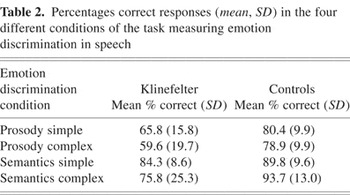
Furthermore, in the simple semantics condition as well as in the complex semantics condition, Klinefelter men made more errors as compared with controls [F(1,42) = 4.5; p = .04 and F(1,42) = 7.4; p = .009, respectively]. All means and SDs are presented in Table 2. Reaction times in the Klinefelter group were significantly higher in all four conditions [F(4,41) = 4.4; p = .005], as indicated by a GLM multivariate test.
Percentages correct responses (mean, SD) in the four different conditions of the task measuring emotion discrimination in speech

Interactions
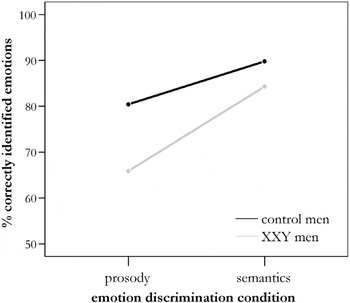
A GLM repeated measures analysis revealed a significant group (Klinefelter, control) by condition (simple prosody, simple semantics) interaction [F(1,44) = 4.0; p = .05], showing that, although Klinefelter men showed deficits in both conditions, they were more impaired in the simple prosody condition than in the simple semantics condition (see Figure 1). A GLM repeated measures analyses showed there were no group (Klinefelter, control) by condition complex (“simple,” “complex”) interactions when attending to emotional prosody or semantics. This finding indicates that performance deterioration in the complex conditions, in which more attentional resources are required, was not different between XXY men and controls.

There was a significant group by condition (prosody, semantics) interaction [F(1,44) = 4.0; p = .05] showing that, although Klinefelter men showed deficits in both conditions of the emotion discrimination task, they were more impaired in detection of emotions based on tone of voice than based on verbal content.
Mental rotation task
No significant group differences were present in performance on the mental rotation task. Mean percentage correct in the Klinefelter group was 66.4% (SD 19.4), in the control group 72.2% (SD 17.5).
DISCUSSION
This is the first study in men with the XXY karyotype that explores the understanding of pragmatic aspects of language. We compared comprehension of emotional prosody, that is, aspects of speech such as loudness and intonation that convey information about the emotional state of the speaker, between men with the XXY karyotype and men from the general population. We contrasted the ability to discriminate emotions in prosody, which may be more lateralized to the right hemisphere, with the capacity to discriminate emotions based on verbal content (semantics), which is more lateralized to left hemisphere. Our findings show that XXY men have difficulties in discriminating emotions in verbal content of speech and, even more so, in tone of voice.
The XXY group showed deficits in identifying emotions from prosodic cues as well as from semantic cues. These impairments were observed in the simple versions of the task, where either the semantic content or the tone of voice was neutral, as well as in the complex versions of the task, where semantic content and tone of voice were emotional as well as incongruent. The finding that XXY men display semantic deficits in our study was expected considering the literature on language deficits in Klinefelter syndrome. However, both the condition by group interaction and the finding that XXY men made significantly more errors in the affective prosody condition, even when corrected for their performance in the semantics condition, suggested that, on top of this semantic deficit, even more profound deficits are present in the prosody task. In the study of Vingerhoets et al. (2003), the observed significant bilateral increase in BFV during the complex versions of these tasks as compared with the simple versions were proposed to reflect a general increase in attentional demand as the level of BFV change is thought to be associated with task demand and reflects the attentional capacity necessary to perform a task (Vingerhoets & Luppens, 2001). As no effects of group on the difference in performance between the simple and complex tasks were present, this finding might suggest that the specific deficits observed in XXY men were not due to a general difficulty in attending to the stimuli. Importantly, as performance on a spatial, 3D mental rotation task was not impaired in the XXY group, the language deficits may not be attributable to a generalized reduction in cognitive performance.
Difficulties in picking up pragmatic communicative cues in conversation might have an impact on how well XXY men cope with social situations, as these aspects of language are important for understanding interpersonal intentions and responding to those in an appropriate way. The present findings show that Klinefelter syndrome may not only be associated with difficulties in identifying emotions based on facial expressions (Van Rijn et al., 2006), but also when expressed in tone of voice. In addition to providing insight in social cognitive impairments that might underlie difficulties in social communication and coping with a social environment, the present findings may have several potential implications.
First, our findings suggest that not only language functions typically mediated by the left hemisphere, but also prosodic aspects of language which may be associated with the right hemisphere, are affected in Klinefelter syndrome. Although speculative, this explanation would be in line with the reported abnormalities in language-related functioning of the right hemisphere. A single-photon emission computed tomography study has shown reduced hemispheric asymmetry in cerebral flood flow in XXY men, with increased cerebral blood flow in the right hemisphere related to difficulties in verbal skills (Itti et al., 2003). Also, a functional neuroimaging study with XXY men has revealed reduced lateralization of brain activation in language regions during verbal tasks, due to increased activation in the right hemisphere, rather than decreased activation in the left hemisphere (Van Rijn et al., manuscript submitted for publication). However, an alternative explanation might be that defects in integrated bihemispheric processing underlie the observed defects in discrimination affective prosody in Klinefelter syndrome. Imaging studies are needed to explore the exact neural underpinnings of affective prosody deficits in XXY men.
Second, as Klinefelter syndrome is characterized by an X chromosomal abnormality, we might extrapolate from these findings that the X chromosome influences some aspects of language, semantic aspects that are associated with the left hemisphere as well as emotional prosodic aspects that are associated with the right hemisphere. Support for a role of the X chromosome in development of the ability to decode emotional prosody is derived from studies with females with Turner syndrome, another X chromosomal disorder that is characterised by the presence of only one X chromosome in females (i.e., the X0 karyotype). Similar to men with the XXY chromosomal pattern, females with X monosomy also display impairments in perception of emotions in tone of voice (Ross et al., 1995).
In summary, this study has shown that the XXY chromosomal pattern may be associated with difficulties in discriminating emotions in verbal content of speech and, even more, in tone of voice. Besides revealing prosodic deficits that might underlie communicative difficulties and social dysfunction in XXY men, our findings may contribute to the development of more comprehensive models addressing the role of the X chromosome in normal and abnormal development of social communication.
ACKNOWLEDGMENTS
We thank Céline Berckmoes for the stimuli in the emotional discrimination task. Sophie van Rijn and Andre Aleman were supported by a “Vernieuwingsimpulse” grant (no. 016.026.027) from the Dutch Organization for Scientific Research (NWO). Conflicts of interest: none declared.