I. INTRODUCTION
Ni-based superalloy is widely used in aerospace, energy, metallurgy, and chemical industries, due to its combination of properties like superior mechanical performance, high temperature oxidation resistance, and corrosion resistance.Reference Yeh, Sato, Kobayashi and Harada1–Reference Sidky and Hocking4 With the development of industries, components made from Ni-based superalloys are increasingly operating in harsh working conditions, making a claim for high-performance superalloys. In gas turbine blades, Ni-based superalloys have to withstand high temperature as well as corrosion coming from oxygen or other aggressive media such as sulfur in ambient atmosphere. There have been numerous efforts to improve the mechanical strength at high temperature as well as better oxidation and hot corrosion resistance.Reference Sidhu, Agrawal and Prakash5–Reference Wang, Zhou, Sheng and Guo8
Oxidation is almost inevitable during the working process of superalloys. Worse still, some certain salts (e.g., sulfate) will form and deposit on the component and accelerate the oxidation process, which is called hot corrosion. Hot corrosion occurs when the fabricated components are working in corrosive atmosphere, such as SO2. Therefore, hot corrosion is merely accelerated oxidation with the effect of deposited salts.Reference Goebel, Pettit and Goward9 At a higher temperature exceeding the melting point of the salt, the molten salt mixture deposited on the coating surface would damage the oxide scales, such as Al2O3, Cr2O3, and SiO2, causing spallation or dissolution of the oxide scales.Reference Lu, Zhu and Wang10,Reference Jiang, Peng, Bao, Liu, Wang, Gong and Sun11 However, the deposited salts will not melt at a lower temperature but turn into low melting point eutectic molten salts, accelerating the corrosion process. Low temperature hot corrosion occurs due to the formation of liquid solution or liquid eutectic phase between the scales and the components.Reference Wortman, Fryxell, Luthra and Bergman12,Reference Gesmundo and Viani13
The existence of Cr in a Ni-based superalloy is beneficial to the corrosion resistance, since dense compacted Cr2O3 scale can be obtained from the interaction between Cr and outer oxygen. And further corrosion will be restrained by the protective Cr2O3 film.Reference Iacoviello, Boniardi and La Vecchia14,Reference Pedraza, Reffass, Balmain, Bonnet and Dinhut15 Hot-corrosion mechanisms of Ni-based superalloys under different simulated corrosion conditions have been studied and Cr has been proved effective in slowing down the corrosion of the substrate.Reference Hocking and Vasantasree16–Reference Lu, Tian, Shui and Yu20 The corrosion behaviors and corrosion mechanisms of Ni–14%Cr alloys in molten salt with Na2SO4 were investigated and results showed that the corrosion resistance of the alloy could be improved significantly by increasing the Cr content.Reference Lu, Tian, Shui and Yu20 A compact Al2O3 layer is also effective in restraining further oxidation or corrosion of alloys, since the layer can isolate the alloys from oxygen or other aggressive media.Reference Mahesh, Jayaganthan and Prakash21,Reference Ma, He, Wang and Zhang22 When introducing Cr and Al together, it has been proven effective in obtaining improved high temperature oxidation resistance and Cr can cause the third-element effect (TEE) in the oxidation of Ni–xCr–7Al alloys, preventing the internal oxidation of aluminum and inducing the formation of external Al2O3 scales.Reference Niu, Zhang, Wu and Gesmundo23
Superalloys are usually designed in such a way that a protective oxide film such as Cr2O3, Al2O3, or SiO2 would form due to the selective oxidation of an element when exposed in reactive environments.Reference Rhys-Jones and Swindells24 Based on this principle, numerous Ni-based alloys have been developed to obtain better corrosion resistance, such as Ni–Al alloy,Reference Mahesh, Jayaganthan and Prakash25 Ni–Cr–Al alloy,Reference Hara, Okumura, Nakagawa, Sato and Shinata26,Reference Yang, Peng and Wang27 Ni–Cr–Mo alloy,Reference Takizawa and Sugahara28 Ni–Cr–Mo–WReference Badwe, Raja and Misra29 alloy, Ni–Nb–Cr–Al alloy,Reference Strangman, Felten and Ulion30 etc.
It is noteworthy that Nb, as an additive, was also introduced into Ni-based superalloy or other alloys in the interest of enhancing high temperature oxidation resistance.Reference Elliott and Hampton31–Reference Zhang, Li, Chen, Wang and Ji35 Nb doping in TiO2 was proved more effective in improving the oxidation resistance of Ti–Ni–Al–Nb alloys, due to a decrease of oxygen vacancies and the suppressed inward diffusion of oxygen. The implanted Nb was proved effective in improving the isothermal oxidation resistance of Ti–Al alloy, which was attributed to the effect of Nb atoms on the nucleation and formation of the oxides and the oxidation scale microstructure.Reference Zhang, Li, Chen, Wang and Ji35
In this study, new type Ni-based superalloys were designed with Ni and Cr as the main constituent elements, and W, Mo, Ti, Al, Nb, etc. were also introduced simultaneously. In addition, hot corrosion behaviors of the prepared superalloys were investigated and the influence of Nb was discussed.
II. EXPERIMENTAL
Two Ni-based superalloys were prepared by vacuum melting appropriate amounts of high-purity elements in a vacuum arc melting furnace. Electromagnetic stirring was used to improve the quality of the ingots. The composition of the alloys is shown in Table I. After normalizing for 4 h at 1200 °C and then aging for 10 h at 800 °C in pure argon, specimens (with a size of 10 mm × 10 mm× 3 mm) were cut from the ingots by electrospark wire-electrode cutting. All the specimens were mechanically abraded on successively finer abrasive papers up to 800#, cleaned ultrasonically with alcohol and acetone, respectively.
Composition of the Ni-based superalloys (wt%).

a M represents the detailed contents of W, Mo, Ti, Al, B, Zr, C, and Fe.
The hot corrosion test was carried out at 800 °C for 20 h. Before exposure, specimens were preheated, followed by deposition with a saturated solution of 75 wt% Na2SO4 + 25 wt% NaCl. The amount of deposition is controlled to 2.0–3.0 mg/cm2. Thermogravimetry was used to measure the corrosion kinetics. The changes in weight of the specimens were discontinuously recorded by an electronic balance (accuracy of 10−4 g) at 1, 3, 5, 10, 15, and 20 h, respectively. The phase constituent of the specimens after hot corrosion testing was analyzed by a D/max-γB x-ray diffraction (XRD) instrument using Cu Kα radiation with the scanning speed of 4°/min. The microstructure of the specimens was examined by a JSM-6380LA scanning electron microscope (SEM) with an energy-dispersive spectrometer (EDS). The specimens for transversal surface observation were prepared by traditional mechanical polishing process. To maintain the integrality of the corrosion scales, the specimens were inlaid in bakelite to protect the scale from spalling.
III. RESULTS
A. Corrosion kinetics
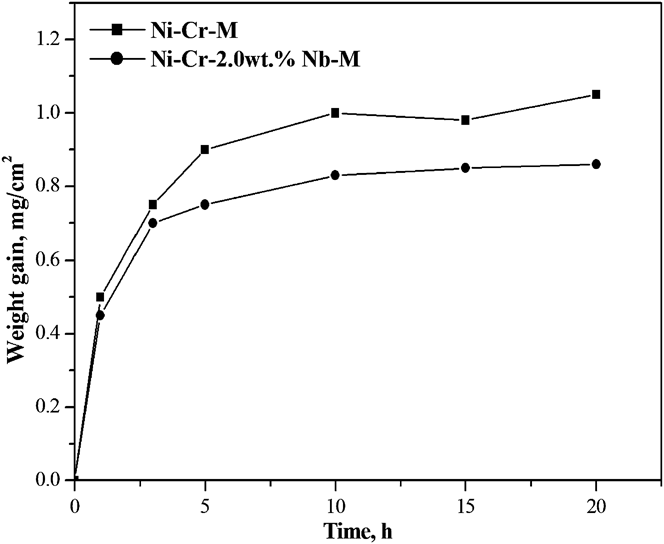
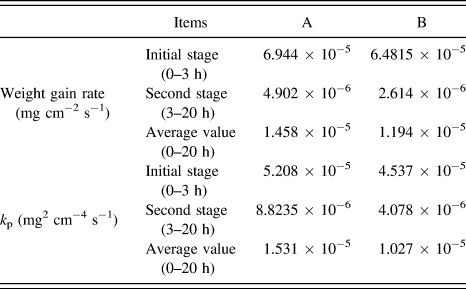
The corrosion kinetics of two different Ni-based superalloys with predeposition of 75 wt% Na2SO4 + 25 wt% NaCl at 800 °C under 1 atm static air is shown in Fig. 1. It is obvious that the Ni-based superalloys with Nb addition exhibit better hot corrosion resistance. The curves for the two different materials follow approximately parabolic rate law, W 2 = k pt, where W (mg cm−2) is the weight gain, k p (mg2 cm−4 s−1) is the parabolic rate constant, and t (s) is the corrosion time. The detailed calculating results are listed in Table II.
Corrosion kinetics of Ni-based alloys with or without Nb at 800 °C in 75 wt% Na2SO4–25 wt% NaCl molten salts.
Calculating results of the weight gain rate and k p for different stages.
The weight gain rate and the corrosion rate constant can be used to compare the corrosion resistance of the two designed alloys quantitatively. The corrosion resistance of the alloy with addition of Nb is enhanced about 30%, evaluated by the average value of k p (Table II).
The weight gain of the alloys increased with the exposure time extending. The weight gain rate in the initial stage was higher lasting about 3 h, and then the curves slowed down with the testing going on. Generally, the corrosion process is an accelerated oxidation process just under the effect of molten salts. Therefore, the corrosion kinetics is similar to the oxidation kinetics. The average weight gain rates during the hot corrosion test were 1.458 × 10⁻⁵ and 1.194 × 10⁻⁵ mg cm−2 s−1 for A and B, respectively. There was a drop in the kinetics curve of Ni–Cr–M at the point of 10 h, which might be due to the spallation of scales. Severe oxidation occurred during the testing process of specimen A. The corrosion products would spall easily due to the stress originated from the growth of the scales. However, the alloy with Nb addition showed a relatively mild rise in weight gain after 3 h, as can be seen in Fig. 1.
B. Scale structure and composition
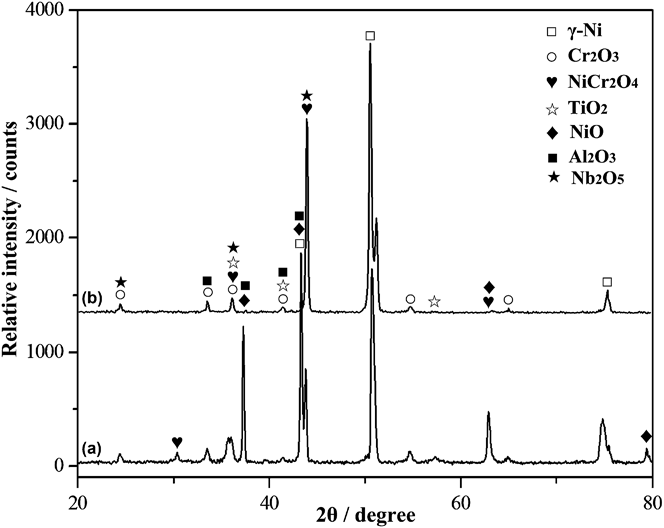
Figure 2 is the XRD results of the two specimens. It was obvious that the corrosion scales of the two specimens mainly consisted of Cr2O3, TiO2, and NiCr2O4. NiO was only detected in the diffractogram of specimen A without Nb addition. Nb2O5 appeared in specimen B, which will be explained later. The diffraction peak of γ-Ni appeared inevitably by the action of x-ray on the substrate, since the oxidation film was thin (<15 μm). Besides, the background of the diffractogram of specimen A was stronger than that of specimen B, due to its coarse corrosion surface, which will be presented subsequently. In addition, no sulfide was detected in the scales, since sulfuration did not occur under the condition in this study.
X-ray diffractograms of the oxidation scales formed on Ni–Cr–M (a) and Ni–Cr–Nb–M (b).
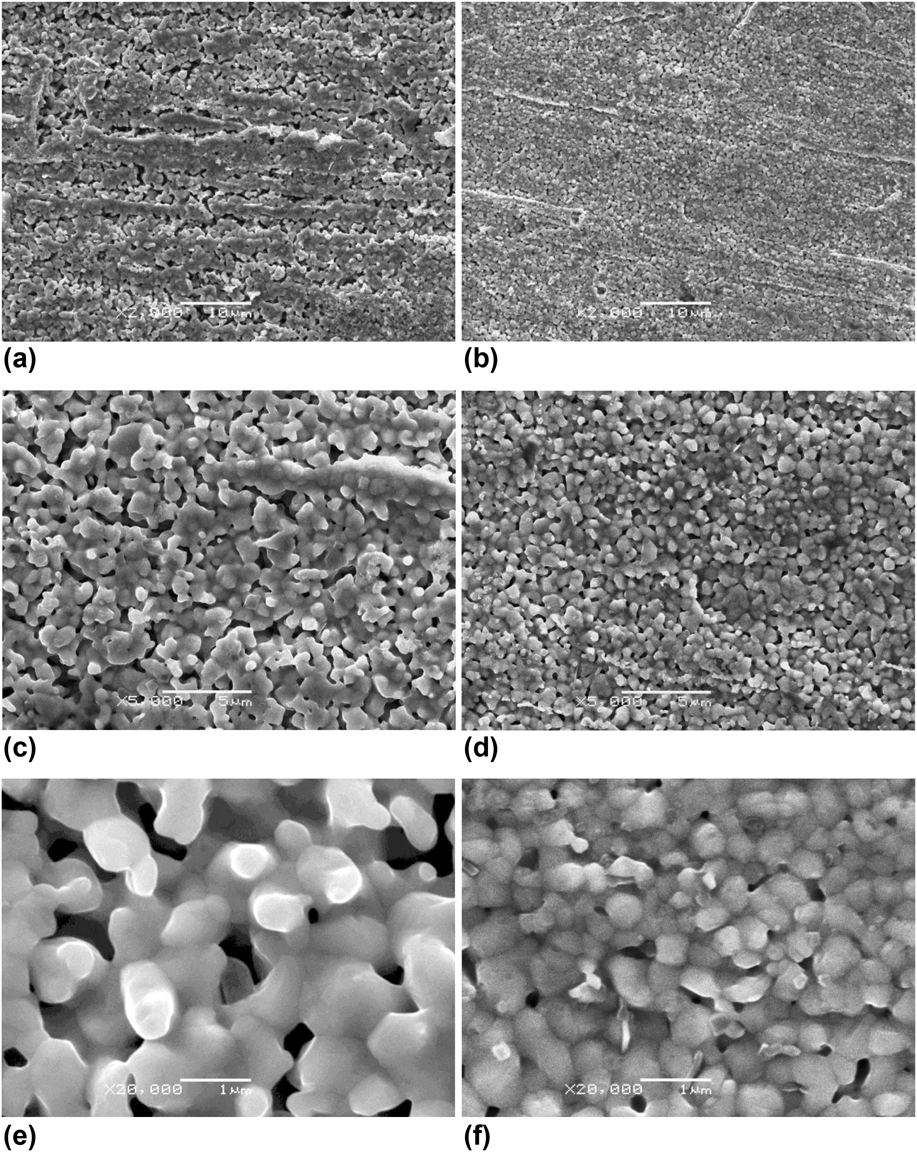
After simulant hot corrosion for 20 h at 800 °C with predeposited NaSO4 + 25 wt% NaCl, the surface morphologies of the two superalloys were observed by SEM, as shown in Fig. 3. A rough surface was observed with many micro grooves and cracks on specimen A, as shown in Fig. 3(a). The oxides appeared in strips and particles, among which grooves and pores distributed irregularly. In contrast, the surface of the corrosion scales on specimen B was even and compact, as shown in Fig. 3(b). In Fig. 3(c), the morphologies of the oxides are revealed more clearly. The strip-like oxides were comprised of little particles. Compared with specimen A, the oxides on specimen B were fine and uniform. As can be seen in Fig. 3(d), fine particles in scale of about 0.5 μm distributed evenly and densely and no obvious pores were observed. This microstructure can keep the alloys from the corrosive media (e.g., oxygen), which is beneficial to the hot corrosion resistance of the alloy. Pores appeared obviously on specimen A after 20 h hot corrosion at 800 °C, as shown in Fig. 3(e). The pores would act as the diffusion channels of oxygen, accelerating the corrosion process of the substrate. However, the Ni-based superalloy with Nb addition exhibited a relatively smooth surface after hot corrosion test, in which the particles were in tight junction with each other [Fig. 3(f)]. Only a few pores were picked out on the corrosion scales of specimen B and these little pores may be harmful to the hot corrosion resistance of the alloy if the experimental period lasts longer.
Surface morphologies of the oxides formed on Ni–Cr–M (a, c, e) and Ni–Cr–Nb–M (b, d, f).
It was noteworthy that a certain amount of incompact white particles distributed irregularly on the surface, as can be seen in Figs. 3(c) and 3(d). These white particles were probably TiO2, deriving from the selective oxidation of Ti. And the dense compact microstructure was Cr2O3, which will be confirmed in the following analysis.
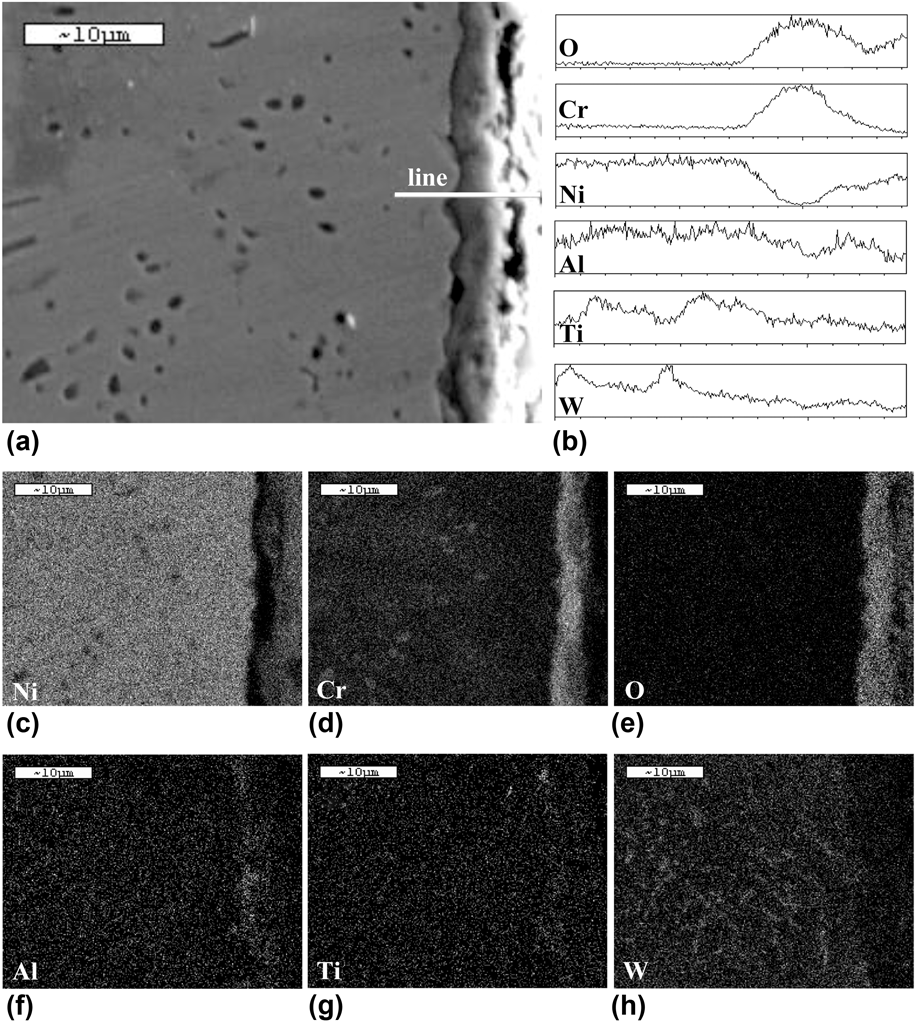
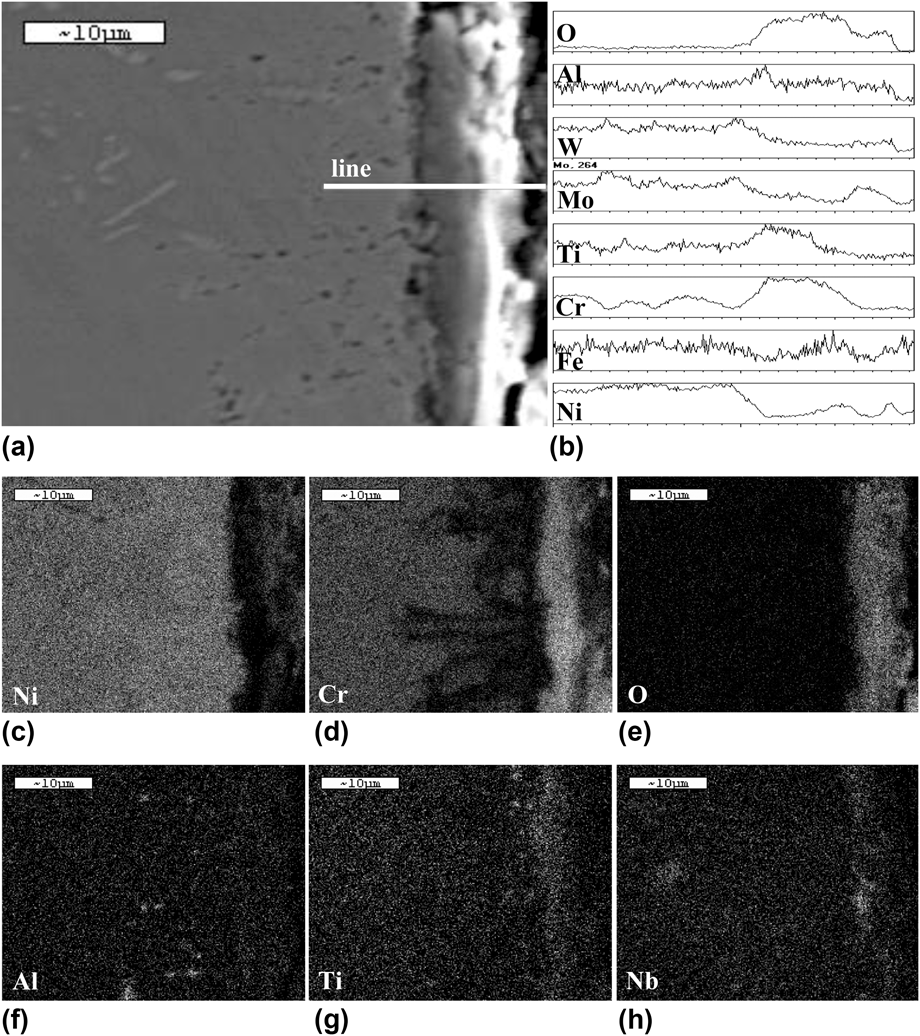
The morphology and the corresponding linear element distribution and element mapping of the cross section of the scales on the two specimens are shown in Figs. 4 and 5, respectively. The oxidation film on specimen A was approximately 6.7 μm, as shown in Fig. 4(a). The film can be divided into three layers, that is, the loose outer layer with NiO and NiCr2O4, the middle dense layer with protective Cr2O3, and the internal oxidation layer with Al2O3. The internal oxidation layer is beneficial to the combination between the oxidation film and the substrate. However, there are three interfaces in the oxidation film, namely, the scale/substrate interface, the outer layer/middle layer interface and the middle layer/internal oxidation layer. So the existence of internal oxidation layer of Al2O3 does not mean that the scale will not spall. In specimen A, spalling occurred easily due to the residual stress among the different layers.
SEM image (a), linear element distribution (b), and the corresponding element mapping (c–h) of the cross section on specimen A (Ni–Cr–M).
SEM image (a), linear element distribution (b), and the corresponding element mapping (c–h) of the cross section on specimen B (Ni–Cr–Nb–M).
As shown in Fig. 4(b), a higher concentration of Cr and O was presented in the scale, indicating the existence of Cr2O3, corresponding with the XRD results. The same element distribution was also detected in the element mapping [Figs. 4(c)–4(h)]. The concentration of Ni was higher in the outer layer of the oxide scale, as the linear element distribution shows [Fig. 4(b)]. Moreover, in Fig. 4(c), Ni was also found rich in the outer layer, revealing the existence of NiO in the outer layer. Besides, NiCr2O4 may be in the interface of the outer layer and the middle layer, since Ni, Cr, and O were detected there simultaneously, as shown in Figs. 4(c)–4(e). Al was mainly in the inner layer of the scale, and was rich in the interface [Fig. 4(f)]. Ti distributed evenly in the oxidation scales. Referring to the XRD results, conclusion can be drawn that TiO2 almost exists in the whole scale, even in a low grade. In addition, there was a Ni-depleted zone in the dense layer of Cr2O3, due to the formation of NiO and NiCr2O4 in the outer layer. A Cr-depleted zone was also detected, owing to the diffusion of Cr outward to form Cr2O3.
As observed in the cross section of specimen B [Fig. 5(a)], the formed oxidation film was dense and uniform and was about 5.8 μm. The concentration of Ni was lower than that in specimen A, and Cr was detected in the same position, as can be seen in Figs. 5(c) and 5(d). By implication, the loose layer mainly consisted of NiCr2O4, consistent with the XRD results. There was scarcely any NiO in the outer layer of the scale. Al2O3 existed in the whole layer according to the element mapping of Al and O, as shown in Figs. 5(e) and 5(f). However, the linear element distribution [Fig. 5(b)] of Al showed a rise in the scale/substrate interface, hinting at the existence of Al2O3. Ti and Nb were found to be rich around the scale/substrate interface. However, the fraction of TiO2 was not high in the XRD results, which was probably attributed to selective oxidation of Cr, Ti, and Al. In addition, the Cr2O3 middle dense layer prevented the diffusion of Ti outward and O inward, thus only an enrichment of Ti appeared instead of the formation of TiO2. TiO2 is always distributing incompactly and is not beneficial to the corrosion resistance of the alloy. Cr2O3 still was a dominant component of the oxides in accordance with the XRD results, which was also identified by the element mapping of Cr and O [Figs. 5(d) and 5(e)]. The Cr-depleted zone was narrow compared with the former one. However, band-like depleted zone appeared in the substrate, as shown in Fig. 5(d). Though induction stirred furnace was used in this study, segregation was inevitable. Therefore, the band-like Cr may derive from segregation during the melting process, in accordance with the morphology in Fig. 5(c). As mentioned above, Nb was found rich in the scale/substrate interface and light Nb was detected in the Cr2O3 layer. It was proved that Nb has a higher affinity for O, forming Nb2O5.Reference Moricca and Varma36 Nb2O5 will distribute in the Cr2O3 layer, forming mixed oxide and enhancing the stability of the dense oxide layer. In this case, the interdiffusion of the metallic ions (e.g., Cr3+) and oxygen will be further depressed. Thus, the appearance of Nb2O5 in the XRD results is explained logically.
IV. DISCUSSION
In this study, new-type Ni-based superalloys with or without Nb addition were designed and their hot corrosion behaviors in a mixture of Na2SO4 and NaCl were studied at 800 °C. The melting point of Na2SO4 and NaCl is 884 and 798 °C, respectively. Low melting eutectic molten salts will be obtained at 625 °C. The low melting eutectic molten salts will accelerate the oxidation process of Ni-based alloys, causing hot corrosion. Unlike the studies under similar experimental conditions,Reference Li, Liu, Wang, Han and Tang37 sulfide was not detected in the two Ni-based superalloys. It was probably because of the difference in the test condition. The observations made by Li et al.Reference Li, Liu, Wang, Han and Tang37 during a hot corrosion test which was conducted by immersing the specimen completely in the mixed 75 wt% Na2SO4+25 wt% NaCl salts were different from the observations made using deposition method in this paper. In contrast, deposition method is more similar to the real working condition for the designed alloys. During the hot corrosion test, oxidation occurred first due to the reaction between the O2 diffusing inward and the substrate. And then the molten salts would take effect.
It has been reported that two equilibriums exist in Na2SO4.Reference Goebel, Pettit and Goward9
 $${\rm{N}}{{\rm{a}}_2}{\rm{S}}{{\rm{O}}_4} = {\rm{N}}{{\rm{a}}_2}{\rm{O}} + {\rm{S}}{{\rm{O}}_3}\quad {\rm{,}}$$
 $${\rm{S}}{{\rm{O}}_3} = {1 \mathord{\left/ {\vphantom {1 2}} \right. \kern-\nulldelimiterspace} 2}{{\rm{S}}_2} + {3 \mathord{\left/ {\vphantom {3 2}} \right. \kern-\nulldelimiterspace} 2}{{\rm{O}}_2}\quad .$$
At the initial stage of the hot corrosion, Cr2O3 and Al2O3 formed by the reaction between Cr, Al, and O. The consumption of O led to a low partial pressure of O2 and caused a rise in alkalinity of molten salts. The formed protective oxides would dissolve in the molten salts, resulting in the formation of porous oxides. Take Cr2O3 as an example.
 $${\rm{C}}{{\rm{r}}_2}{{\rm{O}}_3} + 2{{\rm{O}}^{2 - }} + {3 \mathord{\left/ {\vphantom {3 2}} \right. \kern-\nulldelimiterspace} 2}{{\rm{O}}_{\rm{2}}} = 2{\rm{CrO}}_4^{2 - }\quad {\rm{,}}$$
 $${\rm{C}}{{\rm{r}}_2}{{\rm{O}}_3} + {{\rm{O}}^{2 - }} = 2{\rm{CrO}}_2^{2 - }\quad {\rm{.}}$$
The formed CrO42− and CrO22− decomposed into porous Cr2O3 during their diffusion across the molten salts.
 $$2{\rm{CrO}}_4^{2 - } = {\rm{C}}{{\rm{r}}_2}{{\rm{O}}_3} + 2{{\rm{O}}^{2 - }} + {3 \mathord{\left/ {\vphantom {3 2}} \right. \kern-\nulldelimiterspace} 2}{{\rm{O}}_2}\quad {\rm{,}}$$
 $$2{\rm{CrO}}_2^{2 - } = {\rm{C}}{{\rm{r}}_2}{{\rm{O}}_3} + {{\rm{O}}^{2 - }}\quad {\rm{.}}$$
In contrast, the surface morphology of the hot corrosion products on specimen A was porous, as shown in Figs. 3(c) and 3(e). The porous oxides lost their protective effect and accelerated the oxidation of the substrate. Hence, specimen A suffered from a severe oxidation during the test. Worse still, the scales on specimen A spalled easily due to the porous structure, corresponding with the drop in the kinetics curve of Ni–Cr–M at the point of 10 h (Fig. 1). Besides, the molten salts would exist in the porous structure and further accelerate the oxidation of the substrate. So the corrosion scales on specimen A were thicker than that of specimen B, as shown in Figs. 4 and 5.
Johnson et al. studied the high temperature properties of the Ni-based alloys with the effect of NaCl and Na2SO4.Reference Johnson, Nicholls, Hurst and Hancock38 Results showed that the Cl− could increase the crack and spalling tendency of the scales formed during the initial oxidation. In this study, NaCl in the mixed salts has the similar effect. The crack and spalling of the scales led to the direct exposure of the substrate to the molten salts, causing accelerated hot corrosion. The action mechanism can be summarized as follows.Reference Tang, Wang and Wu39,Reference Mckee, Shores and Luthra40
 $$2{\rm{C}}{{\rm{r}}_2}{{\rm{O}}_3} + 5{{\rm{O}}_2} + 8{\rm{C}}{{\rm{l}}^ - } = 4{\rm{CrO}}_4^{2 - } + 4{\rm{C}}{{\rm{l}}_2} \uparrow \quad {\rm{.}}$$
The formed Cl2 diffused inward across the loose oxide scales and reacted with Cr in the substrate, resulting in the formation of volatile CrCl3. The CrCl3 reacted with O2, as shown in Eq. (9).
 $$2{\rm{Cr}} + 3{\rm{C}}{{\rm{l}}_2} = 2{\rm{CrC}}{{\rm{l}}_3} \uparrow \quad {\rm{,}}$$
 $$4{\rm{CrC}}{{\rm{l}}_3} + 3{{\rm{O}}_2} = 2{\rm{C}}{{\rm{r}}_2}{{\rm{O}}_3} + 6{\rm{C}}{{\rm{l}}_2} \uparrow \quad {\rm{.}}$$
The reactions in Eqs. (3) and (7) proceeded repetitively, giving birth to porous Cr2O3. Porous Al2O3 and TiO2 were produced in a similar way.
Under the effect of the mixed molten salts, hot corrosion was accelerated in the way mentioned above. With the addition of 2.0 wt% Nb, the hot corrosion resistance of Ni-based alloy was improved significantly. By comparison, the oxide scales on specimen B were denser and finer. As was mentioned earlier, Cr2O3 was the dominant oxide in the scales on specimens A and B. The formation of dense Cr2O3 layer was protective for the substrate, isolating the alloys from the high temperature oxygen or other aggressive media. Cr2O3 formed at the beginning of the oxidation and thickened with the proceeding of oxidation. Nb was proved effective in promoting the formation of dense and continuous Cr2O3 layer. And the surface morphology of the oxidation scale can be improved excellently with Nb addition. The effect of Nb can be summarized as follows. First, the formation of Nb2O5 acts as a glue between the otherwise nearly immiscible TiO2 and Al2O3, enabling the formation of a more coherent scale.Reference Xu, Zhao and Gong33 Second, Nb will decrease the oxygen solubility in the alloy.Reference Kantor, Mason, D'Souza, Dong and Green41 Finally, the enrichment of Nb in the scale/substrate interface will decrease the diffusion processes of the metal and/or oxygen.Reference Pérez, Haanappel and Stroosnijder34
V. CONCLUSIONS
Ni–Cr–M and Ni–Cr–Nb–M Ni-based superalloys were designed and the hot corrosion properties were studied in this study. Ni–Cr–Nb–M Ni-based superalloy exhibited better hot corrosion resistance after hot corrosion for 20 h at 800 °C with deposition of 75 wt% Na2SO4 + 25 wt% NaCl. The corrosion kinetics approximately followed parabolic rate law. Hot corrosion resistance of Ni–Cr–Nb–M alloy was enhanced about 30%, evaluated by the average value of corrosion rate constant k p. Layered corrosion scales were generated on the Ni–Cr–M and Ni–Cr–Nb–M superalloy after hot corrosion resistance, which mainly consisted of Cr2O3, NiCr2O4, Al2O3, and TiO2. NiO was only detected in the scale on Ni–Cr–M, and Nb2O5 was found in that of Ni–Cr–Nb–M. With the addition of Nb, the surface morphology of the corrosion scale was notably improved, and the dense and compact scale was protective for the Ni-based superalloy.
ACKNOWLEDGMENT
This work was financially supported by the Department of Science and Technology of Shandong Province (Grant No. 2007GG10003002), P. R. China.