Implications
This study quantifies the development of tail-biting behaviour around a tail-biting outbreak and improves our understanding of the causation of tail biting in a group of pigs. This understanding can improve existing or generate new measures to prevent a tail-biting outbreak, and to use curative measures to improve pig welfare.
Introduction
Tail biting is an adverse behaviour characterised by the manipulation of a pig’s tail by another pig resulting in tail damage of varying severity (Penny et al., Reference Penny, Walters and Tredget1981; Sambraus, Reference Sambraus1985; Schrøder-Petersen et al., Reference Schrøder-Petersen, Simonsen and Lawson2003). The underlying causes of tail biting are multi-factorial (Van Putten, Reference Van Putten1969; Bracke et al., Reference Bracke, Hulsegge, Keeling and Blokhuis2004a and Reference Bracke, Hulsegge, Keeling and Blokhuis2004b) and the likelihood of its expression is influenced by external factors, such as environmental enrichment, housing system, climate, stocking density and feeding management, as well as internal factors, such as breed, gender and age (Schrøder-Petersen and Simonsen, Reference Schrøder-Petersen and Simonsen2001). Two stages can be distinguished in the development of tail biting (Fraser, Reference Fraser1987; Schrøder-Petersen and Simonsen, Reference Schrøder-Petersen and Simonsen2001). The first is the pre-injury stage (before tail damage occurs) and this may be followed by the injury stage (stage 2), in which the tail is damaged and bleeding.
Van Putten (Reference Van Putten1969) and Fraser (Reference Fraser1987) stated that in the pre-injury stage a few pigs lightly chew on penmates’ tails and the recipients usually tolerate this. It has been suggested that this light or non-destructive chewing, also known as tail-in-mouth behaviour or TIM, may be a normal low-frequency behaviour performed by all pigs and the precursor to tail biting (Feddes et al., Reference Feddes, Fraser, Buckley and Poirier1993; Schrøder-Petersen et al., Reference Schrøder-Petersen, Simonsen and Lawson2003). In contrast, Van Putten (Reference Van Putten1968) argued that only some pigs show light chewing before tail damage occurs, while Blackshaw (Reference Blackshaw1981) and Edwards (Reference Edwards2006) proposed that often only a single pig showed this initial tail-biting behaviour. The pre-injury stage may, more or less rapidly, progress to the injury stage (Fraser, Reference Fraser1987). Blood attracts pigs and several penmates may become involved as biters or as victims leading to a rapid escalation of the tail-biting problem (Blackshaw, Reference Blackshaw1981; Fraser, Reference Fraser1987; EFSA, 2007). Conversely, it has been suggested that usually one victim is attacked in a pen and that the other pigs ‘hunt this victim’ (EFSA, 2007).
To summarize, the contribution of particular pigs to the development of tail biting in the pre-injury and injury stages is controversial. Furthermore, there is little quantitative information about the development of tail biting behaviour and whether or not biters victimize specific penmates.
This study aims to quantify the development of tail biting behaviour at pen and piglet level, both before and after the tail-biting outbreak. By quantifying tail biting incidents (TBIs) from 6 days before to 6 days after the tail-biting outbreak in a pen we addressed the following questions:
(a) How many piglets in a pen are involved in performing and receiving tail biting behaviour before and after the tail-biting outbreak?
(b) Is it possible to identify pronounced biters and/or bitten piglets in a pen?
(c) Do biters prefer specific penmates or do they bite randomly?
Material and methods
A library of video records of 96 mixed-sex pens of 10 weaned piglets had been built in a previous study (Zonderland et al., Reference Zonderland, Wolthuis-Fillerup, van Reenen, Bracke, Kemp, den Hartog and Spoolder2008). During this experiment tail damage was scored every morning using three classes; 0 = no tail damage, 1 = bite marks (small damages with the size of a pinhead), 2 = tail wound (clearly visible wound with blood). For the purposes of this study, we selected the video records for 14 of these pens based on the appearance of tail damage and the availability of records for the required D−6 to D6 observation period. These records were examined in greater detail in this study (see below).
The 14 identical pens were fitted with partially slatted floors and provided with a space allowance of 0.4 m2 per weaned piglet (Zonderland et al., Reference Zonderland, Wolthuis-Fillerup, van Reenen, Bracke, Kemp, den Hartog and Spoolder2008). Each pen contained a dry feeder with two feeding spaces and piglets were fed ad libitum. The 140 piglets were not tail docked after birth and not teeth clipped, and the male piglets were not castrated. The piglets were weaned at the age of 4 weeks. The piglets received creep feed for the first 8 days after weaning (14.06 MJ metabolic energy (ME), 180 g/kg protein, 11.88 g/kg lysine, 3.0 g/kg Na (as fed basis)). Over the next 4 days this was gradually switched to a pre-starter diet (13.81 MJ ME, 175 g/kg protein, 11.54 g/kg lysine and 2.5 g/kg Na), which was fed until day 26. Thereafter, the feed was gradually switched to a starter diet (13.48 MJ ME, 175 g/kg protein, 10.30 g/kg lysine and 1.2 g/kg Na), which was fed until the end of the weaning period. A water bowl drinker (situated next to the dry-feeder) provided unlimited water intake. The pens were located in rooms where the environmental temperature was automatically regulated by forced ventilation. Room temperature was set at 28°C when the piglets entered, 26°C after 5 days, 23°C after 21 days and then 22°C after 28 days until the end of the experiment (32 days). Enrichment devices were either a 0.5 m metal chain suspended from the pen partition or two rubber hose tubes (length 0.4 m and diameter 30 mm) tied in a cruciform shape and suspended on a chain (rubber toy). Each pen was digitally video recorded (Poseidon DVR, 8 frames/s) using colour cameras (TC-506CEX) every other day between 1400 h and 1900 h. Markings on the back facilitated individual recognition of the piglets, using three colours of spray (red, blue and green).
Observations
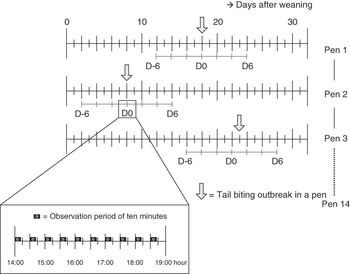
When a tail-biting outbreak became apparent in a pen (i.e. D0; minimal one piglet with a tail wound or at least two piglets with bite marks) the video records of the previous 6 (till D−6) and the following 6 days (till D6) were analysed every other day. Tail-biting incidents (TBI; piglet biting a penmate’s tail) were scored and the identities of the biter and bitten piglet were recorded. This procedure continued until video records had been analysed for the 14 pens for seven observation days (ideally D−6, D−4, D−2, D0, D2, D4 and D6). Occasionally, no video records were available for the pre-selected days because recording was only done on every other day; therefore, video records obtained on the previous days were used. A recording period of 1400 h to 1900 h was used because a preliminary study revealed a daily peak in TBI from mid-day to late afternoon, corresponding to the pig’s diurnal pattern of general activity. A similar pattern was also found for chewing behaviour by Feddes et al. (Reference Feddes, Fraser, Buckley and Poirier1993). Video records were analysed for the first 10 min of each half hour between 1400 h and 1900 h, that is, 1400 h to 1410 h, 1430 h to 1440 h, 1500 h to 1510 h, etc.; see Figure 1) using behavioural sampling (Observer XT, Noldus), resulting in a total of more than 163 h of observation. All 14 pens were watched in random order by a single observer.
Example of selected observation days per pen before and after the first visible tail damage.

Tail-biting behaviour was scored during each 10-min observation period using TBIs. A TBI was scored when one piglet (biter) was observed with the tail of a penmate (bitten piglet) in its mouth while making clear biting movements. A TBI was also scored when the biter manipulated a penmate (bitten piglet) near its tail and this behaviour elicited a clear response from the bitten piglet (standing, jumping up or a quick turn of the head towards the biter). The second part of the above definition was applied in cases in which a bitten piglet’s tail was not visible, for example, when it was obstructed by another piglet. For each TBI, we recorded the identities of the biter and the bitten piglet. The number of TBIs per piglet was summed per observed hour for each of the two 10 min observation periods and multiplied by three to calculate the average TBI per piglet per observed hour. These individual TBIs per piglet per hour were averaged per observation days (D−6 to D6), and this average TBI per piglet per observation day was used for further analyses.
Statistical procedures
First, to quantify the development of tail biting before and after the tail-biting outbreak in a pen and to identify possible pronounced biters and/or bitten piglets within a pen, the average TBIs per piglet per observation day (D−6 to D6) were analysed using model 1. Second, to analyse whether the piglets preferred to bite specific penmates, the coherence between biters and bitten piglets was analysed using model 2. Third, the relationship between tail damage and the received number of tail bites was estimated in order to validate the observation method used. All analyses were performed using Genstat software version 11.1 (VSN International Ltd, Hemel Hempstead, England, UK). Fixed model effects were tested using the corresponding Wald tests. Differences between pair wise treatment means were tested using Fisher’s LSD test.
The recorded TBIs were used to analyse if a particular kind of development (e.g. linear) in biting and being bitten was apparent (at pen and individual level) before and after the tail-biting outbreak (D0). The numbers of bites performed and bites received per piglet were analysed separately.
For biting, we used the average log-transformed number of bites performed per piglet (within pens) per observation day (data were normally distributed after log-transformation). First, a restricted maximum likelihood (REML) variance components analysis with mixed model 1 was used to determine any inclines in biting. Subsequently, the pen slope was used as a fixed factor in the model to identify a pronounced biter in a pen. The analysis showed that at pen level the overall development of performed bites had significant linear (P < 0.001) and negative quadratic (P < 0.05) components. In model 1 these two components are represented by β 1 and β 2. Model 1 represents the final model for bites performed.
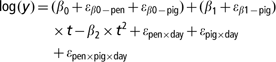
where, y = number of bites performed per observation day, t = day of observation (D−6 to D6). Fixed effect: incline in pen with linear (β 1) and negative quadratic (β 2) components. Random effect: εβ 0−pen = differences in intercept between pens (i.e. the predicted mean level of TBI at D−6), εβ 0−pig = differences in intercept between piglets, εβ 1−pig = differences in TBI development between piglets (slope), ε pen × day = day effects of pens (auto regression), ε pig × day = day effects of piglets and ε pen × pig × day = residual variation.
A similar procedure was used to analyse bites received. Analysis of the average log-transformed numbers of received bites per piglet (within pens) per observation day showed a significant linear (P < 0.001) component (β 1). Therefore, to determine whether some piglets in a pen received pronounced biting, model 1 was used without the negative quadratic component (β 2) as a fixed factor.
For each pen a 10 × 10 matrix with the number of bites performed and received per each of the 10 piglets was calculated. This resulted in a three-dimensional cross table (pen, biter and bitten piglet). To test the absence of coherence between biters and bitten piglets (i.e. the hypothesis that piglets showed no preference to bite a specific penmate (based on a Poisson distribution)), the three-dimensional cross table was analysed using a generalized linear regression model (model 2) and with logarithm as a link function. To test whether tail damage had a specific effect on the preference of biting piglets for a specific penmate, the coherence after the tail-biting outbreak in a pen was analysed separately. Therefore, a subset was created with data from D0 to D6 and again analysed using model 2.

where Eyijk = the estimated number of TBIs per piglet combination per pen, n = total number of TBIs, i = pen, j = biter and k = bitten piglet.
The residual variation of the model was tested for independence using a χ 2 test (P < 0.05).
A REML procedure was used to estimate the relationship between the level of tail damage (no damage, bite marks or a tail wound) at D0 and the cumulative received tail bites before this day (i.e. D−6 to D−2). The mean number of received tail bites per hour per tail damage level before D0 was estimated in the REML procedure with tail damage as fixed and pen as random component. Similarly, the mean number of received tail bites per hour was estimated per tail damage level before D2, D4 and D6.
Results
The average age of the weaned piglets at the start of the experiment was 28.2 (±3.2) days and start weight was 7.9 (±1.3) kg. At the end of the 32-day weaning period, the average end weight was 26.7 (±3.9) kg. During this weaning period, 76 piglets out of the 140 piglets were observed with a tail wound on one or more observation days. Another 49 piglets were observed with bite marks, but no tail wound on one or more observation days, and the remaining 15 piglets had an undamaged tail throughout the period. For piglets that were observed with a tail wound and previously with bite marks, this deterioration of tail damage took on average 7.0 days (s.d. = 4.5 days). In total, 9% of the piglets were observed with a tail wound without bite marks on a previous observation.
Development of TBIs
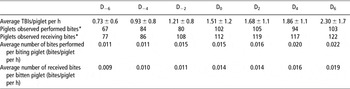
Before the tail-biting outbreak, that is, D−6 to D−2, 115 of the 140 piglets (82%) were observed biting a penmate one or more times (Table 1). In the same period, 135 of the 140 piglets (96%) were bitten by a penmate one or more times. After the tail-biting outbreak was noted, that is, D0 to D6, 138 piglets (99%) were seen biting a penmate, whereas every piglet was bitten.
The average number of TBIs/piglet per h (including s.d.), the observed number of biters and bitten piglets and the average number of performed and received bites per biting and bitten piglet in each observation day

TBIs = tail-biting incidents.
*Total number of piglets was 140.
The overall average number of TBIs per piglet per hour increased from 0.73 to 2.30 between D−6 and D6. The number of biters increased from 67 at D−6 to 102 at D0 and then remained relatively constant. The average number of bites performed per biting piglet increased after D0 from 0.015 to 0.022. The number of piglets receiving bites increased steadily from 77 at D−6 to 122 at D6 and the bites received per bitten piglet increased also steadily from 0.009 at D−6 to 0.019 at D6. There are more bitten piglets than biters.
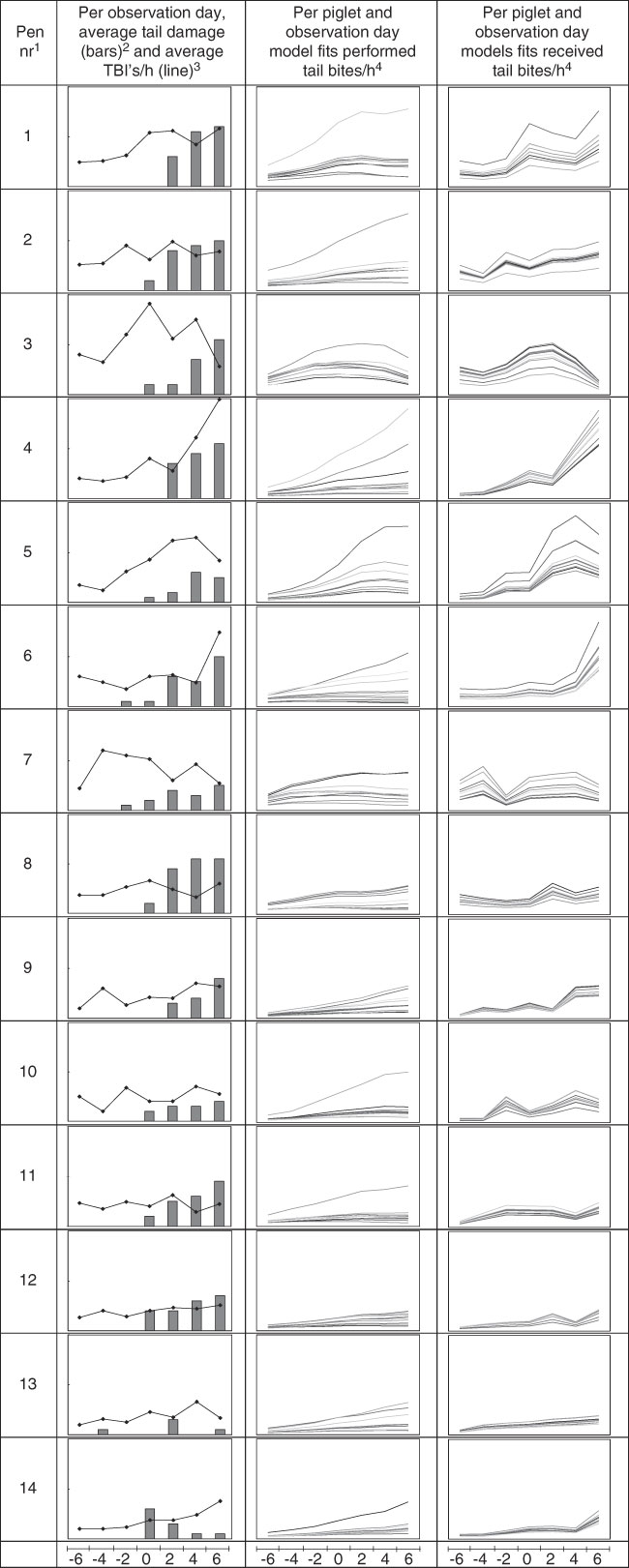
Figure 2 shows the development of tail biting and of tail damage at pen and individual piglet level overall and for each of the 14 pens.
The average tail damage (bars) and the average number of tail-biting incidents (TBIs)/h (line) per pen in each observation day. In addition, per observation day and per individual piglet the back-transformed model fits for performed and received bites per hour, respectively (1pens are sorted by the average TBIs per pen (first row is highest); 2the range for tail damage is from 0 to 2, with 0 = no tail damage, 1 = bite marks and 2 = tail wound; 3the range for TBIs/h is from 0 to 6 bites/h; 4the range for back-transformed tail bites/h is from 0 to 6 bites/h.
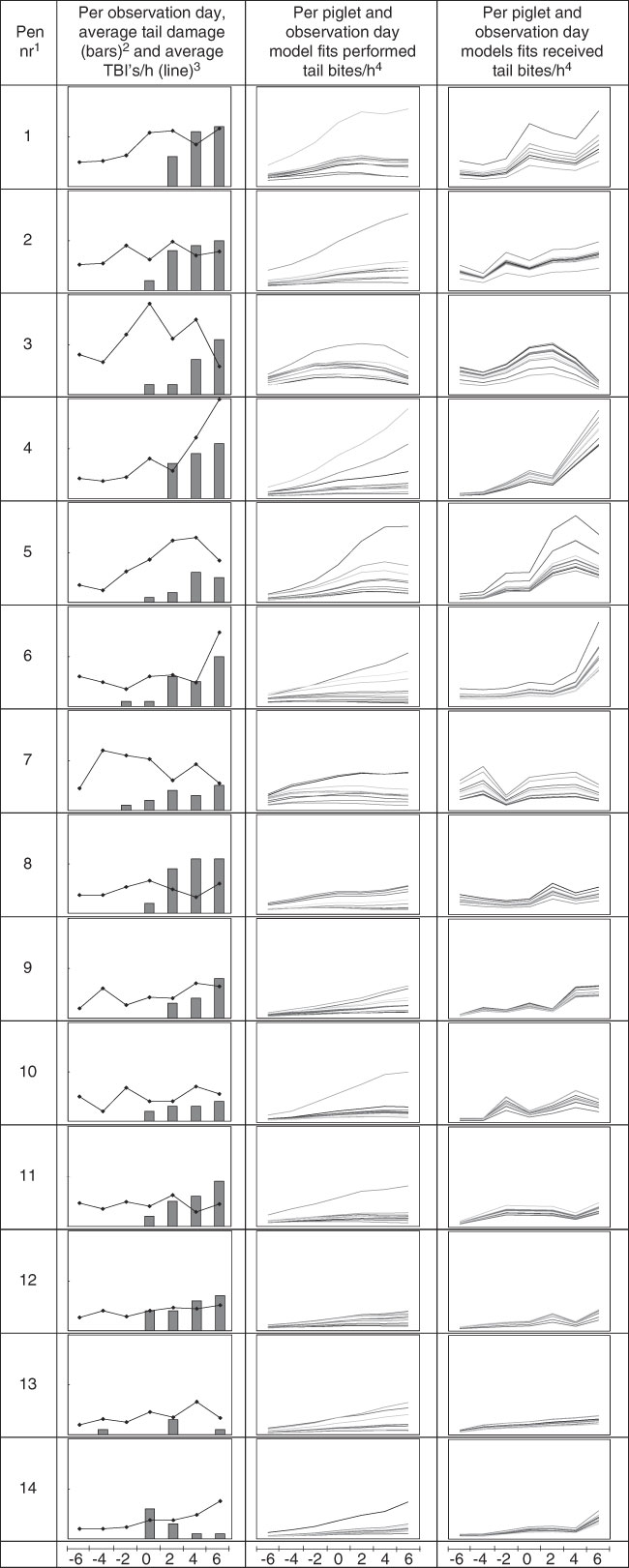
At pen level the development of performed bites had in model 1 two significant components on the log scale: positive linear (β 1) and negative quadratic (β 2). The positive linear component (β 1) corresponds to the increase in TBIs per pen (Figure 2, second column) during the first half of the observation period. From D0 onwards, some pens still showed an increase in TBIs (e.g. pen 4), but the scores of several pens reached a plateau or even a decrease (e.g. pen 3). The latter finding corresponds to the significant negative quadratic (β 2) component in model 1. From D0 onwards, the average tail damage increased in most pens, especially in those with a high average number of TBIs. In some pens, however, tail damage either remained relatively constant (e.g. pen 10) or decreased even though TBIs still showed an increase (e.g. pen 14).
At individual piglet level, Figure 2 shows that in at least 10 pens the model fits for performed bites (visually) deviated for one or a few piglets. Model 1 reveals a significant intercept (εβ 0− pig: P < 0.001) and slope (εβ 1− pig: P < 0.001) for bites performed per piglet. This means that in a pen at D−6 one or a few piglets already performed more tail-biting behaviour (εβ 0− pig) compared to the pen average (e.g. pens 1 and 2). Furthermore, within a pen one or a few piglets showed a higher increase in bites performed (εβ 1− pig) than the pen average (e.g. pen 5).
At individual piglet level, the model fits for received bites per piglet were visually less pronounced than those for biting piglets. One bitten piglet visually deviated from the rest of its penmates in pens 1, 2 and 6. Model fits for bites received per piglet revealed a significant intercept (εβ 0− pig: P < 0.001). As for bites performed, at D−6 one or a few pigs in a pen at D6 received more tail-biting behaviour (εβ 0− pig) compared to the pen average. However, unlike the findings for bites performed, bitten piglets showed no significantly higher increase in received bites (εβ 1− pig) than the pen average.
Preference of biters for a specific penmate
Analyses of the three-dimensional matrix from D−6 to D6 of bites performed and received using model 2 showed that the residual variation of the model was significantly different (χ 2(1355;1133) < 0.001) from a Poisson distribution. This indicates that certain biters preferred to bite a specific penmate. However, further investigation revealed a high number of TBIs involving the same biter and bitten piglet in pen 5 at D0; this sort of relationship was not apparent in the other pens (χ 2(1115;1053) = 0.09). This means that apart from pen 5 at D0, biters tended to have no preferences for a specific penmate. Furthermore, no coherences between biter and bitten piglets was found in the separate analysis of the period after D0 (D0–D6; excluding pen 5, χ 2(1039;1053) = 0.61).
Relationship between tail damage and received tail bites
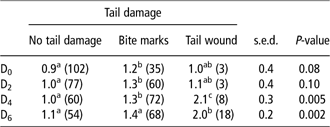
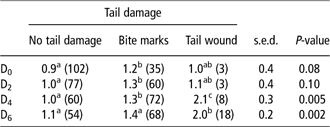
Table 2 presents the relationship between the level of observed tail damage and the cumulative received number of tail bites per hour before this day.
Mean number of received TBIs/h (including the number of piglets) per tail damage class (no tail damage, bite marks or tail wound) cumulative before the day tail damage was observed (D0, D2, D4 and D6), including the s.e.d.
TBIs = tail-biting incidents.
a,b,cDifferent superscripts in a row indicate a significant difference (P < 0.05).
At D0 and D2, a trend was found between the level of tail damage and the cumulative number of received tail bites per hour before this day. Piglets with bite marks received more tail bites compared to piglets with no tail damage. At D4 and D6, piglets with a tail wound received significantly more tail bites compared to piglets with no tail damage and at D4 also compared to piglets with bite marks.
Discussion
The pens used in this study are similar to most of those used in the European Union for housing weaned piglets and finishing pigs, that is, small barren pens for around 10 piglets with partly slatted floors and one feeder. A major difference was that our piglets had intact tails rather than docked ones. Due to the selection of pens with a tail-biting outbreak, the percentage of piglets with tail damage (89%) was considerably higher compared to the tail damage in the whole population (34%) used in the study of Zonderland et al. (Reference Zonderland, Wolthuis-Fillerup, van Reenen, Bracke, Kemp, den Hartog and Spoolder2008). However, the transition from bite marks into a tail wound took in the selected pens 7.0 days, which is comparable with the 7.5 days found in the whole population (Zonderland et al., Reference Zonderland, Wolthuis-Fillerup, van Reenen, Bracke, Kemp, den Hartog and Spoolder2008). This indicates that in pens with a tail-biting outbreak (as used in this study), the speed of tail damage deterioration into a tail wound is comparable with the speed in pens with only one or two piglets with tail damage. Such a development of tail damage best fits the description of a two-stage outbreak with gentle tail manipulation in the pre-injury phase and more forceful biting in the injury phase, as described by Taylor et al. (Reference Taylor, Main, Mendl and Edwards2010). Other types of tail biting, such as sudden forceful or obsessive tail biting, which include grabbing and yanking of the bitten tail leading to severe wounds in a relatively short period have also been suggested by Taylor et al. (Reference Taylor, Main, Mendl and Edwards2010). These types of tail biting might have been present in this study (indeed 9% of the piglets were observed with a tail wound without previous observation of any bite marks); however, grabbing and yanking of a penmate’s tail has been observed rarely during the 163 h of observation.
Development of TBIs
Most (82%) of our piglets were observed tail-biting penmates and almost all (96%) received tail bites before any tail damage was apparent in the pen. We also found large individual variations in 10 out the 14 pens, one or a few piglets noticeably performed more tail biting than their penmates. As far as we know, such results have not been reported before. Schrøder-Petersen et al. (Reference Schrøder-Petersen, Simonsen and Lawson2003) reported that all pigs performed low-frequency TIM behaviour, which is considered a precursor for tail-biting behaviour (EFSA, 2007). Furthermore, TIM behaviour was also performed with considerable variation among the individual pigs (Schrøder-Petersen, Reference Schrøder-Petersen2005). In contrast with our results, several scientists suggested that only one or a couple of pigs show tail biting before an outbreak occurs (Blackshaw, Reference Blackshaw1981; Beattie et al., Reference Beattie, Breuer, O’ Connell, Sneddon, Mercer, Rance, Sutcliffe and Edwards2005; Edwards, Reference Edwards2006). However, these authors may have focused only on pigs that showed a higher frequency of tail biting than the rest of their penmates.
The number of observed biters in a pen increased prior to the tail-biting outbreak in a pen and afterwards remained relatively constant. This indicates that other factors besides the presence of damaged tails with blood enhances tail-biting behaviour of biters. It is possible that the subsequent reaction of the bitten piglet has a rewarding effect, motivating the biter to specifically search for more tails to bite. Not only did these biters increase their biting frequency but it was also noticed that their tail-biting behaviour changed; instead of biting a penmate’s tail that they come across occasionally, they seemed to specifically search for penmates’ tails. They bit a tail until the bitten piglet reacted (mostly by walking away) and then turned to another piglet and repeated the biting behaviour. This pattern seems comparable to an earlier report of ‘fanatical’ tail biters that were hyperactive and moved from tail to tail to bite (Van de Weerd et al., Reference Van de Weerd, Docking, Day and Edwards2005). However, in our study, piglets with the highest levels of tail-biting behaviour (20 to 55 bites/h) showed this high level of tail biting only on 1 day and had lower levels on following or previous observation days. One explanation might be that tail biting is performed in bouts and that our observation periods missed some of these bouts. Another more likely explanation is that ‘fanatical’ biters reported by Van de Weerd et al. (Reference Van de Weerd, Docking, Day and Edwards2005) belonged to the category of ‘obsessive’ tail biting (Taylor et al., Reference Taylor, Main, Mendl and Edwards2010) rather than to the two-stage outbreaks that probably occurred in our pens.
Like biters, some piglets already received more bites compared to their penmates 6 days before the tail-biting outbreak. This indicates that individual piglets also play a role in the development of a tail biting outbreak and that some piglets are more predisposed to become a ‘victim’. However, unlike biters, victims’ frequencies of receiving bites were more evenly distributed among the penmates; all piglets are potential victims. There seemed to be almost no escape from this tail-biting behaviour in a pen and even pronounced biters received their share of tail bites.
The results show that before a tail-biting outbreak in a pen often both a biter and a victim can be identified. This suggests a predisposition to become a ‘biter’ or to a lesser extent become a ‘victim’, although the underlying mechanism remains unclear. It has been proposed that many animals (including pigs) may either show (pro)active or reactive coping styles when exposed to stressful events (reviewed by Koolhaas et al., Reference Koolhaas, Korte, De Boer, Van Der Vegt, Van Reenen, Hopster, De Jong, Ruis and Blokhuis1999). It was then suggested that a predisposition to become a ‘biter’ or a ‘victim’ might be mediated by differences in coping style; piglets with an active coping style might increase tail biting when stressed, whereas passive copers might become more inactive and more likely to receive tail bites (Schrøder-Petersen, Reference Schrøder-Petersen2005). However, more research is needed to confirm this suggestion.
Preference of biters for specific penmate
Biters had no preferences for a specific penmate, even when this penmate had a damaged and bleeding tail (after D0). This was in contrast with what we expected, as Fraser (Reference Fraser1987) suggested that pigs are attracted to blood and damaged tissue. Our finding that no one pig was targeted in any pen is also in contrast with an earlier report that one pig was bitten 11 times by 10 different pigs (Blackshaw, Reference Blackshaw1981). There are no clear explanations for these disparities, although it might be argued that other incentives for biting may exist (e.g. the reaction of the bitten piglet) or that bitten piglets adjust their behaviour and protect their tail from further biting (Zonderland et al., Reference Zonderland, van Riel, Bracke, Kemp, den Hartog and Spoolder2009).
Relationship between tail damage and received tail bites
Although only a trend was found for the level of tail damage at D0 and D2 and the cumulative number of bites received before these days, piglets with bite marks received generally more tail bites compared to piglets with no tail damage. At D0 and D2, piglets with a tail wound received a similar amount of tail bites compared to piglets with no tail damage. This might be explained by the small number of piglets with a tail wound at D0 and D2, but it is also possible that not all tail bites are equally damaging (e.g. light chewing causes less damage than firm biting). At D4 and D6, piglets with a tail wound had received more tail bites compared to piglets with no tail damage or bite marks. Our results show that tail damage can be predicted from the observed level of TBIs.
Conclusions
Our results show that tail biting increased exponentially during the first part of the observation period and then tended to reach a plateau. This developmental profile was mainly caused by an increase in biting frequency rather than in the number of biting piglets. We can also conclude that:
(a) Most piglets performed and received tail bites before any tail damage was apparent, indicating that biting-induced tail damage is a cumulative process. Once tail damage was present, almost all piglets in the pen became involved in the biting process.
(b) One or a few pronounced biters could be identified in most pens. Though less obvious, bitten piglets (victims) could also be identified.
(c) Biters did not prefer to bite a specific penmate, even if it had a damaged tail. This suggests that removal of the biter would be a more effective remedy than removal of the bitten pig.
Acknowledgements
This research project was carried out within the Knowledge Base Research for the Ministry of Agriculture, Nature and Food Quality theme 8: Animal Health and Welfare. We also thank Johan van Riel (Wageningen UR Livestock Research) for his statistical support and Dr Bryan Jones for editing this manuscript.