Policymakers in the United States frequently make policy decisions that go against the interests of low-income Americans (see, for example, Bartels Reference Bartels2008). This tendency is detrimental to the lives of people living in poverty (Hacker Reference Hacker2019) and has been argued to be contrary to the principles of democracy (Page and Gilens Reference Page and Gilens2017). Given these consequences, it is important to consider why politicians make policy decisions that disadvantage low-income Americans.
I explore one potential source of this tendency: politicians' misperceptions of reality. In particular, I consider the possibility that politicians may misperceive the level of economic hardship experienced by those they seek to govern. Many Americans believe that political elites are out of touch with how much those they govern are struggling financially (Cramer Reference Cramer2012; Soss Reference Soss1999).Footnote 1 However, to my knowledge, no prior study has directly assessed politicians' perceptions of economic conditions among those they govern. I fill this gap by measuring the accuracy of politicians' beliefs about how much those they seek to govern are struggling financially. In addition, I ask whether politicians' misperceptions have causal effects on their level of support for policies benefiting low-income Americans.
My preregistered expectation is that politicians will underestimate how many of those they seek to govern are struggling financially, causing them to be less supportive of economic policies benefiting low-income Americans than they would be if they had a more accurate understanding of reality.Footnote 2 However, there are other possibilities. Rather than underestimate the level of financial hardship among those they seek to govern, politicians may have accurate perceptions or even overestimate the level of financial hardship among those they seek to govern. Overestimating financial hardship could have policy consequences as well, potentially causing politicians to be more supportive of policies benefiting low-income Americans than they would be if they had a more accurate understanding of reality.
I arbitrate between these competing possibilities by running an original survey of 1,265 politicians running for state legislature in forty-four states. The decisions made in state legislatures have important impacts on people living in poverty. For example, state legislatures play a direct role in determining the amount of aid that goes to low-income Americans through important social welfare programs like Medicaid and Temporary Assistance for Needy Families (see, for example, Michener Reference Michener2018). My survey includes incumbents, who are already in office helping to make such decisions, as well as challengers, who will help to make such decisions if they are elected. By studying state legislative candidates, I also gain insights about the behavior of politicians more generally (see, for example, Shor and McCarty Reference Shor and McCarty2011).
As a first step, I assess the accuracy of politicians' beliefs about how many of those they seek to govern are struggling financially. To make the analysis more robust, I measure politicians' perceptions of three different economic issues that disproportionately affect low-income Americans. These include high levels of financial insecurity (see, for example, Hacker Reference Hacker2019), the unaffordability of healthcare (see, for example, Michener Reference Michener2018), and the prevalence of student loan debt (see, for example, Mettler Reference Mettler2014). Contrary to my expectations, I find that politicians tend to overestimate the severity of these issues. On average, Democrats overestimate how many people in their state experience all three issues. Republicans also tend to overestimate how many people in their state experience two of the three issues—the unaffordability of healthcare and student loan debt—but do so by smaller margins than Democrats. In addition, I find that, on average, Republicans underestimate how many of those they seek to govern are financially insecure. There are thus at least some instances in which politicians—and Republican politicians in particular—underestimate how many of those they seek to govern are struggling financially.
Next, I ask whether these misperceptions have causal effects on politicians' policy preferences. In a survey experiment, I randomly assign half of the politicians to receive accurate information about how many people experience these issues in the states they seek to govern. After receiving this information in the treatment or receiving no additional information in the control, politicians are asked their level of support for policies that could help to address each form of financial hardship. Overall, I find little evidence that politicians change their policy views when provided with accurate information. When I provide Democrats with accurate information, it has no effect on their preferences. This suggests that Democrats' preferences might be similar if they were more accurately informed. By contrast, there is some evidence that the treatment shifted Republican politicians' views. When provided with accurate information, Republicans appear to increase their support for such policies as spending more on cash assistance to low-income families (which addresses financial insecurity) and Medicaid (which addresses the unaffordability of healthcare). However, I only find evidence for these effects on a few of the policies I asked about, and these effects are no longer statistically significant once I adjust for multiple testing. This suggests Republicans' preferences might also be similar if they were more accurately informed.
In addition to assessing the policy consequences of these misperceptions, I consider some of the mechanisms that might lead politicians to misperceive economic conditions in the first place.Footnote 3 In an observational analysis, I find suggestive evidence of a relationship between politicians' misperceptions and the conditions they see around them in their social networks. In particular, I find that politicians who are highly exposed to financial hardship in their networks are more likely to overestimate the level of financial hardship in their state, while politicians who are highly isolated from financial hardship are more likely to underestimate the level of financial hardship in their state. I further assess this mechanism in an experiment where I randomly assign politicians to think about how well their friends are doing financially. While this treatment mostly has null effects, it does cause a substantial increase in Republicans' tendency to underestimate how many of those they seek to govern are financially insecure. This shows how thinking about conditions in their social networks has the potential to bias politicians' perceptions of reality. While I am unable to provide direct causal evidence that politicians' social networks influence their perceptions, these exploratory analyses suggest that the economic composition of politicians' networks may contribute to their misperceptions of reality.
I make a number of contributions. I extend an important and growing body of research on political elites' misperceptions of reality. Existing studies in this literature focus on political elites' misperceptions of public opinion (Broockman and Skovron Reference Broockman and Skovron2018; Hertel-Fernandez, Mildenberger, and Stokes Reference Hertel-Fernandez, Mildenberger and Stokes2019; Pereira Reference Pereira2021). I take this literature in a new direction by assessing whether politicians also misperceive the state of reality in which those they seek to govern live.
In doing so, I provide the first evidence to my knowledge that politicians misperceive how many of those they seek to govern are struggling financially. Contrary to my own expectations, I find that politicians tend to overestimate the level of financial hardship among those they seek to govern. However, it is also the case that a substantial share of politicians—and Republican politicians in particular—underestimate how many people experience issues like financial insecurity.
This evidence helps us evaluate an important potential mechanism behind politicians' frequent opposition to policies benefiting low-income Americans (see, for example, Bartels Reference Bartels2008). Overall, it does not appear that a lack of knowledge can explain why politicians oppose these policies. For the most part, politicians from both parties appear to understand that many of those they seek to govern are struggling financially. This suggests politicians fail to address issues affecting low-income Americans even though they are well aware of the economic hardships facing those they seek to govern.
Why Do Politicians Neglect Low-Income Americans?
A large body of research shows that politicians frequently disregard the needs of low-income Americans when making policy decisions (see, for example, Bartels Reference Bartels2008). While we know that politicians' policy decisions often disadvantage people living in poverty, we know far less about what causes this to happen. Existing explanations focus on the kinds of ideological and electoral factors that are commonly used to explain politicians' behavior. These include politicians' conservative opposition to big government (Hacker and Pierson Reference Hacker and Pierson2016) and politicians' reliance on economically conservative donors to win elections (Page and Gilens Reference Page and Gilens2017). These factors likely do matter a great deal in explaining why public policy often disadvantages the poor. Yet, a focus on ideology and electoral interests may obscure other factors that shape politicians' decision making as well.
I look beyond these existing explanations to consider previously unstudied factors related to the social psychology of political elites. Recent research in another context—the study of polarization—has demonstrated the value of this approach. Broockman and Skovron (Reference Broockman and Skovron2018) provide evidence that elite polarization may be caused, in part, by politicians' tendency to systematically overestimate the conservatism of public opinion. Hertel-Fernandez, Mildenberger, and Stokes (Reference Hertel-Fernandez, Mildenberger and Stokes2019) provide evidence that legislative staff hold similar biases. Finally, Pereira (Reference Pereira2021) shows that elites may misperceive public opinion, in part, because they disproportionately interact with more affluent voters and project their own personal policy preferences onto their constituents.
I extend this social-psychological approach to better understand why politicians frequently make policy decisions that disadvantage low-income Americans. Rather than consider whether politicians misperceive public opinion as previous studies have done, I ask whether politicians misperceive the state of reality in which those they seek to govern live. In particular, I ask for the first time (to my knowledge) whether politicians accurately understand how many of those they seek to govern are struggling financially.
Why Politicians May Misperceive Social Conditions
In asking whether politicians accurately perceive economic conditions among those they seek to govern, I consider several competing possibilities. My preregistered expectation is that politicians will underestimate how many of those they seek to govern are struggling financially. However, contrary to my expectations, it may be the case that politicians accurately understand how many of those they seek to govern are struggling financially, or even overestimate the level of financial hardship among those they seek to govern.
My expectation that politicians will underestimate how many of those they seek to govern are struggling financially is grounded in prior research that emphasizes the social class background of politicians. Politicians in the United States tend to be far more affluent than those they represent (Carnes Reference Carnes2013). In addition to being affluent themselves, politicians are likely to spend much of their time interacting with other affluent people (Pereira Reference Pereira2021). This is likely to be the case for a number of reasons. First, affluent Americans in general are highly isolated from those of lower socioeconomic status (Thal Reference Thal2017). This suggests that politicians from affluent class backgrounds are likely to have social networks composed largely of other affluent people. Secondly, politicians compete in a political system where candidates must cultivate financial donors to win elections (Bonica Reference Bonica2017). This means that it is in politicians' career interest to spend much of their time with the affluent, who can donate to their campaigns.
To the extent that politicians are isolated among the affluent, it is likely to have consequences for their perceptions of society. Previous theories suggest how living in segregated environments can lead to biased perceptions of social conditions. People form perceptions of society, in part, by extrapolating from what they see around them on a daily basis (Cruces, Perez-Truglia, and Tetaz Reference Cruces, Perez-Truglia and Tetaz2013; Thal Reference Thal2017). Politicians may engage in this same tendency, leading them to form perceptions of the societies they seek to govern based, in part, on what they see around them as they go about their daily lives. As they go about their daily lives in the context of their affluent social networks, politicians are likely to observe that few of those they know personally are struggling financially. If politicians extrapolate from what they observe in these networks to form perceptions of broader social conditions, this may lead them to underestimate how many of those they seek to govern are struggling financially.
While my theory focuses on politicians' social networks, other factors may also contribute to a tendency among politicians to underestimate financial hardship among those they seek to govern. As Pereira (Reference Pereira2021, 1309) notes, politicians' perceptions of society are likely to be influenced by a wide variety of factors beyond their social networks, including the media, political parties, and lobbyists. Depending on what types of information politicians consume through these channels, they may also contribute to a tendency to underestimate financial hardship. For example, politicians may be exposed to media sources that downplay the importance of poverty, receive information from their party leadership that understates the extent of poverty, or hear from interest groups that present poverty as a nonissue.Footnote 4 These factors may also contribute to a tendency among politicians to underestimate how many of those they seek to govern are struggling financially.
To the extent that politicians underestimate how many of those they seek to govern are struggling financially, it seems likely to have important policy consequences. Underestimating financial hardship may cause politicians to be less supportive of policies designed to improve the financial well-being of Americans than they would be if they had a more accurate understanding of reality. For example, if politicians mistakenly believe that few people suffer from extreme financial insecurity, then they may oppose investing resources in policies that aim to improve the financial stability of low-income families. This shows how politicians' misperceptions of reality could help to explain why they often oppose policies benefiting low-income Americans (see, for example, Bartels Reference Bartels2008).
Of the two parties, I expect that Republicans will be especially likely to underestimate how many of those they seek to govern are struggling financially. There are a number of reasons to believe that this is the case. First, Republican politicians may be even more isolated among the affluent than Democratic politicians. I expect this to be the case because Republican politicians are typically more affluent than Democratic politicians (Carnes Reference Carnes2013) and because Republican politicians rely more heavily on support from affluent voters and donors (McCarty, Poole, and Rosenthal Reference McCarty, Poole and Rosenthal2006). Secondly, Republican politicians may be more heavily exposed to information that understates poverty from conservative media, conservative interest groups, and their party leadership.Footnote 5 These factors suggest that Republican politicians will be more likely than Democratic politicians to underestimate financial hardship among those they seek to govern. In turn, these misperceptions may help to explain Republican politicians' frequent opposition to policies benefiting low-income Americans (see, for example, Bartels Reference Bartels2008).
These factors support my preregistered expectation that politicians—and Republican politicians in particular—will underestimate how many of those they seek to govern are struggling financially. However, it is important to consider other possibilities. Rather than underestimate how many of those they seek to govern are struggling financially, politicians may hold accurate perceptions or even overestimate how many of those they seek to govern are struggling financially. Even if politicians are affluent themselves and have friends who are disproportionately affluent, they may learn about financial hardship in other ways. For example, politicians may encounter stories about poverty in the media, hear from interest groups concerned about poverty, or be contacted by constituents who experience poverty. This information could counteract the effects of the factors discussed earlier and allow politicians to form accurate perceptions of how many of those they seek to govern are struggling financially. If politicians are exposed to enough of this information, it could even lead them to overestimate how many of those they seek to govern are struggling financially. This could have policy consequences as well, potentially leading politicians to be more supportive of policies benefiting low-income Americans than they would be if they had a more accurate understanding of reality.
Data
Evaluating politicians' perceptions requires several different types of data, which are described further in the following. First, I use data from different sources to measure the prevalence of financial hardship in each of the fifty states. Secondly, I use data from an original survey of 1,265 politicians running for state legislature. These data sources are used for a series of three analyses. First, I measure politicians' perceptions of how many of those they seek to govern are struggling financially and compare them to reality. Secondly, I assess the potential policy consequences of politicians' misperceptions. Finally, I conduct an exploratory analysis of some of the potential mechanisms that may be related to politicians' misperceptions.
Data on the Prevalence of Financial Hardship
In order to assess the accuracy of politicians' perceptions, I must first measure the actual prevalence of financial hardship across the fifty states.Footnote 6 I focus on three different economic issues that disproportionately affect low-income Americans. I refer to these issues in the following as Financial Insecurity, Unaffordable Healthcare, and College Debt.
The first issue is Financial Insecurity. Due, in part, to rising economic inequality, Americans' financial lives are becoming increasingly precarious (see, for example, Hacker Reference Hacker2019). I measure the objective severity of this issue using the Federal Reserve's Survey of Household Economics and Decisionmaking (SHED), which is an annual nationwide survey conducted to identify risks to Americans' finances. I combine the four publicly available years of the dataset—2013 through 2016—to create a large-scale dataset with 22,239 respondents, with an average of 445 in each state. Using these data, I measure the prevalence of Financial Insecurity as the proportion of respondents in each state who say that they could not afford to pay a US$400 emergency expense without borrowing money or selling something they own (for full details, see the Online Appendix [p. 1]). The level of Financial Insecurity in each of the fifty states is shown in the Online Appendix (p. 3). Nationwide, 43 per cent of Americans cannot afford to pay a US$400 emergency expense.
The second issue is Unaffordable Healthcare. Rising inequality has made it difficult for many Americans to afford healthcare, leading some Americans to forgo necessary procedures because they cannot afford them (see, for example, Michener Reference Michener2018). I measure the objective severity of this issue using the Federal Reserve's SHED survey described earlier. Using these data, I measure the prevalence of Unaffordable Healthcare as the proportion of respondents in the SHED survey who say that they skipped necessary medical care in the past year because they were unable to afford it (for details, see the Online Appendix [p. 1]). The level of Unaffordable Healthcare in each of the fifty states is shown in the Online Appendix (p. 4). Nationwide, 30 per cent of Americans have skipped necessary medical care because they could not afford it.
The third issue is College Debt. Rising inequality has made it harder for many low-income Americans to afford the cost of college (see, for example, Mettler Reference Mettler2014). I measure the objective severity of this issue as the proportion of students at the state's flagship public university (for example, the University of California, Berkeley) who require student loans to graduate. I focus on flagship universities because financial aid data are more readily available for individual universities than the state's entire system of public colleges and universities (a list of flagship universities is provided in the Online Appendix [p. 2]). The institutional data used here were originally collected by Peterson's, a private firm that collects financial aid data directly from colleges and universities (Peterson's 2018). The prevalence of College Debt at flagship universities in each of the fifty states is shown in the Online Appendix (p. 5). At the average flagship public university, 53 per cent of students need to take out loans in order to graduate.
Original Survey of State Legislative Candidates
Having measured the actual level of financial hardship across the fifty states, I must next measure politicians' perceptions of these issues. I do so by conducting an original survey of 1,265 candidates running for state legislature during the 2018 primary elections. To conduct the survey, a team of researchers and I sought to compile a list of email addresses for every candidate running for state legislative office during the 2018 primary elections. This list ultimately contained email addresses for 12,302 candidates. We then emailed each of these candidates to invite them to participate in the survey between April and October 2018. The invitation sent to candidates is shown in the Online Appendix (p. 6). Reminder emails were sent to politicians who did not respond to the original invitation. Of the 12,302 candidates who were invited to participate, 1,265 completed the survey, for a response rate of approximately 10 per cent. This rate is comparable to what others have obtained in email-based surveys of political elites (see, for example, Hertel-Fernandez, Mildenberger, and Stokes Reference Hertel-Fernandez, Mildenberger and Stokes2019). Candidates from forty-four states took the survey.
I provide evidence in the Online Appendix (p. 7) that the candidates who responded to the survey are representative of the larger population of candidates who ran for state legislature in 2018. This analysis focuses on district-level partisanship and legislative professionalism, which are the main representativeness checks reported in Broockman and Skovron (Reference Broockman and Skovron2018, 546). While the data are representative along these dimensions, there are other dimensions on which the data appear less representative. These sources of nonrepresentativeness follow from the reality that certain kinds of politicians are more likely to respond to academic surveys than others. I account for these sources of nonrepresentativeness in the following analysis.
First, I observe that Democrats were more likely to respond than Republicans. This has also been observed in past surveys of elites (Broockman and Skovron Reference Broockman and Skovron2018; Hertel-Fernandez, Mildenberger, and Stokes Reference Hertel-Fernandez, Mildenberger and Stokes2019). Of the candidates who completed my survey, 702 self-identified as Democrats, 352 self-identified as Republicans, and 211 self-identified as independents. Similarly to past work, I focus on the differences between Democratic and Republican politicians, who are analyzed separately (Broockman and Skovron Reference Broockman and Skovron2018; Hertel-Fernandez, Mildenberger, and Stokes Reference Hertel-Fernandez, Mildenberger and Stokes2019). Secondly, I observe that approximately half of the state legislative candidates are running for office for the first time. This suggests that inexperienced politicians may have been more likely to respond to the survey than experienced politicians. Similar forms of nonrepresentativeness have been observed in past elite surveys, which have found that nonincumbents can be more likely to respond than incumbents (Broockman and Skovron Reference Broockman and Skovron2018). I account for this in the Online Appendix (pp. 8–9), where I compare the results for experienced politicians who held elected office at the time of the survey to the results for less experienced politicians who did not hold elected office at the time of the survey. I find evidence that the results are stronger for elected officeholders than they are for all other respondents. This makes clear that the results apply to experienced politicians with influence over policy.
Analysis
Politicians' Perceptions of Financial Hardship
Methods
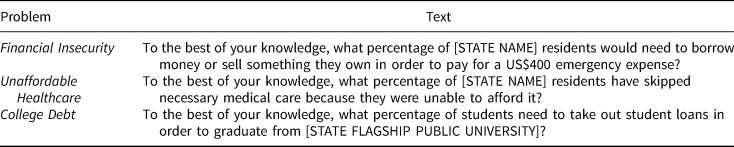
As a first step, I compare politicians' perceptions of financial hardship against objective reality. This analysis relies on new survey items that I designed to measure politicians' perceptions of Financial Insecurity, Unaffordable Healthcare, and College Debt in the states they seek to govern. These items are shown in Table 1.
Items measuring state-level perceptions

Notes: [STATE NAME] is the name of the state in which the politician is running for state legislature. [STATE FLAGSHIP PUBLIC UNIVERSITY] is the name of the flagship public university in the state (for a list of flagship universities, see the Online Appendix [p. 2]).
One potential concern with these kinds of measures is that respondents may cheat by looking up the correct answer. Research has shown that this kind of cheating is very uncommon in surveys, even when respondents are being paid for providing correct answers (Bullock et al. Reference Bullock2015). Moreover, even if the politicians sought to look up the correct answers to the questions in Table 1, some of the answers would be difficult to find. This is particularly the case for Financial Insecurity and Unaffordable Healthcare, which are measured using the Federal Reserve's SHED survey. While the Federal Reserve publishes national estimates of how many Americans experience Financial Insecurity and Unaffordable Healthcare, they do not publish state-level estimates.
Results
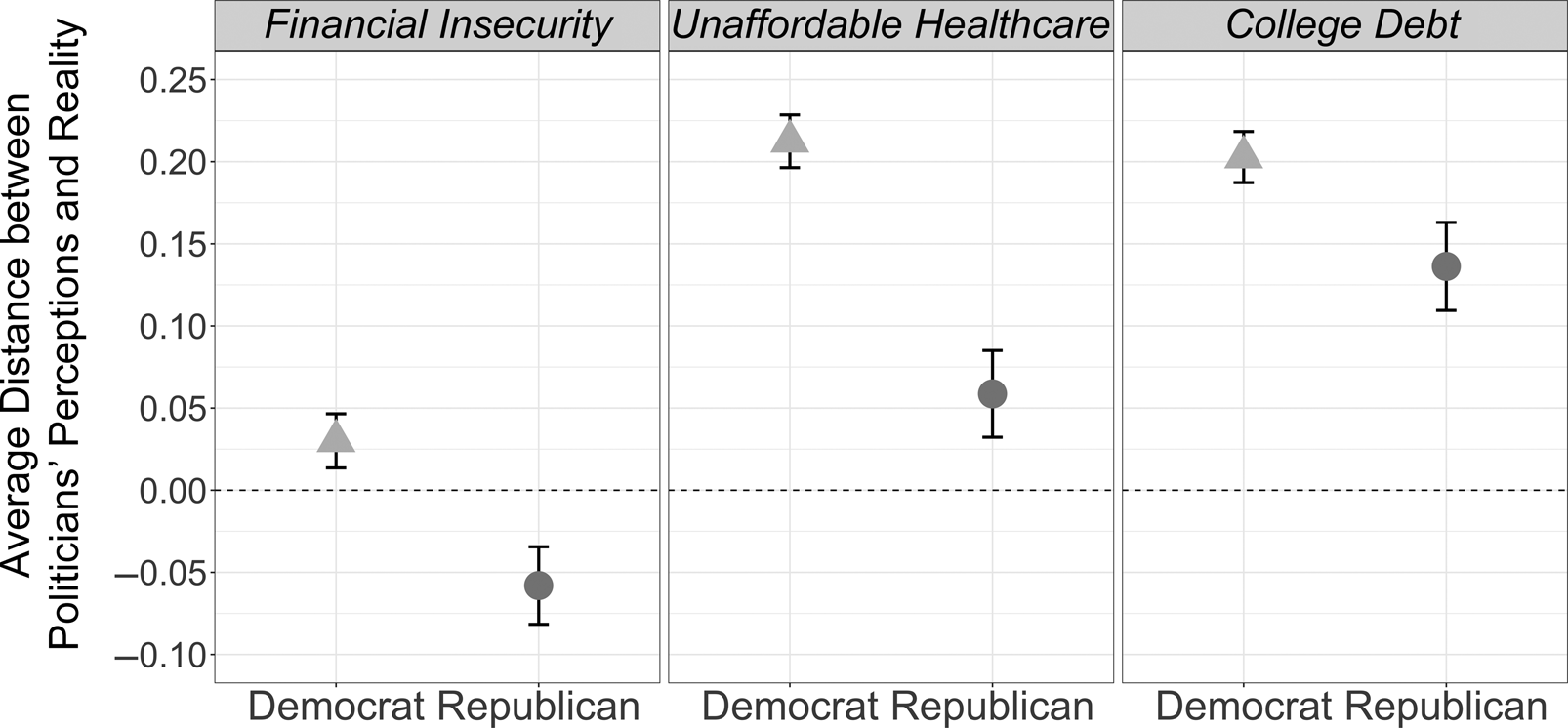
Figure 1 shows the average distance between politicians' perceptions and reality.Footnote 7 I had expected to find evidence that politicians underestimate how many of those they seek to govern are struggling financially. However, this is not the case. Instead, politicians are more likely to overestimate the level of financial hardship among those they seek to govern. This is particularly true for Democratic politicians, who overestimate Financial Insecurity, Unaffordable Healthcare, and College Debt by 3 percentage points, 21 percentage points, and 20 percentage points, respectively. Republicans also overestimate Unaffordable Healthcare and College Debt by 6 percentage points and 14 percentage points, respectively. However, they underestimate Financial Insecurity by 6 percentage points. There are thus at least some instances where politicians—and Republican politicians in particular—do underestimate the level of financial hardship among those they seek to govern.
Average distance between politicians' perceptions and reality.
Notes: The points show the average distance between politicians' perceptions and reality. Bars are 95 per cent confidence intervals. Positive scores indicate that politicians are overestimating an issue, while negative scores indicate that politicians are underestimating an issue.

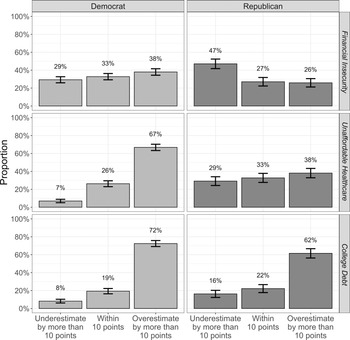
Figure 2 shows the proportion of politicians in each party who underestimate each issue by more than 10 percentage points, have accurate perceptions that come within 10 percentage points of reality, and overestimate each issue by more than 10 percentage points (these thresholds are described in my pre-analysis plan).Footnote 8 Here, we see that Democrats clearly tend to overestimate Unaffordable Healthcare and College Debt but are more evenly split between underestimating and overestimating Financial Insecurity. Meanwhile, Republicans clearly tend to overestimate College Debt, are more evenly split between underestimating and overestimating Unaffordable Healthcare, and tend to underestimate Financial Insecurity.Footnote 9
Proportion of politicians who underestimate, overestimate, and have accurate perceptions of each issue.
Notes: Bars show the proportion of politicians in each party who underestimate each issue by more than 10 percentage points, have accurate perceptions that come within 10 percentage points of reality, and overestimate each issue by more than 10 percentage points. Shown with 95 per cent confidence intervals.

While I interpret these findings as evidence that politicians are misperceiving reality, it is important to consider alternative explanations. One alternative explanation involves expressive responding, which occurs when survey respondents “intentionally and knowingly report an incorrect answer to engage in partisan cheerleading” (Flynn, Nyhan, and Reifler Reference Flynn, Nyhan and Reifler2017, 136). Perhaps politicians are intentionally and knowingly misreporting the severity of these issues in their state as a means of expressing their ideological beliefs. I assess this alternative interpretation using evidence provided in the Online Appendix (pp. 30–5), where I examine which of several factors, including politicians' ideology, are most strongly correlated with holding misperceptions. If expressive responding is driving the results, I would expect politicians' ideology to be among the most powerful predictors of whether politicians hold misperceptions. However, the results show that this is not the case. Instead, other factors, such as politicians' exposure to these issues in their social networks, are more strongly correlated with whether politicians hold misperceptions. This analysis suggests that politicians' misperceptions are not merely an expression of their ideological beliefs.
Another alternative explanation is that the results are partially driven by how I measured the actual prevalence of these issues within politicians' states. This concern is particularly relevant for Financial Insecurity and Unaffordable Healthcare, which I measured using the Federal Reserve's SHED survey. As described in the Online Appendix (pp. 10–16), there are some differences between how respondents were asked about their experiences of financial hardship in the SHED survey and how politicians were asked about their perceptions of Financial Insecurity and Unaffordable Healthcare in the survey of state legislative candidates. To assess the possibility that these differences affected the results, I ran a supplemental survey of N = 500 respondents on Amazon Mechanical Turk. I find evidence that politicians would be even more likely to overestimate financial hardship if the questions asked in the survey of politicians and the SHED survey were more closely aligned (for full details, see the Online Appendix [pp. 10–16]).Footnote 10 In this alternative analysis, I also no longer find that Republicans tend to underestimate Financial Insecurity.Footnote 11 This suggests that politicians would still overestimate how many of those they seek to govern are struggling financially if the questions asked in the survey of politicians and the SHED survey were more closely aligned.
This section provides new insight into politicians' perceptions of those they seek to govern. Contrary to my expectations, both Democratic and Republican politicians tend to overestimate how many of those they seek to govern are struggling financially. These results suggest that politicians are making policy decisions about these issues based on an inaccurate understanding of reality. In the next section, I ask whether politicians' policy preferences would be different if they were more accurately informed.
Policy Consequences
Methods
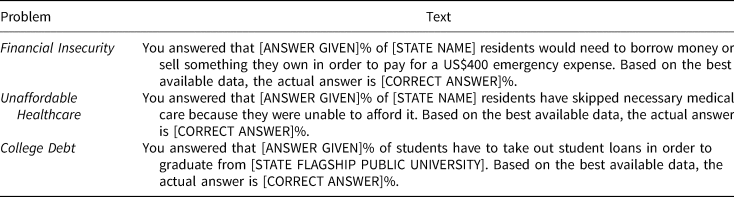
In the prior section, I found evidence that a substantial number of politicians misperceive how many of those they seek to govern are struggling financially. Next, I consider the extent to which politicians' policy preferences would be different if they were more accurately informed. I evaluate this possibility with a randomized experiment. In this experiment, half of the politicians were randomly assigned to a treatment condition in which they received accurate information about the level of Financial Insecurity, Unaffordable Healthcare, and College Debt in their state before providing their views on policies that address these problems. Those assigned to this treatment saw the text shown in Table 2 before providing their policy views, while those assigned to the control saw no additional text before providing their policy views. The “correct answer” shown in the treatment condition is the estimate of the actual level of Financial Insecurity, Unaffordable Healthcare, and College Debt in the politician's state (see the Online Appendix [pp. 3–5]).Footnote 12 As I make clear in the treatment text, the correct answer is based on the “best available data,” which is true to the best of my knowledge.
Policy experiment treatment text

Note: [ANSWER GIVEN] is the politicians' response to the state perception item in Table 1. [STATE NAME] is the name of the state in which the politician is running for state legislature. [STATE FLAGSHIP PUBLIC UNIVERSITY] is the name of the flagship public university in the state (for a list of flagship universities, see the Online Appendix [p. 2]). [CORRECT ANSWER] is the estimate of the actual level of Financial Insecurity, Unaffordable Healthcare, or College Debt in the state (see the Online Appendix [pp. 3–5]).
This design allows me to compare the policy preferences of politicians in the treatment condition, who have accurate information about the level of Financial Insecurity, Unaffordable Healthcare, and College Debt in their state, with an otherwise identical group of politicians in the control condition, who have uncorrected misperceptions of these problems. In doing so, I am able to test the unobserved counterfactual in which politicians possess accurate information about the severity of these issues. Similar designs have been used in other contexts to measure the causal effects of misperceptions (Cruces, Perez-Truglia, and Tetaz Reference Cruces, Perez-Truglia and Tetaz2013; Kuklinski et al. Reference Kuklinski2000).Footnote 13
After being shown the text in Table 2 in the treatment condition or no additional text in the control, politicians were asked a series of survey questions about policies that address Financial Insecurity, Unaffordable Healthcare, and College Debt. The outcomes for these survey questions, which are described further in the following, are all coded to range from 0 to 1, such that higher values indicate increased support for government action to address these three issues. Further details on the exact question wording are provided in the Online Appendix (pp. 63–5).
First, politicians were asked about their willingness to spend government resources to address the three issues. For Financial Insecurity, politicians were asked whether they would like to see their state government increase or decrease spending on “cash assistance to low-income families.” For Unaffordable Healthcare, politicians were asked whether they would like to see their state government increase or decrease spending on “Medicaid.” For College Debt, politicians were asked whether they would like to see their state government increase or decrease spending on “financial aid for low-income students.” These items have the following response options, which are coded from 0 to 1 as follows: “Decrease a lot” (0), “Decrease a little” (0.25), “Neither increase nor decrease” (0.5), “Increase a little” (0.75), and “Increase a lot” (1).
Secondly, politicians were asked whether they would favor or oppose specific policies that address these three issues if they were elected. For Financial Insecurity, politicians were asked whether they would favor or oppose “a proposal to raise the minimum wage” and “a proposal to eliminate the asset limit for welfare recipients.”Footnote 14 For Unaffordable Healthcare, politicians were asked whether they would favor or oppose “a proposal to limit how much hospitals in [their state] can charge low-income patients for necessary medical care” and “a proposal to require hospitals in [their state] to provide reasonable payment plans for patients who are unable to immediately pay for necessary medical care.” For College Debt, politicians were asked whether they would favor or oppose “a proposal to decrease the amount of funding that goes to public universities” and “a proposal to limit tuition increases” at public universities. These items have the following response options, which are coded from 0 to 1 as follows: “Strongly oppose” (0), “Somewhat oppose” (0.25), “Neither favor nor oppose” (0.5), “Somewhat favor” (0.75), and “Strongly favor” (1).Footnote 15
Thirdly, politicians were asked to evaluate details about policies that are meant to address these issues in their state. For Financial Insecurity, politicians were asked to evaluate whether the current welfare asset limit in their state is too high or too low. For Unaffordable Healthcare, politicians were asked whether the premium for a typical insurance plan available in their state through the Affordable Care Act is too high or too low. For College Debt, politicians were asked whether the in-state tuition at the state's flagship public university is too high or too low. These items have the following response options, which are coded from 0 to 1 as follows: “Too low” (0), “About right” (0.5), or “Too high” (1).Footnote 16
Finally, politicians were asked whether they think it is the government's responsibility to address these issues. For Financial Insecurity, politicians were asked whether they agree or disagree that it is the state government's responsibility to make sure all residents “are financially secure.” For Unaffordable Healthcare, politicians were asked whether they agree or disagree that it is the state government's responsibility to make sure that all residents “have access to affordable healthcare.” For College Debt, politicians were asked whether they agree or disagree that it is the state government's responsibility to make sure that “a college degree is affordable for all young people” in the state. These items have the following response options, which are coded from 0 to 1 as follows: “Disagree strongly” (0), “Disagree somewhat” (0.25), “Neither agree nor disagree” (0.5), “Agree somewhat” (0.75), and “Agree strongly” (1).
I measure the effects of the treatment on these outcomes with ordinary least squares (OLS) models that regress each outcome on an indicator variable coded 1 for respondents randomly assigned to the treatment condition and 0 for respondents randomly assigned to the control condition.Footnote 17 These models are run separately for Democratic and Republican politicians. Additional analyses in the Online Appendix (pp. 20–1) show the mean response on all outcomes for Democrats and Republicans in the treatment and control conditions.
Results
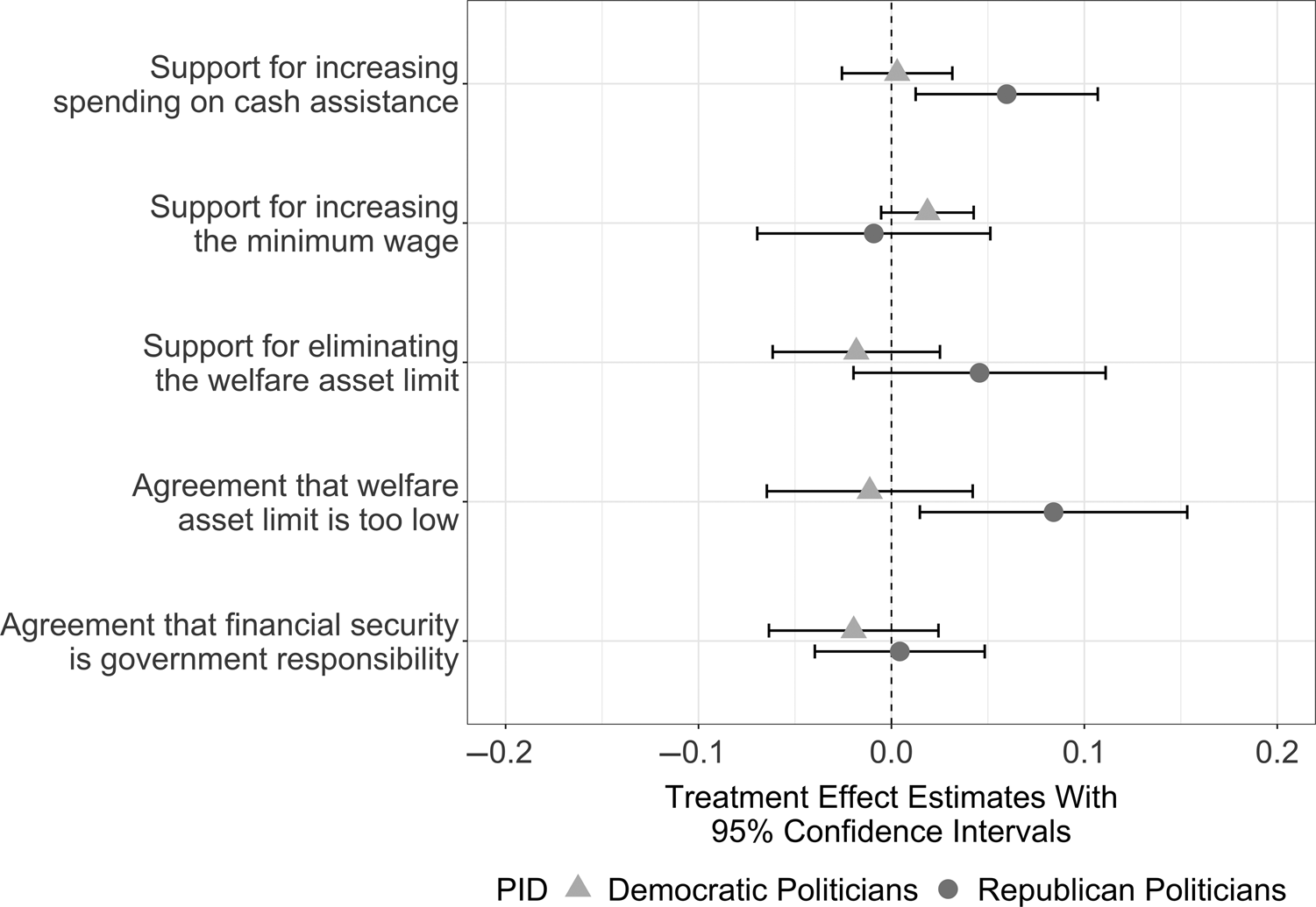
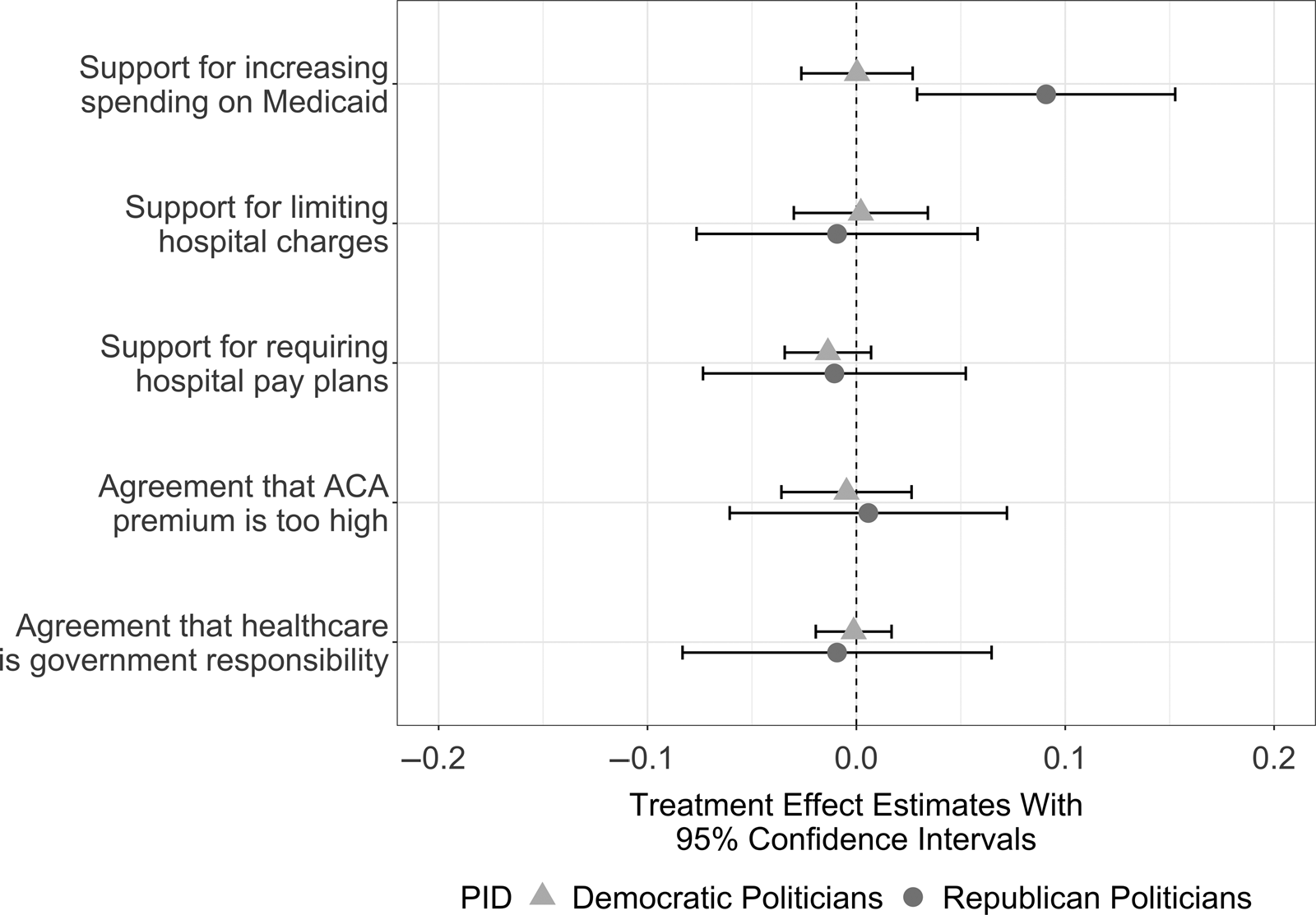
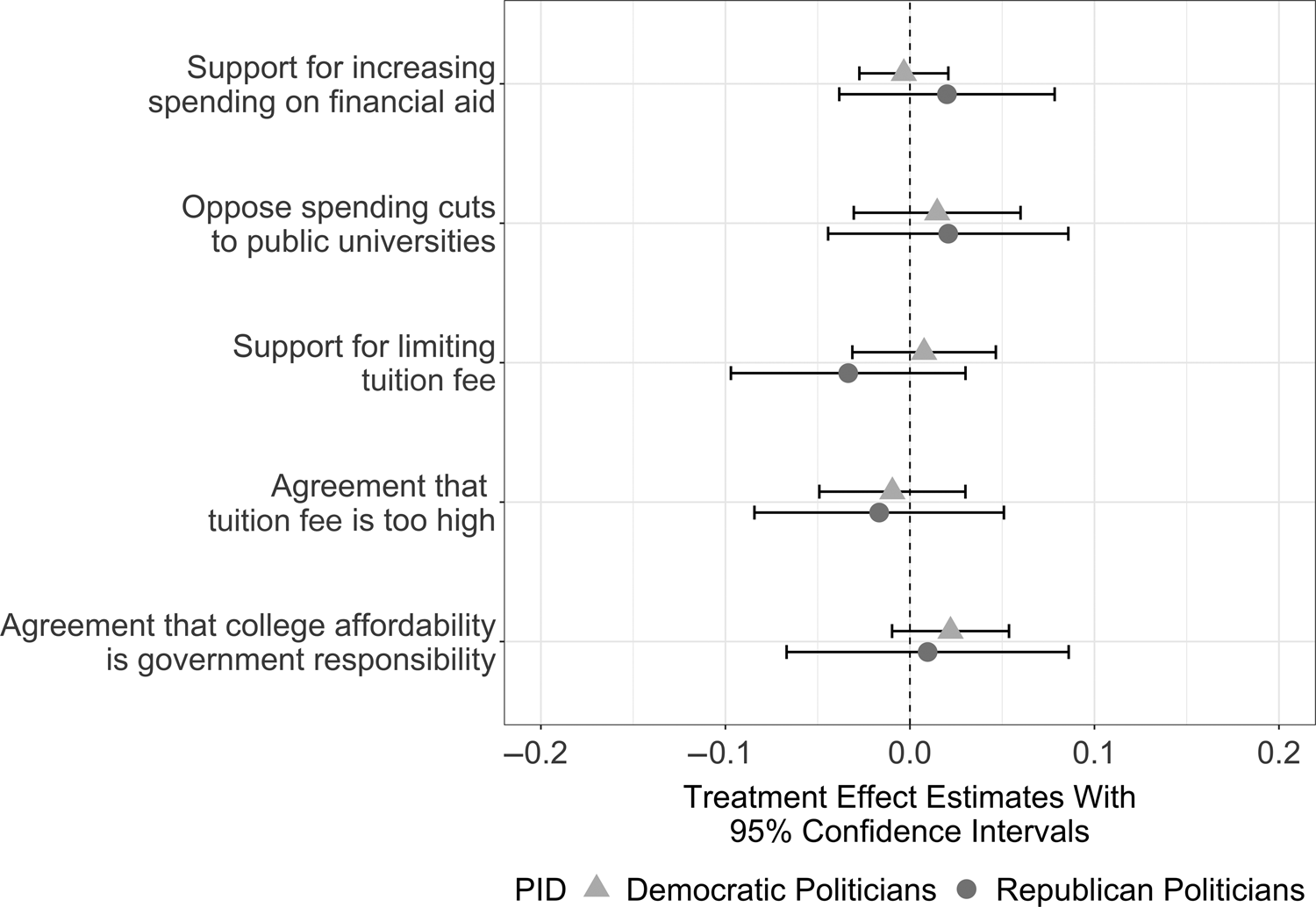
The results are shown in Figures 3 through 5. The treatment effects are shown with 95 per cent confidence intervals. When these confidence intervals do not overlap with 0, it is indicative of a statistically significant treatment effect at p < 0.05. Given the large number of outcomes, I also report whether the results are significant after adjusting for multiple testing. I adjust for multiple testing using the Bonferroni method, which entails dividing the standard α = 0.05 threshold for statistical significance by the number of outcomes. As there are fifteen outcomes across all three issues, this creates a conservative test in which results are only statistically significant if they have a p-value of less than 0.003.
Causal effects of correcting misperceptions on politicians' level of support for policies addressing Financial Insecurity.
Notes: Treatment effects are based on OLS models that regress the policy outcome on an indicator variable coded 1 for respondents in the treatment and 0 for respondents in the control. Positive treatment effects indicate that politicians are becoming increasingly supportive of government action to address Financial Insecurity.

I begin by examining the results for Financial Insecurity (see Figure 3). On average, this issue was overestimated by Democratic politicians but underestimated by Republican politicians (see Figure 2). When I provide Democrats with accurate information, it has no effects on their preferences. This suggests that Democrats' views of policies meant to address Financial Insecurity might be similar even if they were more accurately informed. By contrast, I do see some evidence of movement among Republicans. The treatment causes a 6-percentage-point increase in Republicans' support for increasing government spending on cash assistance to low-income families (p = 0.01), and an 8-percentage-point increase in Republicans' level of agreement that the current welfare asset limit in their state is too low (p = 0.02). However, neither of these results is statistically significant once I adjust for multiple testing and use the lower significance threshold of 0.003. This suggests that Republicans' preferences would also be similar if they were more accurately informed.
Next, I examine the results for Unaffordable Healthcare (see Figure 4). This issue was overestimated by a clear majority of Democrats. By contrast, Republicans were more evenly split between underestimating and overestimating this issue, though they also overestimated it on average (see Figure 2). Once again, there is no evidence that providing accurate information shifts Democrats' preferences. There is some evidence of movement among Republicans, who show a 9-percentage-point increase in their level of support for increasing government spending on Medicaid (p = 0.004). However, this result falls just short of statistical significance once I adjust for multiple testing and use the lower significance threshold of 0.003. The overall lack of effects for politicians of both parties suggests their views of policies meant to make healthcare more affordable would be similar if they were more accurately informed.
Causal effects of correcting misperceptions on politicians' level of support for policies addressing Unaffordable Healthcare.
Notes: Treatment effects are based on OLS models that regress the policy outcome on an indicator variable coded 1 for respondents in the treatment and 0 for respondents in the control. Positive treatment effects indicate that politicians are becoming increasingly supportive of government action to address Unaffordable Healthcare.

Finally, I examine the results for College Debt (see Figure 5). This issue was overestimated by clear majorities of Democratic and Republican politicians (see Figure 2). When I provide Democrats with accurate information, it once again has no effects on their policy preferences. Providing Republicans with accurate information also fails to have any effect on their preferences. This suggests that politicians' views of policies meant to increase the affordability of higher education might be similar if they were more accurately informed.
Causal effects of correcting misperceptions on politicians' level of support for policies addressing College Debt.
Notes: Treatment effects are based on OLS models that regress the policy outcome on an indicator variable coded 1 for respondents in the treatment and 0 for respondents in the control. Positive treatment effects indicate that politicians are becoming increasingly supportive of government action to address College Debt.

In an additional analysis in the Online Appendix, I measure the precision-weighted treatment effect for Democratic and Republican politicians across all fifteen outcomes. Among Democrats, the precision-weighted treatment effect is 0, indicating that the treatment had no effect on their preferences.Footnote 18 Among Republicans, the precision-weighted treatment effect is 0.02, indicating a 2-percentage-point increase in Republicans' support for policies benefiting low-income Americans across the outcomes. However, this effect falls just short of statistical significance, with a p-value of 0.06. While this effect is not statistically significant at the standard 0.05 threshold, it does suggest the treatment may have produced a very small increase in Republicans' support for policies benefiting low-income Americans (for full results, see the Online Appendix [pp. 27–9]).
Overall, this analysis suggests that providing politicians with accurate information did not meaningfully increase their support for policies benefiting low-income Americans. This pattern of null findings aligns with evidence that providing members of the general public with information about poverty and inequality generally fails to produce substantial changes in their policy views. For example, Kuziemko et al. (Reference Kuziemko2015) provide members of the general public with a variety of information about inequality and find that it has very little effect on their redistributive preferences. In a meta-analysis of similar information-provision experiments, Ciani, Fréget, and Manfredi (Reference Ciani, Fréget and Manfredi2021) find that providing information about poverty and inequality generally leads to minimal increases in support for redistribution. I find a similar dynamic among politicians, whose preferences remain largely unchanged when I provide them with information about how much those they seek to govern are struggling financially.
While I do not find any statistically significant results for Democrats or Republicans after adjusting for multiple testing, there is at least some evidence to suggest that Republicans may have become more supportive of policies benefiting low-income Americans. While I attribute this finding to the effects of providing accurate information, it is important to consider alternative explanations. One concern is social-desirability bias. Perhaps Republican politicians view it as socially desirable to become more supportive of policies benefiting low-income Americans when they are informed that they have underestimated financial hardship. As a test of this concern, I ask whether the results are stronger among politicians who are running in liberal districts and may therefore be more likely to perceive support for social welfare as a socially desirable response (see the Online Appendix [pp. 23–4]). I do not find evidence that this is the case. While this test is imperfect, it provides some evidence that social-desirability bias is not driving the results.
Another concern involves demand effects, which occur when a study's participants infer the hypothesis behind a study and respond in a way that seeks to help confirm that hypothesis. Perhaps Republican politicians intuited my hypothesis, leading them to become more supportive of policies benefiting low-income Americans when provided with accurate information. While it is not possible to entirely rule out this concern, research by Mummolo and Peterson (Reference Mummolo and Peterson2019) shows that demand effects are generally weak in online survey experiments. Even when survey respondents are provided with information about a study's hypotheses, they do not change their behavior to align with researcher expectations. This suggests that demand effects are unlikely to be driving the results.Footnote 19
As a whole, these results help us understand the relationship between politicians' misperceptions and the politics of inequality. In the prior section, I found that politicians hold misperceptions about how many of those they seek to govern are struggling financially. In this section, I find that providing politicians with accurate information generally fails to change their policy views. While Democratic politicians substantially overestimate how many of those they seek to govern are struggling financially, I find no evidence that they change their preferences in response to accurate information. By contrast, there is some evidence of movement among Republican politicians, who sometimes underestimate issues like Financial Insecurity and Unaffordable Healthcare. I find some evidence to suggest that Republicans might be more supportive of policies meant to address these issues if they were more accurately informed of reality. However, I only find evidence of these effects on a few outcomes, and these effects are no longer statistically significant after I adjust for multiple testing. Overall, these results suggest that politicians' preferences would be similar if they were more accurately informed.
Exploratory Analysis: Potential Mechanisms
As a final step in the analysis, I consider some of the potential reasons why politicians may hold these misperceptions in the first place (due to space constraints, I describe this analysis briefly here and at length in the Online Appendix [pp. 30–8]).Footnote 20 Politicians' misperceptions are likely to be influenced by a wide variety of factors, and it is beyond the scope of this article to conduct a comprehensive analysis of all of them. However, it is possible to use the State Legislative Candidate Survey to assess several factors that may be related to politicians' misperceptions.
As a first step, I use regression models to measure which of several variables are most strongly related to politicians' misperceptions. The methodology is described in detail in the Online Appendix (beginning on p. 30). The factors I consider include the economic composition of politicians' districts, the level of financial hardship in politicians' social networks, politicians' own socioeconomic status, and politicians' ideology. In assessing the relationship between these factors and politicians' misperceptions, I also account for a range of demographic traits that may be related to politicians' misperceptions, including their gender, race, and age.
Of those factors I consider, the level of financial hardship in politicians' social networks clearly emerges as the strongest and most consistent predictor of politicians' misperceptions (see the results in the Online Appendix [pp. 32–5]). The results show that politicians who self-report high levels of financial hardship in their social network are more likely to overestimate how many people in their state are struggling financially, while politicians who self-report low levels of financial hardship in their social network are more likely to underestimate how many people in their state are struggling financially. Other factors, such as the economic composition of politicians' districts, politicians' own socioeconomic status, and politicians' ideology, do not appear to be as strongly related to their misperceptions.
A randomized experiment included in the survey allows me to further evaluate the relationship between the composition of politicians' social networks and their misperceptions. This experiment is described in detail in the Online Appendix (beginning on p. 36). In the experiment, I randomly assigned half of the politicians to think about how well their friends are doing financially before providing their perceptions of the level of financial hardship in their state. While the treatment mostly has null effects, it does cause a substantial increase in Republicans' tendency to underestimate how many of those they seek to govern are financially insecure (see the results in the Online Appendix [pp. 37–8]). This suggests this mechanism may be particularly useful for explaining why Republican politicians sometimes underestimate how much those they seek to govern are struggling financially. However, further research is clearly needed to know whether this is the case.
As a whole, this exploratory analysis provides preliminary evidence that politicians' misperceptions may be related, in part, to the level of financial hardship they see around them in their social networks. As with all studies of mechanisms, it is important to regard this evidence as tentative. There are several important limitations. First, to be clear, my claim is not that politicians' social networks are the sole, or even the most important, factor driving their misperceptions. Rather, this preliminary evidence points to politicians' social networks as one factor that may matter and is worthy of further study. Secondly, there are well-known difficulties with establishing the causal effects of social context that I have not solved here. Randomizing politicians to think about how well their friends are doing financially falls well short of the ideal test of network effects, which would entail randomizing the composition of politicians' social networks. With the caveat that this ideal test may well be impossible, future research could attempt to measure the effects of politicians' social networks on their misperceptions using experimental treatments that more closely approximate the actual experience of interacting with people of high or low socioeconomic status.
Conclusion
This research provides new insight into politicians' perceptions of those they seek to govern. Existing research finds that politicians systematically misperceive public opinion (Broockman and Skovron Reference Broockman and Skovron2018; Hertel-Fernandez, Mildenberger, and Stokes Reference Hertel-Fernandez, Mildenberger and Stokes2019; Pereira Reference Pereira2021). I take this literature in a new direction by asking whether politicians also misperceive the state of reality in which those they seek to govern live. In particular, I ask whether politicians accurately understand how many of those they seek to govern are struggling financially.
I evaluate politicians' perceptions of financial hardship by conducting an original nationwide survey of 1,265 state legislative candidates. Contrary to my expectations, I find little evidence that politicians systematically underestimate the level of financial hardship among those they seek to govern. If anything, politicians appear to overestimate how many of those they seek to govern are struggling financially. At the same time, there are at least some instances in which politicians—and Republican politicians in particular—do underestimate financial hardship.
In addition to documenting these misperceptions for the first time, I also explore their policy consequences. I do so by randomly assigning politicians to receive accurate information about how much those they seek to govern are struggling financially. For the most part, I find that this information has little effect on politicians' preferences. There is some evidence to suggest that Republicans would be more supportive of policies benefiting low-income Americans if they were more accurately informed. However, I only find evidence of these effects for a few of the policies I asked about, and these effects are no longer statistically significant after I adjust for multiple testing. Overall, the results suggest that politicians' preferences would be similar even if they had accurate information.
As a whole, these results shed new light on the politics of inequality. Prior research shows that politicians frequently make policy decisions that disadvantage low-income Americans (see, for example, Bartels Reference Bartels2008). One possible reason behind this opposition is that politicians are unaware of how much those they govern are struggling financially in the current era of rising inequality. However, my results suggest that a lack of knowledge cannot explain why politicians do not do more to improve conditions for low-income Americans. For the most part, politicians from both parties appear to understand that many of those they seek to govern are affected by issues like financial insecurity, the unaffordability of healthcare, and the cost of higher education. This suggests that politicians fail to address issues affecting low-income Americans even though they are well aware that many of those they govern are struggling financially.
Supplementary Material
Online appendices are available at: https://doi.org/10.1017/S0007123422000643
Data Availability Statement
Replication data for this article can be found in Harvard Dataverse at: https://doi.org/10.7910/DVN/A9GYNP
Acknowledgments
I thank Al Fang and Patrick Tucker for collaborating with me to run the State Legislative Candidate Survey. In addition, I thank Jacob Hacker, Tali Mendelberg, Greg Huber, Katherine McCabe, and the anonymous reviewers for their helpful feedback on this article.
Financial Support
None.
Competing Interests
None.