INTRODUCTION
Parasitism is emerging as an important force influencing the structure, diversity and productivity of coastal marine ecosystems (Sousa, Reference Sousa1991; Mouritsen & Poulin, Reference Mouritsen and Poulin2002; Kuris et al., Reference Kuris, Hechinger, Shaw, Whitney, Aguirre-Macedo, Boch, Dobson, Dunham, Fredensborg, Huspeni, Lorda, Mababa, Mancini, Mora, Pickering, Talhouk, Torchin and Lafferty2008). Many recent studies have shown that parasitism can influence host population dynamics (Fredensborg et al., Reference Fredensborg, Mouritsen and Poulin2005), the composition of whole communities (Mouritsen & Poulin, Reference Mouritsen and Poulin2005; Wood et al., Reference Wood, Byers, Cottingham, Altman, Donahue and Blakeslee2007), and the structure and stability of food webs (Thompson et al., Reference Thompson, Mouritsen and Poulin2005; Lafferty et al., Reference Lafferty, Dobson and Kuris2006) within intertidal ecosystems. Yet, research to date has focused almost exclusively on a small taxonomic subset of host species, namely molluscs, crustaceans, fish and birds. The many other taxa playing important roles in marine systems have received little attention in the context of host–parasite interactions.
Polychaete annelids are one of these overlooked groups. As widespread and ecologically significant as polychaetes are, very little work has been done regarding either their role in the transmission of parasites through the marine environment, or the impact of parasites on their biology. They typically make up a large portion of the intertidal invertebrate fauna (Cardell et al., Reference Cardell, Sarda and Romero1999), where they influence the composition of benthic communities by actively reworking the sediment through ingestion and defecation (Nybakken & Bertness, Reference Nybakken and Bertness2005). Additionally, polychaetes play an important role in the food chain, acting as predators as well as prey items for larger animals (Nybakken & Bertness, Reference Nybakken and Bertness2005).
Sporadic records of helminth parasites of polychaetes (Shaw, Reference Shaw1933; Orrhage, Reference Orrhage1973; Kyle & Noblet, Reference Kyle and Noblet1985) suggest that this group of invertebrates are potentially important hosts for parasites. Margolis (Reference Margolis1971, Reference Margolis1973) has compiled the most recent and comprehensive list of parasitic helminths using polychaetes as hosts. He reports fewer than 30 total species of helminth infecting polychaetes at some stage of their life cycle. Based on the wide range and sheer diversity of polychaetes, it is likely that this is but a tiny fraction of the total number of parasite–host relationships involving the class Polychaeta. In addition, a few studies (e.g. McCurdy, Reference McCurdy2001; McCurdy & Moran, Reference McCurdy and Moran2004) suggest that parasites can have substantial negative impacts on polychaete hosts, with indirect consequences for benthic communities.
Although there have been a few surveys of the New Zealand polychaete fauna (Ralph & Yaldwyn, Reference Ralph and Yaldwyn1956; Knox et al., Reference Knox, Hicks and Bolton1985), there has been no investigation of polychaete parasites in New Zealand. The aims of this study were: (i) to survey the local polychaete fauna in Otago Harbour, South Island, New Zealand, and identify their parasites, with a special emphasis on trematodes; and (ii) to evaluate the potential impact of parasitism on polychaete mortality. The latter objective will be addressed in two ways. First, using host–parasite species combinations for which there are sufficient data, the relationship between host size and parasite infection levels will be investigated. If parasites accumulate passively as the host grows with no impact on host survival, a linear relationship is expected; in contrast, if the number of parasites per host reaches a plateau or even drops beyond a given host size, then this may indicate parasite-induced host mortality (Latham & Poulin, Reference Latham and Poulin2002; Bates et al., Reference Bates, Poulin and Lamare2010; Koehler & Poulin, Reference Koehler and Poulin2010). Second, infection levels will be compared between intact individuals and those that broke in two or three fragments during collection. All else being equal if parasite infection does not compromise the structural integrity of the polychaete host one would expect an equal probability of breakage among all conspecific polychaetes regardless of infection levels. Finding curvilinear relationships between host size and infection level or higher infection levels in broken hosts than in intact ones would provide indirect evidence that parasitism may affect host survival.
MATERIALS AND METHODS
Pilot studies conducted intermittently between January and April 2009 in Lower Portobello Bay, within Otago Harbour, near Dunedin, New Zealand (45°50′S 170°40′E) indicated that a combination of sampling methods are necessary to obtain sufficient numbers of individuals from the most common polychaete species (see list in Table 1). For the main study, from June to October 2009, small interstitial polychaetes, such as Heteromastus filiformis, were collected by sieving (mesh size = 0.5 mm) sediment from haphazardly chosen 4l samples, taken to a depth of approximately 15–20 cm. Abarenicola affinis were collected using targeted sampling, by digging around visible castings on the sediment surface. Targeted sampling was also used to collect Spirobranchus cariniferus, which are encrusted on rocks in parts of the bay. Streblosoma toddae were also found associated with rocks, burrowing under their bases. Eulalia microphylla were collected by searching under rocks in the supralittoral zone. Collection of polychaetes ceased once >40 individuals of H. filiformis and A. affinis, the two most common species, were obtained.
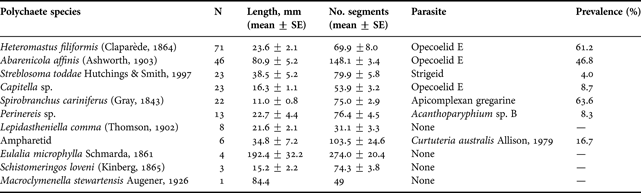
Body length, number of segments and parasites (with their prevalence) of polychaetes collected in Otago Harbour.
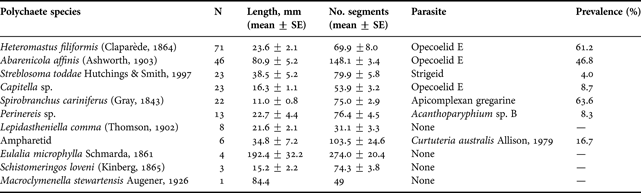
N, number; SE, standard error.
Live polychaetes were brought back to the laboratory in 3l containers of seawater lined with 3 cm of sediment, and kept at 16°C for up to one week following collection, at which time they were dissected for parasite recovery. The survey focused mostly on the discovery of trematode metacercariae, and thus we used micoscopic examination only without preparing tissue smears or blots. Measurements of total body length and number of segments were made under a dissection microscope for larger specimens and a compound microscope for smaller ones. The segment in which each parasite was located was also recorded, with polychaete segments numbered starting from the anterior end. Polychaetes were gently squeezed between two glass plates in order to observe and count encysted trematode metacercariae (the most common type of parasite found) located within host tissue and coelom (following Vanoverschelde & Vaes, Reference Vanoverschelde and Vaes1980; McCurdy, Reference McCurdy2001). Large polychaetes were cut into smaller pieces, which were then sliced along the anterior–posterior axis to open up the body cavity, before being placed between glass plates. Parasite material was separated from host tissue using dissection needles and transferred to a Petri dish filled with artificial seawater (35 psu) in order to wash off any residual host material. Following the wash in artificial seawater, parasites were then transferred briefly to a Petri dish containing distilled water. Each metacercaria was then transferred to a 1.5 ml Eppendorf tube and stored in 95% ethanol at –15°C for later DNA extraction. Polychaetes themselves were preserved as described by Morton (Reference Morton1950). The bulk of each polychaete was fixed in 4% formalin at 7°C for 12 hours/100 g of polychaete tissue. Afterwards, an equal part of 95% ethanol was added to the storage container. The formalin/ethanol solution was removed 24 hours later. The container was then filled with a solution of 70% ethanol and stored at 7°C until subsequent examination of all polychaetes to confirm their identity.
Molecular characterization and analyses were performed to identify trematode cysts retrieved from the polychaetes. Extraction of parasite DNA from individual metacercariae was achieved using standard techniques (see Devlin et al., Reference Devlin, Diamond and Saunders2004). Amplification of the cytochrome oxidase subunit 1 (CO1) gene (~900 base pairs (bp) target length) of each parasite was performed with primers JB3 (5′–TTTTTTGGGCATCCTGAGGTTAT–3′) and trem.cox1.rrnl (5′AATCATGGATGCAAAAGGTA–3′) (Bowles et al., Reference Bowles, Hope, Tiu, Xushian and McManus1993; Kralova-Hromadova et al., Reference Kralova-Hromadova, Spakulova, Horackova, Turcekova, Novobilsky, Beck, Koudela, Marinculic, Rajsky and Pybus2008, respectively) using BioLine DNA polymerase (Total Lab Systems Ltd., Auckland, New Zealand). The optimal cycling parameters included an initial denaturation step of 95°C (2 minutes), followed by 40 cycles of denaturation (30 seconds at 95°C), primer annealing (40 seconds at 48°C) and extension (1 minute at 72°C), followed by a 10 minutes final extension at 72°C (30 µl total polymerase chain reaction (PCR) volume). Amplicons were purified using the ExoSap PCR pre-sequencing purification kit (GE Healthcare, Auckland, New Zealand), cycle-sequenced using the ‘ABI PRISM® Big Dye™ Terminator Cycle Sequencing Ready Reaction Kit v.3.1’ and bidirectionally sequenced using the PCR primers on a 96 capillary 3730XL DNA Analyzer (Applied Biosystems). Sequence data were edited using Sequencher 4.9TM (GeneCodes Corporation, Ann Arbor, MI, USA) and screened using BLASTn (McGinnis & Madden, Reference McGinnis and Madden2004) to confirm orthology with the COI gene of trematodes.
Sequencing of the CO1 gene proved unsuccessful for several parasites, so the D2 domain (hypervariable region) of the large subunit ribosomal DNA (lsrDNA) was sequenced for the remaining unidentified parasites. For this, the 5′ end of the lsrDNA was amplified (~1850 bp) with primers T01N and T13N as described in Harper & Saunders (Reference Harper and Saunders2001), using BioLine DNA polymerase (Total Lab Systems Ltd., Auckland, New Zealand) in 25 µl PCR reactions. The amplification protocol consisted of an initial 4 minutes denaturation phase (94°C); 35 cycles of denaturation (30 seconds at 94°C), primer annealing (30 seconds at 50°C) and extension (2 minutes at 72°C), and a 7 minutes final extension (72°C). The amplicons were gel purified using the Omega Ultra-Sep gel extraction kit (Ngaio Diagnostics, Nelson, New Zealand). The D2 domain was bidirectionally sequenced with primers T16 and T30 (Harper & Saunders, Reference Harper and Saunders2001) as described above. Sequence data were edited as aforementioned and screened using BLASTn (McGinnis & Madden, Reference McGinnis and Madden2004) to confirm orthology with the lsrDNA of trematodes.
The relationship between host length and the number of parasites per host was assessed in polychaete species that were both collected in large numbers and heavily parasitized. This was accomplished by fitting both linear and curvilinear regressions to the data (following log-transformation of one or both variables if necessary). Length is a reliable measure of polychaete size or age, as it relates strongly (e.g. in H. filiformis, r 2 = 0.80) to the number of segment per worm. These regressions included only parasitized individuals. Finally, for one host species (H. filiformis) in which several individuals were whole and several others were only represented by body fragments, the mean number of metacercariae per segment was calculated for each individual by dividing the total number of metacercariae by the number of segments in either the whole worm or the fragment. Only relatively long anterior-end fragments, i.e. about half the polychaete or more, were used in this analysis. The mean numbers of metacercariae per segment were then compared between whole hosts and fragmented hosts using a Wilcoxon two-sample test.
RESULTS
Eleven different species of polychaete were collected during the survey (Table 1). Sample sizes were low (<20 individuals) or even very low (<5 individuals) for some of these species, however, and thus estimates of prevalence when parasites were found are not reliable, and absence of infection when no parasites were found will require confirmation by further sampling. Heteromastus filiformis and Abarenicola affinis were the most abundant species in our collections. Overall, the polychaetes collected span a wide range of body sizes and numbers of segments (Table 1).
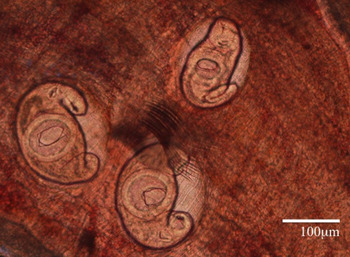
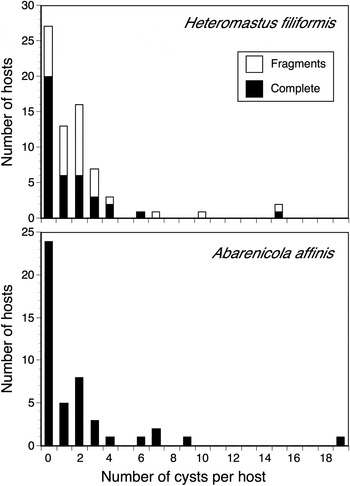
None of the polychaete species collected during the survey was found to harbour more than one parasite species. The parasite species found in greatest numbers was an unidentified trematode belonging to the family Opecoelidae (Figure 1). Metacercariae of this species have already been reported from the body cavity of H. filiformis based on findings from our pilot study (Leung et al., Reference Leung, Donald, Keeney, Koehler, Peoples and Poulin2009). Comparison of the CO1 gene of this opecoelid to that of other opecoelids found in topshells (Gastropoda: Trochidae) in earlier studies (Donald et al., Reference Donald, Kennedy, Poulin and Spencer2004, Reference Donald, Sijnja and Spencer2007) revealed that the opecoelid recovered from H. filiformis is genetically distinct, and is here labelled ‘opecoelid E’. Metacercariae of opecoelid E were also found encysted within A. affinis and Capitella sp. (Table 1) and these host–parasite associations are reported here for the first time. Although a large proportion of H. filiformis and A. affinis are infected by this trematode, the numbers of parasites per host are generally low (Figure 2). Only two infected individuals (8.7%) of Capitella sp. were gathered during the survey.
Metacercariae of opecoelid E encysted within the polychaete Heteromastus filiformis.

Frequency distribution of numbers of encysted metacercariae of opecoelid E per individual Heteromastus filiformis (anterior-end fragments, N = 32; complete specimens, N = 39) and per individual Abarenicola affinis (N = 46).

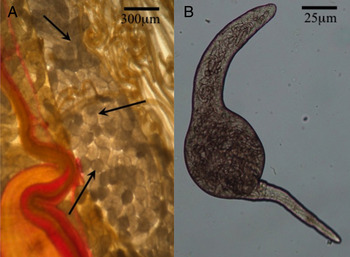
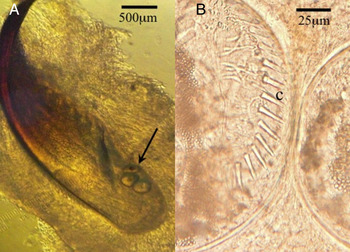
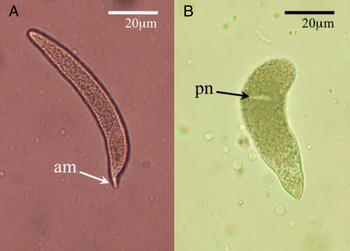
One individual of Streblosoma toddae was found to harbour hundreds of trematode sporocysts within its body cavity (Figure 3). Sequencing of lsrDNA from these sporocysts revealed that these trematode larvae are an unidentified species belonging to the family Strigeidae. A metacercaria of the echinostomatid trematode Acanthoparyphium sp. B (sensu Leung et al., Reference Leung, Donald, Keeney, Koehler, Peoples and Poulin2009) was found encysted in the musculature directly behind the jaws of an individual of Perinereis sp. (Table 1; Figure 4). This finding confirms an observation from the pilot survey, which is reported by Leung et al. (Reference Leung, Donald, Keeney, Koehler, Peoples and Poulin2009). One unidentified ampharetid polychaete harboured 5 encysted metacercariae of the echinostomatid trematode Curtuteria australis (Table 1). Finally, Spirobranchus cariniferus was the only species of polychaete found to harbour apicomplexan gregarine parasites (Figure 5). The prevalence of these gregarine parasites was greater than 50% (Table 1). Although the total number of gregarines found for each individual polychaete could not be counted, infected S. cariniferus often possessed >100 gregarines.
Sporocysts of an unidentified strigeid. (A) Sporocysts, indicated by arrows, within the body cavity of the polychaete Streblosoma toddae; (B) detail of a single sporocyst.

Metacercariae of Acanthoparyphium sp. B. (A) Metacercariae encysted within the jaw muscle of the polychaete Perinereis sp.; (B) detail of a metacercarial cyst showing collar spines (c), a characteristic indicative of a member of the family Echinostomatidae.

An unidentified apicomplexan gregarine found within the polychaete Spirobranchus cariniferus. (A) Gregarine with apical mucron (am) visible; (B) gregarine with pyriform nucleus (pn) visible.

Data on opecoelid E infecting both H. filiformis and A. affinis were used to assess the potential impact of parasitism on polychaete survival, since large samples were only available for these associations. The relationship between host length and the number of parasites per host was analysed in order to determine if there were any patterns of infection as a function of host size/age, and if certain infection thresholds led to mortality in either species. In both cases, there was no significant relationship, either linear or curvilinear, between host length and infection levels among all infected individuals (e.g. linear regressions: H. filiformis, N = 16, r2 = 0.019, P = 0.608; A. affinis, N = 22, r2 = 0.083, P = 0.193). Therefore, parasites did not necessarily accumulate as the host grew, and infection intensity had no apparent impact on host mortality.
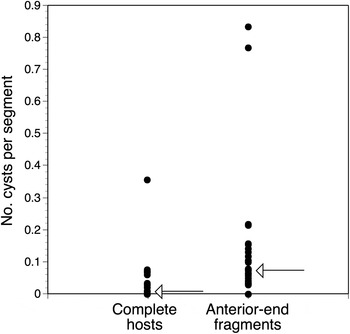
However, while sieving sediment to collect interstitial polychaetes, some H. filiformis fragmented during collection. After finding opecoelid E metacercariae encysted within these polychaetes, we hypothesized that trematode infections may predispose H. filiformis to fragmentation. Since most metacercariae occur in segments 3–6, we used only very long fragments from the anterior portion of the individual, in a manner following Rangel & Santos (Reference Rangel and Santos2009), such that the average number of segments did not differ between the long fragments and the whole worms (t-test, P = 0.14). The comparison revealed that polychaete fragments contain, on average, more parasites per segment than complete individuals (Wilcoxon 2-sample test: Z = 3.997, P <0.0001). The difference is quite pronounced, with fragments showing visibly higher infection levels (Figure 6).
Numbers of encysted metacercariae of opecoelid E per segment in either complete (N = 39) or anterior fragments (N = 32) of the polychaete Heteromastus filiformis. Arrows indicate the median values for each group.

DISCUSSION
The occurrence and significance of parasites in polychaetes are still poorly known. During the course of this study, a total of 11 polychaete species were gathered from the Otago Harbour. Of these, seven were found to harbour parasites. Spirobranchus cariniferus was the only polychaete species found to harbour apicomplexan gregarine parasites. All other parasites recovered in this survey were trematodes. Streblosoma toddae apparently served as a first intermediate host for an unidentified trematode belonging to the family Strigeidae. All other polychaetes housing trematodes in this survey were used as second intermediate hosts, since they harboured encysted metacercarial stages.
The trematode recovered in greatest numbers was opecoelid E. It was found to use the polychaetes Heteromastus filiformis, Abarenicola affinis and Capitella sp. as second intermediate hosts. Opecoelids develop as adults within the digestive tracts of fish belonging to the families Serranidae, Lutjanidae and Lethrinidae, and less frequently in Balistidae, Mullidae and Gadidae (Cribb, Reference Cribb, Jones, Bray and Gibson2005; Bray & Justine, Reference Bray and Justine2007); the definitive host of opecoelid E is most likely a fish belonging to one of these families that feeds on polychaetes. Many trophically-transmitted parasitic helminths can successfully utilize, as intermediate hosts, a range of species taken as prey by the definitive host (see Koehler & Poulin, Reference Koehler and Poulin2010). Cysts of opecoelid E were always found in close proximity to red, haemoglobin-transporting, blood vessels within A. affinis. The polychaetes H. filiformis, A. affinis and Capitella sp. all possess haemoglobin as an oxygen-binding protein (Pals & Pauptit, Reference Pals and Pauptit1979; Mangum et al., Reference Mangum, Colacino and Grassle1992). Aside from this fact, it is unknown whether there are any further similarities between the coelomic fluids of these three polychaetes. Coelomic haemoglobin is more plentiful in H. filiformis and Capitella sp. when compared to A. affinis, and gives H. filiformis and Capitella sp. their bright red coloration (Pals & Pauptit, Reference Pals and Pauptit1979; Mangum et al., Reference Mangum, Colacino and Grassle1992). Based on the present findings it may be that a supply of haemoglobin within the coelomic cavity is a key constraint determining which polychaetes are suitable hosts for opecoelid E.
Fragmented individuals of H. filiformis harboured statistically more encysted metacercariae of opecoelid E per segment compared to complete specimens. It is unclear whether encysted metacercariae of opecoelid E cause sufficient stress and/or a loss of structural integrity within the tissues of H. filiformis leading to the eventual fragmentation of the host polychaete, or whether fragmentation of H. filiformis is an active response elicited by the polychaete as a reaction to being parasitized. McCurdy (Reference McCurdy2001) reported that the polychaete Pygospio elegans frequently undergoes accelerated fragmentation as a means of reproduction in response to being parasitized by the trematode Lepocreadium setiferoides. The fragmentation of P. elegans is believed to decrease the physiological toll that the parasite has on its host, by dividing the stress experienced by the host amongst two regenerating fragments. Heteromastus filiformis, however, can only reproduce sexually, and not by asexual fragmentation. It is able to regenerate lost posterior segments, but unable to regenerate anterior and thoracic segments (Bely, Reference Bely2006). It is unknown whether the fragmentation of H. filiformis provides any benefit or disadvantage to either the host or parasite, but it is likely that fragmentation induces fitness costs for the polychaete, even if it does not result in death. Most of the encysted metacercariae of opecoelid E encysting within H. filiformis were found in the anterior and thoracic segments. Therefore, it would seem that fragmentation would fail to serve as a means of ridding the polychaete of much of its parasite burden.
Polychaetes have been shown to fragment and regenerate lost segments as a response to sublethal predation, or cropping (Berke et al., Reference Berke, Cruz and Osman2009). Sublethal predation is a widespread phenomenon within marine soft-bottom ecosystems, likely due to the high regeneration potential of many benthic invertebrates and the fact that often only a small part of the prey organism is exposed to predators (Mouritsen & Poulin, Reference Mouritsen and Poulin2003). Heteromastus filiformis is a deposit-feeding polychaete that positions itself perpendicular to the surface sediment, its anterior end facing downwards. In this position it feeds on microbial biota and decaying matter at the aerobic/anaerobic interface (Rouse & Pleijel, Reference Rouse and Pleijel2001). It is possible that fragmentation is a response to cropping by predators on the surface sediment elicited by the polychaete as a means of defence. The presence of parasites may aid in this host response, even if it does not appear to benefit the parasite in any obvious way. Alternatively, perhaps the cropper functions as the parasite's next host, in which case infection, fragmentation and transmission might be linked.
Reports of both a steady accumulation of parasites over time (Thomas et al., Reference Thomas, Lambert, De Meeus, Cezilly and Renaud1995; Koehler & Poulin, Reference Koehler and Poulin2010), represented by a linear relationship between host size and parasite burden, and parasite-induced host mortality (Latham & Poulin, Reference Latham and Poulin2002; Bates et al., Reference Bates, Poulin and Lamare2010; Koehler & Poulin, Reference Koehler and Poulin2010), represented by a curvilinear relationship between host size and parasite burden, exist for trematodes parasitizing many intertidal invertebrate species. These patterns are typically observed in organisms serving as intermediate hosts. In H. filiformis and A. affinis, host size did not correlate with infection level, suggesting that metacercariae of opecoelid E accumulate completely independent of host size and do not induce mortality within either of these polychaete hosts.
We could not assess the impact of other parasites found in this study on the fitness of their hosts. The strigeid trematode using S. toddae as first intermediate host may be capable of host castration, as happens routinely in cases where the first intermediate host is a gastropod (Mouritsen & Poulin, Reference Mouritsen and Poulin2002). The second most frequently encountered parasite recovered here was an unidentified apicomplexan gregarine found within S. cariniferus. Gregarines have commonly been reported from a wide range of polychaetes (Castellon & Gracia, Reference Castellon and Gracia1988; Leander et al., Reference Leander, Lloyd, Marshall and Landers2006; Elbarhoumi & Zghal, Reference Elbarhoumi and Zghal2010). Although the relationships between gregarines and their polychaete hosts remain poorly understood, most have been classified as forms of parasitism (Castellon & Gracia, Reference Castellon and Gracia1988; Leander et al., Reference Leander, Lloyd, Marshall and Landers2006; Rueckert & Leander, Reference Rueckert and Leander2010). The potential impact of the gregarines found during the survey on host survival was not investigated, but other gregarines have been shown to induce substantial physiological stress on their intermediate hosts (e.g. Fellous & Koella, Reference Fellous and Koella2010). In contrast, the echinostome trematodes, Acanthoparyphium sp. B and Curtuteria australis (see Table 1), appear to be accidental infections of polychaetes; they normally occur in bivalves (Leung et al., Reference Leung, Donald, Keeney, Koehler, Peoples and Poulin2009), and are unlikely to have much impact on polychaetes.
In summary, five different parasites were recovered from a total of 11 polychaete species collected in Lower Portobello Bay, Otago Harbour. Sporocysts from an unidentified strigeid were found within S. toddae, adding it to a short list of polychaetes serving as first intermediate hosts to trematodes (Martin, Reference Martin1944; Koie, Reference Koie1982). An unidentified, yet genetically distinct, opecoelid was found to use three different species of polychaete as potential intermediate hosts. Opecoelid E does not appear to cause mortality in any of its polychaete hosts. However, fragments of H. filiformis contained more encysted metacercariae of opecoelid E per segment when compared to intact specimens, hinting at sub-lethal costs of infection. Our survey did not find other types of parasites previously reported from polychaetes, such as myxozoans (Koie, Reference Koie2000; Koie et al., Reference Koie, Karlsbakk and Nylund2008) or paramyxeans (Larsson & Koie, Reference Larsson and Koie2005), though they may be present in Otago Harbour. Polychaetes and their respective parasites are prominent members of the infaunal community and are important to the ecology of the intertidal environment. The results of the present study, while adding to our knowledge of these associations, suggest that there are both a vast diversity of symbionts left to discover below the sediment, and a range of potentially significant ecological interactions yet to be recognized.
ACKNOWLEDGEMENTS
We thank Anson Koehler and Tommy Leung for advice and assistance, Brian Paavo and Keith Probert for their help with polychaete identifications, and Armand Kuris for help in identifying apicomplexan gregarines. This research received no specific grant from any funding agency, commercial or not-for-profit sectors.