Introduction
In 2007, heart failure was the fifth leading cause of death for older females and the tenth for older males in Australia.1 There were 45,000 patients discharged from hospital with a diagnosis of heart failure, and 5.8% of Australians over the age of 65 were reported to have died as a result of heart failure in 2007.1 Data from Ambulance Victoria revealed that in 2009 paramedics attended 1,700 cases of acute pulmonary edema (APO) and 377 cases of cardiac failure.2
Non-invasive CPAP is a treatment procedure used to improve oxygenation and ventilation in conscious patients experiencing respiratory distress or respiratory failure.Reference Brywczynski, Barrett and Schriger3 During normal ventilation, air is drawn into the lungs along a negative pressure gradient created when the diaphragm contracts. Continuous positive airway pressure therapy provides a continuous positive pressure regardless of the phase of respiration. This acts to reduce atelectasis and pulmonary shunting, thus improving gas exchange and vital signs such as blood oxygen saturation.Reference Brywczynski, Barrett and Schriger3
In hospital wards and emergency departments, CPAP therapy is currently indicated for conscious patients in acute respiratory distress as a result of congestive cardiac failure, or for acute exacerbations of chronic conditions such as chronic obstructive pulmonary disease (COPD) and asthma.Reference Kallio, Kuisma, Alaspaa and Rosenberg4–Reference Kosowsky, Stephanides, Branson and Sayre6 A further benefit of CPAP therapy is its potential to reduce the incidence of prehospital endotracheal intubation (ETI), when combined with other appropriate treatment.Reference Dib, Matin and Luckert7, Reference Plaisance, Pirracchio, Berton, Vicaut and Payen8 Given the unpredictable nature of the prehospital environment, ETI attempted in the field has been shown to be less successful than when attempted in the hospital, and is associated with higher rates of aspiration of gastric contents and other complications.Reference Ufberg, Bushra, Karras, Satz and Kueppers9, Reference Wang, Sweeney, O'Connor and Rubinstein10 Endotracheal intubation is also known to cause traumatic injury to the upper airway, and results in increased risk of ventilator-associated pneumonia.Reference Hubble, Richards, Jarvis, Millikan and Young11 Studies have shown that patients arriving in hospital emergency departments already intubated are more likely to remain so, exposing them to the aforementioned risks.Reference Fagon, Chastre, Domart, Trouillet, Pierre and Darne12, Reference Torres, Aznar and Gatell13
Despite the significant morbidity and mortality from heart failure, to the authors’ knowledge, there are no published Australian prehospital studies examining paramedic-initiated CPAP for APO. Considering the success and benefits of in-hospital CPAP therapy in the treatment of patients with respiratory distress and APO, this raises the question of whether there is a place for CPAP therapy in the prehospital setting in Australia. Therefore, the objective of this literature review was to identify the effectiveness of CPAP therapy in the prehospital environment.
Methods
A literature review was undertaken using specific medical electronic databases, from their commencement date through the end of May 2012; these included Cochrane, Medline, EMBASE, and CINAHL.
The following MeSH headings and keywords were used: emergency medical services; emergency medical technicians; ambulances; air ambulances; military medicine; emergency treatment; emergency medicine; first aid; emergency care; emergency patients; prehospital care; transportation of patients; pre-hospital; prehospital; out of hospital; out-of-hospital; ambulances; air ambulances; paramedic; right ventricular failure; left ventricular failure; congestive heart failure; pulmonary edema; continuous positive airway pressure; CPAP; pulmonary ventilation; and non-invasive ventilation.
Articles of any study type were included if they reported the use of CPAP therapy in patients with pulmonary edema in the prehospital setting. Articles were excluded if they were not written in English, involved a secondary transport from one hospital to another, featured animals in the study, or were letters to the editor or editorials. The reference list of retrieved articles was reviewed to ascertain if articles were missed during the initial search process.
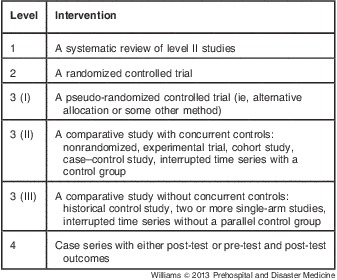
The quality of the included articles was assessed according to the Australian National Health and Medical Research Council (NH&MRC) levels of evidence14 (Table 1).
Australian National Health and Medical Research Council Levels of Evidence14

Results
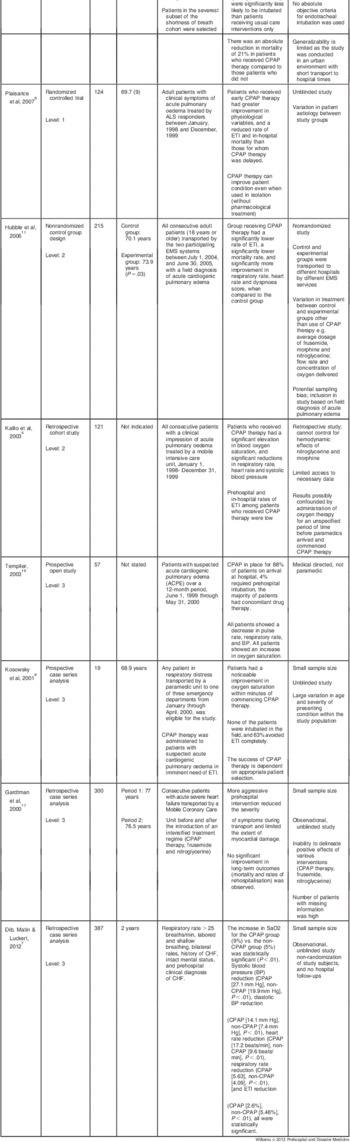
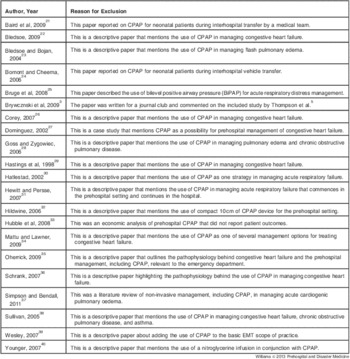
The search located 1,253 articles; initially, 38 publications met the inclusion criteria and further analysis of these articles showed 12 articles were suitable for further review.Reference Kallio, Kuisma, Alaspaa and Rosenberg4-Reference Plaisance, Pirracchio, Berton, Vicaut and Payen8, Reference Hubble, Richards, Jarvis, Millikan and Young11, Reference Dieperink, Weelink and Van Der Horst15-Reference Warner20 A brief summary of each study is shown in Table 2; reasons for studies being excluded are summarized in Table 3.
. Included Studies

Abbreviations: ALS, advanced life support; CHF, congestive heart failure; ETI, endotracheal intubation.
Excluded Studies

Abbreviations: CPAP, continuous positive airway pressure; EMT, emergency medical technician.
Reduced Rate of Prehospital Endotracheal Intubation
In a non-randomized control group study comparing CPAP therapy and pre-existing treatment algorithms in the management of prehospital acute pulmonary edema (APO), it was found that the use of CPAP therapy was associated with a significantly lower rate of ETI.Reference Hubble, Richards, Jarvis, Millikan and Young11 Patients were enrolled in this study based on the treating paramedic's field impression of APO, and 24% of these patients ultimately received a hospital discharge diagnosis other than APO. To control for the potential confounding effects of misdiagnosis, data were analyzed for all patients on an intention-to-treat basis, and then repeated on the subset of patients with confirmed APO. When considering all patients in the study, ETI was performed on 25.26% of control patients compared with 8.92% of patients who received CPAP therapy (P = .003). Within the subset of patients with confirmed APO, the difference in intubation rates was slightly higher; 28.12% of control patients were intubated compared with 6.66% of CPAP therapy patients (P = .001).
These findings are important in the context of paramedic diagnosis and patient assessment, and provide some evidence that diagnosing respiratory pathology in the prehospital setting is often difficult due to limited diagnostic tools. Another study reported that no patients required intubation after being on CPAP; however, two of these patients required intubation prior to intensive care unit (ICU) admission.Reference Kallio, Kuisma, Alaspaa and Rosenberg4 A study by Warner also reported that no patients required prehospital intubation after CPAP treatment had commenced.Reference Warner20 In addition, a recent retrospective review of a large ambulance provider in New Jersey (USA), revealed that ETI was reduced in the CPAP-treated group versus the non-CPAP treated group (4 vs 11, P < .01).Reference Dib, Matin and Luckert7 These findings provide further clinical evidence on the potential of prehospital CPAP.
Reduced Short-Term Mortality
In a randomized, controlled trial published in 2007, 63 patients who received early treatment with CPAP therapy were shown to have reduced in-hospital mortality rates when compared to those patients who received delayed CPAP therapy.Reference Plaisance, Pirracchio, Berton, Vicaut and Payen8 In the study, patients were randomly allocated into early and late CPAP therapy groups, with the early CPAP group receiving CPAP therapy immediately, and the late CPAP group receiving CPAP therapy 15 minutes after standard medical treatment had been initiated. The in-hospital mortality rate of patients in the early CPAP group was 3.23%, while in the late CPAP group, it was 15% (P = .05). In a retrospective review (Dib et al) involving 387 patients, no prehospital mortalities were reported in either CPAP-treated groups or non-CPAP-treated groups.Reference Dib, Matin and Luckert7 A study by Garuti et al reported a reduction in mortality of 94% in the prehospital component of the study compared to standard prehospital management, P = .011.Reference Garuti, Bandiera and Cattaruzza18 Whether these outcomes could be improved in other prehospital settings is an area for further research, and would be an important addition to the limited body of knowledge.
Improvement in Physiological Variables (Vital Signs)
A retrospective cohort study published in 2003 found that patients with suspected APO treated with CPAP therapy had a significant improvement in blood oxygen saturation (from 77% before CPAP therapy to 90% during CPAP therapy; P < .0001).Reference Kallio, Kuisma, Alaspaa and Rosenberg4 There were also statistically significant reductions in patient respiratory rate (from 34 before CPAP therapy to 28 during CPAP therapy; P < .0001), heart rate (from 108 before CPAP therapy to 100 during CPAP therapy; P = .001), and systolic blood pressure (from 173 before CPAP therapy to 166 during CPAP therapy; P = .0002). Similar results were reported by Dib et al, who found an improvement in the CPAP-treated versus non-CPAP treated groups across a number of vital signs: oxygen saturation, heart rate, and systolic and diastolic blood pressure. The retrospective study found an improvement in oxygen saturation by nine percent (P < .01); a reduction in heart rate (17.2 beats/min vs 9.6 beats/min; P < .01); reduction in respiratory rate (5.13/min vs 4.09/min; P < .01) and reductions in diastolic and systolic blood pressures (14.1 mmHg vs 7.4 mmHg; P < .01 and 27.1 mmHg vs 19.9 mmHg; P < .01, respectively).Reference Dib, Matin and Luckert7
Similar findings were found in a prospective study published in 2009.Reference Dieperink, Weelink and Van Der Horst15 Due to the retrospective nature of this study, the hemodynamic effects of nitroglycerin and morphine cannot be excluded. However, a randomized controlled trial conducted by Plaisance et al in 2007 found that CPAP therapy was more effective at improving physiological variables in suspected APO patients than pharmacological treatment.Reference Plaisance, Pirracchio, Berton, Vicaut and Payen8 In that study, patients received CPAP therapy with the addition of pharmacological treatment after 15 minutes, or pharmacological agents with the addition of CPAP therapy after fifteen minutes. The inclusion of pharmacological agents in the early CPAP group did not produce any observable benefit, whereas the addition of CPAP therapy to pharmacological agents in the late CPAP group was associated with a significant improvement in the patient's condition.
Reduced Myocardial Damage
The retrospective case series analysis published in 2000 indicated that more aggressive treatment in the prehospital management of acute severe heart failure may reduce the extent of myocardial damage.Reference Gardtman, Waagstein, Karlsson and Herlitz17 In this study, participants who received more intensive treatment (nitroglycerine, frusemide and CPAP therapy) had significantly less myocardial damage as indicated by the activity of serum creatine kinase and serum aspartate aminotransferase than those who did not. These findings have some application to the Australian prehospital sector, since all paramedics have pharmacological agents and guidelines specifically tailored for CPAP. Thus, there is an opportunity to undertake a similar randomized controlled trial.
Discussion
It is difficult to draw solid conclusions from the findings, as the studies reviewed were predominately low-level studies. Though several of studies demonstrated good internal validity, they lacked sufficient participant numbers to produce conclusive results, and therefore lacked external validity.
The available literature suggests that the use of prehospital CPAP therapy as part of the management of pulmonary edema may be beneficial; namely, it can reduce the need for prehospital endotracheal intubation and reduce short-term mortality, and can improve physiological variables such as oxygen saturation, heart rate, respiratory rate, and systolic and diastolic blood pressure during prehospital transport. There is also evidence to suggest that it may reduce myocardial damage.
The studies conducted of prehospital use of CPAP to manage APO have all demonstrated improvement in patient outcomes, either in the short term (a decrease in heart rate, respiratory rate and an increase in conscious state and oxygen saturation) or long term (decreased mortality rates). Where they were compared, intubation rates were decreased when CPAP was used as part of the management, either individually or in conjunction with drug intervention. The actual and mean hospital and ICU lengths of stay for patients treated with CPAP in the prehospital setting were also decreased, in most cases significantly.
There is a significant deficit in high-quality research pertaining to non-invasive management of APO in the prehospital setting. A large amount of current literature lacks external validity. To date there have been only two randomized controlled trials in the prehospital setting investigating the use of CPAP in the management of APO. There is a need for additional randomized controlled trials to determine the effectiveness of prehospital CPAP in the early management of patients with APO. The prehospital studies also need to emphasize paramedic management using CPAP, and associated technological issues and interactions with paramedic medications, as there is a potentially different overall treatment regime available to physicians.
Limitations
This study is potentially limited by the possibility that journal articles published in languages other than English may have been missed. Omission of manual searching for journal articles not listed in the electronic databases also may have resulted in missing some relevant articles. The findings of this study should be interpreted with caution, as there was a lack of high-quality studies and most of the located studies had small sample sizes.
Conclusion
The evidence suggests that the use of CPAP therapy in the prehospital environment may be beneficial to patients with acute pulmonary edema as it can potentially decrease the need for endotracheal intubation, improve vital signs during transport to hospital, and improve short-term mortality. There is also a need for large, prehospital, multicenter, randomized, controlled trials to determine the outcomes of early CPAP therapy in patients with acute pulmonary edema.