Introduction
In Europe during the twentieth century, life expectancy increased and fertility decreased rapidly. As a result family structures have ‘verticalised’, so that families increasingly consist of more generations with fewer members in each generation. Today, many middle-aged persons (i.e. persons aged 45–65) are not only responsible for providing support to their adult children but also to their parents (Attias-Donfut, Ogg and Wolff Reference Attias-Donfut, Ogg and Wolff2005; Fokkema, ter Bekke and Dykstra Reference Fokkema, ter Bekke and Dykstra2008; Grundy and Henretta Reference Grundy and Henretta2006; Guendouzi Reference Guendouzi2006; Stuifbergen, van Delden and Dykstra Reference Stuifbergen, van Delden and Dykstra2008). In general, women invest more time in informal care than men (Ogg and Renaut Reference Ogg and Renaut2006; Sarasa and Billingsley Reference Sarasa, Billingsley and Saraceno2008; Stuifbergen, van Delden and Dykstra Reference Stuifbergen, van Delden and Dykstra2008). A second demographic trend that took place in Europe during the twentieth century was the growing labour market participation of women (Bolin, Lindgren and Lundborg Reference Bolin, Lindgren and Lundborg2008; Fredriksen-Goldsen and Scharlach Reference Fredriksen-Goldsen and Scharlach2001; Gjerdingen et al. Reference Gjerdingen, McGovern, Bekker, Lundberg and Willemsen2000; Noor Reference Noor2003). These two developments are potentially in conflict with each other.
Public policy makers sometimes fear that women's increased labour market participation pulls them away from care responsibilities, thereby potentially increasing public costs for formal care. Employers, on the other hand, observe that more and more of their employees face care responsibilities and worry that employees providing care to family members experience higher levels of stress, increased absenteeism, and higher job turnover in comparison to those who do not (Dautzenberg Reference Dautzenberg2000; Hammer and Neal Reference Hammer and Neal2008). In the field of human resource studies, the topic of work–family conflict has received much attention. On the level of the individual employee, both work-to-family conflict (e.g. work interfering with family responsibilities) and family-to-work conflict (e.g. family interfering with work responsibilities) have been demonstrated to be associated with stress. However, in order to have a better insight into the circumstances under which work–family conflict leads to stress, more longitudinal research needs to be conducted (Bellavia and Frone Reference Bellavia, Frone, Barling, Kelloway and Frone2005).
Most longitudinal research on the causal effects of combining work and intergenerational support on depressive symptoms has been conducted among young mothers. These studies show that many young mothers have difficulty combining roles and suffer from depressive symptoms as a consequence (Bratberg, Dahl and Risa Reference Bratberg, Dahl and Risa2002; Gjerdingen et al. Reference Gjerdingen, McGovern, Bekker, Lundberg and Willemsen2000; Noor Reference Noor2003). However, there is a gap in the literature concerning the causal effects of combining work and intergenerational support on depressive symptoms among middle-aged women. Although it is known that women who combine work and intergenerational support suffer from more depressive symptoms than women who do not combine work and intergenerational support, it is not known whether combining work and intergenerational support actually causes depression (Glynn et al. Reference Glynn, Maclean, Forte and Cohen2009; Kohli and Künemund Reference Kohli, Künemund, Willis and Martin2005; Künemund Reference Künemund2006; Payne and Doyal Reference Payne and Doyal2010).
Investigating whether or not combining work and intergenerational support causes an increase in depressive symptoms among middle-aged women is important from a scientific as well as a societal perspective. If it is found that the proportion of European middle-aged women combining work and intergenerational support is high and that many of them suffer from stress as a consequence of fulfilling multiple tasks, this could be an indication that family–work reconciliation policies need to be reconsidered. In order to determine whether policies indeed need to be reassessed, we address the following research questions:
RQ1: What proportion of European middle-aged women (a) combines paid work and support to an adult child, (b) combines paid work and support to a parent, and (c) combines paid work and support to both an adult child and a parent?
RQ2: Does combining paid work and support to an adult child and/or support to a parent lead to an increase in depressive symptoms among middle-aged women?
Theory
There are three possible explanations for previous findings that combining paid work and intergenerational support is associated with an increase in depressive symptoms: (a) combining paid work and intergenerational support causes a deterioration in mental health; (b) mental health is positively related to one's willingness to combine the roles of employee and support provider; and (c) both explanations are valid. The aim of this study is to determine whether the first assumption holds, i.e. combining paid work and intergenerational support causes a deterioration in mental health. In order to test this hypothesis, it is of vital importance to control for the selection effect described in the second assumption. Indeed, previous research indicates that persons with higher levels of wellbeing are more inclined to take up the role of employee and/or support provider than people with lower wellbeing (the so-called healthy worker effect, seeRozario, Morrow-Howell and Hinterlong Reference Rozario, Morrow-Howell and Hinterlong2004; Waldron, Weiss and Hughes Reference Waldron, Weiss and Hughes1998).
To establish whether combining paid work and intergenerational support causes a deterioration in mental health, the effects of fulfilling these roles separately should be determined first. By themselves, the roles of paid work and support provider could have a positive effect on mental health. Good performance in one's job can be a source of self-esteem and self-fulfilment. Also, employment leads to an increased satisfaction with one's financial position and housing status. Furthermore, the work place is an important source of social contacts. Social contacts are positively related to mental health and this is another reason why employment is associated with an increase in mental health (for an overview seeArgyle Reference Argyle, Kahneman, Diener and Schwarz2003). Providing support can enhance a person's self-esteem because it gives people the feeling that they mean something to someone else (Batson Reference Batson, Gilbert, Fiske and Lindzey1998). Furthermore, providing support to a relative may induce positive emotions because one is adhering to the norm of family responsibility (Gans and Silverstein Reference Gans and Silverstein2006).
We want to note, though, that the help middle-aged women may give to adult children and to parents is rather different in nature. The adult children may need help establishing their independence from the household and starting their own family. The parents of middle-aged women, however, are often in old age and experience an increased risk of dependency. For the reasons mentioned above, providing support to adult children is probably a more pleasant activity then providing support to parents (Rossi and Rossi Reference Rossi and Rossi1990). It could be that providing support to adult children is beneficial in terms of mental health and that providing support to parents is not. There is also the possibility that providing support to adult children and/or parents is detrimental to women's mental health. Studies frequently indicate that support providers experience a substantial burden. Informal care-givers seem to be at greater risk of depression, social isolation and fatigue (see e.g. Chappell and Reid Reference Chappell and Reid2002; Navaie-Waliser, Spriggs and Feldman Reference Navaie-Waliser, Spriggs and Feldman2002; Nijboer et al. Reference Nijboer, Triemstra, Tempelaar, Sanderman and Van den Bos1999; Schwarz et al. Reference Schwarz, Trommsdorf, Albert and Mayer2005).
The effect of combining paid work and intergenerational support on mental health can be positive, negative or zero. In his role accumulation theory, Sieber (Reference Sieber1974) stressed the positive outcomes of combining multiple roles by arguing that each additional role can increase wellbeing by providing role privileges, overall status security, resources for status enhancement and role performance, enrichment of the personality, and ego gratification. In addition, Sieber argues that multiple roles can increase wellbeing because role strain in the form of stress or poor failure in one role can be compensated with good performance in another. For example, when a woman experiences a setback in her occupational career she may be able to deal better with this setback if she has positive experiences in her care relationships. Similarly, a woman who is worried by the problems her sick parents experience may find distraction from such worries in her job.
Opposing the role accumulation theory is the role combination theory of Goode (Reference Goode1960). According to this theory combining roles can create tension due to conflicts of the allocation of resources. For example, work responsibilities may conflict with care-giving responsibilities or vice versa. Goode (Reference Goode1960) argues that although individuals in general are capable of fulfilling all their roles, in combination with each other the roles can become too demanding. Recent cross-sectional studies among middle-aged women support this role combination theory. Generally, it has been found that middle-aged women who combine work and intergenerational support have poorer mental health (Dautzenberg Reference Dautzenberg2000; Glynn et al. Reference Glynn, Maclean, Forte and Cohen2009; Härenstam and Bejerot Reference Härenstam and Bejerot2001; Payne and Doyal Reference Payne and Doyal2010).
Finally, there might be no effect of combining paid work and intergenerational support on mental health: a woman combining both roles experiences both positive and negative outcomes as a consequence, and the positive and negative outcomes of combining roles may cancel each other out. In this case, an additive model applies and the effect of fulfilling both the role of employee and support provider is no more than the sum of the separate effects of fulfilling the role of employee and of fulfilling the role of support provider. Note that the role accumulation theory, the role combination strain theory, and the additive model do not exclude each other. As mentioned above, fulfilling the role of support provider to a parent might be more arduous than fulfilling the role of support provider to an adult child. It is feasible that combining paid work and support to a parent is thus more difficult than combining work and support to an adult child. Perhaps the role combination strain theory would apply in the first situation, but not in the second.
Data and measurement
Data
The Survey of Health, Ageing, and Retirement in Europe (SHARE) is a large study held in several European countries among randomly selected residents aged 50+ and their partners in order to improve understanding of the effects of ageing on individuals in different societal settings (Börsch-Supan and Jürges Reference Börsch-Supan and Jürges2005).Footnote 1 During the first wave of 2004/05 data were collected on 31,115 individuals from 11 European countries. From this original sample 18,741 respondents participated in the second wave of 2006/07 (SHARE wave 1 release 2.0.1 and SHARE wave 2 release 1.0.1). All respondents were interviewed using the Computer Assisted Personal Interviewing technique (Börsch-Supan and Jürges Reference Börsch-Supan and Jürges2005).
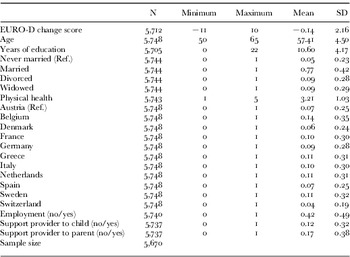
Because we examine role combination strain in middle-aged women, men of all ages (N=13,811) and women younger than 50 and older than 65 (N=8,923) were removed from the original sample of wave 1 SHARE participants. This reduced the sample size of 31,115 to 8,381 (26.9% of the total). Next, because we study change in depressive symptoms, data on 2,633 women who did not participate in the second wave were deleted as well. This reduced the sample size further to 5,748 (68.6% of the total). We used this sample to determine what proportion of European middle-aged women (a) combined paid work and support to an adult child, (b) combined paid work and support to a parent, and (c) combined paid work and support to both an adult child and a parent (RQ1). More information about the sample (N=5,748) is provided in Table 1. This table shows the descriptive statistics on the variables that are introduced in the measurement section.
Descriptive statistics wave 1 (N=5,748)

Notes: SD: standard deviation. Ref.: reference category.
Source: SHARE wave 1 release 2.0.1 and SHARE wave 2 release 1.0.1.
The regression analyses that are used to test whether combining paid work and support to an adult child and/or parent leads to an increase in depressive symptoms among middle-aged women (RQ2) are performed on a sample of women with at least one child and one living parent (N=2,255). The average age of the respondents in this sample was 55.5, the average age of their children 29, and the mean age of their parents was 81.5 for the mothers and 82 for the fathers. We analyse the data with two types of change-score regression models (Allison Reference Allison1990). In the semi-dynamic models, the independent variables represent role occupation at wave 1, and the dependent variable represents change in depressive symptoms between waves. In the full-dynamic models, the change in depressive symptoms is regressed on gaining a designated role between waves.
In the dynamic models, the role combination strain hypothesis and the role accumulation hypothesis are tested by means of interaction effects between the independent variables. When the coefficients for the interaction terms are positive this means that combining roles leads to an increase in depression and that the role combination strain hypothesis is valid. Negative interaction coefficients, on the other hand, would support the role accumulation hypothesis. Such coefficients are an indication that combining roles causes a decrease in the number of depressive symptoms women in the sample experience. If the coefficients are not significant neither hypothesis is supported and the additive model holds.
Measurement
Depressive symptoms
Within SHARE the number of depressive symptoms was measured with the EURO-D scale. The EURO-D scale has 12 items, each representing a depressive symptom: depression, pessimism, wishing death, guilt, sleep, interest, irritability, appetite, fatigue, concentration, enjoyment, and tearfulness. Persons score 1 or 0 on each item, depending on whether or not the described symptom applies to them in the past month. The scores on the different items are added to determine the score on the scale (Prince et al. Reference Prince, Beekman, Deeg, Fuhrer, Kivela, Lawlor, Lobo, Magnusson, Meller, van Oyen, Reischies, Roelands, Skoog, Turrina and Copeland1999b). For the female respondents aged between 50 and 65 participating in both waves of SHARE, the Cronbach's alpha indicating the reliability of the scale was 0.70 at wave 1 and 0.71 at wave 2. The change scores that are used as a dependent variable in the regressions analyses were calculated by subtracting the wave 1 from the wave 2 EURO-D score. Negative change scores mean a decrease in depressive symptoms, whereas positive change scores signify an increase in depressive symptoms.
Employment
Each respondent was asked for her current job situation and could choose from the following options: retired, employed or self-employed, unemployed, permanently sick or disabled, homemaker, and other. A dummy variable for employment was constructed which was coded 1 if respondents were employed or self-employed, and 0 if respondents were non-employed.
Support provided to relatives
Using a so-called social network approach, respondents were asked whether they provided support, and if so to whom. Three types of support were listed and for each type examples of help were mentioned on a specific card that was handed to the respondent. The three types of support were: help with personal care (e.g. dressing), practical household help (e.g. repairs), and help with paperwork (e.g. filling out forms). If respondents indicated that they gave a certain type of help, they could list three persons inside the household and three persons outside the household to which they provided it. By using the information on the recipients, it was determined whether or not women provided support to their adult (biological, fostered, adopted and/or step-) children and whether or not women provided support to their biological parents. Both support provision to children and parents inside and outside the household are included, for the reason that in Southern European countries support is more often provided within the household as generations are more likely to share a household. Excluding one type of support could lead to an underestimation of the percentage of middle-aged female support providers in Europe (e.g. Attias-Donfut, Ogg and Wolff Reference Attias-Donfut, Ogg and Wolff2005; Kalmijn and Saraceno Reference Kalmijn and Saraceno2008; Kohli and Albertini Reference Kohli, Albertini and Saraceno2008; Ogg and Renaut Reference Ogg and Renaut2006).
Control variables
Included in the analyses of this paper as control variables are country, age, marital status, and educational level. Prince et al. (Reference Prince, Beekman, Deeg, Fuhrer, Kivela, Lawlor, Lobo, Magnusson, Meller, van Oyen, Reischies, Roelands, Skoog, Turrina and Copeland1999a) and Castro-Costa et al. (Reference Castro-Costa, Dewey, Stewart, Banerjee, Huppert, Mendonca-Lima, Bula, Reisches, Wancata, Ritchie, Tsolaki, Mateos and Prince2007) showed that all these factors affect a respondents' score on the EURO-D scale. Educational level is measured as years of education so as to make scores from different countries comparable. Further, physical health was included as a variable to control for the correlation between physical health and the number of roles a person is engaged in. We chose the well-known self-rated health question to measure physical health (Idler and Benyamini Reference Idler and Benyamini1997). Self-rated health was assessed with the following question ‘Would you say your health in general is poor, fair, good, very good, or excellent?’ We used this item as a continuous scale with ‘poor’ being the lowest and ‘excellent’ being the highest category. All control variables refer to the first wave.
Results
Descriptive analyses
As much as 44.2 per cent of all European middle-aged women fulfilled none of the roles under study. These women were neither employed, nor did they provide support to a child or parent. In addition, 41.4 per cent of European middle-aged women fulfilled one role only: 28.9 per cent was solely employed, 5.7 per cent only provided support to a child, and 6.8 per cent only provided support to a parent. Of the European middle-aged women, 13.3 per cent combined two roles: 3.8 per cent combined the role of employee with that of support provider to a child, 8.6 per cent combined the role of employee with that of support provider to a parent, and 0.9 per cent provided support to both a child and parent. Combining all three roles was very rare (1.2%).
We note that the numbers above are based on all women, including women who have no children or parents. Focusing now on the subgroup of women with children and parents, we see that three out of ten women (27.5%) fulfilled none of the roles. Further, 46.0 per cent fulfilled one of the roles: 28.5 per cent was solely employed, 4.2 per cent provided support to a child, and 13.3 per cent to a parent. Of the women with children and parents, 23.7 per cent combined two roles: 3.7 per cent combined the role of employee with that of support provider to a child, 18.0 per cent combined the role of employee with that of support provider to a parent, and 2.0 per cent provided support to both a child and parent. Three out of 100 women (2.8%) fulfilled all three roles.
Dynamic models
The dynamic models are estimated on the subsample of women who have living parents and children. We present estimates of the main and second-order interaction effects of the independent variables. Third-order interaction terms are not tested, because very few women are engaged in all three roles. The statistical power for testing such an interaction effect would be low and the results thus unreliable.
Semi-dynamic analyses
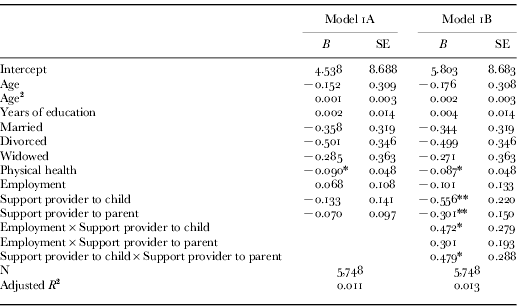
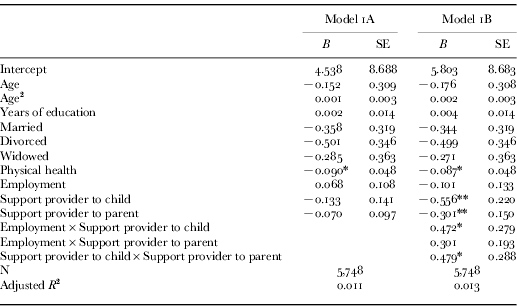
In Table 2, we present the results of the semi-dynamic regression analyses. Model 1A presents the main effects only. None of these effects is significant. In Model 1B we included interaction effects. The main effects in this model pertain to the effect of performing a specific role given that the other role is not performed (i.e. when the other dummy variable is 0). Significant negative effects are found for providing support to a child and providing support to a parent. The main effect of providing support to a child applies to women who do not work and who do not provide support to a parent. For these women, caring for a child brought about a substantial change of (0.556/2.16 ≈) 26 per cent of the standard deviation of the EURO-D change score. Like the women who solely provide support to a child, women who solely provide support to a parent experienced a decrease in depressive symptoms. The magnitude of the effect of providing support to a parent was moderate, as it brought about a decline of (0.301/2.16 ≈) 14 per cent of the standard deviation of the EURO-D change score.
Effects of employment, providing support to an adult child, and providing support to a parent at wave 1 on the EURO-D change score (wave 2− wave 1)Footnote 1
Notes: 1. Controlled for country dummies. SE: standard error.
Source: SHARE wave 1 release 2.0.1 and SHARE wave 2 release 1.0.1.
Significance levels: *p<0.1, ** p<0.05, *** p<0.01.
The role accumulation theory and role combination strain theory are tested using the interaction terms. In Model 1B, we find two significant interaction terms. First, we find a significant and positive interaction between employment and providing support to a child. This means that the beneficial effect of helping a child on mental health was smaller for working women. The effect of providing support to a child was −0.556 for non-employed women, but −0.084 (i.e. −0.556+0.472) for those employed. Although the non-employed women experienced a decrease in depressive symptoms from helping a child, working women did not substantially benefit from providing support to a child.
The interaction effect for combining support to a child and support to a parent is significant and positive as well. This means that the beneficial effects of providing support to a child and support to a parent are reduced when both types of support are given. The effect of providing support to a parent on the EURO-D change score was −0.301 for women not providing support to a child, whereas it was 0.178 (i.e. −0.301+0.479) for women who did provide support to a child. The first group of women thus benefited from providing support to a parent, whereas the second group clearly suffered from additional depressive symptoms as a consequence.
Note that none of the control variables except for physical health had a significant effect on change in depressive symptoms. This is not a surprising finding because although the control variables may affect the number of depressive symptoms that a person experiences at the time of data collection, they are unlikely to affect change in depressive symptoms. The effects of physical health found in Models 1A and 1B were very small (Model 1A: B=−0.090, p<0.10; Model 1B: B=−0.087, p<0.10). The effect of physical health is only minute as it brings about an average change of (0.09/2.16≈) 4 per cent of the standard deviation of the EURO-D change score.
Full-dynamic analyses
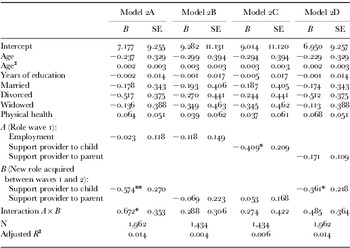
We wanted to explore the effects of combining roles further. For this reason, we investigated (a) whether the effect of starting to provide support to a child between wave 1 and wave 2 on the change in depressive symptoms was different for those employed and those non-employed (Model 2A); (b) whether the effect of starting to provide support to a parent between wave 1 and wave 2 on the change in depressive symptoms was different for those employed and those non-employed (Model 2B); (c) whether the effect of starting to provide support to a parent between wave 1 and wave 2 was different for women who did provide support to a child and those who did not (Model 2C); and (d) whether the effect of starting to provide support to a child between wave 1 and wave 2 was different for women who did provide support to a parent and those who did not (Model 2D) (see Table 3).
Effects of gaining a support-provider role between wave 1 and wave 2 on the EURO-D change score (wave 2− wave 1)Footnote 1

Notes: 1. Controlled for country dummies. SE: standard error.
Source: SHARE wave 1 release 2.0.1 and SHARE wave 2 release 1.0.1.
Significance levels: *p<0.1, ** p<0.05, *** p<0.01.
The variables for starting to provide support to a child and starting to provide support to a parent are dummy variables. A zero score refers to the situation where a woman did not provide such support at both wave 1 and wave 2, and a score of 1 refers to the situation in which a woman did not provide such support at wave 1 but did provide it at wave 2. In order to keep the analyses parsimonious, women who provided such support at wave 1 but not at wave 2, or who provided such support at both wave 1 and wave 2 were left out of the analyses. By analysing the effects of taking up support for a child and taking up support for a parent separately, we kept the sample size as large as possible. We did not investigate the effect of taking up employment, because only 5 per cent of all women started working between wave 1 and wave 2.
In Model 2A, the main effect for employment at wave 1 was not significant, but a negative main effect for starting to provide support to a child and a positive interaction effect between the two variables were found. For women who were not employed, starting to provide support to a child decreased their number of depressive symptoms (0+−0.574+0=−0.574). However, for women who were employed, starting to provide support to a child barely had an effect on their number of depressive symptoms as it stayed approximately the same (0.023+−0.574+0.672=0.075). These findings are in line with the results presented in Model 1B in Table 2.
In Model 2B no significant main effect on change in depressive symptoms is found for employment at wave 1 and starting to provide support to a parent between waves 1 and 2. The interaction effect between the two variables is also not significant. In summary, the findings from Model 1B suggested that providing support to a parent decreased the number of depressive symptoms of women, given that they were non-employed. However, the results from Model 2B suggest that taking up the role as support provider to a parent had no effect on depressive symptoms, regardless of whether a woman is employed or not.
The findings from Model 1B suggest that providing help to a parent decreases the number of depressive symptoms for women, given that they do not provide support to a child. In Model 2C, we found a negative main effect for caring for a child at wave 1 on the change in depressive symptoms (−0.409), but the main effect for starting to provide support to a parent is not significant, nor is the interaction effect between the two variables. Starting to provide support to a parent did not seem to induce a change in depressive symptoms, and this is true for both women who did and who did not provide support to their children.
In Model 2D, no main effect on depressive symptoms was found for providing support to a parent at wave 1. However, a negative main effect exists for starting to provide support to a child. The interaction effect in the model is not significant. Hence, these findings indicate that taking up the role of providing support to a child decreased depressive symptoms, regardless of whether women provided support to a parent.
Discussion
In this paper, we responded to a gap in the literature by focusing on middle-aged women combining employment with support to adult children and elderly parents. We examined the proportion of middle-aged women who combine employment with support provision to an adult child and/or parent and the extent to which combining these roles affects women's depressive symptoms. In debates about ageing western societies it is often assumed that many middle-aged women combine multiple roles, and that their mental health suffers as a consequence. Many, therefore, believe that family–work reconciliation policies need to be reconsidered. Our study indicated that of all European women aged between 50 and 65 only 14 per cent combined the role of employee with that of support provider. These findings are in line with American studies in which the proportion of women combining multiple roles is also relatively small (for an overview seeHammer and Neal Reference Hammer and Neal2008; Kohli and Künemund Reference Kohli, Künemund, Willis and Martin2005). However, for the group of women with both children and living parents the proportion of women that combined paid work and support provision activities was substantially higher: 25 per cent.
Based on previous studies, we expected that employment would have a positive effect on mental health and that the effect of providing intergenerational support could either be positive or negative. Because support provided to an adult child may be a more rewarding activity than support provided to a parent we further expected that providing the first type of support would be associated with a smaller burden. Also, we believed that the effect of combining paid work and intergenerational support could be either positive or negative. Yet, because providing support to a child might be associated with a smaller burden than providing support to a parent, we expected that combining work and support to a parent is more demanding than combining work and support to an adult child. We tested our assumptions with semi-dynamic and full-dynamic regression analyses.
In both the semi-dynamic and full-dynamic models no main effect of paid work on women's depressive symptoms was found. This unexpected finding can possibly be explained by the fact that differences in mental health are not only observed between those employed and non-employed, but also within the group of employed itself, for example due to differences in job demands (Bakker and Demerouti Reference Bakker and Demerouti2007; Klumb and Lampert Reference Klumb and Lampert2004; Van der Doef and Maes Reference Van der Doef and Maes1999). However, we did not control for these differences because doing that would decrease the statistical power as additional main effects and interaction effects would be included in the models. In the semi-dynamic analyses we did find a significant main effect for caring for children and parents. Women who solely provided support to a child or a parent experienced a decrease in depressive symptoms. Likewise, a main effect for providing support to a child was found in the full-dynamic models. In addition, the full-dynamic models indicated that obtaining the role of support provider to a child was associated with a decrease in depressive symptoms. These results support the notion that giving support enhances self-esteem and gives people a meaningful role in society about which they feel good.
In the semi-dynamic models, our interaction effects showed that the positive mental health effect of providing support to a child is annulled for working women. In addition, it was found that the beneficial effect of providing support to a parent on mental health was reversed (i.e. detrimental) for those providing support to a child. These findings match the role strain hypothesis: combining roles is harmful. The results from the full-dynamic models were somewhat mixed. Taking up the role of support provider to an adult child has a beneficial effect on mental health for non-employed women, but a small detrimental effect for employed women. This finding supports the role strain theory. However, taking up the role of support provider to an adult child has a beneficial effect on mental health regardless of whether women provide support to their parents. No mental health effect was found for taking up the role of support provider for a parent.
Future research
For future research it would be interesting to repeat the analyses, including the third wave of SHARE data. It would then be possible to determine whether a change in role occupancy between waves 1 and 2 is associated with a change in depressive symptoms between waves 2 and 3. Such analyses are a better test for causality and can provide an even more reliable answer to our second research question. Also, it would be important to examine the number of women combining paid work and support to in-laws and their level of mental health. Last, it would be interesting to study specific groups of women. In this study neither the number of hours spent on informal support nor the age of the recipients was included. It could be hypothesised, though, that for women who spend a few hours providing informal care the benefits may exceed the burden of this activity, whereas for women spending many hours on this activity they may not. Further, the care to young children and to parents in (very) old age may be especially demanding as they require much personal care.
Limitations
We feel fairly confident in drawing our conclusions given the number of respondents and the quality of the items in the SHARE data set. However, despite the fact that we controlled for between-country variation in depressive symptoms, there may also be differences in the effects of some of the independent variables on the level of depression (i.e. differences in the effects of paid work or providing support). While this is an important issue, the relatively small analytical sample size per country makes it difficult to estimate the change-score regression models for all individual countries. Questions about country-specific effects should probably be analysed with different research designs than the one we chose and that we believe is most optimal for assessing effects of (multiple) roles (e.g. Kalmijn and Saraceno Reference Kalmijn and Saraceno2008). We emphasise that our estimates of the effects of (multiple) roles are an average for the European countries that we analyse and that they may not apply to each individual country to the same extent. Nevertheless, according to our study, we may conclude that combining roles can take away some of the positive mental health effects of fulfilling a role.