INTRODUCTION
Since 1986 practical legal training and law librarianship in Uganda have experienced unprecedented challenges and inevitably transformation whenever circumstances could allow. To understand the transformation and challenges facing professional legal training and legal information management one has to examine two incidents that resulted from political-legal developments in the recent history of the country. These include:
1. The restoration of the rule of law following the seizure of power by the National Resistance Movement (NRM) after a brief but devastating civil war.
2. Government policies that led to the liberalization of university education which saw private universities, beside the only country's public university by then, being accredited to offer a law degree course.
These two incidents would inevitably lead to unparalleled high demand for vocational legal education and legal information. There would also be an interesting growth in the amount of legal information. The Law Development Centre, the only institution of practical legal training, and legal information management in the country as a whole but particularly at the said institution, would be plunged into crisis and inevitably experience some interesting changes!
Joseph A. Semugabi

POLITICAL – LEGAL DEVELOPMENTS SINCE 1986
To appreciate developments since 1986 to date it is pertinent to give a brief description of the period preceding this era, that is, the first 25 years of Uganda's independence.
On 9 October 2012, Uganda celebrated 50 years of self-rule from the British. The territory had become a Protectorate in 1894 and was the responsibility of Her Majesty's Government for 68 years. Whereas the British reluctantly took on the responsibility for this region, these years had far reaching consequences regarding the politico-socio, economic, religious and legal destiny of this nation. Writing about developing countries Kanyeihamba (2010)Footnote 1 notes:
Developing countries, of which Uganda is one, have had to pass and continue to pass, through traumatic experiences of governance. Initially, most of them witnessed a head on collision between their traditional culture and colonialism. While the former was elegant, slow and dignified, the latter was sophisticated and mysterious to the population and certainly superior in technology. Inevitably, the latter superimposed its principles and values on the respective communities which were reluctantly forced to abandon their old ways of doing things in preference to the new and alien modules which they could only partially understand and appreciate. The experience was bound to leave lasting scars.
Following independence in 1962, self-rule for this country was characterised by unmatched political instability. Such instability was to affect literally every aspect of the young nation's life including the public, economic, social and legal sectors. Some have always thought, and rightly so, that there had always been a problem with this era right from the beginning. Museveni (1997)Footnote 2 writes: “The basis of political affiliation at the very beginning of Uganda's independence was … opportunistic and sectarian, with divisions along religious and tribal lines. These divisions clouded the real issues….”
The situation was to deteriorate further and inevitably see a military coup by General Idi Amin Dada who toppled President Milton Obote and ushered in a bloody dictatorship. All semblance of democratic and constitutional governance was suspended. Uganda was to become a closed society and contact with those countries especially in the West, that were very critical of Amin's human rights record was considered treacherous!
There was no freedom of speech; neither would any criticism of the government be tolerated whatsoever. As a matter of fact, most educated and highly resourceful people lost their lives due to state sponsored violence and those who were lucky, fled to exile. Parliament was suspended and the little activity that existed in the judiciary was greatly patronised by the executive arm of government. Few sought legal education at Makerere University, the only University that existed then since 1922. The generation of legal information and those that use it, i.e., students, scholars, judges and advocates was lowest if not non-existent during this period. For example, although Uganda had started producing law reports since the colonial era in 1910, in 1973 during Amin's regime, the publication of Uganda law reports ceased.
1. The Restoration of the rule of law – the period since 1986
Whereas the country is still grappling with a lot of problems there is no doubt that 1986 is a milestone in the political-legal history of this nation. This era which was ushered in by Museveni's National Resistance Movement is effectively described by Kanyeihamba (2010)Footnote 3 as one which “has been a unique superstructure of political and constitutional innovation in Africa if not the whole world.” On the 8 October 1995, a new constitution for Uganda was to be enacted and promulgated by the people's elected Constituent Assembly. In effect, the country had returned to democratic governance, rule of law and observance of basic human rights. Characteristic of this era is a fairly independent judiciary and legislative arms of government with all the implications of such governance including unprecedented court and legislative activity.
With time, the country was also to embrace structural adjustment and the contraction of the role of the state in the productive sector. The emphasis was to be on economic liberalisation, privatisation and encouragement of foreign investment. For the past 25 years we have therefore seen enterprise reforms, privatization, financial sector reforms, legal reformsFootnote 4 as well as private sector development initiatives.
These developments consequently led to:
• A prodigious growth in the number of graduate lawyers pursuing practical legal training and thereby an increase in the number of users of legal information for academic and work related purposes;
• A remarkable growth in the amount of legal Information available from not only foreign sources but also indigenous sources and in both hard and electronic copies.
It is noteworthy that the period preceding 1986 had two challenges. Firstly, the relevant and timely legal information was scarce. Secondly, the financial resources to get even the little that was on the market were not available. However, with the increased availability of legal information in recent years the challenge remained only in regard to the availability of sufficient financial and human resources to consistently procure as well as effectively and efficiently manage it.
2. Liberalisation of university education
Until 1986 the country had only one university and it was a public institution established in 1922. The liberalization of university education was to see the establishment of several other universities in the years that followed. Muwagga (2011)Footnote 5 indicates that “between 1922 and 2010, the number of universities in Uganda grew from one to thirty officially registered universities. They include six public and twenty four private universities”. Six of these have been accredited by the Law CouncilFootnote 6 to offer law courses.
Liberalization of course introduced challenges to professional legal training. When the country still had only one university, there was only one Law Faculty graduating an average of 60 law graduates annually! With five more faculties offering law the number of law graduates increased greatly. Beside, in 2002, the Advocates ActFootnote 7 was amended to enable Ugandans, who had obtained degrees from foreign universities recognized by the Law Council eligible for admission to the Bar Course. All these students now totaling to over 900 or so would apply for the Bar Course at the only institution of practical legal training in the country! The implications of such surge of law graduates to the Law Development Centre are great in terms of available infrastructure as well as financial and human resources. The institution was overtaken by events and everything had become inadequate.
The Ssempebwa CommitteeFootnote 8 noted: “Liberalisation of university education and the opening of access to the profession to graduates of foreign universities have implications on legal education which go to quality as well as quantum.” This report also pointed out that: “So far Uganda does not have a human resources plan. Lawyers are therefore not produced in the context of a rationalised strategy as to output in relation to the market. Legal education is proceeding on the unverified assumption that the demand for lawyers is increasing. This assumption underlies the policy of liberalising legal education at university level.”
THE LAW DEVELOPMENT CENTRE AND PRACTICAL LEGAL TRAINING
A discussion of practical legal training is actually a discussion of the Law Development Centre. This institution, the only one of its kind, has been greatly affected by the liberalization of legal education. There is growing concern whether it can continue with this monopoly in such circumstances.
In 1969, the Gower Committee on Legal EducationFootnote 9 recommended that there should be a separation between university legal education and practical legal training. It clarified that practical legal training was necessary for lawyers after the broad based university legal education. The Committee's Report elucidated that an institution be established where law graduates can be given practical training through small groups (firms) and internship. Consequently, in 1970, the Law Development Centre Act, Cap 132, Laws of Uganda was enacted and under this Act, the Law Development Centre (LDC) was established. Gower envisaged a practical training institution with a broader mandate to carry out a number of activities. In brief, Section 3 of this Act mandates LDC to:
1. Conduct legal training for lawyers as well as paralegals
2. Conduct research and advise on law reform
3. Produce legal publications
4. Undertake law reporting
5. Provide community legal services
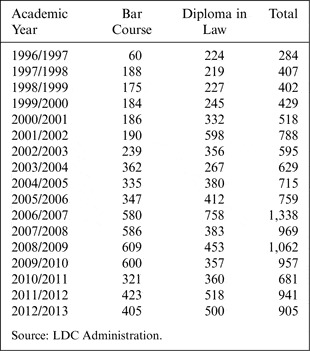
Being the only institution offering the Bar course, the major challenges facing LDC are inadequate funding and inadequate physical facilities. The existing physical facilities at LDC were intended for a total of 80 students on the Bar and other courses. The years preceding 1986, the Bar course programme had an average of 40 students in a class. As indicated in Table 1 below, from 1996/1997 academic year, the number of students in a Bar course class increased to 60.
Student Intake on the two main Courses conducted at the LDC.

Source: LDC Administration.
Student numbers began to swell in the academic year 1997/1998. This is because the Law Council had started accrediting other Universities to offer the law course. Later on, with now six faculties offering law the highest number registered was to be 609 entrants on the Bar Course in 2008/2009. And coupled with other courses the institution was to handle over 1,000 students as was the case in 2006/2007! This was a crisis to say the least!
It is only when the Law Council introduced Bar course pre-entry examinations in 2010/2011 that the student population dropped to an average of 383. For the current academic year, that is 2012/2013, over 1,000 applicants sat for the pre-entry exam conducted by the Law Council. It is interesting that only 405 students made it to the Centre!
Recent breakthroughs
Efforts to get more funding from government have not been forthcoming until only recently. The Justice Law and Order Sector (JLOS)Footnote 10 assisted LDC by providing funding for capital development. This money was used to complete the construction of 5 firm rooms, a hall and a more spacious library premise.
Development partnersFootnote 11 have also gone a long way to assist with funding. Even then it is pertinent that the funding be increased, facilities further expanded and the Law Development Centre Act be amended to relieve the institution of some responsibilities which other bodies are currently performing. These breakthroughs have brought some relief, albeit temporal, to this beleaguered institution.
Research, publications and law reporting
Undertaking research in topical legal issues, production of legal publications as well as law reporting, also constitute statutory functions of the LDC. These had long been abandoned during the traumatic era of the 1970s and 1980s. After 1986 with funding from government and development partners, activity regarding these mandates was to resume. Such publications include digests of the High Court called High Court Bulletins (HCB), Magistrates' Handbook, Uganda Law Focus and Uganda Law Reports.
The challenge with the resumption of these important publications was to first deal with the huge backlog especially in the area of law reporting, with the last law report having been published in 1973 and the last HCB in 1977! These revived functions were to contribute to the availability and growth of legal information most relevant to legal education and practical legal training.
THE SURGE IN LEGAL INFORMATION
With the political-legal changes, the last 25 years have seen an explosion in legal information as a result of the revived or innovative activities of the following public as well as private institutions in the legal sector:
• The judiciary and its court system: apart from the traditional courts of the 1970s and 1980s more courts have been established including the Anti-Corruption Court and the Commercial Court. This meant more court cases. Some of these courts like the Commercial Court even produce law reports and have a database of unreported High Court and Commercial Court cases available on CD-ROM;
• Government ministries/departments including the Ministry of Justice & Constitutional Affairs, Uganda Printing & Publishing Corporation (UPPC), Directorate of Public Prosecution (DPP) as well as the Law Reform Commission;
• More law faculties are undertaking research in topical legal issues and producing papers, articles, reviews, commentaries as well as journals;
• The Law Development Centre which is also mandated by law to produce legal publications and law reports;
• The Uganda Law Society – a professional association of lawyers which also produces digests of court cases among other publications;
• Private agencies as well as publishers like Kampala Law Report and Law Africa producing law reports, journals, reviews as well as textbooks;
• Legal scholars and writers producing articles, papers, handbooks, research findings;
• The media companies which have taken keen interest in publishing and reporting on legal issues;
• Innovations including the establishment of legal databases like Uganda Legal Information Institute (ULII), Southern Africa Legal Information Institute (SAFLII), Uganda Online Law Library (UOLL), Law Africa Legal Database (LALD) whereby legislation, law reports and texts of court cases can easily be accessed electronically.
The role of government
Generally, it is noteworthy that the government has done a lot to create an enabling environment to ensure efficient and effective management of information in both public and private sectors. The following initiatives are indicative of this reality in recent years:
• Enactment of laws regarding access to information including the Access to Information Act 6 of 2005.
• Production of the revised edition of the Laws of Uganda in 2000. This is significant especially that these laws were last revised in 1964! Ideally the revision is supposed to occur every 10 years.
• Establishment of the Ministry of Information and Communications Technology in June 2006 with a mandate of providing strategic and technical leadership, overall coordination, support and advocacy on all matters of policy, laws, regulations and strategy for the ICT sector. It also ensures sustainable, efficient and effective development, harnessing and utilization of ICT in all spheres of life to enable the country achieve its national development goals. The Ministry has two Directorates namely, the Directorate of Communications & Broadcasting Infrastructure and the Directorate of Information Technology & Information Management Services.
• Education and training of library and information professionals at higher levels whereby the Bachelor of Library & Information Science (BLIS) was introduced in 1989, Master of Science in Information Science since 1997 and PhD which commenced in 2004 at the country's leading public university.
• Establishment of the National Council of Higher Education (NCHE), a semi-autonomous and self-accounting body established by the Universities and other Tertiary Institutions Act No. 7 of 2001 whose mission is to set standards and regulations to ensure that all public and private tertiary education institutions in Uganda create, sustain and provide relevant and quality higher education for all qualified Ugandans and to meet the local, national and global challenges of the future. This is the institution that has done a lot to ensure that academic libraries are well stocked and meet the established standards.
• In 1998 the Ministry of Justice, as part of the Uganda Institutional Capacity Building Project (UICBP) – Legal Sector, restocked law libraries throughout Uganda!
The challenge posed to the legal information manager with the dilapidated, small libraries of the pre-1986 era, was on how to grapple with the increased information and an equally large number of patrons. LDC and its library has felt the brunt of these developments more than any other institution involved with higher education. This is mainly because it has the monopoly for professional legal education.
GENERAL COMMENTARY ON LAW LIBRARIANSHIP
It is pertinent to make a general commentary on law libraries in the period before 1986 before consideration of the LDC library. Law libraries of the 1970s and 1980s were in a sorry state. There is no more appropriate description of the libraries during that era than in the words of two reports to the government. Justice Porter noted:Footnote 12
As a result of the country's unsettled past, law libraries have fallen into disrepair, with stocks sadly depleted. Budgets have not allowed replenishment and updating of library stock. Although libraries have recently been updated by the publication of the statutes and statutory instruments since 1964 in booklet form, without case and reference books, judges and magistrates have no comparative basis upon which to work rendering the delivery of justice unpredictable in both criminal and civil cases.
Following a visit to one of the leading university law libraries, the Odoki CommitteeFootnote 13 made the following similar observations and recommendations:
We visited the law collection in the university library and noted the dismal state of the facility. The few titles that exist are outdated. Law reports, statutes and journals are not up-to-date and are too few relative to the number of users. Many of them have suffered from serious mutilation. We recommend that a new basic law collection be acquired. The law library requires almost complete restocking by way of statutes, law reports, text books, case books and journals. Back issues of law journals should be acquired and subscriptions to current issues be maintained. Reference materials such as law reports and statutes should be maintained in sets of at least 10 copies each to meet the demand of the large number of users. Many relevant text books, especially those published in East Africa are out of print. We recommend production of local materials. To this end writing workshops should be organized by academic staff. Individuals should be commissioned to write books and a fund for this purpose should be put in place… Other constraints exist…. Access to electronic information systems is practically non-existent. We recommend computerization and the introduction of related information systems including CD-ROM facilities.
With such revelations and recommendations some key libraries including the LDC law library were to undergo significant transformations. Apparently, it was no longer possible to ignore law libraries and the proper management of legal information which was now in high demand.
THE LDC LIBRARY – THE HUB OF LEGAL INFORMATION
The Ssembebwa CommitteeFootnote 14 noted the library's leading role in the management and provision of legal information at the LDC as well as the legal fraternity. It stated that: “In view of the centrality of the library to the achievement of LDC's objectives, the library facilities need urgent attention.”
The Committee was to make recommendations whereby in addition to earlier government efforts to restock the library, there was still need for more reading materials given the ever increasing number of users. There was also urgent need for a more spacious reading room and shelving space. And since there was a limit on how far physical facilities would be expanded, modernizing by harnessing electronic resources was to be a key option. Although there are still challenges the institution has tried its best to ensure that the library is steered into this direction especially that assistance from both government and development partners has been forthcoming.
With a current stock of over 90,000 thousand volumes of text books, journals and law reports as well as electronic resources the book to student ratio has greatly improved. In 2007, using its own internally generated funds LDC constructed a more spacious library building with a seating capacity of 230 users! Although this is far from being a functional library building it provided some relief regarding the problem of an inadequate reading room especially when you consider that the previous reading room could only accommodate 80 readers. Shelf space however continues to be a serious problem. Compared to other academic institutions, this library is now not only reasonably stocked but also professionally organised and managed.
Patrons
Beside the LDC staff and student body this library serves students from university law faculties who pay an annual subscription fee to use the Centre facility. The library also serves the legal fraternity including advocates, judges, magistrates, scholars/researchers and government officials who are required to pay for the services.
Circumstances underlying the restocking of the library
Liberalisation of legal education also meant a dramatic increase in the number of patrons using the LDC library. There was need for more reading materials, and not just reading materials, but the appropriate and timely legal information leaning more but not exclusively, in the direction of local reports, cases and texts among other things. Fortunately, with the political-legal developments since 1986 these publications had become increasingly available. For cash strapped institutions like the LDC, what remained was the financial assistance to restock accordingly especially given that donations of materials in kind were irregular and paltry. This assistance to supplement the meagre internally generated funds was to be obtained from basically two sources:
• The government, through JLOS, has been allocating funds for texts and reference materials over the last three years which greatly supplements the library fee paid by the students.
• The development partners whereby the library in 2007 received an assortment of reading and reference materials as well as electronic resources including computers, a photocopier, library management software and furniture for the newly established electronic resource unit and library premises.
These opportunities enabled management to review its collection development policy and stock the library in the most appropriate manner. Seventeen years ago the Odoki CommitteeFootnote 15 had observed on visiting one of the leading libraries that “many relevant text books, especially those published in East Africa are out of print. We recommend production of local materials. To this end writing workshops should be organized by academic staff. Individuals should be commissioned to write books and a fund for this purpose should be put in place.” There was a dearth of local materials. This situation however, has long since changed. Unlike the 1970s and 1980s indigenous materials including law reports, journals, reviews, textbooks, court judgments, forms and precedents, legislation as well as academic publications are now in plenty and can now be obtained as fast as foreign materials.
Foreign versus local materials
With the government's revived interest in academic libraries the challenge to librarians was devising collection development policies to ensure that relevant, timely legal information and in reasonable quantities and various formats, is obtained. Such policies for law libraries should ensure among other things a balance between local and foreign materials if they are to effectively facilitate legal education.
For instance, when it comes to court decisions in an independent country like Uganda, the status of foreign decisions is merely of persuasive nature while that of local precedents is binding and authoritative. Veitch (1971)Footnote 16 pointed out that in 1971 the local courts ceased to be bound by English decisions although these are paid the utmost respect and continue to be persuasive. It actually became a legal principle since then whereby local is considered binding; and foreign is merely persuasive.
In courts of law therefore, English decisions are discouraged for local cases. In Othembi v. Adong [1998] (3)Footnote 17 the judge cites Glenister v. Glenister [1945] 1 All E.R. (513) and Chilton v. Chilton [1952] 1 All E.R. (322) and then makes the following remarks: “the above cases are foreign cases but in the absence of local cases exactly on the point, I find them of very persuasive value and decide to follow them.” Odoki(1975)Footnote 18 had noted that:
The post-independence legal developments precipitated the need for local legal materials not only for the new African magistrate and legal practitioner, but for the law student and law teacher as well. The English common law could no longer be administered in its pure form. The challenge that now faces the Bar and Bench was that of developing a new common law for Uganda compatible with her sovereignty and the socio-economic conditions of her people.”
A studyFootnote 19 in 2005 however shows that despite this legal principle, English decisions continued to have undue prominence in legal instruction, publications and libraries. Reasons cited for this scenario include past training, easy availability as well as better quality of the English decisions, predominance of such materials in libraries with little or no local materials and the continued use of English or English derived texts in law schools.
Mugambwa's (2002)Footnote 20 frustration about indigenous legal texts and court cases is indicative of this fact:
There was no textbook on Uganda land law that I could refer to. Finding the current Uganda case law on the subject proved to be most frustrating. I discovered, to my horror, that apart from the High Court Bulletin (HCB), which is a publication of the Law Development Centre, there were no law reports of Uganda in the last twenty years. The HCB, though a useful source of cases, is not a law report; it is a digest of select judgments. For some cases, there were no copies of the judgments in the LDC Library (which has by far the better collection of cases than the Makerere University library) …. Getting access to the reported cases was also cumbersome and frustrating.
This country which operates a common law system was to go without law reports until 2000. There is no wonder that British law reports featured more in legal scholarship, research, education, libraries and practice.
It is however notable that with the developments in recent years including resumption of official local law reporting by the LDC the situation has greatly changed with local cases featuring more in publications and legal instruction.
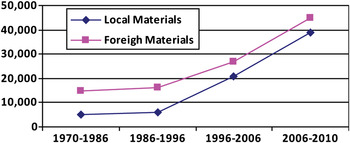
Figure 1 shows the trend in collection development with regard to foreign and local reports and text books over the last 20 or so years at the LDC library. Since independence, foreign texts and law reports have constituted the biggest percentage of the stock. The years from 1970 to 1986 however did register little or no increase in both categories of the collection. From 1986, new acquisitions start coming in and the gap between foreign and local materials decreases considerably.
Collection Development with regard to Foreign & Local Legal Texts & Reference Materials.

Considering this albeit modest, transformation in its collection the LDC library is testimony to the fact that since 1986 there has been an explosion in legal information for mainly three reasons:
1. Government's as well as development partner's efforts to import into the country, books as well as reference materials and restock law libraries to meet the information needs of a new political-legal legal system;
2. Increase in local publications including unreported court cases, law reports, textbooks and journals produced by courts of judicature, government agencies like LDC; academic institutions; professional associations; private organizations; as well as individual legal scholars and researchers.
3. Availability of free and as well as commercial online legal resources covering not only foreign materials but also local publications.
Electronic resources and systems
The use of electronic resources is a nascent development which the institution, in partnership with development partners, has been keen to support. In 2005 a Library Re-Engineering Proposal noted that it was not possible to keep increasing physical space to accommodate the ever increasing legal information materials and patrons. It was argued that the long term solution to the challenge of phenomenal numbers and inadequate reading as well as storage space was technological. The following constitute a description of use and development of electronic resources in the library:
• Electronic Resources Unit – established in 2010 this Unit has 35 computers. In addition to the online legal research undertaken here, this lab is also used for the training of staff and users on how to access electronic resources.
• Internet connectivity – the library and institution as a whole has full time internet connectivity. In November, 2012 wi-fi devices were also installed.
• Online subscriptions – the library subscribes to the following sites:
- Jstor for free access to electronic law journals.
- ULI (Uganda Legal Information Institute) and SAFLII (South African Legal Information Institute): these sites cover the Eastern and Southern Africa region and are the equivalent of BAILII (British and Irish Legal Information Institute) providing free access to online primary legal materials.
- Uganda Online Law Library: this is a commercial online resource which provides primary legal materials including legislation, unreported cases from all courts and documents used in the administration of justice.
- Law Africa legal database: this is also a commercial database that provides access to judgments from all courts in the East African region.
• Compact discs: of legislation as well as some local and foreign Law reports and resource books.
• Digitised materials: following a successful bid by the National Library of Uganda (NLU) to participate in the World Digital Library ProjectFootnote 21 in 2010, several libraries including the LDC Law Library in Uganda were mobilized to provide the appropriate materials for digitisation. From the LDC, reading materials of immense historical and cultural value were duly digitized. And since the library currently does not have the capacity to carry out such a technical exercise they constitute the only materials thus put in this format.
• KOHA Integrated Library Management System: in a bid to cope with the challenges of increased legal information and the number of patrons, this system was installed in 2012. This system also facilitates the Online Public Access Catalogue (OPAC).
Koha is an open source Integrated Library System (ILS), used world-wide by public school and special libraries. It is web-based and has all the features that would be expected in an ILS.
This is indeed a remarkable improvement for a library that was designed to serve not more than 80 patrons and is now serving over 900 patrons including outside users! In 1986 it had less than 21,000 volumes. Most of these were outdated. Law reports, statutes and journals were not up-to-date and were soon to become too few relative to the number of users. Many of them were also in disrepair. Neither did the library have a single computer; all housekeeping functions were done manually. It is also interesting to note that over 60% of the collection constituted foreign materials, rendering it not as effective in facilitating the training of lawyers who were going to practice law in Uganda.
CONCLUSION
I have endeavoured to discuss how an institution with the monopoly for practical legal training has attempted to grapple with the crisis of soaring student numbers within the larger context of recent political-legal developments.
With the restoration of the rule of law, Uganda's law both in terms of legislation and court cases as well as academic publications, has increased greatly. Since the number of those who require the information has also shot up, it was time to review the traditional methods for managing the predominantly paper and print legal information materials. Such methods can hardly deal with the quantity and intricacy of the law which is now touching every aspect of our lives. Susskind's (1998)Footnote 21 “hyperregulated society” where “there is too much law for us to manage” is fast catching up with developing democracies like Uganda! In such circumstances, the way ahead for the effective and efficient management of legal information is the adoption of modern computer and communication technology.
There is no doubt that the management of LDC and its library, with of course, the help of government and Western development partners have done a lot in this direction. A lot however is yet to be achieved.
One wonders whether it is not also the time to rethink the mandate of this institution which has remained the same since 1970. Most people in the legal fraternity strongly advocate that the time has come for the Centre to surrender its monopoly for practical legal training. At the forefront of this school of thought is Tibihikira-Karyegira (2010)Footnote 22 who notes that:
“Access to legal education in Uganda has increased dramatically and will continue to do so. This in turn has led to an increase in the number of applicants seeking entrance to the Law Development Centre (LDC) for the postgraduate Bar course. As the only institution mandated to offer the Bar course, LDC is currently unable to admit all qualified law students from the various universities in the same year that they complete their law degree. Perhaps the time has indeed come when the matter of the monopoly enjoyed by the Law Development Centre in organizing the post-graduate Bar course should be seriously reviewed.”
Indeed, the Odoki Committee (1995:76) had predicted that “the monopoly enjoyed by the LDC in organizing the post LLB bar course may be unavoidable in the short run. But in the medium and long term the monopoly will come increasingly under attack because of pressure for increased space for the admission of Bar students …”
I believe that it is now time to liberalise vocational legal training especially now that more universities are seeking accreditation from the Law Council to offer the law course. This however should only be done when a well funded regulatory body is established. Until then, may be a decentralization LDC would help as is the case in Nigeria where there is one such institution but with several study centres (branches) in different parts of the country.