INTRODUCTION
The weedy variety of Oryza sativa L., the common red rice, occurs in several rice cultivation areas, affecting both yield and grain quality throughout the world (Pantone and Baker, Reference Pantone and Baker1991). Weedy rice plants are similar to those of cultivated rice varieties, but the grain shatters more easily at maturity (Smith, Reference Smith1981). The name red rice is conferred by the anthocyanins content in the pericarp, generally higher than the cultivated rice, which imparts a red colour to the caryopsis (Noldin et al., Reference Noldin, Chandler and McCauley1999). Even if weedy rice is usually presenting different morphological features from cultivated rice (Gealy et al., Reference Gealy, Yan and Rutger2006), they are botanically classified as the same species. Similarities and crosses between them limit available control options. In addition, agronomic and chemical methods for weedy rice control are often not consistent and harmful to cultivated rice (Rao et al., Reference Rao, Johnson, Sivaprasad, Ladha, Mortimer and Donald2007).
Prevention is considered the basic means to reduce weed infestation and can be attained mainly by the adoption of seed material free from red rice grains (Burgos et al., Reference Burgos, Norsworthy, Scott and Smith2008; Davies and Sheley, Reference Davies and Sheley2007), and by preventing the weed to produce and spread its seeds. The utilisation of allelopathic rice varieties has been proposed to limit the competition with paddy rice weeds Echinochloa spp., Heterantera spp. and weedy rice in particular (Rao et al., Reference Rao, Johnson, Sivaprasad, Ladha, Mortimer and Donald2007; Tesio and Ferrero, Reference Tesio and Ferrero2010).
The rotation of rice with highland crops can modify the dynamics of interaction between the red rice and the crop, also allowing the use of herbicides more effective on red rice, thereby reducing infestations and subsequent amount of red rice seeds in the soil seed bank (Askew et al., Reference Askew, Shaw and Street1998; Avila et al., Reference Avila, Marchezan, Machado and Silva2000; Burgos et al., Reference Burgos, Norsworthy, Scott and Smith2008). Unfortunately, crop rotation is difficult to be applied in particular environmental conditions, such as saline and hydromorphic soils (Català, Reference Català1995). While researchers widely proved the efficacy of reducing red rice infestation due to rotation with soybean (Glycine max (L.) Merr.) and corn (Zea mays L.) (Askew et al., Reference Askew, Shaw and Street1998; Burgos et al., Reference Burgos, Norsworthy, Scott and Smith2008), less information is available in the literature in respect to the rotation with sorghum (Sorghum bicolor (L.) Moench).
In Brazil, the main area of rice cultivation is located in Rio Grande do Sul state, where the production is obtained in the humid lowland areas located in the southern part of the State, where farmers generally coupled rice cultivation in summer with extensive cattle raising in the fall–winter. The intensive use of these areas for rice cultivation during summer, together with the absence or a partially efficient weed control during the pasture, caused an increased presence of weedy rice and barnyardgrass (Echinochloa crus-galli (L.) Beauv.), because they are both avoided by cattle and able to recover and disseminate even after grazing (Marchezan et al., Reference Marchezan, Oliveira, Avila and Bundt2003). In addition, cattle trampling in rice areas where rice is grown during summer did not affect red rice seeds viability and distribution in the soil profile. These authors proved that red rice is perpetuated in the area due to the continued existence of favourable conditions, and that if the area is left fallow for 12 months, the number of viable seeds in the soil seed bank will decrease. However, Avila et al. (Reference Avila, Marchezan, Machado and Silva2000) remark the need for crop rotation in reducing red rice infestation in traditional rice fields.
In these conditions, the adoption of crop rotation could represent a valid alternative to attain the goal of integrated management strategies. The main crops used in lowland regions of southern Brazil to compose a rotation with rice are soybean, corn and sorghum. These crops are maintained all-season in dry soil and planted under a range of soil managements, namely the conventional ploughing and harrowing, the minimum-tillage or the complete no-till system. The soil management of humid lowlands is dynamic and depends upon a variety of conditions as rice growing cycle, available machinery on the farm and climatic conditions during the fall. In the no-till and minimum-tillage systems, the straw is maintained over the soil, and both methods of soil management present more weed suppression as compared to the conventional tillage (Rao et al., Reference Rao, Johnson, Sivaprasad, Ladha, Mortimer and Donald2007). Together with the reduction of troublesome weeds, the cultivation of another crop in rotation to rice may allow diversification of grain production. Among the cited crops, sorghum is the most tolerant to soil moisture excess, being characterised by two main uses: grain production or cattle feeding.
During the cultivation of the crop in rotation with rice, weed control must be effective to reduce the presence of the more aggressive species. The identification of the optimum timing of the chemical control of weeds, as well as the type of herbicide and its application rate, has to be taken into particular account. The triazine herbicide atrazine (2-chloro-4-ethylamino-6-isopropyl-amino-s-triazine) is one of the most used pesticides in sorghum, even if this molecule is found in many surface and ground waters, and aquatic ecological effects are a possible concern for the regulatory and regulated communities (Solomon et al., Reference Solomon, Baker, Richards, Dixon, Klaine, La Point, Kendall, Weisskopf, Giddings, Giesy, Hall and Williams1996). Concerns regarding the minimum rate applicable in humid lowland areas and the possible negative effect related to the herbicide use, both over the crop and on the weed community, still subsist. Even if the efficacy of mechanical weed control method is well known, the available experiences cannot supply indications about the number of interventions and how often they should be carried out to avoid weed–crop competition. The chemical strategies should also be effective in different cropping situations. In particular, in the recent decades more attention is paid to the soil cultivation that implies the reduction of tillage inputs (Rasmussen, Reference Rasmussen1999).
The aim of this work was to evaluate the efficacy of both chemical and mechanical methods for the control of weedy rice and barnyardgrass during sorghum cultivation in rotation with rice in southern Brazil, and to asses the efficacy of a possible atrazine rate reduction. In the case of chemical control, atrazine rate and application times were assessed in combination with the soil tillage system. Regarding the mechanical method, the number of interventions to avoid weed competition was determined.
MATERIAL AND METHODS
Weed control methods (experiment 1)
The experiment was carried out under field conditions, in a soil classified as a Haplic Planossoil (Albaqualf), at the Experimental Station ‘Terras Baixas’ of the Embrapa Temperate Agriculture, located in Pelotas, Rio Grande do Sul, Brazil (31°49ʹS; 52°28ʹW), in the cropping season 2005/2006. The conventional soil tillage operations, based on plowing followed by a single harrowing, were adopted. Crop management throughout the growing season was carried out according to the Brazilian Official recommendation for sorghum (Fepagro, Reference FEPAGRO2005). The hybrid variety BRS 305 was seeded in rows spaced in 0.5 m on 9 December, with a final density of 20 seeds m−2. Emergence occurred on 18 December. Soil fertilisation was accomplished at the seeding furrow by applying 400 kg ha−1 of fertiliser (NPK 04-12-08). The post-emergence fertilisation consisted of 150 kg ha−1 of nitrogen, divided in three applications, at the sorghum growing stages of 4, 6 and 8 leaves. Experimental plots measured 3 × 5 m (15 m2), being composed by five rows of the crop. Control check was represented by plots in which weeds were left free to grow throughout the crop-growing season. Treatments were arranged in a completely randomised block design, with four replications in which the plot represented the experimental unit. Determination of sorghum grain yield was carried out in an area of 8 m2 (4 × 2 m) per plot.
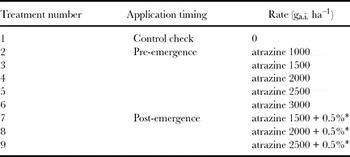
Herbicide treatments (Table 1) were applied in pre-emergence (13 December) and in post-emergence (4 January). During the post-emergence, application sorghum plants were at the stage BBCH 13-14, while red rice and barnyardgrass were at BBCH 12-13 and BBCH 13-14, respectively. The application was carried out with a backpack sprayer pressurised by CO2 at 1.7 bar, equipped with four nozzles DG Teejet 110.015 spaced in 0.5 m, delivering 125 l ha−1. By the time of the applications, relative air humidity was 85 and 80%, temperature around 20 and 22 °C, wind speed was between 3 and 7 km h−1 and the sky was partially cloudy (30% and 40%) for the pre- and post-emergence applications, respectively. Mechanical weed control methods consisted of three hoeing at the inter-rows: at 15 days after crop emergence (DAE) with sorghum at the 3-leaf stage (treatment 10); at 15 DAE and 36 DAE (3–4 and 4–5 leaf stage, respectively; treatment 11); at 15, 36 and 50 DAE (treatment 12) when sorghum plants were at the 3–4 leaves, 4–5 leaves and 6- to 8- leaf stages, respectively. The evaluated parameters were control of red rice (Oryza sativa – ORYSA) and barnyardgrass (Echinochloa crus-galli – ECHCG) at 15, 30 and 95 DAE, plant population at the harvest and grain yield.
Chemical treatments compared in the study, application timing and rate.

* v/v of mineral oil.
The evaluations of weed control were based on a visual scale ranging from 0 (no effect) to 100 (complete weed control). Results were subjected to analysis of homogeneity (Levene Test), fitting to the normal distribution, and subsequently analysed with Anova, using the statistical software SPSS (version 16). Groups of homogeneity were detected with Tukey-B post-hoc test. Data coming from the herbicide treatments were subjected to regression analysis using R software (drc package) (Cedergreen et al., Reference Cedergreen, Ritz and Streibig2005; Ritz and Streibig, Reference Ritz and Streibig2005). A logistic three parameters model was adopted for the regression analysis:
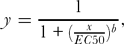
where y is the value (% control), b is the slope of the curve, EC50 is the herbicide rate at the point of inflection halfway between the upper and the lower (equal to 0) asymptotes and x is the herbicide rate. With the curves obtained, GR50, GR80 and GR90 values were calculated for each combination of weed and application timing. These values represent the herbicide rate required to obtain a weed control of 50, 80 and 90%, respectively.
Soil tillage (experiment 2)
The experiment was carried out in the cropping seasons 2006/2007 and 2007/2008 in fields located in the same experimental station, in a similar soil to that used in experiment 1, cropped with rice in the previous year. The results coming from experiment 1 (weed control methods) informed the design of this investigation, as the number of post-emergence applications of atrazine was reduced due to low control efficacy recorded in experiment 1.
This experiment was designed following a 3 × 6 factorial design in split-plots, in which the first factor (main plot) was the soil tillage (conventional tillage, minimum-tillage, sod seeding), and the second factor (allocated at the sub-plots) was represented by four rates of atrazine in pre-emergence (1500, 2000, 2500 and 3000 ga.i. ha−1), plus a check with no herbicide (no weed control) and a post-emergence treatment (2000 ga.i. ha−1 of atrazine). At the conventional tillage, soil was mouldboard ploughed 60 days before sorghum seeding, followed by disc harrowing one day before seeding. In the minimum-tillage, soil was cultivated with a disc harrow 60 days before seeding to remove crop residues and to stimulate weeds emergence. Seven days before seeding, emerged weeds were controlled with glyphosate (1800 ga.i. ha−1). Sod seeding was carried out directly on rice crop residues, seven days after glyphosate treatment (1800 ga.i. ha−1). Fertilisation, variety and seeding density were the same used in experiment 1. Experimental plots measured 3 × 5 m (15 m2), being composed by five crop rows. The single plot represented the experimental unit with four replicates.
Pre-emergence treatments were carried out one day after seeding; the post-emergence application was performed with sorghum plants at the stage BBCH 13-14, while red rice and barnyardgrass were at BBCH 12-13 and BBCH 13-14, respectively. Herbicide applications were carried out with the same equipment reported in experiment 1, at the same flow rate.
Assessments of the effects on O. sativa and E. crus-galli presence were based on a visual scale ranging from 0 (no effect) to 100 (complete weed control) at 45 days after post-emergence application. For both experiments, determination of sorghum grain yield was carried out in an area of 8 m2 (2 × 4 m) per plot. Results were subjected to analysis of homogeneity (Levene Test), fitting to the normal distribution, and subsequently analysed with multivariate analysis, using SPSS software (version 16). The effects considered in the multivariate were ‘year’ (2006/2007 and 2007/2008), ‘species’ (O. sativa and E. crus-galli), herbicide treatments, soil tillage as well as the main interactions. For significant variables, groups of homogeneity were detected with Tukey-B post-hoc test.
RESULTS
Weed control methods (experiment 1)
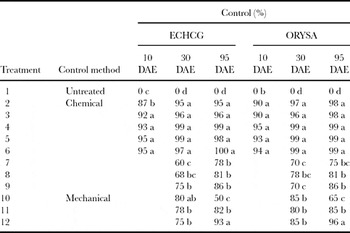
Treatments compared in the study showed significant effect on the control of E. crus-galli and O. sativa during sorghum cultivation in Brazilian lowland areas. Among chemical treatments, the highest effect was obtained with atrazine applied in pre-emergence of the crop and the weeds, at rates starting from 1500 ga.i. ha−1 on both weed species (Table 2). The adoption of higher rates did not significantly increase herbicidal efficacy. Even if significantly different from the control, the application of atrazine in post-emergence showed to be less effective than the pre-emergence treatment. As for example, a difference of about 40% of control was recorded in the application of 1500 ga.i. ha−1 in post- (treatment 7) in comparison with the pre-emergence application (treatment 3). At the moment of the last survey (95 DAE), no differences were recorded among the pre-emergence treatments. Similarly, the same level of efficacy was assessed among the post-emergence application.
Effect of treatments expressed as percent of control on E. crus-galli and rice plants at 10, 30 and 95 days after emergence (DAE).

Within each species and assessment time, letters refer to comparison between treatments. Means sharing the same letter are not significantly different (Tukey-B test; p ≤ 0.05).
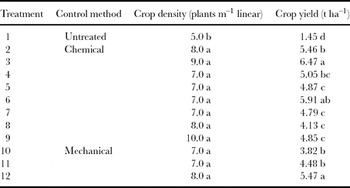
The mechanical weed control demonstrated to significantly reduce weed presence, even if with a level of efficacy lower than that recorded with the herbicide treatments. Only treatment 12 (hoeing at 15, 36 and 50 DAE) attained control efficacy similar to the application of atrazine in pre-emergence. It is interesting to note that this control method resulted in weed control levels higher than the post-emergence application of atrazine. Besides the overall efficacy level, the main difference between chemical and mechanical control is the higher preservation of the efficacy during the cropping season obtained with the chemical intervention. The effect of weed control method adopted on crop density was less important than that caused by the weeds in the untreated check (Table 3). No difference was found on crop density among the control treatments. The lowest grain yield was recorded in the control treatment, with 1.45 t ha−1, while the highest production was obtained with the pre-emergence application of atrazine, treatment 3 (1500 ga.i. ha−1) in particular (6.47 t ha−1). The adoption of two or three mechanical interventions resulted in sorghum yield higher than the chemical post-emergence applications. As expected, among the mechanical treatments, the interventions at 15, 36 and 50 DAE (treatment 12) resulted in the higher yield.
Effect of treatments on sorghum density (assessed at 95 days after emergence) and yield.
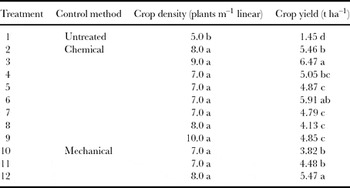
Within each column, letters refer to comparison between treatments. Means sharing the same letter are not significantly different (Tukey-B test; p ≤ 0.05).
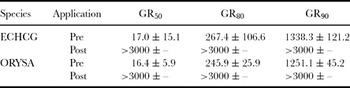
The calculation of the GR values on the fitted curves permitted to highlight the lower efficacy of post-emergence applications of atrazine in comparison with the pre-emergence one (Table 4). On average, a lower rate is required to control O. sativa seedlings in comparison with the amount necessary for the control of barnyardgrass.
Rate of atrazine (ga.i. ha−1) required to obtain herbicidal efficacy of 50% (GR50), 80% (GR80) and 90% (GR90) calculated on the fitted curves.

Values ± Standard error.
The herbicide atrazine was efficient in controlling both grass weeds, with few differences between rates. The main effect was due to the application timing, as higher efficacy was always recorded with application in pre-emergence. In accordance with Burnside et al. (Reference Burnside, Wicks and Fenster1964), the control of E. crus-galli and O. sativa is not adequate if the atrazine needs to be applied in post-emergence. On average, in this condition, the adoption of the mechanical method supplied better weed control and higher yields.
Soil tillage effect (experiment 2)
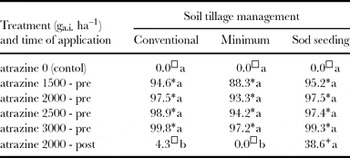
Multivariate analysis showed the absence of significance due to the factor year in both weed presence and crop yield, and the data coming from the two growing seasons were subsequently pool-analysed. In the case of weeds presence, no significant response was also found among the assessed weed species O. sativa and E. crus-galli. Pre-emergence applications demonstrated to reduce weed infestation in comparison with the control treatment under all soil tillage systems, while lower effect was recorded when atrazine was applied in post-emergence (Table 5). Less important differences were found among soil tillage systems, as the overall weed control was about 90%.
Effects of herbicide and soil cultivation expressed as percent of weed control (E. crus-galli and O. sativa).

Letters refer to comparison among soil tillage; symbols (▫, * and +) among herbicide treatments. Means sharing the same letter or symbol are not significantly different (Tukey-B test; p ≤ 0.05).
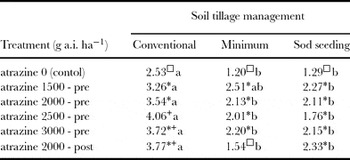
As expected, the highest grain yield was recorded in conventional tillage, as even in the control plots the production was two times that recorded with minimum-tillage and sod seeding (Table 6). The increasing application rates resulted in a greater yield only in the case of conventional tillage, attaining almost 4 t ha−1 with 2500 and 3000 ga.i. ha−1 of atrazine. In the other soil tillage systems, the yield level remained constant at growing application rates ranging from 1.5 to 2.5 t ha−1.
Effect of herbicide and soil cultivation on sorghum yield (t ha−1).

Letters refer to comparison among soil tillage, symbols (▫, * and +) among herbicide treatments. Means sharing the same letter or symbol are not significantly different (Tukey-B test; p ≤ 0.05).
DISCUSSION
Based on the results obtained from both weed control methods (mechanical and chemical), management of the troublesome weeds E. crus-galli and O. sativa for rice cultivation can be profitably attained with the cultivation of sorghum in rotation with rice. The strategy tested permitted to reduce the seed bank of these species, O. sativa in particular as against this species preventive methods still play an important role (Liebman and Dyck, Reference Liebman and Dyck1993). During sorghum cultivation, a sufficient weed control is obtained with a single application of the reduced atrazine rate of 1500 ga.i. ha−1, without affecting the yielding results. This strategy is applicable in conventional tillage, as well as with minimum-tillage and sod seeding, enabling to obtain sufficient weed control without affecting crop production. The highest productive performance was confirmed to be obtained with the conventional tillage, rather than the options that imply a reduction in soil cultivation input. Even in the case of minimum-tillage and sod seeding, the activity of atrazine applied in post-emergence is more variable and generally less effective. If for several reasons such as environmental conditions or restrictions to the use of chemicals, the pre-emergence treatment can not be carried out, resulted convenient the use of hoeing at least two times during the season. Andres et al. (Reference Andres, Concenço, Schwanke, Theisen and Melo2009) suggest that weed control in the sorghum crop should be conducted between the emission of the third and the seventh leaves of the crop. The results obtained in the specific experimental conditions can be profitably extended to other humid lowland regions of the world, in which red rice represents an important weed in rice cultivation, such as in Ethiopia (Mulatu and Belete, Reference Mulatu and Belete2001), Uganda (Doggett and Jowett, Reference Doggett and Jowett1966) or other states of central Africa and America (Craufurd et al., Reference Craufurd, Mahalakshmi, Bidinger, Mukuru, Chantereau, Omanga, Qi, Roberts, Ellis, Summerfield and Hammer1999), or even European lowlands.
Acknowledgements
This research was partially funded and administered by the Embrapa Temperate Agriculture, through project Technologies for diversification of lowland use (04.07.06.010).