I. SPECULATION AND STABILITY
This article examines the interplay between the research agenda of the Grain Futures Administration (GFA)—the predecessor to today’s US Commodity Futures Trading Commission (CFTC)—and Holbrook Working. In retrospect Working is clearly one of the most prominent academic analysts of futures markets, and it is remarkable that he was alternately a close collaborator with the GFA’s research on speculation and the most trenchant critic of its regulatory agenda and economic analysis.
In contrast Paul Mehl is unknown. Although covered in obscurity, he played a critical role in producing the GFA’s analysis of the price impact of large traders and in formulating their policy prescriptions. The GFA view of futures trading was initially presented in a variety of GFA documents with only corporate authorship or signed by Joseph W. T. Duvel, the chief of the GFA, and George W. Hoffman, a consulting economist who held the first chair of insurance at the Wharton school. But Paul Mehl easily dominates the archival record of the GFA’s analytical studies, and he eventually became the senior figure within the Chicago office, once Duvel and his successor moved to Washington. Of all the GFA staff he was most consistently and intimately involved with interpreting the data collected from the Chicago Board of Trade (CBOT). Crucially, Paul Mehl first articulated, and consistently defended, key GFA recommendations for reducing market volatility, such as placing limits on the open interest and the daily trading volume of large speculative accounts, as well as using tighter margin requirements to curb speculative pressure emerging from small accounts.Footnote 1
Despite considerable evolution and refinement in their views over time, Working and the GFA consistently held divergent views of the extent to which the prices quoted on the Chicago grain market reflected the “fundamental” forces of supply and demand. The GFA maintained that speculation and manipulation were fast-moving forces that caused the market to quickly depart from the slower moving fundamentals. The daily volatility of wheat prices simply stunned them when they first began observing the market, and most of Paul Mehl’s work was devoted to seeking to ascertain which types of traders and trading gave rise to that undesirable volatility. The GFA assumed, but also sought to demonstrate, that manipulative and/or speculative trading activity had a large influence on grain prices (both futures and cash prices) and that it moved independently of agricultural fundamentals. This assumption was reflected in the nature of the data they collected, as well as their analyses of it.
It is important to appreciate that Holbrook Working’s research was intimately connected with the GFA’s data and results.Footnote 2 He developed an analysis of agricultural futures prices in the early 1930s that was subsequently dubbed the “Working curve.” Working claimed to have developed his “curve” in response to requests for a statistical measure of speculative and manipulative price pressure from GFA Chief Duvel. Working felt that his curve provided exactly that. But its main message was that most price fluctuations reflected changes in the marginal cost of grain storage, and served a useful economic purpose. This analysis formed the basis of his hitherto unknown effort to dissuade the Secretary of Agriculture from following the GFA’s vision of how to curb speculation. Prices were volatile because the marginal cost of storage was quite sensitive to variations in supply relative to demand.Footnote 3 Working carefully managed to maintain an amicable relationship with Duvel despite this intervention, and he was asked to consult with the GFA staff when difficulties arose in analyzing small trading accounts. At some point he became aware that one of the researchers, Harold Speer Irwin, had found that hedging was far more important, and speculation less important, than what the GFA had been thinking. This contributed several aspects to Working’s emerging view of the grain market as “reliably anticipatory.” Working formulated a “multi-hedging” perspective in which prices reflected the different hedging needs, strategies, and storage capacities of growers, dealers, and processors. In Working’s view these actors sought to transform rather than simply eliminate risk, so their hedging had important speculative aspects. In 1962 Working finally labeled his conception of the futures market “reliably anticipatory,” and it was an important, but nuanced, contribution to what would emerge as the efficient market hypothesis. Well-informed traders, including some skillful speculators, incorporated news into futures prices within a few days, making futures prices look much like the numerically generated random walk data he had published back in 1934. The volatility of these prices served an important function, as it reflected the interplay of hedging needs and marginal storage costs. Working briefly widened the scope of his criticism in 1953 by pointing to price supports as another mistaken effort to reduce price volatility.
II. THE EARLY GFA RESEARCH PROGRAM
During the 1920s addressing problems in the agricultural sector was high on the agenda of federal economic policy. A series of legislative debates foreshadowed the far-reaching expansion of government that followed in the 1930s. The “roaring twenties” bypassed agriculture generally and Midwestern wheat farmers particularly. Farm prices and incomes fell precipitously with the end of the war, and weak world demand together with a relentless mechanization of US wheat production generated a stream of proposed agricultural legislation. Two hundred and fifty-three bills were introduced to regulate or prohibit futures trading between the 61st and 73rd Congresses, which spanned 1907 to 1935. No Congress of the 1920s saw less than a dozen such bills (Romano Reference Romano1997, p. 390).
The GFA was only one expression of the Department of Agriculture’s (USDA) expansion during the first three decades of the century. The USDA was a clear exception to the general pattern of government retrenchment right after the Great War, and it remained among the fastest growing departments in the 1920s (Holcombe Reference Holcombe1996; Carpenter Reference Carpenter2001, p. 290). As part of this growth, the GFA was created by the Grain Futures Act of 1922, which stated thatFootnote 4
the transactions and prices of grain on such boards of trade are susceptible to speculation, manipulation, and control, and sudden or unreasonable fluctuations in the prices thereof frequently occur as a result of such speculation, manipulation, or control, which are detrimental to the producer or the consumer … and render regulation imperative for the protection of such commerce and the national public interest therein.
Given this charge, Duvel’s choice as GFA chief may seem puzzling today. His background lay in botany, with publications such as the Vitality and Germination of Seeds (Duvel Reference Duvel1904), and he received recognition for his patent on equipment for determining the moisture content of grain.Footnote 5 But Duvel’s background was a clear expression of the USDA’s scientific expertise, which at that time lay in biology and chemistry (Carpenter Reference Carpenter2001, ch. 7). The GFA commenced operations at nearly the same time as the USDA formed its Bureau of Agricultural Economics (BAE) and its prestigious Graduate School. So the USDA’s prominence in economic and statistical research was still a few years off (Rutherford Reference Rutherford2011).Footnote 6 Duvel’s occasional suggestion that a statistical method used by seed scientists might be helpful did not ever seem to bear fruit, and he was quite reliant upon Paul Mehl and the other economists on his staff. Duvel usually chose G. W. Hoffman as co-author for the agency’s important studies. Hoffman consulted for the GFA each summer as his full-time job was professor of Insurance and Marketing at the Wharton School.
Starting on July 9, 1923, the Chicago Office of the GFA collected daily reports from the clearing members of the Board of Trade, detailing the open positions of the clearing members and their largest individual accounts. This data figured prominently in the GFA’s reports to Congress. Writing to his direct superior in Washington, Duvel expressed alarm at the large daily price movements his staff had begun recording:
During the last few days we have been checking up on the average daily range in prices for some of the options [sic]. As I have always contended, a large percentage of the manipulation is a daily manipulation and it is the daily manipulations, of I will say fluctuations in prices,—that are responsible for much of the dissatisfaction throughout the country. It is possible that you have already brought together some of these figures. I confess that to me they were amazing.Footnote 7
The early reports initially emphasized the elimination of corners, but they quickly changed priorities to focus attention on excess speculation. The GFA clearly understood that matters such as subsidies and/or production limitations lay well outside its area of expertise, and it was careful not to overstep these bounds in its studies and reports.Footnote 8
Paul Mehl began work at the Chicago office of the GFA in 1924. The GFA was quickly spurred into publishing a report on the workings of the grain market by a Senate Resolution of 1924, which asserted that the market had recently been “depressed by professional speculators.” It required the Department of Agriculture to “determine through the Grain Futures Administration the position on the market taken by the well-known professional speculators” and to “promptly publish the findings without opinions by the investigators as to the effect which the trading by said professional may have had.”Footnote 9 Opinion is certainly minimized in the responding GFA report. Statistical analyses of speculative positions and price changes are presented without editorializing. The key table invites the reader to look for a relationship between the “net sold” of the speculative traders and the average daily closing price of the dominant wheat futures contract during the week. Nothing is said about the cash grain markets or “fundamentals” such as crop sizes or developments in the international market for grains (Grain Futures Administration 1924).
Large price fluctuations in the following years (1924 to 1926) prompted a wave of GFA reports. Three GFA analyses refer to each other and tell a similar story.Footnote 10 The letter of submittal of the first publication raised two issues. First, while the GFA had begun by collecting information on accounts with open interest of half a million bushels (or larger), it found reason to believe that some traders had begun splitting their activity into several accounts so as to evade the GFA’s attention.Footnote 11 Second, and ultimately of greater importance, the speculative activities of a large number of small, ill-informed, and easily misled speculative accounts held by the “public” became as much of a concern as was speculation by a few large traders.Footnote 12 Violent price movements were attributed to the interaction of a small number of large speculative traders and the ill-considered speculation of a large number of small speculative traders who were unable to meet their margin calls. Joseph Mehl, the GFA’s lawyer, wrote to Chief Duvel in 1927 regarding the Chicago research group’s interpretation of the middle of these three publications.
There is one suggestion, first proposed by Mr. Paul Mehl, with which all here seemed to be more or less in agreement. Throughout the bulletin the fact stands out boldly that whenever a certain group of speculators buy or sell the market shows a decided tendency to move in the same direction. Nowhere it seems have we suggested that this buying and selling may be a natural and legitimate course in view of the existing crop and market news. It is not openly stated that these operations are deliberately manipulative and in disregard of supply and demand conditions. We think, however, that such an inference might be drawn. The main point is that the cure is not one solely of driving the vicious and willful manipulators out of the market but that speculative lines, when they exceed certain limits, become a dangerous hazard in any market, whether held with honest and well meaning intentions or for manipulative purposes.Footnote 13
So although the GFA was unwilling to explicitly declare that trading was unrelated to fundamental market news, it fully expected its readers to draw that conclusion from its publications.
III. PAUL MEHL STEPS OUT OF THE SHADOWS
Paul Mehl authored only two journal articles: both concern grain futures and appeared in the Journal of Farm Economics (JFE). But these need to be read against the steady stream of memos and studies he produced for the GFA. His first JFE article (1934) takes up exactly where the third GFA study on the 1924 to 1926 price experience left off. According to Mehl, orders move price because “[a]lthough for every purchase of futures there is a corresponding sale, price changes occur because of the difference in the aggressiveness of buyers and sellers” (Mehl Reference Mehl1934, p. 482). Preceding GFA reports presented correlations between orders and price movements; Mehl presents the relationship in the form of regressions. He examines the relationship between the daily volume of trading and the range of prices visited during the day.
It is not necessary to know why trading takes place in order to show its effect on prices. By correlating the daily volume of trading figures in Chicago wheat futures, as released daily by the Grain Futures Administration, with the daily range in the price of the dominant wheat future at Chicago, one will find that, on the average, the greater the volume of trading in wheat futures the wider is the daily range in the price of the dominant future. Such a correlation was made covering 2,704 trading days during the years 1922–1931, excluding the year 1925. The correlation co-efficient obtained was +.80. The regression equation for the line of least squares was Y = .2756 + .047X and the standard error of estimate was Syx = .669. (Mehl Reference Mehl1934, p. 482)
Mehl asserts that “excessive trading due to speculation that is not engendered by changes in fundamental conditions such as changes in crop conditions, results in wider daily price swings and contributes to needless instability” (Mehl Reference Mehl1934, p. 483). He attempts to give some content to the phrase “excessive speculation” by examining the relationship between the volume of futures contracts and the world supply of wheat. He finds that greater supplies of wheat actually corresponded with smaller volumes of futures trading. Mehl seems to assume that smaller grain volumes should lead to less need for hedging, so a negative correlation between trading and wheat supplies appeared to be a clear indication of “needless” speculation. This finding introduces the prominent role that speculators play in the market.Footnote 14 While “the net effect that the trading of any group of individuals or single persons has on price cannot always be determined with mathematical precision,” the main point remains that changes in speculative positions, and the concomitant increases in trading volume, drive short-term price fluctuations. Indeed, he goes so far as to say, by way of conclusion, “It is not necessary to know what induced the selling or buying of futures to show its effect on price.” Reducing the size, hence the influence, of speculative trading will allow the slower moving forces of supply and demand for grain to determine futures prices. This will be done “[b]y placing a limitation on the size of holdings of a speculator and thereby limiting the amount of trading that he may do on a single day” (Mehl Reference Mehl1934, pp. 494, 495).
Mehl’s case for a limit on trading is made at greater length by an internal document dated April 20, 1932: “Suggested Method for Controlling Large Speculative Lines in Chicago Wheat Futures.” This document starts with an observation: the speculative limit of two million bushels contained in the failed Capper–Haugen bill of 1925 was never enacted, yet “producers” (presumably farmers) want even tighter limits. Mehl reprises a key finding of the three GFA publications mentioned above, concluding that “there is a correlation of +0.70 or better between the daily net changes in the closing price of Chicago wheat futures and net trades of 2,000,000 bushels or more in all wheat futures of the large speculators” (Mehl Reference Mehl1932, p. 5). The merits and demerits of different rules on position size are considered. But his fundamental point is that no rule on position size will address the problem that changes in positions drive price changes. Hence the rule on overall position size is abandoned in favor of (asymmetric) limitations on changes in positions: “the restriction should provide that no one can have combined net sales in all wheat futures for speculative purposes exceeding 500,000 bushels on any one day” (Mehl Reference Mehl1932, p. 23).
Mehl’s second paper in the Journal of Farm Economics (1940) is usefully considered alongside his 1938 memorandum, “Controlling Speculative Activity by Limiting the Size of Lines and Trading.” Both continue the tradition of searching for connections between trading by different types of traders and price movements. Despite his writing well after the Working curve had been published (and sent to the GFA), there is no mention of Working’s recent work. Indeed, the only references are to the series of forbearer GFA publications. Mehl draws his data from a new reporting requirement imposed by the Commodity Exchange Administration (CEA). (The GFA became the CEA in 1936.) Effective August 2, 1937, “every person” who held or controlled open contracts of 200,000 bushels or more was required to report their trading activity directly to the CEA (Mehl Reference Mehl1940). Now the CEA could look through the clearing houses and multiple accounts to see each trader’s underlying position.Footnote 15 Consequently, Mehl’s second JFE paper is able to consider five types of reporting traders: Speculators, Hedgers, Round lot-job lot spreader, Other spreaders, and Non-reporting traders (about whom little was known). His tables report the correlation coefficients between the trading activities of the different trader types. The net purchases of the large speculators are not strongly correlated with those of the large hedgers, and in Mehl’s view this means that the large speculators are not providing the “essential economic function” expected of them.Footnote 16 Rather, it is the small traders who provide the ability to hedge: “The prominent part that the small traders play in carrying hedges is shown by the rather high relationship between the daily net trades of this class and those of the reporting hedgers in Chicago wheat futures during the two periods covered by this study” (Mehl Reference Mehl1940, p. 605).
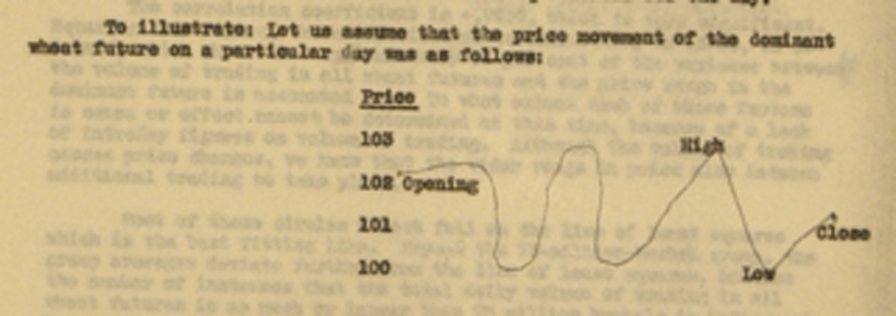
Mehl next looks for a relationship between price movements and the gross and net trading (change in open commitments) of particular types of traders. His measure of price movement is unusual; it is the sum of the 1/8-cent price movements in a day. He calls this the “total number of fluctuations.”Footnote 17 It is the amount of price movement over the day, not the change in price between the open and close. The GFA archive shows that Mehl devoted considerable time to the analysis of the relationship between the daily “aggregate of the minor intraday fluctuations in price” and the volume of trading during the day in the early 1930s (Mehl Reference Mehl1940, p. 607). He illustrated the “aggregate fluctuations” during a day of trading in an internal memo of August 1933.
Paul Mehl’s Aggregate Fluctuations (Mehl Reference Mehl1933, Memo on Chart GF591).
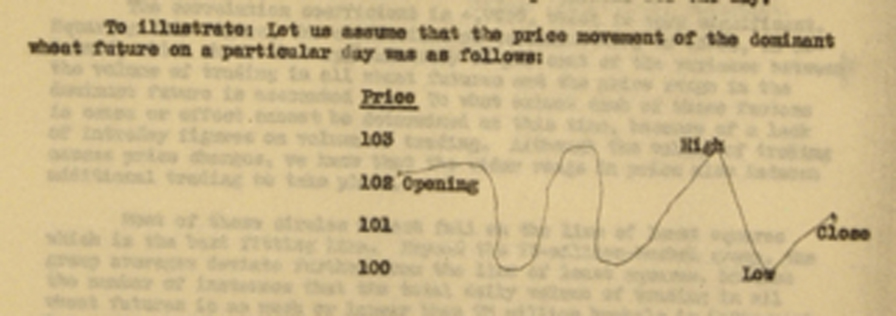
Mehl suggests thinking of the price line as a string and the number of fluctuations as being “the length of that price curve in terms of cents, if it were possible to take hold of it at both ends and pull it straight.”Footnote 18 Mehl’s internal memo emphasizes the fact that the correlation coefficient between trading volume and his “aggregate fluctuations” is larger than that between the daily price range, as normally defined, and trading volume. Consequently, the second JFE paper (1940) reports the relationship between this measure of daily price movement and daily trading volume.Footnote 19 Despite protestations that correlation does not show causality, Mehl is keen to parcel out price movement to the different classes of traders. To that end he presents a table of r-beta coefficients in which each element is the multiple regression beta multiplied by the r (the correlation of a particular trading group’s daily volume with daily price “fluctuations”).Footnote 20 Mehl’s advocacy of limits on the daily net trades as well as limits on the total open commitment of speculative traders is supported by his finding (in the bottom part of Table 3 in the JFE paper) that the net trades of the speculative traders are most strongly correlated with (the absolute value of the daily) open-to-close price movement. But when it comes to total trading, it is the non-reporting traders who are most strongly correlated with price “fluctuations” and price movements. This required a very different approach, since none of these small traders would be affected by either of these constraints. In response Mehl recommended increasing the margin requirements on futures. This is set out clearly in his unpublished 1938 memo, which lists five different ways of controlling speculative activity:Footnote 21 Margin Requirements,Footnote 22 Limits on Daily Price Fluctuations, Permit Delivery after Trading in the Current Future has Ceased, Direct Action by Business Conduct Committee of the Exchange, and Limitation on Speculative Lines and Trades. Margins are regarded as important for limiting the speculative excess of small traders, but could also be of assistance in controlling large lines if they are implemented “on a progressive basis” so that larger positions require larger margins. No analysis is made of the information on underlying fundamentals driving the supply and demand for grain. Indeed, the cash price of grain is not mentioned.
IV. HOLBROOK WORKING: THE ANTICIPATORY MARKET VIEW CONTRA THE GFA
Holbrook Working was one of the most prominent American agricultural economists of the 1930s.Footnote 23 Nearly the entirety of his large corpus of work is in some way relevant to speculation in commodity markets, but only two intertwined strands will be examined here. First, there is his analysis of the interconnections between futures prices and the supply-and-demand conditions expected to prevail in the cash market during the delivery month. A key concept here was “carrying cost”: this is the difference at a given time between prices of a commodity for two different dates of delivery, and intuitively it should reflect the cost of storing grain (“carrying it”) over time. Intuitively it costs something to store grain over time, but it was in the course of this work that Working noticed and explained “inverse” carrying costs: some processers of grain (or bakers) might want to have a large inventory of grain on hand. They derive a convenience yield from their inventory of grain, and if enough of them are active in the market, the carrying charge may become inverted. Moreover Working developed his insight that marginal carrying costs could change dramatically in response to sudden changes in the volume of grain to be carried across delivery months. This is now called the “Working curve.” The second strand of Working’s research that concerns us is his “random difference” time series. He suggested testing particular time series (such as the price of wheat futures) to see if they might be the product of a series of random shocks. This line of inquiry clearly suggested that erratic movements in the price of wheat futures simply (and rationally) reflect the shocks to which the wheat market was subjected. In following these two strands, we will attend to his specific criticisms of the GFA’s methods.
Working’s earliest work predated the GFA and it demonstrates his wide-ranging commitment to improving statistical analysis in agricultural markets. An early—indeed, we believe his first—publication concerned the price of potatoes and appeared as a Technical Bulletin of the Agricultural Experiment Station at the University of Minnesota (Working 1922). He follows Warren Persons, Henry Moore, and George Yule’s use of “partial correlation.”Footnote 24 This analysis launches what becomes the leitmotif of Working’s position regarding the action of speculative inventories on prices: speculative stocks are held on the basis of forward-looking expectations. His article aims to increase the accuracy of those expectations.Footnote 25
IV. CARRYING COSTS AND THE WORKING CURVE
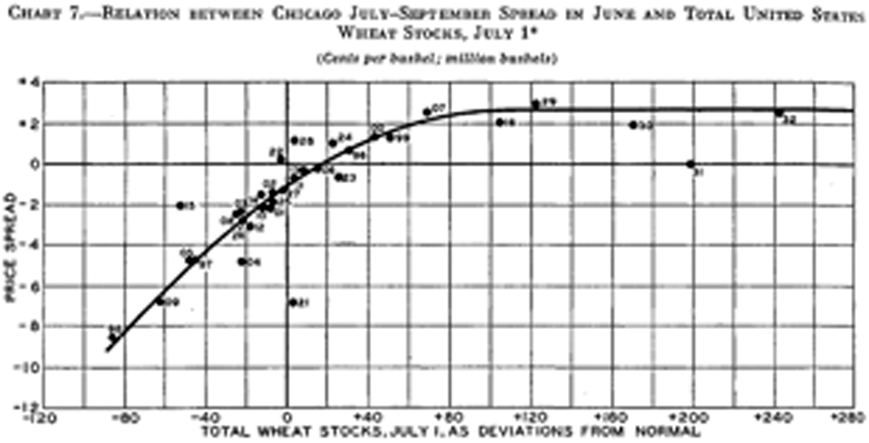
Working and other members of the Stanford Food Research Institute (SFRI) were keen consumers of GFA analyses. As early as 1926 Working wrote Duvel to compliment him on the just published GFA study “Fluctuations in Wheat Futures.” But Holbrook drew very different conclusions from its statistical results. The GFA found that none of the trading groups they studied was systematically profitable, and took that as an indication that poorly informed traders were causing excessive price fluctuations. Working informed Duvel that “these observations … support conclusions of the most fundamental and profound significance.”Footnote 26 This tantalizing statement was not further explained in the letter, but over time Working would develop a “multi-hedging” view of the market in which most trading on the futures exchange did not aim at generating profits in trading accounts—it aimed to transform risk (Working Reference Working1962, p. 440). At any rate, a steady flow of correspondence soon began between the institutions, and by 1931 Working was sending Duvel his studies on the gains and losses of speculative wheat traders for comment. By 1932 Paul Mehl was optimistically telling Duvel that it “[l]ooks like your talks with him [Joseph Davis, co-director of the SFRI] and Dr. Working are bearing fruit.”Footnote 27 It is unfortunate that we do not know more about those discussions, as Working’s most famous contribution to conceptualizing asset markets seems to have been prompted by them. While Working’s 1940s contributions to the theory of carrying costs are well known, it is important to understand that this later analysis emerged from research that, Working asserted, was a direct response to Duvel’s repeated requests for a statistical measure of the price effects of manipulation and speculation. Working’s analysis of carrying costs—more specifically, the marginal costs of storage—first appeared in the SFRI’s house journal Wheat Studies in 1933–34 (Working Reference Working1933, Reference Working1934a).Footnote 28 The first of these articles examined the price spread between neighboring futures as a function of the stocks of commercial wheat. Working produced a curve indicating that the carrying charge varied systematically with the quantity of grain to be carried into the period of the next futures contract.Footnote 29 This relationship is now known as the “Working curve” and first appeared as Chart 7 in Working (1933, p. 206).
The Working Curve (Working Reference Working1933, p.206).

A few substantial departures of this price spread from the curve had occurred in Working’s data:
Substantial disparity between the actual spread in June and that to be expected from the supply statistics has occurred in eight years since 1896. In each of these years there was a peculiar market situation—usually a corner or “squeeze” in the futures market. Existence of such a disparity gives prima facie evidence of abnormal speculative market conditions. (Working Reference Working1933, p. 185)
On the basis of this analysis, Working felt he had in hand a viable indicator of both manipulation and excessive speculation. He sent Duvel this good news together with his 1933 paper.Footnote 30 But he did not exercise much influence on the GFA’s policy position. Duvel and his staff, especially Paul Mehl, were increasingly committed to placing additional constraints on the market in order to prevent excess speculation.
In March of 1934 Working decided to appeal to a higher level. He wrote directly to Secretary of Agriculture Henry A. Wallace, urging a change in regulatory direction. He observed that his new method provided new possibilities for regulating the market. Rather than “generally repressive legislation” (presumably such as that which Paul Mehl had so comprehensively set out), what the market needed was a “qualified umpire to step in and enforce correction of abuses as they develop. The umpire might be the Grain Futures Administration directly, or the Business Conduct Committee of the appropriate exchange, acting under the watchful eye of the Grain Futures Administration.” In closing Working said that he was “confident” that Dr. Duvel would see the merits of this approach.Footnote 31 Working was careful to send a copy of the letter directly to Duvel, and his suggestion that the GFA would play an essential role as umpire within his discretionary regulatory approach successfully allowed him to maintain a highly productive relationship with the GFA.
In this effort Working proved to be less than persuasive. The Commodity Exchange Act of 1936 (which was under intense discussion during the period of Working’s 1934 intervention) expanded the GFA’s regulatory powers along precisely the lines that Paul Mehl advocated. Indeed, the reply to Working, initially drafted for the secretary’s signature but downgraded to the assistant secretary level, noted that a bill had already been submitted to Congress that had the GFA’s approval.Footnote 32 It seems to have gone unattended that the Act also makes provision for setting both open position limits and daily trading limits, both important items on Mehl’s list (sub-paragraph A of section 4a [2] United 1937, p. 22).Footnote 33 Of course the most important New Deal legislation bearing on farming was the Agricultural Adjustment Act, as it addressed downwards price instability directly by reducing output.Footnote 34 It is unfortunate that no archive appears to survive for Working or the SFRI. Only considerably later would Working (Reference Working1953) obliquely criticize price supports for reducing price volatility below its optimal level.
V. RANDOM WALKS AND WORKING’S “RELIABLY ANTICIPATORY” MARKETS
Working’s formulation of “reliably anticipatory” prices and what would become the efficient markets hypothesis was not initially connected to futures regulation and the GFA in an obvious way, but over time it became tightly connected to the GFA’s no-profit finding. Working’s random-difference time series appeared in the 1934 Journal of the American Statistical Association (JASA). As David Hendry and Mary Morgan (1997, p. 15) emphasize, Working was a very early advocate of the view that the movement of market prices (especially futures markets) appeared to be random.Footnote 35 Working exhibits an excess of modesty that may cause confusion. He asserts that the random nature of economic time series is well known. He actually credits William King’s obscure 1930 book Index Numbers Elucidated with having diffused the notion. It contained “chain and fixed-base index numbers [on the basis of which] King has concluded that stock prices resemble cumulations of purely random changes even more strongly than do commodity prices” (1934b, p. 11). But only Working seems to have picked up on this.Footnote 36 Alfred Cowles might be thought to be a precursor, but Cowles’s (1933) paper contrasted the performance of actual investment professionals with that of a list of “24 purely chance forecasting records.” It did not discuss the possibility that stock prices moved in a manner similar to a random walk, as Cowles and Herbert Jones (1937) would later do. Franck Jovanovic (Reference Jovanovic2008) rightly rejects a canonical reading in which Working becomes simply one link in the emergence of Eugene Fama’s efficient market hypothesis. While Working was powerfully struck by the fact that his random difference series looked rather like actual market data, he held back from the assertion that market movements followed a random walk. He knew that new information could find its way into the market only through trading activity, and that some traders had greater insight than others. This begins to be seen as early as December of 1936 when the GFA and SFRI exchanged views in a special session of the American Farm Economics Association.Footnote 37 Working commented on Hoffman’s paper “Futures Trading and Regulation.” Working asserted that the GFA’s correlation analysis failed to discriminate between three different possible explanations for the positive correlation they obtained between trading by large speculators and price movements.
The observed correlations accord with [1] the supposition that large traders have no advantage in knowledge or judgment over small traders; with [2] the supposition that large traders have an advantage, but only such as arises from getting pertinent information more promptly; and with [3] the supposition that large traders have a great advantage over small traders in reliability of their price judgments. (Working Reference Working1937, p. 311)
Working clearly thought that both the second and third possibilities dominated the first. He provided even more pointed comments privately regarding Hoffman’s retrospective examination of fifteen years of GFA/CEA market monitoring. Working remarked on the discussion of price determination: “This is objectionable because it carries the implication that ‘speculative initiative’ carries the price thus far away from what is recognizably the price justified, whereas in fact such departures are largely associated with uncertainly as to what level of prices is justified.”Footnote 38
And to Hoffman’s dismay it was not only Working who objected to the notion that market prices moved far away from levels justified by fundamentals. A senior economist in the USDA’s Bureau of Agricultural Economics reviewed the manuscript and objected to its assertion that “the price of wheat may vary through a range of 30% due to forces other than ‘fundamental trade factors,”’ and that “[i]n a season of unusual speculative initiative these deviations of possible prices may mount to even greater proportions.”Footnote 39 Working also provided extensive and carefully considered comments on work that would become Paul Mehl’s second JFE article, although, as we mentioned above, Mehl made no reference to these comments or to Working’s recent analyses.Footnote 40 Working even became a consultant for the CEA during 1938 and 1939, making critical contributions to a massive CEA study of the small trading accounts of a prominent CBOT broker (finally appearing as Stewart Reference Stewart1949). At some point in his interactions with the GFA, Working became aware that H. S. Irwin, an economist working directly underneath Paul Mehl in the Chicago field office, was generating results that did not readily fit into the GFA’s view of the market. Irwin, as early as 1932, had found that “spreading” traders (who would be long contracts in one month and short in another month) were very important, and needed to be better understood. According to Working Irwin had difficulty publishing his accumulating evidence to the effect that hedging rather than speculation was the dominant reason behind the formation of, and trading on, futures exchanges. Working (Reference Working1962) retrospectively credited Irwin with having providing the basis for Working’s multi-hedging view of futures market prices: prices are determined by the interaction between changing marginal storage costs and the cross-cutting hedging needs (and trading strategies) of growers, marketers, and processors, as well as consumers of grain. Irwin’s evidence also seems to have bolstered Working’s view that most hedgers sought to transform risk rather than eliminate it. Spreaders, for example, will have protected themselves against movements of all futures prices, but will be exposed to changes in (say) the July future price relative to the September future.Footnote 41 (These contracts happen to be the ones Working illustrated his curve with; so in this example the spreader is exposed to movements along the Working curve.)
Working brought all these elements together in the late 1950s and early 1960s when he discussed the nature of “anticipatory markets” (1958, 1962).Footnote 42 Working now looks back on his random difference exercise of some thirty years earlier and recalls that neither he nor anyone else knew what to make of the similarity of random differences (a random walk) to futures (and stock) price movements. In contrast to what Working calls the “perfect market” model (which bears a striking resemblance to what would emerge as the efficient market hypothesis), Working assumes that traders are human, rather than superhuman, and that they differ in knowledge and ability.Footnote 43 As a result of these limitations traders adopt an “informal” division of labor in which some attend to (and pay for) extra information on the current crop, others attempt to forecast the weather, and other groups forecast general business conditions that will affect grain prices. These are professional traders and Working supposes that all have excellent judgment. While there will always be some small ill-advised traders in the market, he is willing to assume, for the purpose of constructing a generally useful model, that they are not large enough to overstrain “the corrective power of the market” (1958, p. 193).Footnote 44 He also explicitly assumes that manipulation has been removed from the market. The link between the seemingly random walk of prices and these assumptions about traders lies in his notion that such a market delivers “reliably anticipatory” prices, which are “mainly appropriate responses to valid changes in expectations” and “represent close approximations to the best possible current appraisals of prospects for the future” (1962, p. 447). Working’s emphasis on “approximation” and realism here is important. No market was in fact “perfect,” and his assumptions (absence of manipulation and a preponderance of informed knowledgeable traders) would occasionally be violated in practice. The aim of regulation is to move the actual market closer to the perfect market benchmark. Hence he opposed the Grain Futures Administration’s tendency to support “regulations that are not helpful to the functioning of the futures market, but detrimental” (Working Reference Working1937, p. 310).
VI. CONCLUSIONS
Paul Mehl was, in our view, the central figure in the GFA’s collection and analysis of trading activity. He placed great emphasis on acquiring the most granular, short-term, trading data possible. By matching price movements with trading data, he tried to identify the role and impact of speculators and other categories of traders on the market, and did so using the most advanced correlation and multiple regression techniques available. Regulators, following this approach, continue to examine the influence of trading behavior on price at very short time frames, using the best technology available, which often utilizes big data techniques. For instance, studies by the CFTC, SEC, US Treasury, and the FRB have used micro time frame data to examine the existence of manipulation or other sorts of disruptive trading by large traders in markets such as futures on oil, stock indices, and US Treasuries. These studies encountered much the same difficulty that the GFA and CEA encountered previously in that they have been unable to identify specific manipulative or disruptive traders.Footnote 45 They have instead pressed for further coordination and resources to “strengthen monitoring and surveillance.”Footnote 46 While these micro time frame data did not help regulators identify market manipulators, the use of big data techniques has enabled nearly real-time regulatory interventions. One example would be the request for more information and use of moral suasion to prevent disruptive trading or market manipulation from occurring. This monitoring is conducted by Self-Regulatory Organizations (SROs), and only overseen by the CFTC.Footnote 47 These efforts may have prevented manipulation, without resorting to the heavy-handed reliance on tighter and tighter position limits, margins, etc. that Mehl advocated.
As far as methodology is concerned, both Mehl’s and Working’s approaches flourish to this day. Government documents continue Mehl’s tradition of examining the purchasing behavior of particularly large speculators, most recently index funds, as the possible cause of undesirable price movements.Footnote 48 For example, the staff of the Senate Permanent Subcommittee on Investigations has produced a series of reports with titles that begin with the phrase “Excess speculation in ….”Footnote 49 Their 2009 report Excessive Speculation in the Wheat Market reprises the early GFA statistical studies of trading and price movements at some length in the section “Basic Futures Market Theory: Impact of Speculation on Price” (Senate 2009). Unlike the early GFA reports, which did not include the cash market for analysis and generally eschewed references to the academic literature, this report is full of references to Holbrook Working’s writings and to those of his successors such as Anne E. Peck of the SFRI, and Thomas A. Hieronymus, and Scott H. Irwin of the University of Illinois, all of whom have expressed strong reservations against expanded regulation of commodities markets.
Rather than focusing on micro time frames, Working emphasized longer term data that could identify the presence or absence of an equilibrium relationship, such as the spreads between two futures contracts or between futures and cash grain. Using his groundbreaking Working curve, he believed that extreme price aberrations caused by manipulation such as squeezes and corners could be detected. While recognizing the occasional and increasingly less frequent existence of price aberrations caused by manipulation or excessive speculation, he attributed smaller departures from randomness to the markets’ price adjustment mechanism. As we have seen above, Working developed his notion of “perfect” markets in dialogue with the GFA and in response to its “no profits” results. Contra Fama, who subsequently developed the idea of efficient markets, Working emphasized the role of order flow in incorporating information into prices. Because some traders such as large speculators may have superior information on supply-and-demand conditions in a market, price will move as new information becomes available. Academic agricultural and natural resources economists reiterate many of Working’s positions. Academic researchers typically find that markets are reasonably efficient and only rarely find instances in which futures markets exhibit bubble-like departures from equilibrium (for example, Knittel and Pindyck Reference Knittel and Pindyck2016; Etienne, Irwin, and Garcia Reference Etienne, Irwin and Garcia2015). This academic tradition of Working’s has been adopted and followed by Tom Hieronymus, Roger Grey, Bill Tomek, Anne Peck, Craig Pirrong, Scott Irwin, and others. These researchers continue to emphasize Working’s point that greater regulation does not necessarily cause markets to become more perfect, and it may cause them to depart further from that benchmark.Footnote 50
Since the 1930s regulation has moved away from the high-water mark of control of speculation via federally controlled margins and other constraints, back towards greater discretionary interventions by exchanges and regulators. Working’s support for a selective and discretionary approach was emphatic, and that support should be recognized. He is widely cited for his methodological innovations. But as far as his policy recommendations are concerned, attention focuses on his defense of futures markets in commodities such as onions, cured pork, durum wheat, and eggs. Legislation abolishing these futures was intended to stabilize prices in the cash market (Senate 2009, p. 52). An important concern expressed in this legislation and recent Senate documents on futures markets has been the failure of futures prices to “converge” with cash prices in the terminal month of the contract. This is not an issue that the early GFA probed, since they paid so little attention to the cash market, but it is important as it undermines the usefulness of the futures contract for hedging purposes by farmers and merchants. Here, Holbrook Working can be regarded as having had some influence in shifting attention from price movements to price spreads. Yet the central regulatory question and response are exactly as they were before. The question is whether large speculators (most recently index funds) drive futures prices away from fundamentals.Footnote 51 This was precisely the question asked regarding speculative traders in the 1930s. And the regulatory responses contemplated have been similar: Who should be allowed to hold large “open” positions, should there be caps on those positions, and should margins be increased to reduce “excess speculation”?Footnote 52 It seems that the methodological approaches pioneered by Mehl and Working continue to be embraced and developed by parties that hold differing presumptions of the existence of speculative behavior.
Appendix: Biographical Notes on Paul Mehl
Paul Mehl was born Gustav Paul Mehl in Chicago on November 13, 1889, to parents who had emigrated from Germany. His early education is a mystery, but a Short Biography of Rural Leaders that was published in 1925 was quite interested in whether its leaders were farm-raised. Paul is recorded as having been “reared in a town.” It is unclear when Paul left Chicago, but the biography has him as “buyer of produce for M. D. Dobson, Boise, Ida., in 1910–1.”
By 1911 Paul was studying at the Oregon Agricultural College (OAC) in Corvallis, where he graduated in 1915. The first textual evidence from his undergraduate years is the short article he contributed to the 1913 edition of The Oregon Countryman, a publication closely associated with the OAC, “Corn Growing in the Irrigated Sections.” He already appears on a national list of agents assisting at the state level in “marketing investigations and demonstrations” efforts to organize agricultural marketing cooperatives in 1913. The Oregon Countryman reports him as having moved to the University of Wisconsin to undertake graduate studies in 1915. The AER of 1919 lists Mehl in the Dissertations Completed, with his title being “National agricultural policies: what a nation produces.” This would put him three years ahead of Holbrook Working, since Working filed his Wisconsin thesis, The Effect of Price Changes Upon Production and Consumption of Wheat, in 1921. According to the Rural Leaders Mehl found time to work in the export department of Western Electric Co., in Hawthorne, IL, in 1916.Footnote 1 He appears to have returned directly to his undergraduate alma mater as he now appears as an “Agent in Marketing” at the OAC in his second publication in The Oregon Countryman. This is actually his first foray into the subject that would come to dominate his work: the “Evolution of the Present System of Organized Speculation,” which appeared in December of 1919. Much of the short contribution is concerned with the historical evolution of grain markets, which Mehl traces from the fall of Rome to the establishment of the Chicago Board of Trade. The introductory section is of greatest interest to us. Mehl (1919, p. 13) begins by considering distinctions between gambling and legitimate trade.
To the writer the distinction between the speculator and the gambler as stated by Hadley seems to be the better basis for judging men as to what class they belong. It is the intent or purpose of men’s dealings that puts them in the class of ordinary tradesmen or among the speculators and gamblers. The ordinary trader’s purpose is to reap the customary margin of profits when making deals while the speculator desires to make an extra profit due to the fluctuation in the price of the commodities.
Mehl would continue to see a clear distinction between speculation and ordinary trade—or hedging—and base his research upon it, after most of his contemporaries came to question the division. How widely his marketing efforts ranged is hard to know but the Reclamation Record for July of 1921 (p. 306) reports his visiting Boise, Idaho, where he encouraged locals to join the poultry marketing cooperative of Oregon and Washington. After two years on staff at the OAC, Mehl took up similar duties as an Extension Agent in Marketing at the University of Connecticut at Storrs, starting in October 1921. One aspect of his work entailed a “Survey of the costs of operating grain and feed stores in Connecticut.” A copy of his general report on the first phase of this project was to be included in the Flour and Feed magazine of March 1922.
Sometime in 1924 Mehl moved to the Grain Futures Administration in Chicago, where he appears to have worked for the remainder of his career.Footnote 2 He published his last visible work in 1958. A search of death records suggests that he died on March 1, 1981, at the age of ninety-one in Glendale, California, in Los Angeles County.