Introduction
The type of animal feed used in toxicological research has recently been identified as an issue of concern.Reference Heindel and vom Saal1 Much of the focus has been the estrogenic activity associated with the use of soy in commercial animal feeds, since the estrogenic activity in these feeds can vary dramatically while protein content remains constant. For example, studies have documented the variability in the concentrations of two soy phytoestrogens, genistein and daidzein, in commonly used commercial animal feeds, since the concentration of phytoestrogens per gram of protein in soy is regulated by environmental factors.Reference Barnard, Lewis, Teter and Thigpen2, Reference Thigpen, Setchell and Padilla-Banks3 The importance of phytoestrogen content of the feed was shown in a study in which variability in the background level of phytoestrogens in batches of a soy-based feed produced in Harlan Teklad was shown to be associated with morphological changes in the uterus in prepubertal female rats.Reference Boettger-Tong, Murthy and Chiappetta4 Subsequently, soy-based Purina 5002 feed was reported to show significant batch-to-batch variation in phytoestrogen (genistein and daidzein) content, and this was related to ‘masking’ of the effects of the potent estrogenic drug diethylstilbestrol (DES) in female mice by the batches of feed with the highest levels of phytoestrogens.Reference Thigpen, Haseman and Saunders5 These findings showed that for two commonly used bioassays in toxicology, the uterotrophic assay and age at vaginal opening, which are both used to detect estrogenic activity of environmental chemicals, and phytoestrogens in feed were a potential source of variability in results. Although this initially led to the suggestion that studies involving the effects of estrogenic chemicals on animals should use soy-free feed, this suggestion led to research showing that at least for mice this is not recommended. Specifically, the use of feed with very low estrogenic activity (casein-based feed) has been shown to result in obesity and other aspects of metabolic syndrome, as well as reproductive abnormalities in miceReference Cederroth, Vinciguerra and Kuhne6, Reference Ruhlen, Howdeshell and Mao7. Although this finding was unexpected, it was determined that in comparison to using a high phytoestrogen feed, the low phytoestrogen feed significantly elevated serum estradiol in mouse fetuses to levels that had been shown in prior research in which estradiol was altered experimentally to be related to abnormal development of the reproductive system.Reference vom Saal, Timms and Montano8
The potential impact of the type of animal feed used on the outcome of studies to examine the estrogenic activity of environmental chemicals such as bisphenol A (BPA) was raised by a panel assembled by the National Toxicology Program (NTP).9 The NTP Low-Dose Peer Review Panel was asked to review published studies that did or did not report adverse effects of very low doses of BPA and other chemicals, such as DES, which had been included as a positive control in some of the studies that showed no harm due to exposure to BPA. A number of experiments that had failed to find any adverse effects due to exposure to BPA used Purina 5002 feed,Reference Cagen, Waechter and Dimond10–Reference Stump, Beck and Radovsky13 which is important in that fewer than 10% of published studies with experimental animals have failed to find adverse effects of low doses of BPA.Reference vom Saal and Hughes14–Reference Myers, vom Saal and Akingbemi16 The NTP panel focused on the use of different types of feed as a potential source of variability in the outcome of experiments on EDCs such as BPA and DES.
Here, we report the results of a study conducted in CD-1 mice, which is an outbred stock that is commonly used in toxicological research, including being the model animal used by the NTP. This study was designed to test the prediction that differences between animal feeds could have been a factor in creating differences in phenotype that could interfere with finding effects of chemicals with estrogenic activity, such as DES. We chose to examine DES since it is the most commonly used positive control chemical in low-dose estrogenic EDC studies,Reference vom Saal and Welshons17 and there are a large number of studies showing effects at both the low and high doses we administered. We administered low and high doses of DES to pregnant mice on a background diet of Purina 5002 or on Purina 5008 during pregnancy. Offspring of females on Purina 5002 feed were maintained on this feed. However, for females that were fed Purina 5008 breeder chow during pregnancy and lactation, their offspring were fed Purina 5001 maintenance chow (with 2% lower fat) after weaning, which is a procedure that we have used in all of our prior studies and is commonly used by other investigators (as recommended by Purina Mills). We examined fetal estradiol and testosterone concentrations and subsequently in adult male and female F1 mice maintained on these different diets, adult daily sperm production (DSP) in males, and first ovulation and fertility and the uterine response to estradiol in females. We also profiled the estrogenic activity of these feeds using a novel ‘fingerprinting’ method coupled with estrogen-stimulated proliferation of human MCF-7 cells.
Materials and methods
Animals
CD-1 mice were purchased from Charles River and maintained as an outbred colony, with periodic replacement. Mice were housed on corncob bedding in standard polypropylene cages that do not leach estrogenic chemicals at biologically active levels.Reference Howdeshell, Peterman and Judy18. Water was provided in glass bottles and was purified by ion exchange and a series of carbon filters. Rooms were kept at 23°C, with 12 h light and 12 h dark. All animal procedures conformed to the National Institutes of Health (NIH) guide and were approved by the University of Missouri Animal Care and Use Committee.
Diets
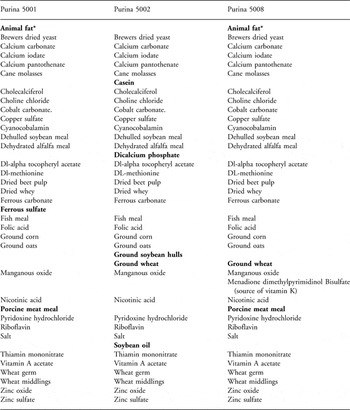
Purina 5001
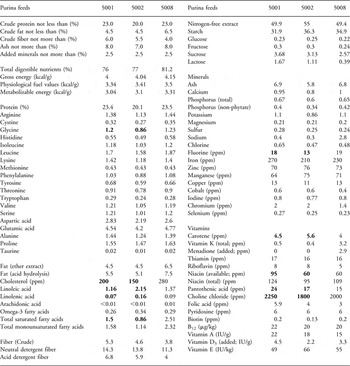
This is a constant-nutrient soy protein-based formulation recommended for rats, mice and hamsters. The constant formula feature is designed to minimize nutritional variables in long-term studies. It is formulated for life-cycle nutrition; however, it is not designed for maximizing production in breeding colonies. Components and energy content of the feed are shown in Tables 1 and 2.
Components of Purina 5001, 5002 and 5008 feeds

*Animal fat preserved with butylated hydroxyanisole.
Components contained in 5001 but not 5002, or in 5002 but not 5001, are indicated in bold.
Components and metabolic energy of Purina 5001, 5002 and 5008 feeds
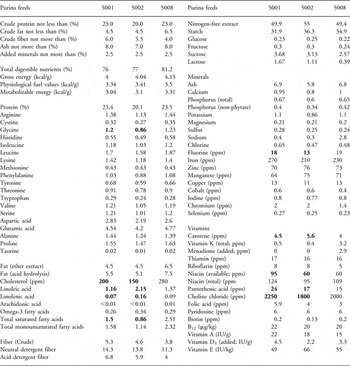
Components that differ notably in amount are indicated in bold.
Purina 5008
This is a constant-nutrition soy protein-based feed that is advertised as being similar to 5001 in terms of nutrient concentration, but with a higher energy concentration (2% more fat). However, there are other differences between 5001 and 5008 (Tables 1 and 2): 5008 contains ground wheat and 5001 has ferrous sulfate. Because 5008 has more fat, it has higher cholesterol.
Purina 5002
This is a constant-nutrient soy protein-based formulation for the maintenance, growth and reproduction of rats and mice. It has been developed as a complete life-cycle diet that can also be used by breeders. A sample of this product is assayed before shipment, with each bag being certified not to exceed maximum concentrations of some specified contaminants. Multiple samples are taken from each manufacturing lot to make lot composite samples, and the composite samples are analyzed for heavy metals, aflatoxins, chlorinated hydrocarbons, organophosphates and specified nutrients to determine whether they are within acceptable limits. For example, for the pesticide methoxychlor, the acceptable limit is 0.5 ppm and for dieldrin it is 0.03 ppm. Components and energy content of the feed are shown in Tables 1 and 2.
Experimental feed protocol
Adult animals used as the F0 generation to produce the F1 experimental animals examined in this experiment were all reared in a colony in which, during pregnancy and lactation, Purina 5008 was used, and after weaning, all animals were fed Purina 5001. In adulthood (average age was 3 months), males and females from this colony were randomly assigned to be fed Purina 5008 or Purina 5002 for 1 week before mating through pregnancy and lactation until the litter was weaned on postnatal day (PND) 20. Pups from dams fed 5008 were weaned to 5001, and pups from dams fed 5002 were maintained on 5002 after weaning.
Timed mating and serum collection
For measurement of serum steroid levels in pregnant females and fetuses, adult females were time-mated by being placed with an adult male for 4 h beginning 2 h before the time that lights came on. Females were examined for the presence of a copulatory plug (gestation day (GD) 0) and housed three mice per cage until GD 18. Randomly selected pregnant females were killed on GD 18, and serum was collected from the dam and each fetus for analysis of estradiol and testosterone levels. Blood from all fetuses of the same sex within a litter was pooled, providing one value for males and another for females from each litter. Detailed methods and validation of the steroid assays have been reported previously.Reference vom Saal, Quadagno and Even19
Maternal DES administration
Time-mated pregnant dams were fed DES once per day from GD 11–17 using an electronic micropipetter by picking up the mouse and gently placing the tip of the pipette into the animal's mouth. DES was dissolved in tocopherol-stripped corn oil (Fisher, St. Louis, MO, USA), and the volume administered was adjusted to maintain a constant dose per kilogram body weight. Mice readily consume this solution, and this procedure is less stressful than gavage. The doses of DES used were 0, 0.1 and 50 μg/kg/day.
Estradiol radioimmunoassay (RIA)
Estradiol RIA was performed as described previously.Reference vom Saal, Quadagno and Even19 Briefly, [125I] estradiol and antisera were obtained from ICN Biomedicals (Costa Mesa, CA, USA), and unlabeled estradiol was obtained from Steraloids (Wilton, NH, USA). Sensitivity of the assay was 0.5 pg. Inter- and intra-assay coefficients of variation were 5% and 4%, respectively. We previously determined the percent cross-reactivity of the estradiol antiserum with estrone to be 0.6%. Cross-reactivity with other steroids was reported by ICN to be negligible.
Testosterone RIA
Testosterone was assayed as described.Reference vom Saal, Quadagno and Even19 Briefly, first antibody (rabbit anti-testosterone), [125I] testosterone and second antibody (goat anti-rabbit) were obtained from ICN Biomedicals (Costa Mesa, CA, USA). Inter- and intra-assay coefficients of variation were determined to be 8% and 3%, respectively. We determined the cross-reactivity of the antisera with dihydrotestosterone and androstenedione to be 1.3% and 10%, respectively. Cross-reactivity with other steroids was reported by ICN to be negligible.
Puberty and fertility in F1 females
Onset of puberty (first ovulation, mating and pregnancy) was determined by randomly selecting up to two PND 20 females from each litter to be individually housed with a sexually experienced male until females reached 60 days of age. We recorded the age of the female on the day that pups were born. Sexually experienced males were used to insure that females conceived at first ovulation. Mice are very sensitive to stress effects, and a significant proportion of females will abort during the first 5 days of pregnancy before implantation occurs if they are stressed by being disturbed; therefore, cages were left undisturbed for 20 days after the F1 females were weaned and paired with a stud male. CD-1 mice have a 19-day gestation period, and therefore, age at first ovulation and mating (estrus) can be determined from age at parturition. Females from Purina 5008 fed dams remained on 5008 feed during mating and pregnancy, and females from Purina 5002 fed dams remained on 5002 feed. Females who did not give birth by 60 days of age were considered infertile, although there is a possibility that they might conceive at an older age or that they did give birth but immediately cannibalized the pups; however, this is a very rare occurrence in this stock of mouse.
Uterine response to estradiol
Three-month-old F1 adult female mice were ovariectomized using ketamine anesthesia, and all females were implanted with a Silastic capsule (0.62 in inner diameter, 1.25 in outer diameter) that was 10 mm long between the capped ends. The capsules contained 0 (controls) or 0.5 μg 17ß-estradiol dissolved in 0.02 μl tocopherol-stripped corn oil (Fisher). Before s.c. implantation, the capsules were pre-incubated in physiological saline for 24 h to stabilize release of estradiol. Seven days after the capsules were implanted, the females were killed, and uteri were collected and weighed along with body weight.
DSP
DSP was determined for the right testis. After removal and weighing, the testis was placed in liquid nitrogen, and subsequently kept at −80°C until being examined. Testes were thawed and homogenized for 3 min in 25 ml of physiological saline containing 0.05% (vol/vol) Triton X-100 (Sigma, St. Louis, MO, USA) using a semimicro Waring container (PGC no. 77-8549) on a Waring blender (Fisher no. 14-509-10). Steps 14–16 spermatids (stages II–VIII) survive this homogenization, and their nuclei were counted using a hemacytometer (Fisher no. 02-671-10). To count the spermatids, a 200-μl sample of homogenate was diluted with 300 μl saline and 500 μl of 4% trypan blue, which stains spermatids and facilitates counting. Sample aliquots of 5.5 μl were then placed on the hemacytometer and counted twice at ×100 magnification under a microscope to determine the average number of spermatids per sample. These values were used to obtain the total number of spermatids per testis, and this number was also divided by the testis weight to give spermatids per gram of testes (referred to as ‘efficiency of sperm production’). Developing spermatids spend 4.84 days in steps 14–16 during spermatogenesis in the mouse. Thus, the values for the number of spermatids per testis and spermatids per gram testis were divided by 4.84 to obtain DSP and efficiency of sperm production. Testis weight and body weight of F1 males were also recorded.
MCF-7 cell proliferation ‘fingerprint’ bioassay following high-performance liquid chromatography (HPLC) separation
Welshons and colleagues previously developed an in vitro bioassay for estrogenic activity coupled with HPLC separation methodology.Reference Howdeshell, Peterman and Judy18, Reference Grady, Nonneman, Rottinghaus and Welshons20. Feed samples were ground and extracted with HPLC-grade methanol (Fisher Scientific) at a ratio of 1 g/10 ml. Samples were processed by HPLC following the methods described previously.Reference Grady, Nonneman, Rottinghaus and Welshons20 The HPLC fractions (30 s/fraction) were dried down and reconstituted, and then applied to the cell proliferation assay. The sensitivity of the HPLC/bioassay was approximately 2 ng for genistein and 0.5 pg for estradiol. These integrated methods allow us to use human breast cancer cells as a bio-detector for the presence of estrogenic activity in media after extraction from feed.
The pattern of estrogenic activity associated with endogenous v. exogenous xenobiotic estrogenic chemicals can be assessed in this assay by first separating the sample into 30-s fractions by HPLC, and then determining the estrogenic activity in each fraction by adding these fractions to wells seeded with MCF-7 breast cancer cells. This procedure provides a ‘fingerprint’ of the estrogenic activity in the sample. As many xenobiotic estrogens can be run as standards, the degree to which each estrogenic chemical contributes to the overall estrogenic load can be estimated. This assay determines estrogenic activity of unconjugated (bioactive) compounds that were extractable by methanol; glycosylated phytoestrogens were thus intentionally not measured in this bioassay; the focus was on detection on unconjugated estrogens in addition to genistein.
MCF-7 cells were maintained in minimum essential medium with non-essential amino acids, 6 ng/ml insulin, 10 μg/ml phenol red, 10 mM HEPES, 100 U/ml penicillin, 100 mg/ml streptomycin and 5% charcoal-stripped calf serum (maintenance medium). Plating the cells, preparing dose–response series by serial dilution, some feeding of the cells, and parts of the final DNA assay were performed by robotics with a Tomtec Quadra 96. For bioassays, cells were plated on day 0 in estrogen-free medium (maintenance medium lacking phenol red) in 96-well plates. On day 1, the medium was replaced with fresh estrogen-free medium. Feed extracts were added to estrogen-free tissue culture medium, and then serially diluted to yield a series of serum equivalent concentrations. Cells were fed with this medium (180 μl/well) for 4 days with daily medium changes, days 3–6. On day 7, the medium was aspirated, and the wells were washed with Hanks’ Balanced Salt Solution plus 25 mM HEPES. Cell growth was determined by well DNA content, and absorbance was read on a Bio-Tek PowerWave-x 96-well plate reader. Estrogenic activity in 30-s HPLC fractions of the feed extract was determined against a standard dose–response curve of purified genistein (Sigma), and concentrations were expressed as free genistein equivalents. Single-point measurements of feed estrogenic activities in the absence or presence of an antiestrogen (ICI 182,780, Tocris) were also performed to verify an estrogen-receptor mode of action; all peaks proved to be inhibited by antiestrogen (data not shown).
Statistics
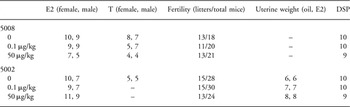
Sample sizes for each endpoint are shown in Table 3. Data were analyzed using the GLM procedure of the Statistical Analysis System (SAS). Both diet and treatment were the main effect variables. Treatment groups were compared to the control group for the same diet, and the controls of each diet were compared to each other. Planned comparisons were only conducted if the overall ANOVA or ANCOVA was statistically significant using LSmeans in SAS. Age at first ovulation was also analyzed by ANOVA. Litter was included in this analysis since two females from some litters were examined, and the F for feed type and prenatal DES dose treatment was divided by the F for litter in determining the final F and P-values that are reported. Effects of treatment and feed on frequency of infertility were analyzed by the χ 2 test. Results were considered statistically significant if P < 0.05. All data are presented as mean ± s.e.m.
Sample sizes and litter numbers

E2, estradiol; T, testosterone; DSP, daily sperm production.
Each data point represents a single litter, except as indicated for fertility.
Results
Maternal and fetal serum estradiol and testosterone
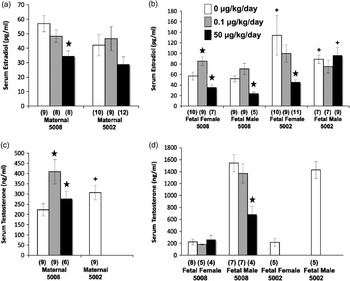
Estradiol in maternal (F0) and fetal (F1) serum from animals maintained on 5008 and 5002 feed was measured by RIA on GD 18, 1 day before parturition, to examine the effects of exposure to 0, 0.1 and 50 μg/kg/day treatment with DES from GD 11 to 17. For fetuses, there was a significant effect of feed (P < 0.001) and DES dose (P < 0.001) and a significant feed × dose × sex interaction (P < 0.05). Specifically, for pups not exposed to DES, Purina 5002 feed significantly increased serum estradiol in female (P < 0.001) and male (P = 0.01) fetuses relative to estradiol concentrations on Purina 5008 feed.
For fetuses on 5008 feed, opposite effects were observed for low- and high-dose DES on serum estradiol concentrations (Fig. 1). On Purina 5008, feed serum estradiol was significantly increased in 0.1-μg/kg/day DES-treated female pups (P < 0.05), but not males (P > 0.1). In contrast, for pups exposed to the 50 μg/kg/day DES, serum estradiol was significantly reduced in both females (P < 0.05) and males (P < 0.01) compared to controls (zero dose of DES) of the same sex. The effects of DES on serum estradiol in fetuses exposed to 5002 feed were markedly different from results on the 5008 feed. Although the 50 μg/kg/day DES reduced serum estradiol in female fetues (P < 0.01) compared to controls, surprisingly, this did not occur in male fetuses. For both males and females on Purina 5002, there was no significant effect of the 0.1 μg/kg/day DES on serum estradiol.
Fetal serum estradiol (pg/ml) and testosterone (ng/ml) of pregnant females and male and female fetuses fed Purina 5008 or 5002, and treated prenatally with 0, 0.1 or 50 μg diethylstilbestrol (DES)/kg maternal body weight (*significantly different v. control of same diet and gender; +significantly different for 5002 v. 5008 feeds for mothers or fetuses of same gender and prenatal DES groups. Sample size (n) was denoted under each bar).

Serum testosterone in maternal serum was significantly elevated (P < 0.05) on Purina 5002 relative to the 5008 feed (Fig. 1). For animals on the 5008 feed, maternal serum testosterone was significantly increased (P < 0.05) in response to the 0.1 μg/kg/day DES, whereas the 50 μg/kg/day DES significantly reduced (P < 0.05) serum testosterone relative to controls.
We did not have enough serum to assay fetuses from litters on 5002 feed exposed to the low and high doses of DES. However, on Purina 5008, serum testosterone in male fetuses was significantly reduced by the 50 μg/kg/day DES relative to controls.
Age at puberty and fertility
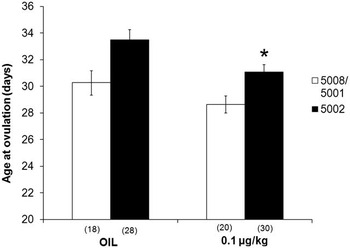
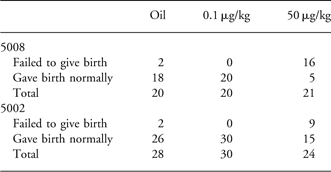
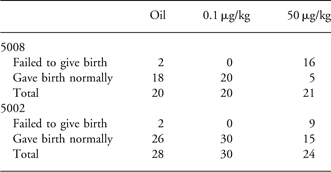
In females on the Purina 5002 diet, first ovulation was delayed by 3.2 days compared to females on Purina 5008 (P < 0.01), and 0.1 μg/kg DES accelerated first ovulation by 2.4 days (P < 0.01). Age at first ovulation did not differ between control and 0.1 μg/kg DES-treated females on 5008 background diet (Fig. 2). Since most females treated with 50 μg/kg DES failed to give birth, comparisons of age at first ovulation could not be made. However, more 50 μg/kg/day DES-treated females on the 5008 diet failed to give birth than those on the 5002 diet (P < 0.01; Table 4).
Age at first ovulation for females fed Purina 5008/5001 or 5002, and treated prenatally with 0, 0.1 or 50 μg diethylstilbestrol (DES)/kg maternal body weight (*P < 0.01 v. control of same diet; sample size (n) was denoted under each bar).

Fertility of females prenatally exposed to 0, 0.1 or 50μg DES/kg maternal body weight and fed 5008/5001 or 5002
DES, diethylstilbestrol.
For 5008 fed, 50 μg/kg DES, χ 2 = 34.0, df = 2, P < 0.001 compared to oil-treated 5002 fed controls. For 5002 fed, 50 μg/kg DES, χ2 = 17.6, df = 2, P < 0.001 compared to oil-treated controls, and χ 2 = 6.8, df = 1, P < 0.01 compared to 5008 fed, 50 μg/kg DES.
Uterine response to estradiol
We previously administered low (0.1 μg/kg/day) and high (100 μg/kg/day) doses of DES to pregnant females fed Purina 5008 using the same methods reported here, and we examined the uterine response to estradiol treatment for 7 days via an s.c. implanted Silastic capsule containing 0.5 μg estradiol in 7-month-old ovariectomized F1 females reared and maintained on Purina 5001 feed after weaning. We administered this dose because it results in a uterine weight increase, that is, about 70% of the maximum increase in uterine weight stimulated by estradiol.Reference Alworth, Howdeshell and Ruhlen21 We reported that for the females exposed to the low dose of DES during fetal life, treatment with estradiol resulted in significantly heavier uteri (mean ± s.e.m.: 191 ± 12 mg) relative to controls not exposed to DES (150 ± 14 mg), whereas the high dose of DES led to significantly lighter uteri (77 ± 23 mg) in response to estradiol treatment in adulthood relative to controls. In addition, the females prenatally exposed to the high dose of DES were significantly heavier (41 ± 1.0 g) than control females (33 ± 0.8 g).Reference Alworth, Howdeshell and Ruhlen21
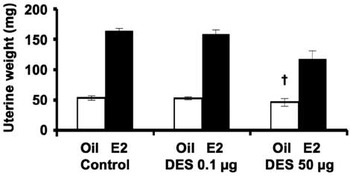
We conducted the same experiment described above using adult F1 females from mothers fed Purina 5002 during pregnancy and lactation, and the F1 females were then maintained on 5002 feed after weaning. These females, each from a separate litter, had been exposed to 0, 0.01 and 50 μg/kg/day DES from GD 11 to 17 as described above. When the females were about 3 months old, they were ovariectomized under ketamine anesthesia, and implanted s.c. with a Silastic capsule containing 0.5 μg estradiol using the procedure described previously by Alworth et al.Reference Alworth, Howdeshell and Ruhlen21 Seven days after the estradiol or vehicle implant, the uterus was removed and weighed, and body weight was recorded. The data in Figure 3 show that, in contrast to prior findings for females exposed to the Purina 5008/5001 feed, females on Purina 5002 did not show a greater uterine response to estradiol as a result of prenatal exposure to the 0.1 μg/kg/day DES relative to control females not exposed to DES. However, the 50 μg/kg/day DES resulted in a significantly lighter uterus relative to controls in response to the estradiol treatment. For females not administered estradiol, the uterus tended to be smaller in females exposed to the 50 μg/kg/day DES relative to control females (P = 0.08). There was no significant effect of prenatal DES or adult estradiol treatment on body weight in the females on 5002 feed, and body weight was not correlated with uterine weight (uterine weight data were thus analyzed by ANOVA and not corrected for body weight).
Uterine weight (in mg) in adult ovariectomized F1 females fed Purina 5002, and treated prenatally with 0, 0.1 or 50 μg diethylstilbestrol (DES). Females were implanted with blank capsules (open bars) or Silastic capsules containing 0.5 μg estradiol in oil for 7 days (solid bars). The unstimulated uterus tended (†P = 0.08) to weigh less for DES 50 μg/kg/day females than DES controls.

DSP
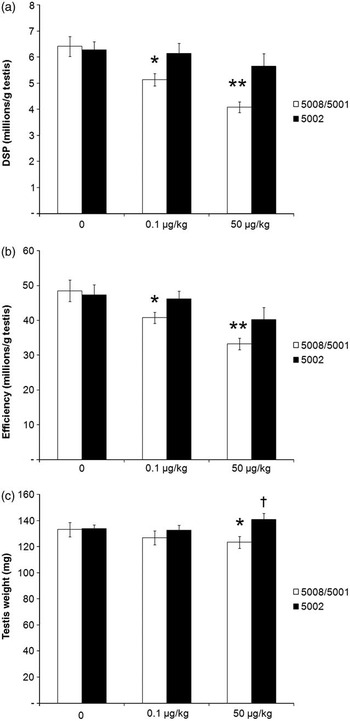
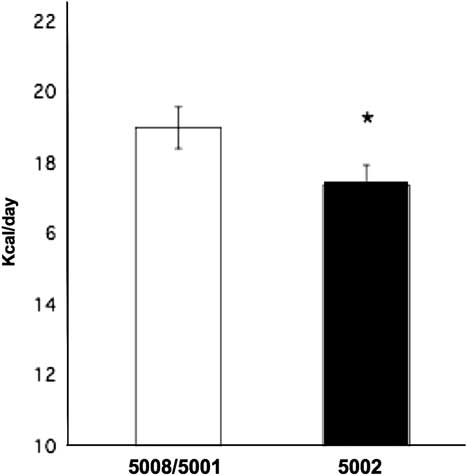
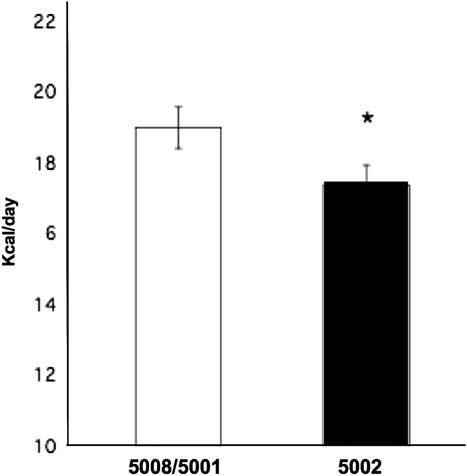
There was a dose-dependent reduction in DSP for males exposed to DES on the Purina 5008/5001 feed (Fig. 4). Males treated with 0.1 μg/kg/day DES had reduced DSP compared to controls (P < 0.05), as did males treated with 50 -μg/kg DES (P < 0.01). On a background diet of 5002, DSP did not differ based on in utero exposure to either the low or high dose of DES. The same pattern remained after correction for testis weight, referred to as ‘efficiency’ (Fig. 4). Males fed 5008/5001 treated with 0.1 μg/kg/day DES had reduced DSP/g testis compared to control (P < 0.05), as did males treated with 50 μg/kg/day DES (P < 0.01). On a background diet of 5002, DSP/g testis did not differ in response to either dose of DES. Testis weight was not significantly correlated with body weight. Testis weights (in mg) were significantly (P < 0.05) higher for control males on 5008/5001 feed (135 ± 4.8 mg) than males on the same feed exposed to the high dose of DES (122 ± 4.5 mg), whereas neither of these groups differed significantly from males on the same feed exposed to the low dose of DES (127 ± 5.4 mg). For F1 males on 5002, there were no differences based on prenatal DES dose: (controls = 134 ± 3.0 mg; low DES = 133 ± 3.8 mg; high DES = 141 ± 4.4 mg). However, the males exposed to the high dose of DES on 5002 feed had significantly (P < 0.01) greater testis weight than males on 5008 feed that were exposed to the high dose of DES. There were no significant differences in body weight based on the type of feed or DES treatment for males on either feed regimen. For 5008/5001, body weights were: controls = 39.1 ± 0.9 g; low DES = 37.6 ± 0.8 g; high DES = 40.3 ± 1.5 g. For 5002 males, body weights were: controls = 39.2 ± 1.3 g; low DES = 38.5 ± 1.7 g; high DES = 39.6 ± 0.7 g. The amount of feed consumed per day (expressed in kcal/day) was determined by weighing the feed that was placed in the stainless steel cage top. We found that males on the Purina 5002 feed consumed significantly (P < 0.05) fewer calories per day than males on the Purina 5008/5001 feed (Fig. 5), although there was no significant difference in body weight.
Daily sperm production (a), efficiency (b) and testis weight (c) of males fed Purina 5008/5001 or 5002, and treated prenatally with 0, 0.1 or 50 μg diethylstilbestrol (DES)/kg maternal body weight (n = 10 except for 50 μg DES groups (n = 9); *P < 0.05, **P < 0.01 v. control of same diet; †P < 0.01 v. same dose of 5008/5001).

Calories consumed per day by adult F1 males fed 5001 after weaning (and reared by mothers fed Purina 5008 during pregnancy and lactation) or Purina 5002 (*P < 0.05).
MCF-7 cell proliferation ‘fingerprint’ bioassay following HPLC separation
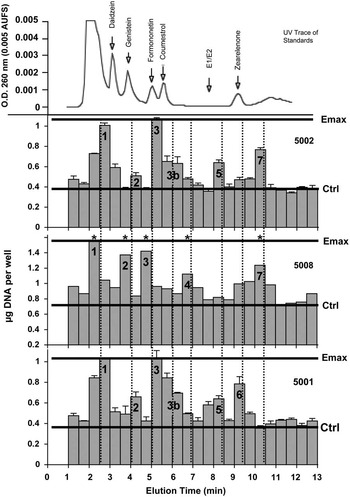
The objective of this experiment was to identify which of the 30-s chromatographic fractions were estrogenic, and whether they could be excluded from being a number of specific estrogenic compounds run as standards, based on their elution time (Fig. 6). The unique aspect of this approach is that by collecting 30-s fractions after separation of non-polar compounds by HPLC using a reverse-phase column, we can measure each fraction regardless of whether there is an identifiable peak by ultraviolet (UV) spectrometry, because the MCF-7 cell proliferation bioassay is much more sensitive than the UV detector. The data in Figure 6 reveal that the ‘fingerprint’ profile of MCF-7 cell proliferation in response to each 30-s HPLC fraction was unique for the Purina 5001, 5002 and 5008 feeds. Importantly, the profiles show activity for fractions not associated with any of the standards that were run using UV detection, indicating unknown and different biologically active sources of estrogenic activity in each of the feeds.
High-performance liquid chromatography (HPLC)-bioassay ‘fingerprint’ separations of a methanol extract of Purina feeds 5002, 5008 and 5001; Emax = maximum estrogen-stimulated proliferation in response to authentic standards; Ctrl = baseline proliferation in estrogen-free medium; estrogenic activity of each numbered peak was confirmed by competitive inhibition by an antiestrogen (not shown). Fractions are shown from 1 through 13 min. Arrows indicate approximate elution times of known standards, separated in individual HPLC runs. Estrogenic activity as increased cell proliferation is shown on the vertical axis. For 5002 and 5001, values are the mean ± s.e. ( n = 3). For 5008, values are from single determinations in one of the five separate assays at varying extract concentrations; however, the asterisks over each of the numbered peaks of 5008 indicate peaks seen in five out of five separate assays, except for the lowest peak (4), which was visible in four of the five separations. The patterns of peaks of estrogenic activity were distinguishable for each feed: 5002 – 1, 2 (low), 3, 3b, 5 and 7; 5008 – 1, 2 (high), 3, 4 and 7; 5001 – 1, 2 (low), 3, 3b, 5 and 6. The fingerprint of feed 5002 differed from feed 5008 at peaks 2, 3b, 4 and 5, while it differed from feed 5001 at peaks 6 and 7. However, for 5008 feed, the elution times for peaks 1, 2 and 3 were slightly earlier in relation to the peaks labeled 1, 2 and 3 in the other feeds, and the exact chemical identities of the peaks are not identified by this method. On the basis of consistency with chemical determinations of isoflavone content across several assays, peak 2 may contain genistein, and peak 1 likely represents unseparated phytoestrogen conjugates. All three fingerprints show estrogenic activities in the feeds that elute after the known phytoestrogens between 2 to 6 min (based on the standards). Although variations in the feed fingerprint pattern were associated with developmental changes to offspring of mothers fed the different feeds in pregnancy, there is no direct information on which peaks, of any of those visible, might be responsible for the developmental changes observed between feeds.

Total estrogenic activity in a methanol extract examined before HPLC separation was also measured by MCF-7 cell proliferation bioassay and expressed as equivalent to the concentration of free genistein (in ppm) that produced a similar stimulatory effect for the batch of 5002 (22.1 ppm), 5008 (33.9 ppm) and 5001 (29.4 ppm) used in the experiment. Purina 5002 feed thus had the lowest total estrogenic activity after methanol extraction of any of the feeds used in this experiment.
Discussion
Our data show that Purina 5002 can alter responses of mice to EDCs observed on another soy-based feed regimen (Purina 5008/5001). The main finding was that for both male and female fetuses not exposed to DES and carried by pregnant mice fed Purina 5002 feed, there was a significant elevation in serum estradiol relative to fetuses carried by pregnant mice fed Purina 5008 feed. Against the relatively low background level of serum estradiol in fetuses from litters exposed to Purina 5008 feed, fetuses from dams fed Purina 5008 had significantly elevated (low DES) and significantly reduced (high DES) serum estradiol levels (Fig. 1). Thus, in addition to being estrogenized by the low dose of DES, male and female fetuses carried by mothers on Purina 5008 feed are also estrogenized by an elevation in endogenous estradiol. The opposite effect of the low v. high dose of DES on fetal serum estradiol levels on Purina 5008 feed is just one more example of an inverted-U, non-monotonic dose–response curve that is a characteristic of endocrine disrupting chemicals (EDCs).Reference Myers, Zoeller and vom Saal22 However, it is expected of an exogenous hormone to result in a dose-related reduction in serum levels of the endogenous hormone that it mimics, which is what was observed for serum estradiol in pregnant females consuming Purina 5008 feed (Fig. 1). The contrast between the effect of the low dose of DES on maternal and fetal serum estradiol for animals on 5008 feed indicates that the elevated serum estradiol in fetuses exposed to the low dose of DES was not of maternal origin.
A markedly different hormonal profile was observed in fetuses carried by dams fed Purina 5002, where control fetuses had elevated serum estradiol in comparison to control fetuses carried by mothers consuming Purina 5008 feed. In contrast to the effect of maternal 5002 feed on serum estradiol in fetuses, there was no increase in serum estradiol in the control pregnant females on Purina 5002 relative to pregnant females on Purina 5008. Thus, by some as yet unexplained mechanisms, Purina 5002 feed led to a significant increase in fetal serum estradiol relative to fetuses exposed to Purina 5008 feed. However, a further increase in serum estradiol was not observed in response to the low dose of DES in fetuses on 5002 feed. Use of Purina 5002 during pregnancy in mice thus estrogenizes control fetuses by elevating serum estradiol. We propose that this interferes with the ability to observe many low-dose effects of EDCs such as DES in mice fed Purina 5002. Focusing only on estrogen content of the feed as the source of estrogenizing fetuses, which is commonly done,Reference Thigpen, Setchell and Saunders23 would not have predicted that the Purina 5002 feed, which had lower overall estrogenic activity than the Purina 5008 feed batch used in these studies, would lead to an elevation in endogenous estradiol in control fetuses. However, this finding is consistent with a prior comparison of a very low estrogen feed (Purina 5K96C) and Purina 5008 feed on serum estradiol levels in CD-1 mouse fetuses.Reference Ruhlen, Howdeshell and Mao7
We have previously reported that the uterine response to estradiol in adulthood in F1 females reared on a combination of Purina 5008 and 5001 showed an inverted-U, non-monotonic dose–response curve, with the low prenatal dose of DES resulting in a significantly more responsive uterus to estradiol treatment (greater uterine weight), whereas the high prenatal dose of DES resulted in a significantly less responsive uterus to estradiol treatment (lower uterine weight) relative to controls.Reference Alworth, Howdeshell and Ruhlen21 In contrast, the Purina 5002 feed masked this inverted-U response, such that there was no detectable difference between controls and F1 females exposed prenatally to the low dose of DES, and a relatively small but statistically significant decrease in the uterine response to estradiol was observed for the 5002 fed F1 females exposed prenatally to the high dose of DES in comparison to controls on the same feed (Fig. 3). We propose that the effects of feed on fetal estradiol impacted the uterine response to estradiol in animals exposed during prenatal life to a low dose of DES. However, it cannot be ruled out that nutritional differences between Purina 5001 and 5002 used after weaning, such as lipid coming from animal fat in 5001 and vegetable oil in 5002 (Table 1), also contributed to the differences in phenotype of these mice.
In utero exposure to both a low and a high dose of DES led to a decrease in DSP only in F1 males fed Purina 5008/5001, but not in F1 males fed Purina 5002 (Fig. 4). This was true for both the high (50 μg/kg/day) in utero DES dose and the low (0.1 μg/kg/day) DES dose. Unlike other responses, such as the inverted-U uterine weight in response to estradiol stimulation on Purina 5008/5001 feed, an elevation of serum estradiol or exposure to estrogenic chemicals during fetal life leads to a decrease in DSP at all doses examined.Reference Thayer, Ruhlen and Howdeshell24 It thus appears that some factor relating to postnatal exposure to Purina 5002 feed interfered with the expected decrease in DSP that would have been expected based on the elevation in fetal serum estradiol that was caused by Purina 5002 feed in males not exposed prenatally to DES.
The effect of low DES on accelerated puberty was only seen on the 5002 diet (Fig. 2). One possible explanation for the earlier puberty in control animals fed Purina 5008 relative to Purina 5002 is that this could be due to the lower fat content in 5002 compared to 5008. Purina 5008 has slightly higher fat to accommodate the increased energy demands of breeding and lactation. However, the effects of the high dose of DES on fertility in the F1 females were pronounced on both diets. Females fed 5008 had a worse fertility outcome than those fed 5002, and therefore, as in males, 5002 mitigated the effect of high-dose DES exposure in pubertal females.
The buffering effect of Purina 5002 may be due to the phytoestrogen content or other factors. Purina 5001, 5008 and 5002 are made using a variety of materials (Table 1 and 2), and it is not always clear which of the ingredients listed are included and in what quantities. One suspect ingredient is fish meal. Aquatic animals are exposed to many chemicals that can accumulate in tissues, and therefore, fish meal may be a source of low doses of unidentified endocrine disruptors as well as a few that have been identified, such as methylmercuryReference Weiss, Stern, Cernichiari and Gelein25 and polychlorinated biphenyls.26
Research showing low-dose effects of EDCs (doses that result in blood levels within the range detected in most people), such as BPA, has generated considerable controversy because a relatively small number of studies have failed to find low-dose effects.Reference Richter, Birnbaum and Farabollini15, Reference Myers, vom Saal and Akingbemi16 Our findings show that the type of feed used has the potential to mask effects of man-made estrogenic chemicals, such as DES,Reference Thigpen, Setchell and Padilla-Banks3, Reference Thigpen, Haseman and Saunders27 or chemicals in products with estrogenic activity, such as BPA. Inclusion of an appropriate positive control (such as DES) at appropriate doses in relation to the doses of the chemical being studied is required in order to reveal the kinds of unexpected effects of feed observed here and thus to interpret negative results of studies with EDCs. A recent example is a study of BPAReference Ryan, Haller and Sorrell28 in which the feed used resulted in control animals that were already obese, and no further increase in obesity was observed in response to exposure to BPA. In addition, an inappropriately high dose of DES was administered to pregnant mice in relation to the one dose of BPA, making it impossible to draw a valid comparison of the results of the experimental chemical and positive control.Reference vom Saal and Welshons29
On the basis of our findings here, the use of Purina 5002 feed in a series of studies to determine whether BPA resulted in low-dose effects when administered during development warrant particular attention.Reference Cagen, Waechter and Dimond10–Reference Stump, Beck and Radovsky13 For example, in the study by Cagen et al.,Reference Cagen, Waechter and Dimond10 the authors reported no effect on male mice of prenatal administration of a 0.2 μg/kg/day DES. The failure to find an effect of their positive control, which did not differ from the negative controls, was determined by an NTP panel to render the study of no value for determining whether or not there are low-dose effects of BPA.30 In the chemical industry-funded Tyl et al.Reference Tyl, Myers and Marr11 and Stump et al.Reference Stump, Beck and Radovsky13 studies, both used 5002 feed and simply did not include a positive control, but they still drew strong conclusions of safety from the absence of low-dose effects of BPA. A subsequent study by Tyl et al.Reference Tyl, Myers and Marr12 that used the same mouse studied here (the CD-1 stock) required an exceedingly high positive control dose of estradiol (100 μg/kg/day), which may have been required to show effects due to the high background levels of fetal serum estradiol caused by the 5002 feed, and it thus is not surprising that no low-dose effects of BPA were reported.Reference Myers, vom Saal and Akingbemi16
One proposed solution to the problem caused by variable levels of phytoestrogens and other unknown estrogenic chemicals in feed is to use minimal-estrogen diets for studies of estrogenic endocrine disruptors.Reference Thigpen, Setchell, Goelz and Forsythe31 However, a number of studies have shown that soy-free (casein-based) feed cause metabolic and reproductive abnormalities in mice.Reference Cederroth, Vinciguerra and Kuhne6, Reference Ruhlen, Howdeshell and Mao7 Another potential solution would be to use custom feeds. One problem with the use of only custom-made diets with carefully controlled ingredients is that this would substantially increase the cost of experiments, but not guarantee that all sources of endocrine disrupting activity are, in fact, being controlled. Our ‘fingerprint’ of estrogenic activity in the three soy-based feeds that we examined shows that there are many sources of estrogenic activity other than genistein and daidzein, the two most potent phytoestrogens, in soy-based feeds. Some authors, conducting studies of estrogenic EDCs, have assumed that by measuring a few phytoestrogens (genistein, daidzein and a few other phytoestrogens) in Purina 5002 feed by chemical analysis, they were controlling for the estrogenic activity in feed,Reference Tyl, Myers and Marr12, Reference Stump, Beck and Radovsky13 which our data in Figure 6 clearly show is not the case.
Further investigation of the interactions of endocrine disruptors and sources of estrogenic activity in feeds is advisable, both in light of the data on the effects on phenotype of laboratory rodent diets and the popularity of phytoestrogen-rich and enriched ‘health’ foods and drinks. In addition, it is important to determine the basis for the reduction in serum estradiol in feeds with high estrogenic activity (Purina 5008), relative to other feeds such as Purina 5002 (Fig. 1) and Purina 5K96C.Reference Ruhlen, Howdeshell and Mao7 Inclusion of a proper positive control at appropriate doses will reveal potential masking effects of diet or other unknown variables and reduce the likelihood of drawing false negative conclusions about the safety of fetal exposure to drugs and environmental chemicals.
Acknowledgments
This study is supported by grants from NIH (ES011283 and ES018764) to FSvS.