INTRODUCTION
The intensification of agriculture, particularly during the latter half of the 20th century, has led to large modifications in agroecosystem characteristics, generating a number of negative side effects such as the depletion of natural resources, the reduction of soil fertility and the accumulation of pollutants in food and the environment (Lu et al. Reference Lu, Watkins, Teasdale and Abdul-Baki2000). Modern producers face growing social pressure to mitigate the damage caused by agriculture to the natural environment and to human health. As a result, the elaboration of cropping systems which are both productive and profitable, but at the same time conserve the quality of the environment and maintain soil fertility, has become a research priority (Djigal et al. Reference Djigal, Saj, Rabary, Blanchart and Villenave2012; Scopel et al. Reference Scopel, Triomphe, Affholder, Macena Da Silva, Corbeels, Valadares Xavier, Lahmar, Recous, Bernoux, Blanchart, de Carvalho Mendes and De Tourdonnet2013).
Cover cropping (the mono- or intercropping of herbaceous plants over either part of a year or over an entire year) has been proposed as a means of improving agricultural sustainability (Mauro et al. Reference Mauro, Restuccia, Occhipinti and Mauromicale2009), since it has the potential to mitigate against soil compaction and erosion (Mitchell et al. Reference Mitchell, Thomsen, Graves and Shennan1999; Scopel et al. Reference Scopel, Triomphe, Affholder, Macena Da Silva, Corbeels, Valadares Xavier, Lahmar, Recous, Bernoux, Blanchart, de Carvalho Mendes and De Tourdonnet2013), increase soil porosity (Carof et al. Reference Carof, De Tourdonnet, Coquet, Hallaire and Roger-Estrade2007), improve the soil's ability to retain leachable nutrients (Doltra & Olesen Reference Doltra and Olesen2013), enrich soil organic matter and organic nitrogen content (especially in the case of legume species) (Stagno et al. Reference Stagno, Abbate, Intrigliolo, Abbate and Gennari2008), enhance the soil's macrofauna (Blanchart et al. Reference Blanchart, Villenave, Viallatoux, Barthès, Girardin, Azontonde and Feller2006), release non-available phosphorus (Kamh et al. Reference Kamh, Horst, Amer, Mostafa and Maier1999), encourage the generalist predator arthropod populations and heartworm communities, and reduce pest and weed pressure on cash crops, so reducing the need for external inputs (Hiltbrunner et al. Reference Hiltbrunner, Liedgens, Bloch, Stamp and Streit2007; Den Hollander et al. Reference Den Hollander, Bastiaans and Kropff2007a ; Pelosi et al. Reference Pelosi, Bertrand and Roger-Estrade2009; Chen et al. Reference Chen, You and Chen2011; Campiglia et al. Reference Campiglia, Radicetti and Mancinelli2012). In Mediterranean environments, where soils are largely characterized by low contents of both organic nitrogen and available phosphorus (Ryan et al. Reference Ryan, Masri, Ceccarelli, Grando and Ibrikci2008), self-reseeding annual legumes represent an important means of improving soil fertility and maintaining high productivity in natural pastures (Osman et al. Reference Osman, Pagnotta, Russi, Cocks, Falcinelli, Osman, Ibrahim and Jones1990). In Southern Italy, this role is largely covered by pasture legume species belonging to the genera Trifolium and Medicago (Abbate et al. Reference Abbate, Patané, Gresta, Sortino and Licitra2003). Most of these species present interesting options for cover cropping purposes, because of their adaptations to limited rainfall and low soil fertility, their formation of a dense ground cover, their ability to self-reseed and their biomass productivity (Dipasquale Reference Dipasquale2007). Their extensive phenological variability in natural populations (Yahiaoui & Abdelguerfi Reference Yahiaoui and Abdelguerfi2000) suggests that specific genotypes could be identified to suit the requirements of the various Mediterranean agricultural systems (Mauromicale et al. Reference Mauromicale, Occhipinti and Mauro2010).
With reference to this last aspect, cover cropping in orchards requires plants that are able to adapt to decreased levels of incoming photosynthetically active radiation (PAR) under the tree canopy (Mauromicale et al. Reference Mauromicale, Occhipinti and Mauro2010). Indeed, photon flux density has a major effect on plant phenology, physiology and growth pattern (Tester et al. Reference Tester, Smith, Smith and Walker1986; Steinger et al. Reference Steinger, Roy and Stanton2003; Weijschedé et al. Reference Weijschedé, Martínková, de Kroon and Huber2006; Mauro et al. Reference Mauro, Occhipinti, Longo and Mauromicale2011; Kyriazopoulos et al. Reference Kyriazopoulos, Abraham, Parissi, Koukoura and Nastis2013), so it is a major determinant of a cover crop's ability to achieve a good soil cover quickly and a sufficient rate of self-reseeding, with resulting implications on both technical and economic viability of cover cropping (Mauromicale et al. Reference Mauromicale, Occhipinti and Mauro2010). To date, there has been little attempt to systematically elucidate the effects of shading on legume species, information that would provide a basis for the breeding of legume cover crop species able to tolerate low light levels. Cultivars that can perform well under these conditions would make legume cover cropping in orchard production systems, which otherwise require a substantial investment in external inputs to remain economically productive, much easier. Thus, the present paper examines the effect of shading on the phenology and development of four Medicago sp. and five Trifolium sp. accessions, focusing most closely on traits known to be critical for a successful cover crop.
MATERIALS AND METHODS
Experimental site
The trial was carried out during 2007/08 and 2008/09 growing seasons (hereafter referred to as seasons I and II, respectively) on a hilly area of South–Eastern Sicily (36°53′N, 14°51′E, 419 m a.s.l.), within a region where olive, almond and carob are commonly grown. The local climate is Mediterranean sub-arid, with mild, wet winters and warm, dry summers. The mean maximum daytime and minimum night-time temperatures over the period 1971–2000 ranged from 12·7/5·7 °C in January to 32·3/20·8 °C in July, respectively. Rainfall over the same period was 576 mm. The moderately deep soil (c. 0·7 m) at the experimental site is a Typic Xerochrepts (USDA 1975). At the outset of the experiment, the soil was assayed as comprising 38% clay, 26% silt, 36% sand (by volume), with an apparent specific weight of 1·1 g/cm3, and containing 1·4 g/kg total N, 52·6 mg/kg P2O5 and 321 mg/kg exchangeable K2O. The soil pH was 7·4, its moisture capacity was 34·2% and its wilting point was 15·7%. The above analyses were carried out following the procedures recommended by Violante (Reference Violante2000).
Experimental design, plant material and crop management
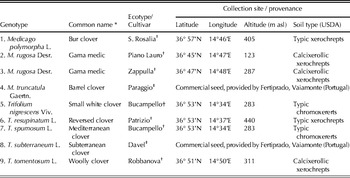
A randomized split-plot design with four replications was adopted, assigning two imposed shading levels to the main plots (removal of 0·0 and 0·50 of sunlight, hereafter referred to as S0 and S50, respectively), and nine cover crop genotypes to the sub-plots (Table 1). The seeds of the autochthonous ecotypes under study were obtained from the germplasm collection held at the Department of Agricultural and Food Science, University of Catania, the original accessions having been collected over the period 2004–2006 from the South–Eastern area of Sicily. They were chosen because of their common presence within Mediterranean pastures, along with their adaptability to Mediterranean climate conditions; two commercial cultivars (Medicago truncatula cvar Paraggio and Trifolium subterraneum cvar Davel) were chosen because of their suitability for cover cropping purposes in the Mediterranean area (O. Sortino, 2006, personal communication). The S50 shading level was imposed to simulate the environment of a typical olive, almond or carob plantation of the area in which the study was conducted, where measured irradiance under shade at the soil level varied from c. 0·56 to 0·48 of the full sunlight exposure, depending on plant density and/or age.
List of the genotypes studied, with geographical information and soil type at the collection sites

The shading structure was realized by erecting a black polyethylene net at c. 2·0 m above ground level, by means of wooden rafters and poles, c. 1 month before seeding. The main plots were oriented in an E–W direction, placing the S0 main plot on the Southern side; in S50 the netting was extended down to 0·3 m above ground level at each edge, in order to avoid lateral irradiation and to minimize the development of microclimate differences among main plots. The sub-plot dimensions were 5×5 m, whereas the main plots were spaced c. 3·5 m from each other, in order to avoid border effects as much as possible. The seedbed was shallow-ploughed a few days before sowing by hand on 27 September 2007 with 500 viable seeds/m2 (germination percentage was tested prior to sowing). After sowing, the beds were uniformly harrowed and rolled. Prior to seeding, 20 kg/ha N and 50 kg/ha P2O5 were incorporated into the soil. Since grain legumes had been grown in the experimental field in the previous seasons, no supplemental Rhizobium was given. Season II started by promoting the germination of self-reseeded material, because this is one of the major characteristics contributing to the economic viability of cover crops (Mauromicale et al. Reference Mauromicale, Occhipinti and Mauro2010). To trigger seed germination, plots were irrigated by sprinklers to field capacity on 27 September 2007 (season I) and 6 October 2008 (season II).
Meteorological measurements
Meteorological data were recorded on a CR 10 data logger (Campbell Scientific, Inc., UK) connected to a meteorological station sited at c. 300 m northwest of the experimental field. The air temperature (minimum, maximum and mean), relative humidity (minimum, maximum and mean), soil temperature at a depth of 20 cm (minimum, maximum and mean), wind direction and speed, PAR, rainfall and evaporation were recorded continuously on a 30-min basis. Within the S50 main plot, minimum and maximum day temperatures were recorded once a day, using a conventional minimum and maximum thermometer, and the effectiveness of the shading was tested on a weekly basis (three measurements taken on a clear day between 09·00 and 15·00 h, both inside and outside the plot) using a solarimeter (Licor Line Quantum LQA, One Meter Sensing Length; LI-Cor Inc., Lincoln, NE, USA).
Phenological measurements
Three randomly chosen 0·25 m2 areas (0·5×0·5 m) per sub-plot were non-destructively sampled 3 days per week. In each season, the following stages were determined and timed in days after the initial irrigation (DAI): emergence time, when at least 50 seedlings/m2 were visible; flowering time, taken as the day when at least 250 flowers or inflorescences per m2 were visible; length of the life-cycle, taken as the day when all the plants within the sub-plot had completely dried up. The length of the growth period was also calculated, as the number of days elapsed between emergence time and flowering time.
Bio-agronomical measurements
In each growing season, starting from c. 50 days after emergence, two randomly chosen 0·25 m2 areas per subplot were harvested monthly, cutting the plants at c. 1 cm above the soil level, until the beginning of flowering (which was assumed to be the time at which cover crop dry biomass peaks) (De Haan et al. Reference De Haan, Sheaffer, Samac, Moynihan and Barnes2002). The resulting sample was divided into two main components (cover crop and weeds) and weighed; a sub-sample was reweighed after drying in a thermoventilated oven at 105 °C until constant weight, in order to determine the above-ground dry biomass of both cover crops and weeds.
Crops were hand-weeded at the start of flowering, before cutting, leaving cover crops undisturbed as much as possible. Cover crop height (from ground level to the tallest fully expanded leaf lamina) and cover crop coverage (as the proportion of soil covered by the cover crop) were determined, the latter representing the mean of three independent visual estimates. At the start of flowering, the crop/weed biomass ratio, as an overall index of competitive ability of cover crops against weeds was calculated. The temporal progress of cover crops’ dry matter accumulation was fitted to the logistic equation:
 $$y = A + \{ B/[1 + \left( {x/C} \right)^D ]\} $$
where A and B are the lower and upper asymptotes, respectively; C is the number of days required to reach half of the inter-asymptote distance (the inflection point) and D is a parameter describing the degree of curvature of the function. This allowed for the calculation of both the maximum growth rate of cover crop (the slope of the tangent straight line in C) and its maximum relative growth rate (by dividing the maximum growth rate for the corresponding estimated above-ground dry biomass in C). Crop light use was also calculated as the slope of the linear regression between the cover crops’ above-ground dry biomass recorded at each time point and the corresponding cumulative incoming PAR (starting from emergence time) at the top of the plant canopy.
Statistical analysis
Levene's test was used to test for homoscedasticity, whereas differences among treatments were determined by applying a two-way (shading level×genotype) analysis of variance (ANOVA), related to the experimental design adopted in the field. In the ANOVA, the growing season was considered as a random variable (Gomez & Gomez Reference Gomez and Gomez1984). Cover crop coverage and crop/weed biomass ratio data were Bliss transformed before the ANOVA (untransformed data are reported and discussed) whereas multiple mean comparisons were performed through Fisher's protected least significant difference (LSD) test (at least for P⩽0·05). Pearson's correlation analysis was also performed for collected and calculated data, in order to define possible relationships among variables.
Meteorological conditions during the trial
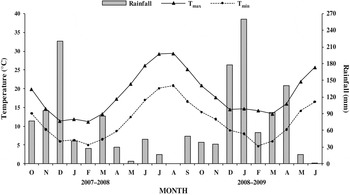
The recorded average monthly temperature minima and maxima were similar in the two growing seasons (Fig. 1), but were somewhat below the 1971–2000 long-term average (by 0·9 and 2·6 °C, respectively). Both the maximum and minimum mean temperatures decreased over the period October (20·4 and 13·6 °C) to February (12·7 and 4·9 °C), then rose in June reaching, respectively, 26·0 and 16·8 °C (Fig. 1). The S50 treatment reduced both the maximum and minimum mean monthly temperatures by 0·3 and 0·1 °C, respectively, with the most significant reduction occurring in the period June–August (data not shown). The total rainfall during season I was 644 mm, 0·85 of which fell between October and March (Fig. 1). In season II, rainfall was rather higher (867 mm) and was mainly concentrated in December (178 mm), January (260 mm), March (93 mm) and April (141 mm) (Fig. 1).
Monthly maximum (solid line), minimum (dotted line) mean temperature and rainfall (bar chart) during the two seasons of cultivation at the experimental site.

RESULTS
Phenological response to shading
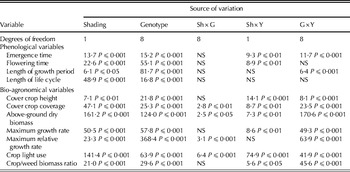
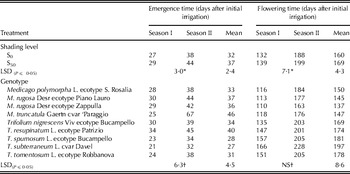
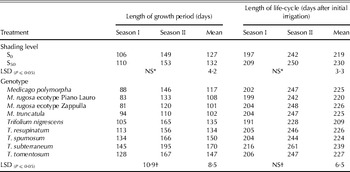
All phenological variables were affected significantly by the main factors, namely shading level and genotype, with shading effects being more evident in season II than in season I for emergence time and flowering time (Table 2). With reference to emergence time and length of growth period, the response of the studied genotypes appeared to be season-dependent (Table 2). Shading caused a shift forwards in the phenology of all the genotypes studied, as it delayed both emergence time (from 32 to 37 DAI) and flowering time (from 160 to 169 DAI) (Table 3), and extended both the growth period (from 127 to 132 days) and the overall life-cycle duration (from 219 to 230 DAI) (Table 4). With regard to the genotypes tested, clovers showed a later flowering time and a longer growth period compared with medics. Three clover species, namely Trifolium subterraneum, Trifolium tomentosum and Trifolium spumosum showed the latest flowering times (178–197 DAI) (Table 3) with T. subterraneum also showing the longest life-cycle (239 DAI) (Table 4). In contrast, three medics species, Medicago rugosa ecotype Piano Lauro, M. rugosa ecotype Zappulla and Medicago truncatula showed the shortest growth periods (104 days, on average), with M. rugosa ecotype Piano Lauro showing also the shortest life-cycle (220 DAI) (Table 4). In season II, there was a significant (P⩽0·001) delay in emergence time compared with season I, with the highest values in season II seen for M. truncatula (67 DAI), T. resupinatum (45 DAI) and in both M. rugosa ecotypes (43 DAI, on average), but the lowest ones in T. spumosum and T. subterraneum (33 DAI, on average) (Table 3). In season II, a significant (P⩽0·001) lengthening of the growth period for the studied entries was recorded, with the longest growth periods recorded in T. subterraneum (195 days), Trifolium nigrescens, T. spumosum and T. tomentosum (166 days, on average), but the shortest ones recorded in M. truncatula and M. rugosa ecotype Zappulla (115 days, on average) and in M. rugosa ecotype Piano Lauro (133 days) (Table 4).
F-values of the main factors and their first-order interactions for the phenological and bio-agronomical variables, with the significance resulting from the analysis of variance

Sh, shading; G, genotype; Y, growing season. NS: not significant.
Effects of the main factors and their interactions with growing season on emergence time and flowering time. Least significant difference (LSD) values are presented

NS, not significant.
* Shading level×season effect.
† Genotype×season effect.
Effects of the main factors and their interactions with growing season on length of growth period and life-cycle. Least significant difference (LSD) values are presented

NS, not significant.
* Shading level×season effect.
† Genotype×season effect.
Cover crop height and coverage
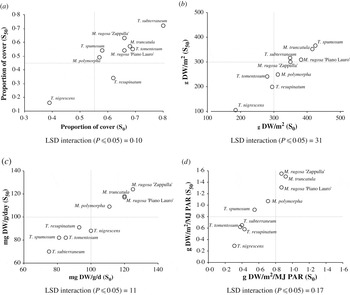
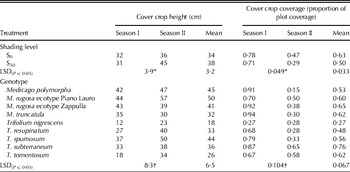
Shading and genotype both significantly affected the two variables being studied, with season-dependent effects (Table 2). On average, there was a significant increase (P⩽0·01) in cover crop height (from 34 to 38 cm) and a reduction (P⩽0·001) in cover crop coverage (from 0·63 to 0·50) between S0 and S50 (Table 5). The differences among shading treatments in terms of cover crop height and cover crop coverage increased over seasons. Indeed, going from season I to season II, cover crop height and cover crop coverage both showed more marked variations under the S50 treatment (from 31 to 45 cm and from 0·71 to 0·29, respectively) when compared with S0 (32–36 cm and 0·78–0·47, respectively) (Table 5). With regard to the genotypes tested, on the average of the 2-year experiment M. rugosa ecotype Piano Lauro, Medicago polymorpha and T. spumosum showed the tallest growth habit (50, 45 and 44 cm, respectively), while T. subterraneum showed the wider plot coverage (0·76) (Table 5). T. nigrescens showed the lowest response in terms of cover crop height (18 cm) and coverage (0·27) (Table 5). There was a significant (P⩽0·001) increase in cover crop height between seasons I and II, except for M. rugosa ecotype Zappulla and M. truncatula. The tallest cover crops were M. rugosa ecotype Piano Lauro (58 cm), M. polymorpha (45 cm) and T. spumosum (50 cm) (Table 5), whereas three medics, namely M. polymorpha, M. rugosa ecotype Zappulla and M. truncatula, showed the largest reduction across seasons in terms of cover crop coverage (by 65%, on average) (Table 5). Moreover, T. nigrescens and T. resupinatum underwent the highest plot coverage reduction between S0 and S50 (from 0·39 to 0·16 and from 0·62 to 0·34, respectively) (Fig. 2 a).
(a) Cover crop coverage, (b) above-ground dry biomass, (c) relative growth rate and (d) crop light use, as affected by ‘genotype×shading level’ interaction.

Effects of the main factors and their interactions with growing season on cover crop height and cover crop coverage. Least significant difference (LSD) values are presented

* Shading level×season’ effect.
† Genotype×season effect.
Above-ground biomass, growth rate and relative growth rate
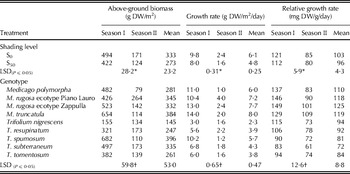
Growth rate and above-ground dry biomass were dependent on both light treatment and genotype (Table 2). The lower level of PAR reduced the biomass from 333 to 273 g DW/m2, the growth rate from 6·1 to 4·8 g DW/m2/day and the relative growth rate from 103 to 96 mg DW/g/day (Table 6). Moreover, the growth rate reduction between seasons I and II appeared to be more marked at S0 (−7·4 g DW/m2/day) than at S50 (−6·4 g DW/m2/day) (Table 6). The highest above-ground dry biomass was recorded in M. truncatula and T. spumosum (390 g DW/m2, on average), followed by the two M. rugosa accessions along with T. subterraneum (337 g DW/m2, on average), with the three medics also recording the highest growth rates and relative growth rates (7·2–8·0 g DW/m2/day). The accessions responded differentially to shading; the S50 treatment affected the biomass accumulation of T. nigrescens and T. resupinatum (Fig. 2 b) most strongly, with the former also recording the largest negative effect on relative growth rate (Fig. 2 c). In season II, M. rugosa ecotype Piano Lauro produced the most biomass and highest growth rates (264 g DW/m2 and 4·0 g DW/m2/day), whereas both M. rugosa accessions along with M. truncatula performed best in terms of relative growth rate (121 mg DW/g/day, on average) (Table 6).
Effects of the main factors and their interactions with growing season on cover crop above-ground dry biomass, maximum growth rate and maximum relative growth rate. Least significant difference (LSD) values are presented

* Shading level×season effect.
† Genotype×season effect.
Crop light use and crop/weed biomass ratio
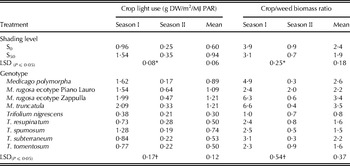
Shading promoted crop light use, with the mean over the two seasons increasing from 0·60 (S0) to 0·94 (S50) g DW/m2/MJ PAR, but decreased the competitiveness of cover crops against weeds, as shown by the decrease in mean crop/weed biomass ratio from 2·4 to 1·9 (Table 7). The differences were particularly marked in season I, where crop light use increased from 0·96 (S0) to 1·54 (S50) g DW/m2/MJ PAR and crop/weed biomass ratio decreased from 3·9 to 3·1 (Table 7). Medicago rugosa ecotype Piano Lauro and M. truncatula showed the highest crop light use (1·21 g DW/m2/MJ PAR) and crop/weed biomass ratio (3·4, on average). The poorest performers were all clover species, the best of which were T. spumosum in terms of crop light use (0·74 g DW/m2/MJ PAR) and T. subterraneum in terms of crop/weed biomass ratio (2·2) (Table 7). The observed increase in crop light use in the S50 treatment was genotype-dependent, with the best medic performers being M. rugosa ecotype Zappulla, M. truncatula and M. rugosa ecotype Piano Lauro and the best clover T. spumosum (Fig. 2 d). In season II, both crop light use and the crop/weed biomass ratio were genotype-dependent. The best performers with respect to the former trait were M. rugosa ecotype Piano Lauro (0·64 g DW/m2/MJ PAR), M. rugosa ecotype Zappulla (0·47 g DW/m2/MJ PAR) and M. truncatula (0·33 g DW/m2/MJ PAR), and with respect to the latter M. rugosa ecotype Piano Lauro and T. tomentosum (2·0 and 0·9, respectively) (Table 7).
Effects of the main factors and their interactions with growing season on crop light use and crop/weed biomass ratio. Least significant difference (LSD) values are presented

* Shading level×season effect.
† Genotype×season effect.
Correlation among variables
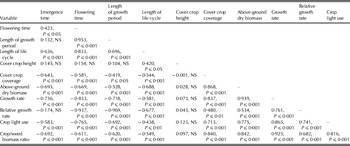
There were significant and negative correlations between the phenological and growth pattern variables. In particular, emergence time was negatively correlated with cover crop coverage (r=−0·643, P⩽0·001), above-ground dry biomass (r=−0·695, P⩽0·001), growth rate (r=−0·736, P⩽0·001) and crop/weed biomass ratio (r=−0·692, P⩽0·001) (Table 8). Flowering time was most strongly correlated with growth rate (r=−0·833, P⩽0·001), relative growth rate (r=−0·937, P⩽0·001) and crop light use (r=−0·765, P⩽0·001). A strong negative correlation also existed between the length of the growth period and the relative growth rate (r=−0·969, P⩽0·001) (Table 8). Positive correlations were established between crop coverage and the above-ground dry biomass (r=0·868, P⩽0·001), between the growth rate and the above-ground dry biomass (r=0·939, P⩽0·001) and between the relative growth rate and crop light use (r=0·741, P⩽0·001). The crop/weed biomass ratio was most strongly correlated to the growth rate (r=0·925, P⩽0·001) and crop light use (r=0·816, P⩽0·001) (Table 8).
Pearson's correlation coefficients (r) between variables (n=36)

NS, not significant.
DISCUSSION
Phenological response to shading
The ability of plants to adjust their morphology, physiology and phenology to sub-optimal light conditions is well documented (Li et al. Reference Li, Jiang, Wollenweber, Dai and Cao2010; Cai Reference Cai2011; Bande et al. Reference Bande, Grenz, Asio and Sauerborn2013); in particular, shading is associated with a longer period of vegetative growth and a delay in reproductive development (Mauromicale et al. Reference Mauromicale, Occhipinti and Mauro2010; Cai Reference Cai2011). The shading of the nine legume species in the present study duly delayed both their emergence and flowering times, and thus prolonged both their growth period and their overall life-cycle. As revealed by the trait correlation analysis, these adaptations had a depressive effect on their growth pattern and their competitiveness against weeds. A key effect of shading was to delay emergence, an effect that was particularly marked at the start of season II. Thus this suggests that, in common with a number of other pasture legumes (Brar et al. Reference Brar, Gomez, McMichael, Matches and Taylor1991; Van Assche et al. Reference Van Assche, Debucquoy and Rommens2003; Abbate et al. Reference Abbate, Maugeri, Cristaudo and Gresta2010), seed dormancy was a major characteristic of the accessions that were tested. As there was little difference in air temperature between the shaded and non-shaded treatments during plant emergence in season II [the mean temperature maxima and minima ranged, respectively, from 17·7 (S0) to 17·3 °C (S50) and from 11·9 (S0) to 11·7 °C (S50)], and given that the temperatures during the emergence period were well within the optimal range for successful germination, any significant reduction in seed germination induced by shade can be excluded. Rather, as previously suggested for T. subterraneum (Mauromicale et al. Reference Mauromicale, Occhipinti and Mauro2010), the sub-optimal light levels experienced in the S50 treatment either increased hard-seededness at the end of the first season, or altered the dormancy break pattern during the summer or both. Shading delayed flowering, thereby causing a forward shift in the timing of burr formation and a consequent reduction in the period of exposure to environmentally induced softening of the seeds. Seed dormancy is under both environmental and genetic control (Dipasquale Reference Dipasquale2007); so the inference is that any breeding programmes targeting these clover and medic species as cover crops for Mediterranean orchards needs to give due weight to improving this trait. Indeed, an early emergence time at the reseeding season has a central role in determining the effectiveness of cover crops to protect the orchard during the early autumn from weed establishment, run-off, N-leaching or soil compaction induced by rain; it is also one of the key characters for economically viable cover cropping, given that it ensures self-regeneration over a number of growing seasons (Campiglia Reference Campiglia1999). Shading also delayed flowering time and lengthened the growing period, both of which serve to maximize the amount of light captured over the season. This response has a marked impact on the cover crop's life-cycle, shifting the onset of full senescence from mid-May into early June. In the Mediterranean environment, where the bulk of rainfall occurs during the autumn and winter months, the rapid establishment of a cover crop in early autumn allows it to avoid or minimize drought stress, so promoting an adequate yield of burrs and seeds (Yahiaoui & Abdelguerfi Reference Yahiaoui and Abdelguerfi2000; Del Pozo et al. Reference Del Pozo, Ovalle, Aronson and Avendano2002). Earliness is also a requirement for the early establishment of a significant volume of dead mulch by the end of the rainy season, so reducing any negative effects of cover crops on soil water reserves as much as possible (Navarro-Cerrillo et al. Reference Navarro-Cerrillo, Ariza, González, del Campo, Arjona and Ceacero2009; Mauro et al. Reference Mauro, Occhipinti, Longo and Mauromicale2011), since shading increases the temporal overlap between cover crop and the cash crop and will potentially generate undesirable competition for soil moisture. The medic accessions showed some interesting traits in terms of flowering time and growth period duration. M. rugosa ecotype Piano Lauro was early flowering and had a short life-cycle. Among the clovers, T. nigrescens was also early flowering with relatively short growth period and life-cycle, whereas T. spumosum emerged early. However, the significant delay induced in emergence in season II suggested that coat-imposed seed dormancy will probably limit their effectiveness for use over consecutive seasons.
Growth response to shading
Both the growth rate and the above-ground dry biomass yield of the cover crops were compromised by the shading treatment. However, the percentage reduction was in each case less than the 50% reduction in available PAR; even for the most shade-sensitive accessions (T. nigrescens and T. resupinatum) the loss was only c. 40%. This implies that these species have an inherent ability to partially adjust to a lower level of incident light. The mechanism for this adjustment may involve the reallocation of photoassimilate to the aerial parts of the plant, given that, although shading did reduce the plants’ relative growth rates, nevertheless the extent of the reduction (from 2 to 11%) was less marked than the effect on other variables. This is in keeping with the widely promoted idea that the response to shading is led by photoassimilate reallocation, resulting in the extension of both the petiole and stem and the expansion of leaf area (Steinger et al. Reference Steinger, Roy and Stanton2003; Weijschedé et al. Reference Weijschedé, Martínková, de Kroon and Huber2006; Li et al. Reference Li, Jiang, Wollenweber, Dai and Cao2010). The height of the cover crops was indeed higher in the S50 than in the S0 treatment, a typical strategy for shade avoidance (Ballaré & Casal Reference Ballaré and Casal2000; Steinger et al. Reference Steinger, Roy and Stanton2003). Alternative or additional shade-induced physiological modifications can also help to cope with shading stress, in particular the adaptation of the photosynthetic apparatus, as has been demonstrated in subterranean clover (Mauro et al. Reference Mauro, Occhipinti, Longo and Mauromicale2011), Macroptilium atropurpureum (DC) Hurb. or Stylosanthes hamata (L.) Taub. (Baig et al. Reference Baig, Anand, Mandal and Bhatt2005). The performance with respect to above-ground dry biomass, relative growth rate and crop light use suggests a ranking of the accessions with respect to shading tolerance. Thus, M. polymorpha ecotype S. Rosalia, M. rugosa ecotype Zappulla and T. spumosum ecotype Bucampello were the least affected by shading both in terms of above-ground biomass yield (−13%, on average) and relative growth rate (−2%), and were the most effective in increasing their light use (+67%). M. rugosa ecotype Piano Lauro was also reasonably well buffered with respect to above-ground dry biomass yield and crop light use, but featured in its effectiveness to self-reseed and provide a stable growth performance.
Competition against weeds under shade
An important trait for any cover crop is its ability to out-compete weeds, which is determined by a complex of genetic and environmental factors (Ross et al. Reference Ross, King, Izaurralde and O'Donovan2001; Den Hollander et al. Reference Den Hollander, Bastiaans and Kropff2007b ; Uchino et al. Reference Uchino, Iwama, Jitsuyama, Ichiyama, Sugiura, Yudate, Nakamura and Gopal2012). In the present study, competition for light was a key factor in determining the competitive outcome, as inferred by the reduction in the crop/weed biomass ratio under the S50 treatment. The delay in phenology induced by shading appeared to affect the cover crops more than it did the weeds, especially with respect to its effect on emergence time, a trait that is highly important in the context of determining competitiveness. Early emergence is well established as a fundamental requirement for assuring rapid soil cover, as it helps to suppress or delay the germination of weeds, and also reduces the competitiveness of emerged weed seedlings (Den Hollander et al. Reference Den Hollander, Bastiaans and Kropff2007a ). Delayed emergence had a more marked effect on competitiveness than did the height of the cover crop plants, which although increased by shading was not able to prevent the growth of the weeds. In this sense, the present results are consistent with those of Uchino et al. (Reference Uchino, Iwama, Jitsuyama, Yudate and Nakamura2009, Reference Uchino, Iwama, Jitsuyama, Ichiyama, Sugiura, Yudate, Nakamura and Gopal2012), who noted that soil coverage of the cover crop was of the highest importance, rather than cover crop height, in determining the competitive ability of cover crops against weeds. However, results from the present study show that early emergence on its own is not a guarantee of high competitiveness, as shown by T. nigrescens and T. tomentosum: although both exhibited early emergence, they nevertheless achieved rather low crop/weed biomass ratios. What is also important, as amply demonstrated by the medics, is that early emergence is combined with an efficient rate of PAR conversion in juvenile biomass. Shading, by reducing both the absolute and relative growth rates, reduced the ability of the cover crops to rapidly colonize the space, and thus compromised their ability to prevent weed germination and/or suppress weed growth. With the exception of T. subterraneum, the clovers were poorer competitors than any of the medics. It has been suggested that large-seeded species make better competitors against weeds than small-seeded ones because seed size is positively correlated to seedling growth rate (Uchino et al. Reference Uchino, Iwama, Jitsuyama, Ichiyama, Sugiura and Yudate2011). The mean seed weight of the medic species was 5·9 mg (ranging from 3·8 mg in M. truncatula to 8·6 mg in M. rugosa ecotype Zappulla), while those of the poorest competitors T. resupinatum, T. spumosum and T. tomentosum were 0·6, 2·2 and 0·7 mg, respectively (data not shown). Trifolium subterraneum produced relatively large seeds (9·1 mg) but showed a low growth rate; nevertheless, it proved to be a better competitor than the other clovers, suggesting the possibility that it can suppress weed growth by means other than light competition (i.e. allelopathy) (Enache & Ilnicki Reference Enache and Ilnicki1990; Den Hollander et al. Reference Den Hollander, Bastiaans and Kropff2007b ). Medicago rugosa ecotype Zappulla was the most competitive accession, followed by M. polymorpha and M. rugosa ecotype Piano Lauro. However, their rather unreliable performance across seasons implies that any attempts to produce improved germplasm should focus on self-reseeding ability in order to secure the restocking of the soil seed bank from one season to the next.
CONCLUSIONS
Shading modified the phenology and growth pattern of all of the legume cover crop accessions tested. The most important modifications comprised the reduction in above-ground dry biomass yield and growth rate, which resulted in a compromised competitiveness against weeds, especially at the reseeding season. All these modifications were strongly related to a delay in the emergence time under shade. In the context of identifying and improving leguminous cover crops suitable for typical orchard environments, the need is to avoid frequent resowing, a practice that would not be economically viable. An attractive possibility may be to target mixtures, taking advantage of complementarity between species, as has been demonstrated for a grass/legume mixture by Kyriazopoulos et al. (Reference Kyriazopoulos, Abraham, Parissi, Koukoura and Nastis2013). From a breeding point of view, although none of the accessions was fully adapted to the severity of the shading applied, M. polymorpha ecotype S. Rosalia and both M. rugosa ecotype Piano Lauro and ecotype Zappulla, along with T. spumosum ecotype Bucampello were all sufficiently resilient to be considered as a baseline for breeding programmes. The three medics in particular proved to be highly competitive against weeds, whereas T. spumosum was interesting in terms of its biomass yield potential and superior crop light use.