Introduction
Nematodes of the genus Trichinella are zoonotic parasites that infect a wide range of vertebrates almost all over the world, with the exception of the Antarctic continent (Pozio & Darwin Murrell, Reference Pozio and Darwin Murrell2006). Today, nine species (T. spiralis, T. nativa, T. britovi, T. pseudospiralis, T. murrelli, T. nelsoni, T. papuae, T. zimbabwensis and T. patagoniensis) and three genotypes (Trichinella T6, T8 and T9) have been identified in the genus Trichinella (Pozio et al., Reference Pozio, Hoberg, La Rosa and Zarlenga2009; Krivokapich et al., Reference Krivokapich, Pozio, Gatti, Prous, Ribicich, Marucci, La Rosa and Confalonieri2012).
The review of the literature shows that Trichinella nematodes have been detected in different carnivorous and omnivorous mammals from various climatic zones of Iran (Afshar & Jahfarzadeh, Reference Afshar and Jahfarzadeh1967; Mobedi et al., Reference Mobedi, Arfaa, Madadi and Movafagh1973; Sadighian et al., Reference Sadighian, Arfaa and Movafagh1973; Massoud, Reference Massoud, Kim and Pawlowski1978; Hamidi, Reference Hamidi1979; Mowlavi et al., Reference Mowlavi, Massoud and Rokni2000, Reference Mowlavi, Marucci, Mobedi, Zahabiioon, Mirjalali and Pozio2009). The first human case of trichinellosis in Iran dates back to 1966 (Moin, Reference Moin1966). Almost half a century later, a family outbreak of trichinellosis due to consumption of pork from a hunted wild boar (Sus scrofa) was described near the Caspian Sea coast (Kia et al., Reference Kia, Meamar, Zahabiun, Soodbaksh and Kordbacheh2008, Reference Kia, Meamar, Zahabiun and Mirhendi2009; Marucci et al., Reference Marucci, La Rosa and Pozio2010) showing that the Muslim population is not exempt from acquiring trichinellosis, as shown by the occurrence of trichinellosis outbreaks in Algeria, Syria and Turkey (Pozio & Darwin Murrell, Reference Pozio and Darwin Murrell2006).
The aims of the present work were to investigate the circulation of Trichinella spp. in carnivorous mammals from the Khuzestan province (south-west Iran), where these parasites had been detected more than 30 years ago, to identify the aetiological agent at the species level by molecular analyses, and to review the literature on Trichinella spp. in animals of Iran.
Materials and methods
Collection and examination of larvae from muscle samples
During the winter of 2009–2010, muscle samples of the shoulder, deltoid, neck and leg from 32 road-killed canine hosts (14 dogs and 18 jackals, Canis aureus) were collected along the roads of the Khuzestan Province (south-west Iran). Muscle samples collected in the field were preserved at 4°C and transferred within 72 h to the Helminthology Laboratory of the Public Health School, at the Tehran University of Medical Sciences, Tehran. From each animal, about 150 g of muscles were digested by HCl-pepsin solution according to a previously published protocol (Gamble et al., Reference Gamble, Bessonov, Cuperlovic, Gajadhar, Van Knapen, Noeckler, Schenone and Zhu2000). After digestion, Trichinella sp. larvae were collected, washed with phosphate-buffered saline (PBS), counted in triplicate and divided into two aliquots. An aliquot of 150 larvae was injected by a gavage needle into a mouse, and the other aliquot of about 100 larvae was preserved in 70% ethyl alcohol for molecular identification.
Molecular analysis
DNA from individual larvae was extracted as described previously (Pozio & La Rosa, Reference Pozio and La Rosa2003) and stored at − 20°C. Two sets of primers were designed using Web Primer Designing Tool (NCBI Primer Tool, http://www.ncbi.nlm.nih.gov/tools/primer-blast/) to amplify partial sequences of the 5S and the internal transcribed spacer 2 (ITS2) from rRNA genes. Primers 5SF (5′-GGAACACGCAGTGTCGTAGAC-3′) and 5SR (5′-CATCGGTGCAGTTTTGGTGC-3′) amplify a 614 bp fragment of the 5S gene and primers ITS2F (5′-CGGTGAGCGTAATAAAGGTG-3′) and ITS2R (5′-CAACATTAACCGCACACCCAC-3′) amplify a 390 bp fragment of the ITS2 gene. The 50 μl reaction mixture contained 5 μl of 10 × buffer, 1.2 U Taq polymerase (Fermentase, Thermo Fisher Scientific, Lithuania), 0.2 mm of each deoxynucleoside triphosphate (dNTP), 2 mm MgCl2, 0.2 μm of each primer, and 3 μl of DNA sample. As the negative control, a mixture containing all reagents except DNA was included in all the assays. Amplifications were performed in a Techne thermal cycler (Techne Ltd, Stone, Staffordshire, UK) programmed for an initial heating at 95°C for 14 min, followed by 35 cycles at 95°C for 40 s, 56°C for 90 s and 72°C for 2 min, and then a final extension of 72°C for 8 min. Polymerase chain reaction (PCR) products were resolved on 1.5% agarose gels in 1 × TAE (Tris-acetate-EDTA) buffer, and amplicons of the expected size were purified using a gel band purification kit (Bioneer AccuPrep® Gel Purification kit, Republic of Korea) according to the manufacturer's instructions. Amplicons were sequenced in both directions using the same primers at a concentration of 10 pmol in Nasl-E-Omid Laboratory (Tehran, Iran) using an ABI 3130 sequencer (Applied Biosystems Inc., Foster City, California, USA). The 5S 614 bp and ITS2 390 bp sequences obtained in this study were aligned by Clustal X software (Thompson et al., Reference Thompson, Gibson, Plewniak, Jeanmougin and Higgins1997) with the sequences of T. britovi available in GenBank. The 5S and ITS2 sequences were submitted to GenBank with the accession numbers HM003574, HM003573 and JQ403275, JQ403274, respectively.
Results and discussion
Of 32 road-killed dogs and jackals, only two jackals (6.25%) from the Shadegan and Susangerd counties of Khuzestan Province were found to be naturally infected with Trichinella sp., with larval burdens of 18 and 23 larvae/g of deltoid muscle. At 4 weeks post-infection in laboratory mice, encapsulated larvae of Trichinella sp. were detected in the deltoid, neck, leg and diaphragm muscles using a trichinoscope. The skinned and eviscerated mouse carcass was digested as previously reported and larvae were stored in ethyl alcohol. The 5S and ITS2 sequences of the Trichinella sp. larvae isolated from the two jackals were similar to the sequences of two other T. britovi isolates from Iran present in GenBank (isolate codes ISS2799 and 2800).
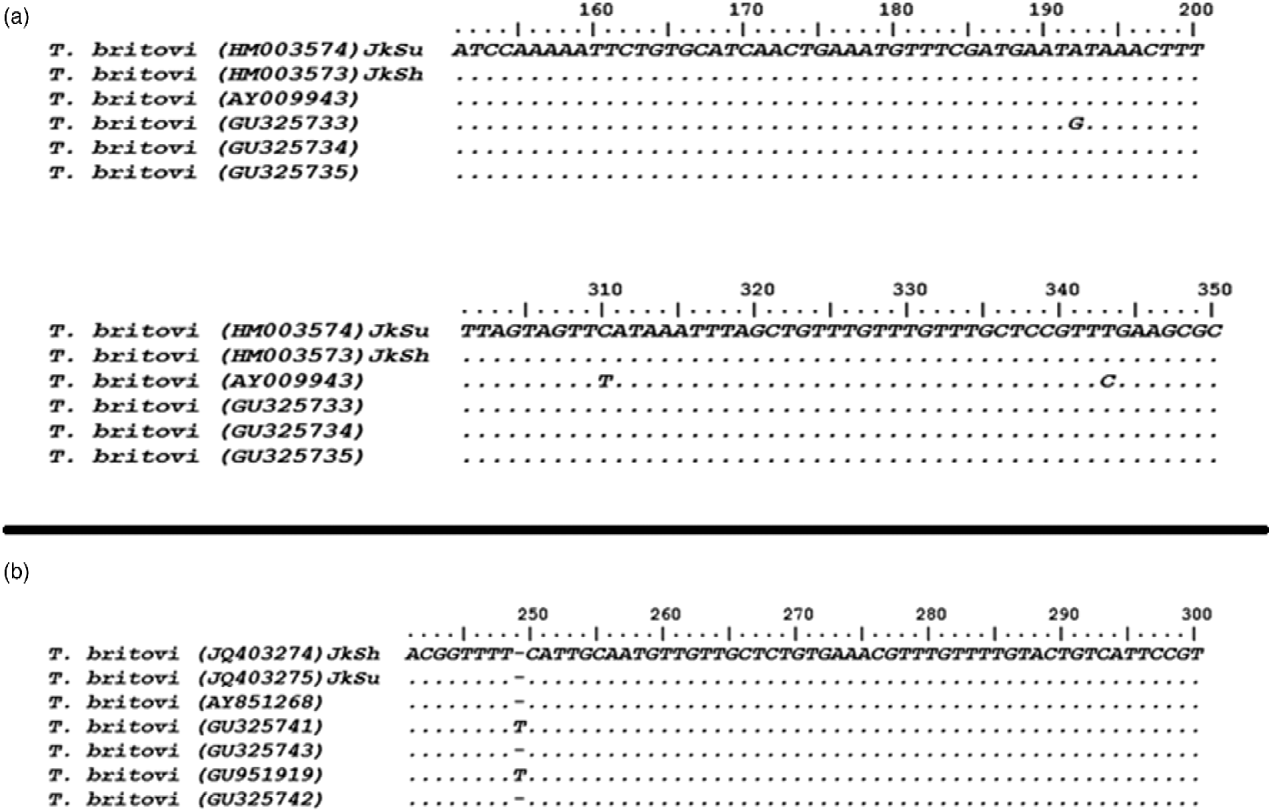
The 5S sequences of the JkSu and JkSh isolates showed 100% homology with two T. britovi isolates from Europe (accession numbers GU325734 and GU325735), but they showed one substitution (A to G substitution at position 192) with a T. britovi isolate from Iran (accession number GU325733), and two substitutions (C to T substitution at position 310, and T to C substitution at position 343) with a T. britovi isolate of unknown origin (accession number AY009943) (fig. 1a).
(a) The alignment of a partial sequence of the 5S ribosomal region of the two Iranian isolates of Trichinella britovi from golden jackals (GenBank accession nos HM003573 and HM003574), three T. britovi isolates from Europe (GenBank accession nos GU325733, GU325734 and GU325735) (Marucci et al., Reference Marucci, La Rosa and Pozio2010), and a T. britovi isolate of unknown origin (GenBank accession no. AY009943) (Rombout et al., Reference Rombout, Bosch and Van Der Giessen2001). (b) The internal transcribed spacer 2 rRNA gene of the two Iranian isolates of T. britovi from golden jackals (GenBank accession nos JQ403274 and JQ403275), three T. britovi isolates from Europe (GenBank accession nos GU325741, GU325742, GU325743 and AY851268) (Zarlenga et al., Reference Zarlenga, Rosenthal, La Rosa, Pozio and Hoberg2006; Marucci et al., Reference Marucci, La Rosa and Pozio2010), and a T. britovi isolate from Iran (GenBank accession no. GU951919) (Mowlavi et al., Reference Mowlavi, Marucci, Mobedi, Zahabiioon, Mirjalali and Pozio2009).

The ITS2 sequences of the JkSu and JkSh isolates exhibited 100% homology with three T. britovi isolates from Europe (accession numbers GU325742, GU325743 and AY851268), and a deletion at position 249 in comparison with a T. britovi isolate from Iran (accession number GU951919) and a T. britovi isolate from Europe (accession number GU325741) (fig. 1b).
Human trichinellosis is not commonly a major concern in Islamic countries as consumption of pork is forbidden according to religious codes. Rare incidences in these countries are usually seen among Christian minorities (Pozio & Darwin Murrell, Reference Pozio and Darwin Murrell2006). In a rural region in southern Lebanon, an outbreak occurred in a Christian village while no Muslim inhabitants in the nearby villages acquired the infection (Haim et al., Reference Haim, Efrat, Wilson, Schantz, Cohen and Shemer1997). However, this should not preclude careful and constant monitoring of meat markets in countries with laws forbidding pork comsumption. In 2004 in Turkey, a T. britovi outbreak involving 1095 people occurred following consumption of illegally mixed pork and beef by a meat supplier (Akkoc et al., Reference Akkoc, Kuruuzum, Akar, Yuce, Onen, Yapar, Ozgenc, Turk, Ozdemir and Avci2009).
Between 1961 and 1967, Trichinella sp. larvae were detected for the first time in two (0.04%) wild boars (Sus scrofa) hunted in the central-northern regions of Iran (Afshar & Jahfarzadeh, Reference Afshar and Jahfarzadeh1967). In 1973, Trichinella sp. larvae were detected in five (0.02%) wild boars, one (6.25%) brown bear (Ursus arctos), 38 (60%) golden jackals and two of three jungle cats (Felis chaus), from the Caspian Sea region in northern Iran (Mobedi et al., Reference Mobedi, Arfaa, Madadi and Movafagh1973). In another study, Trichinella sp. larvae were found in two stray dogs, ten golden jackals, two red foxes (Vulpes vulpes), one striped hyena (Hyena hyena) and one Persian gerbil (Meriones persicus) from Isfahan Province (central Iran) (Sadighian et al., Reference Sadighian, Arfaa and Movafagh1973). In 1978, Trichinella sp. larvae were detected in golden jackals (55.7%), red foxes (8.3%), striped hyenas (2 of 2), stray dogs (4.2%), wild boars (25.0%) and brown bears (6.2%) (Massoud, Reference Massoud, Kim and Pawlowski1978). The boars originated from southern region of Khuzestan, while the jackals came from the northern (Caspian), central (Isfahan) and southern (Khuzestan) regions (Mahdavi & Massoud, Reference Mahdavi and Massoud1987). In previous decades the mongoose (Herpestes auropunctatus) was found to be infected with Trichinella sp. larvae in south-western Iran (Mowlavi et al., Reference Mowlavi, Massoud and Rokni2000).
Previously most Iranian authors had identified the Trichinella sp. larvae isolated from wild animals as belonging to Trichinella spiralis, because at that time the multiple species concept of the genus Trichinella was under discussion (Dick, Reference Dick and Campbell1983). In 1983, four Trichinella isolates from Iranian golden jackals were identified by cross-breeding experiments as T. spiralis (one isolate from Sari, near the Caspian Sea) and as T. nelsoni (three isolates from the Khuzestan province) (Shaikenov & Boev, Reference Shaikenov and Boev1983). Today, the T. nelsoni (Britov & Boev, Reference Britov and Boev1972) isolates from the Palaearctic region are named T. britovi (Pozio et al., Reference Pozio, La Rosa, Murrell and Lichtenfels1992, Reference Pozio, Hoberg, La Rosa and Zarlenga2009; Murrell et al., Reference Murrell, Lichtenfels, Zarlenga and Pozio2000). Therefore the present data confirm the circulation of T. britovi in golden jackals of the Khuzestan Province. Prior to this study, T. britovi had been identified in a panther (Panthera pardus saxicolor) from the Ardabil province, north-western Iran (Mowlavi et al., Reference Mowlavi, Marucci, Mobedi, Zahabiioon, Mirjalali and Pozio2009). Recently, T. britovi was detected in stray dogs of north-eastern Iran (Borji et al., Reference Borji, Sadeghi, Razmi, Pozio and La Rosa2012). The presence of T. spiralis in a jackal from the town of Sari near the Caspian Sea can be explained by the passive introduction of this parasite from Georgia or Russia where T. spiralis was, and still is, present in both backyard and free-ranging pigs and wild animals (Bessonov, Reference Bessonov1994; Ozeretskovskaya et al., Reference Ozeretskovskaya, Mikhailova, Sabgaida and Dovgalev2005). The presence of punctiform deletions or substitutions in the 5S and ITS2 sequences of the two Iranian isolates of T. britovi studied in the present work falls within the observed variability range of these parasites (Marucci et al., Reference Marucci, La Rosa and Pozio2010).
Acknowledgements
The authors greatly appreciate the collaboration of Ahwaz Health Research Station. We also acknowledge Ms Neda Mirsepahi, Mr Ali Rahimi and Mr Reza Eskandari for their kind assistance in the field sampling and in vivo efforts throughout the study. We are also very grateful to Dr G. Marucci and Dr M. Interisano of the Istituto Superiore di Sanita', Rome, Italy, for their technical support. The work was supported by the National Health Research Institute and School of Public Health, Tehran University of Medical Sciences.