Implications
Increasing production in smallholder mixed-crop–livestock systems in order to respond to the increasing demand for animal-source food (and concomitantly contribute to poverty reduction, improved global food security and improved global environment) faces serious difficulties. In development and research activities aimed at livestock production in the tropics, the farm and the farmers’ perspective should be taken into account.
Introduction
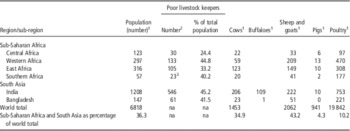
Livestock production in the tropics dominates the global scene when it comes to the number of animals, total output and number of beneficiaries – that is, producers and consumers (Table 1) – when compared with livestock production in the western world. Many contextual reasons make livestock production in the tropics different from that in the West. This was noticed when simple livestock technologies and organisational infrastructure, which were successful in high-production regions, proved unsuccessful when introduced in the tropics (Udo et al., Reference Udo, Aklilu, Phong, Bosma, Budisatria, Patil, Samdup and Bebe2011; Amankwah, Reference Amankwah2013; Sumberg and Lankoandé, Reference Sumberg and Lankoandé2013). Climate, resource availability, input and supply market functioning, social and cultural factors – individually and in complex interactions – create specific local opportunities and constraints for livestock production (Poole et al., Reference Poole, Chitundu and Msoni2013). The global importance, specificity and complex nature of livestock production in the tropics make the specialisation ‘tropical livestock production’ a relevant discipline within the Animal Sciences.
Human and livestock population (numbers in millions) in Sub-Saharan Africa and South Asia

1 FAO (2013).
2 Living below $2 per day (Herrero et al. (Reference Herrero, Grace, Njuki, Johnson, Enahoro, Silvestri and Rufino2013).
3 FAO (2013). Herrero et al. (Reference Herrero, Grace, Njuki, Johnson, Enahoro, Silvestri and Rufino2013) gave an estimate of 53 million poor livestock keepers in Southern Africa.
In recent times tropical livestock production has become more prominent in scientific and societal discourses for a number of reasons. First, in developing countries the consumers’ demand for meat, milk and eggs has increased considerably and will continue to do so (Food and Agriculture Organization of the United Nations (FAO, 2009). Second, the contribution of livestock production in the tropics to global greenhouse gas emissions is high (FAO, 2006; de Vries and de Boer, Reference De Vries and de Boer2009; Gerber et al., Reference Gerber, Vellinga, Opio and Steinfeld2011; Herrero et al., Reference Herrero, Gerber, Vellinga, Garnett, Leip, Opio, Westhoek, Thornton, Olesen, Hutchings, Montgomery, Soussana, Steinfeld and McAllister2011). Third, as many of the livestock keepers in the tropics are poor (Table 1) livestock improvement could lead to poverty alleviation (World Bank, 2007, 2009; Herrero et al., Reference Herrero, Grace, Njuki, Johnson, Enahoro, Silvestri and Rufino2013). See Supplementary Material S1 for background information about these drivers for change.
Scientific and policy literature in the field of tropical livestock production, explicitly or implicitly, presents an objective: to increase the intensity of livestock production in order to meet the increasing food demand; reduce the environmental impact of livestock production per unit animal product; and contribute to poverty alleviation (World Bank, 2007, 2009; McDermott et al., Reference McDermott, Staal, Freeman, Herrero and van der Steeg2010; Herrero et al., Reference Herrero, Grace, Njuki, Johnson, Enahoro, Silvestri and Rufino2013). Research and development, policy making and extension aiming to increase livestock production have been taking place since the middle of the twentieth century. However, sustained adoption of the intensification of livestock production has been relatively marginal, which led Sumberg (Reference Sumberg2002) to conclude: ‘[T]he... technologies have not been able to reliably and economically deliver benefits of interests to large numbers of African farmers’. Apparently, benefits perceived by others were insufficient in the farmers’ perspective to intensify their production and commercialise their marketing, or, in other words, the aforementioned discourses are not clearly connected to the reality of livestock farmers. We may assume that the reality of smallholders is complex and what may be a benefit or cost in their complex reality is insufficiently understood by scientists, policy makers and development practitioners (Sumberg, Reference Sumberg2002; Bernard and Spielman, Reference Bernard and Spielman2009; Jayne et al., Reference Jayne, Mather and Mghenyi2010; Amankwah, Reference Amankwah2013; Sumberg and Lankoandé, Reference Sumberg and Lankoandé2013). The present paper aims to highlight the possible and real discourses at the farmers’ level – that is, to identify reasons why farmers in the tropics perceive intensification of livestock production on their farms not simply as a benefit but also as a pathway towards increased costs, such as dependency on inputs and reduced resilience. We do this by describing the generic effects of intensification on farm size, the roles and functions of livestock within farms and the risks associated with competition between value chains, and we illustrate this by means of a modelling study in which we show the potential effects of interventions on production, methane emissions and animal functions.
Tropical livestock production systems
In this section we will describe the global farming systems with livestock production (FAO, 2009).
Mixed-crop–livestock systems
Mixed-crop–livestock systems are small farming systems with crops and livestock. Smallholder mixed-crop–livestock systems have developed in regions with relatively good conditions for agriculture. Farm sizes can be small (often less than 1 ha due to division of land within families) because small plots still give sufficient yields to sustain the families living from it. This implies that the best lands are often in smallholder regions where land has become a scarce resource. In less favourable regions, sizes of smallholder mixed-crop–livestock farms may be bigger, and land may be or seem less scarce. However, prospects for high production are also lower, because of these same unfavourable conditions. Smallholder mixed-crop–livestock systems often have an intensive land use, which is the cause for the strong interaction between crops and livestock (Tittonell et al., Reference Tittonell, Muriuki, Shepherd, Mugendi, Kaizzi, Okeyo, Verchot, Coe and Vanlauwe2010; Amankwah et al., Reference Amankwah, Klerkx, Oosting, Sakyi-Dawson, van der Zijpp and Millar2012). From the perspective of agro-ecology, the individual smallholder mixed-crop–livestock systems producing for the local markets can be regarded as elements of local ecosystems. In such local ecosystems, livestock contributes to cycling of nitrogen and phosphorus, contributes to crop production by its capital stock function and by supplying draught power and transport, and converts crop residues, household wastes and biomass of marginal lands to valuable food products (Udo et al., Reference Udo, Aklilu, Phong, Bosma, Budisatria, Patil, Samdup and Bebe2011).
Herrero et al. (Reference Herrero, Thornton, Notenbaert, Wood, Msangi, Freeman, Bossio, Dixon, Peters, van de Steeg, Lynam, Parthasarathy Rao, Macmillan, Gerard, McDermott, Seré and Rosegrant2010) estimated that with regard to animal-source food production in the tropics, 65% of beef, 75% of milk and 55% of lamb are produced in such mixed-crop–livestock systems. In Kenya, smallholder farmers in mixed-crop–livestock systems contribute about 60% to 70% of the national milk output (Bebe et al., Reference Bebe, Udo and Thorpe2002; Omiti et al., Reference Omiti, Wanyoike, Staal, Delgado and Njoroge2006; Omore et al., Reference Omore, Kurwijila and Grace2009) and milk contributes 70% of the total livestock revenue (Behnke and Muthami, Reference Behnke and Muthami2011; Onono et al., Reference Onono, Wieland and Rushton2012) and provides a livelihood to the majority of rural households.
Grazing systems
Grazing lands are found where conditions for crop production are unfavourable: where it is either too dry, too cold, too high or too steep for crop production. Pastoralist systems – that is systems in which ruminants and their herders follow the feed – are relatively efficient systems found in such areas (Ayantunde et al., Reference Ayantunde, de Leeuw, Turner and Said2011). Following an increasing demand for crops, grazing lands are gradually being turned into crop land through irrigation and fertilisation. In addition, a trend towards increased settling of pastoralists is reported in West and East Africa (Sendalo, Reference Sendalo2009; McCabe et al., Reference McCabe, Leslie and DeLuca2010).
Rangeland system is another form of grassland-based system, often characterised by an extensive form of beef production on big private properties reaching thousands of hectares. Productivity is low and intensification of rangeland production may occur through irrigation and fertilisation, but this may eventually result in turning the rangelands into crop lands (Kimani and Pickard, Reference Kimani and Pickard1998; Ayantunde et al., Reference Ayantunde, de Leeuw, Turner and Said2011).
Furthermore, smallholder mixed-crop–livestock systems may have a grazing component where grazing occurs on communal lands. Overgrazing is a big issue here (Hardin, Reference Hardin1968; Jones and Sandland, Reference Jones and Sandland1974; de Haan et al., Reference De Haan, Steinfeld and Blackburn1997; Kemp and Michalk, Reference Kemp and Michalk2007) because of high and increasing stocking rates. An important aspect of communal grazing lands is the nutrient transfer from these soils to farm homesteads through grazing animals (Rufino, Reference Rufino2008). This is beneficial for crop production at the homestead, but detrimental for the soil fertility and productivity of the communal grazing lands in the long run.
Industrial systems
In and around urban areas, very intensive systems, referred to as industrial systems, are found with pig, poultry and dairy production. Such systems benefit from urban infrastructure, from nearby markets, from by-products of urban and peri-urban processing industries and from urban wastes as inputs. Direct land use of such systems is often limited because of high land prices in and around cities. Consequently, industrial systems are highly dependent on rural farming systems for inputs such as basal feeds and breeding stock. In addition, accumulation of nitrogen and phosphorus occurs in such systems and sustainable disposal is often a problem (Schiere and van der Hoek, Reference Schiere and van der Hoek2001; Gerber et al., Reference Gerber, Chilondra, Franceschini and Menzi2005).
Scope for increased livestock production
Increased animal-source food production and the reduction of environmental impact and poverty are targets set for livestock production in the tropics.
Smallholder mixed-crop–livestock systems could largely contribute to these targets because of the following reasons: (1) there are many of them; (2) beneficiaries of these systems are poor (Table 1); (3) they already have an important contribution to food production; (4) they reside in high potential regions; and (5) they will remain the dominant farming system in the foreseeable future (Herrero et al., Reference Herrero, Thornton, Notenbaert, Wood, Msangi, Freeman, Bossio, Dixon, Peters, van de Steeg, Lynam, Parthasarathy Rao, Macmillan, Gerard, McDermott, Seré and Rosegrant2010).
Industrial systems with pig and poultry production close to urban areas could contribute to these targets as they are systems with high resource use efficiency resulting in high food output for growing urban populations and low environmental impact per unit of production (FAO, 2006).
The grazing systems could contribute to these targets as they occupy considerable amounts of land and, therefore, a small improvement per hectare could easily result in high overall improvement. Constraints for improvement are severe, however. Pastoralist systems are found in the most unfavourable and marginal conditions and settlement of traditional pastoralist occurs for socio-cultural reasons (Sendalo, Reference Sendalo2009; McCabe et al., Reference McCabe, Leslie and DeLuca2010; Ayantunde et al., Reference Ayantunde, de Leeuw, Turner and Said2011).
The present paper will focus on mixed-crop–livestock systems as they are the largest contributors to livestock outputs and they constitute the majority of livestock-keeping households.
Interventions and scientific disciplines
To narrow the gaps between productivity achieved under temperate and tropical conditions Animal Sciences at first studied and introduced purely western technologies such as breeds, housing systems, veterinary services, and feeds and feeding management to the tropics. Introduction and development of veterinary services were relatively successful (Bosman et al., Reference Bosman, Ayeni and Koper-Limbourg1996; Amankwah, Reference Amankwah2013) and had a good cost–benefit ratio (e.g. Aklilu, Reference Aklilu2007). However, many projects introducing other types of technologies failed in the short or long term (Poole et al., Reference Poole, Chitundu and Msoni2013; Sumberg and Lankoandé, Reference Sumberg and Lankoandé2013). Mortality rates among imported full-bred animals were high (de Jong, Reference De Jong1996), and improved housing systems and improved feeding practices were not widely adopted (Schiere, Reference Schiere1995; Bosman et al., Reference Bosman, Ayeni and Koper-Limbourg1996; Mekoya et al., Reference Mekoya, Oosting, Fernandez-Rivera and van der Zijpp2008). In Kenya, close to 80% of cattle farmers in the highlands keep exotic breeds, mainly breeds with a larger body size, which are perceived as producing more milk (Bebe et al., Reference Bebe, Udo, Rowlands and Thorpe2003a). So far, however, milk production per cow has remained relatively low and strategies to increase yields have not been adequately adopted (Bebe et al., Reference Bebe, Udo, Rowlands and Thorpe2003b). For example, despite the fact that herd improvement through artificial insemination with superior semen and herd replacement by high-quality heifers could potentially improve the productivity of cows, these strategies are not widely practised (Bebe et al., Reference Bebe, Udo, Rowlands and Thorpe2003a; Baltenweck et al., Reference Baltenweck, Ouma, Anunda, Mwai and Romney2004; Bebe, Reference Bebe2008).
It was realised that technologies had to be appropriate for tropical conditions, and research and development concentrated on appropriate technological development. Housing systems of local materials, (Bosman et al., Reference Bosman, Ayeni and Koper-Limbourg1996) attention for traction (Gryseels, Reference Gryseels1988), breeding with local cattle (Samdup et al., Reference Samdup, Udo, CAHM, Ibrahim and van der Zijpp2010), local feeds (Mekoya et al., Reference Mekoya, Oosting, Fernandez-Rivera and van der Zijpp2008) and practices (Schiere, Reference Schiere1995; de Jong, Reference De Jong1996) and taking into account genotype–environment interactions (Frisch and Vercoe, Reference Frisch and Vercoe1978; Seré et al., Reference Seré, van der Zijpp, Persley and Rege2008) should increase adoption by getting technology closer to the context of farmers. However, such appropriate technologies alone or in packages are not believed to have high adoption rates if not accompanied by good markets and measures to overcome institutional barriers (Barrett, Reference Barrett2008; Gildemacher et al., Reference Gildemacher, Kaguongo, Ortiz, Tesfaye, Woldegiorgis, Wagoire, Kakuhenzire, Kinyae, Nyongesa and Struik2009; Hounkonnou et al., Reference Hounkonnou, Kossou, Kuyper, Leeuwis, Nederlof, Röling, Sakyi-Dawson, Traoré and van Huis2012).
Therefore, economics and social science aspects were introduced into studies of tropical livestock production (e.g. Bosman et al., Reference Bosman, Ayeni and Koper-Limbourg1996; Aklilu, Reference Aklilu2007; Amankwah et al., Reference Amankwah, Klerkx, Oosting, Sakyi-Dawson, van der Zijpp and Millar2012; Sumberg and Lankoandé, Reference Sumberg and Lankoandé2013). Markets and value chains were studied as pull factors for production increase (e.g. Kilelu, Reference Kilelu2013). Input supply, milk and meat markets, chain logistics and farmers’ organisations were and are seen as important for development (e.g. the International Livestock Research Institute (ILRI), 2011; Kilelu, Reference Kilelu2013). The Social sciences, studying institutions and stakeholders, claim that organisational structures and formal and informal rules associated with them stimulate or hamper developments (Gildemacher et al., Reference Gildemacher, Kaguongo, Ortiz, Tesfaye, Woldegiorgis, Wagoire, Kakuhenzire, Kinyae, Nyongesa and Struik2009; Hounkonnou et al., Reference Hounkonnou, Kossou, Kuyper, Leeuwis, Nederlof, Röling, Sakyi-Dawson, Traoré and van Huis2012). Moreover, social aspects such as values and interests of stakeholders along the chain are regarded in the development process often through participative approaches (van Mierlo et al., Reference Van Mierlo, Regeer, van Amstel, Arkesteijn, Beekman, Bunders, de Cock Buning, Elzen, Hoes and Leewis2010).
This evolution in reasoning and in the actions taken in livestock (and other) development reflects the fact that tropical livestock production systems are complex and that they operate in complex environments. The literature on livestock production in the tropics by the authors mentioned in the previous sections reveals that most of them see the complex nature of tropical livestock systems and that they recommend interdisciplinary approaches to meet the objectives of development. However, the literature also reveals that the theoretical frameworks used within tropical livestock production research are the theoretical frameworks of the disciplines: that is, feeds, housing, breeding and health for animal sciences; markets and monetary flows for economics; and structures and values for social sciences. The conclusions and solutions offered to overcome constraints are kept within the framework of each individual discipline. Some authors seek a more integrated approach: Poole et al. (Reference Poole, Chitundu and Msoni2013) discussed the importance of local and individual context when it comes to commercialisation of smallholder agriculture; Pica-Ciamarra and Otte (Reference Pica-Ciamarra and Otte2011) reported variation between regions with regard to the development of demand for animal-source food; Sumberg and Lankoandé (Reference Sumberg and Lankoandé2013) demonstrated that just the supply of improved animals in an in-kind heifer scheme will not be the panacea for poverty; and Udo et al. (Reference Udo, Aklilu, Phong, Bosma, Budisatria, Patil, Samdup and Bebe2011) concluded ‘Without development policies that deliberately consider the opportunities and threats faced by mixed-crop−livestock farming households, many of these households are likely to be excluded from the increased market opportunities’.
In the next sections of the present paper we will present two approaches that allow for an integrated view on farming system development from the farm and farmers’ perspective. The first one looks at the value chain–livestock farming system interaction and the second one is a more technical model linking feed quality and availability to maximal and actual production of a total herd.
Livestock value chains and dynamics
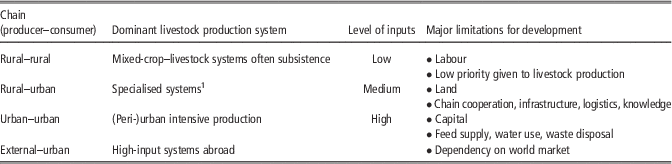
Development of a farming system does not happen in isolation. Farms are part of a value chain (here, broadly defined as the total chain of goods from input supply to a farm, through farm production, to market supply to the consumer via processing, marketing and retailing). We present here the so-called Livestock Value Chain Analytical Framework (LIVCAF). LIVCAF distinguishes four major livestock value chains, each associated with different production systems, roles and functions of animals within the production system, and constraints for development (see Table 2).
Livestock value chains, associated livestock farming systems and constraints

1 Pastoralism can be considered a system that can fluctuate between a subsistence system in lean years and a specialised, market-oriented system with high outputs in flush years.
Dynamics
The LIVCAF framework in Table 2 is used to illustrate the implications of the transition from smallholder subsistence farms to (more) specialised and commercial livestock farms. The emphasis will be on the transition from the rural–rural value chain to the rural–urban value chain. The peri-urban–urban value chain and the import chain may compete with the rural–urban chain and affect smallholder transition to this chain. Transitions from the rural–rural value chain to peri-urban or export value chains are possible: a rural farm could become a peri-urban farm when cities expand and/or better roads make the city ‘closer’; an export chain could develop, making local farmers producers for foreign urban markets. Production developments in such situations most likely follow the economic theory as most farms involved will already be commercial farms and will not be discussed in the present paper.
The rural–rural value chain is dominated by smallholder mixed-crop–livestock systems. The majority of world farmers operate in such systems and almost three billion people depend on such systems for their food supply (Herrero et al., Reference Herrero, Thornton, Notenbaert, Wood, Msangi, Freeman, Bossio, Dixon, Peters, van de Steeg, Lynam, Parthasarathy Rao, Macmillan, Gerard, McDermott, Seré and Rosegrant2010). Production is carried out in rural areas for the family. Local markets are the major outlet for surpluses and, more importantly, for selling livestock in times of emergency (Omiti et al., Reference Omiti, Otieno, Nyanamba and McCullough2009; Amankwah et al., Reference Amankwah, Klerkx, Oosting, Sakyi-Dawson, van der Zijpp and Millar2012). Such livestock outputs may reach urban markets but supply is irregular and of secondary importance for urban consumers. As stated before, livestock in mixed-crop–livestock systems supports crop production directly by delivering manure, traction and draught power. Indirect support from livestock for crop production is by serving as a capital store to be sold to buy seeds and fertilisers (Doumbia et al., Reference Doumbia, van Paassen, Oosting and van der Zijpp2012) or for emergencies (Udo et al., Reference Udo, Aklilu, Phong, Bosma, Budisatria, Patil, Samdup and Bebe2011; Amankwah et al., Reference Amankwah, Klerkx, Oosting, Sakyi-Dawson, van der Zijpp and Millar2012).
From the scientists’ and development agents’ perspectives such smallholder farms should achieve increased agricultural and livestock production. Technologies to increase production are available; the increasing demand for food creates good markets and we understand how farmers could overcome institutional constraints for innovation. However, it could be too easy to assume that the benefits of increased production and marketing will exceed increased monetary and non-monetary costs at the farm level.
First, production increase at a farm implies that the farm has to make a very drastic change with regard to the market they produce for. If more is produced than what the family can consume, farms will become market-oriented for part of their production, and if more than a few farms in a village increase their production local markets will become saturated. For perishable products such as milk and meat this market saturation often means a price reduction (Sharma et al., Reference Sharma, Staal, Delgado and Singh2003) and farms will have to aim at markets with a high demand, which are often in growing urban regions. Such urban market-oriented farms become part of the second value chain in Table 2: the rural–urban value chain. Farms in this value chain are more specialised than the ones in the rural–rural value chain, are market-oriented and they may follow the generic pattern as described by Whittaker (Reference Whittaker2000) for dairy development in New Zealand. At the moment, land availability limits the establishment of new farms (and this is the case in many tropical regions); a part of the existing farms expand at the expense of others (hence, farm enlargement and reduction in the number of farms) with a concomitant increase in the production per animal and per hectare. As a consequence, tropical farms with livestock production for urban markets are, compared with non-market-oriented farms, often bigger and obtain higher per-animal productivity through higher use of inputs, including external labour, land and capital (Tittonell et al., Reference Tittonell, Muriuki, Shepherd, Mugendi, Kaizzi, Okeyo, Verchot, Coe and Vanlauwe2010; Jayne et al., Reference Jayne, Mather and Mghenyi2010; Doumbia et al., Reference Doumbia, van Paassen, Oosting and van der Zijpp2012; Amankwah, Reference Amankwah2013). Inevitably, such farms are more specialised.
Second, the transition of livestock production from the informal rural–rural value chain to the rural–urban value chain implies that transport, processing and retail become important steps between a farmer and consumers. However, all stakeholders in these steps will want to take their share of the economic benefit, which may cause farm-gate prices in the rural-urban value chain to be lower than at local markets despite the higher consumer prices (Sharma et al., Reference Sharma, Staal, Delgado and Singh2003; Omore et al., Reference Omore, Kurwijila and Grace2009). Moreover, product quality demands in the rural–urban value chain are higher than in the rural–rural value chain because of processing requirements, the longer time span between production and consumption, and consumer preferences.
A third reason that limits the possibilities for smallholders to enter the rural–urban chain with increased livestock production is competition. Within farms, crop commercialisation competes with livestock commercialisation. Many smallholder crop–livestock producers already have a market-oriented crop, such as dry-season vegetables (Amankwah et al., Reference Amankwah, Klerkx, Oosting, Sakyi-Dawson, van der Zijpp and Millar2012), coffee (Oosting et al., Reference Oosting, Mekoya, Fernandez-Rivera and van der Zijpp2011) and rice (Doumbia et al., Reference Doumbia, van Paassen, Oosting and van der Zijpp2012). Livestock supports the production of these crops by supply of manure, transport and draught, and by acting as a capital store. Commercialisation of livestock production will at least partly affect these crop-supporting functions of livestock by demanding its share of available land, labour and credits.
A second competition for livestock is at the urban markets. As Table 2 illustrates, the peri-urban–urban chain produces predominantly for the urban markets. Peri-urban production may have comparative advantage over rural production because of economics of scale, better infrastructure for inputs and outputs, and better connection with urban markets. Imports also compete with rural products at urban markets; imports of chicken legs and wings, cheap because they are the least preferred parts in the region of origin (the EU), are considered a major obstacle for poultry production development in Senegal, Ghana and the Ivory Coast (Dieye et al., Reference Dieye, Duteutre, Cuzon and Dia2007) even for production by peri-urban farms (Mahama et al., Reference Mahama, Andah, Amegashie and Mensah-Bonsu2013).
It should be stated that chains may also benefit from each other: The Indian National Dairy Development Board used gains made on reconstituted milk from imports of cheap milk powder to support local milk production by smallholders (Candler and Kumar, Reference Candler and Kumar1998), and feed required by peri-urban livestock farming systems may open a new market horizon for rural smallholders.
From the previous section it can be concluded that livestock production increase is a big step for smallholders as it implies internal changes within the farm, and production for new markets in new value chains with different price settings and different quality demands. It can be questioned whether such big steps are easily made, especially because they affect the way in which farms have to deal with perturbations (external and internal disturbances of the system – e.g. drought, floods, diseases, competition, wars, etc.). The smallholder mixed-crop–livestock farms in the rural–rural value chain are resilient when judged on their ability to retain the functionality of providing livelihood to families in times of perturbations because of the following reasons: (1) the diversity of farm activities and magnitude of the livestock herd or flock; (2) the low dependency on inputs; (3) the low dependency of farm activities on inputs derived from other farm activities (referred to as interdependency); and (4) the low dependency on markets (Dahl and Hjort, Reference Dahl and Hjort1976; Kitano, Reference Kitano2004; Ten Napel et al., Reference Ten Napel, van der Veen, Oosting and Groot Koerkamp2011). Farms in the rural–urban value chain became specialised and consequently less diverse, and acquired more dependency within the farm (e.g. where feed crops are grown for livestock, if one of the two activities fails, both fail) and within value chains, with regard to availability, prices and quality requirements. Such specialised farms may be robust in times of perturbations, but they have to take institutional or technological measures to prevent perturbations to affect the system – for example, irrigation to prevent droughts; housing systems to protect livestock against climate, diseases and predators; creation of external feed supply chains to assure feed supply; and disease prevention measures. If such measures fail, such farms should be well insured to avoid a total collapse of the system (Ten Napel et al., Reference Ten Napel, van der Veen, Oosting and Groot Koerkamp2011).
The transition process is not a gradual process (Sharma et al., Reference Sharma, Staal, Delgado and Singh2003; Udo et al., Reference Udo, Aklilu, Phong, Bosma, Budisatria, Patil, Samdup and Bebe2011). A subsistence smallholder farm could keep a relatively small number of animals (up to 20 to 30 chickens) without investments. A larger number of animals requires investments in housing, feed and veterinary inputs and many more animals should be kept to cover the investment costs (Aklilu, Reference Aklilu2007). Hence, the transition of rural–rural to the rural–urban value chain can be considered a system jump.
Tittonell et al. (Reference Tittonell, Muriuki, Shepherd, Mugendi, Kaizzi, Okeyo, Verchot, Coe and Vanlauwe2010) described three pathways for the dynamics of smallholder crop–livestock farmers: (1) market orientation (2) increasing dependency on off-farm income or (3) marginalisation. These pathways were characterised by Dorward et al. (Reference Dorward, Anderson, Nava, Pattison, Paz, Rushton and Sanchez Vera2009) as stepping up, stepping out and hanging in, respectively. Resource endowment, which could be the cause or effect of a stronger market orientation, was better for market-oriented farmers. Doumbia et al. (Reference Doumbia, van Paassen, Oosting and van der Zijpp2012) illustrated such a pattern for Mali. Rice farmers with better resource endowment – for example, a cattle herd that provided manure, cash and traction animals – had a relatively good position in rice production, whereas those lacking livestock had to rely on working off-farm with a marginalised income from crop production.
The question is whether the process of increased market orientation could occur to all farmers in a community concomitantly. As the theory of Dorward et al. (Reference Dorward, Anderson, Nava, Pattison, Paz, Rushton and Sanchez Vera2009) and results of Tittonell et al. (Reference Tittonell, Muriuki, Shepherd, Mugendi, Kaizzi, Okeyo, Verchot, Coe and Vanlauwe2010) and Doumbia et al. (Reference Doumbia, van Paassen, Oosting and van der Zijpp2012) show, it is likely that a fraction of farmers will step up and that a portion will remain where they are – that is, hang in or (at least partly) step out. Developments in non-tropical regions, where the number of farms reduced drastically (Whittaker, Reference Whittaker2000), suggest that production increase is associated with diminishing farm number and farm enlargement as a result of the need for economics of scale. Hence, developing farmers will be a pull factor on the labour and land of marginalised farmers. As a consequence, in the long term a considerable part of the smallholders in a village will not be part of the development: a part of them will have to become labourers in their community or migrate to urban areas to find employment (Jayne et al., Reference Jayne, Mather and Mghenyi2010; Tittonell et al., Reference Tittonell, Muriuki, Shepherd, Mugendi, Kaizzi, Okeyo, Verchot, Coe and Vanlauwe2010; Udo et al., Reference Udo, Aklilu, Phong, Bosma, Budisatria, Patil, Samdup and Bebe2011).
Farm-level perspective
In the next section an approach is presented that studies the whole herd rather than individual animals and contributes to understanding the farmers’ perspective with regard to animal breeding, feed improvement and the valuation of non-production functions of animals.
If availability of high-quality feeds is limiting livestock production, such high-quality feeds are imported. This is especially true in the west. In most tropical regions, however, export of high-quality feeds is more likely than imports; for the vast majority of production systems in developing countries it can be stated that livestock production follows feed availability. Feeding according to the animals’ requirements is not common practice (Schiere, Reference Schiere1995).
This was modelled for dairy production in a small (virtual) region with a total annual availability of 1000 tonnes of feed dry matter (DM) on the basis of information from studies by Zemmelink et al. (Reference Zemmelink, Ifar and Oosting2003) and Abegaz et al. (Reference Abegaz, van Keulen and Oosting2007). This availability of feeds determines livestock production. Dairy is presented here as a representative example for ruminant production; modelling for beef, sheep or goat production revealed similar conclusions.
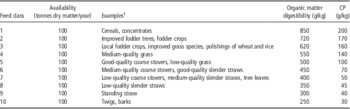
The assumption is that the total feed base consists of 10 equal quantities of 100 tonnes of DM, referred to as class 1 for the best feeds up to class 10 for the worst feeds (see Table 3).
Regional availability and quality of feed

1 Adapted from Zemmelink et al. (Reference Zemmelink, Ifar and Oosting2003) and Abegaz et al. (Reference Abegaz, van Keulen and Oosting2007).
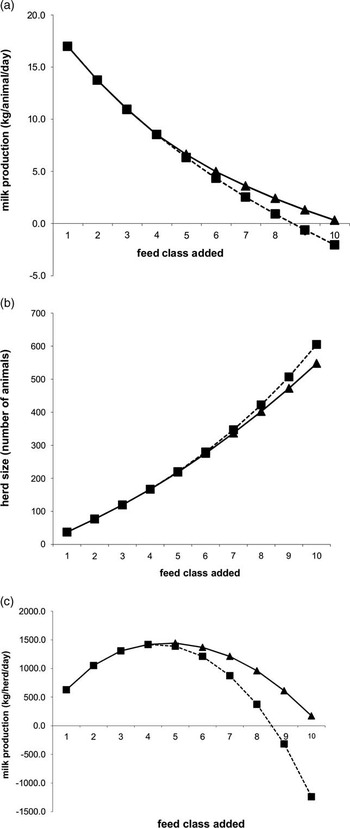
At a low stocking rate (defined as the number of dairy cows relative to the total feed base), cows can select or be given the best-quality feeds. With an increasing number of cows, more feed classes need to be included in the diet and the (mixed) diet’s quality will decrease with decreasing individual animal production (Figure 1a), an increasing herd size maintained on the feed base (Figure 1b) and a curvilinear relationship with total herd production (which equals herd size times production per animal; Figure 1c). Intake and dairy production were modelled for cows of 400 kg on the basis of studies by Ketelaars and Tolkamp (Reference Ketelaars and Tolkamp1992) and Zemmelink et al. (Reference Zemmelink, Ifar and Oosting2003).
Effect of inclusion of feeds of different quality in the diet (class 1 is the best, class 10 is the worst) on individual daily milk production (a), herd size (b) and total herd daily milk production (c) for untreated (dotted line, squares) and treated (e.g. by urea or ammonia) feeds in class 5 up to 10 (straight line, triangles).

Figure 1c shows maximal herd output when up to class 4 feeds are being utilised. Inclusion of more feeds in the diet (and feeding more animals) reduced the total herd output. In the present modelling study we estimated maximal herd output to be 1419 kg milk/day when up to class 4 feeds were used and fed to a herd of 167 cows.
The first implication of Figures 1a to 1c is that maximal herd output in a situation of fixed feed availability is not achieved at the highest production per individual animal. This implies that genotype–ration-quality interactions may be of importance. Selection of breeds and genotypes within breeds with highest performance on high-quality diets might perform worse than other genotypes at the feed quality for maximal total herd output.
A second implication is that meeting non-production functions of animals goes at the expense of total herd output. Using a similar modelling approach, Zemmelink et al. (Reference Zemmelink, Ifar and Oosting2003) and Abegaz et al. (Reference Abegaz, van Keulen and Oosting2007) observed for regions in Indonesia and Ethiopia, respectively, herds with many more animals than the herd size for maximum production. If we, in the present example, assume that up to class 7 feeds are fed in order to maintain more animals to meet non-production functions such as manure production, traction and transport and capital store (all of which are favoured by a high number of animals) then 347 animals can be maintained with a total output of 875 kg of milk/day. Hence, 514 kg of milk is sacrificed to support 180 additional animals, and benefits of non-production functions are equivalent to at least the value of 514 kg of milk/day. The estimate of the value of non-production functions could be higher if monetary values are given to the non-production functions of livestock, as suggested by Moll (Reference Moll2005).
A third implication is the effect of feed improvement. Feed improvement can be achieved by treatment of low-quality feeds or by introduction of better feeds (Gerber et al., Reference Gerber, Vellinga, Opio and Steinfeld2011; Hristov et al., Reference Hristov, Oh, Lee, Meinen, Montes, Ott, Firkins, Rotz, Dell, Adesogan, Yang, Tricarico, Kebreab, Waghorn, Dijkstra and Oosting2013). In the present example we elaborate the effect of treatment with low-quality feeds. Sarnklong et al. (Reference Sarnklong, Cone, Pellikaan and Hendriks2010) reviewed options for treatment with rice straw. The rice straw in their paper is representative of low-quality grass and crop residue, say for feeds in classes 5 up to 8 in Table 3. Chemical treatments (e.g. urea, ammonia or NaOH) and biological treatments (by growing fungi on the straw or by administering fungal enzymes to the straw) all aim to improve straw digestibility by loosening the cell wall structure and making the hemicellulose and cellulose fractions more readily available for rumen digestion. Urea treatment is the most propagated treatment in developing countries. The low-quality feed is mixed with an equal weight of a 0.5% to 3% urea solution and stored under airtight conditions for at least a week. Ammonia will be formed from the urea and the alkaline conditions will affect cell wall confirmation and improve intake and digestibility. An additional benefit is the provision of nitrogen through the treatment.
The effect of treatment is negatively related to the quality of the feed – that is, absolute and relative treatment effects were higher for lower than for higher quality feeds and effects are negligible above an organic matter digestibility (OMD) of 550 g/kg (based on Oosting, Reference Oosting1993). For the modelling study it was assumed that ammonia, urea, NaOH and biological treatments yielded similar effects on OMD.
These principles were applied to the feed classes of Table 3 – that is, only feed classes 5 and higher were treated and treatment effect was higher for the lowest (class 10) feeds (OMD going from 250 to 400 g/kg) than for the class 5 feeds (OMD from 500 to 530 g/kg). The effects are presented as solid lines in Figures 1 and 2. Treatment improved milk production of individual animals and the optimum feed inclusion for total herd production changed from class 4 to class 5 at almost the same output level. The major effect was that more animals could be kept without a reduction in milk output. In our example, even some of the class 9 feeds could be fed after treatment, maintaining a total herd output of 875 l, by almost 450 animals.
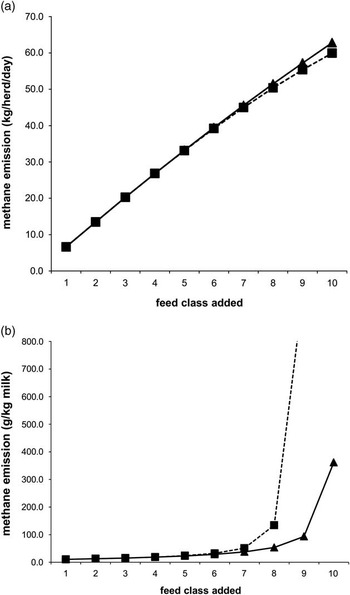
Methane emissions for the total herd (a) and per kg of milk produced (b) for untreated (dotted line, squares) and treated (e.g. by urea or ammonia) low-quality feeds (straight line, triangles).

Economics, labour needs and practical feasibility (e.g. fungal treatment is promising on laboratory scale, but process control is difficult in piles of material because of fermentation heat) have made adoption of treatments poor (Schiere, Reference Schiere1995). Roy and Rangnekar (Reference Roy and Rangnekar2006) described one successful case of urea treatment in India, where treatment helps farmers overcome storage problems in humid conditions.
A fourth implication is the study of methane emissions. Enteric methane emissions were estimated on the basis of the models of Commonwealth Agricultural Bureaux (ARC) (1980) and Oosting et al. (Reference Oosting, Boekholt, Los and Leffering1993) assuming a linear decrease in methane energy produced as a fraction of digestible energy intake (DEI) with increasing quality of the diet (i.e. methane varying from 120 J/kJ DEI for the poorest feed (class 10) to 75 J/kJ DEI for the best feed (class 1)). Increasing inclusion of lower quality feeds resulted in an almost linear increase in methane emissions from the herd (Figure 2a) and in an exponential increase in methane emissions per kg of milk (Figure 2b). Treatment (the solid lines in Figures 1 and 2) had only marginal direct effects on methane emissions. However, the indirect effect through milk production increase is obvious (see Figure 2b).
For the diet with the highest herd production (up to class 4 included), methane emissions were 18.9 g/kg of milk, and with the inclusion of feeds up to class 7 in order to feed a multifunctional herd the emissions were estimated to be 51.4 g/kg of milk. In the latter case, a part of the emissions should be attributed to the non-production functions of livestock. Earlier, we concluded that the economic benefit of the non-production functions was at least equivalent to 514 kg of milk/day. Thus, a fraction (equal to production sacrificed/total potential production=514/1419) of 0.36 should be attributed to the non-production functions. The outcome is that 32.8 g CH4/kg of milk is the methane emission attributable to the milk production. These estimates are much lower than those by Gerber et al. (Reference Gerber, Vellinga, Opio and Steinfeld2011), but still higher than estimates for the Netherlands of 12 to 13 g CH4 emissions/kg of milk (De Haas et al., Reference De Haas, Calus, Mulder, de Haan, Bannink, Dijkstra, Windig and Veerkamp2011). Nevertheless, Figure 2b shows that reduction in stocking rates will reduce methane emissions per kg of milk produced. This mitigation option is highly recommended as it is also beneficial for livestock output (Figure 1c) and it lowers the impact of livestock production on nature, water and other agricultural land use.
Decreasing herd size will occur only if the benefits outweigh the costs of losing non-production functions. Hence, artificial fertilisation, short- and long-term financial institutions and mechanisation should become available reliably and at low cost (Udo et al., Reference Udo, Aklilu, Phong, Bosma, Budisatria, Patil, Samdup and Bebe2011). Regulatory measures (taxes and quota) could reduce the benefits of keeping many animals.
If the non-production livestock functions could partly be replaced by technology and institutions (the aforementioned artificial fertilisation, short- and long-term financial institutions and mechanisation), then whole farm production increase could go along with strengthened agro-ecological values: less livestock would imply less pressure on lands with increased food security and income. Nevertheless, there will be the need to find balances between intensification of crop and livestock production on the one hand and the agro-ecological health of farming systems on the other. Trade-offs between intensification and agro-ecological values should be analysed and understood. Hence, it is a challenge for tropical livestock production research to find ways to deal with issues such as undesired loss of biodiversity – for example, when local breeds are replaced by high-producing exotic ones; social changes when farm intensification leads to fewer farms; and threatened resilience of farming systems when technologies and institutions fail in times of crisis.
Conclusion
The present review presented two approaches for analysis of the farm perspective of production improvement. Both show that the presumed generic drivers for livestock development – increasing demand for animal-source products and desire of smallholders to escape from poverty – meet important barriers at the farm and value chain level. The LIVCAF framework sheds light on constraints for commercialisation, such as the inevitable change of the subsistence-oriented farming system, with its mechanisms of resilience, into a more specialised, land-requiring urban market-oriented farming system, which has to deal with lower prices, more competition and higher-quality demands. Moreover, there is only limited scope for a gradual shift from subsistence to commercial. Benefits of such transition will first meet mountains of monetary and non-monetary costs, which may explain, at least partly, the resistance to adoption.
The modelling study showed that limited feed availability affects breeding objectives and feed improvement. The model gives a tool for quantifying the contribution of non-monetary functions to a farmer or a farming community. Farmers sacrifice production in order to maintain other functions of cattle. Zemmelink et al. (Reference Zemmelink, Ifar and Oosting2003), Abegaz et al. (Reference Abegaz, van Keulen and Oosting2007), Budisatria et al., (Reference Budisatria, Udo, CHAM and van der Zijpp2007) and Udo et al. (Reference Udo, Aklilu, Phong, Bosma, Budisatria, Patil, Samdup and Bebe2011) all argue that farmers optimise on the basis of maximal output of all functions combined and not on milk or meat production alone.
Both approaches presented in this paper focus on the farming system as a whole. The outcomes complement those of constraint studies on the level of inputs, markets and institutions.
Acknowledgements
The authors kindly acknowledge Laura Webb for critically reading the manuscript and for correction of the English language.