Contaminated environmental surfaces in hospitals contribute to the spread of healthcare-associated pathogens. Reference Otter, Yezli, Salkeld and French1–Reference Donskey3 However, reported levels of microbial burden in earlier studies have varied considerably. Reference Huslage, Rutala, Gergen, Sickbert-Bennett and Weber4–Reference Shams, Rose and Edwards6 Lack of agreement between earlier studies can be explained in part by differences in the types of surfaces and areas of the hospital sampled, culture methods, cleaning and disinfectant products used, timing of sampling relative to cleaning and disinfection procedures, and method of reporting results. Reference Rutala, Kanamori and Gergen7–Reference Hayden, Bonten, Blom, Lyle, van de Vijver and Weinstein12 To further study the issue of the microbial burden on environmental surfaces in hospitals, we analyzed the level of contamination of selected surfaces by obtaining cultures before daily cleaning in patient rooms during a trial comparing 2 commercially available hospital disinfectants.
Methods
Study design
Cultures of selected surfaces were obtained during an 11-month prospective cluster-controlled crossover trial that compared the efficacy of a quaternary ammonium (Quat) disinfectant versus an improved hydrogen peroxide (IHP) disinfectant. Reference Boyce, Guercia and Sullivan10 The trial was conducted on 2 medical wards located on one campus, and on an intensive care unit (ICU) and a step-down unit (SDU) located on the other campus of a large university-affiliated hospital. On each campus, 2 wards were randomized to have housekeepers perform daily and discharge cleaning using ready-to-use wipes containing an IHP disinfectant or to continue using a Quat disinfectant used in the rest of the hospital. Wipes used to apply both products were made of melt-blown polypropylene. During months when study wards were assigned to use the Quat disinfectant, rooms of patients with Clostridioides difficile infection (CDI) were cleaned daily and at discharge with bleach wipes. When study wards were assigned to use the IHP disinfectant, all Quat-based wipes and bleach wipes were removed from the wards, bleach wipes were not used for daily or discharge cleaning of rooms occupied by patients with CDI, and the same IHP disinfectant in solution form was used to clean floors. After the first 5-month study period (October 2014–February 2015, period 1), the disinfectant used on each ward was switched for the remaining 6 months (March–August 2015, period 2).
On each of the 4 study wards, 5–8 high-touch surfaces in a convenience sample of patient rooms were marked each month by fluorescent marker and cultured before cleaning. They were checked for the presence or absence of fluorescent marker after cleaning. The percentage of marked surfaces that were wiped (cleaning compliance rates) after cultures had been obtained were recorded monthly for each ward and were used as an estimation of the thoroughness of disinfection. The high-touch surfaces included surfaces near patients (ie, bedside rails, TV remotes, overbed tables), in bathrooms (ie, toilet seat and bathroom grab bar), and other surfaces farther away from patients (ie, supply cart keyboards, counters and computers on wheels in patient rooms). Bedside rails, TV remotes, and overbed tables were present on all wards. Toilet seats and bathroom grab bars were present only on medical wards, whereas supply carts, counters, and computers on wheels were present only in the ICU and SDU. The type of room (isolation room vs nonisolation room) was recorded on the days on which cultures were obtained.
Sample collection and processing
Before routine daily cleaning by housekeepers on weekdays, replicate organism detection and counting (RODAC) plates (Remel, Lenexa, KS) containing Dey-Engley (D/E) neutralizing agar were used by a single microbiologist to sample high-touch surfaces on multiple occasions in varying rooms over 11 months. RODAC plates (1 per surface sampled) were incubated at 36°C for 72 hours, and the number of colonies per plate (aerobic colony counts, ACC) was determined by a single microbiologist. Culture results for each site were also expressed as the number of colony-forming units (CFU)/cm2. Surfaces with ≥2.5 CFU/cm2 were considered “dirty.” Reference Dancer, White and Robertson11
Statistical methods
Bivariate analysis was performed using Mann-Whitney U and Kruskal-Wallis tests. The distribution of ACC values was examined using the Kolmogorov-Smirnov test. Because the distribution of ACCs was overdispersed, ACCs were analyzed by general estimating equations using negative binomial distribution with an independent covariance structure (SSPS, version 24 software, IBM, Armonk, NY). Because not all sites were present on all wards (eg, no bathrooms in ICU and SDU rooms), we examined ICU and SDU separately from the 2 medical wards.
Results
Overall, 590 cultures were obtained on Quat wards and 589 cultures were obtained on IHP wards. The mean ACC per RODAC plate for all 1,179 surfaces was 55.6 (median, 24.0; variance, 4,484). The high variance was due to a substantial number of ACCs that were ≤10 and ≥200, resulting in an overdispersed distribution (Fig. 1). Mean total ACCs per room did not differ significantly between Quat months and IHP months (310 vs 286 CFUs per room), respectively. Mean and median ACCs were calculated for the following factors: study period, cleaning compliance rate, disinfectant used, ward, surface sampled, and isolation room status. The overall mean cleaning compliance rate during period 1 was significantly lower than during Period 2 (75.9% vs 91.7%, respectively; P < .0001). This result was due in part to suboptimal performance of some housekeepers in period 1, which improved with continued feedback. However, the mean cleaning compliance rates for ward months when Quat was used and ward months when IHP was used were similar (85.3% vs 83.8%, respectively). Mean cleaning compliance rates for the 2 medicine wards combined (81.8%) was lower than the rate for the ICU and SDU combined (87.3%), but the difference was not statistically significant.
Frequency distribution of aerobic colony counts (ACCs) per RODAC plate (N = 1,179). Note. RODAC, replicate organism detection and counting.

Mean ACCs varied significantly by ward, with higher AACs on medical wards than in the ICU and SDU when all sites were considered, and when only sites present on all wards (ie, bedside rails, TV remotes, and overbed tables) were included in the bivariate analysis (P < .001 for both comparisons) (Table 1). Mean ACCs differed significantly by type of surface, with the highest mean ACCs occurring on surfaces near patients and in bathrooms. Overall, 341 of 1,179 (28.9%) of surfaces had ≥ 2.5 CFU/cm2 and would be classified as “dirty” before daily cleaning. Using this criterion, the “dirtiest” surfaces were also toilet seats (58.6%), bedside rails (52.1%), and bathroom grab bars (43.6%).
Analysis of Aerobic Colony Counts, by Factor, Using Mann-Whitney U Test or Kruskal-Wallis Test

Note. ACC, aerobic colony counts; IHP, improved hydrogen peroxide; ICU, intensive care unit; SDU, step-down unit.
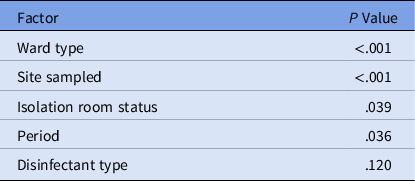
Mean ACCs also varied significantly by ward type, isolation room status, and study period (Table 2). Mean ACCs were significantly higher on medical wards, in nonisolation rooms, and during period 2 (Table 2). For the 2 medical wards, the cleaning compliance did not correlate with the outcomes, nor did we detect any significant 3-way interaction. In the ICU and SDU, we detected no significant interactions of the factors and no significant effect of cleaning-compliance rates.
Multivariable Analysis of Aerobic Colony Counts (ACC), by Factor, Using Poisson Regression Analysis

Discussion
One of the unique aspects of the current study was the combination of factors included in the analysis that could potentially affect estimates of the microbial burden on hospital surfaces. To the best of our knowledge, this was the first study to use multivariable analysis to assess the potential impact of disinfectant type, period, type of surface sampled, ward, cleaning compliance rates, and isolation room status on microbial burden levels present on surfaces before daily cleaning. We chose to analyze ACCs on surfaces before daily cleaning because they reflect the amount of contamination that has accumulated since daily cleaning the previous day, they are higher than levels obtained after daily cleaning, Reference Hayden, Bonten, Blom, Lyle, van de Vijver and Weinstein12–Reference Claro, O’Reilly, Daniels and Humphreys16 and they are presumably more likely to represent the levels of microbial burden that can result in healthcare personnel hand contamination. Reference Hayden, Bonten, Blom, Lyle, van de Vijver and Weinstein12,Reference Bhalla, Aron and Donskey17
Factors that remained statistically significant by multivariable analysis included time of year, type of surface, ward type, and isolation room status. The reason that levels of contamination were higher in the spring and summer than during other times of the year remains unclear. The overall cleaning compliance rate was higher during the spring and summer, suggesting that variables such temperature, humidity, or other unmeasured variables may have affected seasonal microbial levels. We were not able to assess the role of personnel turnover as a potential factor. The finding that mean ACCs were significantly different by type of surface is consistent previous studies conducted before daily cleaning. Reference Wilson, Smyth and Moore14,Reference Claro, O’Reilly, Daniels and Humphreys16,Reference Schmidt, Attaway Iii, Fairey, Steed, Michels and Salgado18–Reference Faires, Pearl and Ciccotelli20 Our finding that bedside rails had high ACCs is consistent with results from other microbial burden surveys. Reference Moore, Muzslay and Wilson5,Reference Wilson, Smyth and Moore14,Reference Adams, Smith, Watson, Robertson and Dancer19–Reference Mulvey, Redding and Robertson21 Surfaces near patients had higher mean ACCs than other surfaces, a finding similar to results of several previous surveys conducted at various times relative to cleaning procedures. Reference Moore, Muzslay and Wilson5,Reference Shams, Rose and Edwards6,Reference Tanner, Leecaster and Zhang8,Reference Mulvey, Redding and Robertson21 We also found that surfaces in patient bathrooms had high ACCs, which is consistent with the study by Moore et al Reference Moore, Muzslay and Wilson5 but differs from the study by Tanner et al, Reference Tanner, Leecaster and Zhang8 which did not include toilet seats.
Mean ACCs differed significantly by ward type, a finding reported in other studies. Reference Moore, Muzslay and Wilson5,Reference Claro, O’Reilly, Daniels and Humphreys16 Based on our findings, it is unlikely that the somewhat lower mean cleaning compliance rate on medical wards would, by itself, account for mean ACCs on medical wards being more than twice as high as on the ICU and SDU (Table 1). Other possible explanations include the presence of bathrooms in medical ward patient rooms (but not ICU and SDU rooms), the number of visitors, or differences in the characteristics of patients housed on the different wards, such as their level of ambulation, Reference Moore, Muzslay and Wilson5 or other clinical factors. Notably, only 27.3% of surfaces sampled on medicine wards were in isolation rooms, whereas 54.7% of surfaces sampled in ICU and SDU rooms were in isolation rooms (P < .0001). This finding is germane because mean ACCs were significantly lower in isolation rooms than in nonisolation rooms (Table 1). The use of bleach may have resulted in lower ACCs in isolation rooms housing patients with CDI on Quat wards. To the best of our knowledge, analysis of microbial burden by isolation room status was not addressed in other studies in which cultures were routinely performed before daily cleaning. Reference Wilson, Smyth and Moore14–Reference Claro, O’Reilly, Daniels and Humphreys16,Reference Adams, Smith, Watson, Robertson and Dancer19–Reference Deshpande, Dunn and Fox22 In contrast, in 2 other studies conducted at various times during the day, ACCs were greater in nonisolation rooms. Reference Moore, Muzslay and Wilson5,Reference Tanner, Leecaster and Zhang8 Overall average cleaning compliance rates were not an independent predictor of the differences in ACCs by type of ward, perhaps due to the following factors: compliance rates were determined on only 39 of the 335 days during the study, housekeeper ward assignments varied, and compliance rates when the person was obtaining samples may not have reflected housekeeper performance on the days before cultures were performed.
Our study had several limitations. It was conducted on only 4 wards located on 2 campuses of a single tertiary-care hospital and may not reflect before daily cleaning microbial burden in other types of facilities. ACCs in our study likely represent underestimates because we sampled each surface with a single RODAC plate. We did not record the indication for isolation rooms (CDI vs MDROs). Bleach was used in isolation rooms of CDI patients on Quat wards; thus, Quat ACCs for some isolation rooms may have been low because bleach-based disinfection often yields ACCs lower than Quats. Reference Rutala, Kanamori and Gergen7,Reference Cadnum, Hurless, Kundrapu and Donskey23 Hand hygiene compliance rates were not included in the analysis. However, reported hand hygiene compliance rates when the Quat disinfectant was used were nearly identical those when the IHP disinfectant was used (95.5% vs 95.8%, respectively). Reference Boyce, Guercia and Sullivan10 Our analysis included only total ACCs, and we did not identify healthcare-associated pathogens. Surfaces with very low ACCs were probably contaminated with very few pathogens. However, surfaces with high ACCs were not necessarily contaminated with pathogens because overall ACCs do not correlate well with the level of pathogens present. Reference Shams, Rose and Edwards6,Reference Tanner, Leecaster and Zhang8,Reference Deshpande, Dunn and Fox22,Reference Widmer, Frei, Romanyuk, Tschudin Sutter and Widmer24
The levels of microbial burden in the present study are difficult to compare to those reported in earlier studies due to the wide variety of study designs, microbiological methods used, and reporting formats used (Table 3). Studies have varied based on the timing of sampling procedure relative to when surfaces were cleaned, sampling methodology, the presence or absence of neutralizer(s) in contact plates or during processing of samples, the type(s) of cleaning and/or disinfectant agents routinely used on surfaces, types of surfaces sampled, wards included, differences in cleaning and disinfection practices, hand hygiene performance, colonization pressure, and antimicrobial usage patterns. Reference Huslage, Rutala, Gergen, Sickbert-Bennett and Weber4–Reference Chen, Knelson and Gergen9,Reference Wilson, Smyth and Moore14–Reference Claro, O’Reilly, Daniels and Humphreys16,Reference Schmidt, Attaway Iii, Fairey, Steed, Michels and Salgado18–Reference Deshpande, Dunn and Fox22,Reference Widmer, Frei, Romanyuk, Tschudin Sutter and Widmer24,Reference Mody, Washer and Kaye25 In the present study, the levels of contamination of surfaces were similar to those obtained before terminal cleaning in a smaller study that utilized similar sampling methods. Reference Huslage, Rutala, Gergen, Sickbert-Bennett and Weber4
Selected Microbial Burden Studies Demonstrating Variations in Study Design

Note. ACC, aerobic colony count; C., Clostridioides; chlorine, chlorine-releasing agent; CFUs, colony-forming units; CNS, coagulase-negative staphylococci; GNR, gram-negative rods; IHP, improved hydrogen peroxide; IPA, isopropyl alcohol; K., Klebsiella; MDR, multidrug resistant; MDRO, multidrug-resistant organism; MRSA, methicillin-resistant Staphylococcus aureus; Quat, quaternary ammonium; RODAC, replicate organism direct agar contact; VRE, vancomycin-resistant enterococci; VSE, vancomycin-sensitive enterococci.
In conclusion, using a combination of factors not previously analyzed in earlier studies, we identified that estimating microbial burden is complex and that simple evaluations of a few sites or settings are unlikely to address this complexity. To the best of our knowledge, ours is the first study to include cleaning compliance rates in addition to several other variables in multivariable analysis of microbial burden on hospital surfaces before daily cleaning. Future studies of the microbial burden on high-touch surfaces would benefit from including most or all of the aforementioned variables, with identification of healthcare-associated pathogens using cost-effective methods such as matrix-assisted laser desorption/ionization time-of-flight mass spectrometry (MALDI-TOF MS). Reference Tanner, Leecaster and Zhang8,Reference Widmer, Frei, Romanyuk, Tschudin Sutter and Widmer24
Acknowledgments
The authors thank members of the housekeeping staff for their cooperation.
Financial support
This study was supported in part by Diversey.
Conflicts of interest
J.M.B. is a consultant to Diversey, GOJO Industries, and Sodexo. He has received research funding and travel support from Diversey and GOJO Industries, and he has spoken at conferences sponsored by Diversey and GOJO Industries. All other authors report no potential conflicts of interest.