In election campaigns, candidates for public office present themselves as the most appropriate representatives to their constituencies in order to increase their chances to get elected. In doing so, politicians running for legislative offices that are already members of the legislature can make use of their voting record to clarify their ideological position to the electorate or to show that the respective opponent’s profile is too extreme or too moderate (e.g., Sieberer Reference Sieberer2010). This strategy is often used in countries where voting behavior of legislators is recorded and available to the public. Election campaigns in the United States are the most prominent example. In the 2004 presidential campaign, the strategy of President George W. Bush successfully belittled his Democratic opponent, Senator John F. Kerry of Massachusetts, as a “typical” liberal because of his presumably left-wing profile that was visible in his voting record in the US Senate (e.g., Clinton, Jackman and Rivers Reference Clinton, Jackman and Rivers2004).
However, in most parliamentary democracies votes on law proposals are only recorded to a small degree. Moreover and more importantly, members of parliament (MPs) are more likely to follow the party line and less likely to vote sincerely (see for an overview Carrubba et al. Reference Carrubba, Gabel, Murrah, Clough, Montgomery and Schambach2006; Hug Reference Hug2010). Thus, recorded votes are only of minor importance in election campaign strategies in parliamentary democracies. Instead, MP’s often use their legislative profile to stress their efforts to act on behalf of their voters and constituencies and—if the proposal gets enacted—their enforcement potential (see, e.g., Bishin Reference Bishin2000; Depauw Reference Depauw2003; Bräuninger, Brunner and Däubler Reference Bräuninger, Brunner and Däubler2012; Brunner Reference Brunner2013; Baumann, Debus and Müller 2015). Following this perspective, there is a strong incentive for any single MP to achieve a surpassing share of legislative activity, so that she can show up with her legislative record in the next election campaign. This supposingly should increase her chances to get re-elected by the local electorate and might also have a positive effect on her chances to get re-nominated by their party (Bowler Reference Bowler2010; Loewen et al. Reference Loewen, Koop, Settle and Fowler2014).
This “vote-seeking” perspective stands in sharp contrast to the “common” perspective on determinants of legislative activity. According to studies that are based on formal modeling and their empirical evaluation, the government is apparently the key player in the political game in parliamentary democracies (e.g., Tsebelis Reference Tsebelis2002; Cox Reference Cox2005; Zubek Reference Zubek2011). Ideally, it controls a legislative majority and thus the parliamentary floor, so that it is the government rather than parliamentary party groups or even single MPs that decide about the outcome of the legislative process. Because of this dominant role of government, plenty of studies in the literature on comparative political economy and public policy analysis focus on the ideological background of the government or the parties in government when explaining the characteristics and content of policy outputs and outcomes (e.g., Schmidt Reference Schmidt1996).
As indicated, this is a very limited, comic book portrayal of parliamentary democracy. In many systems minority governments are frequent, which need the parliamentary support of MPs not belonging to the government camp. The mere existence of junior ministers suggests that legislatures have means to exert influence on governments that on first sight appear to act like “natural monopolies” (Döring Reference Döring1995, 593) in law production (Thies Reference Thies2001). In addition, many constitutions treat governments and parliaments as equal actors when it comes to the introduction of law proposals. The German constitution, for instance, explicitly lists in article 76 the federal government and both chambers of parliament (Bundestag and Bundesrat) as potential initiators of a legislative bill.
We seek to shed light on the role of parliaments in legislative decision making in parliamentary democracies. Is the government really the dominant—or even the sole—agenda-setter that decides about the content of legislative outputs and of policy change? Or does the parliament—despite the nexus between the government and the parliamentary government coalition—have substantial influence on the outcome of the legislative process in modern parliamentary democracies? And if so, under what conditions? In principle, there are two possible explanations. Either parliaments are irrelevant but—for obvious reasons—hesitate in admitting that, or they do not simply wave the government program through. In the latter case, the (majority in) parliament may control individual ministers’ execution of the government policy program (Thies Reference Thies2001; Martin Reference Martin2004; Martin and Vanberg Reference Martin and Vanberg2011), but it may also work on its own policy agenda.
In this paper, we argue that taking a closer look at what legislatures actually do, and how they try to influence or even actively shape the government-driven policy-making process is worthwhile. We therefore consider the agenda-setting powers of both the government and the parliament. We ask when and to what extent policy-making initiatives that originate in the legislature have a chance of being enacted. Obviously, the motivation of legislative actors play a key role. We argue that legislative actors are not only motivated by policy but also electoral (and office) concerns, which renders opposition MPs to initiate bills even if they know they will fail. We present a game-theoretical model of a legislative process to study the influence of policy, office and vote concerns on the incidence and nature of policy initiatives of government and parliament. The empirical analysis of about 12,000 government and opposition bills in four countries suggests that the parliament indeed plays an important role in policy making in parliamentary democracies. Our findings indicate that both the ideological conflict within the government coalition and within parliament has a considerable impact on the duration and success of bills and hence policy outcomes. These findings have important consequences for the analysis of policy making in parliamentary democracies. Our findings suggest that theoretical and empirical models that aim to explain policy making, policy outputs and policy outcomes in parliamentary democracies should not only focus on the ideological positions of governments as a key variable, but should also consider the policy preferences of the parliament and—more specifically—of the opposition parties.
In the remainder of this paper, we first present a simple game-theoretical model of a legislative process to study the impact of office, policy and vote concerns on the potential for government, the legislature to act as an agenda-setter, and the nature and success of their initiatives. We then conduct a statistical analysis of the arguments using original data on legislative acts in four parliamentary and semi-presidential systems (Belgium, France, Germany and the United Kingdom) from 1986 to 2003. The final section provides a conclusion and considers avenues for future research.
Literature
In parliamentary democracies with proportional representation (PR) electoral systems, single parties rarely obtain a majority of seats in elections. Attaining the control of the executive branch normally necessitates the formation of a coalition of legislative parties to gain a majority. The study of the formation and termination of coalitions is a major field of interest in comparative politics. Almost all of these theories start with the assumption that parties are unitary actors seeking office or policy gains (Riker Reference Riker1962; De Swaan Reference De Swaan1973). The initial focus on the partisan composition of coalition governments has somewhat marginalized other issues like the question as to what these collective actors can actually achieve, how government policies come about and what the effect of specific institutional features such as agenda control by ministers or coalition contracts is (Strøm and Müller Reference Strøm and Müller1999). A second generation of studies have begun to study these issues in more detail (Diermeier, Eraslan, and Merlo Reference Diermeier, Eraslan and Merlo2002; Martin and Vanberg Reference Martin and Vanberg2011; Martin and Vanberg Reference Martin and Vanberg2014).
However, the empirical application of theoretical models of legislative policy making suffers from two problems: first, there is a notorious lack of empirical data. Applying and testing standard theories of legislative policy making presupposes not only the identification of the policy preferences of the actors involved, but also the location of the status quo, the bill and the policy outcome. This is a difficult task, in particular for large-N studies. Therefore, comparative studies on legislative politics often focuses on readily available variables like the number of bills introduced or passed (Tsebelis Reference Tsebelis1999), government formation and termination (Lupia and Strøm Reference Lupia and Strøm1995), portfolio allocation (Laver and Shepsle Reference Laver and Shepsle1996) or use of procedural rules and institutions (Huber Reference Huber1996b; Strøm and Swindle Reference Strøm and Swindle2002). Another strategy is to concentrate on fiscal politics as fiscal data is conveniently scaled (e.g., Franzese Reference Franzese2002). Large-N studies on the effects of legislative institutions and the preferences of the actors involved in the course of legislation are rare. Single-country studies include Huber (Reference Huber1996a) for France, Bräuninger, Brunner and Däubler (Reference Bräuninger, Brunner and Däubler2012) for Belgium and Kreppel (Reference Kreppel1997) for Italy. Notable exceptions for comparative studies on parliamentary systems are Döring (Reference Döring1995), Huber and Shipan (Reference Huber and Shipan2002), Döring and Hallerberg (Reference Döring and Hallerberg2004), Martin and Vanberg (Reference Martin and Vanberg2004), Martin and Vanberg (Reference Martin and Vanberg2011) and Zubek (Reference Zubek2011).Footnote 1
Second, current approaches to policy making in comparative politics focus on governments rather than legislatures; the question of interest lies mainly in the relationship between the single or multiparty government and the formal or informal coalition of parties the government is based on. For example, one of the ten differences between Lijphart’s majoritarian and consensus models “with regard to the most important democratic institutions and rules” refers to the power distribution within the cabinet, a second concerns government-dominated versus balanced executive–legislative relationships (Reference Lijphart1999, 2–4). Legislatures are even more marginalized in the veto player framework that builds on the assumption that veto players are the parties in a coalition government in parliamentary systems (with some exceptions like strong heads of states) (Tsebelis Reference Tsebelis2002). As the government controls the legislative agenda, it is the government, not the opposition or private members, that dominate the legislative process. Opposition bills are off-equilibrium and should therefore be unsuccessful.
We do not challenge the observation that cabinets dominate the legislature in the business of policy making. Yet, the empirical record suggests that legislatures do not simply execute the governments’ policy agendas. For instance, Andeweg and Nijzink (Reference Andeweg and Nijzink1995) report cross-country data on the average number of bills introduced and passed in the lower chamber in parliamentary democracies. Their general observation is as expected that most bills passed originate from the government, whereas most of the bills not enacted are initiated by private members. Analyzing legislation in 15 European countries in the five-year period from 1978 to 1982, Andeweg and Nijzink (Reference Andeweg and Nijzink1995, 171–2) report that the number of private member bills as a percentage of all bills passed was 28 percent ranging from effectively 0 in Greece to 60 percent in Portugal. Even in the United Kingdom, the number reaches a considerable 16 percent (Griffith, Ryle and Wheeler-Booth Reference Griffith, Ryle and Wheeler-Booth1989, 394). In Germany, about 25 percent of proposals originating in the lower or upper chamber are successful. Together, this suggests that the government’s control of the agenda-setting process is far from perfect, and the legislation finally enacted does not simply follow the government’s programs.
A number of comments are imperative. First, in addition to the paramount role of executive dominance in parliamentary systems in explaining these patterns, there are various restrictions on individual members or group rights to initiate legislation such as time constraints or limitations on the content of a bill (e.g., Mattson Reference Mattson1995). Second, at times, ministries and MPs draft seemingly similar bills, suggesting that one uses another ones as a blueprint. In any case, the introduction of a bill sends a signal about ones preferred policy so we consider each as part of an electoral strategy. Third, the figures above reveal nothing as to what the content of these legislative bills are. Private member bills may deal with minor matters or are of little weight in terms of policy. We argue that this is of secondary importance when it comes to claiming credit for putting issues on the agenda. In a recent study on particularistic spending in the US Congress, Grimmer, Messing and Westwood (Reference Grimmer, Messing and Westwood2012, 3) likewise find that publicly claiming credit for particularistic spending is much more important to gain constituency support than total spending. Thus, the introduction of private member bills is a form of signaling to the electorate through advancing a cause and arousing public awareness around a controversial issue (Blackburn et al. Reference Blackburn, Ryle, Griffith, Kennon and Wheeler-Booth2003, 545–6).
Theory
We consider a stylized version of a legislative process where an agenda-setter proposes a bill, a committee makes amendments and the floor has the final vote under closed rule. In parliamentary systems, these actors are motivated by policy, office and votes (Müller and Strøm Reference Müller and Strøm1999). Policy pursuit may be both an ends and a means to gain electoral support—and ultimately the spoils of office—when voters reward parties for bringing about public policy change. As coalition governments typically use some sort of bargaining or compromising on policies, individual ministers or government parties often cannot claim sole responsibility for specific policies. Signaling one’s own most preferred policy to the electorate is therefore crucial to maximize electoral support. On the other hand, individual MPs will find it even more difficult to claim responsibility for policy change. For this reason, using parliamentary questions, hearing and bill submissions to communicate ones own ideal position on issues on the public agenda is even more crucial to individual MPs—even if they know that the policies they propose will never get adopted. We now consider how these concerns shape legislative agenda setting.
Agenda-Setting Model
Our formal model focuses on the interaction between an agenda-setter A, the committee C and the government majority in parliament modeled as a finite set M of parties or party leaders, who define the party position. We think of M as a minimal winning coalition so that the consent of all members is both necessary and sufficient for a bill to get adopted. This is in line with the notion of identifiable and stable coalitions in most parliamentary democracies. A can be a government minister or (a group of) individual MPs on the floor. Thus, individual MPs from both the government majority and the opposition can make proposals, but only members of M can veto bills. The game proceeds in three stages. In the agenda-setting stage, A proposes a bill in the policy space X or refrains. Let X⊆ℜ m be convex, compact and non-empty, x 0∈X denotes the status quo, and the mapping p : x 0→X∪{refrain} is the strategy of A. The legislative process usually involves several readings and committee stages. Rather then modeling the details of these procedures, we abstract from country-specific details and make two simplifying assumptions. First, we consider two stages, the committee stage and the floor stage. In committee, most of the substantial work is done. Bills are scrutinized, possibly amended, and reported to the floor. In the floor stage, the bill is voted on. Second, we assume that the committee C can be conceived as a unitary actor.Footnote 2 Confronted with A’s proposal, C can pass the bill to the floor, propose its rejection, i.e., the status quo, or attach an amendment to it, which is simply another policy proposal b. Let b : X→X be the strategy of C. At the floor stage, floor members vote under closed rule, i.e., they can only approve or disapprove the (amended) bill that comes out of committee. Note that this is a simplifying, extreme case that assumes a strong committee system. So, let v i : X→{accept, reject} denote the strategy for any i∈M. Apparently, the status quo will prevail if A refrains, C proposes the status quo or M rejects (see the Appendix for a table of symbols used in the model).
Taking up the notion of policy and vote motivations, we think of the agenda-setter’s utility function as consisting of two components, a standard spatial policy preference and an electoral reward that results from proposing a bill that communicates her ideal policy. Formally, let w
i
be a strictly quasi-concave utility function,
 $$x_{i} =\arg \,\mathop{{\max }}\limits_{{x\in X}} \,w_{i} (x)$$
denote i’s ideal point, f be a strictly quasi-concave function with
 $\arg \,\mathop{{\max }}\limits_{{x\in X}} \,f(x)=x_{A} $
and f(x
A
)>0. The utility function of A is given by
 $$u_{A} =\left\{ {\matrix{ {w_{A} (x_{0} )}\ \ \ \qquad & {{\rm if}} & { & A{\rm }\,{\rm refrains}}\qquad \qquad \qquad \qquad \quad \cr {w_{A} (x_{0} ){\plus}\alpha f(p)} & {{\rm if}} & { & A\,{\rm proposes}\,{\rm }p\,{\rm and }\,b(p)\,{\rm is}\,{\rm rejected,}} \cr {w_{A} (b){\plus}\alpha f(p)} & {{\rm if}} & { & A\,{\rm proposes}\,p\,{\rm and}\,b(p)\,{\rm is}\,{\rm approved}} \cr } } \right.$$
where α>0 is the weighting parameter of the electoral reward for position-taking. The committee is neither punished nor rewarded for making specific amendments, but it certainly operates under a time (or, more generally, resource) constraint. We therefore assume that amending the agenda-setters’ proposal involves costs for the committee. We let costs be increasing in the size of the amendment (in policy terms) implying that passing the proposal unchanged involves no costs. Let c>0, then C’s utility function is given by
 $$u_{C} =\left\{ {\matrix{ {w_{C} (x_{0} )\qquad\qquad \,} & {\,{\rm if}\,} & \,{A\,{\rm refrains}\qquad\qquad\qquad\qquad\qquad\qquad} \cr {w_{C} (x_{0} ){\minus}c\left\Vert {p{\minus}b} \right\Vert^{2} } & {\,{\rm if}\,} & {C\,{\rm makes} \,{\rm amendment}\,b\,{\rm and}\,b\,{\rm is}\,{\rm rejected}}\,\ \cr {w_{C} (b){\minus}c\left\Vert {p{\minus}b} \right\Vert^{2}\ } & {\,{\rm if}\,} & {C\,{\rm makes}\,{\rm amendment}\,b\,{\rm and}\,b\,{\rm is}\,{\rm approved}} \cr } } \right..$$
Finally, the (amended) bill is voted on by the floor, whose members consider the policy implications of the bill. The members of the government coalition here face the dilemma of possibly voting down an undesirable government bill, which may bring down the government and result in even more undesirable policies in the future. We model these opportunity costs by censure costs e to actors from M (cp. Huber Reference Huber1996b). The utility function of floor member i is given by
 $$u_{i} =\left\{ {\matrix{ {w_{i} (x_{0} )} \quad& {\,{\rm if}\,} & {A\,{\rm refrains}\ \quad} \cr {w_{i} (x_{0} ){\minus}e} & {\,{\rm if}\,} & {b\,{\rm is}\,{\rm rejected}}\,\ \cr {w_{i} (b)\,\quad} & {\,{\rm if}\,} & {b\,{\rm is}\,{\rm approved}} \cr } } \right.,$$
where e>0 if A is a government member and e=0 if otherwise.
Strategies
Under which conditions will an agenda-setter propose a bill with the intention to shape policy outcomes and when will she choose to occupy the agenda to signal her policy position to the electorate? What are the policy outcomes in these cases? The equilibrium concept we use is subgame perfect Nash, so we consider the agents’ strategies using backward induction. In the floor stage, the amended bill b has to be approved by all members of M. Let
 $Z_{i}^{e} =\{ x\!\mid\!w_{i} (x)\geq w_{i} (x_{0} ){\minus}e\} $
be the preferred-to-x
0 set for any i∈M, then i’s best response is given by
 $$v_{i}^{{\rm {\asterisk}}} (b)=\left\{ {\matrix{ {accept} \cr {reject} \cr } } \right.\matrix{ {\,{\rm if}\,} \cr {\,{\rm if}\,} \cr } \matrix{ {b\in Z_{i}^{e} } \cr {b\,\notin \,Z_{i}^{e} } \cr } .$$
In the committee stage, in order to get her amendment approved by the floor, C must propose an amendment
 $b\in Z^{e} ={\cap}_{{i\,\in\, M}} {\rm \ztbnd }Z_{i}^{e} $
. Let Q(p)={y|w
c
(y)−c||p−y||≥w
c
(x
0)} denote the set of amendments C is willing to make when confronted with a proposal p, then Q(p)∩Z
e
denotes the viable amendments—amendments C is willing to make and the floor is willing to approve. Conversely, let R
e
={p|Q(p)∩Z
e
≠Ø} denote the set of proposals where C has an incentive to make a viable amendment. By Lemma A1 (Appendix), for any such proposal p, there is a unique solution to C’s problem. Let
 $\hat{b}=\mathop{{{\rm arg}\,{\rm max}}}\limits_{{z\in Q(p)\,{\cap}\,Z^{e} }} \,w_{c} (z){\minus}c\left\Vert {p{\minus}z} \right\Vert$
if p∈R
e
. Then C’s best-response strategy is
 $$b^{{\asterisk}} (p)=\left\{ {\matrix{ {\hat{b}} \cr {x_{0} } \cr } } \right.\matrix{ {\,{\rm if}\,} \cr {\,{\rm if}\,} \cr } \matrix{ {p\in R^{e} } \cr {p\, \notin \, R^{e} } \cr } .$$
For the agenda-setting stage, consider u
A
(p)=w
A
(b(p))+αf(p) for some p∈R
e
, which is A’s utility when proposing p, p gets amended by C and the amended proposal b(p) gets accepted by the floor. We know that u
A
(·) may not be quasi-concave but, as b(·) and therefore u
A
(·) are continuous on R
e
and R
e
is compact for c>0, a maximum exists. Assume that there is a unique maximum (if not, there are possibly multiple equilibrium strategies for A, which does not distort the results below as A is the first mover and A’s move is observed by all other actors). So, let
 $\hat{p}=\mathop{{{\rm arg}\,{\rm max}}}\limits_{{p\,\in\, R^{e} }} \,u_{A} (p)$
if R
e
≠Ø. Then the equilibrium strategy of A is
 $$\hskip 36pt p{\asterisk}{\rm =}\left\{ {\matrix{ {\hat{p}\qquad} & {\,{\rm if}\,} & \eqalignno{ & \displaystyle \hskip -12pt \,\,\ \ \,(x_{A} \in R^{e} \,{\rm and}\,u_{A} (\hat{p})\gt w_{A} (x_{0} ))\,{\rm or} \cr & \hfill \atop \displaystyle (x_{A} \notin R^{e} \,\ne\,\emptyset \,{\rm and}\,u_{A} (\hat{p})\geq w_{A} (x_{0} ){\plus}\alpha f(x_{A} ))\ \ \ \ \cr\hfill } \cr {x_{A} \qquad} & {\,{\rm if}\,} & \eqalignno { & \displaystyle \qquad\quad(\hat{p}=x_{A} \in R^{e} \,{\rm and}\,u_{A} (x_{A} )\gt w_{A} (x_{0} ))\,{\rm or} \cr &\hfill \atop \displaystyle \qquad \quad(R^{e} =\emptyset)\,{\rm or}\,(x_{A} \notin R^{e} \,\ne\,\emptyset\,{\rm and}\,u_{A} (\hat{x})\lt w_{A} (x_{0} ){\plus}\alpha f(x_{A} )) \hfill \cr} \cr {refrain} & {\,{\rm if}\,} & { & x_{A} \in R^{e} \,{\rm and}\,u_{A} (\hat{x})\lt w_{A} (x_{0} )}\quad \quad \quad \quad \quad \ \,\quad \cr } .} \right.$$
For proof, see Lemma A2.
Model Implications
The configuration of ideal points, electoral, amendment and censure costs determine whether, and if so what policy proposal an agenda-setter is willing to make. Depending on its type (government minister or MP) and its policy preferences (x A close or far from x C and x i s), the bill submission behavior of the agenda-setter is more motivated by the outlook to induce policy change or the desire to take and signal a position to the electorate. Consequently, some bills will finally be approved, others will die in committee. We shall note that this stands in stark contrast to standard, complete information models of legislative choice. With perfect foresight, purely policy-motivated agenda-setters have no incentive to submit bills that they know will not succeed. We here argue that it is the combination of policy- and vote-seeking motivations that explain the widespread patterns of success and failure of government and private member bills, respectively.
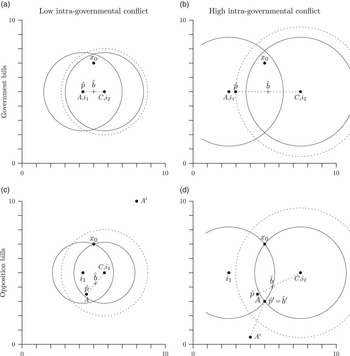
Although the logic behind the above strategies is pretty simple, the comparative static of a multi-dimensional model can be cumbersome. Therefore, we use a two-dimensional example of the agenda-setting model to illustrate its key features and derive expectations as regards the likelihood of bill success and the duration of the legislative process. The panels in Figure 1 show equilibrium strategies for the two types of agenda-setters (government minister and MP), as well as low versus high intra-governmental conflict. Throughout all panels, we fix the committee cost parameter to c=1 and censure costs to e=0.5 if agenda-setter A is a government minister.Footnote 3
Equilibrium strategies by degree of intra-governmental and government-oppositional conflict

Figure 1(a) might serve as a baseline: the government coalition is characterized by low conflict, the parties have a common interest in changing the status quo (x
0). One party controls the committee (C), the second the ministry that can propose a bill (A). What proposal will minister A make? The intersection of the indifference curves of i
1 and i
2 defines Z
e
, the set of viable proposals both i
1 and i
2 are willing to accept on the floor.Footnote
4
As parties i
1 and i
2 are close to each other, A can make a proposal at its ideal point
 $\hat{p}=x_{A} $
, thereby benefit from position-taking while the amendment
 $\hat{b}$
that C will make is small. Under these conditions, government proposals will undergo small changes in committee and all proposals will be passed by the floor.
In Figure 1(b), intra-governmental conflict is larger than in scenario (a) so that the willingness of i
2 and C to accept changes in the status quo becomes smaller. However, more importantly, A’s ideal point is outside the area where C is willing to accept amendments, R
e
(the dotted circle). Thus, the optimal viable proposal is
 $\hat{p}$
on the boundary of R
e
, but whether A adjusts its proposal to this constraint or proposes x
A
to signal its ideal position is largely dependent on α, the importance A attributes to the electoral reward for position-taking. So even though proposing x
A
would not change the status quo, the benefit of having clearly communicated her own position might exceed the minister’s benefit of policy change. It is for exactly this reason why at times we should see a ministerial proposal being made and failing—the minister submits a bill even though all actors anticipate the outcome. In sum, with high intra-governmental conflict, amendments will be larger and they will also fail more often than in the baseline scenario.
In next two panels, we consider the very same scenarios except for the type of the agenda-setter. Suppose the agenda-setter is now MP. As voting down a private member bill will do no harm to the government coalition in parliament, the electoral costs of a rejection are nil (e=0) and consequently the sets of bills both government parties would accept on the floor, Z e , are smaller than in scenarios (a) and (b). More specifically, they intersect in the status quo x 0.
Figure 1(c) shows one extreme scenario where the parliamentary agenda-setter (A) has an ideal position that is close to those of the government majority making a change of the status quo likely. A can propose its ideal position
 $\hat{p}$
, C will make an optimal amendment
 $\hat{b}$
and the floor will accept. Now, suppose that the conflict between government and the oppositional or backbench MP is large. For instance, if an oppositional agenda-setter is far away on the top of the space at A′, we should expect to see a proposal
 $\hat{p}\prime$
at the agenda-setter’s ideal point: there is simply no proposal she could make so that the possibly amended proposal is accepted by the floor and the approved bill would be closer to her ideal point than the status quo. Obviously, whether or not such a proposal exists is largely dependent on the location of this oppositional MP. If A′ had been on the left-hand side of the space, such a proposal would have been existed. Yet, A had to make large concession to C to get C pass the proposal to the floor, possibly too large concessions to make a such a proposal attractive.
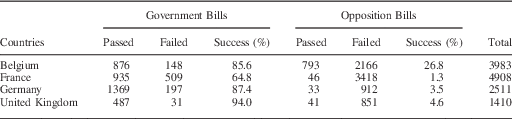
One might wonder why government parties would ever accept an opposition bill? Aren’t there incentives for proposing exactly the same bill to pocket the electoral divident?Footnote 5 Our response is twofold. First, there are good reasons to believe that this happens rarely indeed. As we discuss in the next section, the success rate of opposition bills is generally low in parliamentary systems. In our country sample, it ranges from 1.3 percent in France, 3.5 percent in Germany, 4.6 percent in the United Kingdom to 26.8 percent in Belgium. Some of the rejected opposition bills might then serve as a blueprint for a government bill proposed under a different heading. Second, while this might work for a heavily modified proposal, it seems less likely that an attentive public would reward the government for stealing from rather than cooperating with the opposition. We would argue that given press work of parties and media attention to legislation, the actual agenda-setter is known and capitalizing on her is unprofitable or even hazardous. Considering these dynamics is beyond the scope of our model though.
We finally consider the scenario where a parliamentary agenda-setter is confronted with high intra-governmental conflict (Figure 1(d)). Again, if A is close to the i
1 and i
2, a viable proposal is most likely to exist. Suppose that A submits
 $\hat{p}$
then C has to adjust its amendment
 $\hat{b}$
to the floor constraint. In the scenario shown in Figure 1(d), C will make the largest possible amendment provided that this will be accepted by i
1. For A′, things are virtually the same as in the previous scenario. However, we also note that it can happen that a parliamentary agenda-setter makes a proposal that cannot be amended by C and still get approved. If the agenda-setter is at A″ and proposes
 $\hat{p}\Prime$
,
 $\hat{p}\Prime$
can be and will be accepted on the floor. Yet, there is no amendment C will be willing to make that would also get approved. In sum, Figures 1(c) and 1(d) suggest three conclusions. First, large conflict between government majorities and a parliamentary agenda-setter will ceteris paribus make the success of her bill less likely. Second, and by contrast, we have no straightforward, general expectations as regards the size of the amendments in these scenarios. Third, these general conclusions hold for both oppositional and backbench MPs—what seems to be important is the policy conflict between the agenda-setter and the government majority (or the party leadership) that controls the committee and the floor vote.
We shall now summarize what these different scenarios tell us about the success and nature of government and private member bills. Although the above argument should equally be applicable to government majority and oppositional private member bills, we here focus on oppositional bills only. This is for the mere reason that, empirically, we have measures for the policy positions of government and opposition parties, but not of individual MPs for the time span and countries in our sample. As a result, we can proxy the average conflict between government parties and the average conflict between government and opposition camp in parliament while we have no equivalent information on the average conflict within government parties.
We summarize our expectations without a formal comparative static—though the above exemplary settings all assume a two-dimensional space, the equilibrium conditions show that the very same logic also applies to multi-dimensional issue spaces. First, we note that the larger the electoral costs e, the larger is the acceptance set of the floor (Z e ) and the larger the set of proposals that A can make and the number that finally get accepted. As a result, with large e’s, the agenda-setter will more often have an incentive for policy making rather than position-taking. As e>0 for government bills, an immediate consequence therefore is the following testable hypothesis:
Hypothesis 1: All else being equal, government bills have a higher chance of being passed than opposition bills.
Second, we have shown that the heterogeneity of the government majority and of parliament is an important factor. In Figure 1(b), when the heterogeneity of the majority coalition increases, A will more often find it appealing to just take a position. As a result, there are fewer policies that can be adopted. Thus, with a large policy conflict within the government coalition, ministers will often find it more attractive to take positions rather than make policies. As the discussion of Figure 1(d) suggests, the same holds true when an MP holds a policy position far from that of the government majority. This gives
Hypothesis 2: Higher policy conflict between government parties makes the adoption of government bills less likely, whereas higher conflict between the government and opposition camp makes the adoption of opposition bills less likely.
With the same argument as above, if a minister in a heterogeneous government can make a viable policy proposal, the amendment effort of the committee will be large. Knowing that the government majority will pass a large range of proposals because censure costs are high, the ministers can propose a bill closer to his own position, let the committee scrutinize the bill and amend it so that it reflects the position of the coalition parties in parliament. This is basically the same mechanism as in Martin and Vanberg’s (Reference Martin and Vanberg2005) model of legislative review with the notable difference that we do not resort to an (unenforceable) coalition contract. On the other hand, if an oppositional MP in a heterogeneous parliament can make a viable policy proposal, the proposal will trigger either large or small amendments by the committee. Therefore, we have no corresponding expectation on the effect of large government-opposition conflict on the size of amendments. The data we use for the empirical test provide no information on the amendment efforts of the committees. Scrutinizing and possibly amending bills takes time, so we use the length of the legislative process as a proxy for the amendment activity (cp. Martin and Vanberg Reference Martin and Vanberg2004). Our final hypothesis then is
Hypothesis 3: Higher policy conflict between government parties delays the legislative process of successful government bills.
We confront these model implications with empirical data from four countries such as Belgium, France, Germany and the United Kingdom between 1986 and 2003. Before we discuss the case selection and coding of variables used in the analysis, we first consider some methodological issues regarding the event-history analysis of legislative bills.
Methodology
We propose that, in general terms, legislative processes are shaped by characteristics of the individual bill and institutional settings, as well as policy conflict in government and parliament. More specifically, we conjecture a differentiable impact of these factors on the fate and duration of legislative bills. In this paper, we use a rather uncommon variant of event-history analysis, a so-called split-population model, to model and analyze both the success of bills and their event history in a single setup.
The usual way to analyze data on legislative policy-making processes in large-N studies is to focus on either the final state of policy proposals, i.e., adoption of individual bills or the adoption rate within a certain period (Kreppel Reference Kreppel1997; Tsebelis Reference Tsebelis1999), or some aspect of their timing, notably the time until a bill is initiated or passed by parliament (Becker and Saalfeld Reference Becker and Saalfeld2004; Martin Reference Martin2004; Martin and Vanberg Reference Martin and Vanberg2004). Both types of analysis are valid in that they address different questions. If one is interested in the partisan reasons of legislative gridlock or stalemate, a simple analysis of adoption rates across different settings of divided and unified government may produce valid results (e.g., Mayhew Reference Mayhew1991; Krehbiel Reference Krehbiel1998). Parsimony comes at a cost. One caveat here is that in many parliamentary systems legislative bills lapse at the end of the legislative term or session. This may cause considerable bias as legislative policy making is time consuming and bills introduced late in the term may fail not because of unfavorable conditions but because of time constraints and despite favorable conditions.
By contrast, if one is interested in opposition attempts to obstruct a government-dominated legislative processes, an event-history analysis (Kalbfleisch and Prentice Reference Kalbfleisch and Prentice2002; Box-Steffensmeier and Jones Reference Box-Steffensmeier and Jones2004) of bills may be more appropriate than the analysis of success rates as ultimately most government bills are passed anyway. In addition, event-history analysis allows to make a distinction between uncensored and right-censored observations, which is particularly relevant in the case of legislative bills that expire at the end of the legislative term. The dependent variable in these kinds of models is the time until an event occurs. In our case, it is the time from the introduction of a bill up until its adoption.
An important concept in event-history analysis is the so-called hazard function. It models the time dependency in the data by expressing the risk of experiencing an event at T=t on the condition that it has not happened before t. If T is a non-negative random variable that denotes the time to a failure event and x is a vector of covariates, then the hazard function is (Box-Steffensmeier and Jones Reference Box-Steffensmeier and Jones2004, 12–5)
 $$h(t\!\mid\!x)=\mathop{{{\rm lim}}}\limits_{{{\rm \Delta }t\to0}} {{Pr(t\leq T\lt t{\plus}{\rm \Delta }t\!\mid\!T\geq t,\,x)} \over {{\rm \Delta }t}}.$$
When choosing among different statistical models, one of the major issues involved is how to specify the hazard function h—i.e., how differences in the values of the covariates affect the risk that an event occurs, i.e., a bill is passed at a specific point in time in the legislative process. A drawback of the (semi-)parametric approach to event data is the implicit assumption that as time passes, all observations will eventually fail. In this context, this means that if legislative processes were not interrupted by legislative terms and the entire event history of all bills were observed, all bills would eventually be passed in the long run. This is arguable for many types of social science data (Schmidt and Witte Reference Schmidt and Witte1989; Box-Steffensmeier and Jones Reference Box-Steffensmeier and Jones2004). It is apparently false in the present context. We can easily think of bills that are effectively condemned to death from the very first day as they have been introduced for the mere reason to make a case and take a position on a specific issue. They will never be passed, nor did they ever have the chance of getting passed. The problem then is that there are effectively two types of bills, one being at risk of being accepted by the floor and one having no chance of ever getting approval.
In these situations, standard event history models will usually produce biased estimates of the hazard function. Note that the problem becomes more serious when the proportion of events that are not actually at risk is large and when there are different reasons for the (non-)event that a bill is voted down or expires at the end of the term or session. Going back to what we discussed earlier, we would expect bicameral provisions to prolong the legislative process owing to the necessity of having more than one chamber discussing the bill. However, bicameralism per se might not be an obstacle for passing a bill. By contrast, we would expect opposition bills to regularly fail, but we have no clear expectation as to how long it takes until they are voted down. Other studies on legislative processes have circumvented this problem focusing on bills passed by the legislature supplemented by a minor fraction of bills rejected by parliament (Becker and Saalfeld Reference Becker and Saalfeld2004). Martin (Reference Martin2004) analyze a sample of 276 government bills in Germany and the Netherlands, also rendering a high proportion of bills finally passed or presumably at risk of being passed.
In this paper, we use a split-population model (Schmidt and Witte Reference Schmidt and Witte1989) in which parameters for the probability that a bill gets passed are estimated simultaneously with parameters for the time dependence of a legislative process on some covariates. Intuitively, in the duration part of a split-population model, the impact of an observation on the hazard is weighted by the probability that the event is actually at risk. Following the notation of Schmidt and Witte (Reference Schmidt and Witte1989), we consider an unobserved variable F that indicates whether a bill will finally be passed (F=1) or not (F=0). Assuming Pr(F=1)=δ, Pr(F=0)=1−δ, then δ is the actual passage rate. We then define the standard probability distribution of the survival time t, say g, conditional on F=1, g(t|F=1). Denoting the corresponding cumulative distribution by G(t|F=1), we have a hazard function that is conditional on F=1 but irrelevant for F=0: h(t)=g(t|F=1)/(1−G(t|F=1)).
Now, while F is unobserved, we know whether or not a bill is passed by the end of the observation period. Let C be a dummy variable indicating the status of a bill. For a bill that received the final approval by parliament at time t, we have C=1 and we also know that F=1. The density function of passed bills therefore is Pr(F=1)g(t|F=1)=δg(t|F=1). For bills not passed by parliament until the end of the observation period T, we have C=0, but F is unobserved for these cases. There are two reasons why a bill is not approved until T. Either the bill never had the chance to be approved or it is censored, i.e., it might have been approved after the end of the observation period. The probability of C=0 therefore is
 $$\eqalignno{ Pr(C=0)= & Pr(F=0){\plus}Pr(F=1)Pr(t\,\gt\, T\!\mid\!F=1) \cr = & (1{\minus}\delta ){\plus}\delta (1{\minus}G(T\!\mid\!F=1)). $$
The likelihood function is then defined by the probabilities of these two types of bills (Schmidt and Witte Reference Schmidt and Witte1989, 67):
 $$L=\mathop \prod\limits_i \,[\delta g(t\!\mid\!F=1)]^{C} [1{\minus}\delta {\plus}\delta (1{\minus}G(T \!\mid\! F=1))]^{{1{\minus}C}} .$$
A δ that is (significantly) different from 1.0 suggests that a split-population model specification is warranted, whereas values close to 1.0 suggest that there is no evidence that there are two types of bills so that a standard event history model might be used. The parameter δ can be estimated as a single parameter, but the more interesting case is to consider a number of explanatory variables for the probability that a bill will eventually be passed. We follow other applications of split-population models and use a simple logit specification to model δ where a dummy variable indicating the status of the bill is the dependent variable. As regards the duration part of the model, the density function g can be parameterized in terms of a standard parametric model, but the actual choice of a specific distribution should be grounded in both theory and data. In the next section, we argue for and substantiate our choice of a log-logistic distribution to model the duration of legislative bills.
Data
The country selection and the type of data used in this study differs from those of other major comparative studies of legislative behavior in parliamentary systems (Döring Reference Döring1995; Huber and Shipan Reference Huber and Shipan2002; Döring and Hallerberg Reference Döring and Hallerberg2004; Martin Reference Martin2004; Martin and Vanberg Reference Martin and Vanberg2004) in several ways. First, the country selection follows a most different cases design in terms of the institutional structure as well as the relevant policy dimensions. Considering the prototype of a Westminster system, the United Kingdom, and the semi-presidential, “majoritarian” political system of France, we not only seek to increase the variation across indicators describing the institutional design, but also along measures of party competition and patterns of government formation. Second, we seek to substantiate our results by considering legislative policy making in all policy areas. Third, our data set comprises almost an entire universe of government and opposition bills in these countries in the time period between the mid-1980s and the early 2000s.Footnote 6
As regards the time period, the benchmark for each country is the first election for the lower chamber after 1985. The end date is the first election after 2000. We use election dates and not legislative sessions within parliamentary terms because the latter would lead to the loss of upper chamber initiatives introduced during the election campaign for the lower chamber. In the United Kingdom, bills expire at the end of the session so that we expand the time frame by another two years.
Analyzing the Success and Duration of Legislative Bills
When analyzing data on legislative policy making, it is rather simple to define the initial date of a proposal, but plenty of potential end states and end dates exist. For all four countries, we define the initial date of a proposal as the date when the respective bill is introduced in parliament in either the lower or upper chamber. Government bills are usually drafted by a minister but formally presented by the government as a whole. Opposition bills are bills introduced by individual or groups of MPs that belong to the government opposition, either from the lower or upper chamber.Footnote 7 As for the end date of successful bills, we refer to the date of proclamation of a law as the final date.Footnote 8 In our country sample, the maximum lifetime of a bill then is usually confined by the length of the legislative term at the end of which bills regularly lapse (Döring Reference Döring1995, 242). In the United Kingdom, pending bills lapse at the end of the (one year) session. Although some sort of carrying over of bills is possible in most countries, this is rare and exceptional. As we do not want these proposals to carry too much weight in the duration analysis, we confine the observation period to the legislative term (or session) the bill was introduced and consider bills as unsuccessful if not approved within this time span. For a bill not finally approved, two different points of time may be relevant. If a bill is defeated by a majority in parliament, it is unsuccessful and the day of rejection is used as the final day. If there is no parliamentary vote but the bill gets lost in the legislative process, the end date of each legislative term (or session) marks the end date of the unsuccessful bill. Table 1 shows the absolute number and the share of successful and unsuccessful bills by initiator. The figures demonstrate that a small, yet significant share of successful bills is initiated by MPs. This means that the government is not the sole agenda-setter, but also the opposition or backbenchers in the parliamentary groups of the governing parties are sometimes able to introduce bills that are ultimately successful.
Total Number and Percentage Share of Passed and Failed Bills by Initiator and Country

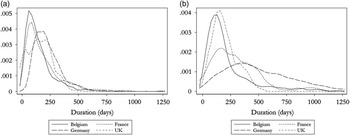
When we look at the length of the legislative process of successful bills in our sample countries, we see considerable variation. There are also distinct common patterns. Figures 2(a) and 2(b) display country-by-country kernel density estimates of the duration of successful bills. Theoretical considerations led us to expect that government and private member bills follow different time dependencies so that we analyze the two types of bills separately. The common pattern in both panels is that the distribution of the duration first increases until it reaches a peak at about 100–200 days, and it then decreases and ends in a long tail. This has obvious face validity because legislative procedures set rules and timetables for when and how often bills have to be discussed or read that cannot be easily circumvented. In our sample, the median duration of successful bills for over all four countries is exactly the same for government and opposition bills (163 days). However, if opposition bills are not adopted within this first half of the year, they take much longer. Actually, it takes about 550 days to pass 90 percent of all private member bills, whereas 90 percent of all government bills are passed within the first year. All in all, we find that one to two years is the broad time frame in which successful policy making takes place.
Duration of successful legislative bills (kernel density plots) (a) Government bills (b) Private member bills.

Yet, there are remarkable differences between the countries. The legislative process of government bills is fastest in Belgium with a median duration of 114 days and slowest in Germany (median duration 202 days). One of the reasons for this arguably is the German constitutional provision that the federal government has to obtain the opinion of the upper chamber, the Bundesrat, on any of its bills before sending them to the lower chamber. For opposition bills, Belgium also has the lowest median duration time (160 days), whereas Germany has the largest (471 days). Note also that even though the four countries impose different time limits on the passage of bills (i.e., the end of the session in the United Kingdom versus the end of the term in the other countries), this institutional provision seems to be of less importance as most of the bills are indeed passed within the first year. Finally, we note that the duration plots suggest modeling the time dependency with hazard functions that allows for first increasing and subsequently decreasing hazard rates. Based on this reasoning and the evidence of a plot of the non-parametric product-limit estimate of the survivor function (Blossfeld and Rohwer Reference Blossfeld and Rohwer2002, 217) (not shown here), we choose a log-logistic distribution to model duration. Specifically, we assume the functional form:
 $$h(t)={{\lambda p(\lambda t)^{{p{\minus}1}} } \over {1{\plus}(\lambda t)^{p} }},$$
where λ is parameterized by λ=exp(−X β) for some covariates X and parameters β. The task then is to estimate β together with the shape parameter p. If p>1, the hazard rate first increases and then decreases.
Measuring Policy Conflict and Institutional Settings
Our key explanatory variables of interest are policy conflict within government and conflict between government and opposition camp in parliament. The question of how to measure differences in the policy or ideological positions of parties and voters has recently re-attracted extensive attention in the literature. In this study, we use the composite unidimensional ideology index developed by Cusack and Engelhardt (2003), which is based on the studies of Castles and Mair (Reference Castles and Mair1984), Huber and Inglehart (Reference Huber and Inglehart1995) and Laver and Hunt (Reference Laver and Hunt1992), and ranges from −1 (far left) to +1 (far right). Based on this index, we use the veto player distance between governmental parties (Tsebelis Reference Tsebelis2002) as a measure for the intra-governmental conflict. For the intra-parliamentary conflict of government and opposition parties, we follow the literature on polarization in party systems (Taylor and Herman Reference Taylor and Herman1971) and use the distance between the centers of gravity of government parties and opposition parties (Gross and Sigelman Reference Gross and Sigelman1984). For the government, the center of gravity is the weighted average of the ideological positions of the parties in government where the weight is the vote share among all coalition parties.Footnote 9
A number of control variables are included in the analysis. First, we include a dummy variable for minority governments. Actually, there are four minority governments in our country sample, namely the French governments of the Prime Ministers Chirac (1986–1988), Rochard (1988–1991), Cresson (1991) and Bérégovoy (1991–1993). As to the effect of a minority situation on the success and duration of bills, we are undecided. On the one hand, the lack of a majority should force the government to make political compromises with the opposition. On the other, minority governments frequently have a central and therefore pivotal position in the policy space and might therefore possess the very same agenda-setting power as majority governments (Tsebelis Reference Tsebelis2002, 97–8).
Second, the provision that in a bicameral legislature the upper chamber has to debate any bill or even to consent on a proposal to become law might be a constraint for policy making. On the one hand, the effect of a bicameral provision on the chances of a bill being passed is hard to gauge. First, while in some countries, both chambers have to agree on a proposal in any case (Belgium until 1995), in the French navette system, the French government can induce the lower chamber to take the final vote, but this comes at some cost (Tsebelis and Money Reference Tsebelis and Money1995). Second, if lower and upper chamber hold similar views regarding a policy, bicameralism should not be a big hurdle to take (Bräuninger and König Reference Bräuninger and Konig1999). Third, the same should hold true if members of the upper chamber view themselves as senior advisors rather than political actors that compete with other actors over the control of government. Finally, agenda-setters may anticipate the hurdles a policy proposal has to take in a bicameral setting, causing them to accommodate or even refrain from introducing the bill in the first place (Manow and Burkhart Reference Manow and Burkhart2007). On the other hand, bicameral procedures lengthen the legislative process by at least one more round of debating and decision making. Therefore, we use two dummies as well as their interaction to assess the effect of bicameral settings. Bicameralism indicates that both chambers have to approve to turn the bill into law. In our country sample, this refers to all Belgian bills until the constitutional reform of 1995 and German bills under mandatory legislation. The expectation then is that bicameralism prolongs the legislative process. Second, divided government refers to situations where the government parties do not hold a majority in the upper chamber. This was the case in Germany from 1991 until October 1998 and from April 1999 until the end of our observation period.
Finally, one might suspect that bills from certain policy areas are on average more likely to be passed than others such as ratification bills in foreign policy. We include dummy variables for the policy areas bills belong to. To define comparable but also exhaustive policy categories, we drew on the typical cabinet structure in each country and came up with a list of 12 ministries. Owing to the low number of bills in some policy areas, we finally had to join bills in the areas of foreign (including European Union) and defense policy, as well as communication and education policy. The final set of policy areas is Economic, Foreign/Defense, Social, Culture, Education and Research, Finance, Interior, Justice, Infrastructure, Health and Environment/Agriculture.
Analysis
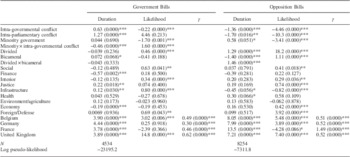
In this section, we present and discuss the results from our empirical investigation of the fate and duration of legislative bills. Results of the maximum-likelihood estimation of the parameters of the split-population models for government and opposition bills are shown in Table 2.Footnote 10 In a split-population model with log-logistic duration part, there are three sets of parameters, one for the duration part, one the likelihood part and one for the shape of the distribution underlying the duration model. As for most variables, we have distinct expectations as to their effects on success and duration, we decided to include the same set of covariates in both the likelihood and the duration equation. Initial analyses of the duration using the standard log-logistic model (with accepted bills only) and the success (using a standard logit model) suggest that this is indeed advisable. There are two exceptions though. When estimating the full model, it turns out that the interaction term of divided government and bicameralism is highly collinear with the success of bills. In addition, the interaction effect of minority government and intra-governmental conflict cannot be estimated for opposition bills. Thus, we dropped these interaction terms in the final specification reported in Table 2.
Duration and Success of Bills: Split-Population Models

Note: The baseline category includes bills in the areas of communication and education. The constant term is dropped as the model is fitted with the full set of country dummies. Robust z-statistics in parentheses (standard errors adjusted for clustering on countries). Estimated (observed) success rate is 0.911 (0.806) for government bills and 0.334 (0.316) for opposition bills.
*p<0.10, **p<0.05, ***p<0.01.
As for the shape of the logistic distribution, the parameter g defines the scale of the distribution. It is monotonically decreasing for g>1, but first increases and then decreases if g<1. Visual examination of the kernel density plot of the duration in Figure 2 leads us to expect that g is <1. The kernel density plot (and the initial analyses of standard duration models) also suggest that country-specific scale parameters should be estimated. We include a full set of country dummies in both the duration and the γ part of the model (and drop the constant instead). In such a stratified parametric model, each country has its “own” baseline hazard function. The estimates in Table 2 show that the country-specific parameters are significantly different so that this is indeed warranted.
Finally, we can use the estimate of the split parameter to assess the necessity of using a split-population model. Using the results from the likelihood part of the estimation, we predict the probability that a bill is successful and use the mean of these probabilities as an estimate of the split parameter δ. We find that δ is 0.911 for government and 0.334 for opposition bills. Both parameters are (significantly) different from 1.0, so that there is evidence that there are indeed two populations—successful and unsuccessful bills—and the standard duration model approach might have led to biased estimates. For the first model, the estimated split (0.911) is also reasonably close to the observed success rate (0.806), suggesting that we do quite well predicting success and failure of government bills even though the split model slightly overestimates the chances of a government bill being accepted. In the case of opposition bills, estimated and actual success rate of 0.316 differ on the margin only.
Policy Conflict
We first look at the key mechanism in our theoretical model, i.e., the effect of policy conflict on the likelihood and duration of bills. In the duration equation, a negative sign of a coefficient results in an increase of the hazard and thus is associated with an early passing of the bill and vice versa for positive coefficients. In the likelihood part of the model, a coefficient’s negative (positive) sign is associated with a decrease (increase) in the likelihood of a successful bill, just as in the standard logit model. The results presented in Table 2 show that policy conflict within the government and within the legislature have a sizable impact on the duration and success of bills.
As for the likelihood of a bill, we find that intra-governmental conflict reduces the likelihood that a specific bill eventually gets accepted. This is the case for both government and opposition bills. A large conflict between the government and the opposition reduces the likelihood that an opposition bill is accepted while there is no significant effect on government bills. This is perfectly in line with our second hypothesis. We also find that a higher ideological distance between the parties in government slows down the decision-making process of government bills. This is in line with what we would expect from veto player theory, and echoes the empirical findings in Becker and Saalfeld (Reference Becker and Saalfeld2004) and Martin and Vanberg (Reference Martin and Vanberg2004). Again, this is what we should expect from Hypothesis 3. More surprising is the finding that with a programmatically heterogeneous government, bills that originate within the parliament and that finally are accepted require less time to be accepted than those that were introduced with a more programmatic homogeneous government. The same holds for the intra-parliamentary conflict: a large ideological distance between the government and opposition camp shortens the duration of private member proposals, whereas it prolongs the duration of government bills. We next turn to minority government. The estimates in Table 2 not only suggest that bills have a lower chance of being accepted in a minority government situation and prolong the legislative process, but they also alter the effect that the conflict within the government has on a bill’s likelihood and duration. For proposals originating from a minority government, conflict within the government coalition no longer has a negative effect on the likelihood and the duration. In sum, we find no evidence that minority governments generally do better than majority coalitions, but the effect is contingent on the conflict within the government coalition (Tsebelis Reference Tsebelis1999). We note that this finding should be taken with a dose of caution as it is based on French minority governments only.
Control Variables
The findings also suggest that institutional settings influence whether or not a bill is accepted. However, the effect is not always what we have expected. Both government and opposition bills are more likely to be accepted under divided than unified government and opposition bills seem to have better chances under bicameral than under unicameral settings. To absorb other effects that result from characteristics of the political systems, a set of country dummies enters the model. In fact, the estimated coefficients of the country dummies show the effect of the institutional design of any of these countries controlling for other features such coalition versus single-party governments that are hard to separate from purely institutional ones. As for the likelihood of bills, government bills in the United Kingdom have a significantly higher chance of being accepted than government bills from any other country. On the other hand, French opposition bills have the lowest chances, whereas the UK scores highest. As for the duration, German government bills have the longest duration, which might be owing to the fact that the German federal government has to seek advice from the Bundesrat on its proposals before submitting the bill to the lower chamber. For opposition bills, the duration is shortest in the United Kingdom and longest in France, which seemingly reflects the power of their governments to set the time agenda in parliament.
A third group of variables are control (dummy) variables for each policy area. One noteworthy finding here is that government bills in the areas of finance and economics have the longest duration. This gives some support to the common conjecture that the socio-economic dimension is not only the most important but also the most controversial policy dimension in all four countries (e.g., Laver and Hunt Reference Laver and Hunt1992; Huber and Inglehart Reference Huber and Inglehart1995; Benoit and Laver 2006).
Predicted Probabilities and Hazards
To facilitate the interpretation of the results and gauge the size of the impact of the various effects on the likelihood and duration of bills, we calculate the effect of a change in any covariate on a baseline bill. The baseline is a German bill in the area of justice policy. Among the four countries, German bills most often have a median effect on the duration and likelihood of a bill, and the same hold true for justice policy bills. The baseline is then created with all dichotomous variables set to 0 (the modal category) and the continuous variables of policy conflict fixed at their median (which is 0.56 for intra-governmental and 0.64 for intra-parliamentary conflict). We then compare this baseline to bills that differ from the baseline in exactly one covariate. A bill with high intra-governmental conflict represents an otherwise typical bill that is introduced by or under a (coalition) government with a conflict of 1.32 (90th percentile). A bill with high intra-parliamentary conflict is an otherwise typical bill where the government and opposition camp are 0.80 far apart on the left–right ideological scale (90th percentile). The three other alternatives represent German justice policy bills where there is a (hypothetical) minority government in place, where the government does not command a majority of votes in the second chamber (divided government) or where the legislative procedure requires the upper chamber to consent on the bill (bicameralism).
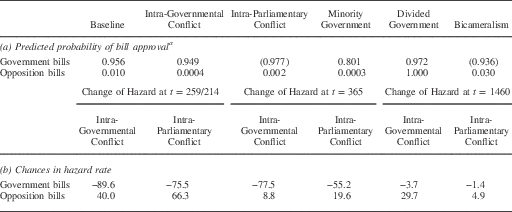
Table 3(a) shows the probabilities that the baseline and alternative bills are accepted for both government and private member initiatives. The government baseline bill has a high acceptance probability of 0.956. This comes close to the overall success rate of German government bills, which is about 90 percent. With high conflict within government, the likelihood decreases by a small amount, which is partly owing to the fact that the baseline probability is almost 1. Minority government reduces the probability to 0.801, whereas the unexpected positive effect of divided government on likelihood is smaller in size (0.972). As argued above, divided government might force governments to draft proposals that are acceptable to both the government supporting majority in the lower chamber and the majority in the upper chamber, which is of a different partisan hue.
Predicted Probabilities and Hazard Rates by Types of Bill

Note: The baseline is a German justice policy bill under unified government and a unicameral legislative procedure, a majority coalition government with coalition partners in a range of 0.56 and a distance between the centers of gravity of government and opposition of 0.64. Entries are predicted probabilities of bill approval.
a Entries in parentheses are probabilities based on effects of covariates that are not significant at the 10 percent level.
For bills originating from members of the parliamentary opposition, the probability that a baseline German justice policy bill finally is approved is only 0.010, which is also close to the average success rate of German opposition bills (about 5 percent). High conflict either within the government or with the legislature virtually reduces the chances of a bill to nil. The same holds for minority government. On the other hand, initiatives by the opposition are more successful under bicameral settings and divided government suggesting, once again, that some sort of pre-selection mechanism takes place.
Reporting the effects of the covariates on the duration of bills is more complicated. In the log-logistic duration model, the effect of a covariate on the hazard is time dependent. It is therefore meaningless to say covariate X reduces the hazard rate by factor Z. We use three specific points in time to gauge the effect of the various covariates. These are the days in which the hazard of the baseline bill is highest, the day when the bill is pending for one year and the day when the bill is pending for 1460 days, i.e., four years, which is a about the length of a legislative term. For government bills, the hazard is highest at the 259th day after the initiation of the bill. For opposition bills, it is at the 214th day. The columns of Table 3(b) compare the hazard rates of the baseline bill to bills with high intra-governmental and high intra-parliamentary conflict at the three points in the process of legislation.
The differentiating effect of policy conflict on government and opposition bills on the duration of the legislative process is nicely illustrated in Table 3(b). At the point in time when the adoption of a bill is most likely, the likelihood of bills from governments with high internal conflict is reduced by about 90 percent at this early stage. When the conflict between government and opposition camp is high, the effect is smaller but still large at 75.5 percent. After one year—which in the case of the United Kingdom is the end of the session and the maximum duration time—these effects are smaller but are still considerable. They finally vanish after around four years. By contrast, opposition bills have a higher chance of being accepted early in the legislative process where conflict is high. When the hazard rate is at its maximum, the probability of a bill’s acceptance under high intra-governmental (high intra-parliamentary) conflict is 40.0 (66.3) percent higher than for bills where there is only modest intra-governmental or intra-parliamentary conflict.
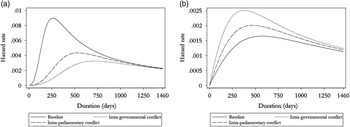
The powerful role that policy conflict plays within the government and between government and opposition camps throughout the duration of the legislative processes can also be seen from Figures 3(a) and 3(b) that show the estimated hazard rates of bills by type of initiator and type of conflict. As Figure 3(a) suggests, conflict not only reduces the hazard rate of governmental bills, it also shifts the point in time where the hazard is at its maximum. In particular, high conflict within the government coalition makes the early adoption of government bills unlikely. This is in line with our model expectation that ministers in heterogeneous governments can use their ministerial discretion to set the agenda and let the committee do the legislative review. By contrast, the swift passage of opposition bills is more likely to arise in the presence of conflict (Figure 3(b)). Although the hazard of a baseline bill shows only a modest peak, a programmatically heterogeneous government makes it more likely that an opposition bill is passed early in the legislative process.
Hazard rates by initiator and type of conflict (a) Goverment bills (b) Opposition bills.

Conclusion
Governments are key agenda-setters in the legislative process of parliamentary democracies. Yet, MPs are sometimes able to initiate policy change by proposing bills that are finally enacted. In this paper, we sought to analyze the conditions under which either governments or parliaments are successful agenda-setters. We focused on how institutionally defined agenda-setting powers in parliamentary systems interact with policy, office, vote incentives and the heterogeneity of preferences when shaping legislative processes. In particular, we considered policy conflicts between parties in government and between government and opposition parties to study the chances of government and opposition legislative bills to receive majority support and get approved. To this end, we used a spatial model framework to derive three hypotheses on the chances of bills of both types of agenda-setters to have their proposals approved as well as analyze the pace of the legislative processes.
Our theoretical argument suggests that legislative agenda-setters trade-off the benefits from making a proposal that will change the status quo and the electoral reward they expect from having occupied the agenda with a policy proposal that caters for the interests of their constituency. If agenda-setters have the chance to significantly shape policy outcomes, they will make proposals that legislative committees will accept to work on and have the chance to get accepted by the parliamentary majority. If such a proposal is not feasible because of opposing interests of how to change the status quo, the agenda-setter will refrain from making a viable proposal and instead submit a bill that signals his policy position to the electorate. We argue that while this logic equally applies to all legislative agenda-setters, government ministers take advantage of the fact that they are backed by a legislative majority that is reluctant to vote down a government bill and take the risk of bringing down the government.
There are other implications of the model we have not put to an empirical test owing to lack of data. First, we excluded bills proposals submitted by MPs of the government majority in parliament. If our argument is correct, these bill proposals should become less likely successful as the policy preferences of the (backbench) MP that sponsors the bill diverge from those of her party faction. As of right now, we have no reasonable measure for the policy positions of individual MPs, we have to defer to future research. Second, the theoretical model suggests that amendment costs are important. If amendment costs are small (c→0), C can propose her most preferred policy
 $$\hat{x}_{C} $$
in Z
e
without costs. The strategy of A on the equilibrium path then is to propose x
A
if
 $\alpha \,\gt\, (w_{A} (x_{0} ){\minus}w_{A} (\hat{x}_{C} ))/f(x_{A} )$
and to refrain otherwise; the equilibrium strategies of C and i are to propose amendment close to
 $\hat{x}_{C} $
and to adopt, respectively. If amendment costs are large (c→∞), A effectively becomes an agenda-setter under closed rule. We would expect to see cross-country differences in the assertiveness of the agenda-setter depending on the strength of the committee system. Third, and probably most interesting, the relative importance of policy and electoral gains may differ across individual MPs, parties or even the electoral system. In first-past-the-post systems sending signals about the own policy position to one’s constituency may be more important than in a closed list PR system, but less important than in open-list PR systems such as Belgium. We would expect α to be larger and position-taking more frequent in Belgium than in United Kingdom and than in Germany.
Overall, our approach complements recent studies on legislative policy making that have challenged the plain picture of governments-as-agenda-setters (Tsebelis Reference Tsebelis2002) and the popular notion of a parliamentary decline subsumed in the phrase that “the significance of Parliament ... is its very insignificance” (Richardson and Jordan Reference Richardson and Jordan1979, 121). Martin and Vanberg (Reference Martin and Vanberg2005) have presented the argument that even though governments are dominant agenda-setters, the legislative process strengthens government parties in monitoring and counteracting the influence of cabinet ministers. This is even more important when policy preferences within the government coalition diverge. We complement this perspective considering the agenda-setting role of parliament. We argue that the capacity or incapacity of government and parliament, respectively, to control the parliamentary agenda has important bearings on the effect of policy divergence on the course of legislative processes. On the one hand, there is an unequivocal negative effect of divergent preferences on the likelihood that a bill is accepted. On the other, it is the agenda control of government that makes it easy for the government to present proposals that have to be scrutinized and are subsequently amended by committees.
The empirical analysis explores these issues using data on (almost all) government and opposition bills in four democracies over a 25-year period. We find evidence for most of the expected effects of policy conflict on the success and duration of bills. Conflict always reduces the chances that a bill is finally accepted, regardless of whether it is presented by government or members of the parliamentary opposition. Government bills take longer to be passed when conflict is high, whereas private member bills are processed faster when conflict is high, suggesting that private member bills are pre-negotiated to a greater extent when the preferences of legislative actors differ significantly. This confirms our initial suspicion that on taking a closer look at what legislatures actually do and how they try to influence or even actively shape the government-driven policy-making process is worthwhile.
Regarding the methodology of the analysis of legislative bills, previous studies have used standard event-history techniques to model the duration of legislative processes (Becker and Saalfeld Reference Becker and Saalfeld2004; Martin and Vanberg Reference Martin and Vanberg2004). However, our results nicely illustrate that bill duration and bill success are two related but distinct aspects: they are two sides of the same coin in more than just the common meaning. They are certainly related in that bills that are not passed in time or simply set aside in the process of legislation lapse at the end of the legislative term or session. Thus, a long legislative process might result from attempts to kill off a defective bill or using instruments to impede the passage of an important bill. Consequently, institutional settings and patterns of conflict may have different effects on the duration and success of bills. Bicameral provisions may decrease the likelihood that bills are accepted, they may prolong the legislative process or they may do both. This calls for more refined statistical techniques. The paper shows that the split-population model used can effectively handle these differential types of effects.
Appendix
Table of symbols of game-theoretical model

Proof of Lemma 1 .
Lemma A1: Q(x)∩Z e is convex for any x∈X and g x (·)=w C (·)−c||x−.||2 is quasi-concave.
Proof. As w
i
(·) is strictly quasi-concave,
 $Z_{i}^{e} $
is convex and so is Z
e
. Let t, z∈Q
b
(x)={y|g
x
(y)≥b} and λ∈(0,1). Then g
x
(λt+(1−λ)z)=w
c
(λt+(1−λ)z)−c||x−λt+(1−λ)z||2>λw
c
(t)+(1−λ)w
c
(z)−cλ||x−t||2−c(1−λ)||x−z||2=λg
x
(t)+(1−λ)g
x
(z)>b. Thus, g
x
(·)∈Q
b
(x) so that g
x
(). quasi-concave, Q(x) and Q(x)∩Z
e
are convex for any x∈X.
Proof of Lemma 2 .
Lemma A2: A’s equilibrium strategy is given by
 $$p{\asterisk}=\left\{ {\matrix{ {\hat{p}\qquad\ } & {\,{\rm if}\,} & \matrix{ \hskip -15pt (x_{A} \in R^{e} \,{\rm and}\,u_{A} (\hat{p})\gt w_{A} (x_{0} ))\,{\rm or} \hfill \cr \hskip -15pt (x_{A} \notin R^{e} \,\ne\,\emptyset \,{\rm and}\,u_{A} (\hat{p})\geq w_{A} (x_{0} ){\plus}\alpha f(x_{A} )) \hfill \cr} \cr {x_{A} \qquad } & {\,{\rm if}\,} & \matrix{ \quad \ \ \ \ \,\,(\hat{p}=x_{A} \in R^{e} \,{\rm and}\,u_{A} (x_{A} )\gt w_{A} (x_{0} ))\,{\rm or} \hfill \cr \ \ \qquad (R^{e} =\emptyset )\,{\rm or}\,(x_{A} \notin R^{e} \,\ne\,\emptyset \,{\rm and}\,u_{A} (\hat{p})\lt w_{A} (x_{0} ){\plus}\alpha f(x_{A} )) \hfill \cr} \cr {refrain} & {\,{\rm if}\,} & {x_{A} \in R^{e} \,{\rm and}\,u_{A} (\hat{p})\lt w_{A} (x_{0} )\qquad \qquad \ \ \ \qquad } \cr } } \right..$$
Proof. We consider several cases. (1) If R
e
=Ø, the outcome is x
0 so that proposing x
A
gives a larger reward than any other proposal. (2a) Consider the case R
e
=Ø and x
A
∉R
e
. Proposing either x
0 or x
A
will result in x
0 so proposing x
0 is always dominated by x
A
or
 $\hat{p}$
. The best viable proposal is
 $\hat{p}$
, so if the reward
 $$w_{A} (\hat{p})$$
from proposing
 $\hat{p}$
exceeds the reward from pure position-taking, w
A
(x
0)+αf(x
A
),
 $\hat{p}$
is chosen, and x
A
otherwise. (2b) Case R
e
=Ø and x
A
∉R
e
, which means that proposing the own position is also a viable policy. x
A
is chosen if it is in the maximal set and beats the status quo;
 $\hat{p}$
is chosen if it beats the status quo. Finally, A refrains if even proposing
 $\hat{p}$
yields less utility than the status quo.