It is widely believed that consequentialists are committed to the claim that persons are mere containers for well-being. In this article I challenge this view by proposing a new version of consequentialism, according to which the identities of persons matter. The new theory, two-dimensional prioritarianism, is a natural extension of traditional prioritarianism. Two-dimensional prioritarianism holds that well-being matters more for persons who are at a low absolute level than for persons who are at a higher level and that it is worse to be deprived of a given number of units than it is good to gain the same number of units, even if the new distribution is a permutation of the original one. If a fixed amount of well-being is transferred from one person to another and then transferred back again, two-dimensional prioritarianism implies that it would have been better to preserve the status quo.
I. INTRODUCTION
It is widely believed that consequentialist moral theories cannot honour the special moral status of persons.Footnote 1 As argued by Rawls and others, the consequentialist's conception of a person is ‘that of a container-person: persons are thought of as places where intrinsically valuable experiences occur, [with] these experiences being counted as complete in themselves. Persons are, so to speak, holders for such experiences.’Footnote 2 This point can also be made by using a well-known analogy: ‘a cup contains different liquids, sometimes sweet, sometimes bitter, sometimes a mix of the two. What has value are the liquids: the sweeter the better, the bitterer the worse. The cup, the container, has no value.’Footnote 3
In this article I argue that some (but not all) versions of consequentialism can withstand the objection that persons are mere containers for well-being. On the consequentialist view I advocate, the identities of persons matter in a strong sense. Well-being can never be freely transferred from one person to another, not even if the new distribution is a permutation of the original one.Footnote 4 An analogy might help explain this point: Imagine two series of glasses of water. If one can rearrange the glasses through a series of pairwise swaps, such that the level in each glass in the first series becomes exactly the same as in the second, then each series is a permutation of the other. Since identities of persons matter in themselves, distributions of well-being cannot be freely permuted. For example, suppose that you may either let your only daughter live, or have her killed painlessly and replaced with another equally happy child who has the same remaining life expectancy. The claim that distributions of well-being cannot be freely permuted means that even if your friends and relatives would remain ignorant of the truth, you are not morally permitted to commit this atrocity against your child. The identity of your daughter matters in itself, and therefore she cannot morally be replaced by another equally happy child.
Utilitarians and traditional prioritarians take the opposite view. On these theories, well-being can be freely transferred from one person to another. Persons matter only insofar as their well-being contributes to increasing the overall sum of (priority-adjusted) well-being in the population. Egalitarians also agree with this. Persons sometimes enjoy more or less well-being than others, thereby affecting the moral value of the distribution of well-being, but all possible permutations of any given distribution of well-being have the same moral value.
The theory to be presented here can be referred to as two-dimensional prioritarianism. Like traditional (i.e. one-dimensional) prioritarianism, it holds that well-being matters more for persons who are at a low absolute level than for persons who are better-off. However, two-dimensional prioritarianism also holds that it is worse to be deprived of a given number of units than it is to gain the same number of units, even if the new distribution is a permutation of the original one. Hence, if a fixed amount of well-being is transferred from one person to another and then transferred back again, rendering the initial distribution of well-being, the two acts performed in this manoeuvre would be morally wrong, because two-dimensional prioritarianism implies that it would have been better to preserve the status quo.
It should be emphasized that two-dimensional prioritarianism is a genuine version of consequentialism. The moral value of an act is determined solely by its effects on well-being.
The focus of this article is on giving a precise formulation of two-dimensional prioritarianism, rather than on defending the theory against its rivals. Arguably, it is important in its own right to clarify what kind of intuitions can and cannot be rendered compatible with consequentialism. Section II outlines a distinction between two kinds of consequentialist theories, viz. state-oriented versus consequence-oriented ones. In section III, this distinction is used to render two-dimensional prioritarianism more precise, and in section IV it is argued that the two-dimensional view is an impartial ethical theory. Finally, section V shows how the new theory repudiates the objection that consequentialists do not honour the special moral status of persons.
II. STATE- VERSUS CONSEQUENCE-ORIENTED THEORIES
State-oriented versions of consequentialism hold that the moral value of an act depends solely on the state of affairs it brings about, irrespective of the initial state of affairs. In essence, the final outcome is all that matters. Consequence-oriented versions of consequentialism hold, in opposition to state-oriented theories, that the moral value of an act depends on the state of affairs it brings about in relation to the initial state of affairs. This is to say, the change itself also matters.
Utilitarianism, prioritarianism and egalitarianism are examples of state-oriented theories. Utilitarians maintain that the moral value of a state of affairs brought about by an act equals its sum total of well-being. Prioritarians hold that the moral value of a state is, as a mathematician would say, an ‘additively separable strictly increasing concave function’ of each individual's well-being – or, put in other words: benefits to those who are worse-off count for more than benefits to those who are better-off. In that sense, equality also matters. However, egalitarians question this account of equality by arguing that the moral value of states is a function of relative differences in well-being. The most influential version of egalitarianism is Gini-egalitarianism, which equates the moral value of a state with its Gini-index.Footnote 5
State-oriented versions of consequentialism cannot account for the intuition that dramatic changes in well-being ought to be treated differently from no change at all. Suppose, for instance, that Marx's vision of a classless society will never be realized. Half of the world's population will forever belong to the upper class and the other half to the working class. All that can be changed is the members of the two classes. At present, Anne is a member of the upper class, whereas Bob is firmly entrenched in the working class. Anne lives in an elegant five-bedroom apartment in Mayfair, London. As she is a member of the upper class, Anne's level of well-being is high (10 units). Bob was born into the working class in Sheffield, but he now works as a porter in Mayfair; his level of well-being is low (5 units).
In terms of these individuals’ levels of well-being, there are two alternatives. One may either preserve the status quo (i.e. let Anne stay at 10 and Bob at 5), or prompt a revolution. In a post-revolutionary society, Bob would become a member of the new upper class, the Ruling Party, whereas Anne would become a member of the working class. Naturally, if such a revolution were prompted, Anne's and Bob's respective levels of well-being would change, such that Anne gets 5 units and Bob 10 units.

In order to complete the thought-experiment, consider a radically different world in which upper-class Anne starts at 5 units and Bob the porter at 10. (Perhaps Anne finds life in luxury a bit boring, whereas Bob very much enjoys relaxing in the local pub with his friends.) As before, one must decide whether to prompt a revolution that changes things, such that Anne ends up with 10 units and Bob with 5.
By definition, state-oriented theories imply that the moral value of preserving the status quo in Situation I is exactly the same as the moral value of starting a revolution in Situation II. This is because the two acts bring about exactly the same state of affairs. Furthermore, state-oriented theories endorsing the condition of permutability (as outlined in section I) also imply that the moral values of all four alternative acts are equal, since they are permutations of each other. However, advocates of consequence-oriented views maintain that there is a significant difference between preserving the status quo in Situation I and prompting a revolution in Situation II. The difference is that the consequences are not the same: preserving the status quo has no consequence at all, whereas prompting a revolution has very dramatic consequences, viz. Anne is deprived of five units of well-being, which are in turn gained by Bob. Intuitively, this difference is not morally inert.
It should be clear that there is a genuine conceptual difference between state- and consequence-oriented theories. They ascribe moral value to different entities. State-oriented theories ascribe moral value to states, whereas consequence-oriented theories ascribe moral value to the change brought about by an act. That said, it remains to be shown that there is a substantial normative difference between the two approaches. The consequence-oriented theorist may, of course, argue that the five units of well-being of which Anne is deprived in the revolution in Situation I are precisely counterbalanced, morally, by the five units gained by Bob.
For the consequence-oriented theorist, there are three possible views to consider. First, in what may be called the neutral view, a benefit of a given number of units of well-being for one individual is precisely counterbalanced, morally, by an equally large loss for another person. This view is normatively equivalent to the state-oriented approach, but as indicated by the thought-experiment above this is a problematic view. Second, it can be argued that being deprived of a given amount of well-being is worse than gaining the same amount, even if the levels of well-being produced by the acts in question are the same; call this the loss-averse view. Third, one may claim the opposite (i.e. that it is better to be deprived of a certain amount of well-being than to gain the same amount, even if the levels of well-being are the same); call this the gain-averse view.
In the next section I shall consider which consequence-oriented view is best supported by our moral intuitions. Nonetheless, it seems clear already at this point that there is a genuine moral difference between preserving the status quo and prompting a revolution. State-oriented theories cannot account for this difference, but consequence-oriented ones can. Therefore, consequence-oriented views are in general more attractive than state-oriented theories, even though it is still too early to tell which version of this approach one ought to prefer.
III. TWO-DIMENSIONAL PRIORITARIANISM
Having established an argument for preferring consequence-oriented theories over state-oriented ones, I shall now discuss a particular version of the consequence-oriented approach. The theory I propose is a natural extension of prioritarianism, from the one-dimensional state-oriented approach to the two-dimensional consequence-oriented approach. Advocates of one-dimensional prioritarianism maintain that the benefits to those who are worse-off should count for more than benefits to those who are better-off because, as Parfit notes, ‘these people are at a lower absolute level’.Footnote 6 Two-dimensional prioritarianism, on the other hand, suggests a more sophisticated view. It holds that moral value is defined by a two-part function that takes as its arguments both the state of affairs and the change brought about by the act. This theory holds that it is worse to be deprived of a given amount of well-being than it is good to gain the same amount, even if the levels of well-being produced by the acts in question are the same. Hence, according to the terminology introduced in the previous section, this view may be classified as a loss-averse position.
In order to explain the merits of two-dimensional prioritarianism over traditional prioritarianism, both versions of the theory must be analysed in greater detail. Consider a fixed set of n persons. Suppose that the well-being of each person i may be described by a real number w i. A vector S=〈w 1, w 2, . . .w n〉 describes the state of affairs in which the first person enjoys w i units of well-being, and so on. One-dimensional prioritarianism holds that the moral value v of a state S is given by the following equation, where f is a strictly increasing concave function (i.e. the graph for f slopes upwards but bends downwards).

As indicated in section II, utilitarianism and egalitarianism are also one-dimensional theories. Put into technical terms, utilitarians hold that the moral value of a state equals the sum total of each person's well-being (i.e. v(S)=w 1+w 2+⋅⋅⋅+w n). Egalitarians maintain that moral value is a function of relative differences in well-being. The following formula summarizes the Gini-egalitarian view, where  is the mean of w 1, . . ., wn:

The Gini index assigns a number between 0 (perfect equality) and 1 (perfect inequality) to every distribution of well-being. In order to visualize equation (2), suppose that all persons are ordered along the horizontal axis according to their well-being, from the worst-off to the best-off. The Lorenz curve is then the cumulative sum of well-being for all persons; for example, if everyone enjoys equally much well-being the Lorenz curve is a diagonal line going from the lower left corner to the upper right one, and if a single person enjoys all well-being the Lorenz curve is a straight horizontal line that turns up at the right end of the vertical axis. Now, equation (2) corresponds to the area trapped by the hypothetical straight line denoting perfect equality and the actual Lorenz curve for the distribution of well-being, divided by the area of the entire triangle.
By definition, consequence-oriented theories maintain that moral value is defined by a two-part function. For simplicity, let a consequence be a vector of real numbers obtained by subtracting the well-being each person enjoys before an act is performed from the well-being brought about by the act – that is, if S=〈w1, w2, . . ., wn〉 is the initial state and S *=〈w*1, w*2, . . ., w*3〉 is the state brought about by performing some act, its consequence C is

Given this framework, two-dimensional prioritarianism is the view that the moral value v ʹ of an act equals:Footnote 7
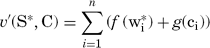
By definition, f and g are strictly increasing concave functions: The graphs for both f and g slope upwards but bend downwards. It is reasonable to assume that g(0)=0 (i.e. that a loss or gain of nothing counts as nothing).
In other words, advocates of two-dimensional prioritarianism would agree with one-dimensional prioritarians that benefits to those who are worse-off should count for more than benefits to those who are better-off, because these people are at a lower absolute level. In addition, however, two-dimensional prioritarians claim that a loss of a given amount of well-being to one person is not morally counterbalanced by an equally large benefit to another person, not even if the new distribution is a permutation of the original one. The concavity of the g-function reflects the intuition that it is worse to be deprived of well-being than it is to benefit from an equally large increase, even if the levels of well-being produced by the acts in question are equal.
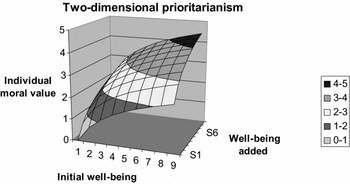
It is helpful to illustrate two-dimensional prioritarianism in a graph. Figure 1 below shows a plot of equation (4), with f and g as logarithmic functions.
Figure 1.

In figure 1, only the positive quadrant of equation (4) is shown. The spherical-horizontal lines denote points that are morally equivalent. The figure illustrates the basic message of two-dimensional prioritarianism: Morally, the addition of well-being counts for more if it is added to a low absolute level, and the first unit that is added counts for more that the second, and so on and so forth. For example, if your initial level were 5 and you gain 1, that would be roughly equal to starting at 2 and gaining 3, even though the total amount of well-being would be different.
So why should one then accept two-dimensional prioritarianism? The best argument is that well-being is not an entity that can be freely transferred from one person to another. To transfer well-being from one person to another is to incur moral costs. A practical analogy might help illustrate this point: Suppose that you have two glasses of champagne, one that is full and one that is almost empty. Also suppose that the relative number of bubbles in the glass is a good measure of moral value. If you were to pour some champagne from the first glass into the almost-empty one, the number of bubbles per cubic inch will decrease, because of a familiar chemical reaction. The number of bubbles per cubic inch in the first glass will, however, not decrease. Therefore, an increase is worth less than a decrease. If well-being is transferred from one person to another, some of its moral value – but not the well-being itself – evaporates from the person, metaphorically speaking.
Before closing this section, I would like to prove that two-dimensional prioritarianism is a genuinely different view from its one-dimensional counterpart, i.e. that the two-dimensional version cannot be reduced into a special case of the one-dimensional theory. In order to see this, consider the following equation:

If there is a one-place function f ʹ that assigns the same value to each w*i brought about by an act as that assigned by f and g to an initial well-being level wi and a consequence ci, then two-dimensional prioritarianism would be nothing more than a special case of the one-dimensional view. However, for the general case, there cannot be any such function f ʹ. This can be shown by constructing a counterexample. Suppose, for instance, that g(0) = 0, g(1) = 1, f(0) = 1 and f(1) = e. Then compare the case in which w*i=1 and wi=0 with the case in which w*i=1 and wi=1. Both acts bring about the same state (w*i=1), but the change involved is different. In the first case f(0) + g(1 − 0) = 0, but in the second case f(1) + g(1 − 1) = e. However, no function f ʹ can assign two values, 0 and e, to the same argument, w*i=1.
IV. IMPARTIALITY
With the exception of ethical egoists, all consequentialists consider impartiality to be a fundamental requirement of a reasonable moral theory. However, one- and two-dimensional consequentialists disagree about the meaning of ‘impartiality’. Advocates of one-dimensional views believe that impartiality should be defined in terms of permutability. For example, Hirose argues that impartiality is best taken to mean that ‘Two alternatives are equally good if they differ only with regard to the identities of the people.’Footnote 8 Expressed in technical terms, Hirose's notion of impartiality-as-permutability can be stated as:
Impartiality-as-permutability:

Utilitarians, egalitarians and one-dimensional prioritarians all endorse impartiality-as-permutability. However, two-dimensional prioritarians reject it; in their view, it is not true that two alternatives are equally good if they differ only with regard to the identities of the people. This is because two-dimensional prioritarians believe that well-being cannot be freely transferred from one person to another, not even if the new distribution is a permutation of the initial one. That said, two-dimensional prioritarians do not wish to reject the idea that moral theories should be impartial; instead, they argue that the notion of impartiality-as-permutability – as defended by Hirose and others – is too strong: Impartiality is not permutability. Consider the following, weaker notion of impartiality:
Weak Impartiality: No person counts for more than another.
Weak impartiality does not imply impartiality-as-permutability. That no one counts for more than another does not imply that two alternatives are equally good, if they differ only with regard to the identities of the persons. Therefore, weak impartiality can be accepted by two-dimensional prioritarians in the literal sense. In order to see this, note that by letting k 1 to k 2 be some constants, equation (4) can be rewritten as follows:
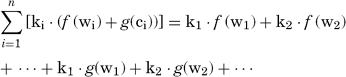
This equation makes it explicit in what sense no one counts for more than another: The point is that if no one is to count for more than anyone else, then it must be the case that k1=k2=⋅⋅⋅=kn. Had one of the constants been higher than the others, as ethical egoists believe ought to be the case, one person would have counted for more. Therefore, equation (7) highlights an ethically substantial sense in which two-dimensional prioritarianism is an impartial moral theory.
The two-dimensional approach to consequentialism also casts new light on ethical egoism. Traditionally, someone is an ethical egoist if and only if he claims that his level of well-being is more important than that of others. However, the two-dimensional approach reveals that there is also another sense in which one might be an ethical egoist, viz. by claiming that changes to one's own well-being are more important than those of others. For example, suppose that you and I are equally well off financially, and that one of us has to give up philosophy and thus suffer a decreased level of well-being. Then, a two-dimensional egoist might claim that even though no one's well-being is more important than another's, changes to one's own well-being count for more, and that morality therefore requires that the egoist keeps his job as philosopher.
V. SOME EXAMPLES
As explained above, two-dimensional prioritarians maintain that each person is of intrinsic importance. Well-being cannot be freely transferred from one person to another, not even if the new distribution is a permutation of the initial one. Thus, the mere fact that a person enjoys a certain level of well-being is assigned moral importance.
The significance of this point can be illustrated through practical examples. Suppose, for instance, that you are a wealthy, potential donor. You may either keep your assets or donate them to famine relief, thereby dramatically increasing the well-being of 10 poor people. Of course, the sum total of well-being obtained by redistributing well-being from you to the poor is higher than in the initial state, as well as its equality. However, it does not follow from this that you ought to make the donation. You must also consider the dynamic dimension of your decision. By making a donation you will (we assume) decrease your well-being. According to the two-dimensional view it is proportionately worse to be deprived of well-being than to benefit from an increase, so the negative moral value of your decrease in well-being may possibly outweigh the increase in others’ well-being.
Compare this with the traditional one-dimensional analysis of famine relief. Peter Singer has famously argued that people living in the affluent west ought to donate most of their assets to Oxfam and similar organizations, thereby transferring significant amounts of well-being to worse-off people in foreign countries. According to Singer,
I and everyone else in similar circumstances ought to give as much as possible, that is . . . up to . . . the point of marginal utility, at which [point] by giving more one would cause oneself and one's dependants as much suffering as one would prevent.Footnote 9
This claim illustrates why persons do not matter as persons in one-dimensional theories – all that matters is the state obtained through the redistribution of well-being.
If two-dimensional prioritarianism is accepted, Singer's conclusion is no longer valid, and it does not hold true that donors ought to make donations ‘up to . . . the point of marginal utility, at which by giving more one would cause oneself and one's dependants as much suffering as one would prevent’. This insight is of substantial significance. Zell Kravinsky, a middle-aged self-made millionaire, is one of the very few who might have acted in accordance with Singer's advice.Footnote 10 In 2003, he donated almost his entire $45-million real estate fortune to charity.Footnote 11 According to Kravinsky, ‘it was a choice between [my] kids having a car when they go to college or a kid in Guatemala having a life’.Footnote 12 However, $45 million was not enough; Kravinsky somehow felt that he could give more than money. Therefore, on 22 July 2003, Mr Kravinsky drove to the Albert Einstein Medical Center in Philadelphia and donated a kidney to a complete stranger. In an interview in the Pittsburgh Post-Gazette, Kravinsky said,
Two hospitals turned me down when I said I wanted to donate it to a stranger . . . But Einstein agreed. I had to convince them why I was doing it: because it is logically and morally compelling to save someone's life if you can.Footnote 13
There is no doubt that Mr Kravinsky acted from altruistic motives. He made the donations with the full awareness that his own well-being would decrease dramatically. Given this, did he act morally right or wrong? From a one-dimensional point of view, Kravinsky certainly did the right thing. However, many people feel that there is something intuitively unsettling about his behaviour; indeed, he has been insulted and attacked by several newspaper columnists and on Internet sites. Two-dimensional prioritarianism can explain this intuition: Mr Kravinsky behaved as if he himself were nothing but a container for well-being. However, persons matter as persons in the sense that it is worse to be deprived of a given amount of well-being than it is to gain the same amount. Kravinsky failed to take this into account when making his donations. Not only was his own well-being severely decreased, but also that of his wife and children.
Of course, the two-dimensional view does not give a clear answer to whether Kravinsky acted rightly or wrongly; that ultimately depends on a number of empirical considerations. However, the mere fact that it is worse to be deprived of a given amount of well-being than it is to gain the same amount, even if the levels of well-being produced by the acts in question are the same, helps to explain the intuition that Kravinsky's acts were not as unproblematic as he himself seems to believe.
For a slightly more technical illustration of how persons matter as persons, consider the Pigou–Dalton condition. This is a normative condition widely accepted by philosophers and economists in discussions of equality. It asserts that a state of affairs obtained by transferring some amount of well-being from a well-off person to a worse-off person is better than the initial state, given that the well-off person remains at least as well-off as the poor one. Hence, if you are at 20 and I am at 10, the Pigou–Dalton condition implies that the state of affairs in which you are at 19 and I am at 11 is better than the initial state. According to the two-dimensional view, the Pigou–Dalton condition is not universally valid, because persons are of intrinsic importance. The negative dynamic effect of redistributing well-being from the well-off to the worse-off may outweigh, morally, the fact that the new state would be better from a static point of view. The upshot is that the Pigou–Dalton condition fails to take the dynamic dimension of morality into account (i.e. it fails to acknowledge that ethics is about persons and that, from a dynamic point of view, these persons matter intrinsically).
In a certain sense, the two-dimensional view is more conservative than one-dimensional views, in that it often recommends against drastic redistributions of well-being. Arguably, this conservative aspect of the two-dimensional view ought to be considered a virtue, not something that must be explained away. Part of the problem with one-dimensional views is that they make it too easy to justify drastic redistributions of resources in society. For example, it might very well hold true that the sum total of well-being in Fidel Castro's Cuba exceeds the sum total of well-being in the pre-revolutionary society he brought down; after all, Castro's regime has provided better education and health care for the vast majority of people, especially in comparison to many similar non-democratic regimes. However, for a significant number of well-off people, things got worse – much worse. If sufficient moral weight is assigned to the dynamic dimension of the two-dimensional view (i.e. if a ‘steep’ concave dynamic function is adopted), it follows that the revolution initiated by Castro could have been morally wrong. The fact that a comparatively large number of well-off people were deprived of huge amounts of well-being could outweigh the significant gains made by the majority. Again, the explanation of this is that persons matter as persons. It is too simplistic to consider only the state of affairs brought about by an act; one must also take into account how one got there. Of course, this reasoning does not imply that all revolutions are always wrong. Under certain circumstances, if the new state of affairs brought about by a revolution outweighs the negative dynamic effects, advocates of two-dimensional prioritarianism may recommend such revolutions.