Mastitis is the most common disease of dairy cows (Halasa et al. Reference Halasa, Huijps, Østerås and Hogeveen2007), mainly caused by intramammary infection (IMI) due to a variety of contagious and environmental pathogens. The importance of reliable identification of the aetiological agent is crucial in mastitis diagnostics. Proper microbiological diagnostics represents the basis for developing efficient mastitis control programmes in herds, as problems due to different pathogens need different approaches. Mastitis is also the major reason for use of antimicrobials for dairy cows. Treatment of mastitis should be based on microbiological diagnosis and when necessary, susceptibility testing in vitro, to avoid inefficient or unnecessary use of antimicrobials. Targeted treatment protocols may increase cure rates, minimise costs, and lower the volumes of antimicrobials used (Lago et al. Reference Lago, Godden, Bey, Ruegg and Leslie2011; Cameron et al. Reference Cameron, McKenna, MacDonald, Dohoo, Roy and Keefe2014; Steeneveld et al. Reference Steeneveld, van Werven, Barkema and Hogeveen2014; Ruegg, Reference Ruegg2014).
Bacteriological culture (BC) of an aseptically taken quarter milk sample is the current gold standard for laboratory diagnostics of mastitis causing microorganisms (National Mastitis Council, 2004). Conventional culturing has a few well-known shortcomings such as the rather long time to obtain results (Hogan et al. Reference Hogan, González, Harmon, Nickerson, Oliver, Pankey and Smith1999), need for experienced laboratory personnel, subjectivity despite the standardised procedures (Sears & McCarthy, Reference Sears and McCarthy2003) and the high numbers of milk samples with no growth (Makovec & Ruegg, Reference Makovec and Ruegg2003; Bradley et al. Reference Bradley, Leach, Breen, Green and Green2007; Koivula et al. Reference Koivula, Pitkälä, Pyörälä and Mäntysaari2007; Olde Riekerink et al. Reference Olde Riekerink, Barkema, Kelton and Scholl2008; Persson Waller et al. Reference Persson Waller, Aspán, Nyman, Persson and Grönlund Andersson2011; Oliveira et al. Reference Oliveira, Hulland and Ruegg2013). Development of modern molecular technologies has offered alternative methods for mastitis diagnostics. PCR assays for detection of mastitis pathogens were introduced at the beginning of this century (Phuektes et al. Reference Phuektes, Mansell and Browning2001; Gillespie & Oliver, Reference Gillespie and Oliver2005; Studer et al. Reference Studer, Schaeren, Naskova, Pfaeffli, Kaufmann, Kirchhofer, Steiner and Graber2008) and the first commercial real-time multiplex PCR test for quarter-based identification of udder pathogens (Thermo Scientific PathoProof Mastitis PCR Assay, ThermoFisher Scientific Ltd., former Finnzymes, Vantaa, Finland) was globally launched in 2008. This assay was quickly adopted for use in Finland and the laboratories of the largest dairy company switched from conventional culturing to PCR in 2010. The method is easy for a farmer: an aseptically taken quarter milk sample is sent to the laboratory in the milk truck or via mail, and the result is provided electronically on the same or the following day. Currently it is estimated that over 80% of the Finnish quarter milk samples are diagnosed using the PCR method alone.
Relative to culture-based methods, PCR is faster as the results are provided within 4 h, and is more sensitive in detecting common udder pathogens (Koskinen et al. Reference Koskinen, Wellenberg, Sampimon, Holopainen, Rothkamp, Salmikivi, van Haeringen, Lam and Pyörälä2010). The number of the target species varies according to the used PCR kit. The results of the assay are expressed in Ct (cycle threshold) values, which reflect genome copy numbers of the detected species. In Finland the results are provided with semi-quantitative estimates of the amounts of the bacterial DNA detected (low, intermediate or high). Using a PCR test as the sole diagnostic method in mastitis diagnostics has raised some concerns. All target species detected from the sample in amounts under the set threshold Ct value (37·0 for all pathogens) are reported without further interpretation by the laboratory personnel. Compared with conventional bacteriology, where the quality of the samples is assessed by the laboratory staff and samples with growth of more than two species are deemed contaminated (Hogan et al. Reference Hogan, González, Harmon, Nickerson, Oliver, Pankey and Smith1999), interpretation of PCR results has been considered more challenging.
In studies published to date, comparison of real-time PCR and conventional culture has focused on detection capabilities of the PCR assay (Taponen et al. Reference Taponen, Salmikivi, Simojoki, Koskinen and Pyörälä2009; Koskinen et al. Reference Koskinen, Wellenberg, Sampimon, Holopainen, Rothkamp, Salmikivi, van Haeringen, Lam and Pyörälä2010; Bexiga et al. Reference Bexiga, Koskinen, Holopainen, Carneiro, Pereira, Ellis and Vilela2011; Keane et al. Reference Keane, Budd, Flynn and McCoy2013). Bacteriological culturing has been carried out according to routine procedures, excluding samples with more than two species detected (Spittel & Hoedemaker, Reference Spittel and Hoedemaker2012; Keane et al. Reference Keane, Budd, Flynn and McCoy2013). In the present study quarter milk samples from subclinical and clinical mastitis were analysed with a real-time PCR assay and semi-quantitative, in-depth bacteriological culture carried out in the Finnish national reference laboratory for mastitis. Detection abilities and diagnostic capability of the PCR assay was compared with the in-depth conventional culturing, aiming to evaluate the diagnostic performance of the real-time PCR assay with routine milk samples.
Materials and methods
Milk samples
A total of 294 quarter milk samples were sent to the local laboratory of Valio Ltd. (Lapinlahti, Finland) between October 2010 and January 2011. The samples were collected by farmers and local veterinarians and arrived at the laboratory refrigerated within 48 h from sampling. Milk samples originated mainly from quarters with subclinical or mild clinical mastitis (Laura Kulkas, Valio Ltd., personal communication). Data on the clinical status or milk somatic cell count (SCC) of the cows were not available. From Valio Ltd. the samples were transferred immediately to the national mastitis reference laboratory, Finnish Food Safety Authority Evira (Kuopio, Finland), and were cultured directly on arrival. The samples were refrigerated without preservatives during both transportations. Two aliquots of the samples were deep frozen (−20 °C) immediately after culturing. One aliquot was sent to the laboratory of the Department of Production Animal Medicine (University of Helsinki, Mäntsälä, Finland) for milk N-acetyl-β-d-glucosaminidase (NAGase) activity determination and the other to the laboratory of Thermo Fisher Scientific Ltd. (Vantaa, Finland) for PCR analysis.
Bacterial culture and interpretation of the microbiological results
A total of 0·01 ml of milk was streaked on to a tryptic soy agar plate containing 5% bovine blood (TSA, CASO agar, Merck, Darmstadt, Germany) and spread over the entire 9-cm plate with a conventional loop. Plates were incubated aerobically at 37 °C for 48 h, and inspected after 24 and 48 h. All colonies on the plate were enumerated when possible. Morphologically different colonies were counted and representatives of colonies of a similar type identified using standard identification schemes (Hogan et al. Reference Hogan, González, Harmon, Nickerson, Oliver, Pankey and Smith1999). Enumeration and identification of the bacterial colonies was made also for cultures with ≥3 species, which in routine diagnostics are defined as contaminated (National Mastitis Council, 2004). Colony-forming units exceeding 100 could not be accurately counted and were recorded as 100. Gram staining, catalase test, oxidase test (Pro-Lab Diagnostics, Richmond Hill, ON, Canada), API Staph, API ID32 Strep, API 20 E and API Coryne (bioMérieux, Marcy l'Etoile, France) were used in the identification schemes. For Staphylococcus spp., a positive coagulase test (BBL™ Rabbit plasma, BD Diagnostics, USA) was confirmed with API Staph (bioMérieux, Marcy l'Etoile, France). Eosin methylene blue agar (EMB) (Oxoid, Basingstoke, Hampshire, UK) was used for detection of Escherichia coli and TSA was supplemented with Tween-80 (0·1%) (Amresco (Solon, OH, US)) to detect lipophilic Corynebacterium bovis.
A positive result for bacterial growth for all micro-organisms was detection of at least one CFU per 0·01 ml of milk. Staphylococcus spp. results and the species not included in the target panel of the PCR assay were additionally examined with a higher threshold for positive result (5 CFU per 0·01 ml of milk) owing to their minor status as mastitis pathogens.
Multiplex real-time PCR
The frozen milk aliquots were tested using Thermo Scientific PathoProof™ Mastitis Complete-12 Kit within 1 week of arrival at the laboratory of Thermo Fisher Scientific Ltd. (Vantaa, Finland). The oligos of the Complete-12 Kit are designed to detect DNA of C. bovis, Enterococcus faecalis/faecium, Esch. coli, Klebsiella oxytoca/pneumoniae, Serratia marcescens, Staph. aureus, Staphylococcus spp., Streptococcus agalactiae, Str. dysgalactiae, Str. uberis and Peptoniphilus indolicus and/or Trueperella pyogenes. Bacterial targets have been divided into four PCR reactions, each of them detecting three targets and an internal amplification control. Sample volume for the PathoProof Mastitis PCR Assay was 350 μl of which 17·5 μl ended up in the PCR reaction after the DNA extraction procedure. Enterococcus spp., Klebsiella spp., and Staphylococcus spp. were identified to group levels. Staph. aureus was separately identified. Ct values above 37·0 were reported as negative results. The number of genome copies targeted in PCR was recorded for Staph. aureus and Staphylococcus spp.
N-acetyl-β-D-glucosaminidase activity in the milk
Milk N-acetyl-β-d-glucosaminidase (NAGase) activity was used as an inflammation indicator of the milk sample. NAGase activity of the milk samples was determined in the laboratory of the Department of Production Animal Medicine (University of Helsinki, Mäntsälä, Finland) using an in-house microplate modification (Hovinen et al. Reference Hovinen, Simojoki, Pösö, Suolaniemi and Pyörälä2014) of the fluorogenic method developed by Mattila & Sandholm (Reference Mattila and Sandholm1985). The results were expressed as picomoles of 4-MU/min/μl milk at 25 °C. The maximum detection limit of NAGase activity is 24·49 pmol 4-MU/min/μl milk. The mean NAGase activity of normal milk (SCC < 100 000 cells/ml) is 0·45 pmol 4-MU/min/μl milk (range 0·09–1·04 pmol 4-MU/min/μl milk) (Hovinen et al. Reference Hovinen, Simojoki, Pösö, Suolaniemi and Pyörälä2014). We used the upper range value for normal milk as our definition for mastitic milk (1·04 pmol 4-MU/min/μl milk).
Calculations for specificity and sensitivity of PCR in diagnosing Staph. aureus and Staphylococcus spp
Specificity (Sp) and sensitivity (Se) of the real-time PCR to detect Staph. aureus and Staphylococcus spp. was calculated assessing the conventional culture as golden standard method. Agreement to provide a positive diagnosis for these species sample by sample was tested with the κ-coefficient. For the calculations of Se, Sp and κ-coefficient, only culture results containing one or two different species and their corresponding PCR results were included (n = 256). In these calculations, a cut-off of one CFU was used for Staph. aureus and a cut-off of ≥5 CFU for Staphylococcus spp. (Honkanen-Buzalski & Seuna, Reference Honkanen-Buzalski, Seuna, Sandholm, Honkanen-Buzalski, Kaartinen and Pyörälä1995). In PCR, detection of the target species with a Ct ≤ 37 was considered as a positive result. For Staph. aureus and Staphylococcus spp., the correlation of CFUs from BC and genome copy numbers from PCR was also tested. Data were transformed to CFUs and genome copy numbers per ml of milk as follows: Genomic copy number = 10(Ct−x)/y, where Ct = cycle threshold value, X = slope of a standard curve and Y = interception of a standard curve. Spearman's rho correlation was used because the data were not normally distributed. The statistical analysis was performed with SPSS Statistics 20 (IBM, Armonk, NY, USA).
Results
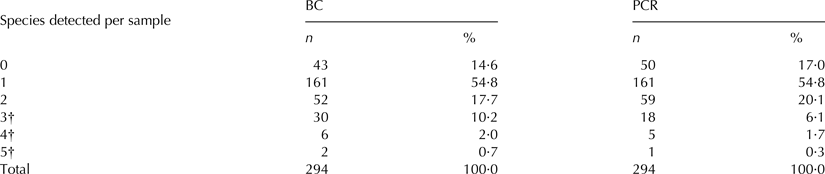
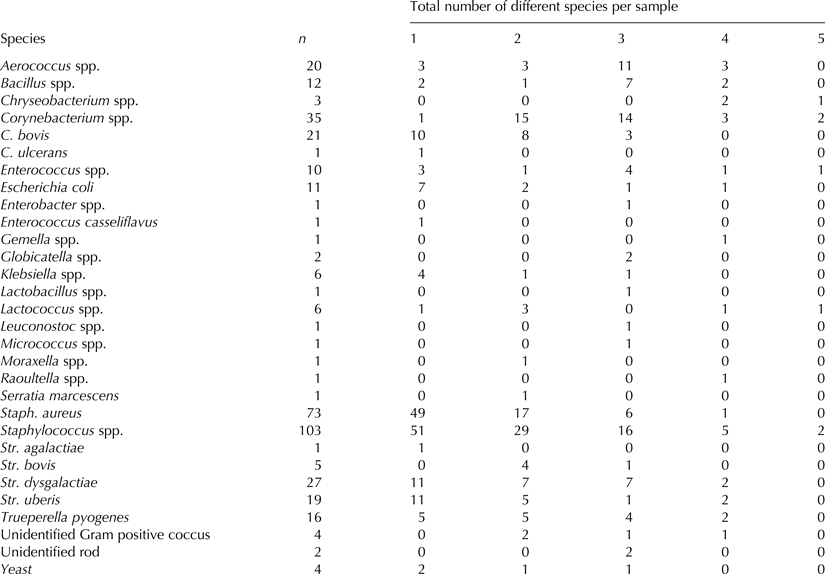
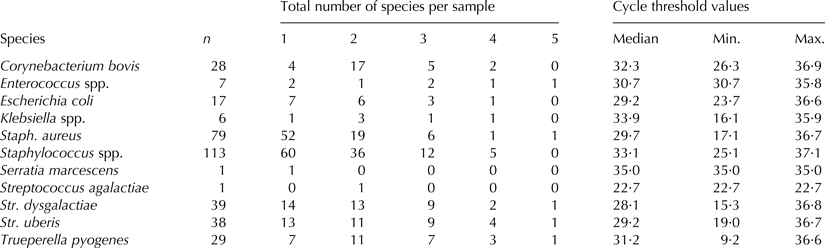
Out of the total 294 milk samples, 251 (85·7%) were positive for bacterial growth in the BC when ≥1 CFU was considered positive. In the real-time PCR, 244 samples out of 294 (83·0%) were positive (Table 1). With both methods, the most common finding was Staphylococcus spp. (CNS group), followed by Staph. aureus (Tables 2 and 3). Assessing culture results of Staphylococcus spp. using a threshold of ≥5 CFU, the number of detections decreased from 103 to 58. Similarly, the number of C. bovis detections decreased from 35 to 18. Species not included in the target panel of the PCR assay were cultured from 77/294 samples (≥1 CFU), but using the threshold of ≥5 CFU, only 7/294 yielded a positive diagnosis. These diagnoses included two samples with yeast (both > 50 CFU), one with C. ulcerans (>100 CFU), one with Aerococcus spp. (33 CFU), one with Str. bovis (64 CFU), one with Corynebacterium spp. (10 CFU) and one with an unidentified coccus (33 CFU). PCR results were negative for five of these samples, while two contained Staphylococcus spp. in low amounts. Half (38/77) of the samples with non-target PCR species cultured contained at least two other species, indicating contamination.
The number of bacterial species per sample detected by the conventional bacteriological culture (BC) or real-time PCR assay. Samples (n = 294) were aseptically taken quarter milk samples. A positive result in BC was one CFU per 0·01 ml of milk and in PCR detection of bacterial DNA under a cycle threshold value of 37

† Considered contaminated in the conventional bacteriological culture
Species isolated in aseptically taken quarter milk samples (n = 294) by the conventional bacteriological culture. The total number of isolations of each species (n) is presented in the second column. The number of different species detected per sample (including the species in the first column) is also shown. A positive result was defined as detection of ≥1 CFU per 0·01 ml of milk for all microorganisms. Samples containing >5 species were not found
Species detected from aseptically taken quarter milk samples (n = 294) with real-time PCR. The total number of detections of each species (n) is presented in the second column. The number of different species detected per sample (including the species in the first column) is also shown. Samples containing >5 species were not found. A positive microbiological result was based on amplifying DNA of the target species using a cycle threshold cut-off value of 37·0
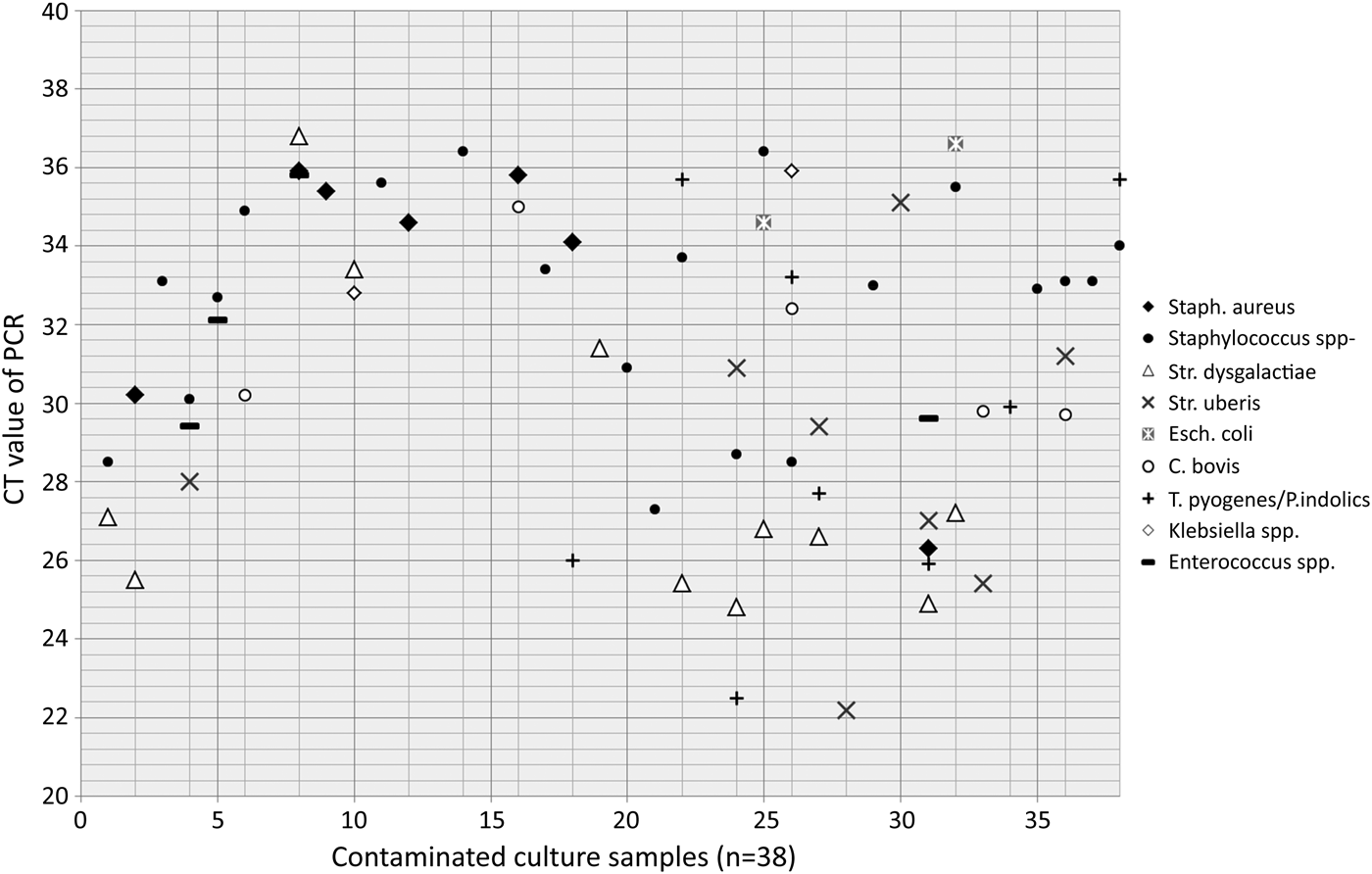
Three or more species were cultured from 38/294 (12·9%) samples. Staphylococcus spp. was the major finding 23/38 (60·5%) in these samples, which are defined as contaminated in the BC (National Mastitis Council, 2004). Other species commonly cultured from the contaminated samples were Corynebacterium spp., Aerococcus spp., Bacillus spp. and Str. dysgalactiae (Table 2). Staph. aureus was found in seven samples with three or more species. PCR results of these 38 contaminated samples included DNA of the target pathogens usually in moderate on low amounts (Fig. 1). In the PCR, 24 samples (8·1%) with ≥3 different species were detected, Staphylococcus spp. also being the most prevalent finding (Table 3). Other frequently detected species in these multi-species samples were Str. uberis, Str. dysgalactiae and T. pyogenes. Staph. aureus was present in 8 samples (Table 3).
Real-time PCR results for aseptically taken quarter milk samples in which ≥3 different species were detected in the conventional bacteriological culture (38/294).
In BC, 52/294 (17·7%) of samples contained two different species. In 30 out of these 52 samples (57·7%) at least the other cultured species was not included in the target panel of the PCR assay. The number of samples with two species was 59/294 (20·0%) in the PCR. Among these 59 samples, only one species was cultured in the BC in 30 (50·8%) samples, four were culture-negative, 18 had growth of two species and the rest (7) three or more species.
Species detected by PCR and their minimum, maximum and median Ct values are shown in Table 3. In 79/113 (69·9%) of the samples positive for Staphylococcus spp. in the PCR, only a low amount of DNA (Ct > 31·1) was detected, and none of the samples contained a high amount of DNA (Ct < 24). Samples positive for Staph. aureus contained mainly high (Ct < 24) or intermediate (Ct 24–30) amounts of DNA; in 32/79 (40·5%) of the samples the amount of DNA was low.
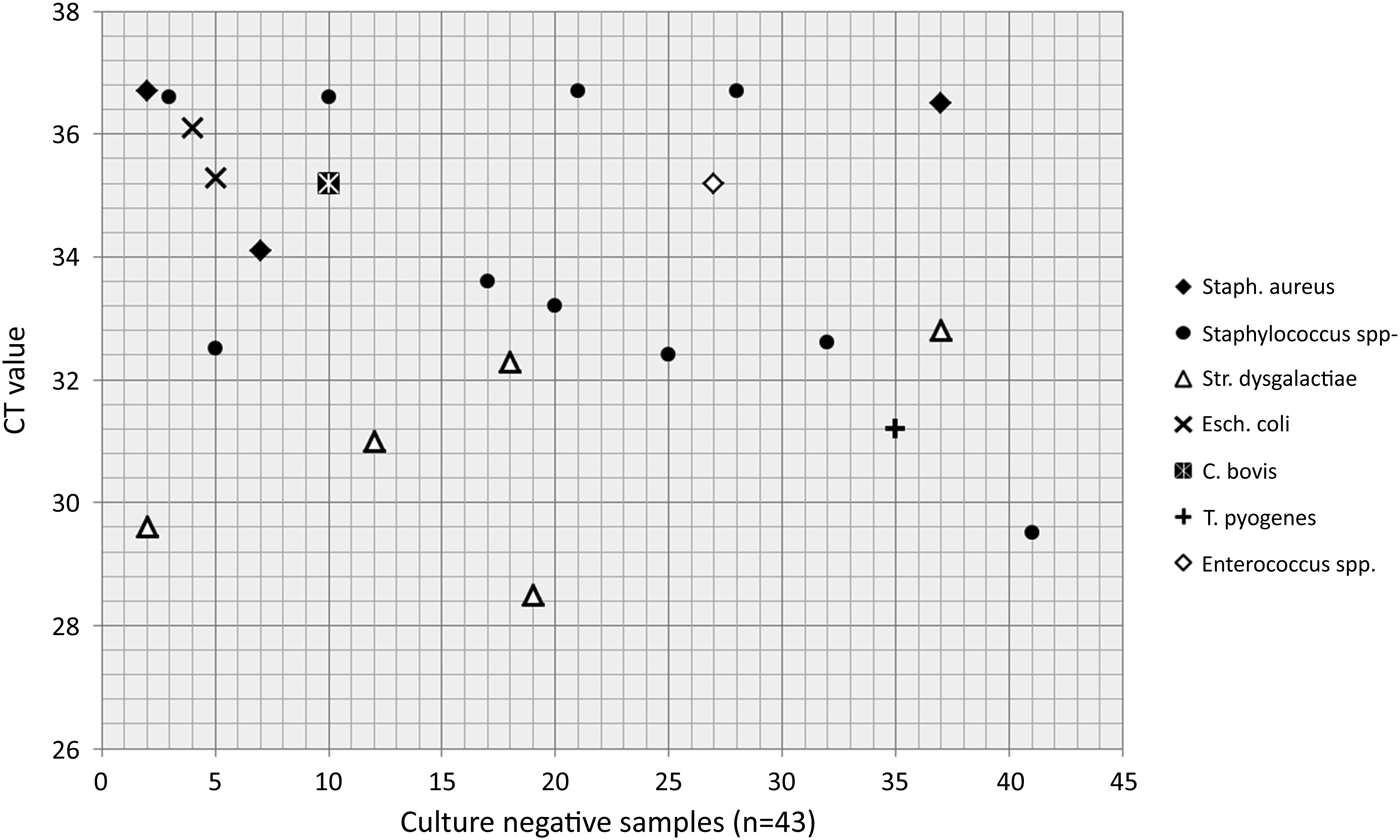
Among the 43 culture-negative samples, PCR gave a positive result for 20 samples (46·5%) (Fig. 2). Staphylococcus spp. was the most common finding, and Staph. aureus was amplified in three samples (Ct range 34·1–36·7). All culture-negative samples, except those positive for Str. dysgalactiae, contained only low amounts of the target DNA in the PCR and no more than two different species (Fig. 2).
Real-time PCR results and their Ct values for aseptically taken quarter milk samples with no growth in the conventional bacteriological culture (43/294). The cycle threshold cut-off value for a positive PCR result was 37·0.
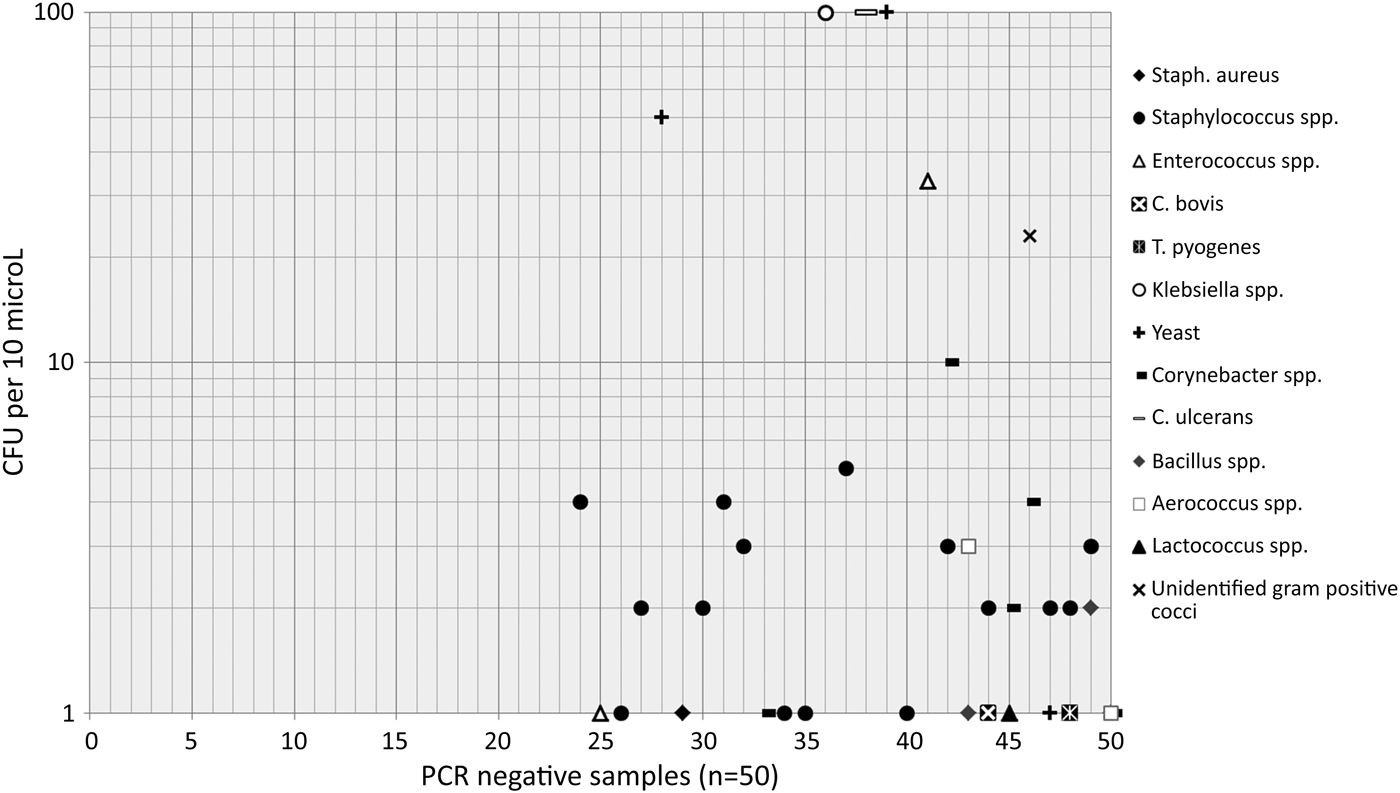
From the total of 50 PCR-negative samples, 27 (54·0%) samples were culture positive (Fig. 3). One of these samples yielded ≥3 species on the plate indicating contamination, 8 samples yielded two species and 18 samples only one species (threshold ≥ 1 CFU). In 13 out of the 27 (48·1%) samples cultured species were not included in the PCR target panel (Fig. 3). Staphylococcus spp., Klebsiella spp., Staph. aureus and Enterococcus spp., which belong to the target panel of the PCR assay were isolated in 20 PCR negative samples. Staphylococcus spp. was detected in 15/27 (55·6%) samples, but only in one sample in numbers higher than 5 CFU per 0·01 ml of milk. One CFU of Staph. aureus was found in one PCR-negative sample.
Results from conventional bacteriological culture for aseptically taken quarter milk samples negative in real-time PCR assay (50/294). A positive result was defined as detection of ≥1 CFU per 0·01 ml of milk for all micro-organisms.
The mean NAGase activity of all milk samples was 5·79 pmol 4-MU/min/μl milk (range 0·11–24·49 pmol 4-MU/min/μl). Based on the milk NAGase activities, 246/294 (83·7%) samples originated from mastitic quarters (activities over 1.04 pmol 4-MU/min/μl milk). For Staph. aureus samples the mean NAGase value was 6·95 pmol 4-MU/min/μl milk (range 0·11–24·49) and for Staphylococcus spp. samples 4·44 pmol 4-MU/min/μl milk (0·12–17·20). Among samples positive for Staph. aureus, in 16/73 (21·9%, BC) and in 14/79 (17·7%, PCR) milk NAGase activity remained low. The corresponding figures for Staphylococcus spp. were 9/103 (8·7%, BC) and 22/113 (19·5%, PCR).
PCR was compared with BC in detecting Staph. aureus and Staphylococcus spp. in the milk samples. The total number of samples in these calculations was 256, as contaminated BC samples and the respective PCR samples were excluded. For Staph. aureus (n = 9 PCR, n = 3 BC), Se and Sp were 97·0 and 95·8%, respectively. The positive predictive value (PPV) was 88·9%, negative predictive value (NPV) 98·9% and κ-coefficient between PCR and BC 0·90 (P < 0·05). For Staphylococcus spp. (n = 113 PCR, n = 58 BC, threshold ≥5 CFU) the corresponding figures for PCR were Se 86·7%, Sp 75·4%, PPV 42·9%, NPV 96·4% and κ-coefficient 0·44 as compared with BC (P < 0·05 for all results).
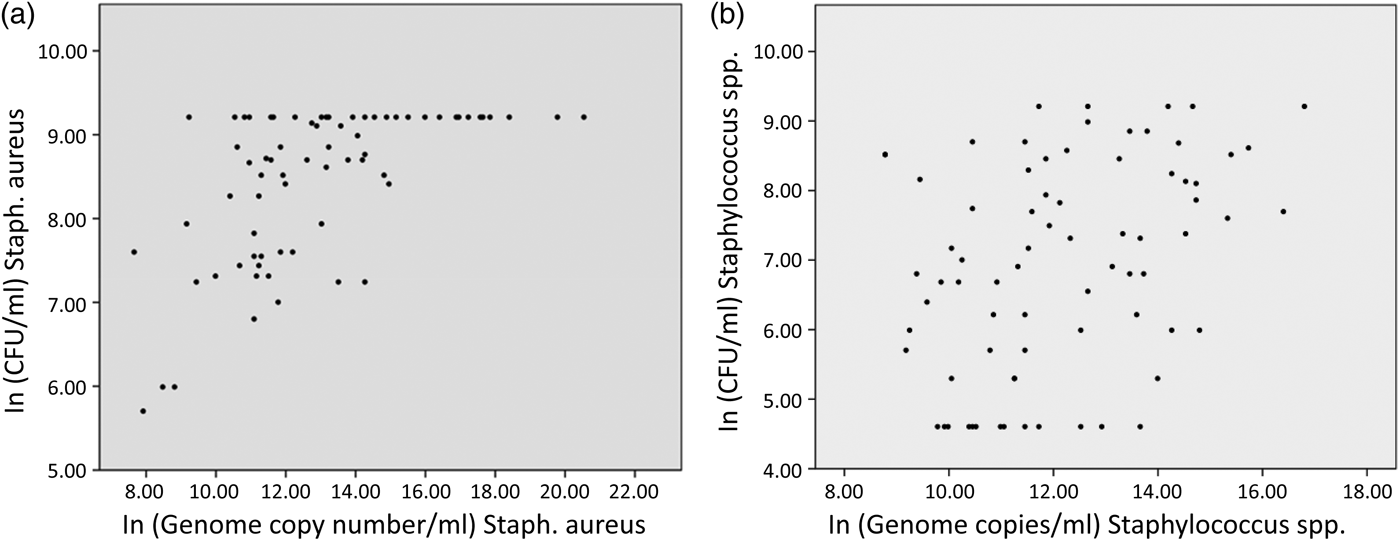
The number of CFU/ml in BC and the number of genome copies/ml in PCR for Staph. aureus and Staphylococcus spp. are shown in Fig. 4. Only samples where the species were detected by both methods are included (n = 70 for Staph. aureus and n = 75 for Staphylococcus spp.). Spearman's correlation coefficient for Staph. aureus was 0·68 (P < 0·05) and for Staphylococcus spp. 0·47 (P < 0·05). High numbers of CFU (≥100) were detected in 27 samples with Staph. aureus and in 6 samples with Staphylococcus spp. When the samples with over hundred CFU of Staph. aureus were excluded, the correlation coefficient decreased to 0·52 (P < 0·05). For Staphylococcus spp., the removal of the 6 high-CFU samples decreased the coefficient to 0·32 (P = 0·007).
The number of CFU/ml in the conventional bacteriological culture and the number of genome copies/ml in real-time PCR for samples positive for Staph. Aureus (a) and Staphylococcus spp. (b) are presented on a logarithmic (ln) scale. Only samples where the target species was detected by both methods are included (Staph. aureus n = 70, Staphylococcus spp. n = 75).
Discussion
In this study, routine quarter milk samples from subclinical and clinical mastitis were analysed with a real-time PCR assay and semi-quantitative, in-depth bacteriological culture carried out in the Finnish national reference laboratory for mastitis. All bacterial colonies grown on the agar plates were quantified if possible and different colonies identified. Detection abilities and diagnostic capability of the PCR assay was compared with the conventional culturing, aiming to evaluate the performance of the real-time PCR assay in routine use. In papers published to date, the focus has been mainly on the detection capabilities of the PCR assay compared with conventional culture carried out in routine mastitis laboratories (Taponen et al. Reference Taponen, Salmikivi, Simojoki, Koskinen and Pyörälä2009; Koskinen et al. Reference Koskinen, Wellenberg, Sampimon, Holopainen, Rothkamp, Salmikivi, van Haeringen, Lam and Pyörälä2010; Bexiga et al. Reference Bexiga, Koskinen, Holopainen, Carneiro, Pereira, Ellis and Vilela2011; Keane et al. Reference Keane, Budd, Flynn and McCoy2013). In the previous studies routine microbiological methods for mastitis diagnostics have been used, with no quantification of the bacterial colonies and excluding samples with more than two species detected (Spittel & Hoedemaker, Reference Spittel and Hoedemaker2012; Keane et al. Reference Keane, Budd, Flynn and McCoy2013).
Based on the NAGase results, the majority (83·7%) of the milk samples originated from mastitic quarters. In the rest of the samples, no inflammatory reaction was present, and they may have been taken to monitor treatment response or because of some clinical signs in the quarter. Regarding the capability of the tests to detect microbes in the milk, the proportion of positive samples was almost similar in PCR (83·0%) and in BC (85·7%), despite the limitations in the number of targets in the PCR panel. Given the relatively high number of samples (77/294) containing species not included in the target panel of the PCR assay, only 7 (1·1%) yielded a positive microbiological diagnosis using a cut-off of ≥5 CFU for a positive result. According to our results the target panel of the PCR assay was adequate. Yeasts, Mycoplasma spp., Mycoplasma bovis and Prototheca spp. have been included in the more recent version of the PCR assay, which is currently in routine use in Finland.
The number of negative samples was rather similar with PCR and BC, but only about half of these samples were negative with both methods. Of the culture-negative samples, PCR provided a positive result in 46%, which is in line with previous studies (Taponen et al. Reference Taponen, Salmikivi, Simojoki, Koskinen and Pyörälä2009; Bexiga et al. Reference Bexiga, Koskinen, Holopainen, Carneiro, Pereira, Ellis and Vilela2011; Spittel & Hoedemaker, Reference Spittel and Hoedemaker2012). The majority of these samples yielded minor pathogens, usually Staphylococcus spp. or environmental pathogens with a low amount of bacterial DNA. Staph. aureus was detected by PCR from three culture-negative samples with low amounts of DNA (Fig. 2). Keane et al. (Reference Keane, Budd, Flynn and McCoy2013) also found that PCR-positive but culture-negative Staph. aureus samples are quite rare. In general, explanations for culture-negative PCR-positive samples could be the inability of the damaged or dead cells to grow, in addition to the presence of inhibitory substances in the milk. A larger volume of milk is analysed with PathoProof Mastitis Assay (17·5 μl) than with BC (10 μl), increasing the sensitivity of the PCR test. The clinical relevance of positive PCR results from samples negative in culture could be questioned. However, when PCR is used as the sole diagnostic test, culture results are not available.
More than half of the 50 PCR-negative samples (54·0%) were positive in BC, and some of them contained target bacteria of the PCR assay, mainly Staphylococcus spp. (Fig. 3). Staph. aureus was cultured only once from a PCR-negative sample with only one CFU on the plate. Non-target microbes were cultured in 26·0% of the PCR-negative samples. An explanation for samples negative in PCR but positive in BC could be incomplete mixing of the sample before the PCR test i.e. inadequate homogenisation of the sample. In the present study, samples where PCR failed to detect bacterial DNA but which were positive in the BC, the number of CFU was always low, with the exception of species not included in the PCR panel.
The correlation between CFU counts in the BC and genome copy numbers in the PCR was fairly good for Staph. aureus (0·68, P < 0·05), but for Staphylococcus spp. only from moderate to poor (0·47, P < 0·05), with considerable variation. For instance, from 14 samples, where PCR indicated a low amount of Staph. aureus in the sample (Ct 30·1–37·0), over 20 CFU per 0·01 ml were cultured and from 5 samples even ≥100 CFU per 0·01 ml (data not shown). Our results support the previous observations on poor agreement between plate counts and quantification of Staph. aureus by PCR (Hein et al. Reference Hein, Lehner, Rieck, Klein, Brandl and Wagner2001; Studer et al. Reference Studer, Schaeren, Naskova, Pfaeffli, Kaufmann, Kirchhofer, Steiner and Graber2008). Botaro et al. (Reference Botaro, Cortinhas, Março, Moreno, Silva, Benites and Santos2013) found that plate counts and genome copy numbers of Staph. aureus correlated very well in milk samples artificially inoculated with a single Staph. aureus strain, but for samples from naturally infected quarters genome copy numbers of Staph. aureus could not be recorded. The ability of PCR to detect DNA from dead or growth-inhibited cells is a well-known cause for variation. Disagreement between plate counts and amount of bacterial DNA amplified by PCR may be related to differences in the growth ability of the strains (Hein et al. Reference Hein, Lehner, Rieck, Klein, Brandl and Wagner2001). The DNA targets (usually proprietary information) may also be present in more than one copy in the target organisms, making the comparison even more difficult. Comparison between published studies is difficult in general, owing to the different real-time PCR assays and sample sizes used. Regarding Staphylococcus spp. (CNS or non-aureus staphylococci), which consists of a group of species, comparison is even more complicated.
The PCR assay appeared to perform as a reliable diagnostic tool for Staph. aureus. Using the conventional culture as an acceptable gold standard could be argued, as this approach may underestimate Se and Sp of the PCR assay because of the inaccuracy of the reference test (Koskinen et al. Reference Koskinen, Wellenberg, Sampimon, Holopainen, Rothkamp, Salmikivi, van Haeringen, Lam and Pyörälä2010; Cederlöf et al. Reference Cederlöf, Toft, Aalbaek and Klaas2012). In a previous study of Cederlöf et al. (Reference Cederlöf, Toft, Aalbaek and Klaas2012) Se of the PCR assay to detect Staph. aureus-IMI at drying off was 93% and Sp 95%. They used the same Ct cut-off value of 37, but the statistical method of analysing the results differed (Latent Class Analysis). Paradis et al. (Reference Paradis, Haine, Gillespie, Oliver, Messier, Comeau and Scholl2012) used a different multiplex real-time PCR assay, resulting in a median Se of 72 to 79%. In our calculations, a positive result for Staph. aureus was based on presence of at least one CFU on the plate (Dohoo et al. Reference Dohoo, Smith, Andersen, Kelton and Godden2011). The clinical relevance of such a finding can be debated, as no agreed standards are available, though proposals have been made (Andersen et al. Reference Andersen, Dohoo, Olde Riekerink and Stryhn2010; Dohoo et al. Reference Dohoo, Smith, Andersen, Kelton and Godden2011). Based on our results and considering the nature of Staph. aureus as a major pathogen, we recommend that also low amounts of Staph. aureus DNA amplified (Ct > 30·1) in the PCR should be noted when using PCR as the only diagnostic method, presuming that the sample is aseptically taken. The performance of the PCR assay for diagnosing other staphylococci than Staph. aureus seems not to be as optimal. In calculations for Staphylococcus spp., using at least 5 CFU as a cut-off for positive diagnosis, over 50% of the positive PCR results could be false positives. The majority of these detections contained only small amounts of DNA of Staphylococcus spp. We suggest that PCR results of low amounts of Staphylococcus spp. should not be automatically interpreted as IMI, but the possibility of contamination should be considered to avoid misdiagnoses and unnecessary antimicrobial treatments or other measures. The cut-off Ct value for Staphylococcus spp. should probably be adjusted to avoid possible false positive diagnoses in the PCR.
The hygienic quality of milk samples was good as 83·9% of samples examined by BC and 86·6% of samples examined by PCR contained only one or two different species. This indicates that aseptic milk sampling routine has been adapted well by the local veterinarians and farmers. In conventional mastitis diagnostics a sample containing more than two species is considered contaminated (Hogan et al. Reference Hogan, González, Harmon, Nickerson, Oliver, Pankey and Smith1999) and the result is provided to the client as ‘mixed growth’, with no bacterial species identified in the sample. In contrast, the results of the PCR assay are presented as a list of species with Ct values or a semi-quantitative classification of the amount of DNA detected. Wrong interpretation of samples with multiple species may lead to misdiagnoses and even to non-justified antimicrobial treatments. In the previous studies PCR has provided more multi-species results than BC (Bexiga et al. Reference Bexiga, Koskinen, Holopainen, Carneiro, Pereira, Ellis and Vilela2011; Spittel & Hoedemaker, Reference Spittel and Hoedemaker2012; Keane et al. Reference Keane, Budd, Flynn and McCoy2013), which is in contrast to our study (BC 12·9% and PCR 8·1%, respectively). This might be due to the in-depth culturing performed in our study as the majority of the contaminated culture samples contained species not included in the PCR target panel and was detected with low CFU numbers. The interpretation of the PCR results was strict: despite the predominance of some pathogens in the PCR results (proportion of some species in the sample >90 or >99%), all detected pathogens were recorded. Detection of more than two bacterial species, especially species of environmental origin and in low amounts of DNA, raises concerns about the hygienic quality of the sample, despite the analysing method. In PCR diagnostics a definition for contaminated sample could be advantageous, especially in cases where a predominant species cannot be identified.
All microbiological tests have their limitations. For all tests, the importance of a proper aseptic technique in milk sampling cannot be over-emphasised. Handling, temperature, transportation and time after sampling can all affect the results despite the method. BC provides results only when organisms are living and can grow on the plate. PCR assays yield microbiological results irrespective of the fitness of the bacteria, detecting DNA also from dead bacteria. Consequently, the clinical relevance of some PCR results can be questionable. It must be emphasised that results from any microbiological analysis provide only a microbiological diagnosis and should always be interpreted with all available information, such as clinical signs and history of the cow, and SCC of the milk, when used in decision-making for antimicrobial treatment or other measures. When using PCR as the only microbiological method for mastitis diagnostics, low amounts of minor pathogens, such as Staphylococcus spp. should be ignored. Introducing the concept of a contaminated sample to mastitis diagnostics with PCR could be helpful to avoid wrong interpretation of the results.
This study was funded by Ministry of Agriculture and Forestry of Finland and Walter Ehrström foundation. We also thank Valio Laboratories for providing the milk samples for the study.