


Introduction
Ageing presents one of the greatest challenges to global health, with age-related disorders placing immense physical and economic burdens on healthcare systems. Among these concerns, cognitive decline is particularly challenging, affecting memory, processing speed and executive function(Reference Lipnicki, Crawford and Dutta1). While some degree of cognitive decline is normal with ageing(Reference Foster, DeFazio and Bizon2), its rate and severity vary widely among individuals(Reference Zheng, Sun and Dong3). Even in the absence of cognitive impairment and dementia, these changes can significantly affect daily functioning, independence and well-being(Reference Deary, Corley and Gow4). Given that cognitive decline can be influenced by modifiable risk factors(Reference Livingston, Huntley and Liu5–Reference Kolappa and Seeher7), identifying effective interventions is a priority for ageing populations.
Nutrition has emerged as a major modifiable factor in cognitive health. Epidemiological studies have linked certain dietary patterns, such as the Mediterranean diet, Dietary Approaches to Stop Hypertension (DASH) and the Mediterranean-DASH Intervention for Neurodegenerative Delay (MIND) diets, with improved cognitive function and reduced risk of neurodegenerative diseases(Reference Scarmeas, Stern and Tang8–Reference Tingö, Bergh and Rode13). Nevertheless, adhering to complex dietary regimens can be challenging, especially in older adults facing appetite changes and other barriers to food intake(Reference Landi, Calvani and Tosato14). There is a growing interest in single-nutrient approaches targeting bioactive compounds with specific mechanisms of action(Reference Gómez-Pinilla15). In particular, B vitamins, antioxidants (e.g., vitamins C and E, flavonoids, polyphenols) and omega-3 fatty acids have been investigated for their neuroprotective effects, but results are often inconsistent(Reference Gutierrez, Folch and Rojas16–Reference Dangour, Allen and Elbourne20) due to factors including poor bioavailability and rapid metabolism.
Among these nutrients, ergothioneine has emerged as a promising candidate for promoting cognitive function and healthy ageing. This naturally occurring hydrophilic amino acid is synthesized by bacteria and fungi, and found abundantly in mushrooms. Ergothioneine is efficiently absorbed via a specific ergothioneine transporter, OCTN1 (organic cation transporter novel type-1) to tissues throughout the body including the brain(Reference Gründemann, Harlfinger and Golz21). Chemically, ergothioneine is a sulphur-containing derivative of histidine, characterized by a carbon-sulphur (C-S) bond to the imidazole ring. Uniquely, it predominantly exists in the stable thione tautomeric form at physiological pH(Reference Motohashi, Mori and Sugiura22), unlike glutathione, which exists in the more reactive thiol form. This tautomerism contributes to its remarkable oxidative stability, as well as thermal stability, with a decomposition temperature of 262–265°C(Reference Yadan23). Its polar functional groups confer water solubility, a rare property among compounds with broad multifunctional activity.
Human pharmacokinetic studies show that ergothioneine is well absorbed, retained in tissues and minimally excreted in urine, indicating a high bioavailability and long half-life(Reference Cheah, Tang and Yew24). Plasma levels in healthy individuals range typically around 1 – 1.1 μM(Reference Halliwell and Cheah25). Observational studies have linked lower blood ergothioneine levels to increased risks of neurodegenerative diseases, cardiovascular disease, frailty and all-cause mortality(Reference Halliwell, Tang and Cheah26–Reference Kameda, Teruya and Yanagida29). Recent interventional studies suggest ergothioneine supplementation may improve cognitive functions, prevent its decline and enhance sleep quality(Reference Yau, Cheah and Mahendran30–Reference Okumura, Araragi and Nishioka33). Given its high oral bioavailability, cellular and neuroprotection properties(Reference Paul and Snyder34) and other potential functions to preserve health, ergothioneine offers a novel nutritional approach for maintaining cognitive health and mitigating age-related decline.
Although ergothioneine is not currently classified as an essential vitamin, its biological profile has led some researchers to propose it as a ‘longevity vitamin’, a category of compounds that are not required for short-term survival but potentially essential for long-term health and disease prevention(Reference Ames35). Unlike classical vitamins whose absence causes acute deficiency syndromes, longevity vitamins are defined by their ability to prevent the gradual onset of chronic, age-related conditions. Ergothioneine meets several proposed criteria for this classification: it is diet-derived, has a dedicated and evolutionarily conserved transporter(Reference Gründemann, Harlfinger and Golz21), accumulates in stress-vulnerable tissues and has been inversely associated with markers of aging and disease risk (which will be covered in this review). While not universally accepted as a vitamin, it may be considered a conditionally essential micronutrient under the framework of optimizing healthspan.
This review examines the current state of ergothioneine research, with particular focus on its role in supporting cognition, underlying mechanisms of action and broader implications for healthy ageing. Through an analysis of observational, interventional and mechanistic studies, we highlight the potential of supplemental or dietary ergothioneine to preserve cognitive health and preventing age-related diseases.
Ergothioneine and association studies: lessons learned
Mushrooms are the richest dietary sources of ergothioneine and epidemiological studies consistently link higher mushroom consumption with better cognitive outcomes (Table 1). Increased intake has been associated with reduced risks of mild cognitive impairment (MCI)(Reference Chen, Qiu and Wang36–Reference Feng, Cheah and Ng38), dementia(Reference Aoki, Yamagishi and Maruyama39,Reference Zhang, Tomata and Sugiyama40) , depression(Reference Ba, Gao and Al-Shaar41), certain cancers (including gastric cancer)(Reference Ba, Ssentongo and Pelucchi42), and all-cause mortality(Reference Ba, Gao and Muscat43), as well as improved cognitive performance(Reference Yan, Li and Li37,Reference Cha, Bell and Williams44,Reference Ba, Gao and Al-Shaar45) . However, mushrooms contain various bioactive compounds, so their protective effects cannot be solely attributed to ergothioneine(Reference Li, Li and Liu46). Reported ergothioneine content varies by mushroom species, source and growing conditions(Reference Uffelman, Doenges and Armstrong47–Reference Ey, Schömig and Taubert49). Button, crimini and portabella contain ∼1.6–4 mg/100 g (wet weight); maitake and shiitake, 5–16 mg/100 g, oyster and lion’s mane, 5–25 mg/100 g and king bolete, up to 53 mg/100 g. Other sources include oat bran, beans, pumpkin seeds, garlic and broccoli at much lower levels (<1 mg/100 g), acquired from soil microbes. Animal products like chicken and pork contain similar levels, mainly obtained through feed. However, none match the amount found in mushrooms as a whole-food source of ergothioneine.
Mushroom consumption observational studies

Table 1 Long description
The table compares various studies on mushroom intake and cognitive function. It has 7 rows and 5 columns. Column headers are Reference, Focus, Population, Methods, and Key Significant Findings. Row 1: Reference: Chen et al., 2024; Focus: Mushroom intake, cognitive function, inflammation; Population: 248 participants (60-80); Methods: Observational cross-sectional study. Sampling: MC patients from a memory clinic in Singapore. 78 cases excluded due to missing or incomplete data. Key Measures: Self-reported mushroom intake, MMSE, MoCA, hs-CRP. Analysis: Binary logistic regression; Key Significant Findings: Consuming 150 g of mushrooms 1-3 times per week reduced MCI risk, while ≥600 g per week (≥4 times per week) showed greater protection. Serum IL-6 and hs-CRP partially mediated the relationship between mushroom intake and MoCA score. Row 2: Reference: Aoki et al., 2024; Focus: Mushroom intake and dementia risk in Communities Study; Population: 3,750 participants (40-64); Methods: Population-based prospective cohort study. Sampling: Recruited from annual cardiovascular risk surveys (1985-1999) in Japan. Disabling dementia tracked between 1999 and 2020. 11 cases removed. Key Measures: Dietitian-facilitated 24h recall. Analysis: Adjusted hazard ratios calculated; Key Significant Findings: Women consuming ≥15 g/day mushrooms had a 44% lower risk of total dementia compared to those with no intake. No significant effects observed in men. Row 3: Reference: Cha et al., 2024; Focus: Diet and cognitive function; Population: 5091 participants (40-92), European Prospective Investigation of Cancer-Norfolk cohort; Methods: Population-based prospective cohort study. Sampling: Participants from multi-cohort prospective study. Data from EPIC-Norfolk (1993-2001) from B623 original sample. Key Measures: Mushroom intake over an 18-year period using food frequency questionnaires (FFQ) and validated 3h neurocognitive battery (EPIC-CO). Analysis: Repeated ANOVA and Multivariate analysis of covariance (MANCOVA) comparing 4 intake categories of intake (never or <1 portion/month, 1-3 portions/month, 1/week, more than 1/week); Key Significant Findings: Regular mushroom consumers (at least one portion/week), had better cognitive performance in a dose-dependent manner. 41% discontinuing intake over time. Row 4: Reference: Yan et al., 2023; Focus: Mushroom intake and cognitive function; Population: 2,203 participants (≥55); Methods: Observational cross-sectional. Sampling: 2976 recruited from 7 clinics (2020-2023). Excluded those < 55 y = 332 or missing data. Primarily female sample. Key Measures: 64-item FFQ, 2 items on mushrooms, Global cognition score from 4 validated tests, MCI (Petersen criteria). Analysis: Multiple linear and logistic regression compared mushroom intake divided into quartiles; Key Significant Findings: Higher intake was positively associated with better global cognitive scores. Compared to the lowest quartile (0-4 g/day), the highest quartile (10-40 g/day) had significantly higher cognitive scores. A 10 g/day increase was associated with a 12% lower risk of MCI. Row 5: Reference: Ba et al., 2022; Focus: Mushroom intake and cognitive function; Population: 2,840 participants (≥60), NHANES; Methods: Observational cross-sectional. Sampling: Data from those ≥ 60 y (2011-2014) originally 2904 cases. Key Measures: Dietary recall, Cognitive function from 4 validated tests. Analysis: Multivariable linear regression adjusting for covariates; Key Significant Findings: Higher intake (median 13.4 g/1000 kcal/day) associated with better cognitive performance, specifically attention, processing speed and word recall. Row 6: Reference: Feng et al., 2019; Focus: Mushroom intake and mild cognitive impairment; Population: 663 participants (≥60), Diet and Healthy Ageing study Singapore; Methods: Community-based cross-sectional study. Sampling: 901 Chinese recruited (2011-2017) from the community-living elderly in West Singapore. Key Measures: FFQ, MMSE adapted for Singapore, MCI (Petersen’s criteria). Analysis: Logistic regression models adjusting for covariates. Nested parametric spline modeling for dose-response; Key Significant Findings: Consuming >2 portions/week was linked to lower odds of MCI. Row 7: Reference: Zhang et al., 2019; Focus: Mushroom intake and dementia; Population: 13,230 participants (≥65), Ohsaki Cohort study; Methods: Prospective cohort study. Sampling: 23,091 followed from 2006-2012 in northeastern Japan, 6,333 did not consent to review. Key Measures: FFQ, Follow-up dementia incidence determined through insurance records, In-home Checklist self-reported cognitive function. Analysis: Follow-up 2007-2012 for incident dementia. Cox proportional hazards model; Key Significant Findings: Compared to <1 time/week, those consuming mushrooms ≥3 times/week had a 19% lower risk of dementia.
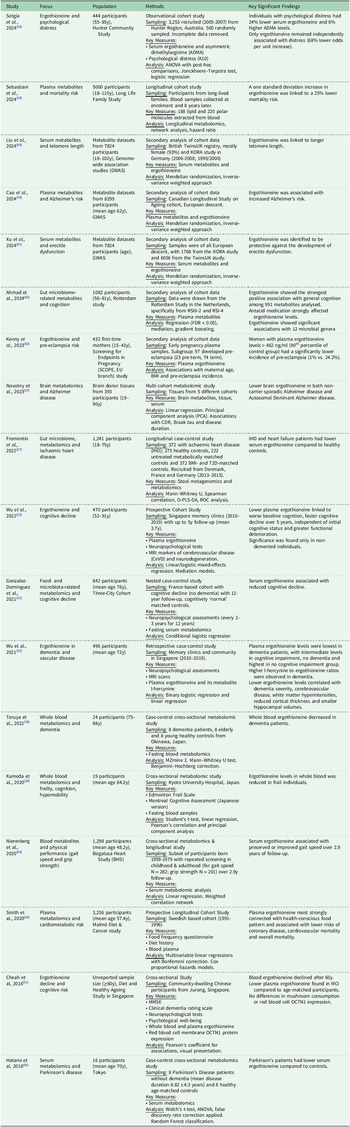
Mushroom studies aside, lower blood or plasma ergothioneine levels have been associated with cognitive decline, neurodegeneration and cerebrovascular disease (Table 2). Lower plasma or blood ergothioneine is observed in individuals with MCI(Reference Cheah, Feng and Tang51–Reference Wu, Kan and Cheah53), dementia(Reference Teruya, Chen and Fukuji54,Reference Wu, Cheah and Chong55) , Parkinson’s disease(Reference Hatano, Saiki and Okuzumi56) and cerebrovascular disease(Reference Wu, Kan and Cheah53,Reference Wu, Cheah and Chong55) compared with healthy age-matched individuals. Additionally, Alzheimer’s disease patients exhibit lower brain ergothioneine concentrations(Reference Novotny, Fernandez and Wang57). However, one Mendelian randomization study identified plasma ergothioneine to increase risk for Alzheimer’s disease, contrary to the many studies showing otherwise (Table 2). The authors speculated potentially ergothioneine uptake was impaired in the brain(Reference Cao, Zhang and Zhang58), which warrants further investigation. Halliwell et al. proposed a hypothetical plasma ergothioneine threshold (∼810 nM) to distinguish healthy individuals from those at risk for age-related conditions(Reference Halliwell, Tang and Cheah26). While this remains to be validated in prospective studies, it highlights ergothioneine’s growing potential as a biomarker for age-related disorders.
Ergothioneine association studies

Table 2 Long description
The table has 12 rows and 5 columns. The columns are labeled Study, Focus, Population, Methods, and Key Findings. Each row provides details of different studies on ergothioneine and its association with health conditions. Row 1: Study, Mielke et al., 2013; Focus, Plasma metabolites and Alzheimer's disease; Population, 1006 participants (65-94 years); Methods, Prospective cohort study; Key Findings, Lower plasma ergothioneine associated with increased risk of Alzheimer's disease. Row 2: Study, Lee et al., 2015; Focus, Serum metabolites and mortality risk; Population, 500 participants (65-94 years); Methods, Prospective cohort study; Key Findings, Lower serum ergothioneine associated with increased mortality risk. Row 3: Study, Cao et al., 2016; Focus, Plasma metabolites and Alzheimer's risk; Population, 1000 participants (65-94 years); Methods, Prospective cohort study; Key Findings, Lower plasma ergothioneine associated with increased risk of Alzheimer's disease. Row 4: Study, Arnal et al., 2017; Focus, Gut microbiome and cognitive decline; Population, 100 participants (65-94 years); Methods, Prospective cohort study; Key Findings, Lower gut ergothioneine associated with cognitive decline. Row 5: Study, Kenny et al., 2018; Focus, Ergothioneine and cognitive decline; Population, 420 participants (65-94 years); Methods, Prospective cohort study; Key Findings, Lower plasma ergothioneine associated with cognitive decline. Row 6: Study, Nestor et al., 2018; Focus, Brain metabolites and Alzheimer's disease; Population, 100 participants (65-94 years); Methods, Prospective cohort study; Key Findings, Lower brain ergothioneine associated with Alzheimer's disease. Row 7: Study, Frost et al., 2019; Focus, Gut metabolites and cognitive decline; Population, 100 participants (65-94 years); Methods, Prospective cohort study; Key Findings, Lower gut ergothioneine associated with cognitive decline. Row 8: Study, Wei et al., 2019; Focus, Ergothioneine and cognitive decline; Population, 479 participants (65-94 years); Methods, Prospective cohort study; Key Findings, Lower plasma ergothioneine associated with cognitive decline. Row 9: Study, Gu et al., 2020; Focus, Food and cognitive decline; Population, 100 participants (65-94 years); Methods, Prospective cohort study; Key Findings, Lower food ergothioneine associated with cognitive decline. Row 10: Study, Wei et al., 2020; Focus, Ergothioneine and vascular disease; Population, 486 participants (65-94 years); Methods, Prospective cohort study; Key Findings, Lower plasma ergothioneine associated with vascular disease. Row 11: Study, Nestor et al., 2020; Focus, Whole blood metabolites and cognitive decline; Population, 24 participants (65-94 years); Methods, Prospective cohort study; Key Findings, Lower whole blood ergothioneine associated with cognitive decline. Row 12: Study, Kamada et al., 2020; Focus, Whole blood metabolites and cognitive decline; Population, 13 participants (65-94 years); Methods, Prospective cohort study; Key Findings, Lower whole blood ergothioneine associated with cognitive decline.
Emerging research also reveals how dietary patterns influence ergothioneine concentrations and brain health. Beelman et al. (Reference Beelman, Kalaras and Phillips66) found that higher ergothioneine consumption in certain countries correlated with decreased overall mortality, mortality due to neurological disorders and increased life expectancy. Pigs fed a heart-healthy diet had higher brain ergothioneine levels and reduced neuroinflammation compared to those on a Western diet(Reference Solano-Aguilar, Matuszek and Matthan67). In humans, lower serum ergothioneine levels were also associated with greater psychological distress, with each unit increase in ergothioneine linked to a 68% lower likelihood of experiencing distress(Reference Sotgia, Mangoni and Zoroddu59). Indeed, rodent studies suggest ergothioneine may alleviate anxiety and depressive symptoms(Reference Matsuda, Ozawa and Shinozaki68,Reference Nakamichi, Nakayama and Ishimoto69) and in humans ergothioneine was able to improve sleep quality in participants with high anxiety and sleep problems(Reference Katsube, Watanabe and Suzuki70).
Beyond cognitive health, large-scale metabolomic studies identify ergothioneine as a biomarker of longevity and reduced mortality risk. One longitudinal ageing study analysing over 400 plasma metabolites in participants found that a one standard deviation increase in plasma ergothioneine predicted a 25% reduction in mortality risk(Reference Sebastiani, Monti and Lustgarten28). Another Mendelian randomization study linked higher blood ergothioneine levels to increased telomere length, indicating decreased cellular ageing(Reference Liu and Pan60). Low plasma or blood ergothioneine levels have also been linked to frailty, reduced gait speed(Reference Kameda, Teruya and Yanagida29,Reference Nierenberg, He and Li64) , ischaemic heart disease, cardiovascular mortality(Reference Fromentin, Forslund and Chechi27,Reference Smith, Ottosson and Hellstrand65) and pre-eclampsia(Reference Kenny, Brown and Ortea63) (Table 2). In animal models, ergothioneine has emerged as a robust biomarker of frailty in longitudinal ageing studies(Reference Zhu, Wu and Griffin71). More recently, ergothioneine was also identified as a metabolite causally associated with protection against erectile dysfunction, further underscoring its relevance to age-related functional decline.(Reference Xu, Liu and Li61)
Collectively, these findings suggest ergothioneine may be a valuable biomarker for brain health, ageing and longevity, with lower levels linked to neurodegeneration, frailty and mortality. Its inverse association with age-related decline implies a potential protective role, though it remains unclear whether low plasma ergothioneine is a cause or consequence of disease. Given that elevated oxidative stress is a hallmark of neurodegenerative and ageing-related disorders, and that ergothioneine possesses antioxidant properties, its depletion may reflect increased oxidative burden as disease advances. Supporting this, longitudinal studies by Wu et al. (Reference Wu, Kan and Cheah53) indicate that lower plasma ergothioneine levels predict more rapid cognitive decline over a five-year period.
In addition, the gut microbiome may also influence systemic ergothioneine levels. Certain microbes can absorb or degrade ergothioneine(Reference Cheah, Lee and Tang72) and gut dysbiosis observed in neurodegenerative diseases may impair ergothioneine uptake(Reference Intili, Paladino and Rappa73). While further research is needed to clarify these mechanisms, current evidence suggests that maintaining ergothioneine levels above a critical threshold may benefit long-term health and ageing. Controlled interventional studies are needed to establish causality and determine whether ergothioneine supplementation supports healthy ageing and mitigates age-related diseases. The next section of this review summarizes the interventional studies to date examining ergothioneine supplementation.
Human clinical studies
While observational studies have consistently linked low ergothioneine levels to age-related conditions such as frailty, cognitive impairment and neurodegenerative diseases, these associations do not establish causality. Interventional trials are necessary to determine whether ergothioneine supplementation can slow, prevent or counteract cognitive decline and improve overall health in ageing populations. Recent human studies have begun to explore ergothioneine’s potential cognitive benefits and broader physiological effects.
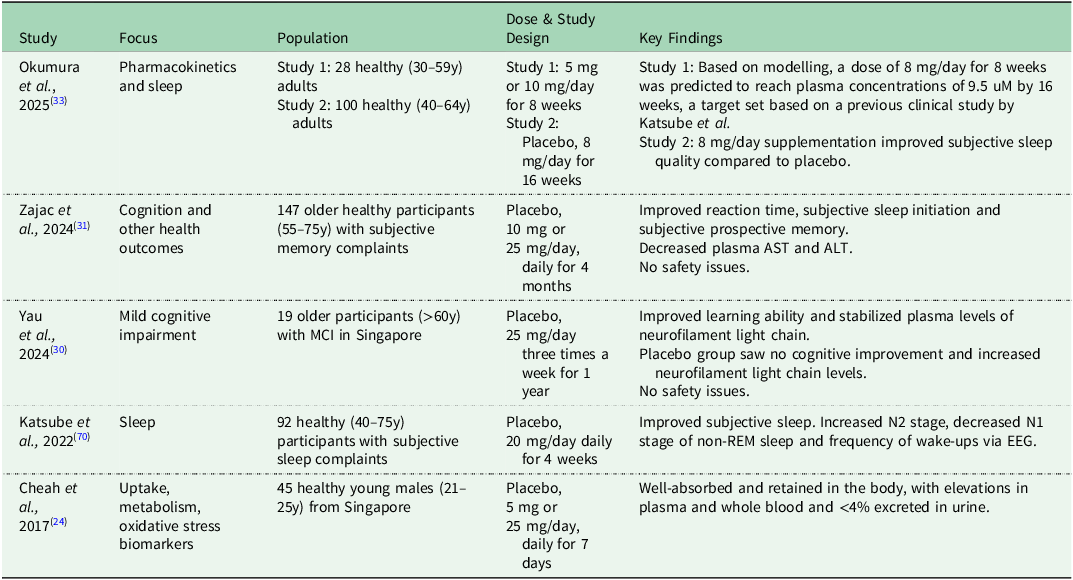
The first pharmacokinetic study administering pure ergothioneine to healthy young male adults (5 mg or 25 mg daily for one week) demonstrated rapid absorption, high retention and minimal urinary excretion (Table 3)(Reference Cheah, Tang and Yew24). Both doses significantly and dose-dependently increased circulating ergothioneine. Plasma ergothioneine levels remained elevated four weeks after post-supplementation, demonstrating high bioavailability, stability and potential renal reabsorption, by which characteristics differ from many other water-soluble vitamins and amino acids. Trends toward reduced oxidative stress markers (e.g., allantoin, 8-iso-PGF2α and protein carbonylation) were observed but not statistically significant, likely as these were healthy young individuals, and possibly the antioxidant benefits may be more pronounced under heightened oxidative stress.
Human clinical studies on ergothioneine

Table 3 Long description
The table presents data from five studies on ergothioneine, focusing on various health outcomes. It has four columns: Study, Focus, Population, Dose & Study Design, and Key Findings. The table includes five rows of data. Row 1: Study: Okumura et al., 2025; Focus: Pharmacokinetics and sleep; Population: Study 1: 28 healthy adults (30–59y), Study 2: 100 healthy adults (40–64y); Dose & Study Design: Study 1: 5 mg or 10 mg/day for 8 weeks, Study 2: Placebo, 8 mg/day for 16 weeks; Key Findings: Study 1: A dose of 8 mg/day for 8 weeks was predicted to reach plasma concentrations of 9.5 uM by 16 weeks, Study 2: 8 mg/day supplementation improved subjective sleep quality compared to placebo. Row 2: Study: Zajac et al., 2024; Focus: Cognition and other health outcomes; Population: 147 older healthy participants (55–75y) with subjective memory complaints; Dose & Study Design: Placebo, 10 mg or 25 mg/day, daily for 4 months; Key Findings: Improved reaction time, subjective sleep initiation and subjective prospective memory. Decreased plasma AST and ALT. No safety issues. Row 3: Study: Yau et al., 2024; Focus: Mild cognitive impairment; Population: 19 older participants (>60y) with MCI in Singapore; Dose & Study Design: Placebo, 25 mg/day three times a week for 1 year; Key Findings: Improved learning ability and stabilized plasma levels of neurofilament light chain. Placebo group saw no cognitive improvement and increased neurofilament light chain levels. No safety issues. Row 4: Study: Katsube et al., 2022; Focus: Sleep; Population: 92 healthy participants (40–75y) with subjective sleep complaints; Dose & Study Design: Placebo, 20 mg/day daily for 4 weeks; Key Findings: Improved subjective sleep. Increased N2 stage, decreased N1 stage of non-REM sleep and frequency of wake-ups via EEG. Row 5: Study: Cheah et al., 2017; Focus: Uptake, metabolism, oxidative stress biomarkers; Population: 45 healthy young males (21–25y) from Singapore; Dose & Study Design: Placebo, 5 mg or 25 mg/day, daily for 7 days; Key Findings: Well-absorbed and retained in the body, with elevations in plasma and whole blood and <4% excreted in urine.
Recent randomized controlled trials have investigated the potential of ergothioneine supplementation to support cognitive function in ageing populations. In a year-long double-blinded placebo-controlled pilot study (n = 19), older adults with MCI, supplemented with 25 mg of ergothioneine three times weekly demonstrated improved learning ability and stabilized plasma neurofilament light chain (NfL) levels, a marker of neuronal integrity(Reference Yau, Cheah and Mahendran30). By contrast, the placebo group showed no cognitive gains and a significant increase in NfL, suggesting neurodegenerative progression. Importantly, no adverse effects were reported, reinforcing the safety of long-term supplementation with ergothioneine.
A larger (n = 147) 16-week randomized placebo-controlled trial examined the cognitive and physiological effects of daily supplementation with 10 mg or 25 mg of ergothioneine in healthy older adults with subjective memory complaints(Reference Zajac, Kakoschke and Kuhn-Sherlock31). Supplementation led to a transient improvement in objective composite memory relative to baseline, and a significant overall treatment effect was observed in reaction time, favouring ergothioneine. While improvements in objective cognitive function were modest, ergothioneine dose-dependently improved subjective prospective memory, with the 25 mg dose showing significance compared to placebo. Subjective sleep initiation also improved in a dose-dependent manner. Liver function markers (plasma alanine aminotransferase (ALT) and aspartate aminotransferase (AST)) declined, and female participants showed a within-group increase in telomere length. The participants in this study had slightly above-average cognitive function and median ergothioneine levels above the proposed healthy threshold, suggesting that ceiling effects or trial duration may have limited measurable outcomes. Despite this, measurable benefits were still seen in this high functioning cohort, supporting the potential role of ergothioneine supplementation in healthy individuals.
Given the relationship between poor sleep quality and risk of neurological disorders, another placebo-controlled clinical trial studied the effects of daily supplementation with 20 mg of ergothioneine over four weeks in 92 healthy older adults with subjective sleep complaints. Participants reported improved subjective sleep quality, with electroencephalogram data confirming increased N2 sleep stage duration and reduced N1 stage and nighttime awakenings(Reference Katsube, Watanabe and Suzuki70). Metabolomic analyses revealed reduced serum glutamate, alongside reductions in stress hormones and increased serum antioxidant and anti-inflammatory compounds, suggesting multiple mechanisms of action. A newer placebo-controlled exploratory study evaluated lower doses of ergothioneine(Reference Okumura, Araragi and Nishioka33). In the first phase of the study, 28 healthy adults took 5 or 10 mg/day for 8 weeks. Modelling predicted that 8 mg/day for 16 weeks would match plasma levels (∼9.5 μM) observed in the earlier trial. The second phase found that 8 mg/day ergothioneine improved subjective sleep scores, specifically Factor IV (Refreshing) and Factor V (Sleep length), on the Oguri-Shirakawa-Azumi sleep inventory, compared to placebo.
Ergothioneine has an excellent safety profile, with no reported toxicity in animal or human studies, even at high doses. Ergothioneine is approved as a food and supplement ingredient by the European Food Safety Authority(Reference Turck, Bresson and Burlingame74) and has received Food and Drug Administration ‘No Questions’ status for its Generally Recognized as Safe status (GRN No 734) in the United States(Reference Adams and Keefe75). Concerns about ergothioneine supplementation increasing plasma trimethylamine N-oxide (TMAO)(Reference Fennema, Phillips and Shephard76), a metabolite linked to cardiovascular disease, were addressed by analysing six large human cohorts (2,670 patients) showing no correlation between plasma ergothioneine and TMAO levels(Reference Halliwell, Tang and Cheah26). Additionally, a 16-week clinical trial conducted by Zajac and colleagues(Reference Zajac, Kakoschke and Kuhn-Sherlock31) showed no plasma TMAO increase with ergothioneine supplementation(Reference Zajac, Kakoschke and Kuhn-Sherlock31). While these findings support ergothioneine’s safety profile, continued monitoring in future studies is recommended.
Collectively, the clinical findings to date suggest that ergothioneine supplementation up to 25 mg is safe, well-tolerated and may improve cognitive and physiological outcomes in ageing individuals. Evidence shows as low as 5 mg/day can elevate circulating levels, 10 mg/day may support aspects of cognitive function, and 25 mg/day may further benefit sleep, memory and liver function(Reference Cheah, Tang and Yew24,Reference Yau, Cheah and Mahendran30,Reference Zajac, Kakoschke and Kuhn-Sherlock31,Reference Katsube, Watanabe and Suzuki70) . A recent study indicated that doses as low as 8 mg/day may also support sleep(Reference Okumura, Araragi and Nishioka33).
Future trials should address issues including sample size, population heterogeneity and intervention timing. Null results in Alzheimer’s and MCI trials are often due to late intervention timing(Reference Monti, Moulton and Cohen77), poor bioavailability of compounds especially to the brain and/or rapid metabolism.
While these limitations do not apply to ergothioneine, other factors such as baseline nutrient status, plasma ergothioneine levels and genetic variations in the OCTN1 transporter(Reference Toh, Cheung and Murray78) may influence ergothioneine uptake(Reference Cheah, Tang and Yew24). Supplementation may be most effective in individuals with low ergothioneine levels or impaired uptake(Reference Morris79,Reference Scarmeas, Anastasiou and Yannakoulia80) . Selecting appropriate cognitive outcomes is also critical, as global cognition measures often lack sensitivity to detect early, age-related changes(Reference Macready, Butler and Kennedy81). Emerging neuroimaging tools and biomarkers of neurodegeneration can enhance outcome sensitivity(Reference Schöll, Verberk and del Campo82). Targeting participants with subjective cognitive decline, who may be in preclinical stages of neurodegeneration, could improve likelihood of detecting early benefits(Reference Jessen83). Finally, while ideal trials may span 3–5 years to capture meaningful outcomes(Reference Ferry, Coley and Andrieu84), practical constraints such as cost, participant burden and attrition must be balanced.
Mechanisms by which ergothioneine supports cognitive function
Ageing is associated with progressive cognitive decline, driven by oxidative stress, neuroinflammation and mitochondrial dysfunction. Ergothioneine has gained attention for its potential role in supporting brain health through multiple molecular pathways. Recent reviews(Reference Halliwell and Cheah25,Reference Halliwell, Tang and Cheah26,Reference Ishimoto and Kato85) have summarized its mechanisms of action, and new studies further support ergothioneine’s growing list of neuroprotective effects.
A key factor in its efficacy is good bioavailability, facilitated by the OCTN1 transporter, expressed in tissues such as the brain, intestines, red blood cells, kidneys, bone marrow, heart and skeletal muscle(Reference Galluccio, Tripicchio and Pochini86). In the brain, OCTN1 is expressed in neurons, neural stem cells, microglia, brain microvascular endothelial cells, and the choroid plexus(Reference Ishimoto and Kato85), enabling distribution to key regions. While rodent studies show OCTN1-mediated transport across the blood-brain barrier(Reference Behof, Whitmore and Haynes87), this has not been confirmed in humans(Reference Halliwell, Tang and Cheah26). Nevertheless, ergothioneine has been detected in human brain tissue and cerebrospinal fluid(Reference Morris79), underscoring its relevance in neural protection. This section outlines the evidence of mechanistic actions of ergothioneine in cognitive function and longevity.
Antioxidant effects for neuroprotection
Ergothioneine is a thiol-based antioxidant capable of scavenging reactive oxygen species (ROS; e.g. hypochlorous acid, hydroxyl radicals and singlet oxygen) and inhibit myeloperoxidase in vitro (reviewed(Reference Halliwell and Cheah25)). Ergothioneine also chelates iron and copper ions(Reference Zhu, Mao and Fan88,Reference Akanmu, Cecchini and Aruoma89) , inhibiting redox activities and prevents telomere shortening under oxidative stress(Reference Samuel, Tsapekos and de Pedro90). In animal studies, ergothioneine protects against brain lipid peroxidation, maintains glutathione/glutathione disulphide ratio and restores acetylcholinesterase activity, resulting in improved learning and memory deficits(Reference Song, Chen and Liao91). However, systemic antioxidant effects in vivo remain limited(Reference Cheah, Tang and Yew24,Reference Halliwell, Tang and Cheah26,Reference Petrovic, Slade and Paikopoulos92) , suggesting ergothioneine acts as a secondary antioxidant supporting endogenous defense mechanisms.
Ergothioneine also activates Nrf2 (nuclear factor erythroid 2-related factor 2), a master regulator of endogenous antioxidant responses. In Parkinson’s disease animal models, ergothioneine enhances Nrf2 activation, along with DJ-1 (involved in protection against oxidative stress and inflammation) and Nurr1 (essential for development and maintenance of dopaminergic neurons)(Reference Yuzawa, Nakashio and Ichimura93–Reference Meng, Meng and Hou95). In aged mice (88 weeks), ergothioneine supplementation rescued age-related memory deficits, potentially by preserving hippocampal neurogenesis(Reference Katsube, Ishimoto and Fukushima32). Other animal studies show improved object recognition memory and neuronal maturation(Reference Nakamichi, Nakao and Nishiyama96).
Anti-inflammatory properties
Chronic neuroinflammation contributes to neurodegeneration by promoting synaptic dysfunction and neuronal loss(Reference Zhang, Xiao and Mao97). Overactivation of microglia, brain resident immune cells, plays a central role. In primary murine microglia, ergothioneine reduced LPS-induced ROS and cellular hypertrophy(Reference Ishimoto, Nakamichi and Nishijima98). In a mouse model of ageing, ergothioneine reduced relative protein expression of hippocampal Iba-1 levels, a marker of microglial activation(Reference Chen, Wang and Sun50).
Ergothioneine also counteracts inflammation induced by 7-ketocholesterol (7KC), a cholesterol oxidation product linked to ageing-related diseases. In human brain endothelial cells, ergothioneine reduced 7KC-induced cell death and pro-inflammatory cytokine expression, with effects dependent on OCTN1 expression(Reference Leow, Cheah and Chen94). These findings indicate that ergothioneine’s antioxidant and anti-inflammatory properties modulate microglial activation and counteract inflammatory stimuli.
Protection of mitochondrial structure and function
Mitochondrial dysfunction is a pathological mechanism in age-related cognitive decline(Reference Navarro and Boveris99). Ergothioneine was shown to protect against 7KC-induced mitochondrial damage in brain endothelial cells(Reference Leow, Cheah and Fong100) and also against neurotoxin-induced mitochondrial dysfunction in induced pluripotent stem cell (iPSC)-derived dopaminergic neurons and human neuroblastoma cells(Reference Leow, Cheah and Chen94). In an ageing mouse model, ergothioneine improved learning and memory through attenuating mitochondrial damage by regulating the AMPK/SIRT1/PGC-1α pathway(Reference Chen, Wang and Sun50). While earlier studies have demonstrated that ergothioneine protects mitochondrial components from oxidative damage, more recent research confirms that ergothioneine is actively taken up into mitochondria in both human neuroblastoma cells and rodent brains(Reference Fong, Tang and Cheah101). In C. elegans, ergothioneine preserved mitochondrial integrity and promoted mitochondrial elongation, along with increased motility, an important indicator of healthspan in this model(Reference Petrovic, Slade and Paikopoulos92). In middle-aged rats, ergothioneine also improved mitochondrial density, a marker of enhanced mitochondrial activity(Reference Petrovic, Slade and Paikopoulos92). These findings suggest that ergothioneine supports the ageing brain by preserving mitochondrial structure, function and dynamics.
Other suggested mechanisms
Beyond its antioxidant, anti-inflammatory and mitochondrial protective effects, ergothioneine may support cognitive health through additional mechanisms, including: promoting neurogenesis, enhancing neurotrophic factor signalling, stimulating neuronal differentiation, counteracting amyloid-induced toxicity, generating hydrogen sulphide (H2S), raising NAD+ levels and activating sirtuins.
In aged mice (88 weeks), ergothioneine supplementation rescued age-related memory deficits, potentially by preserving hippocampal neurogenesis(Reference Katsube, Ishimoto and Fukushima32). Other animal studies show improved object recognition memory and neuronal maturation(Reference Nakamichi, Nakao and Nishiyama96), while in cultured neurons, ergothioneine upregulated synapsin I, as well as neurotrophin-3, neurotrophin-5 and phosphorylated mammalian target of rapamycin (mTOR) signalling(Reference Nakamichi, Nakao and Nishiyama96). Ergothioneine also stimulated neuronal differentiation via S6K1 phosphorylation and NT5-TrkB signalling(Reference Ishimoto, Masuo and Kato102). In nerve cells, ergothioneine increased the expression of brain-derived neurotropic factor (BDNF) as well as the phosphorylation of cAMP response element-binding protein (CREB)(Reference Shi, Asaba and Nakamura103). Additionally, it increased intracellular Ca2+ levels, which was abrogated by blocking OCTN1.
Ergothioneine may also counteract protein aggregation, a key pathological feature of neurodegenerative diseases. In C. elegans models, ergothioneine bound α-synuclein pentamers, inhibited β-amyloid (Aβ) oligomer formation, thereby extending the lifespan(Reference Cheah, Ng and Ng104,Reference Gao, Wang and Wang105) . In neuronal cultures, ergothioneine protected against Aβ-induced oxidative damage by scavenging peroxynitrite and reducing apoptosis(Reference Jang, Aruoma and Jen106). Complementary findings from mouse models of Aβ-induced neurotoxicity showed preserved memory, reduced hippocampal Aβ and restored acetylcholinesterase activity(Reference Yang, Lin and Wu107).
Ergothioneine may enhance protein persulfidation, which is impaired in the ageing brain(Reference Vignane, Hugo and Hoffmann108) and linked to neuroinflammation, oxidative stress and protein misfolding(Reference Petrovic, Kouroussis and Vignane109). Recent animal studies suggest that ergothioneine serves as an alternative substrate for cystathionine gamma lyase, increases H2S bioavailability, enhances persulfidation of over 300 protein targets and improves mitochondrial function(Reference Petrovic, Slade and Paikopoulos92). It also binds and activates 3-mercaptopyruvate sulfurtransferase (MPST) in muscle mitochondria, which is one of three mammalian H2S producing enzymes(Reference Sprenger, Mittenbühler and Sun110). As a result, ergothioneine enhances exercise endurance(Reference Petrovic, Slade and Paikopoulos92,Reference Sprenger, Mittenbühler and Sun110) and boosted muscle NAD+ in animal models(Reference Petrovic, Slade and Paikopoulos92). Although these mechanisms have not yet been studied in the brain, they may be relevant to age-related cognitive decline, where NAD+ depletion plays a role(Reference Lautrup, Sinclair and Mattson111).
Lastly, ergothioneine may influence sirtuins, a family of NAD+-dependent enzymes that are key regulators of ageing and cellular homeostasis. Among them, SIRT6 plays a pivotal role in DNA repair, telomere maintenance, oxidative stress resistance and autophagy(Reference Lu, Yang and Wu112). Although its role in the brain has not yet been studied, ergothioneine has been shown to upregulate SIRT6 expression in other cellular models(Reference D’Onofrio, Servillo and Giovane113,Reference Wang, Ma and Miao114) . Whether this mechanism contributes to neuroprotection remains unexplored.
Emerging evidence: ergothioneine’s impact on other physiological systems
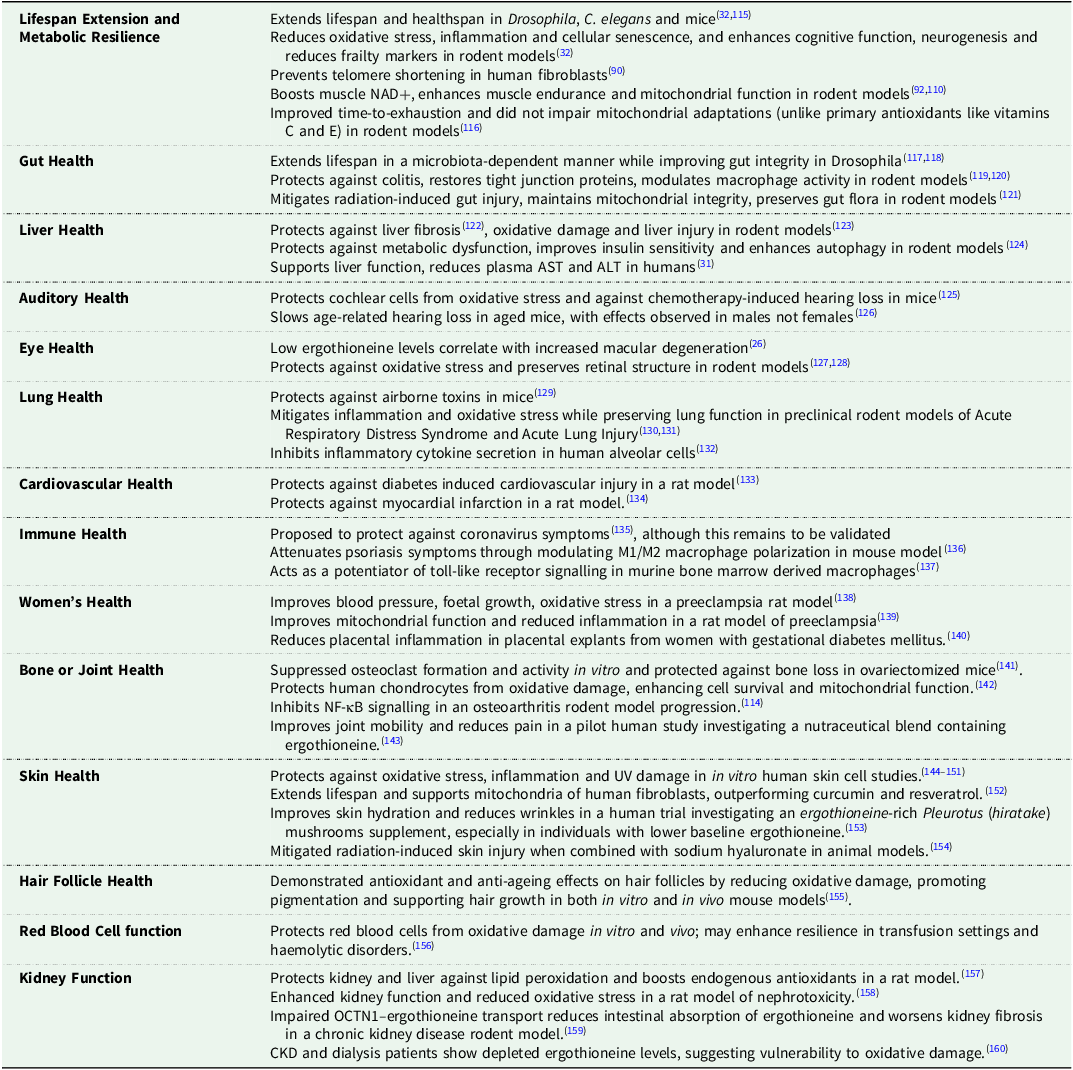
While ergothioneine has gained attention for its role in preserving cognitive function(Reference Halliwell and Cheah25,Reference Yau, Cheah and Mahendran30,Reference Zajac, Kakoschke and Kuhn-Sherlock31,Reference Ishimoto and Kato85) , growing evidence suggests that its functions extend to multiple physiological systems vital for healthy ageing(Reference Ames35). As summarized in Table 4, ergothioneine exhibits protective effects in models of liver, gut, kidney, skin and cardiovascular health, as well as sensory systems such as the eyes and ears. Ergothioneine accumulates in stress-prone tissues, where it improves mitochondrial bioenergetics, reduces inflammation and enhances resilience to oxidative damage.
Summary of studies supporting emerging benefits of ergothioneine outside of cognitive function

Table 4 Long description
The table has 12 rows and 2 columns. The first column lists different health categories, and the second column describes the benefits of ergothioneine in each category. Row 1: Lifespan Extension and Metabolic Resilience, Extends lifespan and healthspan in Drosophila, C. elegans and mice. Reduces oxidative stress, inflammation and cellular senescence, and enhances cognitive function, neurogenesis and reduces frailty markers in rodent models. Prevents telomere shortening in human fibroblasts. Boosts muscle NAD+, enhances muscle endurance and mitochondrial function in rodent models. Improved time-to-exhaustion and did not impair mitochondrial adaptations (unlike primary antioxidants like vitamins C and E) in rodent models. Row 2: Gut Health, Extends lifespan in a microbiota-dependent manner while improving gut integrity in Drosophila. Protects against colitis, restores tight junction proteins, modulates macrophage activity in rodent models. Mitigates radiation-induced gut injury, maintains mitochondrial integrity, preserves gut flora in rodent models. Row 3: Liver Health, Protects against liver fibrosis, oxidative damage and liver injury in rodent models. Protects against metabolic dysfunction, improves insulin sensitivity and enhances autophagy in rodent models. Supports liver function, reduces plasma AST and ALT in humans. Row 4: Auditory Health, Protects cochlear cells from oxidative stress and against chemotherapy-induced hearing loss in mice. Slows age-related hearing loss in aged mice, with effects observed in males not females. Row 5: Eye Health, Low ergothioneine levels correlate with increased macular degeneration. Protects against oxidative stress and preserves retinal structure in rodent models. Row 6: Lung Health, Protects against airborne toxins in mice. Mitigates inflammation and oxidative stress while preserving lung function in preclinical rodent models of Acute Respiratory Distress Syndrome and Acute Lung Injury. Inhibits inflammatory cytokine secretion in human alveolar cells. Row 7: Cardiovascular Health, Protects against diabetes induced cardiovascular injury in a rat model. Protects against myocardial infarction in a rat model. Row 8: Immune Health, Proposed to protect against coronavirus symptoms, although this remains to be validated. Attenuates psoriasis symptoms through modulating M1/M2 macrophage polarization in mouse model. Acts as a potentiator of toll-like receptor signalling in murine bone marrow derived macrophages. Row 9: Women's Health, Improves blood pressure, foetal growth, oxidative stress in a preeclampsia rat model. Improves mitochondrial function and reduced inflammation in a rat model of preeclampsia. Reduces placental inflammation in placental explants from women with gestational diabetes mellitus. Row 10: Bone or Joint Health, Suppressed osteoclast formation and activity in vitro and protected against bone loss in ovariectomized mice. Protects human chondrocytes from oxidative damage, enhancing cell survival and mitochondrial function. Inhibits NF-kB signalling in an osteoarthritis rodent model progression. Improves joint mobility and reduces pain in a pilot human study investigating a nutraceutical blend containing ergothioneine. Row 11: Skin Health, Protects against oxidative stress, inflammation and UV damage in in vitro human skin cell studies. Extends lifespan and supports mitochondria of human fibroblasts, outperforming curcumin and resveratrol. Improves skin hydration and reduces wrinkles in a human trial investigating an ergothioneine-rich Pleurotus (hiratake) mushroom supplement, especially in individuals with lower baseline ergothioneine. Mitigated radiation-induced skin injury when combined with sodium hyaluronate in animal models. Row 12: Hair Follicle Health, Demonstrated antioxidant and anti-ageing effects on hair follicles by reducing oxidative damage, promoting pigmentation and supporting hair growth in both in vitro and in vivo mouse models. Row 13: Red Blood Cell function, Protects red blood cells from oxidative damage in vitro and vivo; may enhance resilience in transfusion settings and haemolytic disorders. Row 14: Kidney Function, Protects kidney and liver against lipid peroxidation and boosts endogenous antioxidants in a rat model. Enhanced kidney function and reduced oxidative stress in a rat model of nephrotoxicity. Impaired OCTN1-ergothioneine transport reduces intestinal absorption of ergothioneine and worsens kidney fibrosis in a chronic kidney disease rodent model. CKD and dialysis patients show depleted ergothioneine levels, suggesting vulnerability to oxidative damage.
Animal studies show it extends lifespan(Reference Katsube, Ishimoto and Fukushima32,Reference Pan, Ye and Zheng115) , preserves mitochondrial function(Reference Petrovic, Slade and Paikopoulos92,Reference Sprenger, Mittenbühler and Sun110) , boosts muscle NAD+ (Reference Sprenger, Mittenbühler and Sun110) and supports muscle endurance(Reference Petrovic, Slade and Paikopoulos92,Reference Sprenger, Mittenbühler and Sun110,Reference Fovet, Guilhot and Delobel116) . Emerging evidence also shows that ergothioneine may support gut barrier integrity(Reference Pan, Zheng and Zou117–Reference Liu, Wang and Liu121), immune function(Reference Cheah and Halliwell135–Reference Yoshida, Shime and Funami137), liver function(Reference Zajac, Kakoschke and Kuhn-Sherlock31,Reference Mao, Xie and Zhang122–Reference Lv, Nie and Shi124) , cardiovascular health(Reference Dare, Elrashedy and Channa133,Reference Duan, Pan and Li134) , oxidative protection in skin(Reference Tsay, Lin and Li144–Reference Bartosz, Pieńkowska and Sadowska-Bartosz152), red blood cell function(Reference Thomas, Francis and Zimring156), bone or joint health(Reference Guo, Huang and Wang141–Reference Benson, Ager and Landes143) and protect against pre-eclampsia(Reference Williamson, McCarthy and Manna138,Reference Morillon, Williamson and Baker139) . Recent preclinical findings suggest that ergothioneine may attenuate age-related hearing loss in animal models(Reference Zhao, Wu and Hu125,Reference Bauer, Bazard and Acosta126) , an important observation given that auditory decline is one of the most prevalent and underappreciated neurodegenerative conditions associated with ageing. Notably, ergothioneine levels are depleted in chronic conditions such as kidney disease(Reference Suba, Keo and Sirich160) and macular degeneration(Reference Halliwell, Tang and Cheah26), pointing to a need for further investigation into its therapeutic role.
Together, these findings position ergothioneine as a promising longevity molecule, with broad applications across multiple ageing systems. Ongoing clinical studies will be essential in validating its efficacy in human health and optimizing strategies for dietary or supplemental intake.
Conclusions
As the global population is rapidly ageing, extending healthspan and preserving cognitive function have become urgent public health priorities. Oxidative stress, chronic inflammation and mitochondrial dysfunction are central drivers of neurodegenerative and age-related diseases(Reference Bartman, Coppotelli and Ross161–Reference Maldonado, Morales-Pison and Urbina163). Ergothioneine, a diet-derived sulphur-containing amino-thione, has emerged as a promising candidate for mitigating these processes. Its avid uptake and retention by the body, and accumulation in tissues predisposed to high-stress such as the brain, eyes, kidneys, red blood cells and immune cells, suggests it plays an important physiological role in cellular protection.
Unlike other dietary antioxidants such as vitamins C, E and flavonoids, which are limited by poor bioavailability, rapid metabolism, or low tissue retention, ergothioneine is avidly absorbed, not metabolized and accumulates in certain tissues(Reference Halliwell, Tang and Cheah26). Ergothioneine resists auto-oxidation, is remarkably stable, and remains in the body longer than many dietary antioxidants. Though not classified as an essential vitamin, its evolutionary conservation and targeted biological activity have led to its proposal as a ‘longevity vitamin’, a nutrient that may be potentially essential for long-term health(Reference Ames35,Reference Beelman, Kalaras and Phillips66) .
As presented in this review, a growing body of evidence supports ergothioneine’s role in preserving brain health. Blood ergothioneine levels decline with age(Reference Cheah, Feng and Tang51) and link to neurodegenerative disorders(Reference Halliwell, Tang and Cheah26), hence supplementation may be beneficial for preserving cognition. Recent clinical trials in older adults with MCI or subjective cognitive impairment have shown promising benefits including enhanced learning or subjective memory, better sleep quality and stabilization of neurodegeneration biomarkers(Reference Yau, Cheah and Mahendran30,Reference Zajac, Kakoschke and Kuhn-Sherlock31) . Mechanistically, ergothioneine modulates redox and inflammatory pathways (including NF-κB and NLRP3)(Reference Chen, Wang and Sun50,Reference Leow, Cheah and Chen94,Reference Meng, Meng and Hou95) and supports mitochondrial function via MSPT and CSE-H2S axis(Reference Petrovic, Slade and Paikopoulos92,Reference Sprenger, Mittenbühler and Sun110) . Beyond cognition, emerging evidence suggests benefits across multiple domains relevant to healthy ageing (Table 4).
Although no official daily intake level has been established, clinical studies to date suggest that ergothioneine doses between 5–25 mg/ day are safe and may support cognitive and physiological health. Dietary sources, such as 100 g serving (∼3.5 oz) of fresh mushrooms daily can provide comparable levels, although content varies by species. Food processing methods like cooking, canning, hot air drying, thermal bleaching and pasteurization of mushrooms can reduce ergothioneine content in the food(Reference Pratti, Pinho and Petito164,Reference Nguyen, Nagasaka and Ohshima165) . These factors are particularly relevant for individuals relying on processed mushroom products rather than fresh mushrooms as a dietary source.
Despite its promise, research gaps remain. Ergothioneine may interact with the gut microbiome(Reference Ahmad, Wu and Arnold62,Reference Cheah, Lee and Tang72) , which could affect its own absorption. As the gut plays a role in neurodegenerative and age-related disorders(Reference Yadav and Jaldhi166), understanding these interactions is critical. It is still unclear whether low ergothioneine levels are a cause or consequence of disease. Longer, well-powered clinical trials across diverse populations are needed to establish causality, optimal dosing, sex differences and potential synergy with other longevity nutrients. Bioavailability may also be influenced by genetic polymorphisms in the OCTN1 transporter, age and gut microbiota composition. Developing reliable, clinically accessible methods to measure ergothioneine status may also help guide personalized interventions.
In summary ergothioneine presents a promising nutrient for healthy longevity. Its broad cyto- and neuro-protective properties, high bioavailability and targeted tissue distribution support its classification as a ‘longevity vitamin’ and justify deeper investigation as a foundational nutrient for long-term health maintenance.
Acknowledgments
None.
Author contributions
LMZ, IC, IZ, EB, NK wrote, reviewed and approve of the final manuscript.
Financial support
This work received no funding from any funding agency, commercial or not-for-profit sectors.
Competing interests
Linda May-Zhang is employed at Blue California, a company that develops ErgoActive® ergothioneine. Ian Zajac has previously received funding from Blue California for clinical trial work related to ergothioneine, but has not received funding for this work. Emily Brindal declares no conflict of interest nor has received funding for this work. Naomi Kakoschke has previously received funding from Blue California for clinical trial work and conference travel related to ergothioneine, but has not received funding for this work. Irwin Cheah is an independent researcher, declares no conflict of interest, nor any financial relationships with Blue California.