Introduction
Schizophrenia is associated with marked neurocognitive impairments across several domains including verbal (Reference Tracy, Mattson, King, Bundick, Celenza and Glosser1–Reference Brebion, David, Jones and Pilowsky3), working memory (Reference Fuller, Luck, McMahon and Gold4–Reference Zanello, Curtis, Badan and Merlo7), attention Reference Gold, Wilk, McMahon, Buchanan and Luck(8) and executive functioning Reference Chan, Chen and Law(9), although schizophrenia patients often display poor insight into their own level of cognitive functioning Reference Medalia and Lim(10). Neurocognitive deficits in psychosis-affected populations have been linked to difficulties in social and occupational functioning (Reference Hofer, Baumgartner and Bodner11–Reference McGurk and Meltzer18), as well as impaired quality of life and reduced capacity for independent living (Reference Hofer, Baumgartner and Bodner11,Reference Cohen, Forbes, Mann and Blanchard12,Reference Green16,Reference Green, Kern, Braff and Mintz17,Reference Revheim, Schechter and Kim19).
Cognitive assessment in psychosis is considered part of good clinical practice. Likewise, monitoring changes in neuropsychological profiles may provide key clinical information about illness progression and the benefits of any psychological or pharmacological intervention. This information could also provide a basis for deciding on more comprehensive neuropsychological investigation Reference Dickerson, Boronow, Stallings, Origoni, Cole and Yolken(20) or influence the focus of rehabilitation efforts. Assessing cognitive dysfunction prior to illness onset in ‘high risk’ individuals could also aid earlier identification Reference Lewis(21).
Recently, attempts have been made to develop a comprehensive ‘consensus cognitive battery (for schizophrenia)’ for assessing cognitive change in clinical trials Reference Green, Nuechterlein and Gold(22), resulting in the selection of 10 existing tests covering 7 domains – known as the MATRICS Consensus Cognitive Battery (MCCB) (Reference Kern, Nuechterlein and Green23–Reference Nuechterlein, Green and Kern25); MATRICS domains: speed of processing (e.g. trail making, symbol coding and category fluency), attention/vigilance, working memory (verbal and non-verbal), verbal learning, visual learning, reasoning and problem solving, and social cognition. The symbol coding subtest is also part of another recently developed instrument, the Brief Assessment of Cognition in Schizophrenia (BACS) Reference Keefe, Harvey and Goldberg(26), which includes assessments of four of the MATRICS domains.
Despite the obvious advantages of neurocognitive assessment in psychosis, the time, cost, resource and personnel demands required to collect comprehensive assessment data make this impractical for many health-care settings and professionals. Illness factors, such as fatigue and reduced motivation, can also lead to poor assessment performance and skewed results. For these reasons, brief neurocognitive assessments offer a time- and resource-efficient method of measuring cognition Reference Randolph(27).
A number of brief neuropsychological instruments have been developed to provide a ‘snapshot’ of a patient's cognitive strengths and weaknesses in the most cost- and time-effective manner. However, several of these are not sufficiently sensitive for use in psychosis (e.g. Mini Mental State) Reference Gold, Queern, Iannone and Buchanan(28). The Repeatable Battery for the Assessment of Neuropsychological Status (RBANS) Reference Randolph(27) is a widely accepted US standardised (Mean = 100, SD = 15 per scale) adult (20–89 years) brief neuropsychological assessment with an administration time of approximately 30 min. Although originally designed to detect cognitive impairment in elderly people, RBANS performance has subsequently been reported in a number of schizophrenia studies (Reference Dickerson, Boronow, Stallings, Origoni, Cole and Yolken20,Reference Gold, Queern, Iannone and Buchanan28–Reference Hobart, Goldberg, Bartko and Gold31). Outpatient schizophrenia samples generally perform poorest on RBANS indices of immediate (Reference Dickerson, Boronow, Stallings, Origoni, Cole and Yolken20,Reference Randolph27–Reference Wilk, Gold and Bartko29,Reference Hobart, Goldberg, Bartko and Gold31) and delayed Reference Loughland, Lewin, Carr, Sheedy and Harris(30) memory. Normative RBANS data have also been developed for schizophrenia samples, which highlights the need to consider education effects when assessing cognitive performance in this population Reference Wilk, Gold, Humber, Dickerson, Fenton and Buchanan(32,Reference Iverson, Brooks and Haley33), perhaps because of the variability in education levels associated with the onset of this disorder. On the other hand, some researchers suggest that education-correction factors should be applied differentially, with schizophrenia patients excluded Reference Keefe, Harvey and Goldberg(26), a practice that we consider to be equally as problematic; as an alternative, the MCCB scoring programme offers a range of correction factors including no correction, age/gender and age/gender/education corrections Reference Kern, Nuechterlein and Green(23).
Measures such as the RBANS and BACS require a trained professional (e.g. a psychologist) to conduct the assessment. On the other hand, studies of service contacts among psychosis-affected populations suggest that they are most likely to have contact with general practitioners and community-based mental health teams Reference Carr, Johnston, Lewin, Rajkumar, Carter and Issakidis(34), who may not have the expertise necessary to administer cognitive tests. This may be especially true in geographically isolated areas, which represents a significant barrier in countries such as Australia, where there are large, dispersed or remote communities.
The Audio Recorded Cognitive Screen (ARCS) is a brief neuropsychological assessment specifically developed to detect cognitive impairments across a range of domains, while not being burdensome in terms of clinician time or resources Reference Schofield, Lee and Lewin(35). The ARCS is administered using a portable audio device (e.g. CD player, MP3) to patients who record their responses by writing in a specially designed response booklet that can later be scored. Standardised normative scores (Mean = 100, SD = 15 per scale) have been established for the ARCS based on a large Australian community sample; these cover five ARCS domain scores: memory (immediate/delayed recall, delayed recognition), fluency (category, letter and action), visuospatial functioning, language and attention/executive function, together with a speed of writing score, an overall ARCS score and a ‘QuickARCS’ score (used to estimate overall ARCS performance without the necessity of scoring all the tests or looking up norms) Reference Schofield, Lee and Lewin(35). Age, gender and education are considered in the process of generating ARCS standardised scores. ARCS domain scores show good convergent validity with more comprehensive and established measures of cognitive performance Reference Schofield, Lee and Lewin(35). The ARCS is comparable to RBANS in its scope and duration (34 min to complete) and only requires a few minutes of scoring to obtain a test result. Its low resource requirements mean that it can be used in small clinical practices, or by patients in remote regions, with minimal impact on the workloads of health personnel Reference Schofield, Lee and Lewin(35). The ARCS potentially presents a cheap, practical alternative in a variety of medical and research settings for the routine assessment of patients with psychotic disorders. The ARCS subtests also address several of the domains covered by the MATRICS Reference Nuechterlein, Green and Kern(25), with the exception of reasoning and problem solving, and social cognition.
Purpose of this paper
To date, the ARCS has been administered to several thousand individuals, including community samples without any known cognitive deficits, and clinical samples with dementia and a range of other neuropsychiatric syndromes Reference Schofield, Lee and Lewin(35,Reference Lechner-Scott, Kerr, Spencer, Agland, Lydon and Schofield36). The current study is the first to assess the potential utility of the ARCS in a psychosis sample. The goals of the current study were as follows:
1 To pilot the use of the ARCS in a sample of individuals with a psychotic illness, primarily to establish the feasibility of administration to this population
2 To assess the ARCS ability to discriminate cognitive deficits associated with psychosis (relative to control participants), compared to those detected by an established standardised test (the RBANS)
Because ARCS and RBANS measure broadly similar cognitive constructs, we predicted that there would be significant positive correlations between participant performance on the corresponding subscales. Further, in light of observations of a core memory deficit in community psychosis populations Reference Loughland, Lewin, Carr, Sheedy and Harris(30), we also predicted that individuals with psychosis would perform more poorly on measures of memory, relative to healthy controls. Finally, we predicted that ARCS and RBANS would perform similarly in the detection of the cognitive deficits typically associated with psychosis, after controlling for education effects.
Methods
Participants
Participants comprised 25 people with psychosis (17 males, 8 females; mean age = 43.72, SD = 9.78 and 25 healthy age- and gender-matched controls (mean age = 43.64, SD = 12.10) aged between 18 and 65 years, without any history of serious head injury, brain injury, alcohol dependence or mental retardation. The participants were recruited through the resources of the Schizophrenia Research Institute (SRI) and the Australian Schizophrenia Research Bank (ASRB) Register Reference Loughland, Carr and Lewin(37); their diagnosis was confirmed using the Diagnostic Interview for Psychosis (DIP) Reference Castle, Jablensky and McGrath(38), and each met DSM-IV (39) criteria for either schizophrenia/schizoaffective disorder (n = 20, 80%) or another psychotic disorder (n = 5, 20%). No participants were hospitalised during this study. Healthy control participants were recruited either through the Hunter Medical Research Institute (HMRI) Volunteer Register (n = 17) or the community (n = 8). Approval for this study was obtained from relevant local ethics committees and all participants gave written consent to be involved.
Materials
All participants were assessed using two standardised neuropsychological instruments, namely RBANS Form B (RBANS-B) Reference Randolph(27) and the ARCS Reference Schofield, Lee and Lewin(35). Data about ARCS usability were obtained through participant completion of a brief survey, which allowed for identification of any practical issues associated with audio-administered assessment. We also administered the Expanded Brief Psychiatric Rating Scale (BPRS-E) Reference Ventura, Lukoff, Nuechterlein, Liberman, Green and Shaner(40) to the participants as a screen for current illness-related symptoms. The BPRS-E is a 24-item clinician-rated measure of psychosis-related symptoms and behaviours and general psychopathology.
Procedure
Individuals registered with the ASRB Register or HMRI Research Volunteer Register received information about the study through mail. All potential participants were screened for exclusion criteria prior to consenting. Patients and control participants were then matched for age and gender. Participants were randomly allocated to one of the two counterbalanced conditions relating to the order of ARCS and RBANS administration. Both instruments were administered according to their respective standardised instruction booklets approximately 1 week apart (Mean = 7.84 days, SD = 2.15) to control for practice effects. In the psychosis sample only, psychiatric symptoms were assessed on their first visit using the BPRS-E. In addition, the participants' scores on the Global Assessment of Functioning (GAF) (39), Social and Occupational Functioning Assessment Scale (SOFAS) (39), Positive and Negative Syndrome Scale (PANSS) Reference Kay, Fiszbein and Opler(41) and RBANS-A Reference Randolph(27), as well as data relating to their illness onset and duration, were obtained from ASRB Register intake data.
Data analysis
Cognitive and symptom measures were scored according to standardised scoring instructions (RBANS and ARCS) Reference Randolph(27,Reference Schofield, Lee and Lewin35). Statistical analyses were conducted using SPSS (Version 17.0; SPSS, Chicago, IL, USA). Group demographic differences were examined for categorical variables using chi-squared tests and for continuous variables using separate analyses of variance (ANOVAs). The Pearson correlation coefficient was used to assess the strength of relationships between pairs of continuous measures. Analyses of covariance (ANCOVAs) were conducted to ensure that any observed between-group differences on ARCS and RBANS performance did not reflect the effects of education. Consistent with the methods used in the ARCS standardisation studies, participants were classified into the four pseudo-continuous categories of education shown in Table 1, and this categorisation was also used as the covariate. Partial Eta-squared (η p2) values were used to estimate the magnitude of the between-group differences. As a partial control for the number of statistical tests, the threshold for significance was set at p < 0.01.
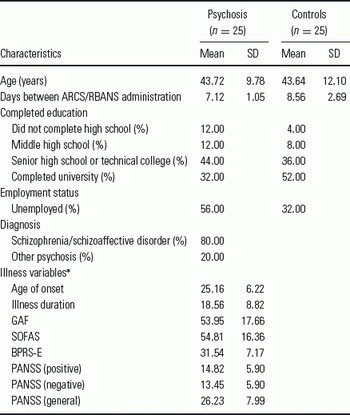
Sample characteristics

* Sample sizes vary from 20 to 24.
Results
Sample and testing characteristics
Table 1 reports sample characteristics by group. The mean age of participants was 43.68 years (SD = 10.89). The psychosis and control groups did not differ in terms of education (χ 2(3) = 2.59, p = 0.46) or employment status (χ 2(1) = 2.92, p = 0.09). Ninety-two percent (n = 23) of participants with psychois were currently taking antipsychotic medication, and their mean GAF ratings placed them in the ‘moderate symptoms' range of general overall functioning (39), a level approximately equivalent to the ‘medium’ functioning range group reported by Loughland et al. Reference Loughland, Lewin, Carr, Sheedy and Harris(30). However, as indicated by their mean BPRS-E scores, collectively, they were currently experiencing low levels of psychiatric symptoms, reflecting the sample's overall non-acute status. For example, BPRS-E scores potentially range from 24 to 168, such that a mean of ‘32’ equates to ‘very mild’ for one-third of the 24 items and ‘not present' for the remainder; by comparison, psychiatric in-patients in a study by Thomas et al. Reference Thomas, Donnell and Young(42) had a mean BPRS-E score of 55.0 (SD = 14.0).
In terms of testing procedures, 42 participants (84%; 24 psychosis, 18 controls) completed their second appointment 6–8 days after their first assessment and the remainder 12–14 days after their first assessment. Seven participants in the psychosis group reported minor difficulties with the ARCS (three, occasional difficulty hearing test instructions; three, some technical difficulties and five, exposure to external distractions), which may reflect general concentration difficulties for this group. No participants in the control group reported difficulty with the ARCS. This represents a marginally significant difference between groups in the reporting of any difficulties with the ARCS (χ 2(1) = 8.14, p = 0.01). However, within the psychosis group, there were similar ARCS profiles for those reporting and not reporting any minor ARCS administration difficulties (e.g. mean overall ARCS score: 84.83 vs. 80.78).
Correlations among ARCS domain scores
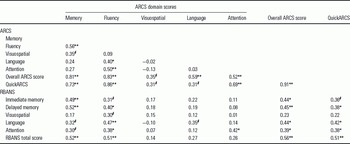
Table 2 reports correlations among the ARCS domain and total scores, together with associations with the RBANS index scores. The highest correlation among the ARCS domain scores was between memory and fluency (r(49) = 0.56), which is consistent with previous applications of the ARCS in control and clinical populations Reference Schofield, Lee and Lewin(35). However, the associations between the visuospatial domain and the other ARCS domains (except memory) were weaker than previously observed, perhaps attributable to the narrower range of performance in the present (smaller) sample. The QuickARCS displayed a strong positive correlation with the overall ARCS score (r(49) = 0.91), which is also consistent with the normative analyses (r = 0.93), providing further support for the use of these aggregate indices of overall cognitive functioning. Within the psychosis group, there were modest correlations between GAF ratings and ARCS memory domain scores (r(19) = 0.50, p = 0.03 and overall ARCS scores (r(19) = 0.50, p = 0.03), with non-significant correlations with the other domains.
Correlations among scaled ARCS measures and with RBANS index scores (n = 50)

# Approaching significance p < 0.05.
* p < 0.01.
** p < 0.001.
Associations between ARCS and RBANS scores
To explore the overall pattern of associations (i.e. shared variance) between the set of ARCS measures and the set of RBANS measures, a canonical correlation analysis was conducted (five ARCS domain vs. five RBANS index scores). This analysis revealed a moderate–high level of shared variance (R c2 = 0.44), suggesting that the two sets of measures are assessing broadly similar aspects of performance.
The lower portion of Table 2 reports significant positive correlations between several individual ARCS and RBANS scales. Apart from the RBANS visuospatial measure, which displayed relatively weak associations with the ARCS scales, the remaining RBANS scales revealed moderate positive correlations with several ARCS measures and with overall ARCS and QuickARCS scores. ARCS memory domain scores correlated moderately with RBANS total, delayed and immediate memory measures and less strongly with RBANS language (p = 0.03) and attention (p = 0.04) measures. ARCS fluency domain scores also displayed significant positive correlations with most RBANS measures, the highest association being with RBANS language (r(50) = 0.47). ARCS and RBANS attention measures displayed significant moderate associations, with weaker associations between ARCS and RBANS language measures (p = 0.01). Based on the current evidence, the ARCS and RBANS visuospatial measures appear to be assessing different constructs, given the absence of cross-correlations (Table 2), although there was a marginally significant positive correlation between ARCS fluency and RBANS visuospatial scores (p = 0.04).
Test performance and profiles
RBANS-A performance data (from ASRB intake interviews) were available for the majority of the psychosis group (n = 23). The mean test–retest interval between administration of these alternate forms of the RBANS was 1.69 years (range: 0.71–5.56 years). Correlations between RBANS-A and RBANS-B revealed a significant positive association between total performance scores (r(23) = 0.80, p < 0.001), which compared favourably with previous schizophrenia studies (r = 0.84) Reference Gold, Queern, Iannone and Buchanan(28). Comparable ARCS reliability coefficients have been reported previously for neuropsychiatry clinic attendees over a 90-day follow-up Reference Schofield, Lee and Lewin(35), ranging from 0.70 (attention domain) to 0.88 (fluency domain), with an overall reliability of 0.88 (ARCS total score).
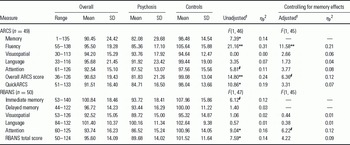
Table 3 reports ARCS and RBANS profiles (i.e. means, SDs and ranges) and associated group comparisons. As expected, mean performance by control participants was within approximately 0.5 of a standard deviation from the population norms for both the ARCS and RBANS measures Reference Randolph(27,Reference Schofield, Lee and Lewin35). Performance profiles for schizophrenia samples completing the RBANS have previously been obtained from both outpatient Reference Wilk, Gold, Humber, Dickerson, Fenton and Buchanan(32) and research register Reference Loughland, Lewin, Carr, Sheedy and Harris(30) samples, with research register samples typically performing better on all RBANS scales than outpatient samples. Register samples have previously shown the largest deficits on RBANS measures of immediate and delayed memory, while displaying near normal performance on visuospatial, language and attention measures Reference Loughland, Lewin, Carr, Sheedy and Harris(30). In the current study, the psychosis sample revealed modest RBANS deficits on all measures except language; however, only the attention measure approached a 1 SD difference from the population norms. On the other hand, ARCS mean scores for the psychosis sample were approximately 1 SD below the population mean for memory, fluency, overall ARCS and QuickARCS scores, suggesting that the ARCS may prove a useful tool in the detection of cognitive deficits in psychosis populations. Interestingly, the psychosis group also displayed a larger variability in their ARCS memory domain performance (SD = 29.68), perhaps reflecting variations in performance on the underlying tests (i.e. immediate/delayed memory, delayed recognition), which may be worthy of exploration in a large sample.
ARCS and RBANS profiles and associated group comparisons

† Level of education was used as a covariate in these ANCOVAs to control for the lack of RBANS scaling for education.
# Approaching significance p < 0.05.
* p < 0.01.
** p < 0.001.
A series of one-way ANCOVAs was carried out to examine group differences in cognitive performance for each of the ARCS and RBANS scales, while controlling for level of participant education (Table 3). The psychosis group performed significantly worse than the controls on ARCS memory and fluency measures as well as overall and QuickARCS total scores, with a marginal difference observed for the ARCS attention (p = 0.02) domain. On the RBANS, the psychosis group performed significantly worse on the attention scale as well as on the RBANS total score, with a less marked difference on the immediate memory scale (p = 0.02).
In view of the research evidence about the centrality of memory deficits in psychosis, and the observed correlations and associations in the current study (Tables 2 and 3), we undertook an additional series of analyses controlling for memory effects (ARCS: memory domain; RBANS: immediate and delayed memory scales), i.e. Do the non-memory ARCS and RBANS measures contribute to any additional discrimination between groups? As shown in the right-hand columns of Table 3, when controlling for the effects of education and memory performance, the psychosis group still performed significantly worse than the control group on the ARCS fluency domain and marginally worse on the overall score (p = 0.02). For the RBANS, there remained a marginally significant trend for the psychosis group to have poorer RBANS attention scores (p = 0.02).
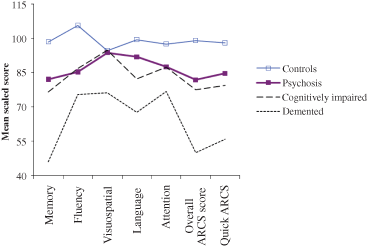
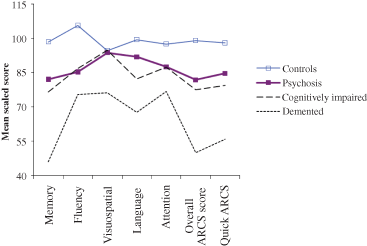
Finally, to better understand the pattern of ARCS effects, we compared the observed profiles against those for the cognitively impaired and demented samples reported in Schofield et al. Reference Schofield, Lee and Lewin(35). As shown in Fig. 1, the ARCS performance profile for the psychosis group is very similar to the group with confirmed cognitive impairment (based on comprehensive clinical and neuropsychological assessments), with the possible exception of the language domain. Collectively, these groups (i.e. psychosis and cognitively impaired) are also intermediate between the controls and those with confirmed dementia, the notable exception being the visuospatial domain for which only the demented group displayed substantially poorer performance.
Preliminary ARCS performance profiles for psychosis (n = 25), compared with current controls (n = 25) and clinical groups classified as cognitively impaired without dementia (n = 33) or with mild–moderate dementia (n = 25), as described by Schofield et al. Reference Schofield, Lee and Lewin(35).
Discussion
The overall development and psychometric properties of the ARCS have been detailed recently Reference Schofield, Lee and Lewin(35); however, the potential utility of this measure in other clinical settings has only begun to be explored (e.g. multiple sclerosis) Reference Lechner-Scott, Kerr, Spencer, Agland, Lydon and Schofield(36). The current findings suggest that the ARCS can be administered to individuals with a psychotic illness and that the resulting cognitive profiles largely correspond with expectations based on the research literature and concurrent performance on the RBANS. While these early results are based on a small, well-functioning psychosis-affected sample, they provide preliminary evidence that the ARCS performs satisfactorily as a brief multidomain neuropsychological assessment in this population.
Participants generally reported few problems with the ARCS administration, suggesting that the ARCS can be completed by people with psychotic disorders. A small number of participants reported occasional difficulties; however, no participant reported trouble understanding test instructions. This suggests that to maximise the validity of the assessments it would be ideal, but not essential, to administer the ARCS in a comfortable, controlled environment where low-level technical assistance is available, if required (e.g. to help familiarise participants with the equipment and the setting). As with other cognitive measures, acutely unwell patients are not likely to be suitable for formal ARCS assessment, with a temporary deferral recommended.
Mean performance of the control group was within 0.5 SD of normative population scores for both the ARCS and RBANS, suggesting that the current application of these measures was in line with previous results. Research register-recruited psychosis samples typically display higher levels of both general and cognitive functioning, with better performance on all RBANS indices, compared to those recruited directly from patient services Reference Loughland, Lewin, Carr, Sheedy and Harris(30,Reference Loughland, Carr, Lewin, Barnard, Chapman and Walton43). Additionally, less severe cognitive deficits are associated with medium and high levels of general functioning in these populations Reference Loughland, Lewin, Carr, Sheedy and Harris(30), while those with the lowest general functioning perform more like the normative psychosis groups reported by Iverson et al. Reference Iverson, Brooks and Haley(33), Wilk et al. Reference Wilk, Gold, Humber, Dickerson, Fenton and Buchanan(32) and Gold et al. Reference Gold, Queern, Iannone and Buchanan(28). Hence, for the current psychosis sample, which displayed general functioning in the medium range, we expected that only the most prominent cognitive deficits would be observed. Despite this caveat, both the ARCS and RBANS showed lower performance across a range of tests in the psychosis group.
ARCS memory, fluency and overall scores and RBANS attention and overall scores were the main discriminating measures between groups, with controls significantly outperforming the psychosis group. A marginal advantage for control participants was also observed for ARCS attention and RBANS immediate memory measures. These effects are largely in line with the literature. While deficits on measures of memory, general cognitive performance (Reference Gold, Queern, Iannone and Buchanan28,Reference Loughland, Lewin, Carr, Sheedy and Harris30,Reference Wilk, Gold, Humber, Dickerson, Fenton and Buchanan32,Reference Iverson, Brooks and Haley33) and attention (Reference Gold, Queern, Iannone and Buchanan28,Reference Wilk, Gold, Humber, Dickerson, Fenton and Buchanan32,Reference Iverson, Brooks and Haley33) are commonly associated with psychosis, language and visuospatial abilities are found to be relatively unimpaired (Reference Gold, Queern, Iannone and Buchanan28,Reference Loughland, Lewin, Carr, Sheedy and Harris30,Reference Wilk, Gold, Humber, Dickerson, Fenton and Buchanan32). In terms of fluency, uniform deficits in schizophrenia samples have been shown on the Controlled Oral Word Association Test (COWAT) across research studies Reference Addington, Saeedi and Addington(13,Reference Fitzgerald, Lucas and Antoinette44). The relatively poor performance of the visuospatial domains within both the ARCS and RBANS may also reflect ceiling effects within their constituent tests, particularly among well-functioning samples Reference Loughland, Lewin, Carr, Sheedy and Harris(30,Reference Schofield, Lee and Lewin35).
The current data indicate that the ARCS and RBANS display a large degree of overlap in the deficits they detect in psychosis. For example, effect size calculations indicate that the magnitude of the between-group discrimination effects obtained with ARCS memory and RBANS immediate memory scales were comparable (0.14 vs. 0.12). Effect size differences for the attention scales were also comparable (0.11 vs. 0.16). The current analyses further suggest that ARCS fluency represents a key index of discrimination between control and psychosis populations. Consequently, the more comprehensive assessment of this construct in the ARCS may be viewed as a particular strength. Thus, to some extent, the ARCS reduces the need to supplement assessment protocols with measures of executive function, as is the case with the RBANS Reference Hobart, Goldberg, Bartko and Gold(31).
On the other hand, none of the brief, multidomain assessments suggested for psychosis samples (e.g. approximately 30 min administration: RBANS, BACS and ARCS) cover the full range of domains proposed by the MATRICS group Reference Nuechterlein, Green and Kern(25), with social cognition being absent from all measures. Future refinements to the ARCS for specific use with psychosis samples could include the strengthening of some domains and subtests, and the exclusion of others considered not to be central to psychosis Reference Green, Nuechterlein and Gold(22); however, it would be premature to do so at this stage, and there would be little change to the already minimal demands on clinicians time (for scoring the ARCS).
The current data also provide some preliminary evidence about the expected ARCS profile for psychosis, with average performance in this group 1 SD below the population mean on memory, fluency and overall indices of cognitive performance. This ARCS profile is similar, with the exception of superior language performance, to that of individuals with cognitive impairment without dementia assessed by Schofield et al. Reference Schofield, Lee and Lewin(35) (see Fig. 1). The establishment of a typical ARCS performance profile for people with psychotic disorders would also guide referrals for more comprehensive neurological assessment.
Limitations
The small sample size is a clear limitation, with the current study functioning more as a ‘proof of concept' than a definitive set of findings – i.e. showing the feasibility of using the ARCS as a novel, resource-efficient and brief neuropsychological assessment among psychosis samples. As current ARCS norms apply primarily to participants with some level of secondary education Reference Schofield, Lee and Lewin(35), caution may need to be exercised in the interpretation of the ARCS in situations where the participants education has been truncated because of illness or mental health problems. However, in the current sample only four participants (3 = psychosis, 1 = control) had completed less than 4 years of secondary education and, therefore, this limitation is unlikely to have had a significant effect on the current analysis.
In addition, as the current study included volunteers with schizophrenia who were recruited through the resources of a schizophrenia research register, comprised largely of individuals living in the community Reference Loughland, Carr and Lewin(37), it is possible that the findings have limited generalisability to other psychosis samples. Participants recruited from these sources are usually highly motivated, better functioning and display better cognitive performance than those recruited from alternative settings (Reference Loughland, Lewin, Carr, Sheedy and Harris30,Reference Loughland, Carr and Lewin37,Reference Loughland, Carr, Lewin, Barnard, Chapman and Walton43). Moreover, the schizophrenia participants were somewhat older than those in other studies (with an average illness duration of 18.56 years) and they displayed few symptoms at the time of assessment, as shown by their low mean BPRS-E scores; these features, and the small sample size, also limited our ability to examine associations between illness characteristics and cognitive functioning. On the other hand, in cases of very low functioning or highly active psychosis, traditional one-to-one assessments are also often inappropriate and, as such, the ARCS faces similar limitations to other assessments of cognitive functioning (such as the RBANS).
The lack of direct comparison of the ARCS with well-established and rigorous neuropsychological evaluations is also a limitation, although such comparisons were part of the ARCS development Reference Schofield, Lee and Lewin(35). Future comparisons of ARCS performance by psychosis-affected populations with more comprehensive batteries (such as the MATRICS), and with larger sample sizes, may improve the assessment of convergent validity and generalisability of the current findings. Further exploration of the usage of the ARCS in primary care and community mental health settings is also warranted, together with practical guidance about the circumstances under which observed ARCS performance profiles or changes should trigger referral for more comprehensive neuropsychological assessment.
Conclusion
This pilot study provides a preliminary examination of the utility of the ARCS in psychosis-affected samples through comparisons with the well-established RBANS measure. Overall, the ARCS and RBANS appear to be efficient and reliable screeners, appropriate for use in psychosis samples and for identifying individuals requiring more comprehensive assessment. The ARCS is a novel and innovative cognitive screening instrument, which uses audio administration to reduce clinician time, costs and personnel resources. Having been used successfully in general neuropsychiatry clinic populations Reference Schofield, Lee and Lewin(35), the current study extends the scope of its potential utility to include individuals with a psychotic illness.
Acknowledgements
Aspects of the data reported here were included in a clinical doctoral thesis submitted to the University of Newcastle (by L. G.). The authors would like to acknowledge the volunteers from the Hunter Medical Research Institute (HMRI) and from the Australian Schizophrenia Research Bank (ASRB) for their participation in this study. The ASRB provided both data and participants for this study and is supported by the National Health and Medical Research Council of Australia, the Pratt Foundation, Ramsay Health Care and the Schizophrenia Research Institute (SRI). Two of the authors (P. W. S. and T. J. L.) were involved in the initial development and evaluation of the ARCS, although they are unlikely to derive any personal financial benefit from recommending its ongoing usage.