Implications
The development of an accurate calf model has been challenging because several factors affect growth such as breed, colostrum and feeding programs, facilities and environmental conditions. Because of the conventional feeding system (e.g. 4 l/calf at each of two daily feedings) and tropical conditions, the animals evaluated in this study showed poor weight gains. The low energy to protein ratio likely reduced calf growth rates. Currently available calf models can be used to predict calf growth during pre-weaning phase in tropical conditions, but with low precision.
Introduction
Mathematical models are important tools to estimate the development, nutritional requirements, growth and performance of animals. The development of models is based on known facts and logical assumptions, and then the predictions from the model are compared with independent real data (Vanden Berg, Reference Vanden Berg1980). The evaluation of different models is important to verify the accuracy and precision of the estimated values in different environmental conditions, genotypes and managements.
Over the last few decades, several nutrition models (Institute National de la Recherche Agronomique, 1989; Commonwealth Scientific and Industrial Research Organisation, 1990; Fox et al., Reference Fox, Sniffen, O’Connor, Russell and Van Soest1992; Agricultural and Food Research Council (AFRC), 1993; National Research Council (NRC), 2001; Tylutki et al., Reference Tylutki, Fox, Durbal, Tedeschi, Russell, Van Amburgh, Overton, Chase and Pell2008) were developed, evaluated or updated, and used to estimate requirements and performance of animals. However, some groups such as dairy calves less than 2 months of age are overlooked on the farms.
The last update of Nutrient requirements of dairy cattle (NRC, 2001) organized a chapter on the Nutrient Requirements of the Young Calf and described three phases of development of animals related to digestive function. The first one is a liquid-feeding phase, in which all or most of the nutrient requirements are met by milk or milk replacer. In the transition phase, both liquid diet and starter contribute to the supply of nutrient requirements of the calf. In the third phase, called ruminant, the nutrient requirements are met by microbial fermentation of solid feeds in the reticulo-rumen (Davis and Clark, Reference Davis and Clark1981; Davis and Drackley, Reference Davis and Drackley1998).
Most dairy cattle nutritionists in Brazil have adopted the NRC (2001) and the Cornell Net Carbohydrate and Protein System (Fox et al., Reference Fox, Tedeschi, Tylutki, Russell, Van Amburgh, Chase, Pell and Overton2004; Tylutki et al., Reference Tylutki, Fox, Durbal, Tedeschi, Russell, Van Amburgh, Overton, Chase and Pell2008) models to estimate the requirements and performance of dairy cows, heifers and dairy calves. These models were developed in North America under temperate climatic conditions and based on different milk replacers, calf starters and management. Therefore, some characteristics to the specific Brazilian environmental conditions, management and animal genotypes should be considered: (1) frequently the calf is a Holstein-Zebu cross-bred; (2) a calf <2 months of age is often lighter than a Holstein calf; (3) the temperature is higher during the summer and there is no rigorous winter; (4) the calf is fed with around 4 l/day of non-saleable (waste) milk or raw (saleable or non-saleable) milk.
Consequently, the Brazilian dairy herd is mainly made up of cross-bred cows fed under tropical conditions. Currently, few models have been evaluated to estimate the requirements and performance of young calves in different feeding strategies and diversity of climate. The purpose of the present study was to evaluate the NRC (2001) and Agricultural Modeling and Training Systems (AMTS) models for predicting gain (energy and protein-allowable gain) of young dairy calves under tropical conditions.
Material and methods
Data
The data used for parameter estimation were collected from Brazilian studies indexed in the Scientific Electronic Library Online (2014), an electronic library covering a selected collection of Brazilian scientific journals. Initially, an extensive electronic search of scientific literature of dairy calf trials was conducted. Methods for the literature search and screening process have been described previously (Olsen, Reference Olsen1995; Sauvant et al., Reference Sauvant, Schmidely, Daudin and St-Pierre2008). The meta-analysis methods may be more economically viable when compared with high cost of using experimental herds to carry out studies in dairy science (Fuentes-Pila et al., Reference Fuentes-Pila, Ibañez, De Miguel and Beede2003).
The data set was compiled using data from dairy calves in the pre-weaning phase. Studies included in this meta-analysis were selected based on specific criteria: studies conducted in Brazil using dairy calves during the pre-weaning phase; studies with description of the starter composition during the entire experimental period; studies that included weaning weights; studies that included liquid diet (milk and milk replacer) composition, starter intake, liquid diet intake and average daily gain (ADG). Following rigorous screening for appropriate subject matter, quality of trial design and adequate statistical reporting, data were extracted for inclusion in the data set. Consequently, the data set was analyzed to verify its biological coherence. Therefore, outliers were removed from the data set before the evaluation of models.
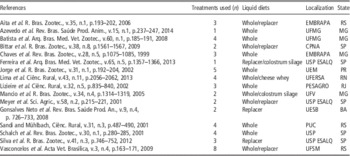
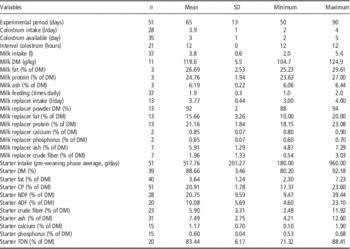
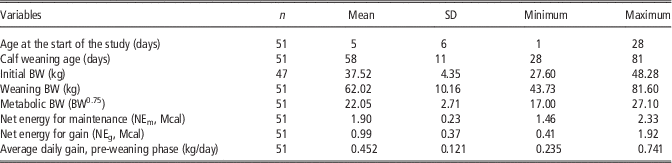
Data from 16 previous studies involving 51 diets for dairy calves under tropical conditions (Table 1) were used to evaluate the NRC (2001) and AMTS (AMTS.Cattle.ProTM 2015, version 3.5.8) calf models. Data for diet composition (Table 2) and animal performance (Table 3) were collected and summarized. Actual calf weaning weights, liquid diet and starter composition, and intake were used as inputs into the NRC (2001) and AMTS models. The temperature was set at 20°C, therefore, the temperature was considered to be thermoneutral and no adjustments were made for environment by either NRC or AMTS.
Studies selected from Brazilian journals for compiling the data set used to evaluate the calf models in the National Research Council (2001) and Agricultural Modeling and Training Systems

Whole=whole saleable milk; replacer=commercial milk replacer; EMBRAPA=the Brazilian Agricultural Research Corporation; RS=Rio Grande do Sul; UFMG=Federal University of Minas Gerais; MG=Minas Gerais; CPNA=Researcher Center of Animal Nutrition Nutron Company; SP=São Paulo; USP ESALQ=University of São Paulo; UEM=The State University of Maringá; PR=Paraná; UFERSA=Federal Rural University of the Semiarid Region; RN=Rio Grande do Norte; PESAGRO=Agricultural Research Company of the State of Rio de Janeiro; RJ=Rio de Janeiro; colostrum silage=anaerobically fermented colostrum/transition milk; UFV=Federal University of Viçosa; UESB=State University of South East Bahia; BA=Bahia; PUC=Pontifical Catholic University; UFSM=Federal University of Santa Maria.
Intake, diet composition and chemical analysis from studies used to estimate the weight gains of dairy calves in tropical conditions

DM=dry matter; TDN=total digestible nutrients.
Animal performance from studies used to estimate the average daily gain of dairy calves in tropical conditions

Treatment means were used for evaluation of the models. Diets included whole milk, commercial milk replacer or anaerobically fermented colostrum (colostrum silage). In addition, when liquid diet and starter composition were not analyzed for some nutrients, the composition used was from NRC (2001). The animal description and average of the actual starter intake and liquid diet for the entire pre-weaning period was used to calculate a predicted ADG. In the studies, the gain during pre-weaning was calculated from birth and weaning weights. The ADG observed during the pre-weaning phase was used to evaluate the models.
Statistical analysis
The data set was submitted to graphical analysis of SAS® (SAS Institute, 2008) to perform data exploration and observe biological coherence. Descriptive statistics were generated using the MEANS and FREQ procedures. The assessment of outliers and relationships between observed and model-predicted ADG were generated by using the REG procedure of SAS®. The accuracy of the ADG predictions of the NRC and AMTS models were tested by analysis of the mean bias (bias), mean square error of prediction (MSPE) and its decomposition (Bibby and Toutenburg, Reference Bibby and Toutenburg1977), concordance correlation coefficient and accuracy or bias correction factor (Cb) (Lin, Reference Lin1989), the goodness of fit (R 2) of the linear regression between observed (X-axis) and model-predicted (Y-axis) values and probability to test for intercept=0 and slope=1, for all evaluations as described by Tedeschi (Reference Tedeschi2006). Statistical analyses for model adequacy were performed with R version 3.1.1 (R Development Core Team, 2014) and the Model Evaluation System (Tedeschi, Reference Tedeschi2006).
Nutrition models
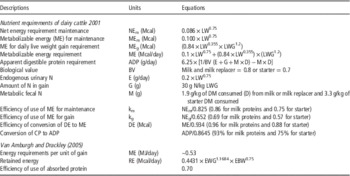
The NRC (2001) and AMTS calf models were evaluated in this study. In the last years, experiments at Cornell University and the University of Illinois provided data to modify NRC (2001) equations for predicting growth performance by dairy heifer. The main equations used in this study are described in Table 4.
Empirical equations developed from National Research Council (2001) and Van Amburgh and Drackley (Reference Van Amburgh and Drackley2005)

DE = digestible energy; LW=live weight (kg); LWG=daily live weight gain (kg/day); DM=dry matter; EWG=empty weight gain (kg/day); EBW=empty BW (kg); NEg = net energy for growth (Mcal/kg).
Results
Data
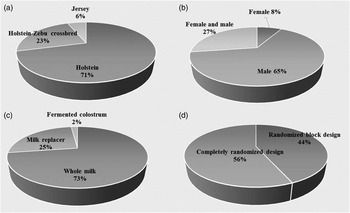
The data set included 51 treatment means collected from 16 experiments all performed in seven different states from Brazil (south, southeast and northeastern region). The starter intake and ADG observed from birth to weaning were 0.518±0.201 and 0.452±0.121 kg/day, respectively. The design, gender, calf genotype and liquid diet of the studies used in this evaluation are shown in the Figure 1. Most of the studies were conducted with male Holstein calves fed whole milk.
Summary of calf breed (a), gender (b), liquid diet (c), design (d) from data set used to evaluate the Nutrient requirements of dairy cattle 2001 and Agricultural Modeling and Training Systems (version 3.5.8) models.

Evaluation
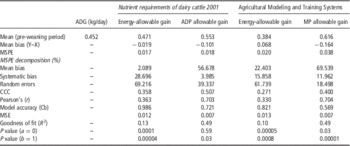
When all data were pooled (n=51 diets), predictions had a mean bias of −0.019 and 0.068 kg/day for energy-allowable gain using NRC (2001) and AMTS models, respectively. The R 2 for energy-allowable gain was lower than for protein-allowable gain in both models (R 2<0.13). Indeed, a lower R 2 value represents less precise predictions for ADG from dietary energy. The protein-allowable gain over-predicted actual gains in both models (Table 5).
Average daily gain (ADG) predicted by National Research Council (2001) and Agricultural Modeling and Training Systems from data pooled for all calf diets

ADP=apparently digested protein; MP=metabolizable protein; MSPE=mean square error of prediction; CCC=concordance correlation coefficient according to Lin (Reference Lin1989); Cb=bias correction factor; MSE=mean square error.
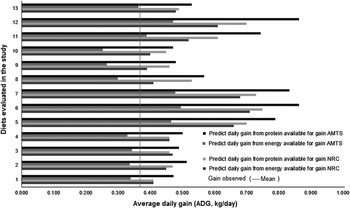
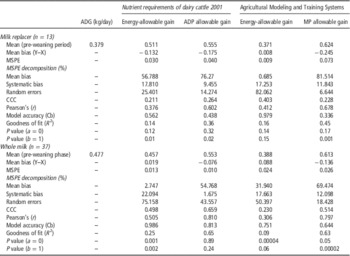
Calves that were fed whole milk had greater ADG compared with calves fed milk replacer (0.477 v. 0.379 kg/day, Table 6) during the milk-feeding period. In the second evaluation, when calves were fed only milk replacer the energy-allowable gain from AMTS showed the lowest mean bias (0.008 kg/day) and 82.1% of the MSPE value originates from random errors. The lowest MSPE (0.0092 kg2/day), the higher value of Cb and no significant slope bias (P>0.05) indicates that the AMTS model was accurate for calves fed with milk replacer (Table 6, Figure 2). However, within these latter two approaches, the goodness of fit (R 2) had a low value.
Relationships of observed and predicted average daily gain (ADG, kg/day) using the calf submodel in the Nutrient requirements of dairy cattle (NRC) published in 2001 and Agricultural Modeling and Training Systems (AMTS). Data from Brazilian dairy calves fed only milk replacer.

Average daily gain (ADG) predicted by National Research Council (2001) and Agricultural Modeling and Training Systems for calves fed milk replacer or whole milk

ADP=apparently digested protein; MP=metabolizable protein; MSPE=mean square error of prediction; CCC=concordance correlation coefficient according to Lin (Reference Lin1989); Cb=bias correction factor.
Discussion
Data
In this data set 73% of calves were fed with 3.8±0.6 kg of whole milk per day. Similar to our study, Hotzel et al. (Reference Hotzel, Longo, Balcão, Cardoso and Costa2014) reported that most calves were fed with up to 4 l of milk or milk replacer per day, or the equivalent to 10% to 15% of BW. This survey was made from 242 small holder family farms in the South of Brazil. In a recent survey, Santos and Bittar (Reference Santos and Bittar2015) reported that in three important milk production regions from Brazil, around 50% of the calves receive 4 l/day of liquid diet, but close to 25% are receiving 6 l/day. In this aspect, Khan et al. (Reference Khan, Weary and Von Keyserlingk2011) described that conventional feeding practices (4 l/day or 0.5 kg of solids) resulted in calves being hungry with negative effects on growth, health, welfare and future milk production. The management adopted in Brazil may represent an insufficient milk allowance for dairy calves. In addition, studies showed that increases of milk or replacer resulted in higher ADG (Brown et al., Reference Brown, Vandehaar, Daniels, Liesman, Chapin, Keisler and Weber Nielsen2005a and Reference Brown, Vandehaar, Daniels, Liesman, Chapin, Forrest, Akers, Pearson and Weber Nielsen2005b; Hill et al., Reference Hill, Aldrich, Schlotterbeck and Bateman2006). In general, the biological value (BV) and digestibility of milk proteins are higher than those for starter proteins (NRC, 2001). Therefore, increases of starter intake may result in lower BV and digestibility of the diets (Hill et al., Reference Hill, Bateman, Quigley, Aldrich, Schlotterbeck and Heinrichs2013).
In the United States, until the 1950s, most dairy calves were fed whole milk (Otterby and Linn, Reference Otterby and Linn1981). Currently, a large percentage of calves are fed with milk replacer with different protein sources such as dried skim milk, casein and dried whey. These sources are most frequently used in American dairy farms (National Animal Health Monitoring Service, 2007). On the other hand, in Brazil the most part of calves were yet fed with whole saleable or non-saleable milk, with only 13% of the calves being fed commercial milk replacers (Santos and Bittar, Reference Santos and Bittar2015), often with low quality (vegetable protein sources) and nutritional values (low protein and fat). The typical milk replacers have lower energy than whole milk (milk: 5.29 Mcal metabolizable energy (ME)/kg solids v. milk replacer: 4.0 to 4.4 Mcal/kg) with 18% to 28% of protein, 15 to 20% fat, <10% ash and <0.15% crude fiber. In general, fiber levels above 0.15% indicate inclusion of plant origin proteins. In this study the fiber level was of 1.96%; consequently, we infer that many of the milk replacers contained vegetable protein sources at high inclusion rates and, as a result, decreased protein digestibility and BVs would be expected. Liquid diets based on whole milk are expensive and frequently the milk quality used for calves is poor (high somatic cell, bacterial count or antibiotic), which may reduce pre-weaning health and growth of the calf.
The calves fed with whole milk showed higher pre-weaning ADG than calves fed with milk replacer (0.477 v. 0.379 kg/day). The composition of milk replacer used in Brazil may have influenced this result. As described, sources of vegetable protein are used frequently in milk replacer formulation for dairy calves. Therefore, use of vegetable proteins with lower BV and digestibility than milk proteins may reduce the growth rate. In addition, the protein (12.5% to 24% dry matter basis) and fat levels (4.9% to 18% dry matter basis) are lower than most of the replacers fed in the United States (Silva and Bittar, unpublished results).
The pre-weaning ADG of the dairy calves from Brazilian studies were 0.45±0.12 kg/day, with a range from 0.23 to 0.74 kg/day. Soberon et al. (Reference Soberon, Raffrenato, Everett and Van Amburgh2012) described a mean of 0.82±0.18 kg/day of pre-weaning growth rates, with a range from 0.10 to 1.58 kg/day from the Cornell herd. Also, in that study a commercial American dairy farm showed a mean of 0.66±0.11 kg/day, with a range from 0.32 to 1.27 kg/day. However, those ADG were attained with a much higher liquid-diet daily intake, with commercial milk replacers containing 28% CP and either 15% or 20% fat. Bateman et al. (Reference Bateman, Hill, Aldrich, Schlotterbeck and Firkins2012) reported a total ADG (0 to 56 days) of 0.615 kg/day with a range from 0.129 to 1.161 kg/day. Consequently, the pre-weaning ADG of the Brazilian dairy calves were 27% to 32% lower than reports from American dairy farms, mainly because of the lower liquid-feeding volume.
The low ADG by the Brazilian calf can be linked to colostrum management, availability and quality of milk or milk replacer, and management of the calf on farms. In addition, genetic differences may have been very important. The Brazilian Holstein herd has a smaller mature size, which should be associated with a lower BW gain potential. In the United States, selection for increased milk production has increased the body size and weight of dairy cows, therefore altering the conditions of environment necessary to maintain welfare (Oltenacu and Broom, Reference Oltenacu and Broom2010). The genetic selection for milk production in Brazil was low as compared with that in the United States. The Brazilian dairy herd consists mainly of cross-bred Holstein-Zebu cows, with a significant number of crosses between Holstein and Gyr cows (Madalena et al., Reference Madalena, Peixoto and Gibson2012). The Gyr breed has a lower birth weight than Holsteins. It is important to consider that our data set was developed with 71% of Brazilian Holstein and 23% cross-bred Holstein×Zebu calves.
Management differences may also be relevant. In Asia and other tropical countries, inadequate heifer management is a main problem for numerous small holder dairy farms (Moran, Reference Moran2011). In the South of Brazil, 71% of 242 smallholder families reported that diarrhea was the main cause of calf mortality (Hotzel et al., Reference Hotzel, Longo, Balcão, Cardoso and Costa2014). Santos and Bittar (Reference Santos and Bittar2015) reported that in three important milk production regions from Brazil almost 48% of all calves present diarrhea and that 22% have respiratory problems. Most of the problems are not only related to failure of passive transfer of immunity because of inadequate colostrum feeding, but also to inadequate housing conditions.
The starter intake over the total trial period was 0.518±0.201 kg/day, with a range from 0.180 to 0.960 kg/day. Bateman et al. (Reference Bateman, Hill, Aldrich, Schlotterbeck and Firkins2012) reported a starter intake mean of 0.894±0.242 kg/day with a range from 0.134 to 1.592 kg/day during pre-weaning phase. In addition, their study reported that starter intake had the greatest effect on ADG during the 56-day growth period. In the present study, a low starter intake is in agreement with lower ADG of the Brazilian dairy calves, and may reflect temperature effects on dry matter intake and increased energy requirements as a result of the tropical conditions. Furthermore, a lower intake may be explained by lower growth potential as well as management and health problems.
Energy-allowable gain
The NRC (2001) and AMTS models use ME as the respective energy term. The NRC (2001) nutrient requirements are based on a database of Holstein veal calves fed with high-fat diets. For those cases, there is extra fat per unit of weight gain. In general, dairy calves have lower fat and greater protein retained per unit of weight gain than veal calves (Van Amburgh et al., Reference Van Amburgh, Raffrenato, Soberon and Everett2009). Van Amburgh and Drackley (Reference Van Amburgh and Drackley2005) reviewed data from tissue-deposition trials from Holstein calves fed modern milk replacers containing whey proteins, relative to NRC (2001) requirements. This study resulted in an update of the NRC (2001) equations. The updates suggested by Van Amburgh and Drackley (Reference Van Amburgh and Drackley2005) were inputted into the AMTS model.
The ADG of the calves fed with milk replacer predicted by energy-allowable gains from the AMTS model showed the lowest MSPE and higher Cb value. The MSPE is used to estimate the predictive accuracy of a model (Tedeschi, Reference Tedeschi2006). Therefore, in the tropical conditions the AMTS model showed better accuracy than NRC (2001) for estimating ADG of dairy calves fed with milk replacer, probably as a result of adjusted equations from Van Amburgh and Drackley (Reference Van Amburgh and Drackley2005), which considered the composition of the gain.
On the other hand, the R 2 was very low for both models (energy-allowable gain R 2<0.25 and protein-allowable gain R 2<0.65). The low R 2 values represent a low precision for estimating ADG of Brazilian dairy calves. The ADG predicted by dietary energy was more accurate than precise, because the accuracy (Cb) had to be higher than the r. In this study, the limitation for the analysis was the low number of calves fed with milk replacer in Brazil. Therefore, it is suggested that a future evaluation with a higher number of calves fed with modern milk replacers be conducted as data become available.
In the United States, a recent evaluation of the NRC (2001) calf model was made using 996 individual data from dairy calves. Hill et al. (Reference Hill, Bateman, Quigley, Aldrich, Schlotterbeck and Heinrichs2013) used the lowest ADG value predicted by the ME or apparently digestible protein (ADP) allowable gain and regressed those against observed ADG. The study reported that the NRC (2001) was inaccurate in predicting ADG when a data set from a wide range of feeding programs in a commercial management setting was used. The R 2 was low (R 2=0.42) and NRC (2001) model resulted in under-prediction of the ADG from calves with high rates gain (>700 g/day).
Several factors may influence ADG of calves in tropical conditions. The higher temperature in the summer may decrease starter intake and reduce ADG (McKnight, Reference McKnight1978). In tropical conditions, calves may suffer with heat stress, which may reduce starter intake and the health of animals. In the same time, there is an increase in maintenance requirements. Another aspect is that sick calves may use dietary energy for the immune system (Martin et al., Reference Martin, Scheuerlein and Wikelski2003), instead of growth. All these factors may have contributed to the observed lower ADG.
According to Hill et al. (Reference Hill, Bateman, Quigley, Aldrich, Schlotterbeck and Heinrichs2013), the accuracy of the ADG predictions for pre-weaning dairy calves is commonly not high, because there are several different factors that impact ADG. Gain can be responsive to a complexity of dietary changes, BVs, metabolic coefficients for different nutrient types, effect of colostrum intake on health, physiological changes from a glucose-utilizing to a gluconeogenesis metabolism system, environmental temperature and management practices that stress the calf.
The low calf starter intake during the pre-weaning phase in the Brazilian data set limited energy used for ADG. This low intake could be a result of lower genetic growth potential, management, dietary constraints or overstress of the calf and health problems. The low performance of Brazilian dairy calves suggest that energy that potentially could be used for gain may have been used instead for other physiological processes, such as fighting diseases (diarrhea and pneumonia) and minimizing heat stress effects.
Protein-allowable gain
The ADP allowable gain from NRC (2001) and metabolizable protein-allowable gain from AMTS were evaluated. The NRC (2001) adopted the factorial method from Blaxter and Mitchell (Reference Blaxter and Mitchell1948) to estimate protein requirements of dairy calves with weight up to 100 kg. The last NRC edition described the protein requirements for maintenance and gain.
The AMTS has a mechanistic calf model that is based on the NRC model as updated with new requirements suggested by Van Amburgh and Drackley (Reference Van Amburgh and Drackley2005). This update indicated that the protein requirement is higher than predicted by the NRC publication, due to difference in the assumed efficiency of protein use. The NRC (2001) calculations suggested that absorbed protein was used with an efficiency of 0.80. The Van Amburgh and Drackley (Reference Van Amburgh and Drackley2005) modifications suggest that the efficiency is closer to 0.70; consequently, the actual requirements are 10% to 12% higher than the current NRC predictions.
Under the conditions of our study, dietary protein-allowable gain was greater than observed ADG for calves fed whole milk, milk replacer or both. An important aspect is that the energy-allowable gain predicted by the models was more limiting than protein-allowable gain (Tables 5 and 6) for conventional milk-feeding systems used in Brazilian trials. The protein to energy ratio of the diet can change efficiency and composition of live weight gain (Van Amburgh and Drackley, Reference Van Amburgh and Drackley2005). The protein requirement is a function of the energy-allowable gain and adequate ratios of CP to energy are important to maximize ADG of the animal (Hill et al., Reference Hill, Bateman, Aldrich and Schlotterbeck2009).
According to National Research Council (NRC) (1996) the ME is defined as gross energy minus fecal energy, urinary energy and gaseous energy losses. A study published by Hill et al. (Reference Hill, Bateman, Aldrich and Schlotterbeck2009) described that in calves fed low ME intakes (3.26 Mcal/day or 0.0656 Mcal/kg of BW daily) the maximum ADG was reached with 51.5 g of CP/Mcal of ME. However, calves fed with high ME intake (3.71 Mcal/day or 0.0743 Mcal/kg of BW daily) required 55.0 g of CP/Mcal of ME to maximize ADG. In this meta-analytical study, diets for dairy calves provided an average of 57±7.2 g CP/Mcal of ME, and would be considered as low ME intakes (0.067 Mcal/kg of BW daily) according to the Hill et al. (Reference Hill, Bateman, Aldrich and Schlotterbeck2009) analysis. In Brazil, the data suggest a necessity to increase ME intake of the diets, in order to meet the optimum ratio of 51.5 g of CP/Mcal as described by Hill et al. (Reference Hill, Bateman, Aldrich and Schlotterbeck2009).
The weight gain estimated by the energy available from the diet was overestimated by 19 g/day when calculated by the NRC and underestimated by 68 g/day when calculated by AMTS. When gains were estimated by protein available in the experimental diets both the AMTS and the NRC showed greater overestimation of gain than when energy-allowable gain was used. In the conditions of this study, the proposed Van Amburgh and Drackley (Reference Van Amburgh and Drackley2005) seems to be more accurate in predicting the performance of dairy calves fed milk replacers. The Brazilian data showed a calf gain around 32% lower than those described in United States dairy farms. The reasons for this discrepancy need to be understood, for only then new models could be developed and parameterized to estimate animal performance in tropical conditions more accurately and precisely.
Acknowledgements
This work was supported by São Paulo Research Foundation (FAPESP), grant number 14/12475-6. Appreciation is extended to the University of Illinois, Department of Animal Sciences, Urbana, IL, and to the Dairy Focus Lab at that institution. Thanks to Dr Tom Tylutki and Mariann Fessenden.