Introduction
Panspermia is the idea that life can propagate from one planet to another (Wesson Reference Wesson2010; Wickramasinghe Reference Wickramasinghe2010). Impacts on the surface of a planet can launch debris at above the escape speed of the planet, thereby allowing debris spread throughout the planetary system and constituting a plausible mechanism for exchanging life between planets orbiting the same star (Mileikowsky et al. Reference Mileikowsky, Cucinotta, Wilson, Gladman, Horneck, Lindegren, Melosh, Rickman, Valtonen and Zheng2000; Fritz et al. Reference Fritz, Artemieva and Greshake2005). However, it is difficult to eject life-bearing material at speeds above the escape speed from a planetary system that is effectively shielded from destructive radiation, presenting a significant challenge for spreading life between stars (Wesson Reference Wesson2010).
Life in the Earth's atmosphere has been detected up to an altitude of 77 km (Imshenetsky et al. Reference Imshenetsky, Lysenko and Kazakov1978), constituting a reservoir of microbes that objects grazing the atmosphere could draw from. Long-period comets (LPCs) represent a population of bodies that can easily be ejected from the Solar System by gravitational interactions with planets due to their low gravitational binding energies and planet-crossing orbits. This makes them ideal, in principle, for both picking up life from Earth and exporting it out of from the Solar System.
In addition, the high speed and abundance of interstellar objects (ISOs) make them, in addition to LPCs, potential exporters of life from Earth to exoplanetary systems. 1I/‘Oumuamua (Meech et al. Reference Meech, Weryk, Micheli, Kleyna, Hainaut, Jedicke, Wainscoat, Chambers, Keane, Petric, Denneau, Magnier, Berger, Huber, Flewelling, Waters, Schunova-Lilly and Chastel2017; Micheli et al. Reference Micheli, Farnocchia, Meech, Buie, Hainaut, Prialnik, Schörghofer, Weaver, Chodas, Kleyna, Weryk, Wainscoat, Ebeling, Keane, Chambers, Koschny and Petropoulos2018) was the first ISO detected in the Solar System, CNEOS 2014-01-08 (Siraj and Loeb Reference Siraj and Loeb2019a) was tentatively the first interstellar meteor discovered larger than dust and 2I/Borisov (Guzik et al. Reference Guzik, Drahus, Rusek, Waniak, Cannizzaro and Pastor-Marazuela2019) was the first confirmed interstellar comet. Ginsburg et al. (Reference Ginsburg, Lingam and Loeb2018) and Lingam and Loeb (Reference Lingam and Loeb2018) demonstrate dynamically that ejected objects can be gravitationally captured by other star systems.
In this paper, we study whether it is possible for ISOs and LPCs to have exported life from Earth's atmosphere out of the Solar System. First, we analyse the gravitational slingshot effect of the Earth during such encounters. We then evaluate the effects of atmospheric drag on the transporting body's size and minimum encounter altitude. Next, we discuss the collection of microbial life during the transporting body's passage through the atmosphere. We then estimate the total number of exportation events since the dawn of life on Earth. Finally, we summarize our main conclusions.
Gravitational slingshots with earth
To gain an understanding of the approximate change in energy that a transporting body receives through a random gravitational interaction with the Earth, we developed a Python code that randomly initializes and integrates the motions of particles from their points of closest approach to Earth in the past or future, computing the total change in energy over the interaction. The Python code created for this work used the open-source N-body integrator software REBOUNDFootnote 1 to trace the motions of particles under the gravitational influence of the Earth-Sun system (Rein and Liu Reference Rein and Liu2012).
We initialize the simulation with the Sun, Earth and a volume of test particles surrounding Earth at 80 km from the Earth's surface, with near-zero gravitational binding energies from the Sun as appropriate for LPCs.Footnote 2 The Sun and Earth define the ecliptic plane. For each test particle, we randomly pick an angle within the ecliptic plane between 0 and 2π, as well as a zenith angle between 0 and π. Using these two angles, we set each particle's position vector relative to Earth.
To ensure that each particle is at its distance of closest approach, we require the velocity vector to lie in the plane perpendicular to the position vector relative to Earth. For each particle, we pick a random angle between 0 and 2π to determine in which direction the velocity vector points within this plane. Using the angle within the plane perpendicular to the position vector, we construct each particle's velocity vector. At this point, we have fully initialized the 6D coordinates of each particle in both position and velocity.
In the first stage of the simulation, we integrate all of the particles backward in time. We use the IAS15 integrator in REBOUND to trace each particle from t = 0 to an earlier time − t i (Rein and Spiegel Reference Rein and Spiegel2014), where t i is an amount of time to sample either side of the closest approach to Earth. The only constraint on t i is that it is a time interval at and above which the results of the simulation do not change, on the order of a few times the encounter period; in this case, t i is on the order of a few days. We record the change in the speed at infinity for the incoming segment of the particle's trajectory, Δv ∞, in. In the second stage of the simulation, we integrate the particles with unbound initial conditions forward in time. We use IAS15 to integrate each particle from t = 0 to t i. We record the change in the speed at infinity for the outgoing segment of the particle's trajectory, Δv ∞, out, and add it to theincoming and outgoing changes to find the change in speed at infinity for the entire encounter, Δv ∞.
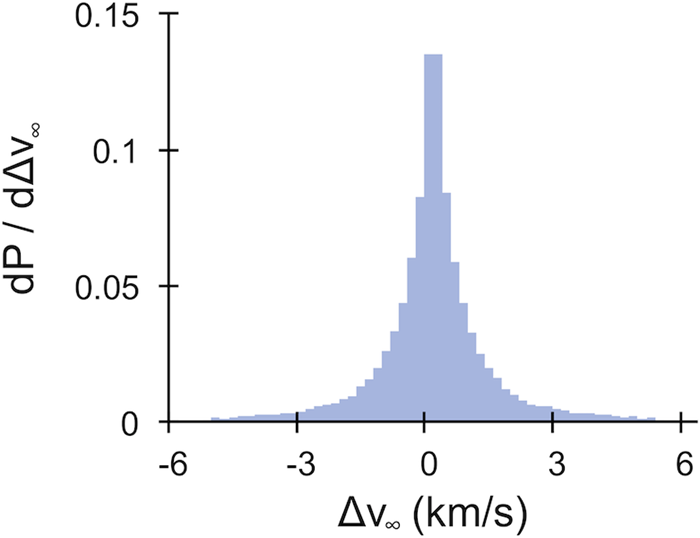
We ran our Python code for 105 particles, and the resulting distribution of Δv ∞ is shown in Fig. 1. Half of encounters resultin a positive change in energy, as expected from symmetry to time-reversal, and 95% of such encounters result in Δv ∞ ≤ 3 km s−1;. This corresponds to objects with perihelion distances $\gtrsim 200\, {\rm AU}$ , or LPCs.
Distribution of the gravitational Δv ∞ for random encounter geometries between Earth and LPCs marginally bound to the Sun near the Earth's surface.

Atmospheric drag
As the transporting object grazes the atmosphere, it encounters atmospheric drag, giving rise to constraints on its minimum size and minimum encounter altitude for it to escape.
Because the change in energy due to the gravitational slingshot is small relative to the initial kinetic energy, we approximate the transporting object's path as linear, summarized by the following expression for altitude:

where $R_{\oplus }$ is the radius of the Earth, z min is the minimum altitude of the encounter and x is a distance parameter that fulfils z(0) = z min and dx = v dt, where v is the instantaneous speed.
The density of the atmosphere as a function of altitude is ρ(z) = e−z/8 km kg m−3, and the density of the transporting body is taken to be that of a typical cometary nucleus, ρ tb = 600 kg m−3. The acceleration of the transporting body is given by the drag equation (Collins et al. Reference Collins, Jay and Marcus2010):

where C D is the drag coefficient, set to the typical value of 2 and L tb is the length of transporting body.
We use the expression given in Collins et al. (Reference Collins, Jay and Marcus2010) to estimate the yield strength Y tb of the transporting body to be ~4300 Pa. The altitude at which the body begins to break up, $z_{\star }$ , is given by the solution to the transcendental equation:

which yields, $z_{\star } \simeq 100\, {\rm km}$ .
Expansion and slow-down
At z < 100 km, the transporting body expands according to the equation (Collins et al. Reference Collins, Jay and Marcus2010):

We note that equations (2)–(4) represent the ‘pancake’ or ‘liquid drop’ model, and become less accurate for km-sized impactors and larger, so our results regarding km-sized impactors should be regarded with this caveat (Register et al. Reference Register, Mathias and Wheeler2017).
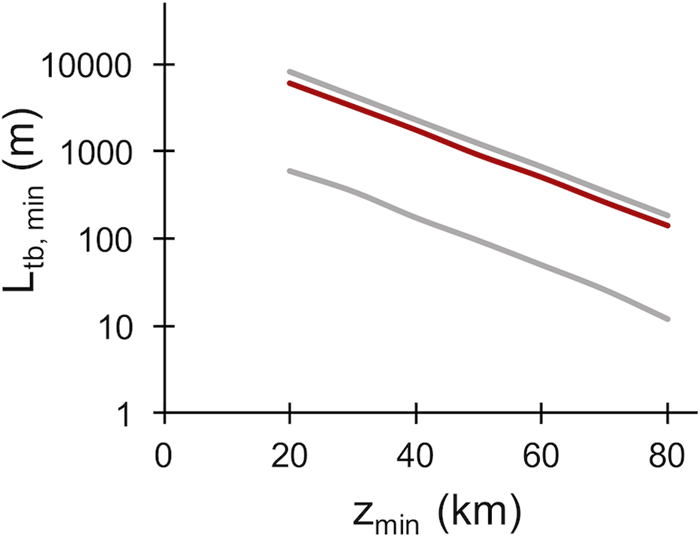
We developed Python code that integrates along the path of the transporting body, using equations (1), (2) and (4) to continuously update v and L tb, thereby deriving the total expansion of the object and change in speed as a function of minimum encounter altitude and size. The minimum size to guarantee a negligible expansion of ≲10% as a function of altitude is shown in Fig. 2 for the range of minimum encounter altitudes 20–80 km. The lower bound of 20 km was defined by the result that the minimum size was of order the altitude for lower altitudes. The upper bound, 80 km, was chosen because it is the highest altitude at which life has been detected as of yet (Imshenetsky et al. Reference Imshenetsky, Lysenko and Kazakov1978). It is important to note that the Imshenetsky et al. (Reference Imshenetsky, Lysenko and Kazakov1978) result should be treated with caution due to the lack of detail on how the system was sterilized and due to the fact that non-biological particles may resemble bacteria, and thus be mistaken for the latter (Wainwright et al. Reference Wainwright, Weber, Smith, Hutcheon, Klyce, Wickramasinghe, Narlikar and Rajaratnam2004; Smith Reference Smith2013).
Minimum diameter of transporting body to guarantee total expansion of <10% as a function of minimum encounter altitude. The red line indicates the result for an encounter velocity of 42 km s−1, and the grey lines represent the upper and lower bounds, corresponding to the maximum and minimum encounter velocities of 72 km s−1 and 12 km s−1, respectively.

The change in speed for all successful encounters is $\lesssim \!10^{-5}\, {\rm m \, s}^{-1}$ , which is reasonable considering the fact that significant slow-down will lead to runaway expansion. Such a small change in speed does not cause significant heating of the body.
Collection of microbial life
While the abundance of microbes in the upper atmosphere is poorly constrained (Burrows et al. Reference Burrows, Elbert, Lawrence and Pöschl2009), we use the Imshenetsky et al. (Reference Imshenetsky, Lysenko and Kazakov1978) detections to come up with an order-of-magnitude estimate. Imshenetsky et al. (Reference Imshenetsky, Lysenko and Kazakov1978) reported 31 colonies of microorganisms collected over four sounding rocket launches, each with ~30 s at the altitude range 48–77 km, travelling at ~0.75 km s−1, with a detector of size ~5 × 10⁻³ m2. The total detection volume for all four flights was then ~450 m3, giving an average colony number density of ~0.1 m−3 at the altitude range 48–77 km.
The total number of collected colonies is then estimated by the equation:

where τmin is approximately the amount of time spent at z min. This suggests a large number of collected colonies for typical values.
The collected microbes will experience accelerations of order 105 g if they are accelerated over a distance of ~ 100 m. For microbes including Bacillus subtilis, Deinococcus radiodurans, Escherichia coli and Paracoccus denitrificans, a large proportion would survive accelerations of 4−5 × 10⁵ g, which are of interest for planetary impacts (Mastrapa et al. Reference Mastrapa, Glanzberg, Head, Melosh and Nicholson2001; Deguchi et al. Reference Deguchi, Tsuji and Horikoshi2011). We therefore assume that acceleration is not an important lethal factor for microbes picked up by the transporting body.
In addition, comet nuclei are porous, making it likely that some incident microbes become embedded several metres below the surface, providing protection from harmful radiation in interstellar space (Wesson Reference Wesson2010).
Number of exportation events
Francis (Reference Francis2005) estimates an LPC flux of F LPC ~ 11 LPCs yr−1 with q < 4 AU and $H \lesssim {\rm 11}$ . Francis (Reference Francis2005) estimates H ~ 11 to correspond to a cometary diameter of L H~11 ~ 1−2.4 km (Bailey and Stagg Reference Bailey and Stagg1988; Weissman Reference Weissman1990), but Fernandez and Sosa (Reference Fernandez and Sosa2012) estimate a cometary diameter of L H~11 ~ 0.6 km. Weissman (Reference Weissman2007) calculates the impact probability of LPCs with the Earth to be $P_{\oplus } \simeq 2.2 \times 10^{-9}$
 per comet per perihelion. While the cumulative size distribution of sub-km LPCs in uncertain, Vokrouhlicky et al. (Reference Vokrouhlicky, Nesvorny and Dones2019) estimate a cumulative power-law distribution of sizes with an index of ≃−1.5.
We estimate the total number of exportation events caused by Solar System bodies, N S, over the age of the Earth, $T_{\oplus }$ , given the cross-sectional area of the Earth, $A_{\oplus }$
 , and occurring between altitudes z 1 and z 2, to be:

where the value of L tb, min is computed as a function of altitude, z, with the encounter speed assumed to be 42 km s−1. For z 1 = 20 km and z 2 = 80 km, N S ~ 1−10.
We also consider ISOs, such as ‘Oumuamua (Meech et al. Reference Meech, Weryk, Micheli, Kleyna, Hainaut, Jedicke, Wainscoat, Chambers, Keane, Petric, Denneau, Magnier, Berger, Huber, Flewelling, Waters, Schunova-Lilly and Chastel2017; Micheli et al. Reference Micheli, Farnocchia, Meech, Buie, Hainaut, Prialnik, Schörghofer, Weaver, Chodas, Kleyna, Weryk, Wainscoat, Ebeling, Keane, Chambers, Koschny and Petropoulos2018). In the ~100 m size regime, the power law exponent for the cumulative size distribution is estimated to be ≃ −3 (Siraj and Loeb Reference Siraj and Loeb2019b). We can then express the total number of exportation events caused by ISOs, N I, in terms of the size of ‘Oumuamua, L O, and the timescale over which an ‘Oumuamua-size object is expected to collide with the Earth, $t_{\rm O}^{-1}$ :

assuming that the composition of such objects are similar to LPCs and that the gravitational deflection by the Earth is small relative to the object's incoming energy.
‘Oumuamua's diameter is estimated to be L O ≃ 100−440 m, based on Spitzer Space Telescope constraints on its infrared emission given its temperature (Trilling et al. Reference Trilling, Mommert, Hora, Farnocchia, Chodas, Giorgini, Smith, Carey, Lisse, Werner, McNeill, Chesley, Emery, Fazio, Fernandez, Harris, Marengo, Mueller, Roegge, Smith, Weaver, Meech and Micheli2018). The implied timescale for collisions of ‘Oumuamua-size ISOs with the Earth is t O ~ 3 × 10⁷ years (Do et al. Reference Do, Tucker and Tonry2018). As a result, for z 1 = 20 km and z 2 = 80 km, N I ~ 1−50.
Possibility of exportation events above 100 km
Life has not yet been detected above an altitude of 80 km. One obstacle to life in the thermosphere is that the temperature exceeds 400 K, a temperature at which no functional microbes have been confirmed to survive on Earth. However, if we extrapolate the Imshenetsky et al. (Reference Imshenetsky, Lysenko and Kazakov1978) results to $z \gtrsim 100\, {\rm km}$ by assuming that turbulent mixing makes the exponential scale height for microbial life equal to that of air, ≃ 8 km, breakup will not occur for icy objects, allowing for smaller and therefore more abundant transporting bodies. If we require that the total number of collected colonies $N_{\rm col} \gtrsim 10^3$
 , we can derive an expression for $L_{{\rm tb}\comma \, \min }^{\star }$
 as a function of z:

The total number of $z \gtrsim 100 {\rm \, km}$ exportation events for Solar System bodies and ISOs, respectively, are,

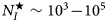
We find $N_{\rm S}^{\star } \sim 3 \times 10^2 \!-\! 2 \times 10^3$ and $N_{I}^{\star } \sim 10^3\!-\!10^5$
 .
Conclusions
In this paper we evaluated the possibility of LPCs and ISOs exporting life from Earth's atmosphere out of the Solar System. We estimate the total number of exportation events over the lifetime of the Earth to be ~1−10 for LPCs and ~1−50 for ISOs. If life existed above an altitude of 100 km, we find that up to ~ 105 exportation events could have occurred over Earth's lifetime.
An important comparison to make is to the conventional mode of panspermia involving impacts and subsequent ejecta. Belbruno et al. (Reference Belbruno, Moro-Martin, Malhotra and Savransky2012) find that 1014−3 × 10¹⁶ objects with mass >10 kg were transferred from the Sun to its nearest neighbours in the birth cluster. Assuming a density of 600 kg m−3 and a cumulative size distribution exponent of −1.5 in terms of size, we find that ~108−1010 km-sized objects were transferred. If $\gtrsim \!\! 10^{-6}$ of such objects had viable microbes (Belbruno et al. Reference Belbruno, Moro-Martin, Malhotra and Savransky2012), this would yield >102−104 objects, which is higher than the number of LPCs and ISOs capable of transferring life, given the cutoff height of 80 km.
The atmospheric scale height, h ~ 〈v 2〉/g, where 〈v 2〉 includes the sound and turbulence speeds summed in quadrature, and g is the acceleration due to the Earth's gravity. If the atmosphere temperature was higher due to volcanic activity early on, or if turbulence was stronger, then h could have been larger, making the prospect of interstellar panspermia even more realistic.
Improved measurements of the size distribution of LPCs and ISOs would allow for more precise estimates. In addition, more research into the abundance of characteristics of microbes in the upper atmosphere, as well as into impacts at tens of km s−1 with such microbes, is crucial for evaluating the merit of the panspermia hypothesis. In particular, the discovery of life above 100 km in the atmosphere would be a very encouraging sign for the feasibility of interstellar panspermia.
Acknowledgments
This work was supported in part by a grant from the Breakthrough Prize Foundation.